
- Ocrolus is the default choice for cash flow underwriting, but buyers frequently leave over contract minimums, processing latency on complex documents, and pricing that does not fit early-stage volume.
- The strongest alternatives split into three distinct categories: pure bank statement analysis tools, full document intelligence platforms, and income-plus-cash-flow APIs built for specific lending verticals.
- Migration risk varies sharply by how deeply Ocrolus is embedded: teams using only the bank statement parsing API migrate in weeks; teams relying on Ocrolus QA workflows take months.
- No single alternative beats Ocrolus across every dimension. Heron Data wins on SMB cash flow depth, Inscribe leads on fraud-plus-analysis pairing, and DocuClipper is the fastest path for budget-constrained teams.
- The sponsored profile in this article is clearly labeled. Scoring reflects independent editorial criteria, not placement.
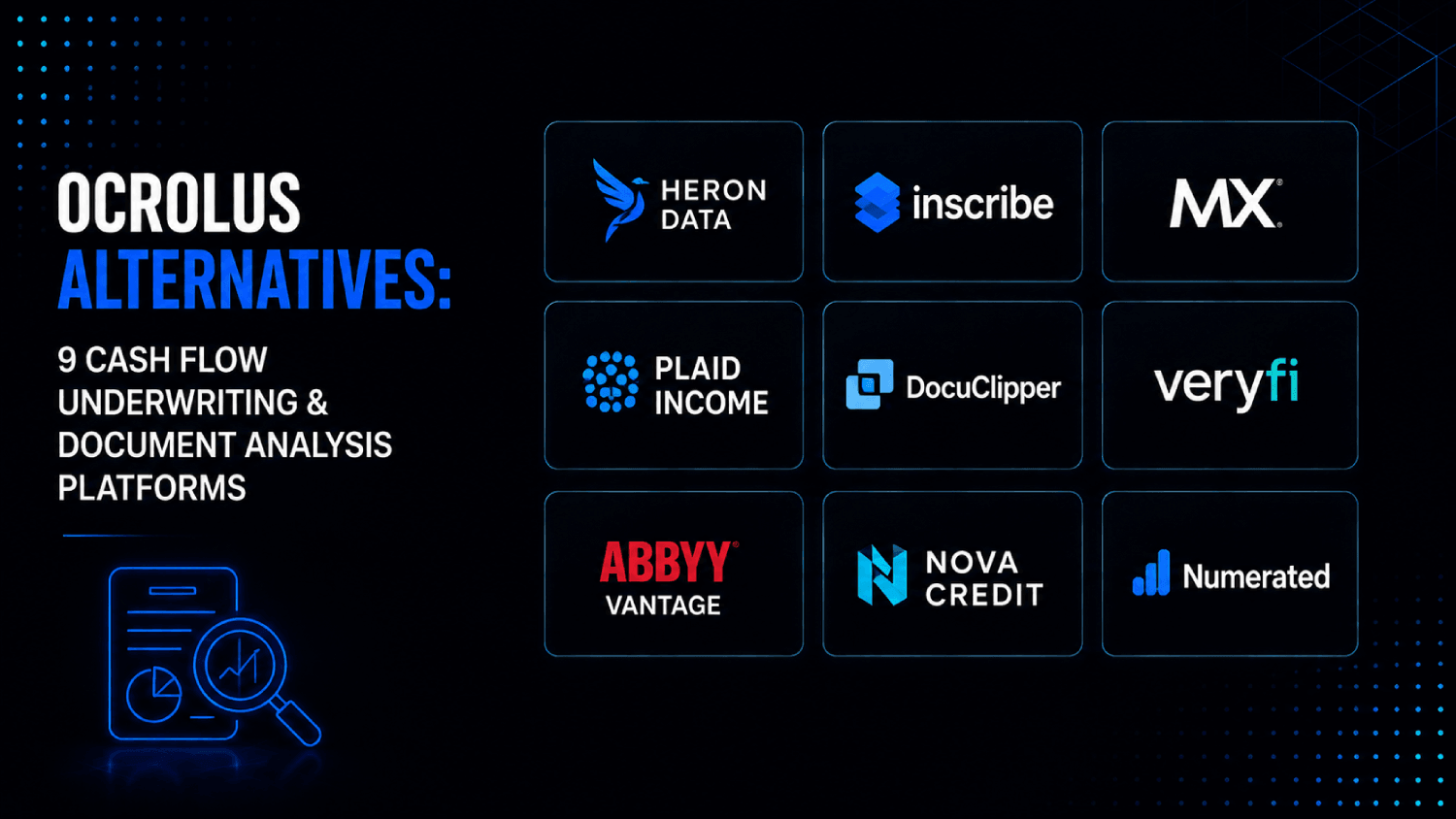
Several credible alternatives to Ocrolus exist for cash flow underwriting and document analysis, including Heron Data for SMB lending, Inscribe for fraud-aware analysis, MX for open banking-native decisioning, Plaid Income for payroll-linked cash flow, and DocuClipper for cost-sensitive teams. The best replacement depends on document type coverage, API integration depth, volume commitments, and whether you need human-review fallback or fully automated output.
Why Do Buyers Actually Leave Ocrolus?
Ocrolus built its reputation on high-accuracy bank statement classification and cash flow analytics, particularly for SMB and small-dollar lending. For many teams, it remains genuinely good. But three recurring complaints surface in vendor evaluations often enough to take seriously.
First, contract structure. Ocrolus typically requires volume commitments, and buyers at early-stage lenders report that the minimum spend feels misaligned with their actual throughput, especially in the first 12 months. Second, processing latency on lower-quality or handwritten documents can extend turnaround on deals where underwriters expect near-instant decisioning. Third, the platform’s QA layer, while accurate, is a black box for teams that want auditable, explainable outputs tied to their own data lineage requirements.
A fourth reason is narrower but meaningful: Ocrolus is primarily a bank statement and payroll document tool. Lenders who need a single vendor to handle tax returns, business financials, invoices, and bank statements often discover mid-contract that Ocrolus covers some of those categories less thoroughly than the initial sales conversation implied. Teams with complex, mixed-document underwriting workflows tend to feel this most acutely.
How to Evaluate an Ocrolus Replacement Without Getting Burned
Most vendor evaluations in this space fail at the same step: teams test accuracy on clean sample documents, sign a contract, then discover edge cases at production volume. The FintechSpecs Document Intelligence Stress Test is a four-point checklist built to catch failures before they cost money.
Step one: dirty-document accuracy. Run at least 50 documents from your actual pipeline through any candidate vendor before signing. Include mobile-capture images, older PDFs with scan artifacts, and multi-period statements. Accuracy on vendor-provided demo documents is not the same as accuracy on your borrowers’ documents.
Step two: field-level explainability. Ask for a sample output file. If the vendor cannot show you which page and line a specific cash flow figure came from, your compliance team will face problems at audit. This matters more than headline accuracy numbers.
Step three: volume floor and overage math. Model your expected monthly volume at p10, p50, and p90. Calculate total cost at each scenario, including overages. Some vendors look cheaper at p50 but are dramatically more expensive at p90 because overage rates are punitive.
Step four: migration surface area. List every Ocrolus output field your underwriting models or decision engines currently consume. Map those to the candidate vendor’s schema. Gaps require engineering work. The wider the schema gap, the longer the migration.
Which Ocrolus Alternatives Work Best by Use Case?
Rather than ranking nine platforms on a single score, this article segments them by the primary use case where each alternative outperforms Ocrolus. A platform that is excellent for consumer mortgage pre-qualification is often a poor fit for small-dollar merchant cash advance underwriting.
Best for SMB Cash Flow Underwriting: Heron Data
Heron Data focuses specifically on SMB cash flow analysis from bank transaction data. Where Ocrolus processes document images, Heron ingests raw transaction feeds and applies merchant categorization and revenue signal extraction at the transaction level. For lenders underwriting merchant cash advances, revenue-based loans, or working capital lines, Heron’s output is structurally more useful because it produces categorized revenue metrics rather than raw totals pulled from statement images.
The trade-off is narrow document coverage. Heron is not a general document intelligence tool. If your workflow requires processing tax returns or pay stubs alongside bank transactions, Heron must be paired with another vendor. Migration from Ocrolus to Heron requires schema remapping because the two platforms produce fundamentally different output shapes: Heron returns transaction-level records with individual merchant categorizations, while Ocrolus returns statement-level summaries with aggregate cash flow figures, your downstream model needs to consume one or the other, not both interchangeably.
| Dimension | Ocrolus | Heron Data |
|---|---|---|
| Primary input | Document images, PDFs | Raw bank transactions |
| Cash flow output depth | Statement-level summaries | Transaction-level categorization |
| Document type coverage | Bank statements, pay stubs, tax docs | Bank transaction data |
| Best lending vertical | Consumer, SMB mixed | SMB revenue-based, MCA |
| Migration risk | Baseline | Medium (schema remapping required) |
Best for Fraud-Aware Document Analysis: Inscribe
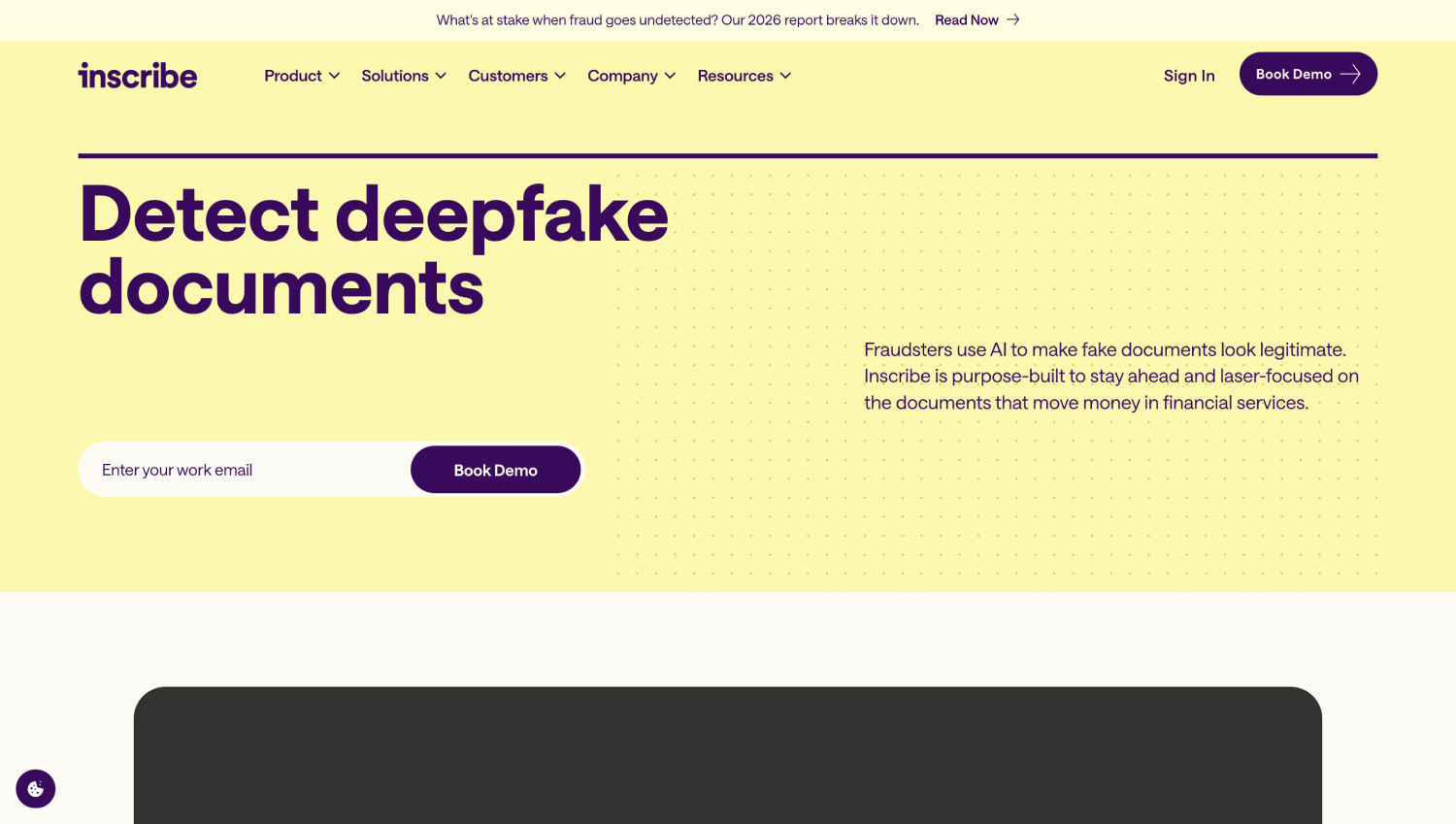
Inscribe combines bank statement extraction with document fraud detection in a single API. For lenders that currently use Ocrolus for data extraction and a separate vendor for fraud signals, Inscribe collapses that into one workflow. Its fraud detection layer checks for document tampering, metadata anomalies, and transaction inconsistencies that would not surface in a pure OCR pipeline.
This pairing matters more than it might seem. A lender that catches a manipulated bank statement during underwriting saves not just the bad loan but also the regulatory and reputational exposure that follows a fraud-induced default. Our coverage of fake document detection tools for fintech startups covers this category in more depth if document authenticity is a top priority.
Inscribe’s extraction accuracy on complex documents is generally strong, though it is not as deeply specialized in cash flow categorization as Heron. Teams switching from Ocrolus primarily for the fraud layer will find the migration straightforward. Teams switching primarily for cash flow analytics should run side-by-side accuracy tests before committing.
Best for Open Banking-Native Decisioning: MX
MX approaches cash flow underwriting from the opposite direction as Ocrolus. Instead of analyzing uploaded documents, MX pulls data directly from financial institutions through its open banking network and applies categorization and analytics on the connected feed. For lenders targeting borrowers who consent to direct account connection, this removes the document-upload friction entirely.
The limitation is borrower adoption. Direct bank connection requires borrower consent and works best in consumer and small business lending contexts where the application flow can prompt for account linking. Lenders underwriting on submitted documents, particularly in commercial contexts, will find MX’s core value proposition misaligned with their workflow. For context on how MX compares to Plaid and Finicity in the open banking stack, the FintechSpecs comparison of Plaid, MX, and Finicity covers the connectivity and data quality differences in detail.
Best for Payroll-Linked Income Verification: Plaid Income
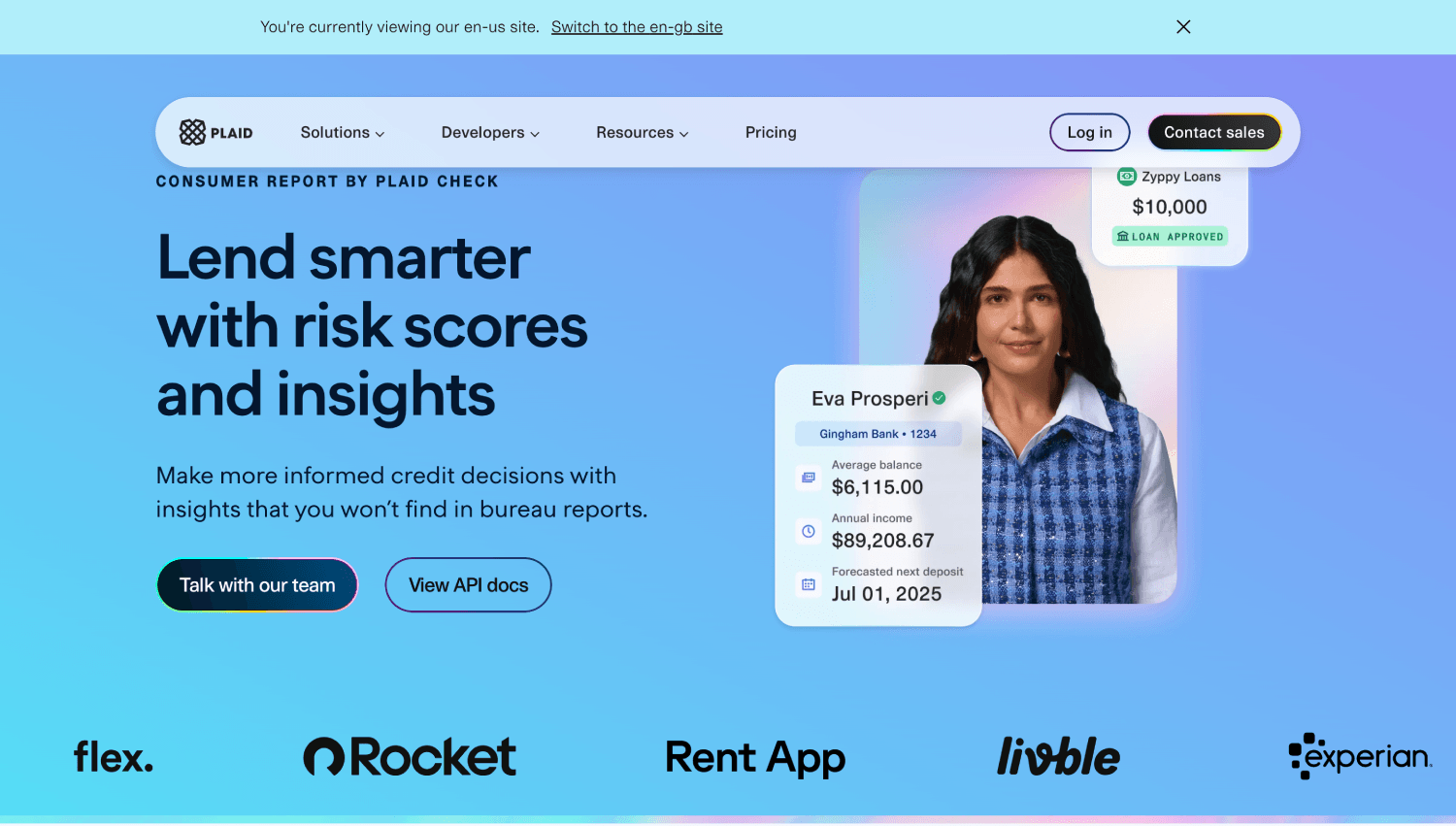
Plaid Income covers a specific and increasingly common underwriting requirement: verifying income from both payroll data and bank cash flow in one call. For consumer lenders, mortgage originators, and personal loan platforms, Plaid Income can replace the combination of Ocrolus bank statement analysis plus a separate payroll verification vendor like Argyle or Pinwheel.
Plaid’s bank connectivity network is wide, which means coverage in consumer applications is generally strong. The cash flow categorization in Plaid Income is less granular than Heron Data’s SMB-focused output, but for consumer lending that distinction rarely matters. Migration from Ocrolus is cleanest for teams that are already using Plaid for bank account linking, because the Income product layers onto existing Plaid integration rather than requiring a net-new vendor relationship. For teams choosing between income verification APIs, the FintechSpecs guide to income and employment verification APIs covers Argyle and Pinwheel alongside Plaid in comparable depth.
Best for Budget-Constrained Teams: DocuClipper
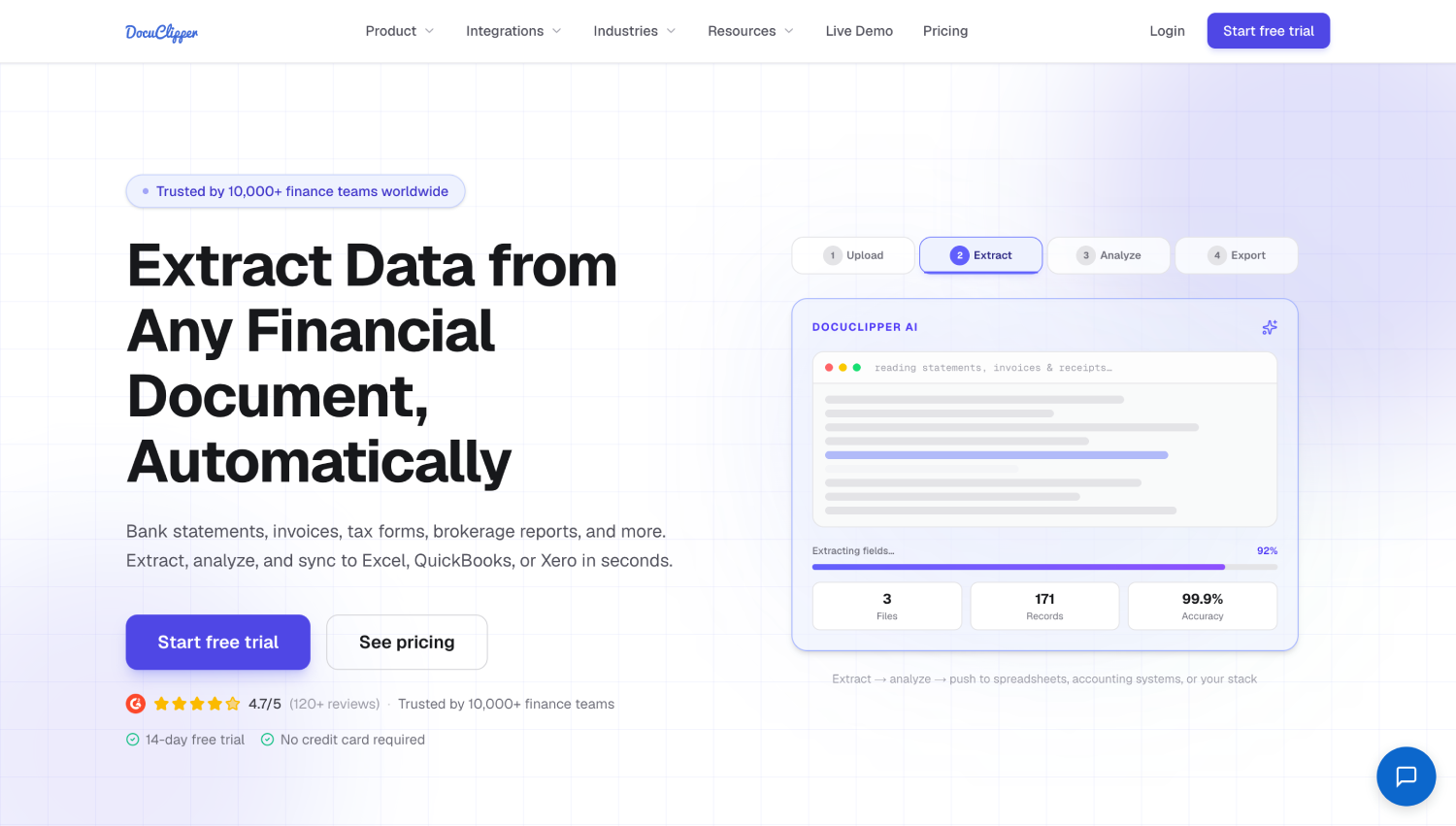
DocuClipper positions itself explicitly as a cost-accessible alternative to Ocrolus for bank statement extraction, invoice processing, and receipt analysis. The company publicly claims 99.9% accuracy on bank statement extraction, a figure that should be tested on your specific document types before treating as a given.
DocuClipper’s pricing is available on its public pricing page and is meaningfully lower than Ocrolus for comparable bank statement volume. The trade-off is that DocuClipper lacks the cash flow analytics layer that makes Ocrolus useful for underwriting decisions: it extracts data accurately but does not produce the enriched income categorization, cash flow trending, or anomaly signals that underwriting models typically consume. Teams that need raw extracted data fed into their own models may find DocuClipper sufficient. Teams that rely on Ocrolus-style cash flow signals for direct decisioning will need to build that analytics layer themselves.
Best for Tax Return and Business Financial Analysis: Fieldpoint (formerly Finicity Business)
Lenders processing SBA loans, commercial real estate applications, or business lines of credit frequently need to analyze tax returns (1120S, 1065, Schedule C) alongside bank statements. Ocrolus handles some of these but receives consistent criticism for lower accuracy on complex multi-page tax documents. Finastra’s acquisition of Finicity, alongside purpose-built tools like Veryfi, addresses this gap more directly.
Veryfi’s document processing API covers bank statements, receipts, invoices, and financial documents with strong multi-format support. It is API-first, with a developer experience that is notably more self-service than Ocrolus, which typically requires a sales engagement before teams can run meaningful tests. For teams that want to run a proof of concept quickly without a procurement cycle, Veryfi is worth testing early.
Best for Enterprise Document Workflow Automation: ABBYY Vantage
ABBYY Vantage is not a lending-specific tool, but it appears on Ocrolus alternative lists because it handles the widest range of document types at enterprise scale. For larger financial institutions that process not just bank statements but also contracts, correspondence, and structured forms, ABBYY provides a configurable intelligent document processing platform that Ocrolus cannot match in breadth.
The trade-off is implementation complexity and cost. ABBYY Vantage is an enterprise software deployment, not an API call. Smaller teams without dedicated IT or implementation resources will find the ramp time prohibitive. Migration from Ocrolus to ABBYY also requires building custom skills (ABBYY’s term for document models), which is a meaningful engineering investment. ABBYY is the right choice for regulated financial institutions with complex, multi-document workflows who have already outgrown purpose-built lending tools.
Best for Consumer-Lending Cash Flow with Thin-File Borrowers: Nova Credit
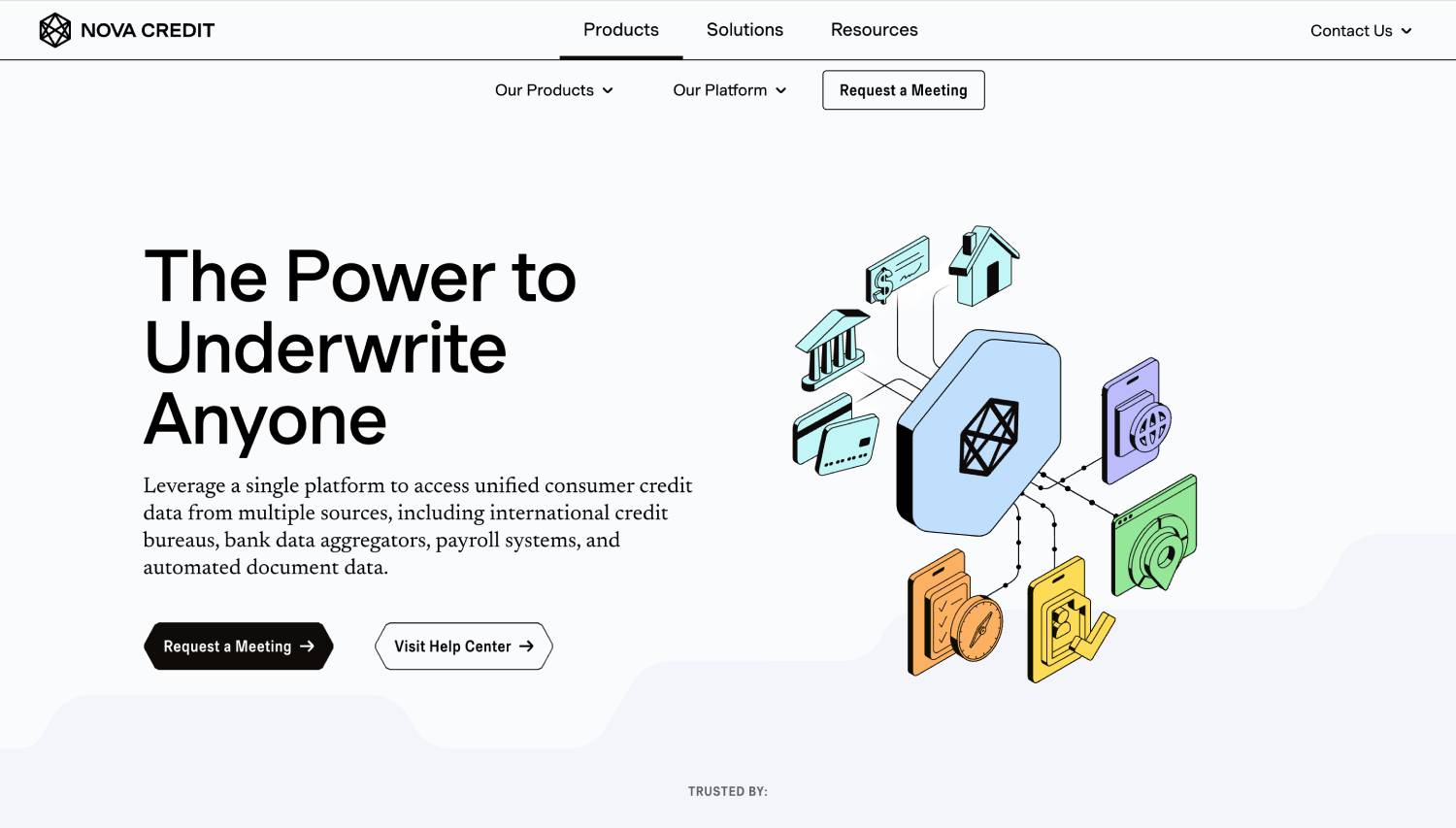
Nova Credit serves a specific and underserved use case: cash flow underwriting for borrowers with limited US credit history. Its international credit passport product is the most widely recognized feature, translating foreign credit bureau data into a US-equivalent score that feeds directly into a lender’s existing cash flow underwriting model alongside bank transaction signals. Nova Credit also offers cash flow analytics through bank data for thin-file and new-to-credit borrowers. For lenders targeting immigrant populations, recent graduates, or borrowers without established FICO scores, Nova Credit’s combination of international credit data and US cash flow signals produces underwriting inputs that Ocrolus cannot replicate.
This is not an Ocrolus replacement for a standard US SMB lending workflow. It is a replacement for a very specific borrower profile. Teams serving that profile who are currently using Ocrolus for cash flow and finding gaps in thin-file accuracy should evaluate Nova Credit separately.
Best for Automated Spreading of Business Financials: Numerated
Numerated (also Moody’s) targets the commercial lending workflow specifically, with automated spreading of business financial statements that feeds directly into credit memo generation. Spreading, the process of normalizing financial statement data into a standardized credit analysis format, is time-intensive manual work at most community banks and credit unions. Numerated automates it.
Ocrolus extracts data from documents. Numerated both extracts and structures that data into a credit analysis output, which shortens the path from document to credit decision. For commercial lenders at community banks or credit unions who use Ocrolus primarily to reduce manual data entry on financial statements, Numerated is a more complete replacement than a pure document intelligence API.
Migration Risk Comparison Across All Nine Alternatives
Migration risk from Ocrolus is not uniform. It depends almost entirely on how deeply Ocrolus is embedded in downstream systems. The table below scores migration risk on three factors: schema compatibility, QA workflow dependency, and time-to-production estimate for a team with one to two engineers.
| Alternative | Schema Compatibility | QA Workflow Dependency | Est. Migration Time | Best For |
|---|---|---|---|---|
| Heron Data | Low (remapping required) | Low | 4-8 weeks | SMB revenue-based lending |
| Inscribe | Medium | Medium | 3-6 weeks | Fraud-aware consumer and SMB lending |
| MX | Low (different paradigm) | Low | 6-12 weeks | Open banking-native consumer apps |
| Plaid Income | Medium (if already on Plaid) | Low | 2-4 weeks | Consumer income verification |
| DocuClipper | High (similar output structure) | Low | 1-3 weeks | Cost-sensitive extraction-only workflows |
| Veryfi | Medium | Low | 2-4 weeks | Multi-document types, self-service teams |
| ABBYY Vantage | Low (custom skill build required) | High | 12-24 weeks | Enterprise multi-document workflows |
| Nova Credit | Low (additive, not replacement) | Low | 3-5 weeks | Thin-file consumer borrowers |
| Numerated | Low (purpose-built schema) | High | 8-16 weeks | Commercial bank spreading |
Sponsored Profile: Inscribe for Fraud-Aware Underwriting
This profile is sponsored by Inscribe. Inscribe paid for placement in this section. The “best for” verdicts and migration risk scores throughout this article reflect independent editorial judgment and were not influenced by sponsorship.
Inscribe is worth examining in more depth because it solves a problem that pure document intelligence tools do not: it detects fraudulent documents at the same step that it extracts cash flow data. For lenders that currently maintain separate vendors for document extraction and fraud screening, Inscribe eliminates a workflow seam that creates both latency and data consistency problems.
The platform ingests bank statements, pay stubs, tax documents, and business financials. On the extraction side, it returns structured cash flow data comparable to Ocrolus output. Simultaneously, it checks documents for tampering indicators: pixel-level manipulation, font inconsistencies, altered transaction amounts, and metadata anomalies that indicate a digitally modified PDF. A lender using Inscribe receives a single API response with both the extracted financial data and a fraud risk signal.
For underwriting teams concerned about application fraud, this matters because fraudulent documents are increasingly sophisticated. Our coverage of application fraud and synthetic identity tools for lenders describes the broader fraud environment in this category, but Inscribe’s specific value is integrating fraud detection into the document step rather than running it separately in an identity layer. Pricing is not publicly listed; Inscribe sells through a sales process with custom pricing based on volume and document types. Teams evaluating Inscribe should request pricing benchmarks at their p50 and p90 volume scenarios before entering a contract negotiation.
Migration from Ocrolus to Inscribe requires mapping Ocrolus cash flow output fields to Inscribe’s response schema, which takes one to two weeks of engineering time for most teams. The QA workflow is API-driven with no mandatory human review layer, which is a structural difference from Ocrolus for teams that rely on Ocrolus’s QA team as a fallback accuracy mechanism.
How Much Does Ocrolus Cost, and How Do Alternatives Compare on Price?
Ocrolus does not publish pricing. The company sells through a direct sales process, and contract terms vary by volume, document type mix, and customer size. Publicly available buyer reports suggest Ocrolus contracts typically include a monthly minimum, though specific figures vary and cannot be independently verified here.
DocuClipper publishes pricing on its website. Veryfi lists a developer tier and enterprise pricing on its public pricing page. Plaid Income pricing requires a sales conversation but Plaid generally provides sandbox access and pricing estimates early in the process, which is faster than Ocrolus’s typical sales cycle. ABBYY Vantage is enterprise-priced and not publicly listed. Heron Data, Inscribe, MX, Nova Credit, and Numerated all sell through direct sales without public pricing.
For teams trying to model cost before entering a sales process, the most useful proxy is per-document cost at your expected monthly volume. A team processing 1,000 bank statements per month, for example, can ask any candidate vendor for a per-document rate at that tier plus the monthly floor, this gives a concrete anchor for negotiation and makes it easy to compare vendors on the same basis even when none of them publish a public rate card. If a vendor refuses to provide a range before a formal process, that itself is a signal about how the contract negotiation will go. The hidden costs that erode fintech SaaS margins are rarely in the base rate; they are in overage pricing, support tiers, and integration fees that surface after signing.
What Is the Right Way to Think About Switching from Ocrolus?
The teams that switch successfully treat migration as a parallel-run problem, not a cutover. Run the candidate vendor on a live slice of your incoming document volume alongside Ocrolus for at least three to four weeks. Compare output field by field, not on aggregate accuracy claims. The fields that differ are the ones your underwriting model will react to when you switch.
The teams that struggle with migration treat it as a procurement decision rather than a technical one. They sign a new contract based on a demo, then discover at implementation that their decisioning model was consuming specific Ocrolus-formatted fields that the new vendor outputs differently. Rebuilding model feature pipelines mid-migration is expensive and slow. Running the FintechSpecs Document Intelligence Stress Test before signing eliminates most of this risk.
One thing buyers routinely underestimate: the cost of staying. If your current Ocrolus contract is priced at a volume minimum you are not hitting, or if your team is spending engineering cycles working around processing delays, the status quo has a real cost too. That cost belongs in the same model as migration risk when you are making the decision.
Frequently Asked Questions
How much does Ocrolus cost?
Ocrolus does not publish pricing. The company sells through a direct sales process with custom contracts that typically include monthly minimums. Buyers evaluating Ocrolus alternatives have reported that Ocrolus pricing varies significantly by document volume, document type, and the presence of QA workflow services. To get a real number, you must engage their sales team and model your p10, p50, and p90 volume scenarios explicitly in the conversation.
Is Ocrolus an AI platform?
Ocrolus uses a combination of machine learning models and human quality assurance review to process financial documents. Its core value proposition is high-accuracy data extraction from bank statements and payroll documents, with AI handling classification and extraction and human reviewers handling edge cases. It is not a purely automated AI system; the human QA layer is part of what the company cites as a differentiator for accuracy on difficult documents.
What is the best alternative to Ocrolus for SMB lenders?
Heron Data is the strongest replacement for SMB lenders running cash flow underwriting on business bank transaction data. It produces transaction-level categorization and revenue signal extraction that is more granular than Ocrolus’s statement-summary output. Inscribe is the better choice if fraud detection is equally important as data extraction. DocuClipper works for teams that need extraction only and are building their own cash flow analytics on top of the raw data.
Can I use Plaid instead of Ocrolus for cash flow underwriting?
Plaid Income is a credible Ocrolus alternative for consumer lenders who can prompt borrowers to connect bank accounts directly rather than upload documents. For document-based workflows, Plaid is not a direct replacement. For open-banking-native consumer lending, Plaid eliminates the document step entirely and may be more accurate because it reads live transaction data rather than processing a PDF image of that data.
How long does it take to migrate off Ocrolus?
Migration time depends heavily on how deeply Ocrolus is embedded in your systems. Teams using Ocrolus only for bank statement extraction with a clean API integration can migrate in one to three weeks. Teams that rely on Ocrolus QA workflows, have downstream decisioning models consuming specific Ocrolus output fields, or process multiple document types should budget four to twelve weeks for a parallel-run validation period before full cutover.
What Ocrolus alternatives work for tax return analysis?
Numerated is purpose-built for commercial lenders who need automated spreading of business tax returns (1120S, 1065, Schedule C) into credit analysis formats. Veryfi handles multi-document extraction including tax documents and outputs structured JSON that can feed into custom analytics. ABBYY Vantage can be configured for tax document processing at enterprise scale but requires custom model development. Ocrolus’s own coverage of complex multi-year tax documents receives more mixed reviews than its bank statement accuracy.
What is the difference between document extraction and cash flow underwriting?
Document extraction converts a PDF or image into structured data fields: account numbers, transaction dates, amounts, and balances. Cash flow underwriting applies categorization, trend analysis, and anomaly detection to those fields to produce signals an underwriter or credit model can act on, such as average monthly revenue, revenue volatility, recurring expense burden, and NSF frequency. Ocrolus does both. Some alternatives only do the first step and require you to build the second step yourself.
The Decision Most Teams Get Backwards
Most teams evaluating Ocrolus alternatives start with the vendor and work backward to fit their workflow. The more reliable approach is to start with the specific output fields your underwriting model or decisioning engine currently consumes, then find the vendor whose output matches those fields most closely with the least engineering transformation. That inversion usually surfaces the right answer faster and reveals migration complexity earlier in the process.
Cash flow underwriting is not a commodity function. The difference between a vendor that returns monthly average deposits and one that returns categorized recurring revenue with volatility bands is the difference between a data input and a decision-ready signal. Switching vendors without accounting for that distinction is how teams end up with accurate extraction and degraded model performance simultaneously.
The right Ocrolus replacement exists for almost every use case in this market. Finding it is mostly a matter of being precise about what Ocrolus is actually doing in your stack today, not what its marketing page says it does. For teams building out broader lending infrastructure alongside this decision, the FintechSpecs comparison of loan origination and management platforms covers the adjacent systems that often integrate directly with document intelligence tooling.