
TLDR
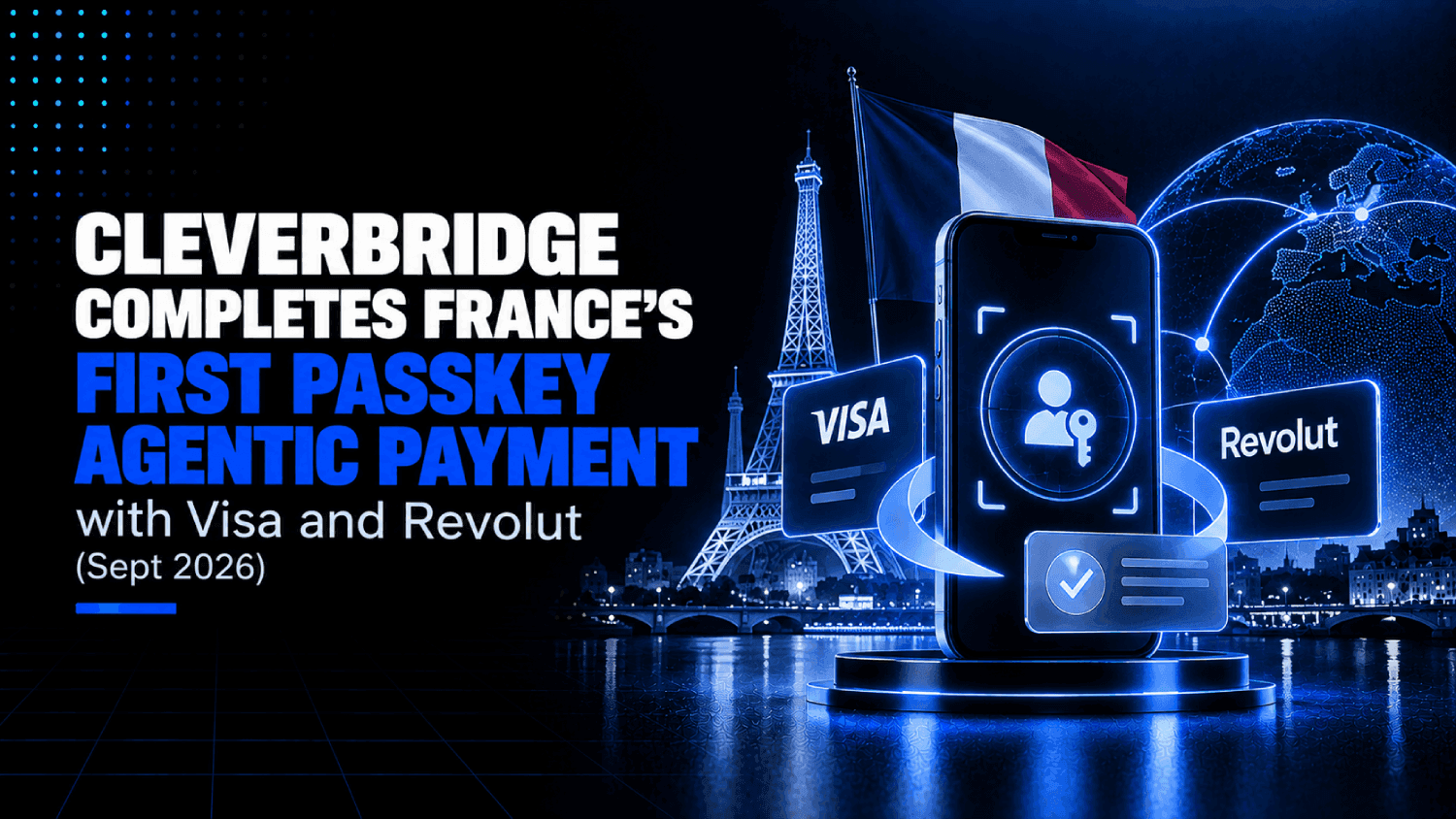
- On Sept. 24, 2026, Cleverbridge said it completed France’s first Passkey-authenticated agentic payment in a live checkout, in a pilot with Visa and Revolut (FinancialContent Business Wire mirror).
- Visa’s test agent, My Agent, initiated the purchase. Cleverbridge recognized it via Visa’s Trusted Agent Protocol and Agentic Directory. A Visa Payment Passkey authenticated the payment for European Strong Customer Authentication (SCA), and Revolut authorized it on a live French consumer retail card.
- The stack runs on Visa Intelligent Commerce over existing Visa rails (card security, identity checks, real-time fraud monitoring). Visa positions passkeys as guaranteeing purchase intent: protect the consumer from agent mistakes, and protect the merchant from AI-led chargeback requests.
- Context, not conflict: Visa France / Revolut described the France Passkey milestone around Sept. 7, 2026. Cleverbridge’s Sept. 24 release is the merchant-platform announcement that the live checkout completed on its commerce environment. The Paypers notes it is not yet a Revolut app feature; it is a controlled pilot.
- This is a merchant SCA / Trusted Agent Protocol news explainer, not a rewrite of FintechSpecs’ Mastercard × Alchemy Agent Pay, Ant Account for Agent, or Visa × Reap stablecoin credit cards pieces. Ask who verifies the agent at the merchant, how Passkey binds for SCA, and who owns chargebacks when software sits at checkout.
Sept. 24, 2026 puts the merchant side of agentic checkout on the record. Cleverbridge, a managed commerce platform for software and technology companies, announced that it completed France’s first Passkey-authenticated agentic payment in a live checkout with Visa and Revolut (Business Wire; FinancialContent mirror).
For FintechSpecs operators, the story is not “AI bought something.” It is whether a merchant can recognize a verified agent, satisfy PSD2-era SCA without a human OTP dance at the last step, and keep the issuer in the authorization loop on a live consumer card. That sits next to agentic checkout tools, best AI agent payment infrastructure, ACP vs AP2 vs x402, and AI agent identity verification, and it is distinct from Mastercard × Alchemy AgentCard (credential provisioning) and Ant Account for Agent (agent business accounts).
What Cleverbridge, Visa, and Revolut announced
Per the Sept. 24, 2026 Cleverbridge Business Wire release (also mirrored on FinancialContent):
- Cleverbridge completed France’s first Passkey-authenticated agentic payment in a live checkout.
- Visa’s test agent, My Agent, initiated the purchase.
- Cleverbridge recognized the agent as approved through Visa’s Trusted Agent Protocol (and Agentic Directory, per earlier July enablement).
- A Visa Payment Passkey authenticated the transaction to support European SCA requirements.
- Revolut authorized the payment on a French consumer retail card.
- The transaction used Visa Intelligent Commerce on Visa’s existing payment infrastructure.
- Cleverbridge says support for approved AI agents is being built into the commerce environment it operates, rather than as a one-off project per software client.
- Work continues with Visa through the Agentic Ready programme.
Richard Stevenson, CEO of Cleverbridge, said: “Agents need more control than an ordinary purchase, not less, and it has to work in a live market rather than a lab. Here the merchant knew which agent it was dealing with and the customer’s bank stayed in charge of the payment. That is what has to be true before agentic commerce can carry real volume, and helping define it is why we are in this programme.”
Timeline operators should keep straight
| Date | What became public | Primary source |
|---|---|---|
| July 2, 2026 | Cleverbridge among first merchants to enable Visa Trusted Agent Protocol and Agentic Directory; began agent-initiated tests in its environment | Cleverbridge news |
| ~Sept. 7, 2026 | Visa France / Revolut describe France’s first Visa Payment Passkey-enabled agentic transaction on a live Revolut card at Cleverbridge | Visa France press release; The Paypers |
| Sept. 24, 2026 | Cleverbridge announces the live France Passkey-authenticated agentic checkout milestone from the merchant platform side | Business Wire |
Treat Sept. 24 as the merchant go-public of a controlled pilot already described earlier in September, not as a brand-new consumer product launch inside the Revolut app.
What the stack actually did (merchant, network, issuer)
Three sides had to agree for the checkout to clear:
- Merchant recognition: Cleverbridge treated My Agent as a known, approved actor via Trusted Agent Protocol / Agentic Directory, instead of unverified bot traffic.
- Authentication for SCA: Visa Payment Passkey stood in for the usual PIN / OTP / device challenge at the point of payment (The Paypers).
- Issuer authorization: Revolut authorized on a live French consumer retail card and, per Paypers, retained issuer control; the agent acted only with prior customer authorization and spending rules. Functionality is not activated as a Revolut consumer app feature.
Visa Intelligent Commerce supplies the network path: existing card security, identity checks, and real-time fraud monitoring. Cleverbridge’s Sept. 24 release repeats Visa’s claim that passkeys guarantee purchase intent, protecting consumers from agent mistakes and merchants from AI-led chargeback requests. That is a network product thesis. Dispute rules for “agent bought the wrong SKU within limits” are still the diligence gap.
Visa France’s Sept. 7 materials add consumer-market framing: France generative-AI usage stats from the Baromètre du numérique 2026 (51% of the French population; 85% among young adults), Revolut scale claims (80M+ customers globally, 8M in France), and quotes from Béatrice Cossa-Dumurgier (Revolut Western Europe) and Florence Mélique (Visa) on trust and control. Use those as context; the operator headline remains SCA + agent recognition + issuer loop.
How this differs from Mastercard Alchemy, Ant AFA, and Visa × Reap
FintechSpecs already covered adjacent agent and Visa stories this month. Keep the buyer questions separate.
| Dimension | Cleverbridge × Visa × Revolut (Sept. 24 merchant announce) | Mastercard × Alchemy AgentCard | Ant Account for Agent | Visa × Reap |
|---|---|---|---|---|
| Primary job | Live merchant checkout that recognizes a trusted agent and clears SCA with Passkey | Credential provisioning for agents (tokenized Mastercard) + Verifiable Intent | Agent business account • KYA + fund-back packaging | Issuing infrastructure for stablecoin-linked Visa cards across markets |
| Who sits at checkout | Commerce platform (Cleverbridge) + Visa test agent | Developer/agent via AgentCard CLI/API | Agent operating a WorldFirst account object | Partner card programs on Reap |
| Trust object | Trusted Agent Protocol + Visa Payment Passkey | Verifiable Intent + Agent Pay tokens | KYA contracts + AgentSafePay claims | Issuing / settlement pathways |
| Regulatory surface called out | European SCA / PSD2-style auth | Issuer and network control schemas | Cross-border account / wallet rules | Card issuing + stablecoin settlement |
| Production status framing | Controlled live pilot on a consumer Revolut card; not a Revolut app feature | Network + AgentCard rollout messaging | Product suite launch at VOYAGE | Partner program availability claims |
Keep all four URLs. Do not merge this into the Alchemy or Ant posts. Merchant agent recognition under SCA is a different RFP line than “give my agent a card” or “give my agent an account.”
How this sits next to FintechSpecs agentic coverage
Use category posts for vendor shortlists. Use this post for what the merchant pilot proved in France.
Related FintechSpecs depth (do not cannibalize)
- Mastercard × Alchemy AgentCard / Agent Pay
- Ant International Account for Agent (AgentSafePay, AMP)
- ACP vs AP2 vs x402 agentic payment protocols
- Skyfire vs Payman vs Natural agent payment infrastructure
- Best AI agent payment infrastructure providers
- Agentic checkout tools
- AI agent identity verification providers
- Visa × Reap stablecoin credit cards (issuing, not SCA agent checkout)
Operator map for the France Passkey pilot
| Layer | What this pilot mainly moves | What it does not replace |
|---|---|---|
| Merchant agent recognition | Trusted Agent Protocol / Agentic Directory so the commerce stack treats the agent as known | Your bot-management, WAF, and fraud orchestration for non-Visa agents |
| SCA authentication | Visa Payment Passkey as the SCA path for an agent-initiated debit | Issuer-by-issuer rollout of Passkey enrollment for all cardholders |
| Issuer control | Revolut authorizing on a live French retail card under prior customer rules | A production Revolut consumer “agent pay” toggle in-app |
| Network rails | Visa Intelligent Commerce over existing Visa infrastructure | x402 / ACP-class agent-native settlement at merchants off card rails |
| Chargeback thesis | Passkey intent framing aimed at AI-led chargeback risk | A published scheme operating guide for agent instruction mismatch |
Risk, controls, and diligence questions
Agentic checkout fails on ambiguity and liability, not on whether the agent can click Buy.
Controls and promises in launch materials
- Merchant-side recognition of approved agents (Trusted Agent Protocol / Agentic Directory)
- Passkey authentication framed for European SCA
- Issuer remains in the authorization loop (Revolut)
- Prior customer authorization and spending rules (Paypers / Revolut framing)
- Existing Visa fraud monitoring and card security in the path
- Cleverbridge building approved-agent support into the shared commerce environment
What operators should still design for
- Pilot vs product. Paypers is explicit: not activated in the Revolut app. Model volume, UX, and support SLAs as pilot until a consumer or commercial GA is published.
- Agent mandate scope. Who defines merchant allowlists, amount caps, time windows, and “check with me before buy”? Where do those controls live: agent, issuer, network, or merchant?
- Passkey binding for software. SCA Passkeys were designed around a human device. Ask how the Passkey binds to an agent session versus a browser session, and what happens on agent re-auth or key rotation (open questions flagged by The Paypers).
- Chargeback when the cardholder is software. Intent-guarantee marketing does not equal a published liability shift. Ask for representment evidence packets when the agent followed a literal budget and still violated policy.
- Bot vs trusted agent at the edge. Trusted Agent Protocol helps for Visa-directory agents. Your fraud stack still needs a path for non-directory agents, scraping bots, and prompt-injected “approved” agents.
- Multi-network reality. Santander × Mastercard Agent Pay already showed an earlier European agent-executed path on a different scheme stack (Paypers). Visa Passkey in France is not “first agent payment in Europe.” It is France’s first Visa Passkey-authenticated agentic card payment in this framing.
- Merchant platform concentration. Cleverbridge processing the checkout for software/SaaS clients is powerful for those merchants, and it concentrates agent-recognition logic in the commerce platform. Confirm whether your own checkout (or PSP) gets the same Trusted Agent Protocol path without changing platforms.
Who should care, and what to ask
Prioritize a deep read if you:
- Run European ecommerce, SaaS checkout, or a managed commerce / PSP stack that must satisfy SCA for agent-initiated spend
- Own fraud, disputes, or payments product and need a live reference for Trusted Agent Protocol + Passkey
- Build AI shopping or procurement agents that need card acceptance under PSD2-style rules
- Compare network Agent Pay / Intelligent Commerce paths against specialist agent payment infra
Concrete questions for Visa, Revolut, Cleverbridge, your acquirer, and counsel
- Is Trusted Agent Protocol available for your merchant MID / PSP today, or only inside Agentic Ready pilots?
- What fields are bound in the Passkey / intent object (merchant, amount, agent ID, time window), and what is advisory metadata?
- How does Passkey enrollment work for cardholders who have never set up a Visa Payment Passkey?
- What is the chargeback reason-code path when the customer says “I authorized an agent, not this SKU”?
- How do issuer spending rules interact with merchant agent allowlists when they conflict?
- For dual Visa + Mastercard agent checkout: one consent UX or two network-specific authorization objects?
- When does Revolut (or your issuer) plan a generally available consumer or commercial agent-pay control, versus remaining pilot-only?
- If you are not on Cleverbridge, what is the integration path for Trusted Agent Protocol on Adyen, Stripe, or your gateway?
The take: SCA is the gate; merchant recognition is the product
Cleverbridge’s Sept. 24 announcement matters because it names the hard European problem: agentic checkout only scales if the merchant knows the agent, the network can satisfy SCA, and the issuer still authorizes the debit. Passkeys plus Trusted Agent Protocol are a credible answer class for that triad on Visa rails.
The operator lesson is narrower. This is still a controlled pilot on a test agent and a live Revolut card, not a mass-market Revolut feature. Intent-guarantee language is not a finished dispute guide. Non-directory agents still look like bots to everyone else.
Treat the France Passkey milestone as proof that SCA-compatible agent debit can clear in a live European checkout when merchant, network, and issuer cooperate. Then diligence directory access, Passkey binding, and chargeback packets before you rewrite your agent checkout roadmap around it.
For category depth after this news, start with agentic checkout tools and best AI agent payment infrastructure providers. For adjacent September agent stories, keep Mastercard × Alchemy and Ant Account for Agent as separate URLs.
FAQ
When did Cleverbridge announce the France Passkey agentic payment?
Sept. 24, 2026, via Business Wire and the FinancialContent mirror. Visa France / Revolut described the underlying France Passkey milestone around Sept. 7, 2026 (Visa France).
Who initiated the payment?
Visa’s test agent, My Agent, initiated the purchase. Cleverbridge recognized it through Visa’s Trusted Agent Protocol, a Visa Payment Passkey authenticated it, and Revolut authorized it on a French consumer retail card.
Does this mean Revolut customers can pay with an AI agent in the app today?
No. The Paypers reports the functionality has not been activated within the Revolut app and remains a controlled pilot.
What is Visa Trusted Agent Protocol?
Visa’s framework (with Agentic Directory) for merchants to recognize verified AI agents versus unknown or untrusted traffic. Cleverbridge enabled it in July 2026 and used it for this France live checkout (Cleverbridge July announcement).
What is a Visa Payment Passkey in this context?
An authentication method used in the pilot to support European Strong Customer Authentication without a traditional PIN/OTP challenge at the point of payment, while keeping the issuer in the authorization loop.
How is this different from Mastercard × Alchemy Agent Pay?
Mastercard × Alchemy is mainly about provisioning tokenized Agent Pay credentials (and Verifiable Intent) so agents can spend at Mastercard merchants. This Cleverbridge story is about a merchant live checkout clearing SCA with Passkey after recognizing a Visa trusted agent.
How is this different from Visa × Reap?
Visa × Reap is about partner card issuing and stablecoin-linked programs across markets. This piece is about agent-initiated checkout authentication under European SCA rules.
Does this replace FintechSpecs’ agent protocol or infrastructure listicles?
No. Those posts compare protocols and vendors. This piece explains what Cleverbridge, Visa, and Revolut put on the record for a France Passkey-authenticated agentic card payment, and which diligence questions operators should ask.