
TLDR
- HighRadius, Workiva, and Numeric each solve a different bottleneck in the close cycle. Buying the wrong one means paying for features your team will never use while the actual problem stays unresolved.
- HighRadius wins on record-to-report automation depth, particularly for companies running complex reconciliations across hundreds of accounts. Workiva wins on connected reporting and audit-ready disclosure management. Numeric wins on speed-to-value for finance teams that want close management without a six-month implementation.
- BlackLine is not the only enterprise option. All three vendors here compete for enterprise contracts and have the compliance posture to support SOX environments.
- Pricing is not publicly listed for any of the three. Enterprise contracts are the norm, and total cost of ownership diverges significantly based on module count and implementation scope.
- The right shortlist question is not “which platform has the most features” but “where does our close actually break down.” The answer determines the vendor.
HighRadius, Workiva, and Numeric serve different failure points in the financial close. HighRadius targets high-volume reconciliation and R2R automation for large enterprises. Workiva targets multi-entity disclosure management and audit-ready reporting. Numeric targets mid-market and growth-stage finance teams that need close orchestration without a lengthy enterprise deployment. None of the three publicly lists pricing. For teams comparing these platforms, the decision comes down to where the close breaks, not which vendor has the longest feature list.
Why Most Close Automation Shortlists Start With the Wrong Question
Most finance teams shopping for close automation frame the problem as a software problem. They want a better tool. The more accurate framing is a bottleneck problem, and the bottleneck varies enormously between organizations.
A 600-entity global company struggling to consolidate intercompany eliminations has a different problem than a 200-person SaaS company whose controller is manually tracking task status in a shared spreadsheet. Selling the former on task checklists wastes their time. Selling the latter on a full R2R suite is overkill they cannot implement. This is why BlackLine, which dominates brand awareness in this category, does not fit every buyer, even though most buyers assume it does.
To frame this comparison, FintechSpecs uses what we call the Close Bottleneck Map, a three-layer diagnostic that identifies where close delay actually originates. Layer one is reconciliation volume (how many accounts, entities, and data sources need matching). Layer two is reporting complexity (how many stakeholders, formats, and regulatory frameworks need to be served). Layer three is process visibility (whether the team can see task status, blockers, and owner accountability in real time). HighRadius, Workiva, and Numeric each address a different primary layer.
What Does HighRadius Actually Do for Financial Close?

HighRadius built its business on accounts receivable automation before expanding into the record-to-report space. Its Financial Close Management suite covers account reconciliation, journal entry management, task management, and variance analysis. The platform is AI-native in the sense that matching logic, anomaly detection, and predictive close tracking are built into the core product rather than bolted on.
Where HighRadius earns its enterprise positioning is reconciliation depth. Companies running thousands of account reconciliations per period, particularly those with high transaction volumes that need automated matching against bank feeds, ERP data, and subledgers, get more out of HighRadius than any comparable platform in this comparison. Its AI-driven matching is genuinely differentiated here.
HighRadius Close: What the Platform Handles Well
HighRadius integrates directly with SAP, Oracle, NetSuite, and Microsoft Dynamics. The journal entry automation layer can reduce manual entry volume substantially for companies with repetitive, rule-based postings. The task management module provides visibility across the close calendar but is not its primary strength. Think of HighRadius as a reconciliation-first platform with close management attached, not a close management platform that also does reconciliation.
The implementation curve is real. HighRadius deployments at large enterprises typically involve significant configuration and a dedicated implementation partner. Teams expecting a quick go-live should adjust expectations, especially if they are migrating existing reconciliation templates from another tool. For context on broader R2R automation tradeoffs, the FintechSpecs guide to account reconciliation software for bank and balance sheet recs covers the vendor field in more detail.
HighRadius Pricing
HighRadius does not publish pricing. Contracts are structured around module selection, transaction volume, and entity count. Implementation fees are separate. Buyers should expect a multi-month sales process with a proof of concept phase before any commercial terms are set.
What Does Workiva Actually Do for Financial Close?

Workiva is primarily a connected reporting and disclosure management platform. Its financial close functionality sits within a broader platform designed to link source data, working papers, and final reports into a single audit trail. For public companies or PE-backed companies preparing for exit, this connectivity is the whole point.
The Workiva financial close product manages close tasks, tracks preparers and reviewers, and connects those outputs directly to the SEC filings, board reports, or management reporting packages that come out the other end. The reason this matters is that most close automation tools treat reconciliation and reporting as separate workflows. Workiva treats them as one continuous data flow, so a number changed during the close period propagates automatically to every downstream report that references it.
Workiva Financial Close: Where It Wins and Where It Does Not
Workiva is the clearest choice for any company with a complex disclosure obligation. Public companies managing 10-K and 10-Q processes, companies under SOX 302 and 404 requirements, and companies managing ESG or sustainability reporting alongside financial reporting all benefit from Workiva’s linked-data architecture. The platform’s audit trail is designed from the ground up to satisfy external auditors, which is a genuine differentiator versus task-management-first competitors.
Where Workiva is weaker is high-volume transaction matching. It is not a reconciliation engine in the same way HighRadius is. Companies whose primary bottleneck is matching millions of transactions per period will find Workiva’s reconciliation module less powerful than what HighRadius offers. Workiva’s strength is downstream of the reconciliation: it is the platform that takes close outputs and turns them into auditable disclosures efficiently.
Workiva Pricing
Workiva does not publish pricing. It is a publicly traded company (NYSE: WK) and its revenue is observable from earnings filings, but per-contract pricing is not disclosed. Contracts are typically annual, module-based, and scale with user count and entity count. Implementation is often handled by Workiva-certified partners rather than the vendor directly.
What Does Numeric Do Differently for Close Management?
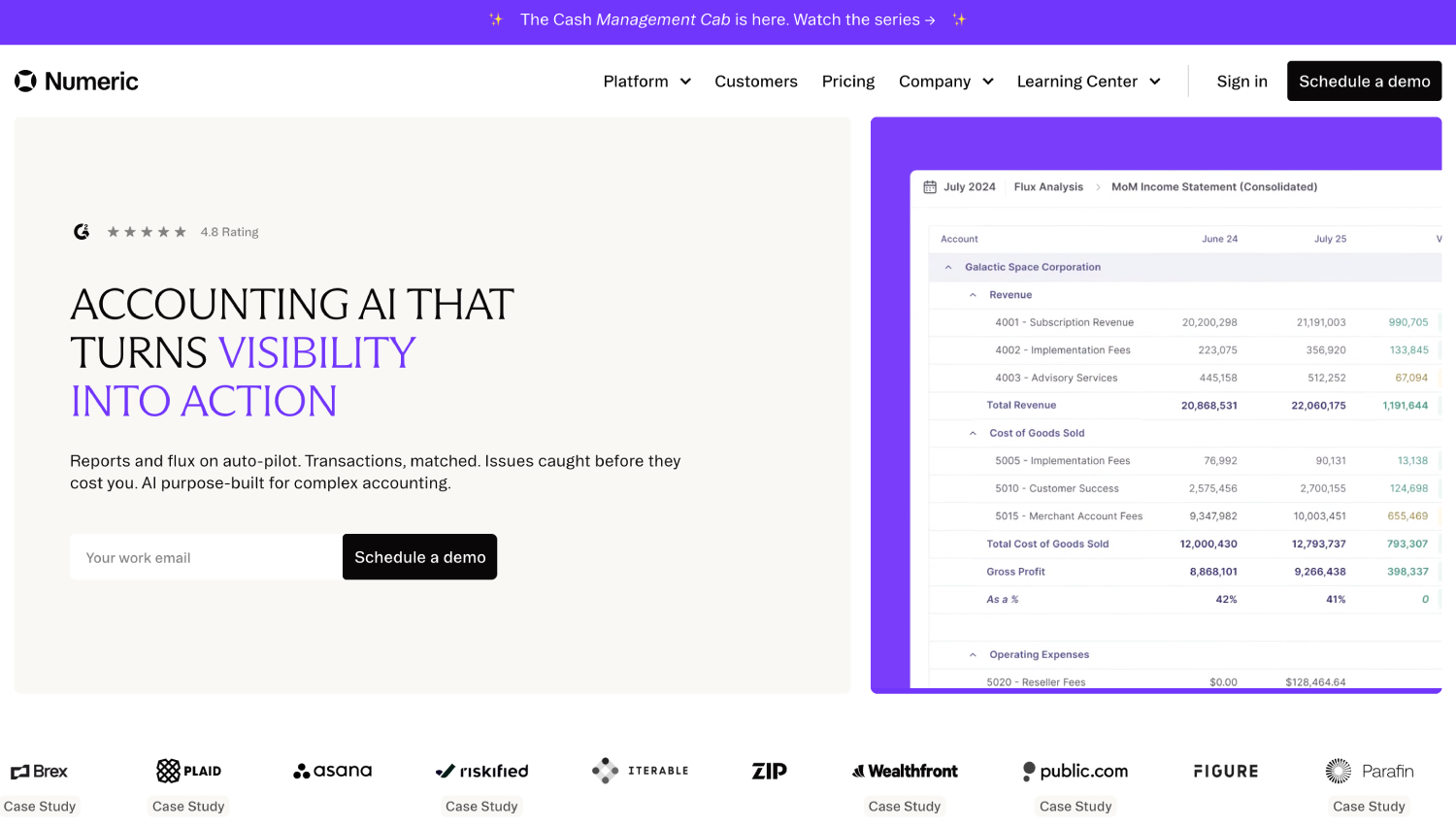
Numeric is a close management and reporting platform built for modern finance teams, typically companies running on NetSuite, QuickBooks, or Xero that want structured close processes without the complexity of an enterprise implementation. It is the newest of the three platforms and the one most explicitly designed to replace spreadsheet-based close tracking rather than a legacy enterprise tool.
Numeric’s core product is close task management with native ERP integration, automated flux analysis, and reporting that connects close data to the CFO-level dashboards that leadership actually reads. The flux analysis feature is worth highlighting: rather than requiring a finance team member to manually compare month-over-month balances, Numeric flags variances automatically and prompts the owner to explain or approve them. This turns a manual analytical step into a structured workflow.
Numeric Close Management: The Case for It
The implementation timeline is Numeric’s clearest advantage over HighRadius and Workiva. Teams that have evaluated Numeric report going live in weeks rather than months. For a Series B or C company that cannot afford a six-month implementation project and does not have a dedicated systems team, this matters more than any feature comparison. The platform is deliberately opinionated about the close process rather than infinitely configurable, which is a trade-off that works in its favor for teams that do not need custom workflow design at every step.
Numeric is also the only platform in this comparison that is designed from the start for the CFO-as-operator model, where the finance leader is deeply involved in the close process itself rather than receiving a summary after the fact. The reporting layer connects close status to narrative commentary, which reduces the time between books-closed and board-ready reporting.
Numeric Pricing
Numeric does not publicly list pricing. The company positions itself below the pricing of enterprise platforms like HighRadius and Workiva, targeting the mid-market segment. Interested buyers should contact Numeric directly for a quote.
HighRadius vs Workiva vs Numeric: The Close Bottleneck Table
| Close Bottleneck | Best Fit | Why |
|---|---|---|
| High-volume transaction reconciliation (thousands of accounts) | HighRadius | AI-driven matching engine built for large transaction volumes; deepest ERP integration for SAP/Oracle environments |
| Multi-entity consolidation and disclosure management | Workiva | Connected reporting links close outputs directly to SEC filings, board decks, and ESG reports with full audit trail |
| Close task visibility and owner accountability | Numeric | Fastest implementation; flux analysis and task management designed for teams replacing spreadsheet-based close tracking |
| SOX 302/404 compliance documentation | Workiva | Audit-ready architecture with controls documentation built into the workflow |
| Journal entry automation at scale | HighRadius | Rule-based and AI-assisted journal entry posting reduces manual entry volume for high-frequency postings |
| CFO-ready close reporting in days, not weeks | Numeric | Narrative reporting layer connects close data to board-ready outputs without a separate BI tool |
| NetSuite or QuickBooks native integration | Numeric | Built specifically for mid-market ERP stacks; HighRadius and Workiva are optimized for SAP and Oracle enterprise environments |
How Does HighRadius Compare to Workiva for Financial Close Automation?
The honest answer is that HighRadius and Workiva rarely compete for the same buyer at the same bottleneck. HighRadius competes most directly with BlackLine on account reconciliation and close task management for large enterprises running SAP or Oracle. Workiva competes most directly with Trintech and Certent on disclosure management and connected reporting.
When a company is evaluating both, it usually means they are trying to solve two different problems with one vendor. That is where the comparison gets complicated. A company that needs both deep reconciliation automation and connected disclosure management may end up running HighRadius and Workiva together, using HighRadius to close the books and Workiva to report on them. This is not a theoretical scenario. It reflects how some large public companies actually configure their close stack.
For companies that want one platform to handle both, neither is a perfect answer. HighRadius’s reporting capabilities are improving but are not Workiva’s equal on the disclosure side. Workiva’s reconciliation capabilities are functional but are not HighRadius’s equal on transaction volume. Buyers who need both should evaluate whether a combined deployment makes more sense than choosing one. Finance teams evaluating their full software stack alongside the close platform decision might also reference this overview of financial close and month-end automation tools.
Workiva vs Numeric: Where the Mid-Market Decision Lives
Workiva and Numeric do sometimes compete for the same buyer, typically a growth-stage company that has outgrown spreadsheet close tracking but is not yet a public company with complex disclosure obligations. In that buyer profile, Numeric wins on speed of deployment and total cost. Workiva wins if the company has a near-term IPO or acquisition on the horizon that will require SEC-grade reporting infrastructure.
A Series C company with 15 entities, planning to go public in 18 months, should almost certainly start evaluating Workiva now rather than implementing Numeric and migrating later. The switching cost of moving from a lightweight close management tool to a full disclosure management platform during an S-1 preparation process is painful. Buying ahead of the need is justified when the regulatory event is visible.
A Series B company with three or four entities, no imminent exit timeline, and a controller who spends two weeks per quarter manually reconciling accounts in Google Sheets, should start with Numeric. The implementation will take weeks, the close will tighten, and when the company grows to the point where Workiva’s disclosure management becomes relevant, the decision can be revisited from a position of process maturity rather than chaos.
The FintechSpecs Close Bottleneck Decision Framework
The FintechSpecs Close Bottleneck Decision Framework applies three diagnostic questions before putting any platform on a shortlist. Running through these before scheduling demos prevents teams from spending 90 days evaluating a tool that addresses the wrong constraint.
Question 1: Is the delay happening at matching or at management? If reconciliations take the most time because transaction volumes are high and data sources are fragmented, the bottleneck is at matching. HighRadius addresses this. If reconciliations close reasonably fast but the team loses days coordinating preparer and reviewer tasks, the bottleneck is at management. Numeric or BlackLine addresses this.
Question 2: Is the close output a report or a filing? If the close ends with a board deck, a management report, or an investor update, almost any close management platform will get the data there. If the close ends with an SEC filing, a consolidated statutory report, or a controlled disclosure document, the downstream reporting infrastructure needs to be audit-ready by design. Workiva is built for that requirement; the others are not.
Question 3: How long can implementation take? This is not a question about patience. It is a question about organizational capacity. A company with a two-person accounting team cannot absorb a six-month implementation project that requires dedicated internal resources. HighRadius and Workiva both require substantial implementation investment. Numeric does not. The capacity constraint eliminates options faster than any feature comparison.
What Are the Real Risks of Each Platform?
HighRadius carries implementation risk. The platform is powerful, but power requires configuration. Companies that underestimate the internal resource commitment for a HighRadius deployment frequently find themselves six months in with partial functionality and a frustrated accounting team. The lesson is not to avoid HighRadius but to staff the implementation properly and agree on a phased rollout scope before signing.
Workiva carries scope creep risk. Because the platform can absorb so many reporting workflows, non-finance stakeholders (legal, IR, sustainability teams) often want access and customization. What starts as a close management implementation becomes a cross-functional platform project. Finance teams should establish governance around what lives in Workiva and what does not before the platform goes live.
Numeric carries growth-ceiling risk. The platform is excellent for what it does, and what it does is close management for mid-market teams. Companies that grow significantly in entity count or move into complex disclosure requirements will eventually face a platform decision again. Numeric is the right starting point for many buyers, but it is worth accepting that it may not be the final destination.
Finance teams thinking about how close automation connects to the broader fintech stack may also find it useful to read through common mistakes in fintech infrastructure decisions, many of which apply directly to close software selection.
How Does Each Platform Handle R2R Automation?
Record-to-report automation, often abbreviated as R2R, covers the full workflow from transaction data in the ERP to a reportable financial statement. All three platforms touch parts of this workflow, but they enter at different points.
HighRadius enters at the reconciliation layer, matching transactions to source data and automating journal entries. It is the most complete R2R automation platform of the three for the front half of the workflow. Workiva enters at the reporting layer, taking close outputs and converting them into final disclosures. It is the most complete platform for the back half. Numeric sits in the middle, orchestrating the tasks and approvals that connect the reconciliation work to the report, but without the depth of either HighRadius at matching or Workiva at disclosure.
For a company that genuinely needs end-to-end R2R automation, a combined HighRadius plus Workiva deployment is more comprehensive than either alone. For a company that needs most of the middle workflow solved without the cost and complexity of two enterprise platforms, Numeric is the practical path. Teams building out their complete finance operations picture may find the FintechSpecs overview of FP&A and financial planning tools useful alongside this comparison, since close automation and planning tools often share the same evaluation cycle.
Frequently Asked Questions
Is HighRadius a direct competitor to BlackLine?
Yes, for account reconciliation and financial close management at large enterprises, HighRadius competes directly with BlackLine. Both platforms target companies running high-volume reconciliations on SAP, Oracle, and similar ERP environments. The differentiator is that HighRadius has a stronger AI-driven matching capability and a broader order-to-cash suite, while BlackLine has a longer enterprise track record and a larger existing customer base. Teams already evaluating BlackLine should put HighRadius on the same shortlist and run both through a proof of concept on actual reconciliation volume.
Can Workiva replace a financial close tool like BlackLine or HighRadius?
For reconciliation-heavy close processes, Workiva is not a replacement for BlackLine or HighRadius. Workiva’s reconciliation module exists but is not its core competency. Where Workiva replaces those tools is for companies whose primary close pain point is connected reporting and disclosure management rather than transaction matching. A company that closes its books on time but spends two weeks manually linking close data to its 10-Q process is the buyer Workiva is designed for. For companies where the close itself is the bottleneck, Workiva is a complement to a reconciliation platform rather than a replacement.
Who is Numeric best suited for?
Numeric fits finance teams at Series A through Series C companies, typically 50 to 500 employees, running on NetSuite, QuickBooks, or Xero, where the close is delayed by task coordination and manual variance analysis rather than high-volume transaction matching. Controllers who are managing the close process in shared spreadsheets and spending more than a week per period chasing down reconciliation sign-offs are the clearest use case. Numeric is not designed for companies with complex multi-entity consolidation needs or SEC filing obligations.
How long does a HighRadius financial close implementation typically take?
HighRadius does not publicly state standard implementation timelines, and actual duration depends heavily on ERP environment, module scope, and internal readiness. Customer case studies and implementation partner documentation published by HighRadius and its partners indicate that large enterprise deployments commonly run six to twelve months from contract to full go-live. Phased implementations that start with a single module such as account reconciliation can go live faster, but full R2R automation coverage typically requires the longer runway. Teams should confirm timeline expectations directly with HighRadius and any proposed implementation partner before signing.
Does Workiva support SOX compliance workflows?
Yes. Workiva is explicitly designed for SOX 302 and 404 compliance environments. The platform’s linked-data architecture creates audit trails that connect every number in a disclosure document back to its source data, which satisfies the internal control documentation requirements that SOX compliance requires. Many public companies and PE-backed companies preparing for exit use Workiva specifically because external auditors are familiar with its audit trail format. This is a genuine competitive advantage versus close management tools that manage tasks but do not create audit-ready documentation chains.
What ERP systems does Numeric integrate with?
Numeric integrates natively with NetSuite, QuickBooks Online, and Xero, which are the ERP systems most common at growth-stage companies. It does not target SAP or Oracle enterprise environments, which is a deliberate positioning decision. Companies running SAP or Oracle will find HighRadius and Workiva better equipped to handle the integration complexity of those platforms. Numeric’s ERP focus is a signal about its target customer: mid-market finance teams on modern cloud ERP stacks rather than large enterprises on legacy systems.
Can a company use HighRadius and Workiva together?
Yes, and some large public companies do exactly this. HighRadius handles the reconciliation and journal entry layer during the close, and Workiva takes the closed-book data and routes it through the disclosure management and filing workflow. The integration between the two platforms is not plug-and-play; it requires configuration and typically an implementation partner who has done the integration before. For companies with the budget and the regulatory obligation to justify both platforms, the combination provides more complete R2R automation coverage than either platform alone.
How does Numeric’s flux analysis feature work?
Numeric’s flux analysis automatically compares current-period balances against prior-period and budget figures, then surfaces variances above a defined threshold and assigns them to the responsible account owner for explanation or approval. This replaces a process that many finance teams run manually in Excel, where a controller or senior accountant compares GL balances line by line and writes commentary in a separate document. Numeric structures that commentary directly inside the close workflow, which means the explanation is attached to the reconciliation and available for review without a separate document. For teams doing their first structured close process, this is often the highest-value feature in the platform.
The Single Most Important Insight About This Decision
The category framing of “financial close software” obscures more than it reveals. HighRadius, Workiva, and Numeric are not three versions of the same tool. They are three different answers to three different questions about where the close breaks down. Buying the wrong one because the sales process was more responsive or the demo was more polished is an expensive mistake that typically costs a company a year of stalled adoption before they revisit the decision.
Run the Close Bottleneck Map first. Identify whether your primary constraint is reconciliation volume, reporting complexity, or process visibility. That answer will narrow the shortlist to one platform before you ever talk to a vendor. If the answer is reconciliation volume and journal entry automation at enterprise scale, HighRadius deserves serious evaluation. If the answer is connected disclosure management and audit readiness, Workiva is the right starting point. If the answer is close process visibility and faster time-to-value, Numeric is worth evaluating before assuming you need an enterprise platform.
The assumption that enterprise close automation means BlackLine or nothing has left a lot of finance teams either overbought on functionality they cannot use or under-served by a tool that was not built for their actual bottleneck. For teams that have already done the initial research and are shortlisting vendors, the FintechSpecs framework for evaluating a fintech vendor before signing applies directly to this category and is worth running before any commercial conversation.