
TLDR
- Most “AI” close tools are still checklist software with a GPT wrapper. The tools in this list actually draft reconciliations, write flux commentary, and propose journal entries without a human starting the work.
- The clearest dividing line in this market is between workflow orchestration (FloQast, BlackLine) and AI-native close agents (Numeric, Nominal, Ledge, Rillet, Basis, Double) that treat human review as the final step, not the first.
- For seed-to-Series B finance teams doing the close in spreadsheets, any of the AI-native tools will compress a multi-day close into hours. For enterprise teams, the question is whether an AI layer on top of BlackLine is faster than switching.
- Pricing is not publicly disclosed for most vendors in this category. Assume a discovery call before any number. Budget pilots exist for several of these tools.
- The FintechSpecs AI Close Readiness Test identifies four signals that separate tools doing real agentic work from tools marketing around AI. Applied below to every vendor.
The nine AI month-end close tools most worth evaluating are Numeric, Nominal, Ledge, Rillet, Basis, Double, FloQast, BlackLine, and HighRadius. The first six are AI-native, built to draft reconciliations and commentary before a human touches anything. The last three are established platforms that have added AI layers. For teams under 200 employees still running the close in Google Sheets and Slack, an AI-native tool is the faster and cheaper path. For teams already on BlackLine or FloQast, switching cost math matters more than feature lists.
Why Finance Teams Are Re-Evaluating the Close Right Now
The month-end close has not changed structurally in decades. A controller opens a checklist, assigns reconciliations, chases preparer emails, reviews flux explanations written in shorthand, and signs off. The bottleneck is always the same: humans creating the first draft of everything.
What changed is that LLMs can now create those first drafts at sufficient quality that a controller’s job shifts from author to editor. That is a material difference. A reconciliation drafted by an AI agent and approved in 90 seconds is not the same category of thing as a reconciliation template in FloQast that a staff accountant still fills out manually.
Search volume data from Semrush (as of Q2 2025) shows “AI powered” financial close generating 1,300 monthly searches and “AI assisted” generating 590, with both numbers trending upward. Finance teams are past the awareness phase. They are now evaluating specific products.
What Does AI Actually Do in These Close Tools?
Before buying anything, run what FintechSpecs calls the AI Close Readiness Test, a four-part framework for separating genuine agentic capability from rebranded workflow software.
Signal 1: Does AI draft, or does AI assist? A tool that auto-populates a reconciliation template based on your GL data is assisting. A tool that ingests your bank feed, matches transactions, flags exceptions, and writes a reconciliation memo is drafting. Only the second type materially compresses close time.
Signal 2: Does the AI write flux commentary from source data? Variance analysis written by a human controller, even a fast one, takes 30 to 90 minutes per entity. An AI tool that reads actuals versus prior period, pulls causal drivers, and writes a first-draft narrative changes what the close day looks like.
Signal 3: Can it propose journal entries? Suggesting accruals or reclassifications based on pattern recognition in historical data is a meaningful AI capability. Flagging a missing entry is not the same thing.
Signal 4: Does human review happen at the end, or throughout? In a true agentic close workflow, the preparer role diminishes and the reviewer role expands. If a tool still requires a human to initiate every task, the AI is cosmetic.
| Tool | AI Drafts Recs | AI Writes Flux Commentary | AI Proposes JEs | Agentic Workflow | Best For |
|---|---|---|---|---|---|
| Numeric | Yes | Yes | Yes | Yes | Series A-C SaaS finance teams |
| Nominal | Yes | Yes | Yes | Yes | Multi-entity, high-transaction-volume companies |
| Ledge | Yes | Partial | Yes | Yes | Fintech and crypto-native teams |
| Rillet | Yes | Yes | Yes | Yes | Revenue-heavy SaaS with complex billing |
| Basis | Yes | Yes | Partial | Yes | Startup and growth-stage teams replacing NetSuite |
| Double | Yes | Partial | Partial | Partial | Fractional CFOs and lean finance teams |
| FloQast | No | AI-assisted | No | No | Mid-market teams already on NetSuite or Sage |
| BlackLine | No | AI-assisted | No | No | Enterprise teams with SOX requirements |
| HighRadius | Partial | AI-assisted | Partial | Partial | Large AR-heavy organizations |
Which AI-Native Close Tools Are Worth Piloting?
Numeric
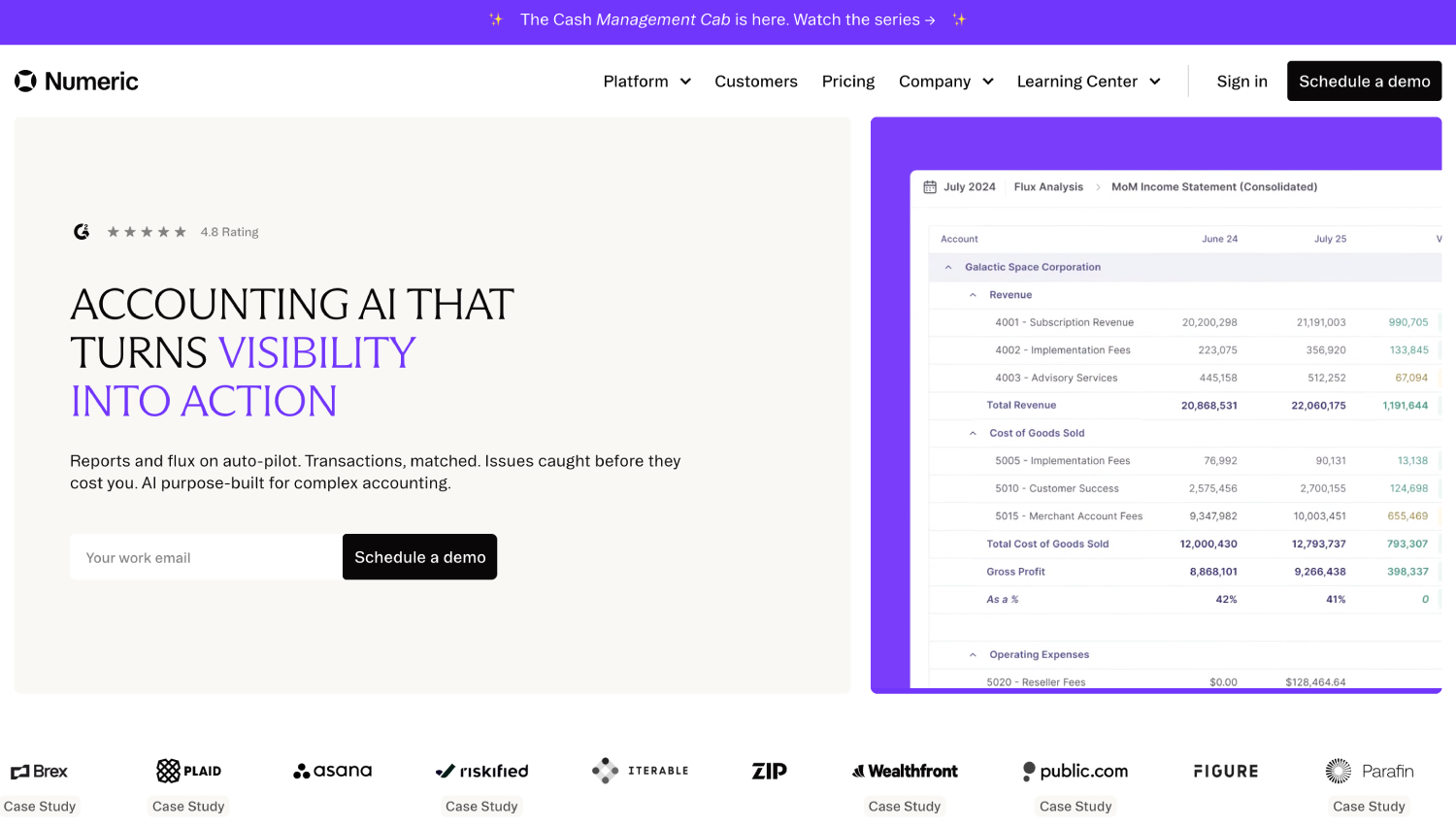
Numeric is the most discussed AI month-end close tool among Series A and Series B SaaS finance teams, and for good reason. The platform connects to your GL, ingests transaction-level data, and runs reconciliations automatically. Its AI writes the flux commentary narrative from actuals versus prior period data without a controller prompting it manually.
The journal entry proposal feature is the most advanced part of the product. Numeric identifies patterns in historical entries, flags accruals that should recur, and drafts the JE for approval. A controller reviews rather than authors. Pricing is not publicly disclosed, and Numeric’s site directs teams to a demo request.
Numeric publishes substantial product documentation and case study content, which has the secondary effect of making their AI’s reasoning more auditable by finance teams evaluating whether to trust its output.
Nominal
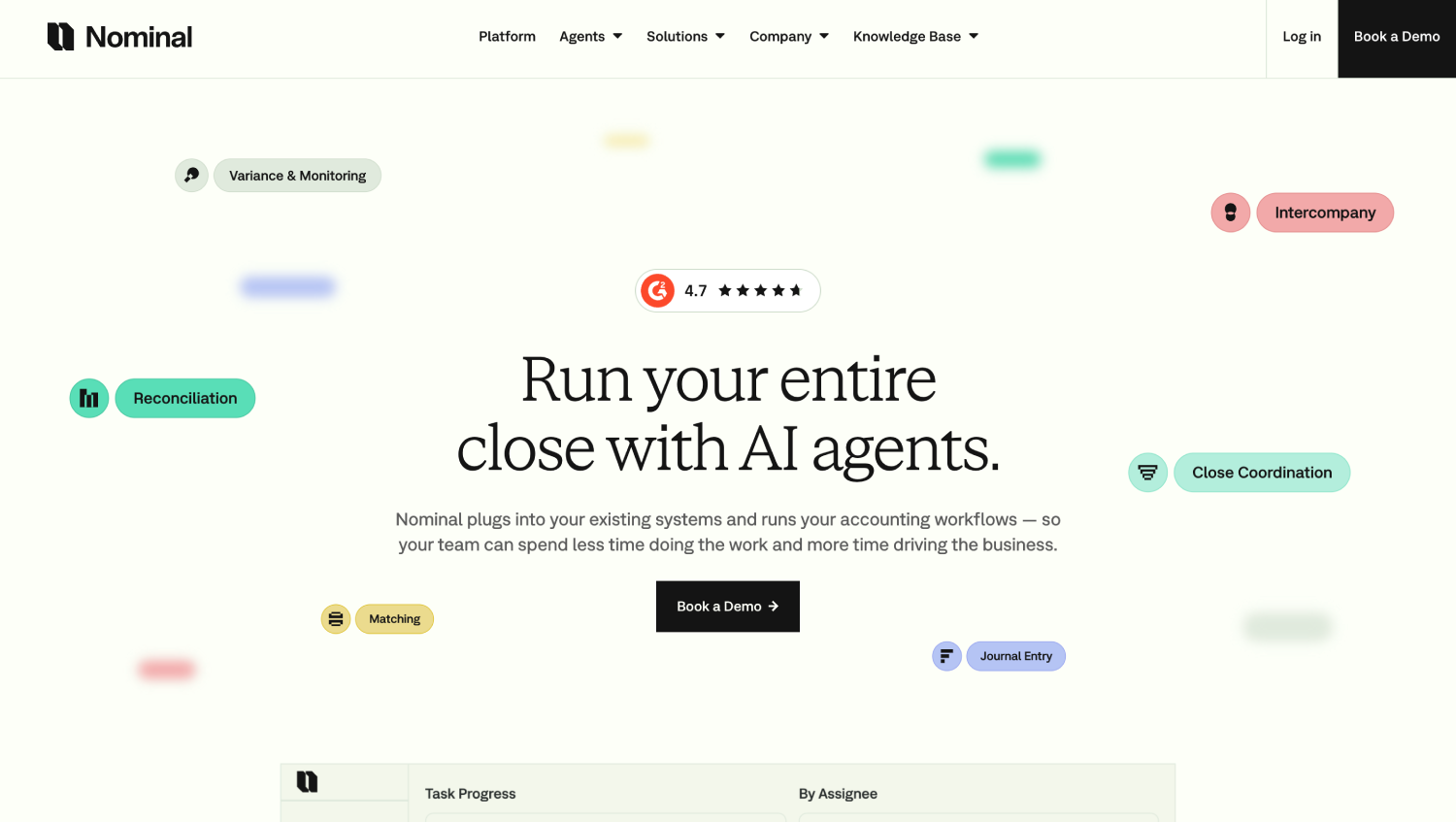
Nominal targets companies with multiple entities, high transaction volume, and complex intercompany eliminations. The AI agents handle reconciliation matching across entities and generate variance commentary at scale, which matters when a finance team is consolidating five legal entities at month-end rather than one.
Nominal’s positioning is explicitly agentic. Their product frames the human role as approval-gated rather than task-executing. For a multi-entity company consolidating books across subsidiaries, that framing reflects a real workflow change, not marketing copy. Pricing is not listed publicly.
Teams running multi-entity consolidations will also want to cross-reference our coverage of financial consolidation software for multi-entity companies, which covers the upstream accounting layer these tools connect into.
Ledge

Ledge has carved out a specific niche: fintech and crypto-native finance teams with non-standard transaction types, stablecoin settlements, and high-frequency payment volumes that traditional close tools cannot parse cleanly.
Where Ledge differentiates is in its data ingestion layer. It connects to payment processors, crypto rails, and banking APIs natively, rather than relying on a GL export. That means reconciliations happen closer to the source of truth. The AI proposes journal entries based on classified transaction data, which is the right architecture for a company settling in USDC or running split payments across multiple processors.
Ledge’s flux commentary generation is partial compared to Numeric. The narrative layer is less developed, but the reconciliation accuracy for high-volume fintech transaction data is the stronger differentiator. Pricing is available on request.
Rillet
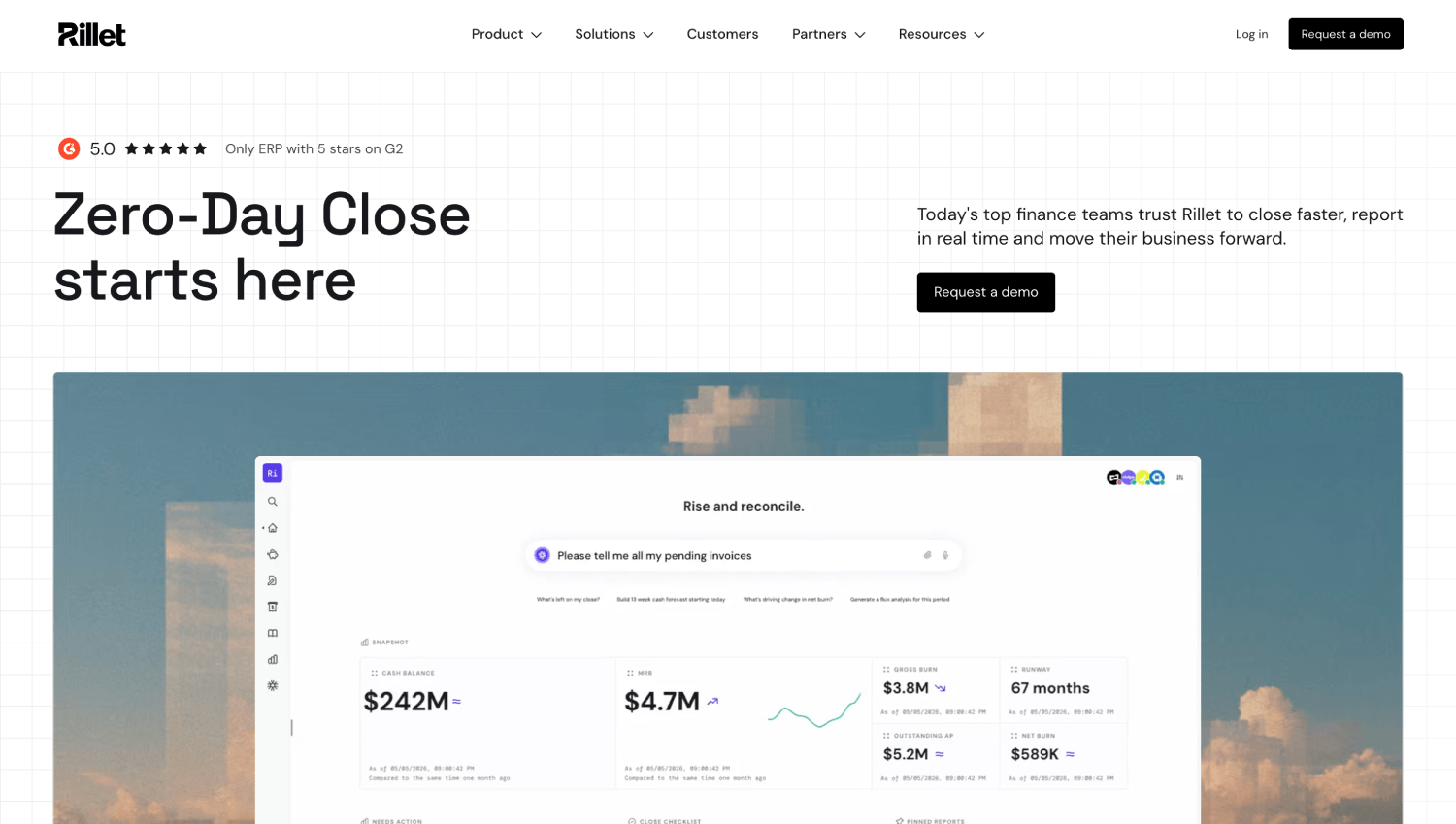
Rillet is built as an accounting system with AI close capabilities embedded, not a close layer sitting on top of an existing ERP. That distinction matters. A team replacing NetSuite with Rillet gets revenue recognition, the general ledger, and the AI close workflow in a single product, rather than paying for integration work between a GL and a close tool.
For SaaS companies with subscription billing, usage-based pricing, or complex revenue schedules, Rillet handles ASC 606 revenue recognition natively and then closes the books on top of that recognized revenue. The AI writes flux commentary comparing recognized versus deferred revenue, ARR movements, and expense variances in one pass. Pricing is not listed publicly.
Given Rillet’s positioning as an accounting system rather than a point solution, teams evaluating it should also read how finance teams evaluate payment infrastructure that feeds into their GL, covered in our overview of payment infrastructure tools for SaaS founders.
Basis
Basis positions as an AI-native accounting platform targeting growth-stage companies that have outgrown QuickBooks but are not yet ready for the implementation cost of NetSuite. The AI close workflow handles reconciliations, drafts commentary, and flags anomalies.
Journal entry proposals in Basis are partially automated. The system suggests recurring accruals and catches missing entries but does not draft full journal entries from raw transaction data the way Numeric does. For a 30-to-100-person company with a two-person finance team, that is still a meaningful time reduction. Pricing is not listed publicly.
Double
Double combines AI accounting software with an embedded human bookkeeping layer. A finance team using Double gets AI-driven reconciliations and anomaly detection, with a Double bookkeeper handling edge cases that the AI cannot resolve. That hybrid model works well for fractional CFO shops and lean finance teams at sub-50-person companies.
The agentic capability in Double is partial. Flux commentary is not auto-generated in the same way as Numeric or Rillet. Where Double earns a spot in this list is the practical close output: books that are closed and reviewed on a faster cycle than a pure-human bookkeeping firm, without the full implementation burden of an enterprise AI close platform. Pricing is not listed publicly.
Where Do FloQast and BlackLine Fit in an AI-Native World?
FloQast is the dominant close management platform for mid-market teams, and its AI features are real but honest about what they are. FloQast AI surfaces insights from checklist completion data, helps document flux explanations, and offers anomaly flagging. What it does not do is draft the reconciliation or write the variance narrative from scratch.
For a team already on FloQast with 200 close tasks configured, the switching cost to an AI-native tool is real. The question is whether the AI-native tools offer enough time reduction to justify rebuilding the workflow. For teams where the close takes under five business days and the team is above 50 people, FloQast’s stability and integration depth with NetSuite, Sage Intacct, and Oracle often wins. Our detailed comparison of BlackLine and FloQast for fintech finance teams covers the feature and pricing trade-offs in depth.
BlackLine targets enterprise finance teams with SOX controls, large reconciliation volumes, and audit trail requirements. BlackLine has added AI capabilities including anomaly detection and automated matching, but the architecture remains human-initiated. A staff accountant still opens the reconciliation template. The AI helps complete it, not start it.
BlackLine pricing is enterprise-negotiated and not publicly listed. For a company with 10 entities and a 20-person accounting team already on BlackLine, the AI-native tools are not a swap. They would be an addition, and the integration complexity rarely justifies the cost at that scale.
What About HighRadius?
HighRadius operates at the intersection of accounts receivable automation and financial close, which makes it relevant for AR-heavy organizations where the close bottleneck is open invoice reconciliation rather than general ledger flux. Its AI handles cash application, auto-matching of payments to invoices, and some journal entry suggestions.
For a manufacturing or distribution company with high invoice volumes, HighRadius reduces the close bottleneck at the AR layer in a way that most accounting-focused close tools do not. For a SaaS company, the fit is weaker. The product carries enterprise implementation timelines and pricing that reflect its target customer. For context on tools that address the AR layer specifically, see our coverage of accounts receivable automation tools that cut DSO for B2B SaaS.
How Should Finance Teams Decide Between These Tools?
The FintechSpecs AI Close Readiness Test applied above points to a practical decision tree. Start with your current bottleneck, not the vendor’s feature list.
If your close takes more than seven business days and the bottleneck is first-draft creation, reconciliation matching, or flux commentary writing, an AI-native tool like Numeric, Nominal, or Rillet is the right category. These compress the close by changing who creates the first draft, not by organizing the existing process better.
If your close takes four to seven business days and the bottleneck is review coordination, checklist completion, and audit trail management, FloQast or BlackLine remains the right answer. Adding an AI-native tool on top is not additive at this stage. Fix the coordination problem first.
If your team is under 20 employees and the close is happening primarily in QuickBooks or spreadsheets, Basis or Double offers the fastest path to a structured AI-assisted close without a six-month implementation. Both are designed to replace your existing accounting tool rather than layer on top of it.
Multi-entity companies above Series B should look seriously at Nominal before any other AI-native tool. The intercompany elimination and consolidation problem is where most AI close tools break down, and Nominal’s architecture is designed specifically for that scenario.
Fintech companies with non-standard transaction types, crypto settlements, or high-frequency payment data should evaluate Ledge before Numeric. The data ingestion architecture is the differentiating factor, not the AI layer itself.
What Does an AI Month-End Close Actually Look Like in Practice?
Consider a Series B SaaS company with $15 million in ARR, one controller, and two staff accountants. This scenario is illustrative, modeled against typical workflow patterns observed in AI-native close tool documentation and product walkthroughs as of 2024 to 2025, and is not a vendor-published case study. Under a conventional process, close takes eight business days. Day one is spent pulling reports from Stripe, the bank, and NetSuite. Days two and three are reconciliations. Days four and five are flux commentary for the CFO deck. Days six through eight are review cycles and final approvals.
After implementing an AI-native tool like Numeric, the workflow changes. On day one, the AI ingests Stripe, bank, and GL data, matches transactions, flags exceptions, and drafts reconciliation memos. The controller reviews flagged exceptions rather than building the rec from scratch. By the end of day one, reconciliations are substantially complete. On day two, the AI generates flux commentary comparing actuals to prior period and budget. The CFO deck narrative is drafted. Day three is the review cycle. The eight-day close compresses to three days, not because the team worked faster, but because the first-draft burden moved to the machine.
The time savings come from eliminating the first-draft labor, not from organizing existing labor more efficiently. Finance teams evaluating how this kind of operational shift affects overall cost structure should also review our analysis of hidden costs killing fintech SaaS margins, which covers where close-related overhead tends to compound at scale.
How Does AI Reconciliation Differ From Traditional Matching Tools?
Traditional reconciliation software like ReconArt or AutoRek uses rule-based matching: transaction A matches transaction B because the amounts and dates fall within defined tolerance windows. That works at scale for high-volume payment matching but requires humans to define every rule and to resolve every exception manually.
AI reconciliation tools use pattern recognition trained on historical transaction data. When an exception does not match a rule, the AI proposes a resolution based on similar past exceptions rather than routing it to a human queue immediately. For companies with complex transaction types, that difference in exception handling is where the time savings compound. Our coverage of account reconciliation software for bank and balance sheet recs covers the traditional tool category in detail for teams evaluating both approaches.
Frequently Asked Questions
What is AI month-end close software?
AI month-end close software uses machine learning and large language models to automate the tasks that humans previously did from scratch during the accounting close: matching transactions in reconciliations, identifying variance drivers, writing flux commentary, and proposing journal entries. The AI-native tools in this category treat human review as the final step. Traditional close management tools like FloQast use AI to assist humans who are still completing these tasks manually.
How do AI agents for month-end close actually work?
AI agents for the close ingest data from your general ledger, bank feeds, payment processors, and sub-ledgers. They match transactions using pattern recognition, flag exceptions that fall outside historical norms, draft reconciliation memos, generate variance narrative from actuals versus prior period data, and propose journal entries based on historical patterns. The controller or CFO reviews and approves outputs rather than creating them. The agent operates continuously once data is connected, rather than waiting for a human to initiate each task.
Is FloQast an AI tool or close management software?
FloQast is close management software with AI features added. It organizes checklists, tracks reconciliation completion, and surfaces insights from workflow data. Its AI capabilities assist with anomaly detection and flux documentation but do not draft reconciliations or generate journal entries autonomously. For teams with complex workflows and existing NetSuite or Sage Intacct integrations, FloQast remains a strong choice. Teams looking for AI to replace the first-draft labor in their close should evaluate AI-native tools like Numeric or Rillet instead.
How does BlackLine compare to AI-native close tools?
BlackLine is an enterprise reconciliation and close management platform designed for SOX-compliant, multi-entity organizations with large accounting teams. Its AI features include automated matching and anomaly detection, but humans still initiate tasks. AI-native tools like Nominal or Numeric invert that workflow: the AI creates the first draft and humans approve. BlackLine’s implementation depth, audit trail capabilities, and enterprise integrations make it the right choice for companies above 500 employees. Below that threshold, AI-native tools offer faster time-to-value at lower cost.
Can AI write journal entries automatically?
Several AI close platforms, including Numeric and Rillet, can propose journal entries based on pattern recognition in historical data. The AI identifies recurring accruals, flags missing entries, and drafts the journal entry for controller review and approval. Fully autonomous journal entry posting without human review is not the standard workflow in any of the current tools, and for good reason: a controller must remain in the approval chain for audit and control purposes. The productivity gain comes from eliminating the drafting work, not the review.
What is flux commentary and can AI generate it?
Flux commentary is the narrative explanation of significant variances between actual results and a prior period or budget. It typically appears in board packages, audit files, and CFO review decks. Writing it manually requires a controller to pull variance data, identify the drivers, and write a coherent explanation for each material line item. AI tools like Numeric and Rillet generate this narrative automatically from GL and sub-ledger data. A controller reviews and edits the draft rather than authoring it from scratch, which eliminates one of the most time-consuming parts of the close cycle.
How much do AI close tools cost?
Pricing for AI-native close tools including Numeric, Nominal, Ledge, Rillet, Basis, and Double is not publicly listed. All require a demo or discovery call before providing pricing. Based on market positioning, these tools generally price on a per-seat or platform fee basis appropriate for Series A through Series C companies. FloQast and BlackLine also price by custom quote. HighRadius pricing is enterprise-negotiated. No vendor in this category publishes a public pricing page, which means the best approach is to run a pilot RFP across two or three vendors before committing.
Which AI close tool is best for a fintech startup?
For a fintech startup processing payments through multiple rails, settling in multiple currencies, or handling crypto transactions, Ledge is the most purpose-built option because its data ingestion layer connects natively to payment processors and banking APIs rather than relying on GL exports. For a standard SaaS fintech without complex payment architecture, Numeric or Rillet will deliver more value faster. Teams already using NetSuite and over 100 employees should evaluate FloQast before switching to an AI-native tool, since the integration depth and close coordination features may outweigh the AI drafting benefits at that scale.
The Deciding Factor Most Finance Teams Miss
Every evaluation of AI close tools eventually comes down to a debate about accuracy. Controllers worry that AI-drafted reconciliations will miss exceptions or generate plausible-sounding flux commentary that is factually wrong. That concern is legitimate and worth stress-testing in a pilot. But it obscures the more important question: compared to what baseline?
A staff accountant writing flux commentary at 6 PM on day four of close, pulling from three different spreadsheets, under pressure to hit a deadline, is also an error-prone process. The AI tools reviewed here are not being asked to replace a perfectly designed human workflow. They are being asked to improve a compressed, manually intensive process that already produces errors, late revisions, and rework cycles.
Run a one-month pilot on historical data before going live. Give the AI tool your prior quarter’s close data and evaluate its reconciliation output and flux narrative against what your team actually produced. The gap, in both accuracy and speed, will answer the adoption question more definitively than any vendor demo. That is the practical test that separates a real productivity gain from a feature announcement.