
TLDR
- Most business lenders treat KYB and credit data as two separate vendor relationships and two separate steps in onboarding. Several platforms now combine both, cutting the time between application and decision.
- Platforms like Middesk, Enigma, and Experian Business Information Services pull entity verification and business credit signals through a single API call, reducing the manual handoff that slows underwriting queues.
- For SBA lenders and small business lenders specifically, the biggest risk is not fraud alone but synthetic business identity, where a real EIN is layered onto a fabricated operating history.
- The right platform depends on whether you need bureau-grade tradeline data, cash flow signals, or just entity and ownership verification. These are different products with different data lineages.
- Pricing across these platforms is not publicly standardized. Custom contracts are the norm above moderate volume, which makes early pilot structure more important than list price comparisons.
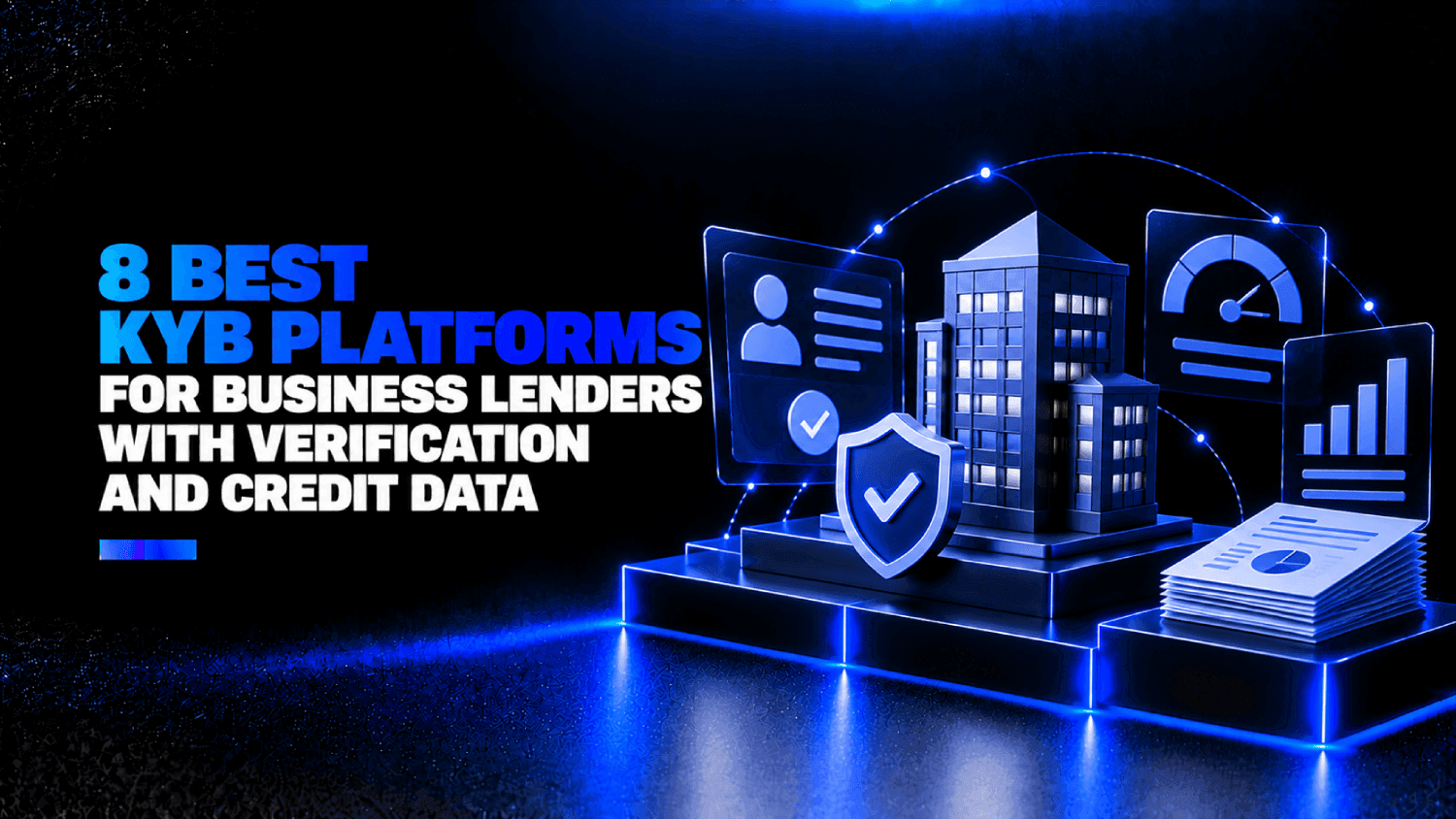
The best KYB platforms for business lenders are Middesk, Enigma, Baselayer, Ocrolus, Experian Business Information Services, Dun and Bradstreet, Ekata (now part of Mastercard), and LexisNexis Risk Solutions. Each serves a different part of the lender onboarding stack: some cover entity verification and UBO, others add business credit tradelines or cash flow data. Lenders that connect KYB directly to credit signals during onboarding cut decisioning time without adding a separate bureau pull.
Why Do Business Lenders Treat KYB and Credit Checks as Separate Steps?
The assumption has a historical basis. Compliance teams owned KYB, credit teams owned bureau pulls, and the tools were built separately for each. KYB vendors focused on Secretary of State filings, beneficial ownership, and sanctions screening. Credit bureaus focused on tradelines, payment history, and scores.
The problem is the handoff. A lender that completes KYB, confirms the entity is real, and then triggers a separate credit pull in a different system creates a gap where an underwriter waits. For small business lenders processing hundreds of applications weekly, that gap adds up to days of queue time. Platforms that unify both workflows either own the credit data themselves or have deep integrations with the major bureaus, and that distinction matters when you are evaluating a vendor.
There is also a fraud dimension specific to commercial lending. Synthetic business identity, where a genuine EIN is combined with fabricated revenue history or inflated ownership structures, has grown as a vector. KYB alone does not catch it, and a credit pull alone does not flag the entity mismatch. Lenders who layer both checks simultaneously close that gap faster than those running sequential processes. Our piece on top application fraud and synthetic identity tools for lenders covers the fraud angle in detail if that is the primary driver of your vendor search.
The FintechSpecs KYB-Credit Convergence Test: How to Evaluate Any Platform Before You Sign
Before comparing individual vendors, it helps to have a consistent evaluation lens. The FintechSpecs KYB-Credit Convergence Test is a four-check framework for lenders evaluating whether a KYB vendor genuinely reduces underwriting friction or just adds another data layer.
Check 1: Data lineage independence. Does the credit data come from a bureau the vendor licenses, or is it their own proprietary dataset? Licensed bureau data is auditable and FCRA-compliant for credit decisioning. Proprietary enrichment data often is not, which limits how you can use it in adverse action notices.
Check 2: Single API surface. Can you retrieve entity verification, UBO data, and a business credit signal in one API call? If the vendor requires two endpoints and separate credentialing, the workflow integration is no simpler than using two vendors.
Check 3: Ongoing monitoring scope. Does the platform alert you to material changes post-origination, such as a state registration lapse or a derogatory tradeline event? Lenders with portfolio monitoring obligations need this, and not all KYB vendors include it.
Check 4: SBA and regulatory data compatibility. SBA lenders have specific documentation requirements for Form 1919, business verification, and owner identity. A platform that exports structured data in formats compatible with SBA loan origination systems saves manual re-entry.
Which KYB Platforms Also Provide Business Credit Data for Lenders?
| Platform | Entity Verification | Business Credit Data | Cash Flow / Bank Data | Best Lender Use Case |
|---|---|---|---|---|
| Middesk | Yes | Via bureau integrations | No | Digital lender onboarding at volume |
| Enigma | Yes | Proprietary business signals | No | Small business lenders needing revenue estimates |
| Baselayer | Yes | No (pure KYB) | No | High-risk or complex entity onboarding |
| Ocrolus | No | No | Yes (bank statements, tax docs) | Cash flow underwriting alongside KYB stack |
| Experian Business Information Services | Partial | Yes (Intelliscore, SBFE) | No | FCRA-compliant bureau data for decisioning |
| Dun and Bradstreet | Yes (DUNS) | Yes (PAYDEX, Delinquency) | No | Commercial lenders needing tradeline depth |
| LexisNexis Risk Solutions | Yes | Yes (via RiskView) | No | Lenders with compliance and identity overlap |
| Ekata (Mastercard) | Partial (identity graph) | No | No | Owner identity verification alongside entity check |
Middesk: Best for Digital Lenders Running High Application Volume
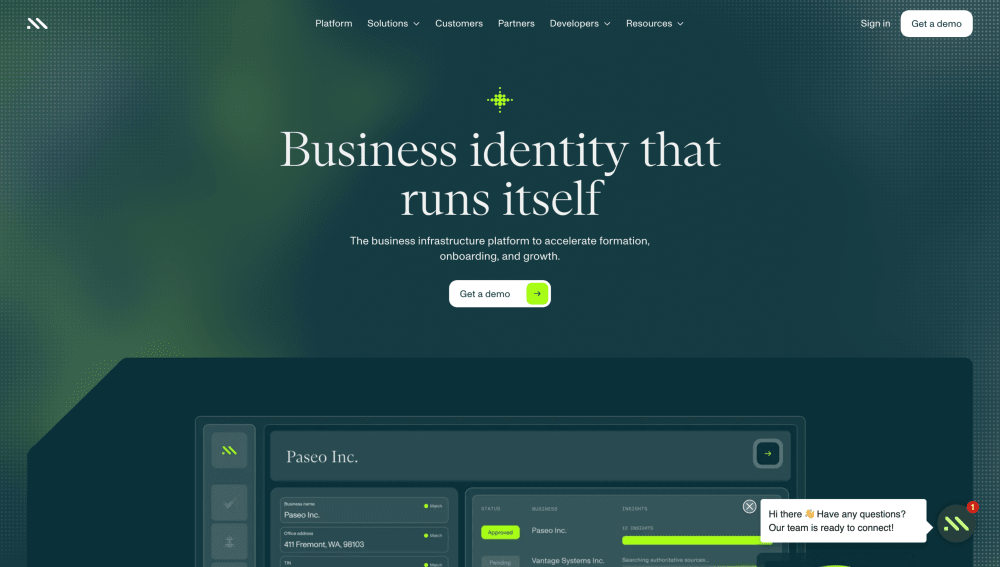
Middesk focuses on business identity verification in the US market, pulling data from Secretary of State filings, IRS records, USPS address validation, and sanctions lists. Their API returns a structured verification result that most loan origination systems can ingest directly without custom parsing. For lenders processing hundreds of applications per week, that structure matters more than marginal data coverage differences.
Middesk does not maintain its own business credit bureau, but it does integrate with external bureau data and supports connections to the Small Business Financial Exchange data. Lenders who want a single vendor for both entity verification and credit signals will need to wire Middesk to a bureau separately or use a platform like Alloy that orchestrates multiple data sources. Our comparison of Alloy vs Middesk for KYB covers that architectural decision in depth.
Middesk’s pricing is not publicly listed on their site. Volume-based contracts are the standard for lenders. Their onboarding product includes ongoing business monitoring, which satisfies portfolio review requirements for lenders who need to flag post-origination changes.
Enigma: Best for Small Business Lenders Who Need Revenue and Health Signals
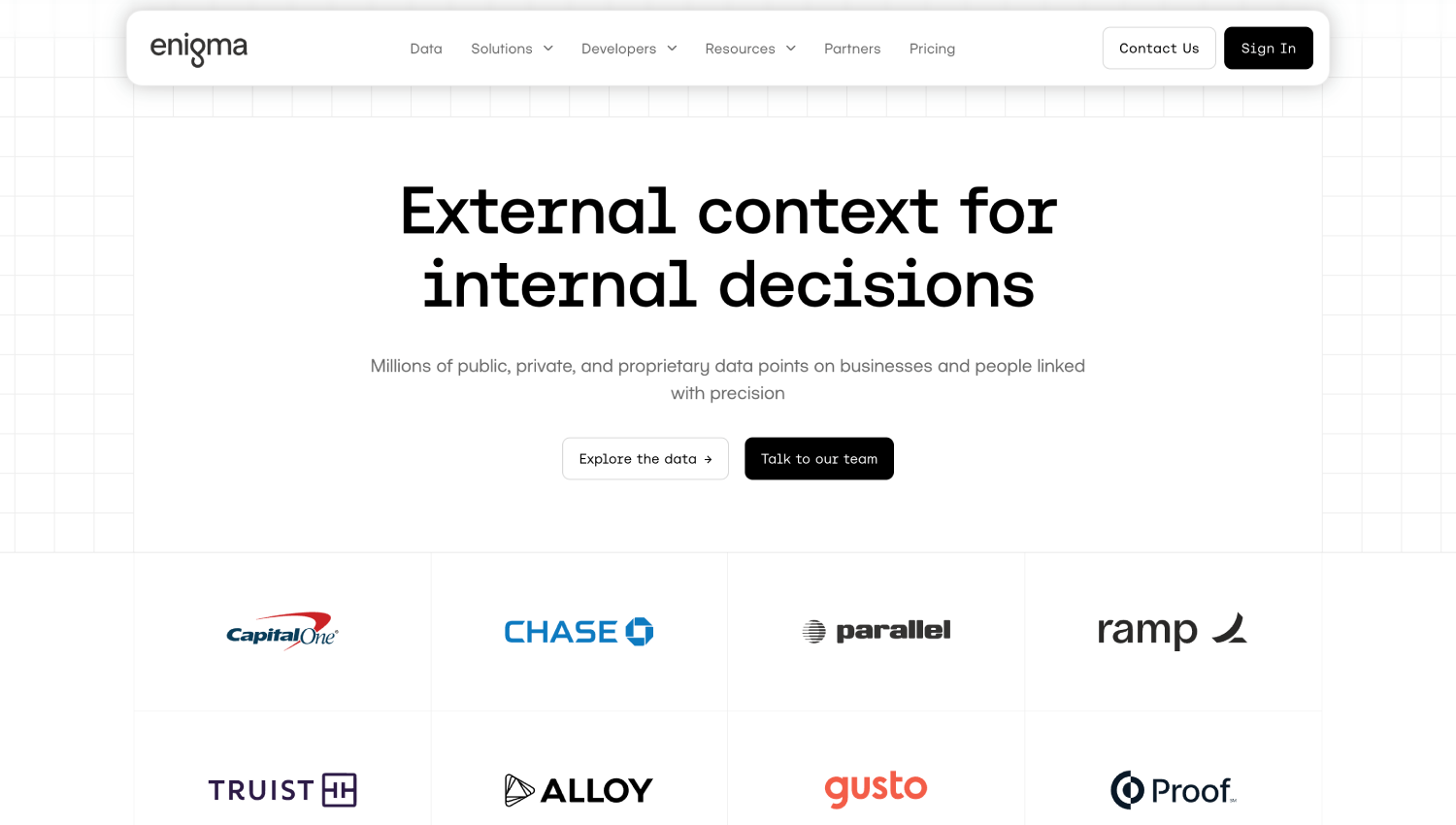
Enigma takes a different approach than a traditional KYB bureau. Their proprietary dataset aggregates data from payment networks, public filings, and alternative signals to estimate business revenue, employee count, and financial health for small businesses. This is particularly relevant for small business lending where the applicant may have thin or no traditional credit bureau history.
For a small business lender underwriting a two-year-old restaurant or a sole-proprietor contractor, Enigma’s signals can substitute for a bureau pull that would return a thin file. The data is proprietary, not FCRA-regulated bureau data, which means lenders cannot use it as the basis for an adverse action notice without layering in bureau data for that purpose. Enigma positions its product as enrichment and pre-screening, not as a replacement for FCRA-compliant credit data.
Pricing is custom and not publicly listed. Enigma targets lenders and fintech platforms rather than individual businesses, and their contracts are typically structured around API call volume or business verified per period.
Baselayer: Best for Complex Entity Structures and High-Risk Onboarding
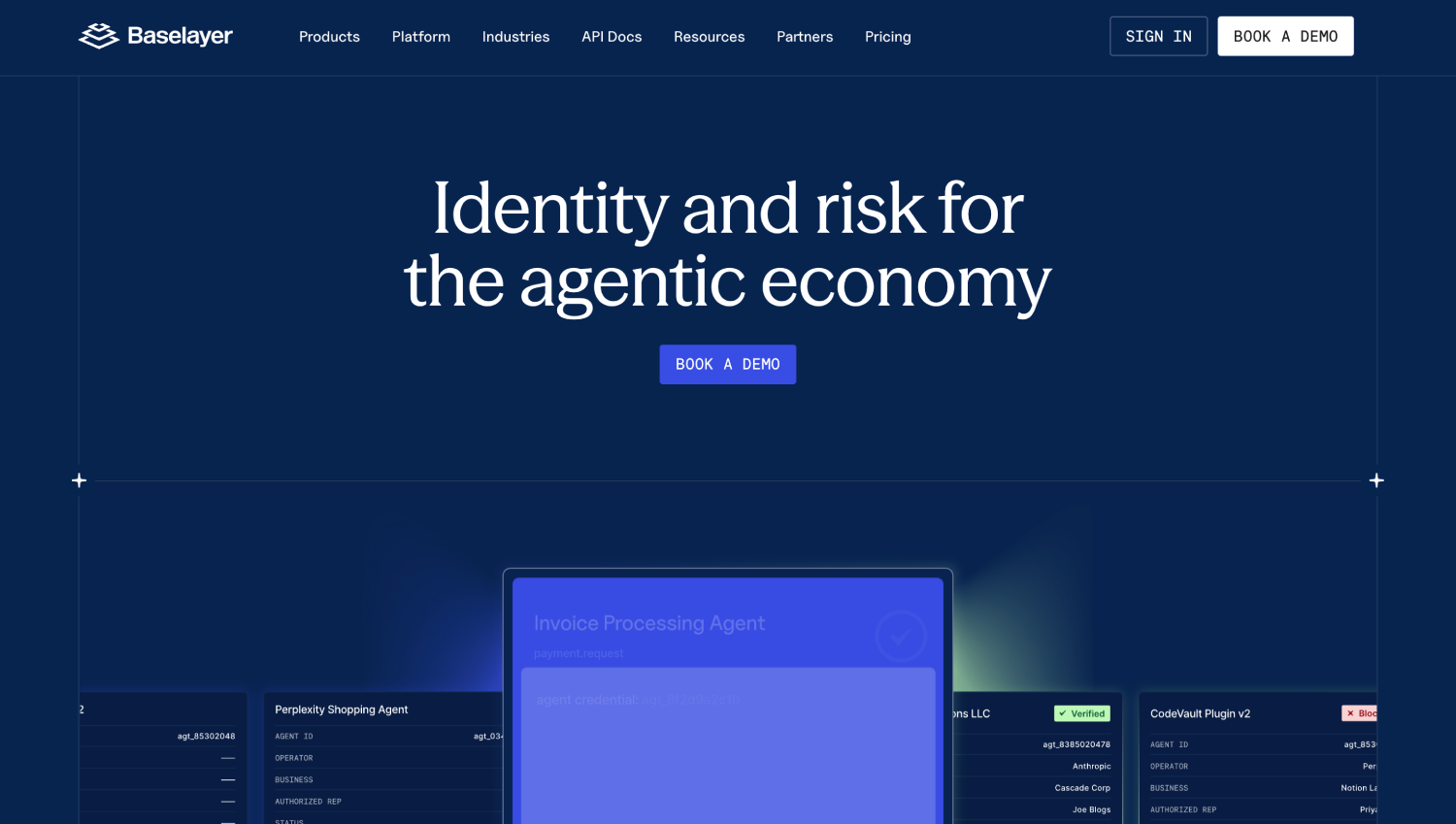
Baselayer is purpose-built for lenders and fintech platforms that deal with non-standard business structures: holding companies, multi-layer LLCs, franchise operators, or businesses with international ownership. Their beneficial ownership resolution goes deeper than most KYB vendors, tracing ownership chains through multiple corporate layers to identify the natural persons who ultimately control an entity.
Baselayer does not provide business credit data. It is a pure KYB play, which makes it a strong complement to a bureau rather than a replacement. Lenders building a two-vendor stack, one for entity and UBO and one for credit signals, will find Baselayer’s API coverage more thorough for complex cases than Middesk’s for the same entity complexity tier. Our deep comparison at Middesk vs Baselayer for high-risk KYB onboarding walks through the specific data coverage differences.
Pricing is not publicly listed and is structured by contract.
Ocrolus: Best for Lenders Adding Cash Flow Underwriting to Their KYB Stack
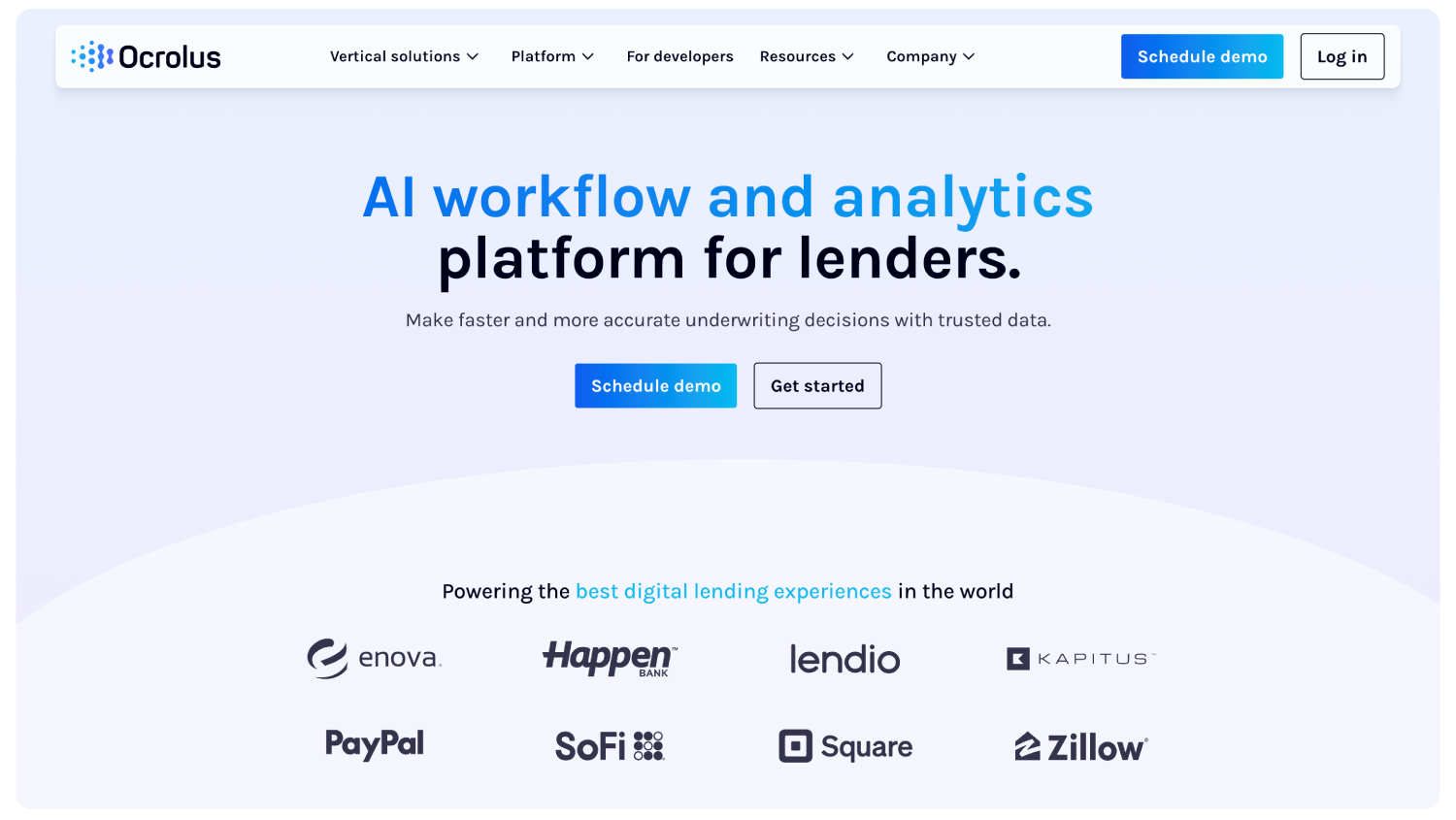
Ocrolus is not a KYB platform in the traditional sense. It does not verify business registration or ownership. What it does is analyze bank statements, tax returns, pay stubs, and other financial documents with high accuracy to extract cash flow signals, revenue patterns, and income consistency. For commercial lenders, Ocrolus fills the gap between “is this entity real?” and “can this entity repay?”
The practical use case for a lender is pairing a KYB platform like Middesk or Baselayer for entity verification with Ocrolus for financial document analysis. Both APIs can return data to the same underwriting workflow, creating a single decisioning view without manual document review. Ocrolus has published accuracy claims for their automated bank statement analysis, though lenders should conduct their own validation on their specific file types during a pilot. For a broader look at cash flow underwriting tools, our bank statement analysis and cash flow underwriting API comparison covers the full field.
Ocrolus pricing is not publicly standardized and depends on document volume and product tier.
Experian Business Information Services: Best for FCRA-Compliant Bureau Data in Decisioning
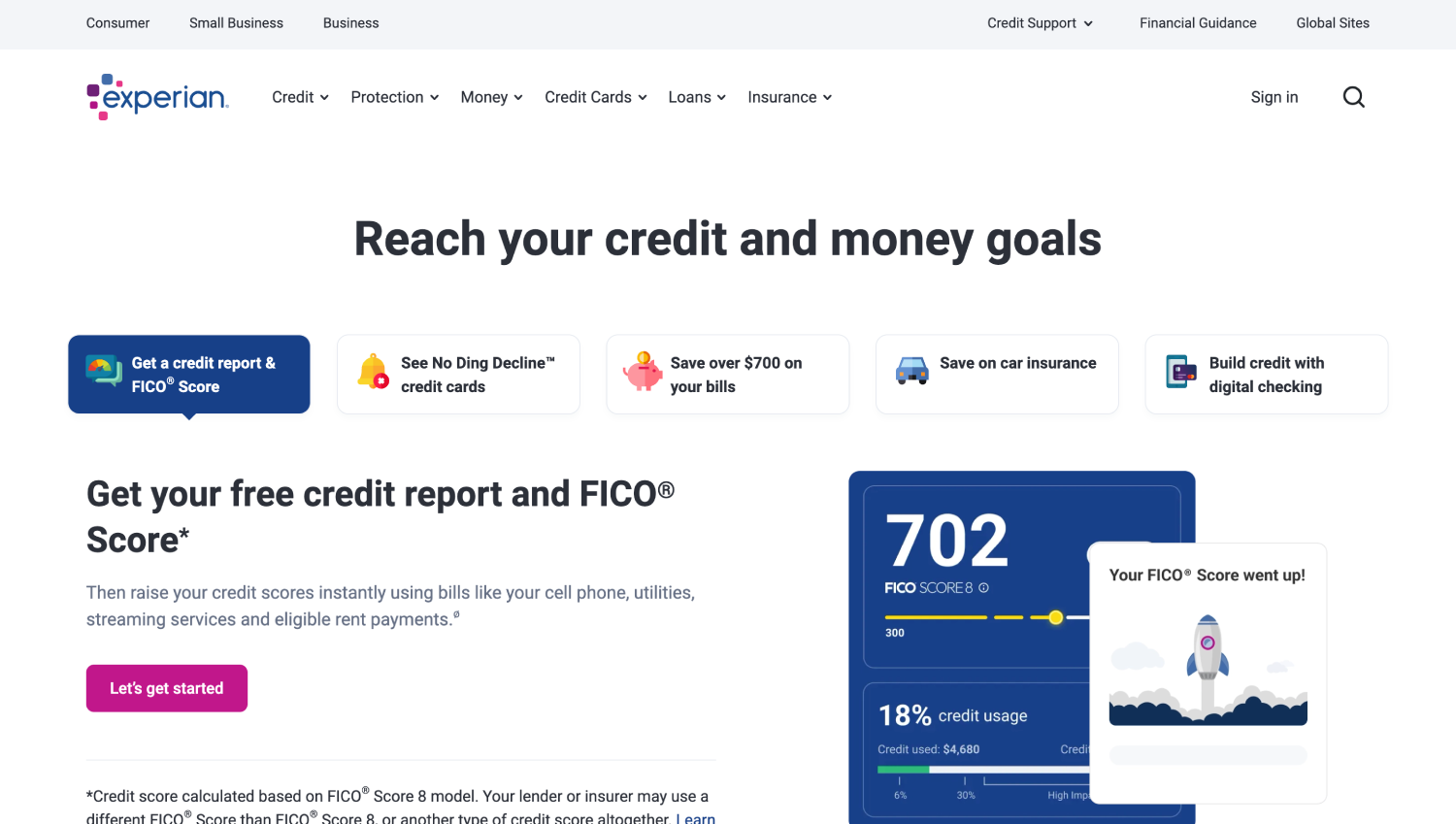
Experian Business Information Services provides commercial credit data from its own bureau, including the Intelliscore Plus commercial credit score and access to Small Business Financial Exchange tradeline data. For lenders who need to issue adverse action notices citing a specific credit bureau, Experian’s data carries the FCRA designation that proprietary enrichment data does not.
Experian also offers business entity verification as part of their commercial data suite, though their entity verification depth is more limited than dedicated KYB vendors like Middesk or Baselayer. Most lenders use Experian Business Information Services as the credit data layer and a specialist KYB platform for entity and ownership verification. Experian’s API access requires a data agreement and pricing is negotiated by contract, with no public per-pull pricing.
One specific advantage for SBA lenders: Experian Business Information Services data is compatible with SBA loan processing systems and supports the documentation requirements for SBA 7(a) and SBA 504 programs, which many smaller bureau integrations do not address explicitly.
Dun and Bradstreet: Best for Commercial Lenders Requiring Deep Tradeline History
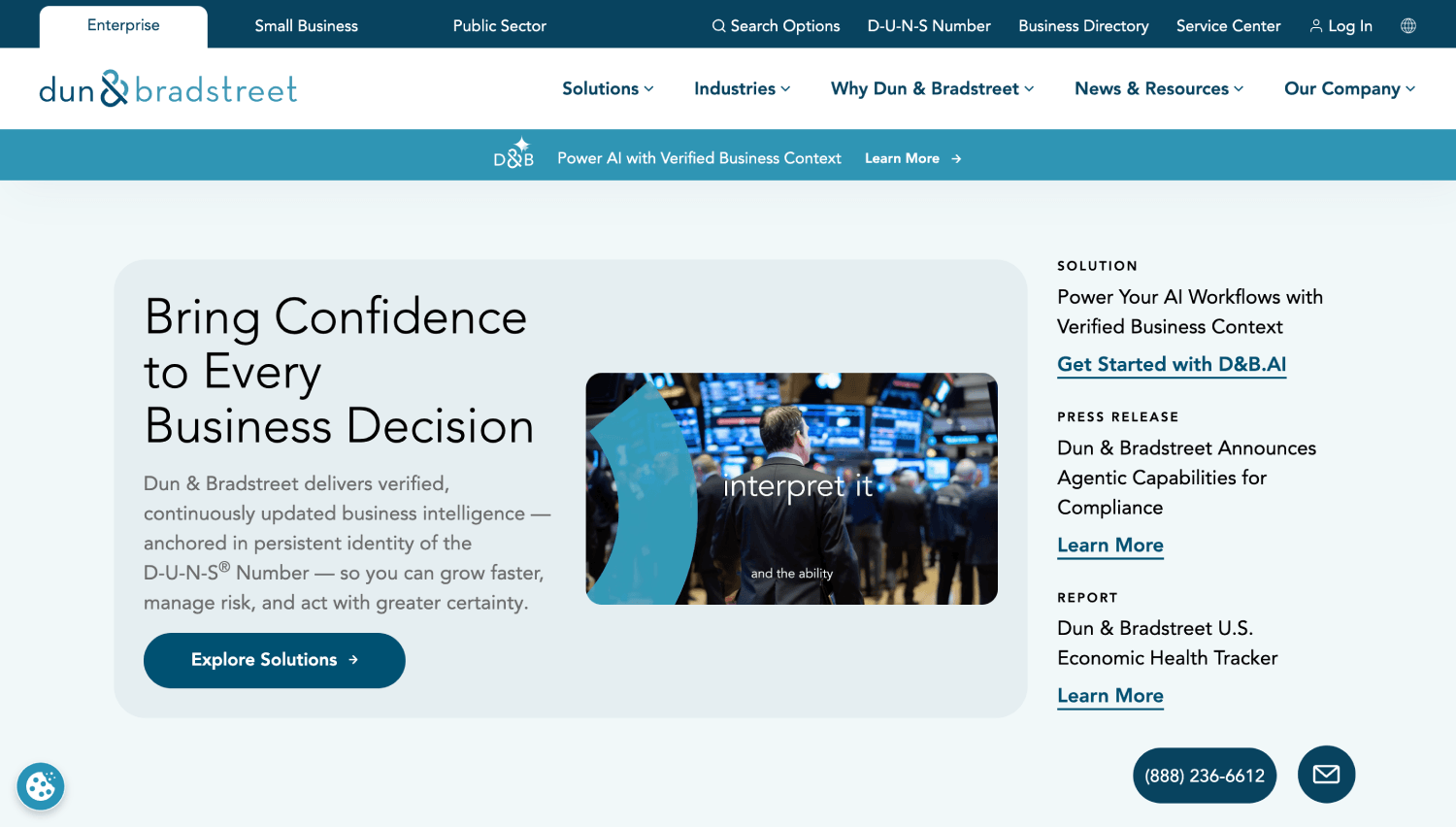
Dun and Bradstreet is the oldest business credit bureau and carries the deepest tradeline coverage for US commercial entities, anchored by the DUNS Number system that assigns a unique identifier to registered businesses. Their PAYDEX score measures payment history across supplier and trade credit relationships. Their Delinquency Predictor and Failure Score models add predictive signals relevant to commercial lending decisions.
D&B is not a developer-first platform. Their API integration is functional but requires more implementation work than modern fintech-native tools. Lenders with enterprise credit systems already built on D&B data will find the integration path straightforward. Lenders building greenfield underwriting stacks may find the developer experience heavier than Middesk or Experian’s commercial API.
D&B also maintains a business verification product that can confirm entity registration and match applicants to their DUNS record. Combined with their credit data, this creates a unified D&B-sourced view of an applicant, which some lenders prefer for audit trail simplicity. Pricing is contracted and not publicly disclosed.
LexisNexis Risk Solutions: Best for Lenders with Overlapping Compliance and Identity Needs

LexisNexis Risk Solutions sits at the intersection of identity verification, KYB, and risk scoring. Their Business Verification product confirms entity registration and principal identity, while their RiskView commercial credit data adds a scored credit signal. For lenders who also have AML, sanctions screening, or PEP obligations, LexisNexis offers a way to consolidate several compliance checks into one vendor relationship.
The practical advantage is compliance overhead reduction. A lender that uses LexisNexis for both KYB and adverse media screening reduces the number of compliance data agreements it manages. The trade-off is that each individual product from LexisNexis is rarely the deepest option in its category: Baselayer goes deeper on UBO, Experian goes deeper on credit tradelines, and pure-play AML vendors like ComplyAdvantage go deeper on watchlist screening.
LexisNexis pricing is negotiated by contract and not publicly listed.
Ekata (Mastercard): Best for Pairing Owner Identity Verification with Business Onboarding
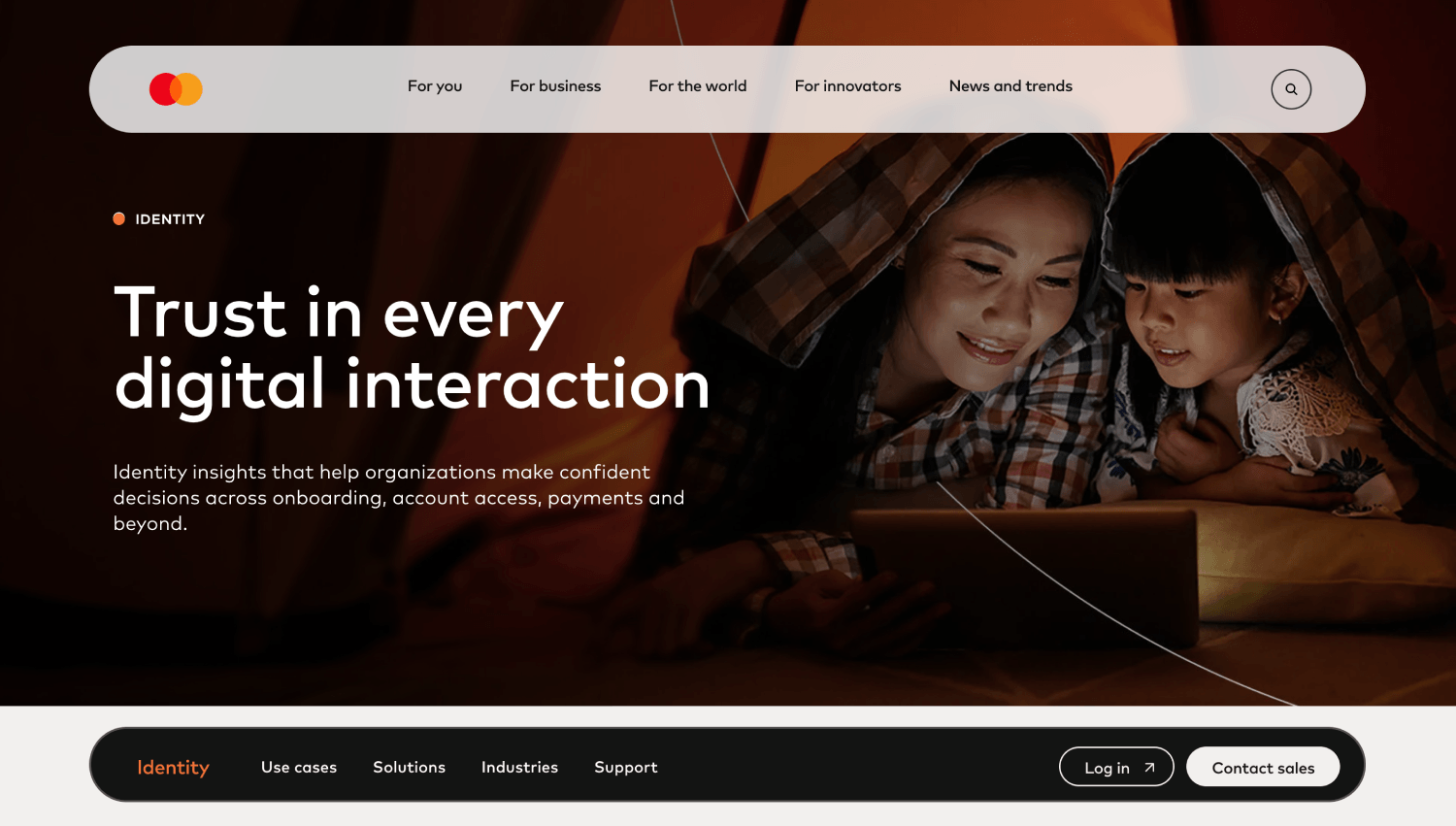
Ekata, now part of Mastercard’s identity solutions portfolio, provides an identity graph that connects email addresses, phone numbers, names, and addresses to assess the legitimacy of an individual identity. For business lenders, this is most relevant at the point of owner identity verification, the step where KYB transitions from entity-level to person-level checks.
Ekata does not verify business registrations or provide business credit data. Its value in a lending stack is confirming that the person claiming to own the business has a verifiable digital identity footprint consistent with their stated profile. It pairs well with a full KYB platform rather than replacing one. Lenders building a multi-layer identity and entity check will find Ekata useful for the UBO verification step specifically.
Ekata’s API pricing is available through Mastercard’s commercial sales team and is not publicly listed.
What Should SBA Lenders Specifically Look for in a KYB Platform?
SBA lenders operate under more structured documentation requirements than most non-bank commercial lenders. The SBA’s Standard Operating Procedure for 7(a) loans specifies what business information must be collected and verified, and lenders that miss documentation requirements face clawbacks and guarantee impairment on defaulted loans.
A KYB platform for an SBA lender needs to return structured data that maps to SBA Form 1919 fields, including business legal name, EIN, state of formation, years in business, and principal officer identity. Experian Business Information Services and D&B both have established data formats that SBA-approved loan origination systems recognize. Newer API-first platforms like Middesk may require custom field mapping to fit SBA documentation workflows, which adds implementation time.
SBA lenders should also evaluate whether a KYB platform flags businesses in restricted industries or with ownership structures that SBA eligibility rules exclude. This is not standard in most KYB products and typically requires a custom rule layer in the lender’s origination system. Our guide to KYB requirements and business verification checklists for fintechs covers the regulatory mapping in detail.
How Does Lender Onboarding Verification Differ from Standard KYB?
Standard KYB confirms that a business is real, registered, and not sanctioned. Lender onboarding verification goes further: it also needs to establish that the business can repay, that its financial representations are consistent with third-party data, and that the principals are who they claim to be at the person level.
The practical difference is data depth. A payment platform doing KYB for a merchant needs entity confirmation and sanctions clearance. A lender doing KYB for a borrower needs all of that plus financial signals that inform credit risk. That gap is where the market has moved, with platforms like Enigma, Experian Business Information Services, and D&B offering credit signals alongside or adjacent to entity verification, and document analysis tools like Ocrolus bridging into cash flow underwriting.
Consider a Series B alternative lender processing 400 small business applications per month. If KYB runs in one system and the credit pull runs in a second, and a human underwriter reconciles the two outputs before decisioning, that reconciliation step might add two business days to the average cycle. A platform that returns entity verification and a business credit score in one API call eliminates that handoff. At 400 applications monthly, two days saved per file compounds into significant capacity gains. The math depends entirely on the lender’s current workflow, but the structural argument for convergence holds across volume tiers.
Frequently Asked Questions
What is KYB for lenders and how does it differ from KYC?
KYB, or Know Your Business, is the process of verifying that a business entity is real, legally registered, and not subject to sanctions or adverse risk flags. KYC, or Know Your Customer, verifies the identity of individual persons. For business lenders, KYB covers entity-level checks such as state registration, EIN confirmation, and beneficial ownership, while KYC covers the personal identity of the business owners and principals. Most lending workflows require both, running in sequence or in parallel during onboarding.
Can KYB platforms replace a business credit bureau for underwriting?
Not directly. KYB platforms confirm that a business exists and is legitimately structured, but they do not provide FCRA-regulated credit data that lenders can legally cite in adverse action notices. Platforms like Enigma provide proprietary business health signals that can inform pre-screening, but lenders using those signals in final credit decisions must layer in a regulated bureau pull from Experian Business Information Services, Dun and Bradstreet, or Equifax Business for adverse action compliance purposes. KYB and credit bureau data serve different legal and operational functions in the underwriting stack.
Which KYB platform is best for small business lending specifically?
Enigma is the strongest fit for lenders whose small business borrowers have thin bureau files, because Enigma’s proprietary signals can surface revenue and health estimates where a bureau pull would return little usable data. Middesk is better for lenders prioritizing fast entity confirmation and clean API output at volume. For lenders who need both entity verification and FCRA-compliant credit data, pairing Middesk with Experian Business Information Services covers both requirements without relying on proprietary enrichment for the credit decision.
How does synthetic business identity fraud affect lender KYB requirements?
Synthetic business identity fraud typically combines a real or recently registered EIN with fabricated operating history, inflated revenue claims, or layered ownership structures designed to pass surface-level KYB checks. A KYB platform that only validates state registration and EIN existence will not catch synthetic identities that use legitimate credentials. Lenders need platforms that cross-reference ownership data against third-party identity records , platforms like Middesk verify principals against IRS and Secretary of State data, while identity graph tools like Ekata cross-check stated owners against email, phone, and address signals , and flag newly registered entities with sparse footprints applying for credit above a risk threshold. No single platform covers every synthetic identity vector, which is why most lenders layer at least two data sources for this check.
Is KYB for lenders subject to FCRA?
Entity verification data used solely to confirm that a business is real and not sanctioned typically falls outside FCRA regulation. Business credit data used in credit decisioning, specifically data that informs whether to extend credit and on what terms, is subject to FCRA requirements including permissible purpose and adverse action notice obligations. Lenders should confirm with counsel which data layers in their KYB and underwriting stack trigger FCRA obligations, because the line between enrichment data and consumer report data is not always obvious when owner-level information is included.
What pricing model do KYB platforms for lenders typically use?
Most KYB platforms for business lenders price on a per-verification or per-API-call basis, with volume discounts for committed minimums negotiated into annual contracts. None of the eight platforms covered in this article publish standard per-check pricing publicly. Lenders should expect to negotiate based on monthly application volume, data product mix (entity only versus entity plus credit signals), and whether ongoing portfolio monitoring is included. Pilots or proof-of-concept agreements are the standard entry point before committing to contract minimums.
Do any KYB platforms support ongoing business monitoring after loan origination?
Middesk, LexisNexis Risk Solutions, and Dun and Bradstreet all offer ongoing monitoring products that alert lenders to changes in business registration status, ownership, or credit profile after origination. This is relevant for lenders with portfolio review requirements or covenant-based monitoring obligations. Baselayer and Enigma have more limited ongoing monitoring functionality compared to their onboarding verification products. Lenders should clarify monitoring alert frequency, data refresh cadence, and whether derogatory event alerts are included before signing a contract with any of these platforms.
How long does KYB typically take for a small business loan applicant?
Automated KYB via API can return entity verification results in seconds for businesses with clean state registration data and matching IRS records. The total onboarding time depends on how many downstream checks are triggered: beneficial ownership verification, owner identity checks, sanctions screening, and credit bureau pulls each add latency. Lenders running all checks in parallel through an orchestration layer like Alloy can compress total KYB-to-decision time to under five minutes for clean files. Complex entities, foreign ownership, or manual review triggers extend that window significantly and are where most lender onboarding queues actually stall.
The Case for Building a Two-Layer Stack Rather Than Finding One Platform That Does Everything
The vendor market has not converged on a single platform that leads across entity verification, business credit data, and cash flow underwriting simultaneously. Middesk is the fastest API for clean entity verification. Experian Business Information Services and D&B carry the deepest FCRA-compliant credit data. Enigma covers thin-file small businesses that bureaus cannot score. Ocrolus fills the cash flow gap that no KYB or credit bureau product addresses.
Lenders who hold out for a single vendor that does all of this well are making a longer-term bet on a market that has not yet resolved. The more practical path is a deliberate two-layer stack: one vendor for entity and UBO confirmation, one vendor for credit signals, with both feeding the same decisioning workflow. That architecture also reduces single-vendor risk and gives the lender negotiating position when either contract comes up for renewal.
The compliance readiness question underneath all of this is whether a lender’s underwriting workflow can consume API data from two vendors in a way that produces a documented, auditable credit file. If not, the data platform investment is premature. Our fintech product and compliance readiness checklist is a reasonable self-assessment starting point before committing to any KYB or credit data vendor contract. The stack choice follows from the workflow design, not the other way around.