
TLDR
- Marketplace platforms like Gumroad take a cut of every sale and give you limited control over pricing, licensing, and customer data.
- A dedicated merchant of record for digital products handles VAT, GST, and sales tax collection across 40 to 100+ countries without you registering in each jurisdiction.
- Platforms like Freemius, Paddle, and PayPro Global are built specifically for plugins, apps, and templates, with licensing and upgrade flows native to the product type.
- The right choice depends on whether you sell one-time licenses, subscriptions, or both, and whether you need WordPress-specific tooling or a general digital goods storefront.
- Fee structures vary widely: percentage-based MoR fees range from 5% to 9% plus transaction costs depending on the platform and your volume tier.
The best merchant of record platforms for digital products are Freemius, Paddle, Lemon Squeezy, PayPro Global, FastSpring, Polar, Payhip, and Gumroad. Each acts as the legal seller of record, collecting and remitting VAT and sales tax globally so you avoid multi-jurisdiction tax registration. Freemius is the strongest choice for WordPress plugins and themes. Paddle and PayPro Global serve broader SaaS and software products. Lemon Squeezy and Polar suit indie developers. Payhip and Gumroad work for creators selling templates or digital files.
Why Gumroad-Style Marketplaces Fall Short for Plugin and App Sellers
Selling a WordPress plugin on Gumroad is fine for your first $500 in revenue. At $5,000 a month, the problems start showing up. Gumroad charges a flat 10% on every sale per its current public pricing page, takes ownership of the customer relationship, and gives you no native tooling for license key generation, upgrade paths, or plugin update delivery.
A dedicated merchant of record for digital products works differently. The platform becomes the legal seller to your customer, which means it collects VAT in the EU, GST in Australia, and sales tax in US states with economic nexus thresholds. You receive the net revenue. You keep the customer data. And you never file a VAT return in Germany yourself.
This distinction matters more than it used to. The EU’s VAT OSS rules, combined with US economic nexus thresholds that now exist in every state, mean a solo developer selling a $49 WordPress plugin to buyers in 30 countries has real tax exposure if they are handling payments through Stripe directly. A platform acting as merchant of record absorbs that liability. If you want a deeper breakdown of where MoR platforms differ from standard payment processors, the merchant of record vs payment processor comparison explains the legal and operational distinctions clearly.
The FintechSpecs Digital MoR Stack Test: Four Questions Before You Pick
Before reviewing individual platforms, run your situation through four questions. This is the framework we used to evaluate each platform below. It is designed to surface the decisions that most platform comparison guides skip: product-type fit, tax jurisdiction depth, fee math at your actual volume, and customer data ownership. No platform scores perfectly on all four. The order of priority changes depending on your revenue stage and distribution model.
- Product type fit: Does the platform natively support your distribution model, meaning plugin updates, license keys, activation limits, or file downloads?
- Tax coverage: How many jurisdictions does the platform remit to, and does it cover your top buyer geographies including the EU, UK, Canada, and Australia?
- Fee math at your volume: A 9% MoR fee on $200/month is $18. On $20,000/month it is $1,800. At what revenue threshold does the fee structure change?
- Ownership of the customer: Can you export email lists, run your own marketing, and contact buyers directly, or does the platform own the relationship?
Every platform below is scored against these four criteria in the comparison table at the end of this section.
Which Platforms Actually Qualify as a Merchant of Record for Digital Products?
Not every platform that handles payments qualifies. A true MoR is the entity that appears on the customer’s credit card statement, issues the VAT invoice, and holds the legal liability for the transaction. Stripe does not do this by default. Neither does PayPal Standard. A Stripe integration with Anrok or TaxJar gets you tax calculation and filing, but you remain the merchant of record and the legal seller. That is a meaningful difference for liability purposes.
The platforms below are confirmed MoRs: they appear as the seller on customer receipts, handle chargebacks in their own name, and remit taxes in covered jurisdictions under their own tax registrations.
8 Best Merchant of Record Platforms for Plugins, Templates, and Apps
1. Freemius
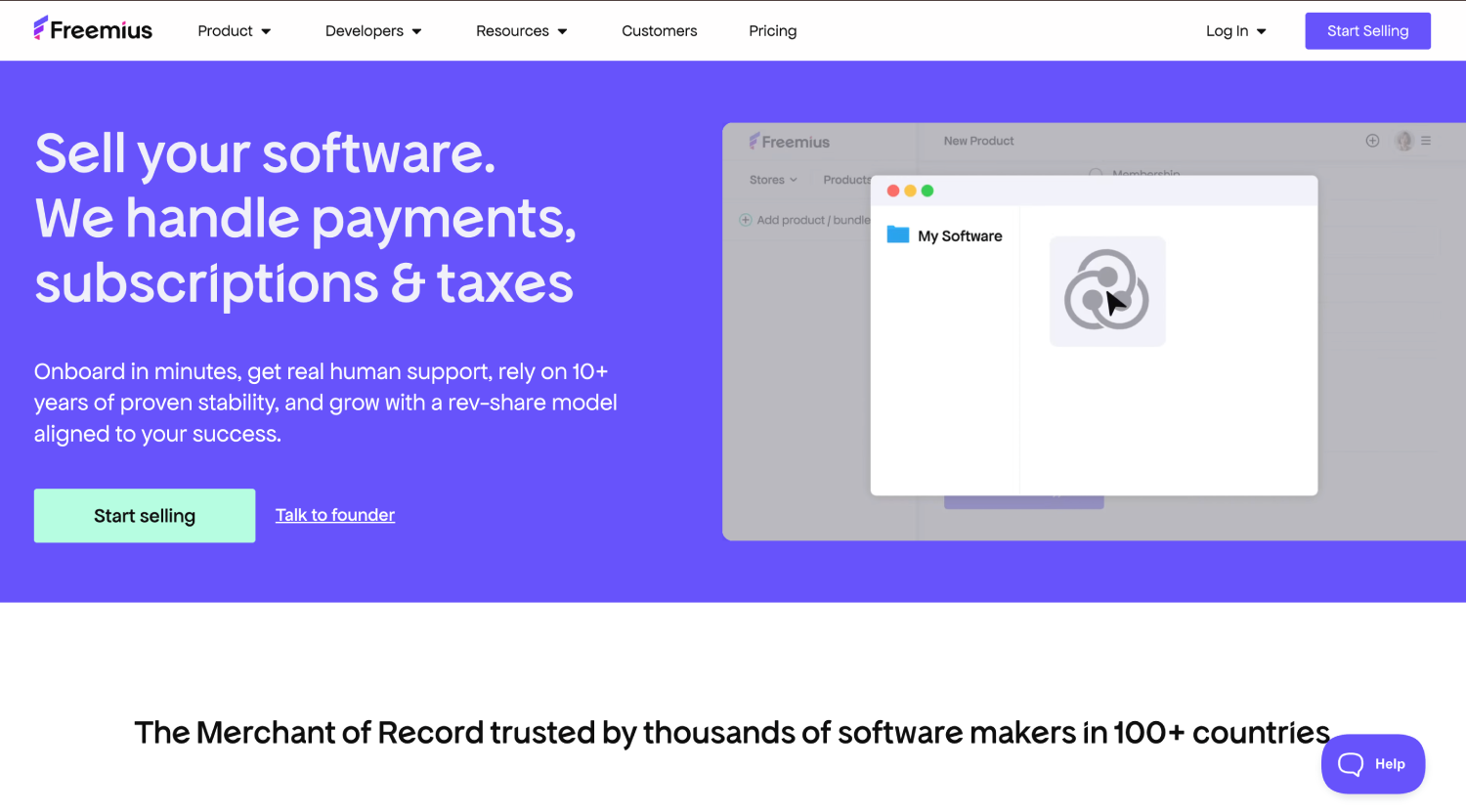
Freemius is the most purpose-built merchant of record for WordPress plugins and themes. It was designed specifically for this use case, which means the platform has native support for license key management, freemium-to-premium upgrade flows, plugin update delivery through the WordPress.org network, and customer-facing account dashboards.
Freemius does not publish its revenue share rate on a public pricing page. The company states it takes a percentage of revenue that decreases as your revenue scales, but the specific tiers are disclosed during onboarding rather than listed publicly. Given that opacity, any specific percentage calculation would be speculative. If the rate is a deciding factor in your evaluation, request it directly from Freemius during signup. The platform handles VAT collection across the EU and UK, sales tax in the US, and GST in several other jurisdictions. Chargebacks are handled under Freemius’s merchant account.
For a plugin developer earning between $2,000 and $50,000 monthly, Freemius is difficult to beat on feature depth. The built-in analytics cover trial conversion rates, license activations per site, and upgrade timing, data points that a general-purpose MoR like Paddle does not surface for plugin-specific workflows. The tradeoff is that Freemius is almost exclusively valuable for WordPress products. If you sell a SaaS app or a design template, it is not the right fit.
2. Paddle
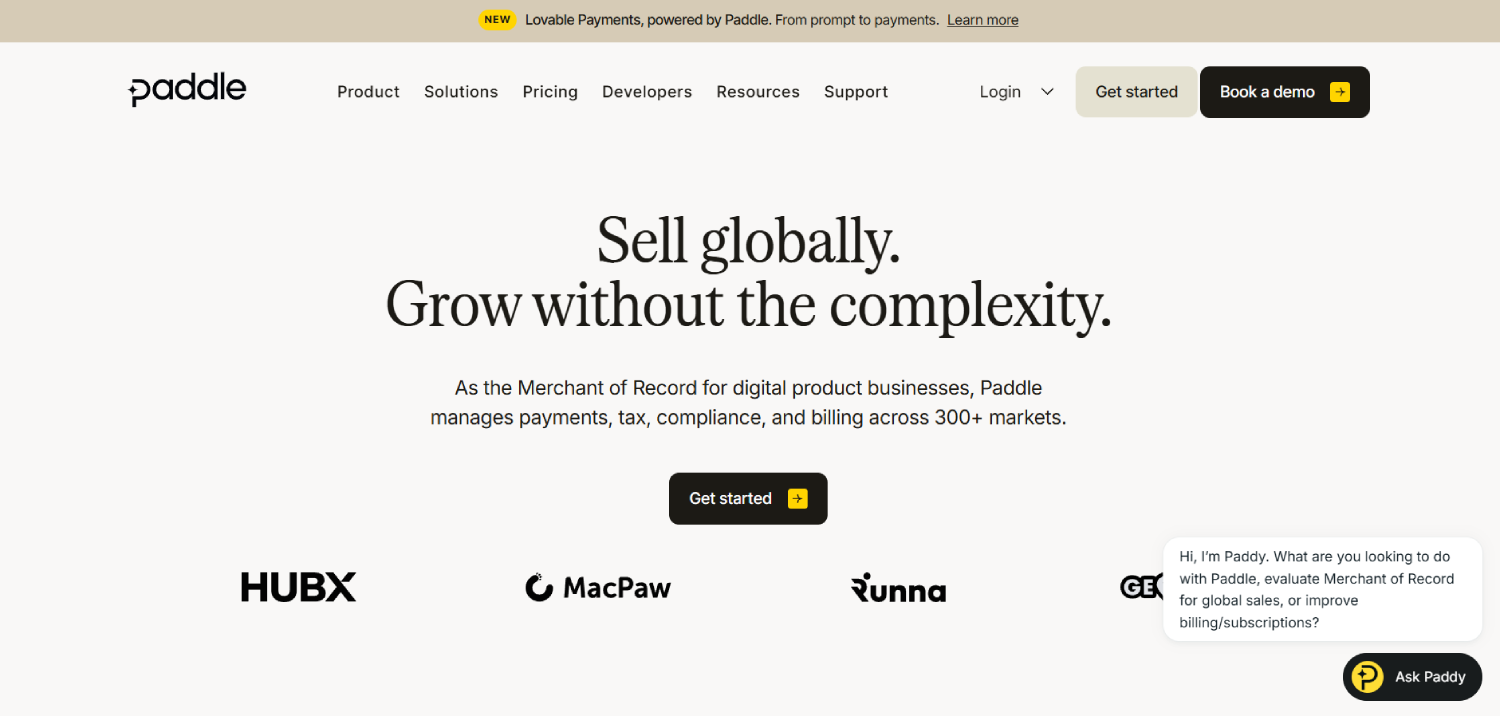
Paddle is the most widely used MoR for SaaS and software companies operating at meaningful scale. It covers VAT collection in 200+ countries and territories, handles US sales tax across all states with economic nexus, and issues compliant invoices to business buyers automatically. Per Paddle’s public pricing page, the standard fee is 5% plus $0.50 per transaction, with custom pricing available for higher-volume sellers.
For developers selling apps or desktop software internationally, Paddle’s checkout handles currency localization, payment method diversity including PayPal, Apple Pay, and local methods, and subscription management natively. The platform’s developer API is solid for building custom checkout flows. One limitation worth knowing: Paddle’s built-in product catalog is better suited to subscription software than to one-time license files or template bundles.
Paddle also owns Profitwell, which gives subscribers access to revenue analytics including MRR, churn, and LTV reporting at no additional cost. For a comparison of Paddle against other MoR options including Lemon Squeezy and Polar, the Stripe vs Paddle vs Lemon Squeezy vs Polar breakdown goes deeper on the B2B SaaS decision specifically.
3. Lemon Squeezy

Lemon Squeezy is owned by Paddle following its 2024 acquisition. Lemon Squeezy operates as a separate product positioned at indie developers, freelancers, and small teams selling digital products including software, templates, ebooks, and courses. Per its public pricing page, the fee is 5% plus $0.50 per transaction.
Lemon Squeezy handles VAT in 100+ countries as the merchant of record and is notably easy to set up. A developer can go from signup to a working checkout in under an hour, which makes it attractive for early-stage products. The platform includes license key generation, product variants, discount codes, and an affiliate system out of the box.
The weakness is scale. Larger sellers often find Lemon Squeezy’s analytics and subscription management tools less sophisticated than Paddle’s, and the platform offers fewer enterprise checkout customization options. If you are selling your first paid plugin or template bundle and want global tax compliance handled immediately, Lemon Squeezy is a reasonable starting point. Developers who outgrow it often migrate to Paddle without significant friction given the shared infrastructure.
4. PayPro Global
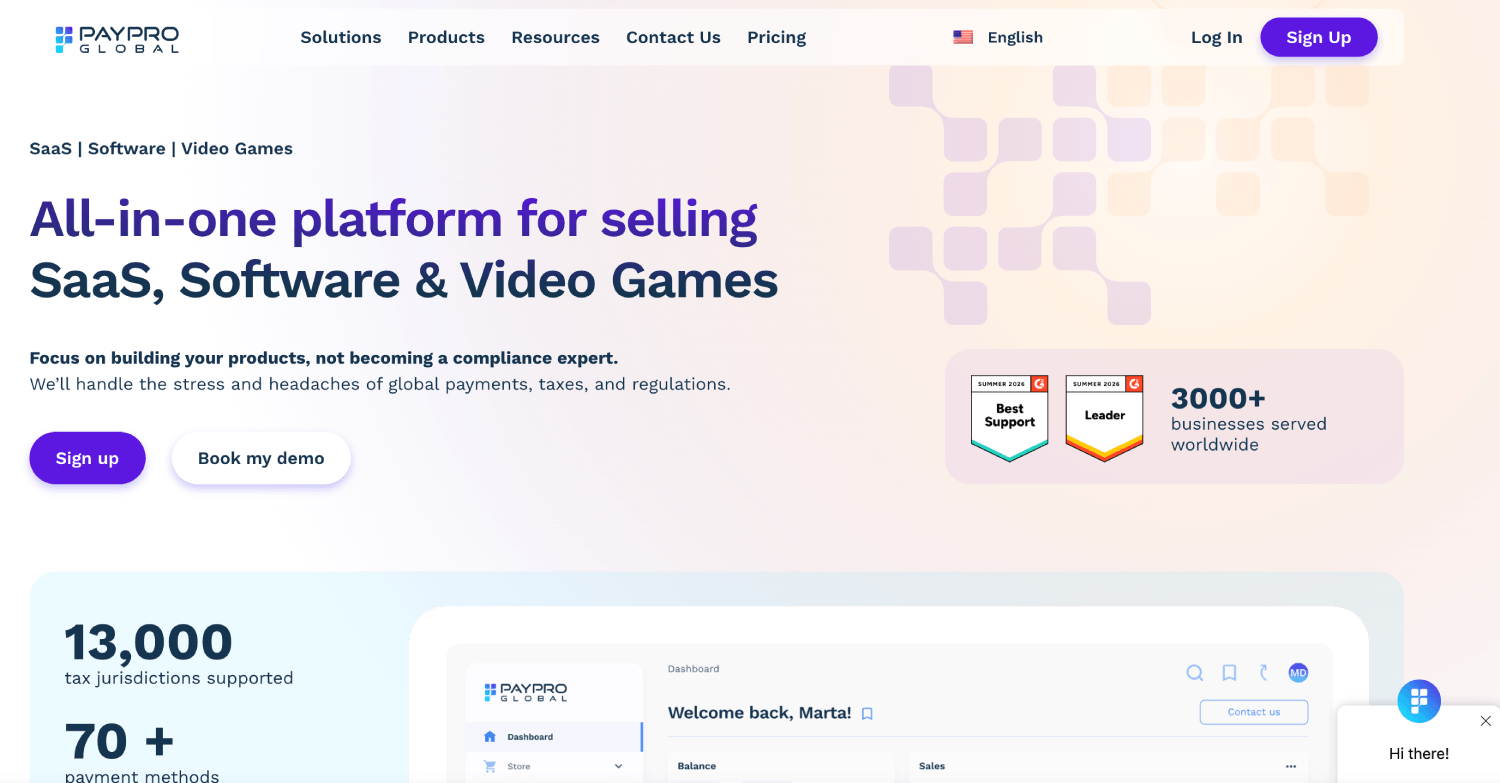
PayPro Global positions itself as a high-coverage merchant of record for software, SaaS, and digital goods companies that need broad geographic reach. The platform covers VAT and GST remittance in 180+ countries and supports local payment methods across emerging markets that most MoRs skip.
PayPro Global does not publish its fee structure publicly. Pricing is quote-based, which means smaller sellers without negotiating leverage may find it harder to benchmark costs. The platform’s strength is compliance depth: it supports US sales tax, EU VAT OSS, UK VAT, Australian GST, and Canadian GST/HST, plus a broader set of jurisdictions than most competitors. For software companies selling into Southeast Asia, Latin America, or the Middle East, that coverage matters.
The checkout experience and developer documentation are less polished than Paddle or Lemon Squeezy. PayPro Global tends to suit companies that prioritize tax coverage in non-standard geographies over developer experience or modern UI.
5. FastSpring

FastSpring is one of the older MoR platforms in the market and remains a strong option for desktop software and app companies, particularly those with B2B buyers who need formal invoices, purchase order support, and multi-currency pricing. The platform acts as the merchant of record in 200+ countries and handles VAT, GST, and US sales tax.
FastSpring’s pricing is not publicly listed and operates on a custom quote model. The platform has strong support for complex product configurations including upgrade pricing, cross-sells, order bumps, and physical-to-digital bundle sales, making it more capable than lighter MoRs for companies with complicated catalogs.
The interface feels older than Lemon Squeezy or Polar, and the developer API, though functional, requires more implementation effort. FastSpring works well for established software companies with dedicated ops resources. Early-stage developers may find the onboarding slower than alternatives. For teams considering alternatives, the FastSpring alternatives comparison covers nine other platforms with verified fee data.
6. Polar

Polar is an open-source-friendly MoR built for developers selling software, APIs, and digital products directly to other developers. It handles VAT and sales tax as the merchant of record and integrates natively with GitHub, making it practical for open-source maintainers monetizing through sponsorships, premium features, or software licenses.
Per Polar’s public pricing page, the fee is 4% plus Stripe’s payment processing fee, making it one of the lower-cost MoR options for developers at early volume. The platform includes a public storefront, license key delivery, and subscription management. Its checkout is lightweight and developer-focused rather than optimized for high-conversion consumer buying flows.
Polar is best suited to developers who already have an audience on GitHub or in developer communities, and who want a simple, low-cost MoR without building a full e-commerce stack. It is not the right tool for high-volume commercial software companies that need sophisticated analytics, affiliate programs, or advanced subscription logic. For a direct comparison with Paddle on this dimension, the Paddle vs Polar breakdown covers developer-first use cases specifically.
7. Payhip
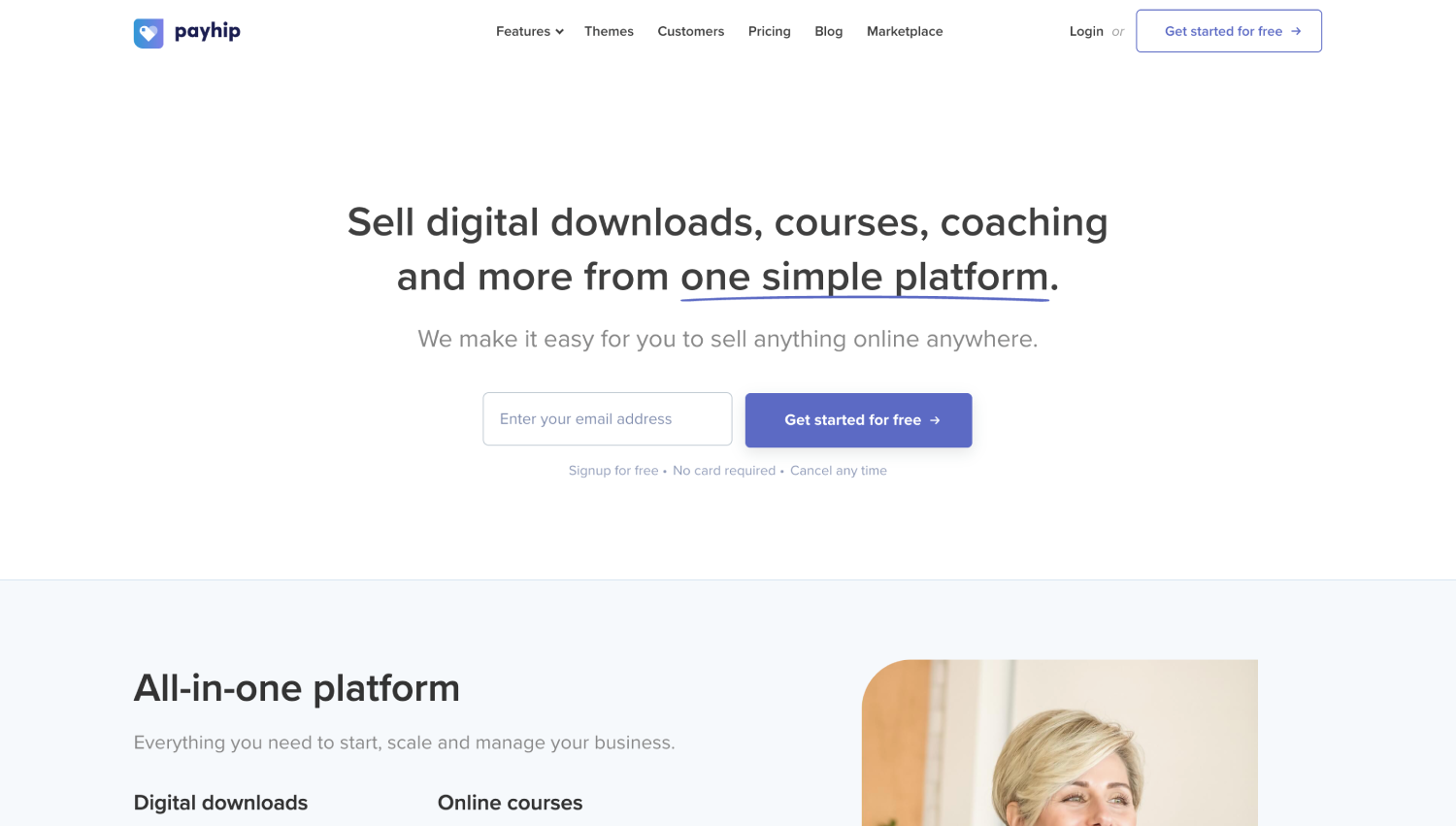
Payhip is a lower-friction option aimed at creators, designers, and developers selling digital products including templates, fonts, design assets, ebooks, and simple software licenses. Payhip acts as the merchant of record for VAT purposes in the EU and handles UK VAT. US sales tax handling varies depending on plan and product type.
Per Payhip’s public pricing page: the free plan takes a 5% transaction fee, the Plus plan runs $29 per month with a 2% fee, and the Pro plan runs $99 per month with no additional percentage fee beyond payment processing costs. The lower price points make it accessible for creators testing monetization before committing to a higher-cost platform.
The tradeoff is depth. Payhip lacks native license key management, plugin update delivery, or the subscription analytics that plugin and app developers typically need at growth stage. It is a reasonable starting point for template sellers or designers moving their first digital products to a paid model, but it does not scale well into professional software distribution.
8. Gumroad
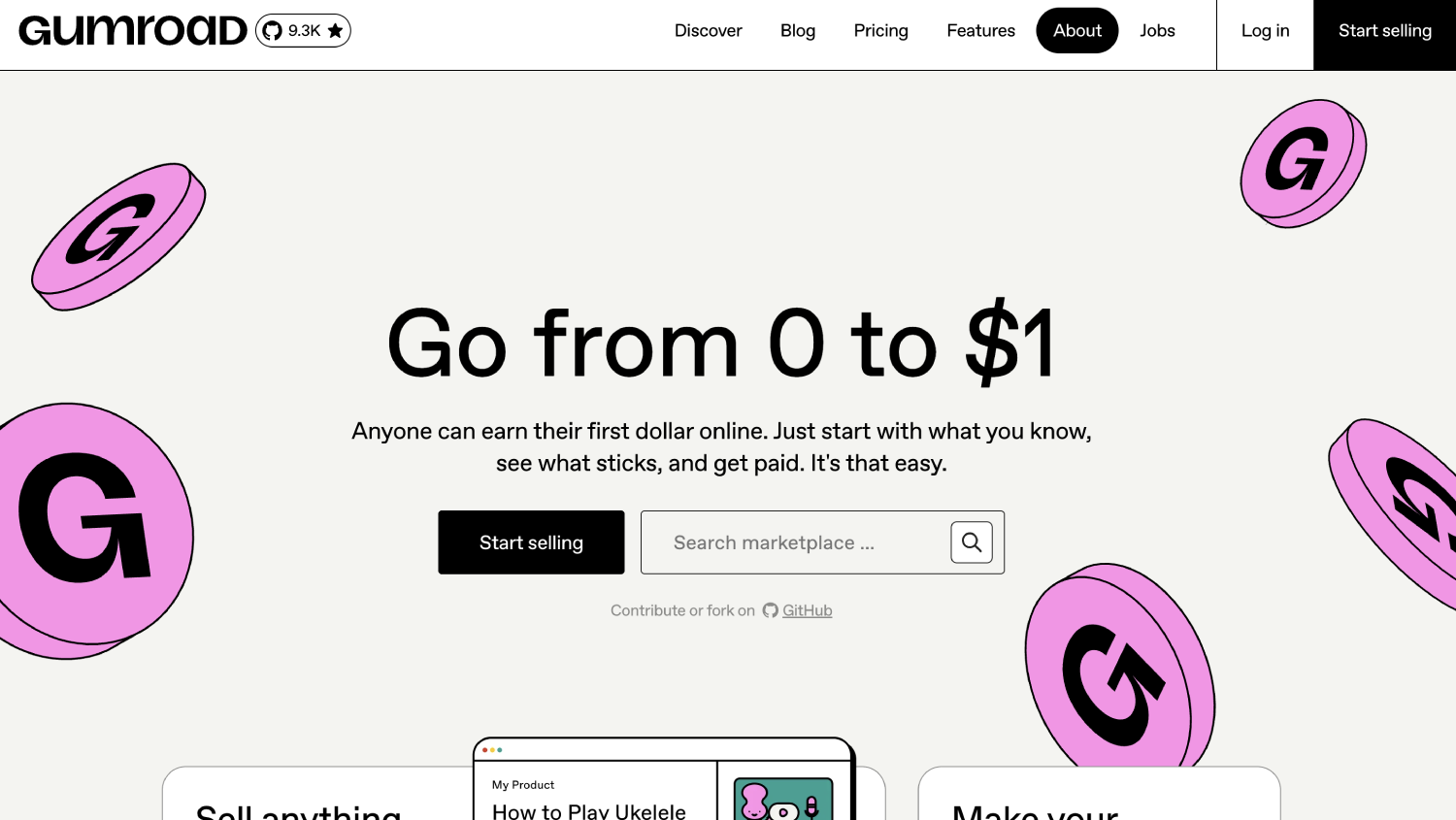
Gumroad is included here because it is where many creators and developers start, and because it does act as a merchant of record for digital product sales including VAT collection in covered jurisdictions. Per Gumroad’s public pricing page, the fee is a flat 10% of each sale with no monthly fee, which is the highest percentage-based rate among the platforms in this list.
Gumroad’s advantage is simplicity. Setup takes minutes. The platform has a built-in audience of buyers and supports file delivery, payment plans, and memberships. For a designer selling a $15 template pack, the 10% fee on low volume is an acceptable cost of distribution.
Gumroad becomes a poor choice as revenue grows. At $10,000 monthly GMV, you pay $1,000 in platform fees for infrastructure that Lemon Squeezy provides at $500 plus transaction costs. You also get no license key management, no plugin update delivery, and limited customer export tools. Developers who started on Gumroad and scaled past $3,000 to $5,000 per month almost universally migrate to a platform with better tooling and lower percentage fees.
Platform Comparison: Product-Type Fit, Tax Coverage, and Fee Structure
| Platform | Best For | MoR Fee (Public Pricing) | WP Plugin Support | License Keys | Tax Jurisdictions |
|---|---|---|---|---|---|
| Freemius | WordPress plugins and themes | Revenue share (tiered, disclosed on signup) | Yes, native | Yes, native | EU VAT, US, UK, AU |
| Paddle | SaaS, desktop apps, subscriptions | 5% + $0.50 | Via API | Via API | 200+ countries |
| Lemon Squeezy | Indie software, templates, ebooks | 5% + $0.50 | Via API | Yes, native | 100+ countries |
| PayPro Global | Software with broad global reach | Quote-based | Via API | Yes | 180+ countries |
| FastSpring | Desktop software, B2B apps | Quote-based | Via API | Yes | 200+ countries |
| Polar | Developer tools, open-source monetization | 4% + Stripe fee | No | Yes, native | EU VAT, US, UK |
| Payhip | Templates, fonts, digital files | Free: 5% / Plus: 2% / Pro: 0% | No | No | EU VAT, UK |
| Gumroad | Creators, early-stage digital sales | 10% | No | No | EU VAT, US, UK |
How Does VAT on Digital Products Actually Work Through an MoR?
When a platform acts as your merchant of record, it registers for VAT in each required jurisdiction using its own tax ID, not yours. When a buyer in France purchases your plugin, the platform charges French VAT at 20%, collects it from the buyer, and remits it to the French tax authority under the platform’s OSS registration. You never appear on the French VAT filing.
This matters enormously for solo developers and small teams. EU VAT OSS registration requires an application, ongoing quarterly filings, and currency conversion calculations across 27 member states. UK VAT requires a separate registration. Australian GST requires another. An MoR absorbs all of that. You receive the net-of-tax amount.
The one area where MoR platforms sometimes create confusion is US sales tax. Not all platforms cover all US states, and the rules differ for software, SaaS, and digital downloads depending on the state. Paddle, FastSpring, and PayPro Global provide the broadest US coverage. Payhip and Polar handle fewer states. Before signing up, verify that your top US buyer states are covered by the platform you choose. For teams thinking about the broader tax compliance picture, the sales tax compliance tools comparison is useful context on what DIY tax filing actually involves.
Which MoR Is Right for WordPress Plugin Sellers Specifically?
Freemius is the clear choice for WordPress plugin and theme developers at almost every revenue stage. No other MoR platform in this list has native WordPress update delivery, native license activation tracking, or built-in freemium conversion flows designed around how plugin businesses actually grow.
A practical example: say you sell a plugin with a free version on WordPress.org and a pro license at $99 per year. With Freemius, the upgrade prompt inside the WordPress admin, the checkout, the license key, the annual renewal email, and the VAT invoice are all handled natively. With Paddle, you build most of that yourself through the API. With Gumroad, you cannot build it at all.
Developers who use Paddle for WordPress plugins typically do so because they also sell a SaaS product or desktop app and want a single MoR across their portfolio. That is a legitimate reason. For a dedicated plugin business, Freemius’s product depth justifies the revenue share even without knowing the exact rate upfront.
What Does It Cost to Sell Digital Products Globally Through an MoR?
Consider a developer earning $8,000 per month from a plugin or template product with an average order value of $79. Here is how the MoR fee math works across three platforms at that volume, using each platform’s current public pricing rates.
On Lemon Squeezy at 5% plus $0.50 per transaction: roughly 101 transactions per month, yielding $400 in percentage fees plus $50.50 in per-transaction fees, for a total MoR cost of approximately $450.50. On Gumroad at 10%: $800 per month. On Polar at 4% plus Stripe’s standard rate of 2.9% plus $0.30 per transaction: roughly $320 in Polar fees plus $234 in Stripe fees plus $30.30 in per-transaction fees, totaling approximately $584. These are illustrative calculations based on published fee rates and a hypothetical transaction volume. Actual costs vary with currency conversion, refunds, and dispute rates.
The point is that at $8,000 monthly revenue, the choice of MoR is worth $350 or more per month in fees. That gap compounds as you grow. Understanding the full fee structure before you commit, not just the headline percentage, matters significantly. The merchant of record fees comparison across Paddle, FastSpring, Lemon Squeezy, Polar, and PayPro Global breaks this down with verified public pricing side by side.
Frequently Asked Questions
What is a merchant of record for digital products?
A merchant of record is the legal entity that processes a customer’s payment, appears on their receipt, and holds liability for the transaction including chargebacks, VAT collection, and refunds. For digital product sellers, using an MoR means the platform collects and remits indirect taxes like VAT and GST globally under its own registrations, so you do not need to register in each country where you have buyers. Freemius, Paddle, and Lemon Squeezy are all confirmed merchant of record platforms for digital products.
Do I still need to collect VAT if I sell through an MoR?
No. When you sell through a true merchant of record, the platform is the legal seller. It collects VAT from your buyers, files the returns in each jurisdiction under its own tax registrations, and remits the tax. You receive net revenue after tax. This applies to EU VAT OSS, UK VAT, Australian GST, and other indirect taxes depending on which jurisdictions the platform covers. Always verify coverage in your top buyer countries before signing up, since not all MoRs cover identical jurisdictions.
Can I sell WordPress plugins through Paddle instead of Freemius?
Yes, but it requires significantly more custom development. Paddle does not have native WordPress plugin update delivery, license activation management, or freemium-to-premium upgrade flows. You would build those through the Paddle API or use a third-party plugin toolkit alongside Paddle. Freemius provides all of that natively. Paddle makes more sense for WordPress plugin developers who are also running a SaaS product or desktop app and want a unified MoR across their entire product portfolio.
Is Gumroad a merchant of record?
Yes, Gumroad acts as a merchant of record for EU VAT, UK VAT, and US sales tax in states where it has collected thresholds. The platform appears as the seller on customer receipts and handles tax remittance in covered jurisdictions. The main reasons to move away from Gumroad are its 10% fee rate, which is the highest among major digital product MoRs per current public pricing, and its lack of license key management or plugin update delivery, which limits its usefulness for software developers.
What is the cheapest merchant of record for selling digital products?
Polar charges 4% plus Stripe processing fees, making it the lowest percentage-based MoR rate among platforms in this comparison per current public pricing. Payhip’s Pro plan at $99 per month eliminates MoR percentage fees entirely beyond payment processing costs, which is cheaper at higher volumes. The right answer depends on your monthly GMV and transaction count. Polar is cheaper than Lemon Squeezy for lower-volume sellers. Payhip Pro becomes cheaper than both at roughly $3,000 to $4,000 monthly GMV depending on transaction count.
Does Lemon Squeezy support license key delivery for software products?
Yes. Lemon Squeezy includes native license key generation and delivery as a built-in feature, not an add-on. When a buyer completes a purchase, the platform generates a license key, delivers it via email and the order confirmation page, and provides an API endpoint for your software to validate activations. You can set activation limits per key. This makes Lemon Squeezy a workable option for indie developers selling software with license-based copy protection without needing a separate licensing service.
Which MoR platforms cover the most countries for selling digital products globally?
Paddle and FastSpring both claim 200-plus country coverage for VAT and GST remittance. PayPro Global covers 180-plus countries and is notable for supporting local payment methods in regions like Southeast Asia and Latin America that most other MoRs skip. Lemon Squeezy covers 100-plus countries. Polar and Payhip cover the core Western markets including the EU, UK, US, and Australia but have narrower coverage in emerging markets. For sellers with significant revenue from outside North America and Western Europe, Paddle, FastSpring, or PayPro Global offer the most complete tax coverage.
The Most Important Thing to Get Right Before You Pick
Most digital product sellers over-index on fee percentages and under-index on product-type fit. A platform that charges 5% and requires three weeks of custom API work to deliver license keys is more expensive, in total cost, than a platform charging 7% that handles it natively. Calculate your real monthly cost including engineering time, not just the MoR percentage.
For most WordPress plugin and theme developers, Freemius is the answer, and has been for years, because no other platform was built for that specific distribution model. For indie developers selling apps, templates, or software licenses more broadly, Lemon Squeezy at 5% plus $0.50 offers the best combination of ease, tax coverage, and license management without a marketplace cut. For companies at scale with global ambitions and complex product catalogs, Paddle or FastSpring is worth the quote-based conversation.
The broader takeaway is that the MoR model exists precisely because international tax compliance on digital goods is genuinely complicated, and the compliance burden falls entirely on you if you process payments through a standard payment processor. Choosing a platform that absorbs that liability is not just operationally convenient. It is the correct default for any digital product business with buyers in more than a few countries. The fee you pay an MoR is cheaper than the penalty exposure and accounting cost of handling EU VAT registration independently, especially at early scale when your time is already stretched thin. For teams thinking about how these costs compound over time, the hidden costs that erode SaaS margins is a useful lens on the full picture.