
TLDR
- Ramp’s core spend management platform is free for an unlimited number of users and cards, but that free tier excludes several features finance teams at growth-stage companies typically need.
- Ramp Plus, the paid tier, is priced at $15 per user per month as of November 2026, according to Ramp’s public pricing page. It adds advanced workflow controls, custom fields, and procurement features.
- Ramp’s real revenue model runs on interchange, not subscription fees. The company earns a cut of the swipe fee every time an employee uses a Ramp card, which is why the free tier can exist at all.
- Add-on modules for travel, vendor management, and accounts payable carry separate costs, which means the true cost of a full Ramp deployment is rarely zero and rarely just the Plus fee.
- Finance teams comparing total cost of ownership should model interchange economics alongside subscription costs before assuming Ramp is cheaper than software-first competitors.
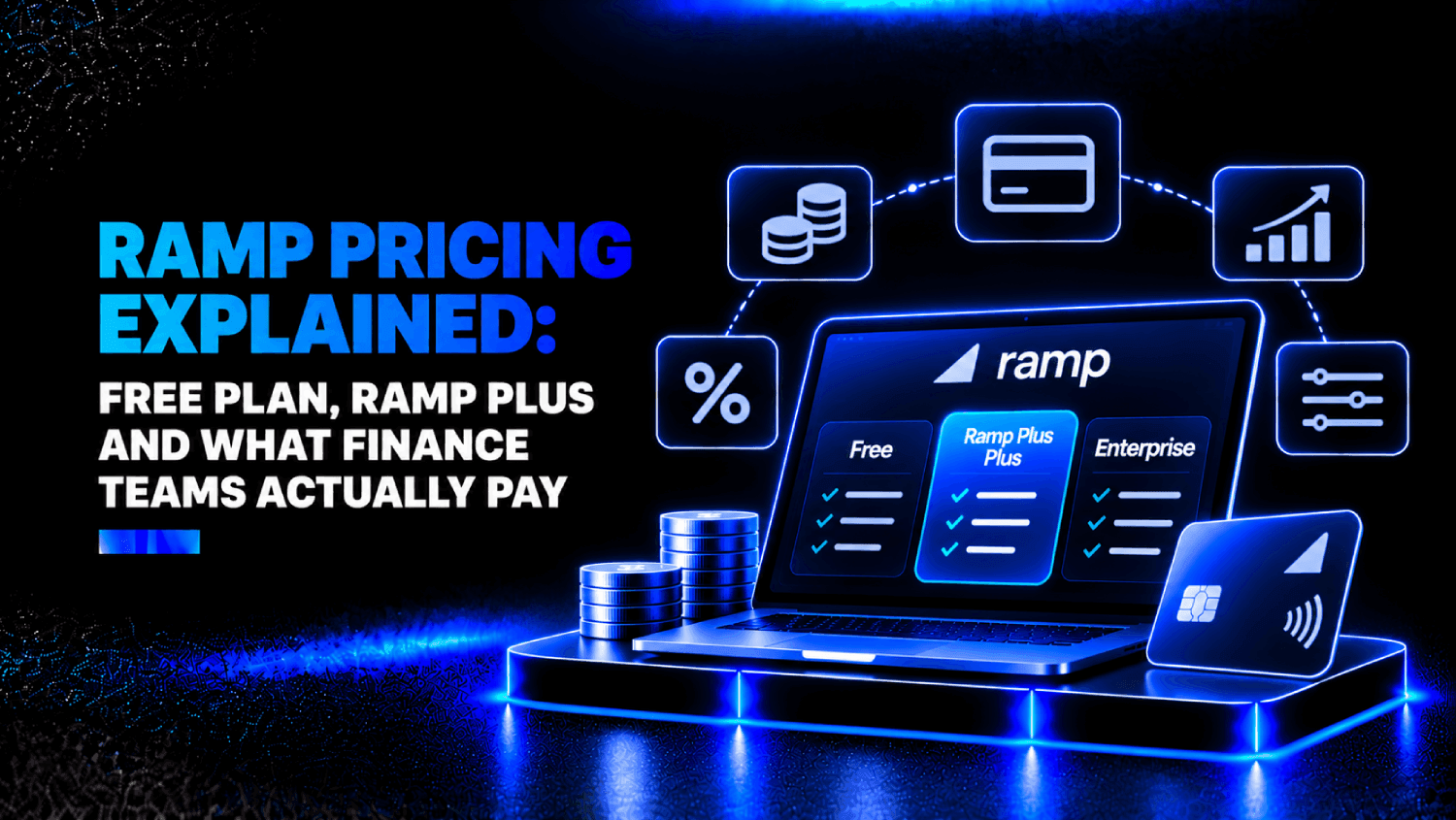
Ramp pricing has two tiers: a free plan covering core corporate cards, expense management, and basic reporting, and Ramp Plus at $15 per user per month as of November 2026. Both plans layer on optional paid modules for travel, procurement, and bill pay. The free plan works for lean teams with simple workflows. Ramp Plus is worth evaluating once a company needs approval hierarchies, custom fields, or procurement-level controls. Neither plan reflects the full cost picture, because interchange income funds the free tier and add-on module fees add to the paid one.
Why “Ramp Is Free” Is Only Half True
Ramp built its pricing model around a core insight borrowed from corporate card programs that predate fintech: interchange pays for the software. Every time an employee swipes a Ramp card, the merchant pays a swipe fee. A portion of that fee flows to Ramp. Because Ramp processes enough card volume across its customer base, it can afford to give away the software layer and still generate revenue.
That mechanic is worth understanding before evaluating any plan tier. Ramp’s free offering is not a loss leader. It is interchange subsidizing software. This also means Ramp has a structural incentive to push card spend, which is worth keeping in mind when evaluating which expense categories the platform encourages you to route through cards versus direct ACH.
The free plan genuinely covers the basics: unlimited physical and virtual cards, real-time spend controls, receipt capture, QuickBooks Online and Xero integrations (per Ramp’s public pricing page), and reimbursements. NetSuite integration is available on Plus and Enterprise tiers, not on the Free plan. For a 15-person seed-stage company with one person managing finance, the Free plan covers most of the workflow. The ceiling appears when companies hit more complex needs, typically around 30 to 50 employees, when approval chains, procurement policies, and multi-department budgeting start to strain single-layer controls.
What Does Ramp Plus Actually Cost?
Ramp Plus is priced at $15 per user per month as of November 2026, per Ramp’s public pricing page. The billing is per seat, meaning costs scale with headcount rather than card volume or spend. A 50-person company with all users on Plus pays $750 per month. A 200-person company pays $3,000 per month.
The critical nuance here is what “user” means. Ramp counts active users, not every employee on payroll. If only finance staff and department budget owners need Plus features, a company might license 20 seats even with 150 total employees. That changes the math considerably. A 150-person company that only assigns Plus to 20 budget owners pays $300 per month, not $2,250.
What Ramp Plus Adds Over the Free Plan
The most operationally important additions in Plus are custom approval workflows, custom fields and tags for expense categorization, advanced vendor management, and procurement request management. These features matter because they replace manual finance oversight with automated policy enforcement.
Consider a growth-stage SaaS company with $8M in annual spend. On the free plan, a department head can spend up to their card limit without a multi-step approval. On Plus, the CFO can require dual approval on any transaction above $5,000, route software purchases to IT review, and block spend in specific merchant categories without manual intervention. That is not a convenience feature. It is the difference between a policy that exists in a spreadsheet and one that is actually enforced at the point of purchase.
Ramp Pricing Tiers: Free vs. Plus Compared
| Feature | Ramp Free | Ramp Plus ($15/user/mo as of Nov 2026) |
|---|---|---|
| Corporate cards (physical and virtual) | Unlimited | Unlimited |
| Expense management and receipt capture | Yes | Yes |
| Accounting integrations | QuickBooks Online and Xero only (per Ramp’s public pricing page) | Yes, plus NetSuite and others |
| Reimbursements | Yes | Yes |
| Custom approval workflows | No | Yes |
| Custom fields and tags | Limited | Yes |
| Procurement and purchase requests | No | Yes |
| Advanced vendor management | No | Yes |
| Price intelligence (negotiation data) | No | Yes |
| ERP-grade integrations (deeper sync) | Standard | Enhanced |
| Dedicated account management | No | Available at higher spend volumes; confirm threshold with Ramp sales |
What Are Ramp’s Add-On Modules and What Do They Cost?
This is where Ramp’s pricing model gets more complex than most evaluations acknowledge. Beyond the free and Plus tiers, Ramp offers separate modules for travel, bill pay, and accounts payable automation. These are not included in either plan by default.
Ramp Travel
Ramp Travel is a corporate travel booking product that competes with platforms like TripActions and Navan. Pricing for Ramp Travel is quote-based as of November 2026, meaning Ramp does not publish a flat monthly rate on its public pricing page. Pricing drivers typically include the number of travelers, booking volume, and whether the company wants managed travel support or self-serve only. If your team books more than 20 to 30 trips per month, expect a conversation with their sales team before getting numbers.
Ramp Bill Pay
Ramp’s bill pay feature handles invoice capture, approval routing, and payment scheduling for vendor invoices paid via ACH or check. The core bill pay functionality is available on both free and Plus plans. More advanced AP automation features, including OCR-based invoice processing at scale and multi-entity support, are available on Plus and in some cases require a higher-tier commercial arrangement. Ramp does not publish per-transaction fees for bill pay on its public pricing page as of November 2026.
Ramp for Accounting Firms
Ramp maintains a separate program for accounting firms that manage clients on the platform. Pricing for that channel is not publicly disclosed and is handled through a partner agreement. This is relevant for companies using an outsourced CFO or accounting firm to manage Ramp on their behalf.
How the Interchange Economics Work (And Why They Matter for Your True Cost)
Every dollar spent on a Ramp card generates interchange revenue for Ramp. The standard interchange rate on a commercial card transaction in the US runs between 1.5% and 2.7%, with the exact rate depending on card type, merchant category, and transaction size. Ramp keeps a portion of that. The company does not publicly disclose its interchange share, but it is the structural reason the free plan exists.
For a finance team, this creates a subtle cost to model. Say a company routes $500,000 per month through Ramp cards. At a 2% blended interchange rate, roughly $10,000 in fees flows from the merchants where your employees spend. That $10,000 is split across the card network (Visa), the issuing bank Ramp partners with, and Ramp itself. The employee cardholder pays nothing directly, the merchant absorbs the fee. But those merchant costs are baked into the prices your company pays for goods and services: a SaaS vendor charging you $50,000 per year has already priced in the cost of card acceptance. Routing that payment through a Ramp card rather than ACH means the merchant pays interchange on that transaction, and your vendor pricing reflects it even if the line item is invisible. At $500k monthly spend, the embedded cost of the card layer is not zero, it is just someone else’s line item, not yours.
This is not a reason to avoid corporate cards. It is a reason to understand that “free software” is funded by a spread embedded in your vendor transactions. It becomes relevant when comparing Ramp against a tool like Brex or a more traditional setup where you might pay explicit software fees but also earn more card rewards back. Our three-way comparison of Ramp, Brex, and Airbase breaks down how these economics differ across platforms and which spend profiles favor each model.
The FintechSpecs Ramp Cost Stack: A Framework for Real Total Cost
Most evaluations treat Ramp’s pricing as a two-line item: free or $15 per seat. A more accurate model has four layers, which we call the FintechSpecs Ramp Cost Stack.
Layer 1: Platform fee. This is the visible tier, either $0 or $15 per active user per month as of November 2026. Apply the actual seat count for finance and budget-owner roles, not total headcount.
Layer 2: Module fees. Add travel, bill pay automation, or any other add-ons the sales team quotes. These are not published and require a direct conversation. Budget a placeholder until you have a signed order form.
Layer 3: Interchange cost basis. This is embedded in your vendor pricing, not invoiced by Ramp directly. It shows up as a structural cost of routing spend through cards rather than ACH. For companies with high vendor spend on categories where ACH is available, routing through Ramp cards may carry an implicit cost versus paying via bank transfer. For categories where cards are the only option, this is irrelevant.
Layer 4: Implementation and integration lift. Ramp’s accounting integrations are solid, but any company deploying a new expense platform alongside an ERP like NetSuite or Sage Intacct will incur setup time. That might be internal finance team hours or an implementation partner. Ramp does not charge for standard integration setup, but the labor cost is real.
Running all four layers gives a more honest total cost than either the free-plan framing or the per-seat sticker price alone. Finance teams building a board-level evaluation of spend management tools should include all four. This approach also maps to how hidden costs erode margins in fintech operations more broadly, a pattern that applies equally well to internal tooling decisions.
Who Should Stay on the Free Plan?
The free plan covers the full use case for companies in a fairly specific window: under 30 to 40 employees, one person or a small team managing finance, straightforward expense categories, and no need for multi-step procurement approvals. Early-stage startups from seed through early Series A fit this profile cleanly.
A company with five departments, $2M in annual software spend, and a VP Finance trying to enforce a purchase request process will hit the ceiling of the free plan quickly. The lack of custom approval workflows is the most common reason companies move from free to Plus. The absence of custom fields and tags is the second, because it limits how granularly you can allocate costs across projects or cost centers in your accounting system.
Who Actually Needs Ramp Plus?
Ramp Plus fits companies in a specific operational band: post-Series A through Series C, roughly 40 to 500 employees, with a finance team that needs policy automation rather than just spending visibility. The $15 per user per month cost, applied to 20 to 30 active budget owners, comes to $300 to $450 per month. For a company running $3M to $10M in annual card spend, that is a minor line item relative to the control value.
The procurement features in Plus are underrated. The ability to require a purchase request before a card is charged, route that request through department head and finance approval, and tie the approval directly to a vendor in the system replaces a workflow that many Series B companies are running in Slack threads and email. That workflow carries real soft cost, in finance team time and in policy exceptions that slip through.
How Does Ramp Pricing Compare to Its Direct Competitors?
| Platform | Entry Price (as of Nov 2026) | Paid Tier | Pricing Model |
|---|---|---|---|
| Ramp | Free | $15/user/mo (Plus) | Interchange + per-seat SaaS |
| Brex | Free (Essentials) | $12/user/mo (Premium, per public pricing page) | Interchange + per-seat SaaS |
| Airbase | Quote-based | Quote-based | Per-seat SaaS, spend-tiered |
Brex’s published Premium tier is slightly cheaper on a per-seat basis than Ramp Plus as of November 2026. The more meaningful difference is in product emphasis: Ramp leans harder into AI-assisted spend intelligence and savings detection, while Brex has historically competed more aggressively on the banking side with integrated business accounts. Airbase, now part of Paylocity, prices exclusively through a sales conversation and is typically better suited to mid-market companies with complex multi-entity needs. For a full side-by-side across all three platforms, see our Ramp vs. Brex vs. Airbase comparison.
Is Ramp Pricing Available for Enterprise or Custom Contracts?
Ramp does offer enterprise arrangements for larger organizations, typically those with significant card spend volume or complex multi-entity needs. Pricing for enterprise tiers is not published and is entirely quote-based as of November 2026. The drivers Ramp’s sales team uses to set enterprise pricing include total card spend volume, number of entities, required integrations, and whether the company needs a dedicated customer success arrangement.
Enterprise deals may also include negotiated rewards or cashback structures, which can partially offset subscription costs for high-spend accounts. Companies processing over $1M per month in card spend are likely to receive a meaningfully different commercial offer than the published $15 per seat rate. The only way to know is to run the conversation. Do not let the published Plus price anchor your expectations if you are above that spend threshold.
Frequently Asked Questions About Ramp Pricing
Is Ramp actually free with no hidden fees?
Ramp’s core platform is genuinely free, with no platform fee, no per-card fee, and no minimum spend requirement as of November 2026. There are no hidden monthly charges in the traditional SaaS sense. The economic reality is that Ramp earns interchange revenue on every card transaction, which funds the free tier. That is not a hidden fee charged to you directly, but it is how the business model works. Add-on modules such as travel management are priced separately and require a sales conversation.
What is included in Ramp Plus and how much does it cost?
Ramp Plus costs $15 per user per month as of November 2026, per Ramp’s public pricing page. It adds custom approval workflows, custom fields and tags for expense categorization, procurement and purchase request management, advanced vendor management, NetSuite integration, and enhanced ERP integrations. These features are primarily aimed at companies past early-stage that need automated policy enforcement rather than just spending visibility. The plan bills per active user, not per total employee, which reduces the effective seat count for most companies.
Does Ramp charge per card or per transaction?
Ramp does not charge per card or per transaction as of November 2026. Both the free and Plus plans include unlimited physical and virtual cards. There are no per-swipe fees charged to the cardholder or the employer. Ramp generates revenue from interchange paid by merchants on the other side of every transaction, not from per-card or per-transaction fees billed to the corporate account holder.
How does Ramp Plus pricing compare to Brex Premium?
Ramp Plus is priced at $15 per user per month and Brex Premium is priced at $12 per user per month as of November 2026, per each company’s public pricing pages. Brex is marginally cheaper on a per-seat basis. The relevant comparison is features: Ramp’s Plus tier puts more emphasis on procurement workflow automation and AI-assisted spend intelligence, while Brex’s premium tier includes stronger built-in banking features. The right choice depends on whether your finance team prioritizes spend control or integrated banking more heavily.
Can startups use Ramp for free indefinitely?
Yes, Ramp does not enforce a time limit on the free plan as of November 2026. There is no trial period that converts to a paid subscription automatically. Companies can use the free tier as long as they meet Ramp’s eligibility requirements, which primarily means operating as a US-based business entity. Growth, headcount increases, or time on the platform do not trigger automatic upgrades to Plus. Upgrades happen when a company decides it needs the features in Plus.
How can a company evaluate Ramp Plus features before committing?
Ramp has offered access to Plus features for companies evaluating the upgrade, though the specific terms of any evaluation arrangement should be confirmed directly with Ramp’s sales team, as these are subject to change. The standard product flow starts on the free tier, so evaluation of Plus features typically happens through a sales-assisted conversation rather than a self-serve process. This is worth asking about directly when evaluating the platform.
What is Ramp’s pricing model for accounts payable automation?
Ramp includes basic bill pay in both the free and Plus plans. More advanced accounts payable automation, including high-volume invoice processing and multi-entity AP workflows, is available at higher tiers or through a custom commercial arrangement. Ramp does not publish specific per-transaction AP pricing as of November 2026. If AP automation is a primary use case rather than a secondary feature, budget for a sales conversation where pricing will depend on invoice volume and workflow complexity. Our accounts payable automation roundup covers how Ramp’s AP capabilities compare to dedicated AP platforms.
How should a Series B company budget for Ramp?
A Series B company with 80 employees should apply the FintechSpecs Ramp Cost Stack: start with the per-seat Plus fee for active budget owners (likely 15 to 25 people), add any quoted module fees for travel or advanced AP, note the interchange layer as an embedded cost rather than a cash fee, and factor implementation time. At 20 seats on Plus, the monthly platform fee is $300 as of November 2026. That figure is a floor, not a ceiling. Add-on modules and enterprise features will push the number higher depending on scope.
What the Pricing Model Tells You About the Product Direction
A company that makes money from interchange has a fundamentally different incentive structure than one that charges flat SaaS fees. Ramp has every reason to make card spending easier, faster, and more rewarding because higher card volume directly improves its unit economics. That is not a criticism. It explains the product roadmap clearly: more integrations, better AI-assisted receipt matching, and faster card issuance all serve both the customer and Ramp’s revenue model simultaneously.
Where that incentive diverges from a pure finance team interest is in scenarios where paying a vendor by ACH or wire would be cheaper for the business but less beneficial for Ramp. The platform does support bill pay via bank transfer, but the nudge toward card spend is structural. Finance teams should set card-vs-ACH routing policies deliberately rather than defaulting to whatever the platform makes easiest. This is especially relevant for large recurring vendor payments where merchants may pass card acceptance fees back to you, a practice that is common in B2B transactions. Understanding how fintech companies monetize payments gives useful context for reading these structural incentives correctly.
The conclusion that matters most for a finance team evaluating Ramp is this: the pricing model is coherent and the free tier is real, but “free” describes only the invoice Ramp sends you, not the full economic picture. Run the Cost Stack, understand the interchange layer, and compare the Plus seat count carefully against your actual org chart before deciding where to land. Companies that do that work find the right tier quickly. Companies that skip it often either overpay for seats they do not use or underestimate the gap between the free plan and what their workflows actually require. For teams that want to see how the full spend management decision plays out against alternatives, the multi-entity expense management comparison covers the broader competitive set in detail.