
TLDR
- Adyen is not the only enterprise-grade payment processor. Checkout.com, Worldpay, and Braintree all handle comparable transaction volumes with different trade-off profiles.
- Payment orchestration layers like Spreedly and Primer let you route across multiple processors, which reduces your exposure to any single vendor’s downtime or pricing changes.
- Adyen’s minimum monthly fees and contract requirements make it a poor fit for companies under a certain volume threshold. Several alternatives on this list have no minimums.
- The right Adyen replacement depends on whether your priority is global acquiring reach, developer experience, marketplace payouts, or pricing transparency.
- Stripe is the most common default comparison, but it is not always the best Adyen alternative for SaaS or marketplace use cases at scale.
The best Adyen alternatives for SaaS platforms and marketplaces are Checkout.com, Worldpay, Braintree, Stripe, Spreedly, Primer, Rapyd, Nuvei, and PayPal Commerce Platform. Each competes on different dimensions: Checkout.com on global acquiring and authorization rates, Worldpay on enterprise volume and processing history, Braintree on marketplace payouts and developer tooling, and orchestration layers like Spreedly and Primer on multi-processor flexibility that no single-processor contract can match.
Who Actually Needs an Adyen Alternative?
Adyen targets high-volume merchants. Its pricing model includes interchange-plus fees plus a processing fee per transaction, and it typically requires meaningful monthly minimums before the account team will engage seriously. For companies processing tens of millions per month, that is a reasonable trade-off for access to Adyen’s direct acquiring licenses in 30-plus markets.
Below that volume, the trade-off flips. You pay the minimums, receive less negotiating leverage on interchange, and get limited integration support. Founders often discover this after signing. If you are evaluating Adyen because a competitor uses it, that is worth examining separately from whether Adyen is actually right for your volume and product architecture.
Three signals suggest you should shortlist alternatives before committing. First, your monthly processing volume is under $1 million and Adyen’s minimums represent more than 0.5% of that figure. Second, your marketplace or platform needs sophisticated split-payment logic that Adyen’s platform solution does not cover cleanly. Third, you operate in a vertical, like B2B SaaS with net terms billing, where card-network acquiring is secondary to ACH and invoicing.
The FintechSpecs Processor Fit Matrix: Four Axes Before You Shortlist
Most processor comparisons rank features. That is the wrong starting point. Before listing alternatives, the useful question is: which axes actually differentiate your decision? The FintechSpecs Processor Fit Matrix evaluates candidates across four dimensions, in order of elimination power.
Acquiring geography: Where do your customers pay from, and does the processor hold local acquiring licenses there? Routing a European card through a US acquirer adds 1-2% in cross-border fees. That single variable can override every other consideration at scale.
Payment architecture: Are you a direct merchant, a marketplace splitting funds to sellers, or a SaaS platform embedding payments for sub-merchants? Each model requires different tooling. Marketplaces need split-payment APIs and sub-merchant onboarding. SaaS platforms embedding payments need PayFac or PayFac-as-a-service infrastructure.
Pricing model fit: Interchange-plus is cheaper at volume. Blended rates are simpler to predict at lower volume. Minimum monthly fees are a fixed cost you pay regardless of performance. Run the math for your actual transaction mix before the demo call, not after.
Integration depth required: Some processors have excellent hosted payment pages and poor APIs. Others have excellent APIs and poor documentation. If your team is building a custom checkout, developer experience is not a soft preference. It is a launch risk.
9 Best Adyen Alternatives for SaaS Platforms and Marketplaces
1. Checkout.com
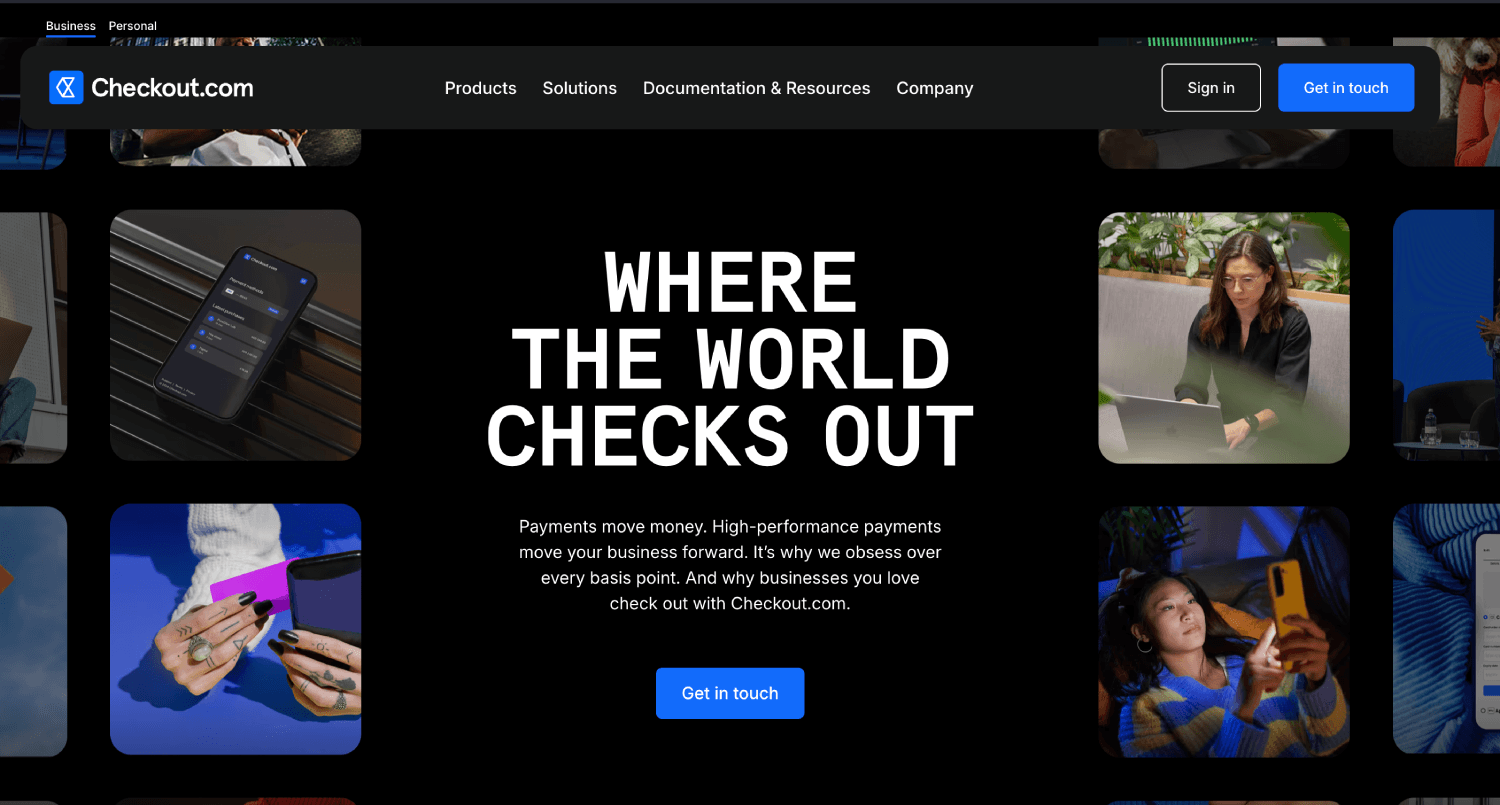
Checkout.com is the closest architectural competitor to Adyen. It holds direct acquiring licenses in major markets, publishes authorization rate data as a differentiator, and pitches specifically on the gap between its optimization and industry averages. The core argument is that higher authorization rates on cross-border transactions offset processing costs.
Its Flow product provides a hosted payment page with local payment method support, and its API layer is well documented for teams building custom experiences. Checkout.com does not publish standard pricing publicly; its fees are negotiated based on volume and merchant category. The platform suits companies processing at significant scale in Europe, the Middle East, and Asia who want a credible Adyen alternative without migrating to a US-first processor.
2. Worldpay
Worldpay (now part of FIS) processes an enormous volume of global card transactions and has decades of acquiring history. For enterprises that prioritize processor stability, banking relationships, and an established track record in regulated industries, Worldpay is a serious candidate. It is not the choice for a Series A startup wanting clean REST APIs and fast onboarding.
Worldpay’s implementation is typically handled through a managed services engagement. That adds time and cost but also means your integration has dedicated support. Pricing is enterprise-negotiated. Its strength is in industries like retail, travel, and financial services where relationship-based acquiring and chargeback management infrastructure matter more than developer agility.
3. Braintree
Braintree, owned by PayPal, has a developer-friendly reputation and a marketplace payout product that competes directly with Adyen’s platform solution. Its Marketplace and Platform product handles split payments, sub-merchant onboarding, and fund disbursement within a single API, which matters for two-sided platforms where seller onboarding velocity affects supply-side growth.
Standard card processing rates are 2.59% plus $0.49 per transaction for most card types, as listed on Braintree’s public pricing page. At enterprise volume, pricing is negotiated. The tradeoff against Adyen is reach: Braintree has fewer direct acquiring relationships in non-English-speaking markets, so European or Asian expansion may require a secondary processor. For US-focused marketplaces, that trade-off is often acceptable.
4. Stripe
Stripe is the most common Adyen alternative in practice, partly because most SaaS founders already use it before they outgrow it and partly because Stripe’s product surface area has expanded substantially. Connect handles marketplace payouts and sub-merchant onboarding. Stripe’s Billing product covers subscription logic. Radar handles fraud scoring.
The honest limitation is that Stripe’s acquiring model is primarily an aggregator model, not a direct acquirer in every market. That can affect authorization rates on international cards compared to Adyen’s direct licensing. If you are running a global payments operation and authorization rate differences of even half a percent represent material revenue, that is worth modeling before choosing Stripe over Adyen or Checkout.com. Our full comparison of Stripe vs Adyen for B2B SaaS covers that trade-off in detail.
5. Spreedly
Spreedly is not a processor. It is a payment orchestration layer that sits in front of multiple processors and handles tokenization, routing logic, and vault management. If you want to route transactions across Braintree, Checkout.com, Adyen, and Stripe based on cost, geography, or failure recovery, Spreedly is what makes that possible without rebuilding your integration each time.
The practical use case: a platform processing in Europe routes to Checkout.com for EU cards, routes US debit to Braintree for cost reasons, and falls back to Adyen for specific high-value transactions. That routing logic sits in Spreedly. Spreedly’s pricing is not publicly listed and requires a quote, this is standard practice for orchestration layers, which are almost universally priced through sales conversations based on transaction volume and processor count. For teams evaluating their payment orchestration platform options, Spreedly is the most processor-agnostic option on this list.
6. Primer
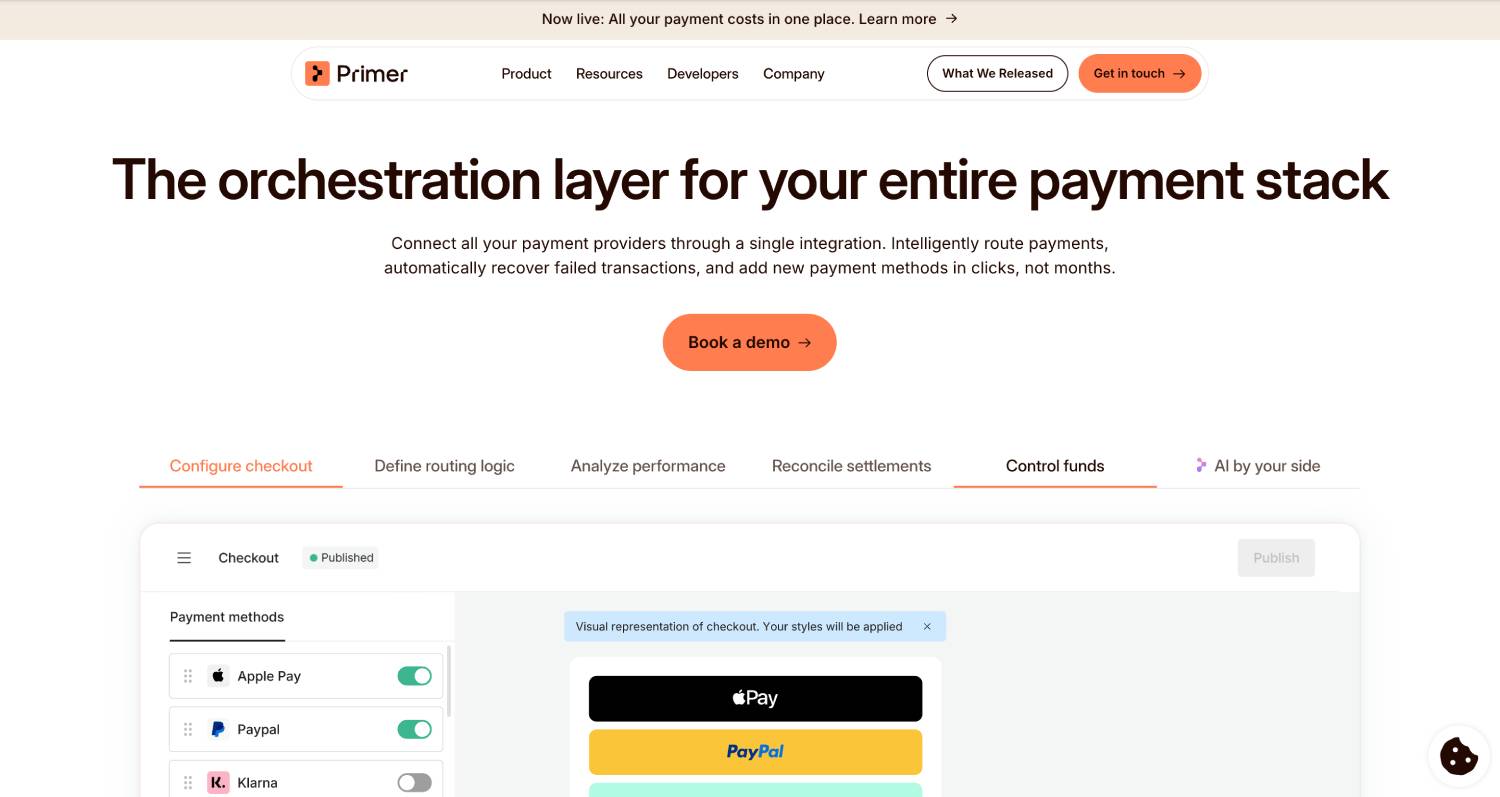
Primer takes a similar orchestration approach to Spreedly but adds a visual workflow builder for routing rules, A/B testing of payment flows, and a broader set of pre-built payment service connections. The pitch is that a payments or FinOps team can adjust routing logic and test checkout configurations without engineering involvement.
Primer positions itself against the scenario where every routing change requires a sprint. For high-volume e-commerce or SaaS companies running payment optimization as an ongoing function, that operational flexibility has real value. Pricing is not public, like Spreedly and other orchestration platforms, Primer prices through a sales process. Primer is a reasonable shortlist candidate if Adyen’s inflexibility on routing and checkout customization is part of why you are looking for an alternative.
7. Rapyd

Rapyd competes on local payment method breadth. Its network covers cash payments, local bank transfers, and regional wallets in markets where card acquiring is not the primary payment method. For platforms expanding into Southeast Asia, Latin America, or Eastern Europe, Rapyd’s local payment method coverage can exceed what Adyen’s acquiring network provides in those regions.
Rapyd also offers a Fintech-as-a-Service layer that includes card issuing, payouts, and e-wallets, which is relevant for platforms that want to combine payment acceptance with payouts to sellers or contractors in emerging markets. Pricing is not publicly listed. Rapyd’s main limitation is that it is not a direct competitor in the US or Western European core card market. It fills gaps that Adyen leaves in emerging market expansion.
8. Nuvei
Nuvei is a Montreal-headquartered processor with notable market share in iGaming, regulated industries, and cross-border payments. It has expanded aggressively into SaaS and platform payments with a modular product that covers acquiring, payouts, card issuing, and local payment methods. Nuvei’s direct acquiring licenses and global bank relationships give it authorization rate claims similar to Checkout.com.
For companies in regulated verticals that Adyen’s risk team declines or underwrites conservatively, Nuvei’s experience in iGaming and financial services means it may approve merchant accounts where others do not. Pricing is enterprise-negotiated. Nuvei is worth including on a shortlist when the merchant category code or regulatory classification of your business is a complicating factor in getting approved with more conservative processors.
9. PayPal Commerce Platform
PayPal Commerce Platform is the enterprise-tier product that sits above standard PayPal and Braintree, designed specifically for platforms and marketplaces. It combines PayPal acceptance, Venmo, Braintree card processing, and Buy Now Pay Later through Pay Later into a single API, with a marketplace split-payment product for distributing funds to sellers.
PayPal is commonly offered as a higher-converting checkout option, particularly in the US consumer market. That is relevant for marketplace platforms where buyer-side conversion affects GMV directly. The limitation is that PayPal Commerce Platform requires accepting PayPal’s terms for sub-merchant onboarding, which are more restrictive in some verticals than Braintree’s or Stripe Connect’s terms. As of November 2026, PayPal does not publicly publish Commerce Platform pricing; it is negotiated based on volume.
Side-by-Side Comparison: Adyen vs Its Nine Competitors
| Processor | Best For | Acquiring Model | Marketplace Payouts | Pricing Transparency |
|---|---|---|---|---|
| Adyen | High-volume global merchants | Direct, 30+ markets | Yes (Adyen for Platforms) | Published rates; minimums apply |
| Checkout.com | Global acquiring, auth rate optimization | Direct, major markets | Limited | Negotiated; no public pricing |
| Worldpay | Enterprise/regulated industries | Direct, global | Limited | Enterprise contracts only |
| Braintree | US marketplaces, developer teams | Aggregator/direct hybrid | Yes | Published standard rates |
| Stripe | SaaS billing, broad product surface | Aggregator-first | Yes (Connect) | Fully published |
| Spreedly | Multi-processor orchestration | Passes through to processor | Depends on processor | Negotiated; no public pricing |
| Primer | Routing optimization, checkout A/B | Passes through to processor | Depends on processor | Negotiated; no public pricing |
| Rapyd | Emerging market local payment methods | Local network/aggregator | Yes | Negotiated; no public pricing |
| Nuvei | Regulated verticals, cross-border | Direct, broad | Yes | Negotiated; no public pricing |
| PayPal Commerce Platform | US consumer marketplaces | Aggregator | Yes | Negotiated; no public pricing |
When Does a Payment Orchestration Layer Beat a Single Processor?
A single-processor migration from Adyen to any one alternative replaces one dependency with another. If Checkout.com has a regional outage or changes its pricing on renewal, you are in the same position you started in. Payment orchestration layers solve a different problem: they let you treat processors as interchangeable infrastructure rather than vendor relationships.
Consider a SaaS platform processing $3 million per month across Europe and North America. Routing all EU cards through a European direct acquirer and all US cards through a US-first processor could reduce cross-border fees meaningfully. Failing over to a secondary processor during peak periods prevents revenue loss from downtime. Neither outcome is achievable with a single-processor contract, regardless of which processor you choose.
Orchestration adds its own cost and integration overhead. It is worth modeling if you are processing above $1 million per month, operating in more than two currency regions, or running authorization rate optimization as an ongoing function. Below that volume, the complexity rarely pays. For a broader view of the infrastructure category, the best payment infrastructure tools for SaaS founders covers both processor and orchestration options in one place.
What Should SaaS Companies Prioritize That Marketplaces Do Not?
SaaS companies with subscription billing have different pressure points than marketplaces. The primary concern is failed payment recovery, not split payouts. A subscription processor needs strong dunning logic, smart retry scheduling, and account updater integration to keep involuntary churn low. Adyen has account updater but its dunning tooling requires custom work. Stripe Billing and Braintree handle retry logic natively.
Tax compliance is the other SaaS-specific variable. A processor that handles card acquiring does not automatically handle sales tax calculation or VAT for international subscribers. If you are selling to businesses in multiple US states or internationally, that is a separate layer. The distinction between a merchant of record and a payment processor matters here. Some SaaS companies solving for global tax compliance are better served by a merchant of record than by a payment processor replacement.
How Do Marketplace Payout Requirements Change the Processor Decision?
Marketplaces face a structural compliance requirement that direct merchants do not: they must onboard sellers as sub-merchants and manage beneficial ownership verification, often under FinCEN’s rules. The processor that handles your buyer-side card acquiring may not be the same infrastructure layer that handles seller onboarding and payouts.
Stripe Connect, Braintree Marketplace, Adyen for Platforms, and PayPal Commerce Platform all attempt to handle both sides of that equation in one product. Each has limits. Stripe Connect’s onboarding flow works well for US sellers and reasonably well in Europe but has gaps in emerging markets. Adyen for Platforms has stronger global payout rails but heavier underwriting requirements for sub-merchants.
For platforms that need highly customized seller onboarding with risk-tiered KYC, the cleaner architecture is often to use a PayFac-as-a-service layer for sub-merchant management and a separate processor for acquiring. That separation adds complexity but gives you more control. The leading PayFac-as-a-service providers offer another path that does not force you to choose a single processor to solve every problem.
Frequently Asked Questions
Is Checkout.com a direct replacement for Adyen?
Checkout.com is the closest functional replacement for Adyen among single-processor alternatives. Both hold direct acquiring licenses in major markets, both price on interchange-plus models, and both pitch on authorization rate optimization. The main difference is that Adyen has a longer enterprise track record and a more developed platform product for marketplaces. Checkout.com is competitive in Europe and Asia but has fewer enterprise case studies at the same scale as Adyen’s largest merchants.
Can Stripe replace Adyen for a high-volume enterprise?
Stripe can replace Adyen for most SaaS and marketplace use cases at scale, but it has a known limitation: its aggregator model in some markets produces lower authorization rates on international cards than Adyen’s direct acquiring. For companies processing primarily in the US where Stripe has strong acquiring, the gap narrows significantly. For high-volume cross-border merchants where even a 0.5% difference in auth rates represents material revenue, the comparison deserves a quantitative model, not a default assumption either way.
What is payment orchestration and when should I use it instead of switching processors?
Payment orchestration is a middleware layer that routes transactions across multiple processors based on rules you define, such as geography, card type, cost, or failure recovery. It makes sense when you need multi-processor redundancy, regional routing for cost reduction, or the ability to add or swap processors without rebuilding your integration. Companies processing under $1 million per month rarely justify the added complexity. Above that threshold, orchestration can reduce total processing cost and increase authorization rates, often more effectively than any single-processor migration.
Does Adyen have monthly minimums?
Adyen does require a minimum monthly fee for processing accounts. The specific amount varies by contract and merchant category, and Adyen does not publish this figure on its public pricing page as of November 2026. The minimums are most punishing for companies in a growth phase where processing volume fluctuates month to month. If your volume is not consistently high, the minimums represent a fixed cost that makes per-transaction economics look worse than the headline rates suggest.
Which Adyen alternative is best for a two-sided marketplace?
For US-focused two-sided marketplaces, Stripe Connect and Braintree Marketplace are the most developer-accessible options with established split-payment APIs. For global marketplaces that need local acquiring and emerging-market payout rails, Adyen for Platforms and Rapyd are stronger candidates. If sub-merchant onboarding volume is high and customized risk tiering matters, separating the acquiring layer from the sub-merchant management layer with a PayFac-as-a-service provider often produces a cleaner architecture than any single-vendor solution.
How do I evaluate whether Adyen’s pricing is actually competitive for my volume?
Start with your actual transaction mix: average ticket size, card types accepted, percentage of international cards, and chargeback rate. Apply interchange-plus pricing to that mix using published interchange tables from Visa and Mastercard, then add Adyen’s processing fee. Compare that total against quotes from Checkout.com and Braintree using the same transaction inputs. The difference in headline rates rarely tells the full story. Cross-border fees, scheme fees, and minimum monthly charges determine the actual cost at your specific volume profile. Those numbers should drive the decision, not the marketing deck.
The Decision Most Teams Make Too Late
The mistake that surfaces repeatedly in payment processor migrations is evaluating alternatives only after the pain of the current contract becomes acute. By that point, the migration timeline is compressed, the team is reactive, and the new vendor negotiates from a position of strength. The teams that get the best pricing and the most favorable contract terms are the ones that run a competitive process before they have to, ideally 6-12 months before renewal or before hitting the volume threshold where minimums become material.
Adyen is a genuinely good processor for the merchant profile it was built for. The alternative list above is not a ranking of better options. It is a map of which option fits which situation. Checkout.com and Nuvei are serious global acquiring alternatives. Braintree and Stripe are developer-first options that trade some acquiring reach for integration speed. Spreedly and Primer are not Adyen replacements at all. They are infrastructure choices that make the processor decision less permanent. That distinction is what most comparison articles miss.
If you are building a payment stack from scratch and reading this before committing to any single vendor, the strongest position is one where your payment credentials are stored in a vault you control, your processor choice is abstracted behind an orchestration layer, and your contract includes volume-based pricing reviews. That architecture is harder to build than plugging in a single SDK, but it means that the next time a processor changes pricing or has a regional outage, it is a routing rule change, not an engineering project. The most common fintech infrastructure mistakes share one pattern: locking in a vendor before the architecture was designed to accommodate change.