


TLDR
- Tipalti is not the only serious option for global AP and mass payouts. Bill.com, Airbase, Trolley, Payoneer, Stampli, Coupa, Netsuite AP, and Part.com all cover overlapping ground with different pricing models and ERP compatibility.
- The most common reason teams leave Tipalti is pricing opacity at lower volumes and a setup process that takes longer than expected for smaller finance teams.
- If you pay fewer than 1,000 payees per month internationally, several cheaper alternatives handle the same tax form collection, FX, and local rail delivery without enterprise contract minimums.
- ERP fit is the real differentiator. The right Tipalti alternative depends almost entirely on whether you live in NetSuite, QuickBooks, Sage, or a custom stack.
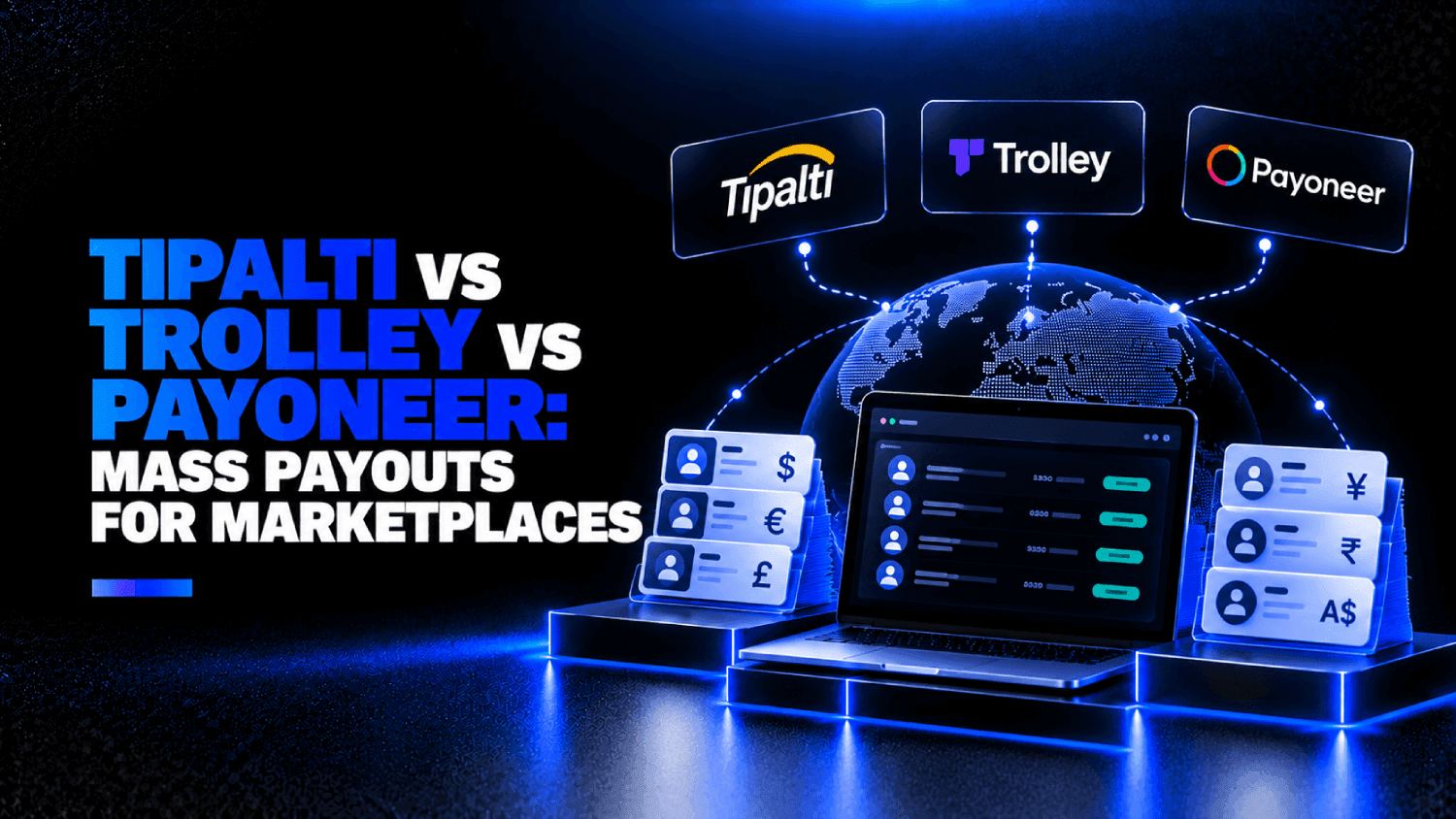
- Marketplace-specific payout needs (split payments, seller onboarding, 1099 compliance) belong to a different product category. For that use case, see the Tipalti vs Trolley vs Payoneer comparison.
The main Tipalti alternatives for AP and global payables are Bill.com, Airbase (now part of Maxio), Stampli, Trolley, Payoneer, Coupa, Sage AP Automation, and NetSuite Bill Pay. Each fits a different company size and ERP stack. Bill.com suits SMBs on QuickBooks or Xero, Tipalti suits high-volume global payables teams, and Coupa fits large enterprises that need procurement and AP in one contract.
Why Are Finance Teams Looking for a Tipalti Replacement?
Tipalti targets finance teams processing high volumes of international supplier and contractor payments. Its pitch is end-to-end AP automation: invoice capture, approval workflows, tax form collection (W-9, W-8BEN, VAT), multi-currency payouts via ACH, wire, PayPal, and local bank transfers, plus 1099 and 1042-S filing. That is a genuinely wide feature surface.
The complaints that push teams to look for alternatives cluster around three things. First, pricing is not publicly disclosed and contracts typically require a demo before any numbers appear, which frustrates buyers who want to compare costs quickly. Second, implementation can take weeks for teams without a dedicated finance ops person. Third, some mid-market teams find the platform over-engineered for their actual payee volume.
For teams comparing Bill.com against Tipalti directly, our Bill.com vs Tipalti breakdown covers how the two platforms differ on approval routing, global payout reach, and ERP depth.
The FintechSpecs AP Fit Test: Four Questions Before You Shortlist
Before evaluating any alternative, run what we call the FintechSpecs AP Fit Test. It is four questions that cut the field significantly before you book a single demo.
1. What is your monthly payee count? Under 500 payees per month, you probably do not need enterprise AP software. 500 to 5,000 puts you in the mid-market tier. Above 5,000, you need Tipalti-class tooling or a direct competitor built at that scale.
2. What percentage of payments are cross-border? If over 40% of your payments go outside the US, the platform’s local rail coverage and FX spread matter more than any other feature. If you are mostly domestic, most alternatives will do.
3. What is your primary ERP? NetSuite, QuickBooks, Sage, SAP, and Workday each have different native integrations across these platforms. A mismatch creates reconciliation headaches that eat whatever you saved on the platform fee.
4. Do you need payee self-service? Some platforms (Tipalti, Trolley, Payoneer) have a payee portal where contractors submit banking details and tax forms directly. Others route everything through your AP team. That difference alone shapes how much internal labor the tool requires.
Which Tipalti Alternatives Actually Cover Global Payables?
| Platform | Best For | International Payout Reach | ERP Fit | Public Pricing |
|---|---|---|---|---|
| Bill.com | SMB and lower mid-market | Limited (USD-focused) | QuickBooks, Xero, NetSuite | Yes |
| Stampli | AP invoice automation | Domestic-first | Broad ERP coverage | No (quote only) |
| Trolley | Contractor and affiliate payouts | Strong (220+ countries) | API-first, limited native ERP | Partial |
| Payoneer | Freelancer and marketplace payouts | Strong (200+ countries) | Minimal native ERP | Partial |
| Airbase / Maxio | Spend management plus AP | Limited (US-centric) | NetSuite, QuickBooks | No (quote only) |
| Coupa | Enterprise procurement plus AP | Strong (global) | SAP, Oracle, NetSuite | No (quote only) |
| Sage AP Automation | Sage ERP users | Moderate | Sage native | Varies by plan |
| NetSuite Bill Pay | Teams already on NetSuite | US-focused | NetSuite native | Bundled with NetSuite |
Bill.com: The Obvious Starting Point for SMBs Leaving Tipalti
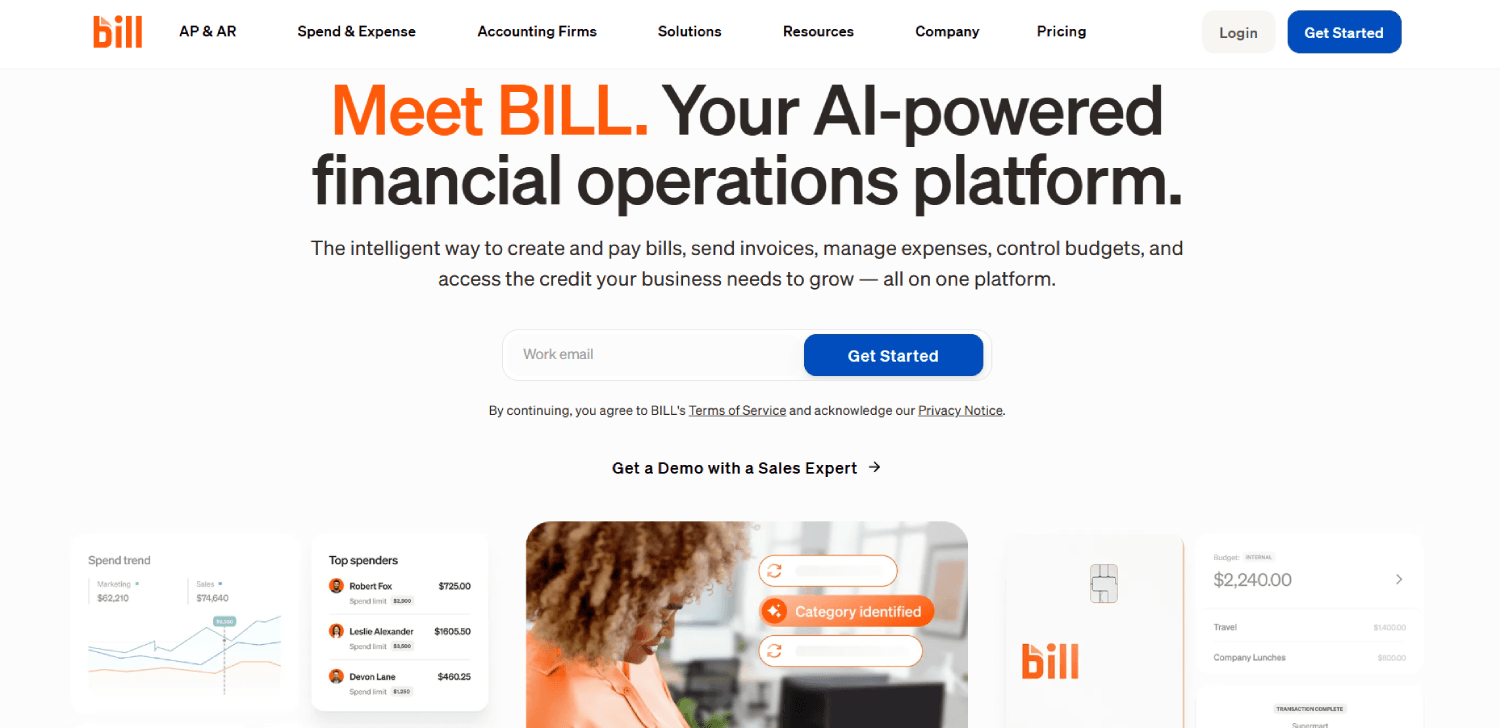
Bill.com is the most searched Tipalti alternative, and the comparison is not always fair to either product. Bill.com targets smaller finance teams processing domestic and limited international payments. Tipalti targets operations processing thousands of international supplier invoices per month. These are different markets using the same label.
Bill.com’s public pricing (as of November 2026) starts at $45 per user per month for the Essentials plan and rises to $79 per user per month for the Team plan, with custom pricing for the Corporate and Enterprise tiers. International payments carry additional wire fees. The platform connects natively to QuickBooks Online, Xero, Sage Intacct, Oracle NetSuite, and Microsoft Dynamics.
Where Bill.com lags behind Tipalti is payee self-service and tax form collection at scale. If your contractors are filing W-8BEN forms in multiple countries, Bill.com’s tooling for that workflow is less mature. For domestic-focused AP with clean ERP sync, it is cheaper and faster to implement.
Stampli: For Teams That Need Better Invoice Approval, Not Global Payouts
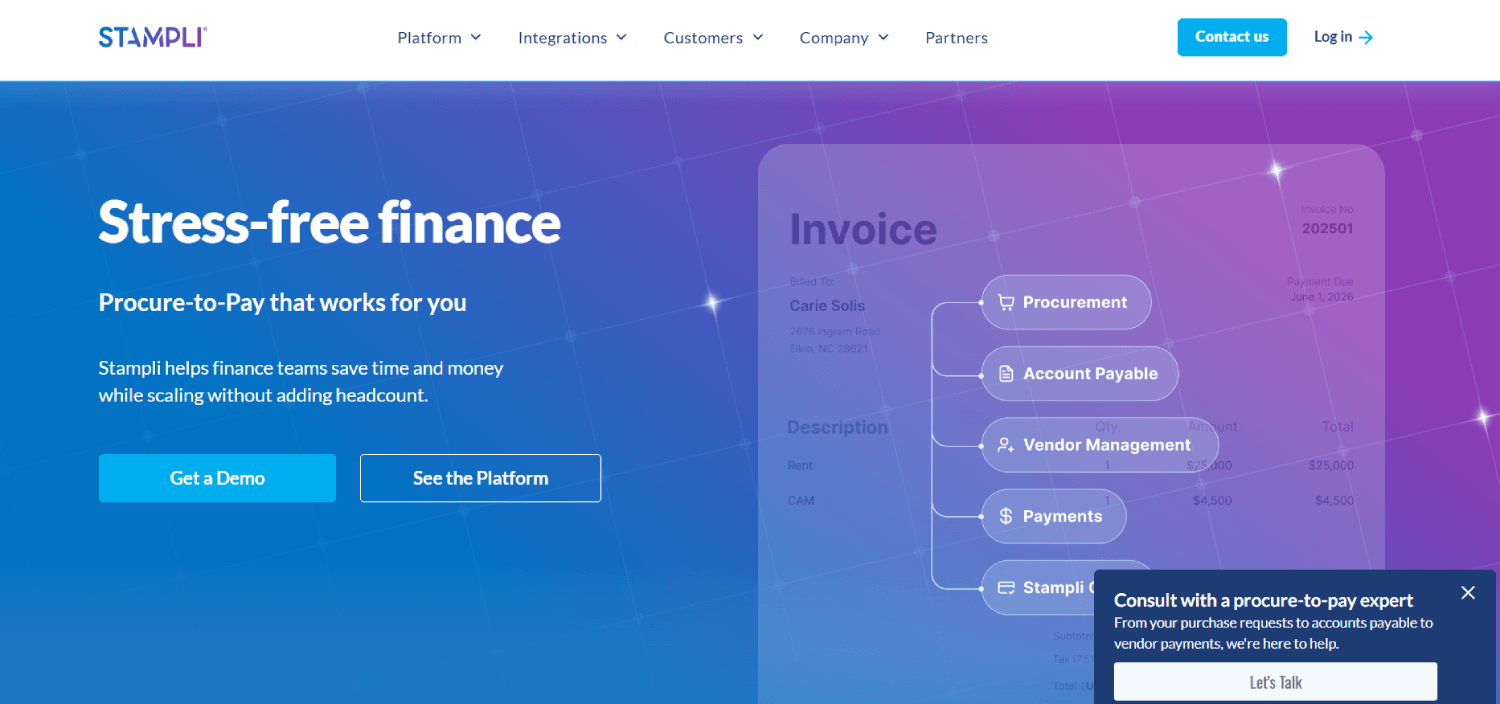
Stampli positions itself around invoice processing intelligence rather than global payout reach. Its differentiator is an AI layer that learns your GL coding patterns and flags anomalies in approval workflows. Teams running 200 to 2,000 invoices per month with complex internal approval chains tend to find it faster to implement than Tipalti.
Stampli does not publish pricing publicly as of November 2026. It integrates with over 70 ERPs per its public documentation, which is a broader list than most alternatives in this tier. If your problem is invoice capture, three-way matching, and approval routing rather than cross-border supplier payments, Stampli is worth a demo. If you need to pay contractors in Indonesia, Vietnam, or Colombia via local rails, it is the wrong tool.
For teams evaluating AP automation tools more broadly, the full accounts payable automation roundup covers the wider field beyond these Tipalti-specific alternatives.
Trolley: The Closest Global Payout Competitor for Mid-Market Teams
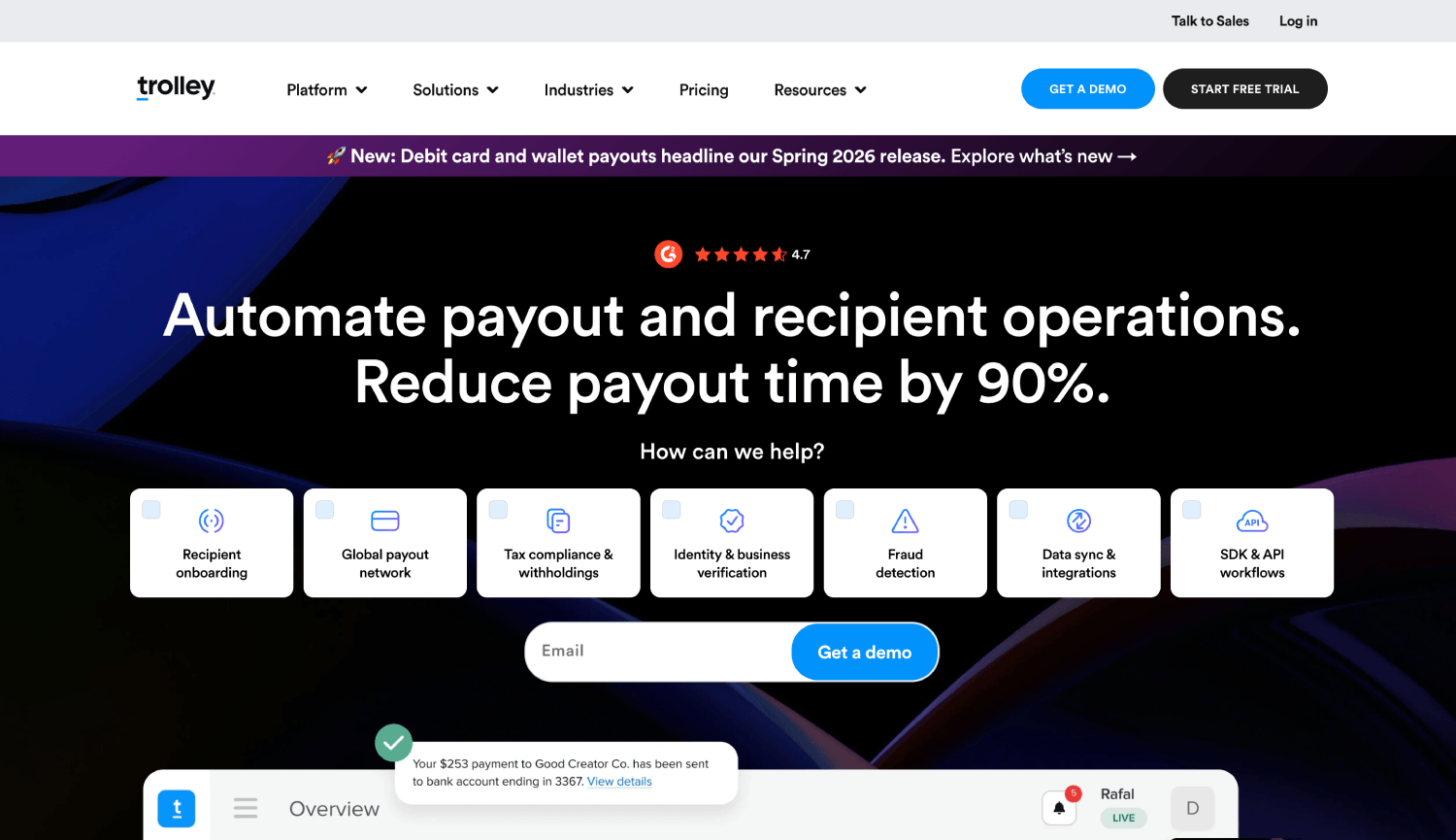
Trolley (formerly Payment Rails) is the most direct functional competitor to Tipalti for companies running contractor or affiliate payouts globally. It covers 220+ countries, supports payouts via bank transfer, PayPal, and other rails, and handles 1099 and 1042-S tax form collection and filing. The payee portal experience is comparable to Tipalti’s.
Trolley’s pricing is partially public as of November 2026. The standard tier charges per payout rather than a flat monthly platform fee, which makes it meaningfully cheaper for teams with variable monthly volumes. That per-transaction model also means costs can rise sharply at high volumes, so the math favors Trolley under roughly 1,000 payees per month.
The practical gap versus Tipalti is ERP integration depth. Trolley is more API-first than native-ERP-first, so teams without engineering resources to maintain an integration should factor that into the evaluation. It is a strong Tipalti replacement for digital media, creator economy, and affiliate network operators who need global payee reach without enterprise contract minimums.
Payoneer: Global Reach With a Different Business Model
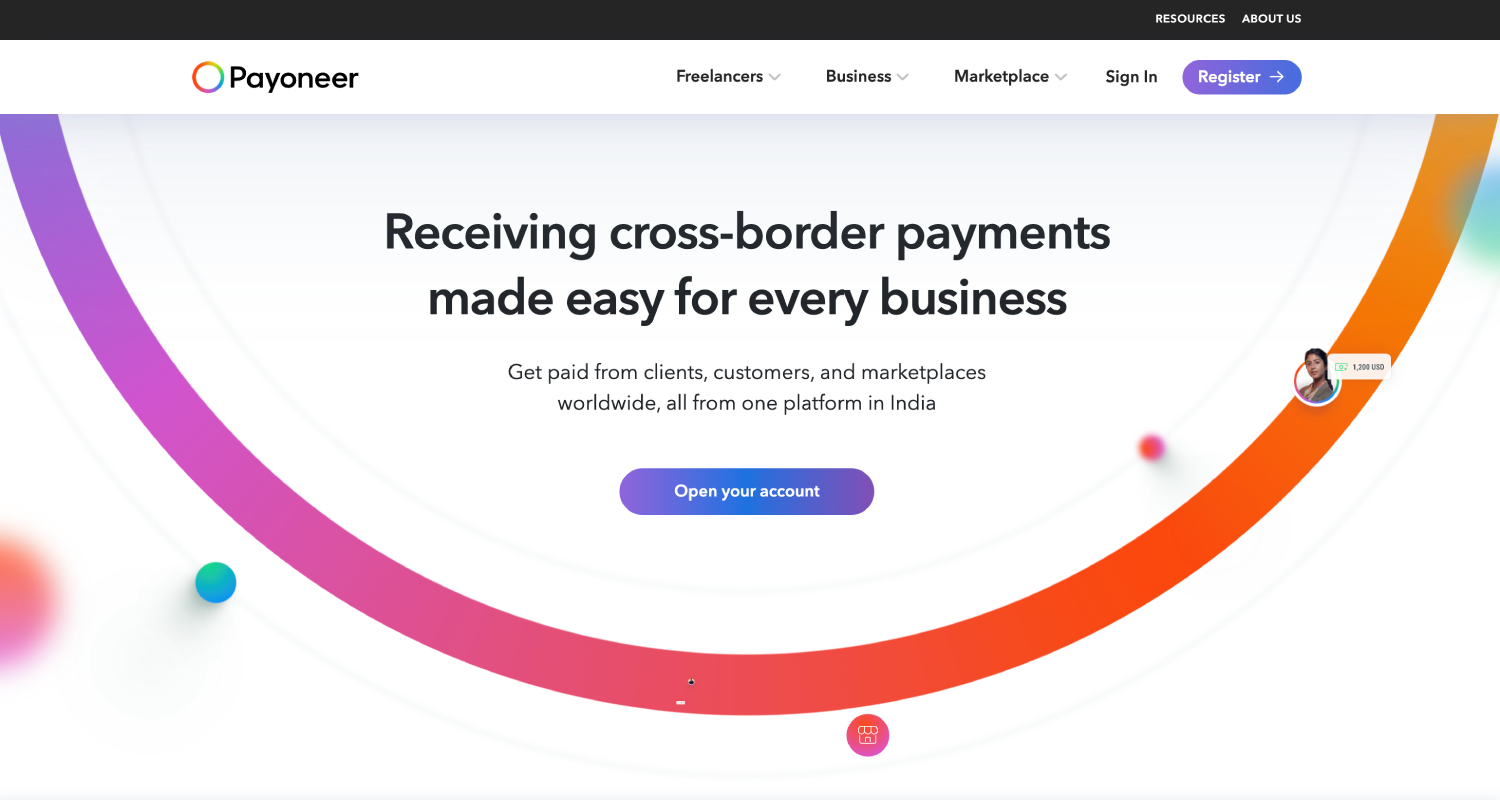
Payoneer is a Tipalti alternative in the same way that a wire transfer is an alternative to an AP platform: it solves part of the problem. Payoneer excels at cross-border payments, covering over 200 countries with local bank transfer support and competitive FX rates. It is also one of the few platforms where payees can hold balances in multiple currencies.
What Payoneer lacks relative to Tipalti is the AP workflow layer: invoice capture, three-way matching, GL coding, approval routing, and deep ERP sync are not Payoneer’s strengths. Teams using Payoneer as a Tipalti replacement typically handle the AP workflow in their ERP or accounting software and use Payoneer purely as the payout rail.
That split architecture works for companies that already have a functional AP process and need only the payment execution piece handled globally. It does not work for teams trying to consolidate the full invoice-to-payment cycle in one platform. Payoneer’s fee structure as of November 2026 varies by payment method and corridor, with some details published on their pricing page and others disclosed only after account creation.
Airbase (Now Maxio): Spend Management That Includes AP
Airbase merged with Maxio in 2023, and the combined platform now covers subscription billing alongside spend management and AP. For companies already using Airbase for corporate cards and expense management, extending to AP automation in the same tool reduces the number of finance platforms to reconcile.
Airbase’s AP module handles domestic bill pay with approval workflows and ERP sync. Its international payout coverage is narrower than Tipalti or Trolley. Teams processing primarily US-based supplier invoices, with occasional international wires, fit the product well. Teams running high-volume international contractor payouts will find gaps.
Pricing is not public as of November 2026 and requires a sales conversation. The platform targets Series A through Series C companies, which aligns with the audience most likely to be re-evaluating Tipalti’s contract economics.
Coupa: The Enterprise Alternative With Procurement Included

Coupa is Tipalti’s enterprise-tier competitor. It combines procurement, invoice management, expense management, and payment execution in a single platform. For companies where procurement and AP are separate teams that need to share workflow and data, Coupa removes the integration gap that often exists between a standalone AP tool and a procurement system.
Coupa’s pricing is not publicly disclosed as of November 2026 and typically involves multi-year enterprise contracts. Implementation timelines are measured in months, not weeks. If your company is below $100M in revenue or fewer than 200 employees, Coupa is likely over-engineered and over-priced for your current stage.
Where Coupa earns its cost is global supplier network coverage. Its pre-vetted supplier network reduces payee onboarding friction for large procurement teams managing hundreds of vendors across multiple countries. For the right organization, that is a genuine time and compliance advantage.
Sage AP Automation: The Right Answer If You Are Already on Sage
Sage’s AP automation capabilities are native to Sage Intacct and Sage 50cloud, which matters enormously if your ERP is already in the Sage environment. Switching AP platforms while staying on Sage avoids the integration cost that any third-party tool introduces. Sage’s AP module handles invoice capture, approval workflows, and payment processing with minimal configuration for existing Sage users.
Sage’s international payout reach is moderate rather than comprehensive. Teams with significant global supplier bases may still need a secondary payment rail. For primarily domestic operations on Sage, it is the lowest-friction option on this list.
NetSuite Bill Pay: If You Live in NetSuite, Start Here
NetSuite’s native bill pay functionality is frequently overlooked in comparisons because it is bundled rather than sold as a standalone AP product. For companies already on NetSuite, it handles domestic ACH and check payments with full GL coding and approval workflow inside the ERP. The reconciliation is automatic because payment and accounting live in the same system.
NetSuite Bill Pay’s limitation is international payment support. For cross-border payouts, most NetSuite users add a third-party connector, commonly Tipalti (which has a deep NetSuite integration) or one of the payout API providers covered in the cross-border payout API comparison. If your global payment volume is low, NetSuite’s native tooling plus a lightweight payout API may be cheaper than any dedicated AP platform.
Finance teams building out the broader infrastructure stack alongside AP tooling should also look at how payee tax compliance layers on top of these platforms. The payee tax compliance tools comparison covers W-9, W-8BEN, and 1099 automation across several of the vendors listed here.
How Do These Tipalti Alternatives Compare on Payee Tax Compliance?
| Platform | W-9 / W-8BEN Collection | 1099 Filing | 1042-S Filing | VAT Handling |
|---|---|---|---|---|
| Tipalti | Yes (payee portal) | Yes | Yes | Yes |
| Bill.com | Partial | Yes (1099 only) | No | No |
| Trolley | Yes (payee portal) | Yes | Yes | Partial |
| Payoneer | Partial | Limited | No | No |
| Stampli | No | No | No | No |
| Airbase / Maxio | Partial | Limited | No | No |
| Coupa | Yes | Yes | Yes | Yes |
| Sage AP Automation | Partial | Partial | No | Partial |
| NetSuite Bill Pay | No (requires add-on) | Via SuiteTax | No (requires add-on) | Via SuiteTax |
What Is the Real Cost Difference Between Tipalti and Its Competitors?
Tipalti does not publish pricing. The company requires a demo conversation before any numbers surface, and contract terms vary significantly by payee volume and feature set. This makes direct cost comparison difficult, which is itself a reason some teams look elsewhere.
Consider a hypothetical mid-market scenario: a 150-person company processing 400 international contractor payments per month in 15 countries, primarily via ACH and local bank transfer, with 1099 and 1042-S requirements. At that volume, Tipalti’s platform fee is not publicly disclosed; the company does not publish pricing on its website and requires a demo to receive a quote. Trolley at that volume, using its published per-payout pricing model, would likely land lower than a typical Tipalti contract at comparable volume. Bill.com at $79 per user per month plus transaction fees would cost less still, but it would not cover the 1042-S requirement or the breadth of local rails needed.
The honest takeaway: if your international payee count is under 300 per month, the premium Tipalti charges for its full compliance and payee portal stack is harder to justify. Above 1,000 payees per month with meaningful 1042-S and VAT exposure, Tipalti’s consolidation value starts to pay for itself in avoided headcount and compliance risk. The range in between is where the switching decision is genuinely close.
Finance leaders evaluating infrastructure costs across the full stack may also find the hidden cost breakdown for fintech SaaS margins relevant, particularly the sections on vendor platform fees and reconciliation labor.
Frequently Asked Questions
What is the cheapest alternative to Tipalti for a startup paying fewer than 200 contractors per month?
Bill.com is typically the cheapest starting point for sub-200 payee volumes, with published pricing starting at $45 per user per month as of November 2026. If a significant share of those payments are international and require 1042-S compliance, Trolley’s per-payout model is likely more cost-effective than committing to a Tipalti contract. For purely domestic payments, NetSuite Bill Pay bundled into an existing NetSuite license costs nothing incremental.
Can Bill.com replace Tipalti for international payments?
Not directly. Bill.com handles international wires in a limited number of currencies but does not offer the same local rail coverage, payee self-service portal, or tax form collection depth (particularly for W-8BEN and 1042-S) that Tipalti provides. Teams with significant international contractor bases and cross-border tax obligations will find Bill.com inadequate as a full Tipalti replacement. It works for companies where international payments are occasional rather than systematic.
Which Tipalti alternative has the best ERP integrations?
Stampli has the broadest ERP integration list, covering over 70 ERP systems per its public documentation. Bill.com integrates natively with QuickBooks, Xero, Sage Intacct, NetSuite, and Microsoft Dynamics. Coupa integrates deeply with SAP, Oracle, and NetSuite at the enterprise tier. If your ERP is not on a vendor’s native list, factor in the API development cost or middleware fees before comparing platform pricing.
Does Trolley fully replace Tipalti for marketplace and affiliate payouts?
Trolley is the closest functional alternative for marketplace and affiliate payout use cases. It covers 220+ countries, supports multiple payout rails, and handles 1099 and 1042-S filing with payee self-service. The gap is ERP integration depth: Trolley is more API-first than native-ERP-first, which can create reconciliation work for teams without engineering support. For a full three-way comparison on marketplace payout platforms, see the Tipalti vs Trolley vs Payoneer comparison.
How long does it take to implement a Tipalti alternative?
Implementation timelines vary by platform and finance team size. Bill.com typically takes one to two weeks for a small team. Stampli’s onboarding is designed to be faster than traditional AP platforms, with some teams live within a week. Trolley’s API-first architecture means implementation time depends heavily on internal engineering capacity. Coupa implementations run three to twelve months. Tipalti itself typically takes four to twelve weeks, which is a common complaint from teams that expected faster onboarding.
What should I do about 1099 and 1042-S compliance when switching away from Tipalti?
Before switching, map which of your payees require 1042-S filing versus 1099. That distinction determines your shortlist: only Tipalti, Trolley, and Coupa handle 1042-S with any depth in this comparison. If you switch to a platform without 1042-S support, you will need a separate payee tax compliance layer. The payee tax compliance tools comparison covers standalone vendors that fill that gap for teams using platforms without native support.
Is Airbase a good Tipalti replacement after the Maxio merger?
Airbase is a strong replacement if your primary AP pain point is domestic bill pay with better approval workflows and spend visibility alongside corporate cards and expenses. After merging with Maxio, the combined platform targets SaaS finance teams managing both billing and AP. It is not a strong replacement if you need international payout reach or 1042-S compliance. The Tipalti use case it replaces is narrow: US-focused AP with complex internal approval routing.
Who Should Actually Switch Away From Tipalti?
Tipalti’s market position is defensible at scale. For teams paying 1,000 or more international payees per month, with 1042-S obligations and multi-currency ERP reconciliation requirements, the alternatives on this list either cannot match the feature set or would cost more in aggregate when you price in the gaps. The switching calculus at that volume rarely favors moving.
The teams with a genuine case for switching are earlier-stage companies that signed a Tipalti contract before their payee volume justified it, or companies whose payment activity is primarily domestic with occasional international wires that do not require the full compliance stack. For those teams, Bill.com or NetSuite Bill Pay plus a lightweight payout API is a materially cheaper and simpler architecture.
The most useful frame is not which platform is better in the abstract but which platform is correctly sized for your current operation and the one you will have in 18 months. Overpaying for Tipalti at 150 payees per month is a real cost. Underpaying for Bill.com and absorbing manual 1042-S filing for 800 international contractors is also a real cost, it just shows up in finance team hours rather than on a vendor invoice. The right answer is whichever platform closes that gap most economically for your specific volume, geography, and ERP stack.




9 Best AI Month-End Close Tools for Accounting Teams