
TLDR
- Tipalti, Trolley, and Payoneer approach mass payouts from fundamentally different starting points: Tipalti is built for AP automation with payouts as an output, Trolley is built specifically for marketplace recipient onboarding and 1099/1042-S compliance, and Payoneer is a global payments network first and a platform payout tool second.
- Tax form handling is the sharpest dividing line. Tipalti collects W-9/W-8 data during onboarding and files 1099s natively. Trolley does the same with an API-first design built for developer integration. Payoneer leaves most tax compliance to the platform.
- Recipient experience varies enormously: Trolley gives recipients a self-service portal and payment preferences dashboard; Payoneer recipients get a full Payoneer account with a debit card; Tipalti recipients choose from a payment method menu but stay within your platform’s branded flow.
- Pricing structures differ in ways that punish the wrong buyer: Tipalti’s annual contract fees favor finance teams running high-volume AP, Trolley’s per-payout model scales predictably for marketplaces, and Payoneer’s fee structure is oriented toward recipients, not platforms.
- The Hyperwallet comparison (now PayPal’s payout infrastructure) belongs in this conversation for enterprise marketplace deployments, and it changes the calculus at scale.
Tipalti handles AP automation with tax compliance baked in. Trolley handles marketplace payouts with API-first recipient onboarding and native 1099/1042-S filing. Payoneer operates as a global payment network that platforms can plug into, but without the compliance scaffolding the others provide. The tipalti vs trolley decision comes down to whether your organization needs a finance-led AP workflow or an API-first marketplace payout layer , and the answer to that question determines almost everything else. For a US marketplace paying gig workers or sellers across borders, Trolley fits best at the Series A-to-C stage. Tipalti fits finance-led orgs with complex AP needs. Payoneer fits recipient-facing networks where end users already have or want a Payoneer account.
Why Mass Payout Platforms Are Not Interchangeable
Most marketplace founders shortlist these three tools because they all send money to many people at once. That framing misses what actually differs between them and what those differences cost at scale.
Payout platforms split into two architectural types. The first type is finance-layer tools: they sit in your AP workflow, handle invoice approvals, manage global supplier payments, and produce tax documents as a byproduct. Tipalti is the clearest example. The second type is recipient-layer tools: they sit between your platform and your payees, handle onboarding, payment preferences, identity verification, and compliance at the recipient level. Trolley and, to a significant extent, Hyperwallet fit here.
Payoneer is neither cleanly. It is a payment network with platform APIs bolted on, which is why it works well when your recipients already use or want a Payoneer account, and works poorly when you need to control the full recipient experience or own the compliance chain.
What Does Tipalti Actually Do for Marketplace Payouts?
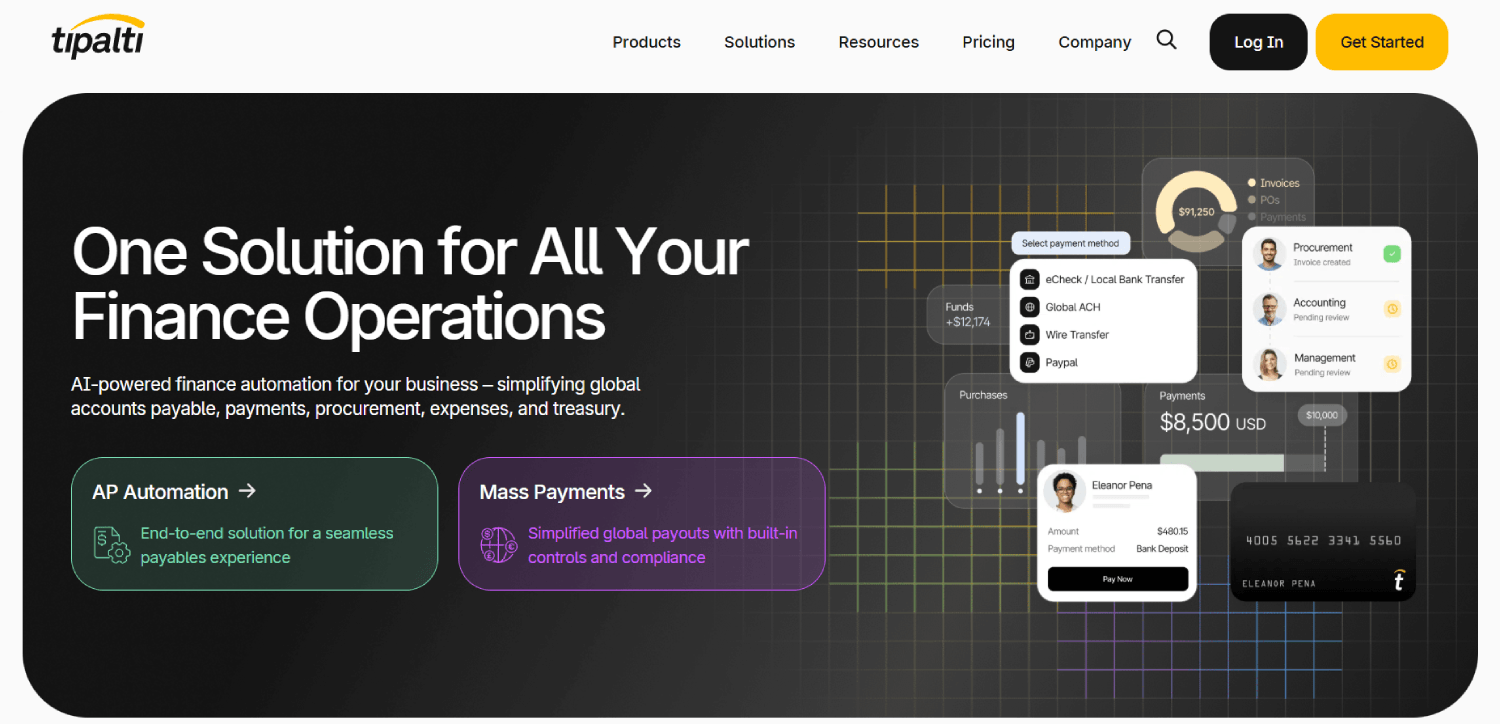
Tipalti’s core product is accounts payable automation. Payouts to partners, affiliates, publishers, and suppliers are a natural extension of that core, which means the platform carries significant infrastructure that most marketplaces will never use: invoice capture, PO matching, approval workflows, ERP sync with NetSuite, SAP, and QuickBooks.
For payout-specific needs, Tipalti handles payment method selection (ACH, wire, PayPal, prepaid debit, check, eCheck across 190+ countries as listed on their public product pages), collects tax form data directly from payees through a self-service portal, and manages 1099-MISC, 1099-NEC, and 1042-S filing. The tax module is the strongest argument for Tipalti among finance-led orgs. If your controller is worried about year-end 1099 filing across 2,000 contractors, Tipalti handles collection, validation, and IRS submission natively.
The trade-off is pricing structure and contract terms. Tipalti does not publish pricing publicly; the platform operates on negotiated annual contracts. Reviews on G2 consistently indicate that entry-level plans require minimum annual commitments that price out early-stage startups. A company processing fewer than several hundred payouts per month rarely finds Tipalti cost-effective against Trolley. The Bill.com vs Tipalti comparison on FintechSpecs goes deeper on where Tipalti’s AP features actually justify that price gap.
Tipalti’s developer API exists, but the platform is primarily configured through its dashboard, not integrated programmatically the way Trolley is. That distinction matters for product teams building payout flows natively into their marketplace UX.
What Does Trolley Do Differently for Marketplace Payouts?
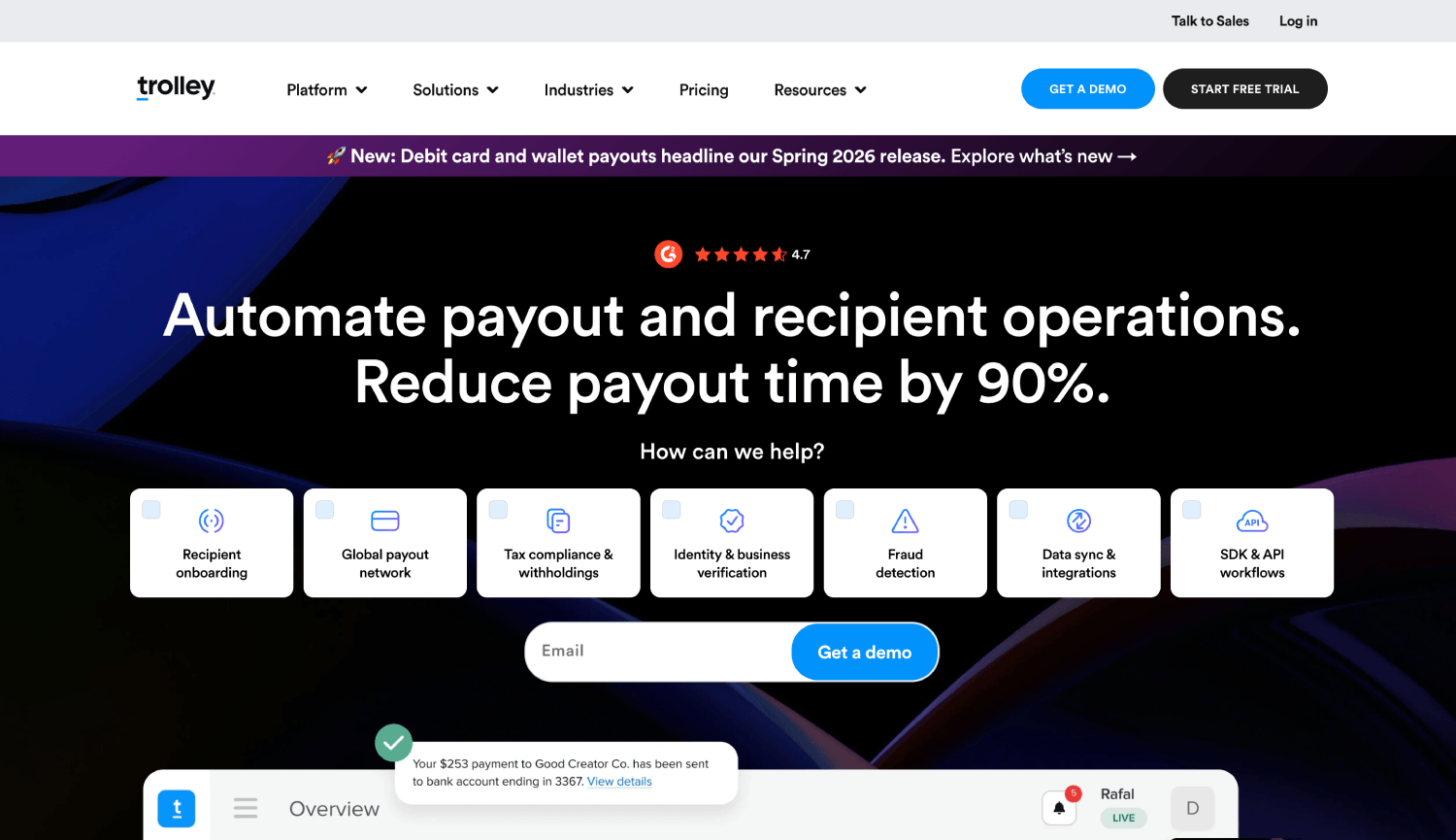
Trolley (formerly Payment Rails) was built specifically for platforms paying large numbers of recipients: gig economy apps, creator platforms, insurance marketplaces, freelance networks. The architecture reflects that origin in three concrete ways.
First, recipient onboarding is API-native. A developer can trigger a recipient signup flow, collect bank account details or payment preferences, run identity verification, and store that information programmatically. This matters when your marketplace already has a signup flow and you do not want to redirect users to a separate portal to set up their payout preferences.
Second, tax compliance is treated as a first-class feature rather than a module add-on. Trolley collects W-9 and W-8-BEN data during recipient onboarding, validates the information, and files 1099-NEC, 1099-MISC, and 1042-S forms. The filing infrastructure covers both domestic and international recipients, which is the pain point that trips up most marketplaces once they cross into cross-border payouts.
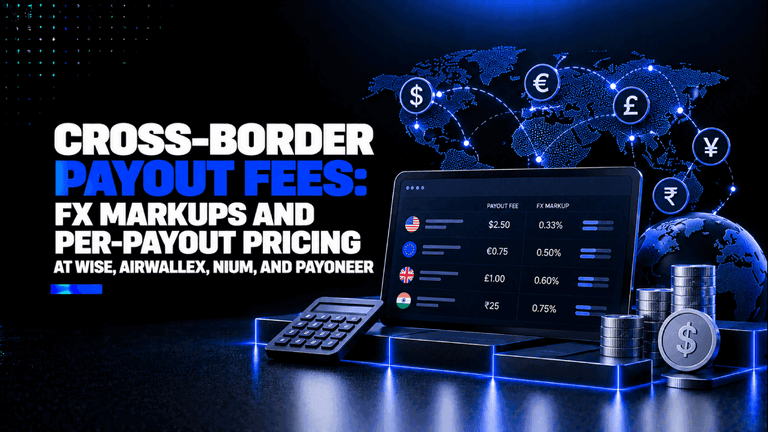
Third, Trolley publishes pricing. As of Trolley’s public pricing page, the platform charges a per-payout fee in addition to a monthly platform fee, with both rates scaling based on volume. Exact figures are not reproduced here because Trolley updates its pricing page periodically , check the page directly for current rates before modeling costs. This transparency is operationally significant for marketplace finance teams modeling payout costs at different GMV levels. For detailed cross-platform payout fee comparisons, the cross-border payout fee breakdown across Wise, Airwallex, Nium, and Payoneer provides useful benchmarking context.
Trolley’s payment rail coverage includes ACH, wire, PayPal, and a number of local payout methods in international markets. Coverage depth is narrower than Payoneer’s global network, which matters if your recipients are concentrated in emerging markets.
What Does Payoneer Offer for Platform Payouts?
Payoneer operates as both a financial services network for recipients and a B2B payout infrastructure layer for platforms. The distinction is important. When a recipient receives a payout through Payoneer, they get a Payoneer account, a prepaid Mastercard, and the ability to hold and spend funds in multiple currencies. That is a meaningful benefit for freelancers and sellers in markets with limited banking infrastructure.
For platforms, Payoneer’s Mass Pay and Partner Payouts APIs allow batch payment initiation to registered Payoneer users. The friction point is that recipients must have or create a Payoneer account to receive funds, which adds a step to onboarding that some users abandon. For marketplace operators, that abandonment rate is a real cost even if it never appears on a vendor invoice.
Payoneer’s global coverage is the strongest in this comparison: the platform supports payouts in 190+ countries across multiple currencies as stated on Payoneer’s mass payouts product page, and recipients in markets where Payoneer’s debit card is useful (parts of Southeast Asia, Eastern Europe, Latin America) actively prefer it. If your seller base is internationally distributed and many recipients already have Payoneer accounts, that existing network effect reduces your onboarding friction rather than adding to it.
Tax compliance is the weakest area. Payoneer does not natively manage 1099 filing or W-9/W-8 collection on behalf of platforms. Platforms using Payoneer for contractor payouts typically need a separate tax compliance solution, which adds cost and integration complexity. This is a meaningful gap for US-based marketplaces with 1099-NEC filing obligations. See the best 1099 and tax compliance APIs for platforms paying contractors for tools that fill this gap alongside Payoneer.
Where Does Hyperwallet Fit Against Tipalti?
Hyperwallet, now owned by PayPal and branded as PayPal Payouts for Enterprise, entered this comparison because it targets the same enterprise marketplace segment as Tipalti’s payout module. The hyperwallet vs tipalti question typically surfaces when a marketplace is processing high payout volumes and has been introduced to PayPal’s enterprise sales team.
Hyperwallet’s core advantage is PayPal integration: recipients can receive funds directly into their PayPal wallet, a network with significant penetration in North America and Western Europe. For marketplaces where recipients are likely to already have PayPal accounts, this is a genuine reduction in friction. Hyperwallet also supports local bank transfers, prepaid debit cards, and paper checks across a wide geographic footprint.
Tipalti’s advantage over Hyperwallet is its AP automation layer and more mature tax compliance workflow. Tipalti’s payer-side controls, approval routing, and IRS form management are more deeply developed than Hyperwallet’s. For a marketplace that is also managing supplier payments, partner commissions, and affiliate payouts within a single finance workflow, Tipalti’s breadth is worth its cost. Hyperwallet fits better when the core need is mass consumer-level payouts within PayPal’s network.
The FintechSpecs Payout Stack Decision Matrix
The following framework, which we call the Payout Stack Decision Matrix, maps each platform against the four variables that actually determine fit for a marketplace operator.
The four variables are: tax ownership (who is responsible for collecting and filing), recipient control (how much the platform controls the recipient’s experience), rail depth (breadth of payout methods and geographies), and integration mode (API-first vs dashboard-first). Every marketplace should rank these four in order of priority before shortlisting vendors.
| Capability | Tipalti | Trolley | Payoneer | Hyperwallet (PayPal) |
|---|---|---|---|---|
| Native 1099/1042-S filing | Yes | Yes | No | Limited |
| W-9/W-8 collection | Yes, payer portal | Yes, API-native | No | Limited |
| API-first integration | Partial | Yes | Yes | Yes |
| Recipient self-service portal | Yes | Yes | Full Payoneer account | Yes |
| ACH payouts (US) | Yes | Yes | Yes | Yes |
| Cross-border local rails | 190+ countries | Broad, narrower than Payoneer | 190+ countries | Broad |
| Debit card for recipients | Prepaid option | No | Yes (Mastercard) | Yes (prepaid) |
| AP automation layer | Full | No | No | No |
| Public pricing | No | Yes | Partial | No |
| Primary fit | Finance-led AP + payouts | Marketplace payout API | Global recipient network | Enterprise PayPal network |
How Do Tax Forms and Compliance Actually Work Across Each Platform?
Tax compliance is where this comparison gets concrete fast. US marketplaces paying independent contractors above $600 annually must file 1099-NEC forms with the IRS and provide copies to recipients. Marketplaces paying non-US persons must collect W-8BEN forms and may need to file 1042-S returns for certain payment types. Getting this wrong triggers IRS penalties, and at scale those penalties compound.
Tipalti manages this through its payee onboarding portal. When a new recipient is added, Tipalti prompts them to complete a digital W-9 or W-8 form, validates the information (including TIN matching against IRS records), and stores it. At year-end, Tipalti prepares and files 1099s and 1042-S forms. The platform also handles backup withholding for payees who fail TIN validation. For a finance team with hundreds or thousands of payees, this automation saves significant manual effort during Q1.
Trolley follows the same compliance workflow but makes it available through API calls, not just a portal configuration. A developer can trigger the tax form collection step programmatically, embed it within the platform’s own onboarding UI, and receive status updates via webhook. This matters for product teams that want compliance to feel native to their app rather than a redirect to a third-party screen. Trolley also files 1099s and 1042-S forms at year-end.
Payoneer does not own this workflow. Platforms using Payoneer are responsible for their own tax form collection and 1099 filing, typically through a separate tool or manual process. For a marketplace with a large 1099 filing obligation, this is a meaningful operational gap that adds cost in tooling or accountant time. The best 1099 e-filing APIs for platforms and marketplaces covers what that supplemental layer looks like in practice.
What Does a Realistic Payout Stack Look Like by Stage?
Consider a US-based services marketplace at Series A, paying 800 active contractors per month, roughly 60% domestic and 40% international. Total payout volume is $1.2 million per month. The finance team is two people. The product team is building a native earnings dashboard for contractors.
At this stage, Trolley fits cleanest. The API allows the product team to build the earnings dashboard directly, with payment preference selection and tax form collection embedded in the contractor onboarding flow. The per-payout pricing model is predictable at $1.2M monthly volume. 1099 filing is handled without adding a separate tax filing service. The finance team gets a reconciliation dashboard and batch payment confirmation without managing a full AP workflow they do not need.
At Series C, the same marketplace has grown to 8,000 active contractors, $9M monthly payout volume, and has added supplier relationships that require invoice approval routing and ERP integration with NetSuite. Now Tipalti starts to make sense on the payer side. The AP automation layer earns its contract cost. But the product team may still prefer Trolley’s API for the recipient-facing experience and use Tipalti for the internal finance workflow, running both in parallel for different payout categories.
Payoneer becomes the right answer when recipient geography is the dominant constraint. A marketplace primarily serving sellers in Southeast Asia, Eastern Europe, or Latin America, where local banking infrastructure is thin and Payoneer card penetration is high, benefits from Payoneer’s existing recipient network. The tax compliance gap must be closed separately, but the friction reduction on recipient onboarding can justify that tradeoff. For broader context on how marketplace payout APIs handle split payments and seller onboarding, the payout API comparison for marketplaces covers additional vendors in this category.
How Does Pricing Compare Across Tipalti, Trolley, and Payoneer?
Pricing transparency varies sharply across these three. Trolley publishes its pricing publicly, which makes it the easiest to model. Tipalti operates on negotiated annual contracts with no public pricing page. Payoneer publishes some fee schedules for recipients but not a clear platform pricing structure for marketplace operators.
| Platform | Pricing Model | Public Pricing | Key Cost Drivers |
|---|---|---|---|
| Tipalti | Annual contract, tiered by payment volume | No | Annual platform fee, payment processing fees, module add-ons |
| Trolley | Platform fee plus per-payout fee | Yes (see Trolley’s pricing page) | Monthly platform fee, per-transaction fee, FX spread on cross-border |
| Payoneer | Per-transaction fee, FX markup | Partial (recipient-facing fees published) | FX markup, receiving fees for recipients, platform fees negotiated |
| Hyperwallet (PayPal) | Enterprise contract, negotiated | No | Platform fee, payout fees, PayPal network fees |
One pricing dynamic worth flagging: Payoneer’s fees are often partially absorbed by recipients rather than platforms. A recipient receiving $1,000 via Payoneer in a market where Payoneer charges a receiving fee effectively nets less than $1,000. For a marketplace where seller trust is a competitive factor, that recipient-side fee visibility matters. Platforms sometimes gross up payouts to cover these fees, which adds a hidden cost to the platform’s payout budget that does not appear in the vendor’s platform pricing. The hidden costs killing fintech SaaS margins covers this pattern in detail for other infrastructure categories, and the dynamic is identical here.
Which Platform Handles International Payouts Best?
Payoneer’s global network is broader and more deeply embedded in markets where formal banking access is limited. For a creator platform paying people in the Philippines, Ukraine, or Colombia, Payoneer’s local presence and the usability of the Payoneer Mastercard in those markets is a real product advantage, not just a spec on a feature comparison sheet.
Trolley covers a wide range of international payout methods, including local bank transfers in many markets, but its coverage depth in emerging markets is narrower than Payoneer’s. For a marketplace where 80% of international recipients are in Western Europe, Canada, or Australia, Trolley’s coverage is sufficient. For heavy emerging market exposure, Payoneer’s network is harder to match without adding a second payout rail. For teams evaluating cross-border payout infrastructure more broadly, the best cross-border payout APIs for US platforms covers additional options including Nium and Airwallex.
Tipalti covers 190+ countries with wire transfers and local payment methods as listed on their public product documentation, which is competitive, but its strength is in the payer-side workflow rather than recipient-side experience in specific regional markets.
Frequently Asked Questions
Is Tipalti or Trolley better for a marketplace paying 1099 contractors?
Trolley is better suited for most marketplaces paying 1099 contractors, because its tax form collection and 1099-NEC filing are built into an API-first workflow that product teams can embed natively. Tipalti’s 1099 handling is equally capable but lives inside a broader AP automation platform that most Series A and B marketplaces do not need. If your finance team is also managing supplier invoices and needs approval routing alongside contractor payouts, Tipalti justifies the broader scope.
Can Payoneer handle 1099 filing for a US marketplace?
No. Payoneer does not natively manage 1099 collection or filing for platforms. US marketplaces using Payoneer for contractor payouts must implement a separate tax compliance solution to meet IRS 1099-NEC and 1042-S obligations. This is a meaningful gap compared to Tipalti and Trolley, which handle tax form collection, TIN validation, and year-end filing as part of their core payout infrastructure.
What is the difference between Tipalti and Hyperwallet for enterprise marketplace payouts?
Tipalti is stronger on the payer side: AP automation, invoice management, approval workflows, and tax compliance. Hyperwallet, now part of PayPal’s enterprise payout infrastructure, is stronger on recipient-side experience within the PayPal network, including PayPal wallet deposits and prepaid card delivery. For an enterprise marketplace where recipients widely use PayPal, Hyperwallet reduces recipient onboarding friction. For a marketplace that needs end-to-end finance workflow control, Tipalti’s AP layer is more complete.
Does Trolley work for international marketplace payouts?
Yes, but with caveats. Trolley supports cross-border payouts across a broad range of countries via local bank transfer, ACH, wire, and PayPal. Coverage is strong for North America, Western Europe, and Australia. For marketplaces with heavy recipient concentration in Southeast Asia, Sub-Saharan Africa, or Latin America, Trolley’s rail depth is narrower than Payoneer’s, and some recipient markets may only support wire transfer, which is slower and more expensive than local rails.
How does Tipalti pricing compare to Trolley pricing?
Tipalti does not publish pricing and operates on negotiated annual contracts. Trolley publishes its pricing on their public pricing page, with a per-payout fee structure plus a monthly platform fee , check the page directly for current rates, as figures are updated periodically. For companies that need to model payout costs before committing to a vendor, Trolley’s transparency is a practical advantage. Tipalti’s pricing typically favors higher-volume organizations where the AP automation features offset the platform cost.
Should a Series A marketplace use Tipalti, Trolley, or Payoneer?
Trolley fits best for most Series A marketplaces. The API-first integration allows product teams to build native payout experiences, the tax compliance layer handles 1099 and 1042-S obligations without additional tooling, and the per-payout pricing model scales predictably. Tipalti’s annual contract structure and AP automation scope is more than most Series A companies need. Payoneer makes sense at Series A only when the recipient base is heavily concentrated in markets where Payoneer’s debit card and local network provide meaningful onboarding advantages.
What is the FintechSpecs Payout Stack Decision Matrix?
The Payout Stack Decision Matrix is a framework for evaluating marketplace payout vendors across four variables: tax ownership (who collects and files), recipient control (how much the platform shapes the recipient experience), rail depth (breadth of payout methods and geographies), and integration mode (API-first versus dashboard-first). Ranking these four by priority for your specific marketplace surfaces the right vendor faster than comparing feature lists. A marketplace where tax ownership is the top priority points to Tipalti or Trolley. A marketplace where rail depth dominates points to Payoneer.
The Decision Is Simpler Than the Shortlist Suggests
The apparent overlap between Tipalti, Trolley, Payoneer, and Hyperwallet dissolves once you answer two questions: who owns tax compliance, and who controls the recipient experience. Trolley owns both within an API-first design built for marketplace use. Tipalti owns both within a finance-team workflow that extends well beyond payouts. Payoneer owns neither on the platform’s behalf, but offers a recipient network and global reach that the others cannot match in certain geographies.
For a US-headquartered marketplace between seed and Series C, paying domestic and international contractors, Trolley is the default-correct choice until a specific factor disqualifies it: heavy emerging market concentration, an existing finance stack deeply tied to AP automation, or a recipient base that already lives inside Payoneer’s network. Those conditions exist, but they are the exception rather than the rule.
The Hyperwallet question is worth taking seriously only when PayPal’s enterprise team is already part of your payment infrastructure conversation, or when recipient-side PayPal penetration is measurably high in your market. Enterprise contracts with Hyperwallet carry the same opacity as Tipalti’s, and the recipient experience advantages only materialize where PayPal’s network density is real. Get specific about where your recipients are and how they want to be paid before that conversation goes further.