
TLDR
- The IRS finalized regulations in 2024 requiring certain crypto brokers, including platforms facilitating digital asset sales and stablecoin transactions, to file Form 1099-DA starting with the 2025 tax year, with copies to users by January 31, 2026.
- Most crypto and stablecoin platforms are not ready: cost-basis tracking, proceeds calculation, and CARF-compatible XML output are distinct engineering problems that generic 1099 APIs do not solve.
- The vendors that matter most for platform operators are those with native digital asset data models, not tax tools retrofitted from W-2 or contractor workflows.
- CARF, the OECD’s Crypto-Asset Reporting Framework, is live in a growing number of jurisdictions, the OECD’s own implementation tracker lists over 60 committed or participating countries, and increasingly shapes how US-facing platforms build their reporting infrastructure, even if the US has not formally adopted it yet.
- Buying the wrong vendor now means a re-platform in 12 months. The cost-basis methodology you lock into at integration becomes the accounting position you defend in an audit.
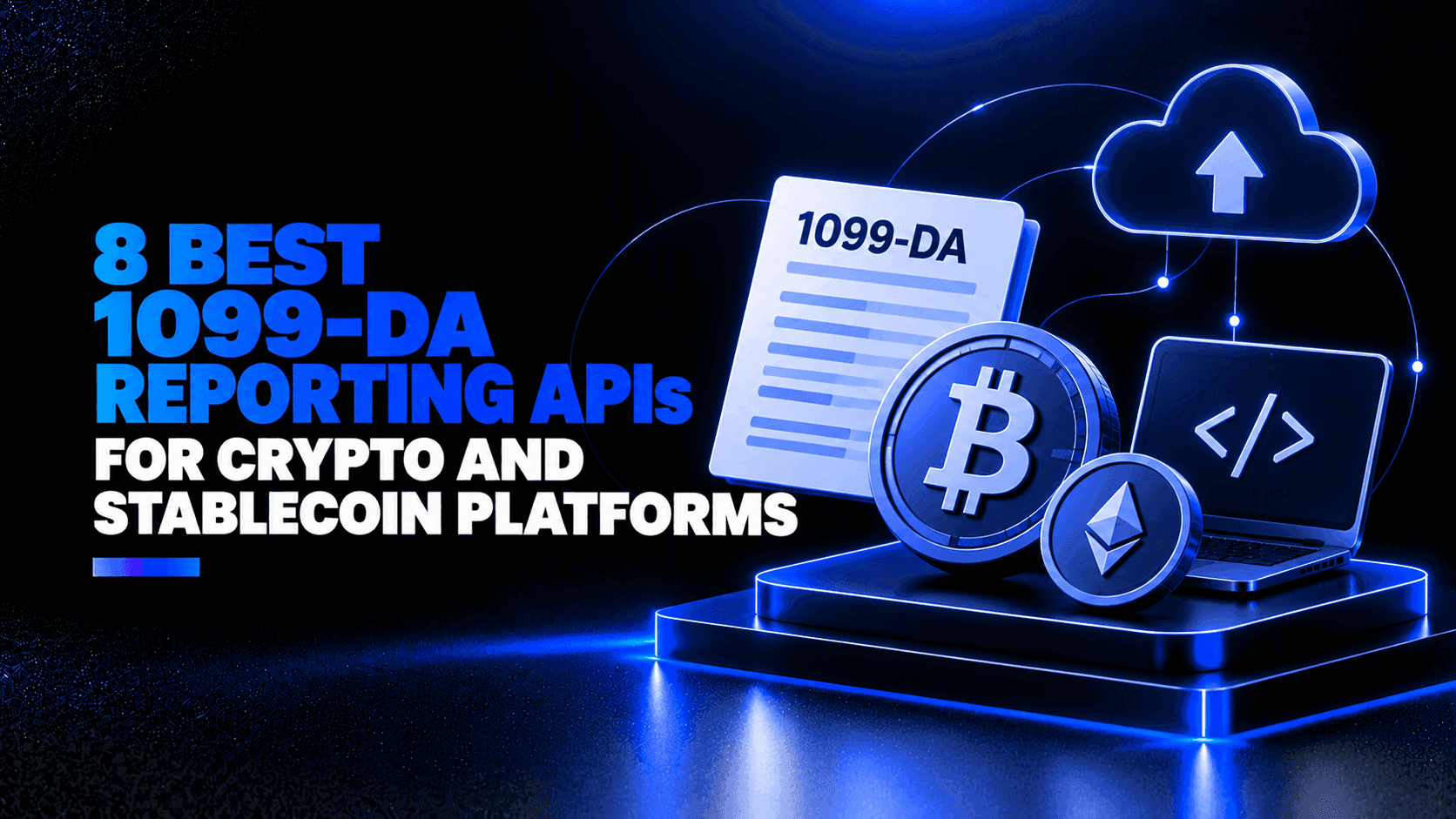
The eight best 1099-DA reporting APIs for crypto and stablecoin platforms are TaxBit, Trolley, Lukka, CoinTracker Enterprise, Ledgible, Sovos, ZenLedger for Business, and NODE40. TaxBit and Lukka are strongest for exchanges and institutional-grade cost-basis reconciliation. Trolley and Sovos bring the widest tax form coverage for platforms with mixed payee populations. Ledgible and CoinTracker Enterprise are practical for mid-market platforms that need embedded reporting without a dedicated compliance engineering team.
Why 1099-DA Reporting Is Now a Platform Obligation, Not a User Problem
For years, crypto exchanges told users to figure out their own taxes. That era ended when the IRS published final 1099-DA regulations in June 2024 under the Infrastructure Investment and Jobs Act, formally classifying certain digital asset platforms as brokers. Covered brokers must now track sales proceeds, apply cost-basis accounting, and file 1099-DA forms with the IRS for each reportable transaction. The obligation sits with the platform, not the user.
Stablecoin platforms are not automatically exempt. USDC or USDT transfers that constitute a sale of a digital asset, or redemptions at a non-dollar price, can trigger reporting. If your platform holds custody, supports sales, or facilitates exchange of digital assets and has US account holders, you need to assess whether you meet the broker definition before assuming you are outside scope. Getting this wrong is not a paperwork problem; the IRS treats failure to file information returns as a penalty situation with per-form fines.
For operators building on stablecoin infrastructure today, it is worth reading alongside our guide to stablecoin infrastructure providers to understand where 1099-DA obligations intersect with your payment rails and custody layer.
What Makes a 1099-DA API Different from a Standard 1099 Filing Tool?
Standard 1099-NEC or 1099-MISC APIs handle relatively simple data: a payer, a payee, a dollar amount, and a form submission to the IRS. Form 1099-DA is architecturally different. It requires proceeds per transaction, cost basis, acquisition date, disposition date, and gain or loss classification, plus asset-level identifiers for each digital asset involved. That data does not exist in a payroll or contractor payout ledger; it lives in on-chain transaction records, wallet histories, and internal exchange ledgers.
A credible 1099-DA reporting API must be able to ingest raw blockchain or ledger data, apply a defensible cost-basis method (FIFO, LIFO, HIFO, specific identification), produce per-asset gain/loss calculations, and output IRS-spec XML for filing. Most generic tax APIs cannot do any of this natively. The ones that claim to handle “all 1099 forms” are typically adding a form template, not building the data model underneath it.
CARF compatibility adds another dimension. OECD’s Crypto-Asset Reporting Framework requires platforms to report user account balances, transaction values, and counterparty information in a standardized XML schema to participating tax authorities. Platforms with users in the EU, UK, or CARF-adopting countries need a vendor that can produce both IRS 1099-DA output and CARF XML from the same underlying data pipeline, otherwise they maintain two separate reporting stacks.
The FintechSpecs 1099-DA Vendor Stress Test
Before evaluating any vendor, run them through what we call the FintechSpecs 1099-DA Vendor Stress Test: four checks that separate genuine digital asset tax reporting APIs from rebranded payee tools.
Check 1: Native cost-basis engine. Ask whether cost-basis calculation happens inside their platform or whether your engineering team must pre-calculate and pass in the gain/loss figures. A vendor that requires you to send pre-computed cost basis is a form-filing wrapper, not a reporting API.
Check 2: On-chain data ingestion. Can the API ingest wallet addresses, transaction hashes, or exchange ledger exports directly? Platforms that only accept structured CSV uploads put the reconciliation burden back on your team.
Check 3: CARF XML output. Ask specifically for their CARF schema documentation. If they do not have one, they are a US-only solution with no path to multi-jurisdiction compliance.
Check 4: Audit trail depth. Every cost-basis determination must be traceable to a specific lot, acquisition event, and methodology choice. If a vendor cannot show you the lot-level audit trail for a sample transaction, their output will not survive an IRS examination.
What Are the 8 Best 1099-DA Reporting APIs?
| Vendor | Best For | Native Cost-Basis Engine | CARF Output | On-Chain Ingestion | Form Coverage Beyond 1099-DA |
|---|---|---|---|---|---|
| TaxBit | Exchanges, institutional brokers | Yes | Yes | Yes | 1099-B, 1099-MISC, W-2 |
| Trolley | Platforms with mixed payee populations | Partial | In development | Via integration | 1099-NEC, 1099-MISC, 1042-S, W-9 |
| Lukka | Institutional-grade reconciliation | Yes | Yes | Yes | 1099-B, FBAR |
| CoinTracker Enterprise | Mid-market platforms, embedded UX | Yes | Roadmap | Yes | 1099-B |
| Ledgible | Accounting-first ops teams | Yes | Roadmap | Yes | 1099-B, 1099-MISC |
| Sovos | Enterprise with global compliance needs | Yes | Yes | Via partner | 1099-full suite, VAT, DAC7 |
| ZenLedger for Business | DeFi-heavy platforms | Yes | Roadmap | Yes (DeFi protocols) | 1099-B |
| NODE40 | Crypto-native, audit-focused operators | Yes | In development | Yes (Bitcoin-native) | 1099-B |
TaxBit
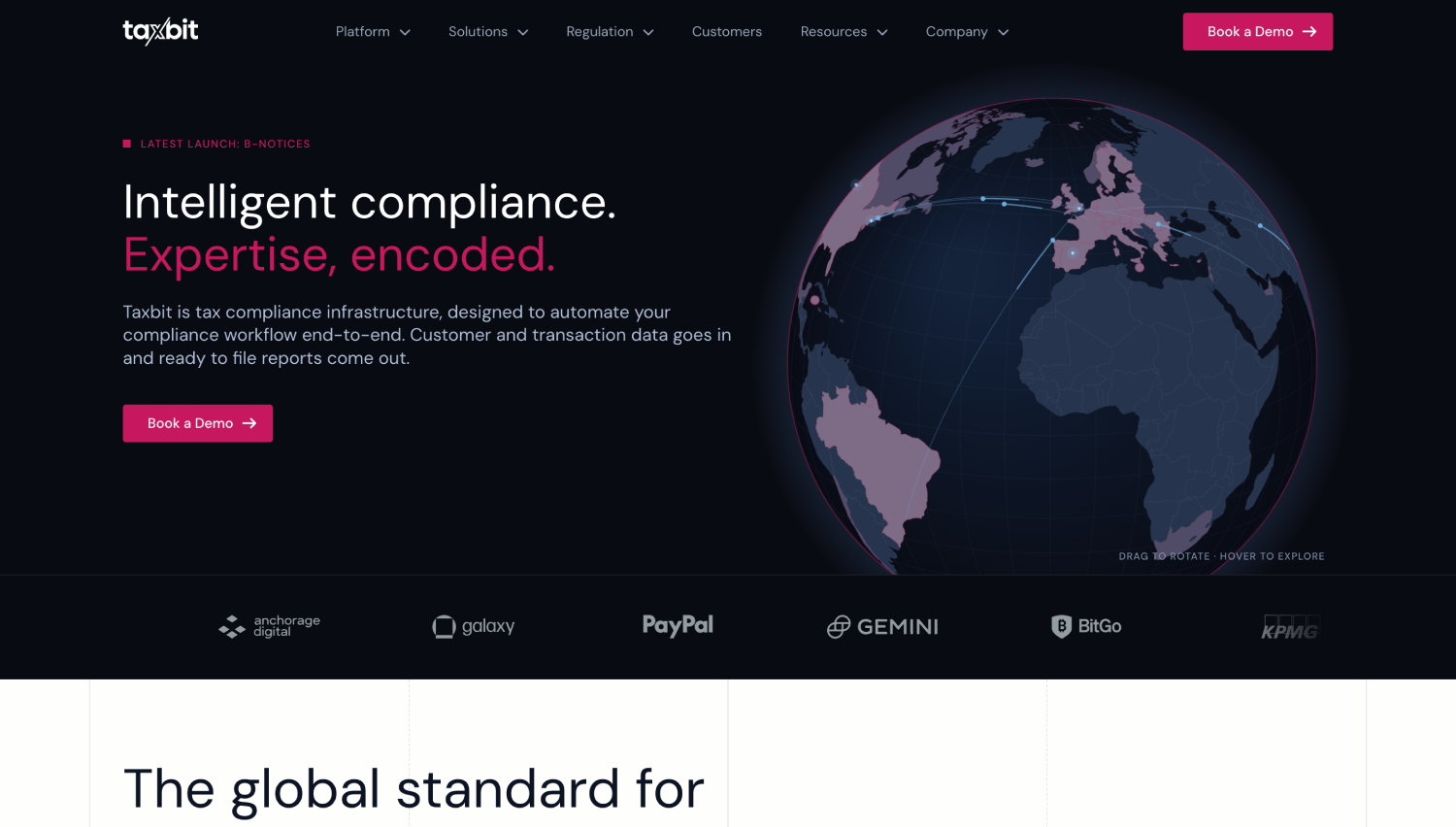
TaxBit is the most mature enterprise-grade 1099-DA reporting platform available to US crypto platforms. It was built specifically for digital asset tax compliance, not adapted from a payroll or contractor payments background. TaxBit’s pipeline handles on-chain ingestion, applies cost-basis methodologies including FIFO, HIFO, and specific identification, produces lot-level audit trails, and outputs IRS-spec XML for 1099-DA, 1099-B, and 1099-MISC. The platform has been used by major US exchanges and is one of the few vendors that has explicitly disclosed its 1099-DA readiness in public product documentation. Pricing is enterprise, meaning the company does not publish per-transaction rates publicly. Operators should expect custom contracts based on transaction volume and form count.
Trolley
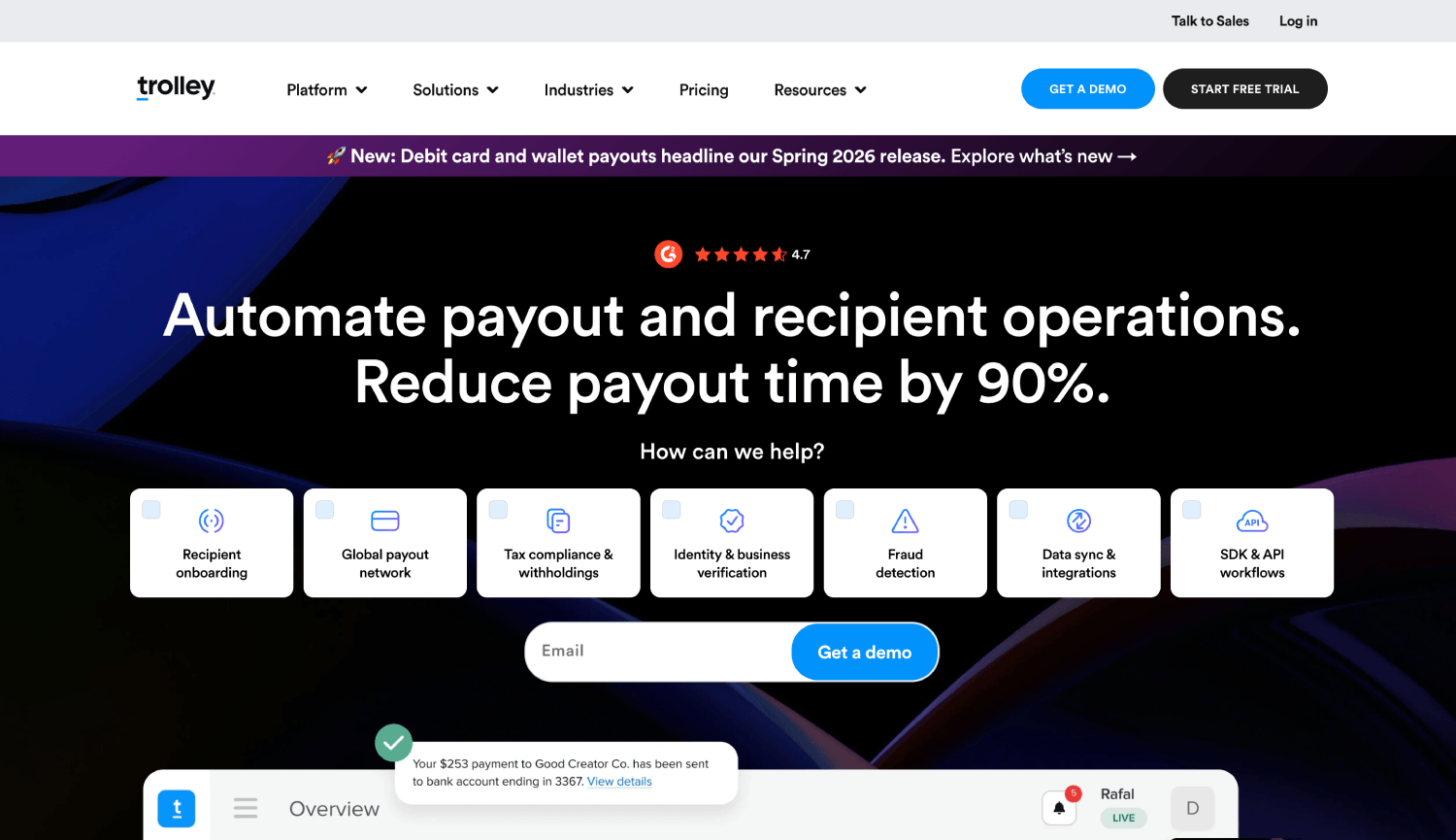
Trolley is primarily a payee tax and mass payout platform, but it has built meaningful digital asset reporting coverage that makes it relevant for platforms with both traditional contractor populations and crypto-earning users. Trolley handles 1099-NEC, 1099-MISC, and 1042-S natively, and its 1099-DA coverage is evolving alongside IRS guidance. The platform’s strongest argument for mixed-use operators is that you can manage your entire payee tax workflow, including W-9 collection, TIN verification, and multi-form filing, in one place rather than routing different user cohorts to different vendors. Trolley publishes per-payee pricing on their public pricing page for contractor tax workflows, though 1099-DA-specific pricing requires direct contact. For platforms evaluating 1099 contractor APIs alongside 1099-DA, our guide to 1099 and tax compliance APIs for contractor platforms covers the overlap in detail.
Lukka
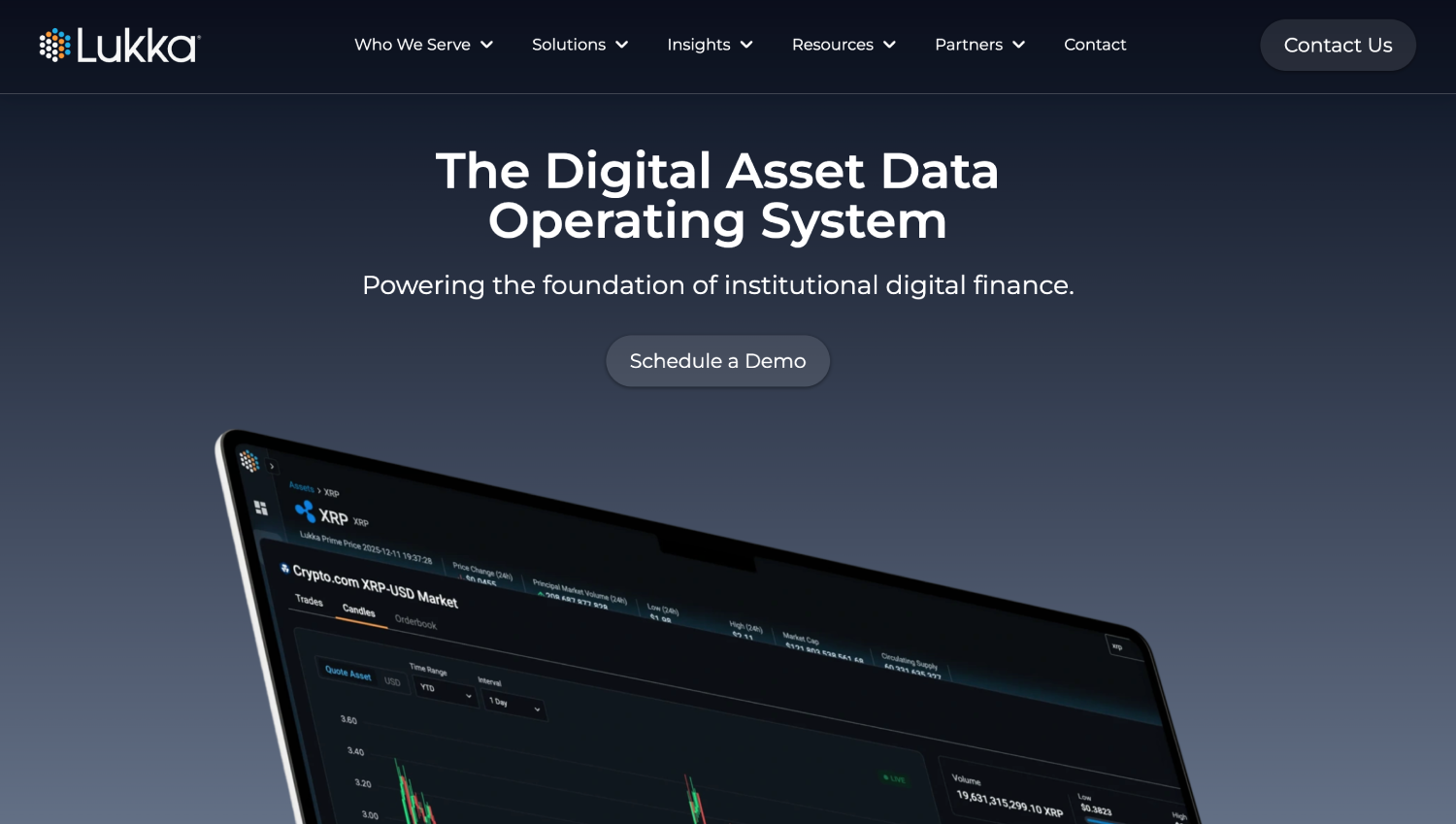
Lukka sits closest to TaxBit in terms of institutional depth but differentiates on its data layer. Lukka operates its own digital asset pricing and reference data infrastructure, which matters for cost-basis accuracy: if you are calculating gain on an obscure token traded across five venues, you need reliable price-at-time-of-transaction data to defend your methodology. Lukka provides this as part of its reporting stack. It also has explicit CARF support and has worked with institutional asset managers and custodians on both US and cross-border reporting. For exchanges or platforms with institutional clients, Lukka’s combination of reconciliation depth and reference data coverage is difficult to match. Pricing is not publicly disclosed and is structured around enterprise contracts.
CoinTracker Enterprise
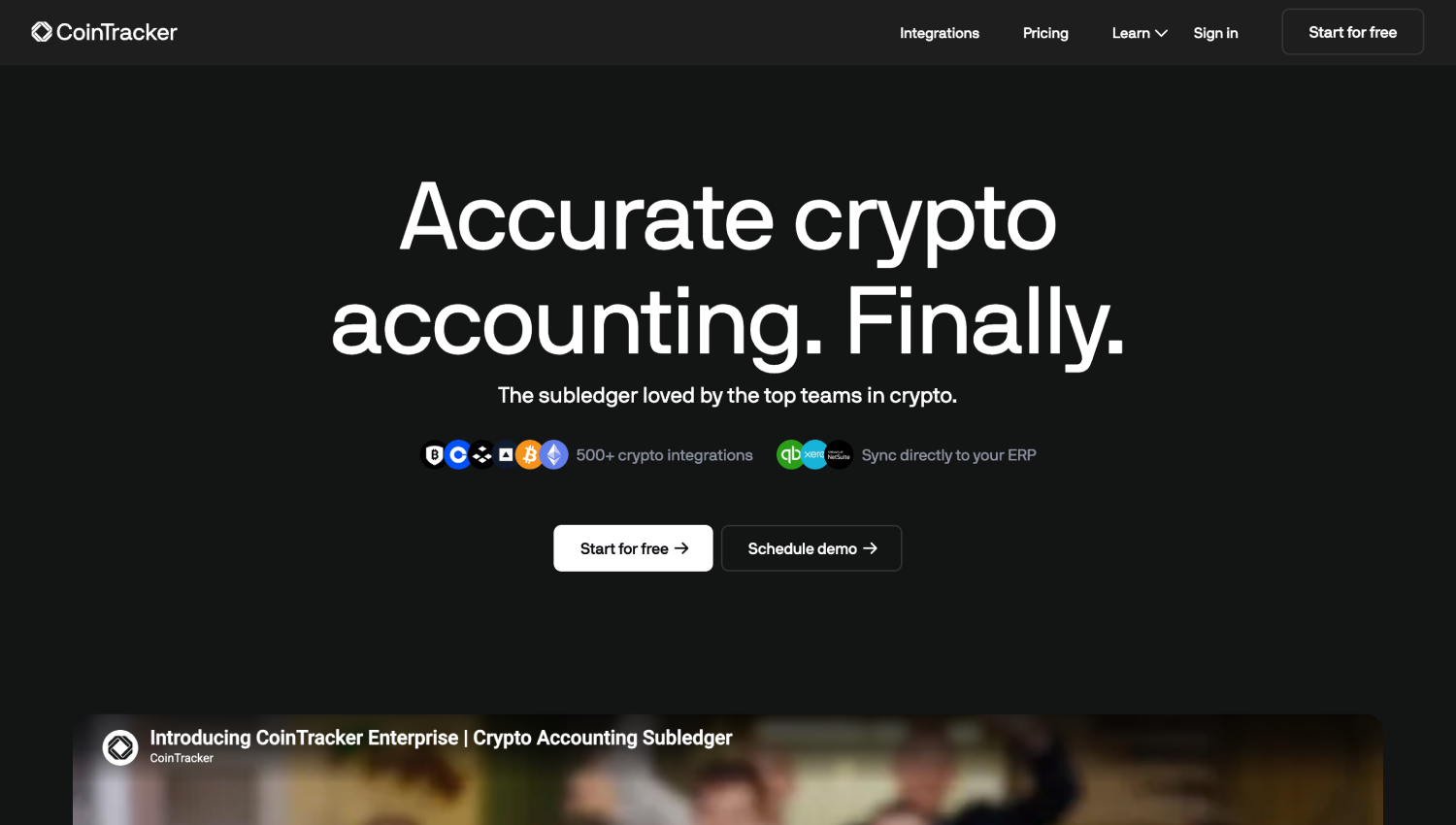
CoinTracker Enterprise is the right vendor for mid-market platforms that need a production-ready 1099-DA solution without building an internal reconciliation team. CoinTracker’s consumer product has broad wallet and exchange connectivity, and the enterprise tier packages that same connectivity into a white-label or API-first deployment model. Cost-basis calculation supports multiple methods. The platform’s DeFi and NFT transaction handling is better than most competitors in its tier, which matters for platforms where users are transacting in non-fungible or protocol-specific assets. CARF output is on the roadmap rather than live, which is a constraint for any platform with non-US filing obligations. Enterprise pricing is negotiated; the company does not publish per-seat or per-form rates publicly.
Ledgible
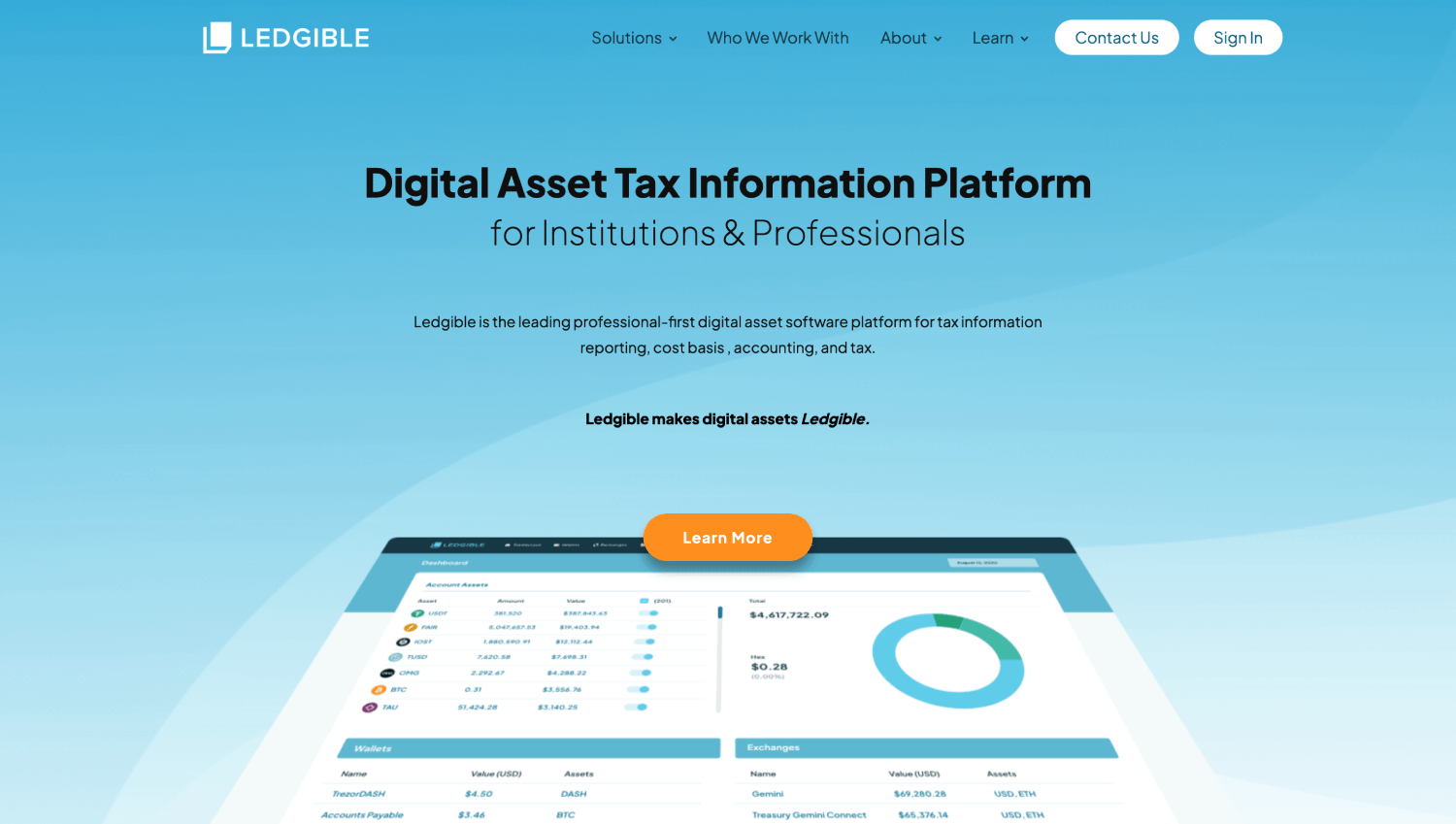
Ledgible positions itself at the intersection of crypto tax reporting and accounting software, which makes it useful for operators whose finance teams are already working in platforms like QuickBooks, Xero, or NetSuite. Where most 1099-DA APIs output data to the IRS and stop, Ledgible produces reporting that feeds back into accounting workflows, including general ledger categorization and reconciliation. For platforms where the CFO owns compliance (rather than a dedicated tax engineering team), Ledgible’s accounting-first approach reduces the gap between transaction reporting and financial close. The platform supports 1099-DA and 1099-B natively with on-chain ingestion. CARF support is roadmapped. Pricing is not publicly listed for enterprise tiers.
Sovos
Sovos is the only vendor on this list that was a global tax compliance platform before crypto was a reporting category. That lineage matters when your platform has US and international filing obligations simultaneously. Sovos handles the full 1099 form suite, DAC7 (the EU’s digital platform reporting directive), VAT filing, and CARF, all from a single compliance engine. For a platform operating in both the US and EU, Sovos removes the need to maintain separate vendors for IRS and OECD obligations. The trade-off is complexity: Sovos is an enterprise platform built for large organizations, and implementation timelines and contract structures reflect that. Smaller platforms may find the onboarding process heavier than the problem justifies. Pricing is enterprise and not publicly disclosed.
ZenLedger for Business
ZenLedger for Business is the strongest option for platforms where a meaningful share of transactions run through DeFi protocols, DEXes, or cross-chain bridges. ZenLedger has invested in protocol-specific parsing that handles AMM swaps, liquidity pool entries and exits, yield farming rewards, and staking transactions, asset types that most enterprise tax tools handle poorly or require manual classification for. The business API exposes this same parsing logic so platforms can automate transaction classification rather than passing unclassified events to their compliance team. 1099-DA and 1099-B coverage is production-ready. CARF is on the roadmap. Pricing for the business API is not publicly listed at enterprise scale.
NODE40
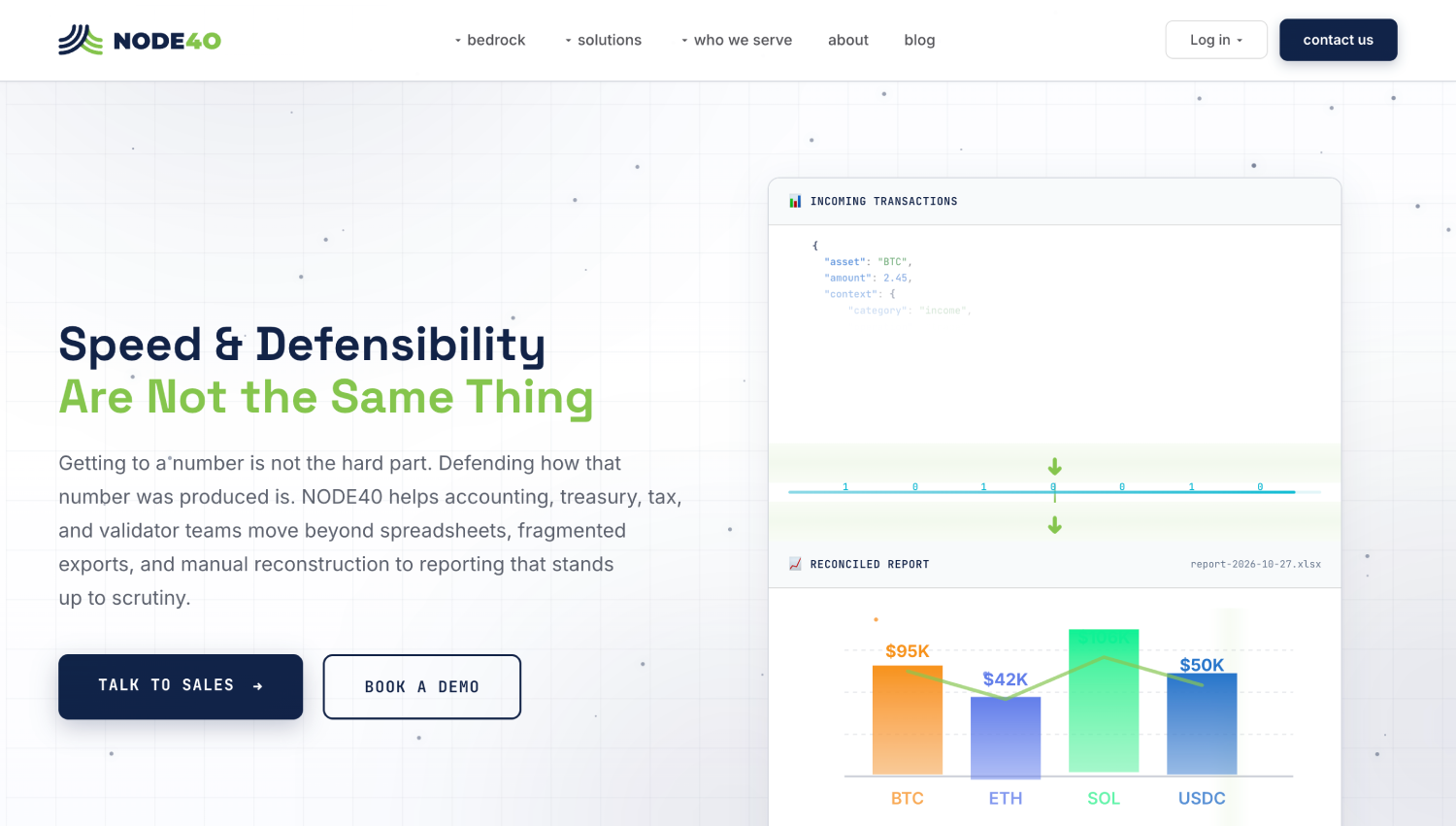
NODE40 is a crypto-native reporting platform with roots in Bitcoin-specific accounting, and it shows in the audit depth. NODE40’s transaction-level traceability is built for operators who expect IRS examination, producing chain-of-custody documentation that most broader platforms do not generate by default. The platform handles UTXO-based accounting (Bitcoin, Litecoin) better than almost any competitor, though it has expanded to cover Ethereum and ERC-20 assets. For platforms primarily dealing in Bitcoin or Bitcoin-adjacent assets, particularly institutional or custody-adjacent platforms, NODE40’s audit trail is a meaningful differentiator. CARF support is in development. Pricing is enterprise and not publicly disclosed.
How Do 1099-DA Reporting Costs Compare Across Vendors?
None of the enterprise-tier vendors on this list publish per-form or per-transaction pricing publicly. Cost depends heavily on transaction volume, number of reportable users, whether you need CARF alongside IRS filing, and how much data engineering support the vendor provides during onboarding. What you can expect from RFPs: vendors typically price on a combination of annual form count, active accounts, and a platform fee. Some add usage-based components for API calls or ingestion volume.
Trolley is the exception for lower-volume platforms: their public pricing page lists per-payee fees for contractor tax workflows, though 1099-DA-specific pricing requires direct contact. ZenLedger and CoinTracker Enterprise have tiered pricing visible at consumer and small-business levels that give a rough directional floor before volume discounts apply at enterprise scale. For any platform evaluating total compliance cost, the hidden variable is data engineering: if you need the vendor to build a custom ingestion connector for your internal ledger, that cost will often exceed the first year of platform fees. The real cost of compliance in fintech SaaS breaks down how these infrastructure costs tend to compound across growth stages.
Which Vendors Support CARF Compliance for Crypto Platforms?
Of the eight vendors profiled, TaxBit, Lukka, and Sovos have live or explicitly documented CARF support. The rest are in development or roadmap stages, which is reasonable given that CARF implementation timelines vary by jurisdiction and the US has not formally adopted the framework. For a US-only platform with no international account holders, CARF is not an immediate filing obligation. For any platform with EU, UK, Canadian, or APAC users, CARF readiness should be a procurement requirement, not a nice-to-have.
CARF requires reporting of the asset type, gross proceeds, number of transactions, and account holder identifying information per reportable user. This is a different data model than 1099-DA, which focuses on US gain/loss per transaction. Platforms that assume CARF is just a version of 1099-DA will discover during implementation that the two schemas require different data collection at the point of transaction, not just different output formats. Choosing a vendor that supports both from the same data pipeline avoids rebuilding the collection layer twice.
For platforms still mapping out their overall compliance architecture, our Fintech Product and Compliance Readiness Checklist walks through the broader vendor evaluation questions that apply before signing any infrastructure contract.
What Should Crypto Platforms Do Before Filing Season?
The 1099-DA filing deadline for transactions in tax year 2025 is January 31, 2026 for payee copies and the standard IRS e-file deadline for the IRS copy. Platforms that have not begun vendor evaluation by Q3 2025 are already behind on a reasonable implementation timeline, because 1099-DA onboarding requires historical transaction ingestion, cost-basis method election, W-9 or substitute form collection from all reportable users, and at minimum one test filing cycle before live submission.
The cost-basis method election is particularly consequential. Once a platform files 1099-DA using a specific methodology (FIFO, for example), switching methods requires regulatory consideration and could create inconsistencies between what users report on their individual returns and what the platform filed with the IRS. This is not a setting to leave as a default; it should be a deliberate decision reviewed with tax counsel before the first API call.
Platforms evaluating this alongside their broader fintech API stack can reference our review of the best fintech APIs for SaaS for context on how compliance tooling fits into the wider infrastructure decision.
How Does 1099-DA Differ from 1099-B for Digital Asset Platforms?
Before 1099-DA existed, some crypto platforms filed 1099-B under a loose interpretation of the broker rules applicable to securities. The IRS finalized Form 1099-DA to replace this practice with a digital-asset-specific form that captures data elements 1099-B was not designed to hold: asset identifiers, blockchain-specific transaction details, and the distinction between covered and uncovered securities in a digital asset context. Vendors that handled 1099-B for crypto clients have a head start, but 1099-DA is not a drop-in replacement; it requires new data fields and a revised filing schema.
One practical implication: platforms that were filing 1099-B for crypto transactions must transition to 1099-DA for applicable transactions, and the switchover year requires careful coordination to avoid duplicate or missing reporting. Vendors with existing 1099-B crypto workflows, particularly TaxBit, Lukka, and Ledgible, are better positioned to manage this transition than vendors entering the digital asset space fresh.
Frequently Asked Questions
Who is required to file Form 1099-DA?
Under IRS final regulations published in 2024, entities classified as digital asset brokers must file Form 1099-DA. This includes custodial platforms, crypto exchanges, and certain digital asset payment processors that regularly handle the sale or exchange of digital assets on behalf of customers. Non-custodial protocols and decentralized exchanges have a different and still-evolving compliance timeline. Platforms should assess their classification with tax counsel before assuming they are outside scope, particularly if they hold assets on behalf of users or execute trades on user instruction.
What is CARF and does it apply to US crypto platforms?
CARF is the OECD’s Crypto-Asset Reporting Framework, a multilateral standard for the automatic exchange of crypto transaction information between tax authorities. The US has not formally adopted CARF, but the OECD’s implementation tracker lists over 60 committed or participating jurisdictions. US platforms with account holders in CARF-participating countries may be subject to CARF obligations in those jurisdictions even without a US mandate. Platforms building international user bases should evaluate CARF readiness in their vendor selection now, because retrofitting a reporting stack for CARF after the fact is significantly more expensive than selecting a vendor that supports both IRS and OECD output from the start.
Can a standard 1099 filing API handle Form 1099-DA?
Not reliably. Generic 1099 APIs handle simple payment records: who paid whom and how much. Form 1099-DA requires proceeds per transaction, cost basis, acquisition and disposition dates, gain/loss classification, and digital asset identifiers. These data points do not exist in standard payroll or contractor payment ledgers; they must be derived from on-chain transaction records and internal exchange data. A vendor that does not have a native cost-basis calculation engine and on-chain ingestion capability cannot produce a defensible 1099-DA filing. Reusing a contractor 1099 tool for digital asset reporting is the most common and most expensive mistake platforms make in this space.
How do I choose a cost-basis method for 1099-DA reporting?
The IRS allows several cost-basis methods for digital assets including FIFO (first in, first out), HIFO (highest in, first out), and specific identification. HIFO typically minimizes taxable gain for users holding appreciated assets, making it the method most favorable to users in bull markets, while FIFO is simpler to implement and audit. The method you elect at the platform level applies consistently across your user base unless your vendor supports per-account elections. Once you file using a given method, switching creates reconciliation complexity. This is a tax policy decision, not a technical one, and should involve your tax advisor or general counsel before your first filing.
What data does a 1099-DA API need to generate a compliant form?
At minimum: transaction date, asset type and quantity, proceeds in USD, cost basis in USD, acquisition date and cost, disposal method (sale, exchange, gift), and whether the asset was a covered or uncovered security. For stablecoin transactions, the platform also needs to determine whether each transfer constitutes a taxable disposition, which depends on whether the stablecoin maintained a one-to-one dollar peg at the time of the transaction. Platforms should map their ledger data fields to these requirements before vendor selection, not after, because gaps in historical data are difficult to retroactively fill and can result in incomplete or inaccurate filings.
What happens if a crypto platform misses the 1099-DA filing deadline?
The IRS imposes per-form penalties for failure to file information returns on time. Penalty amounts vary based on how late the filing is and whether the failure is considered intentional disregard. For platforms with large user bases, per-form penalties at scale can become material. Platforms should also be aware that 1099-DA creates a paper trail for users: if a user’s individual return conflicts with the 1099-DA the platform filed, it flags the discrepancy for IRS review. Getting the filing right the first time is significantly cheaper than corrections, amended returns, and the audit risk that comes with inconsistencies.
How long does it take to integrate a 1099-DA reporting API?
Integration timelines vary widely based on the complexity of your transaction data and the vendor’s onboarding support model. Platforms with clean, structured internal ledgers and modern APIs can complete integration in six to ten weeks. Platforms with fragmented historical data, multiple custody arrangements, or DeFi transaction history should plan for three to six months, including a historical data remediation phase. All vendors require at minimum: a data ingestion setup, cost-basis method configuration, W-9 collection workflow, and a test filing cycle before live submission. Starting integration in Q4 for a January filing deadline is possible but leaves no margin for data quality issues.
The Vendor Decision Most Platforms Get Wrong
The most common mistake is treating 1099-DA as a form-filing problem rather than a data infrastructure problem. Platforms that evaluate vendors based on price per form, or whether a vendor “supports 1099-DA,” end up with a tool that can submit the XML to the IRS but cannot produce the underlying data that makes the filing defensible. The form is the output. The cost-basis engine, the lot-level audit trail, and the on-chain reconciliation pipeline are the product.
Compliance infrastructure decisions at this layer also compound. The methodology you choose, the vendor’s data model, and the way you collect user tax IDs all create path dependencies that are expensive to undo. A platform that grows from 5,000 to 50,000 users on a vendor whose architecture does not scale cleanly will face a forced migration during the exact period when filing accuracy is most visible to regulators. Choosing a vendor with institutional-grade architecture, even at a higher initial cost, is almost always the right trade-off for any platform expecting meaningful growth. For context on how these kinds of infrastructure decisions affect long-term unit economics, see our breakdown of critical mistakes when choosing fintech infrastructure.
For teams thinking through the broader vendor evaluation process before signing a contract, the FintechSpecs fintech vendor evaluation framework covers the contractual, technical, and operational checks that apply across any infrastructure decision at this stage.