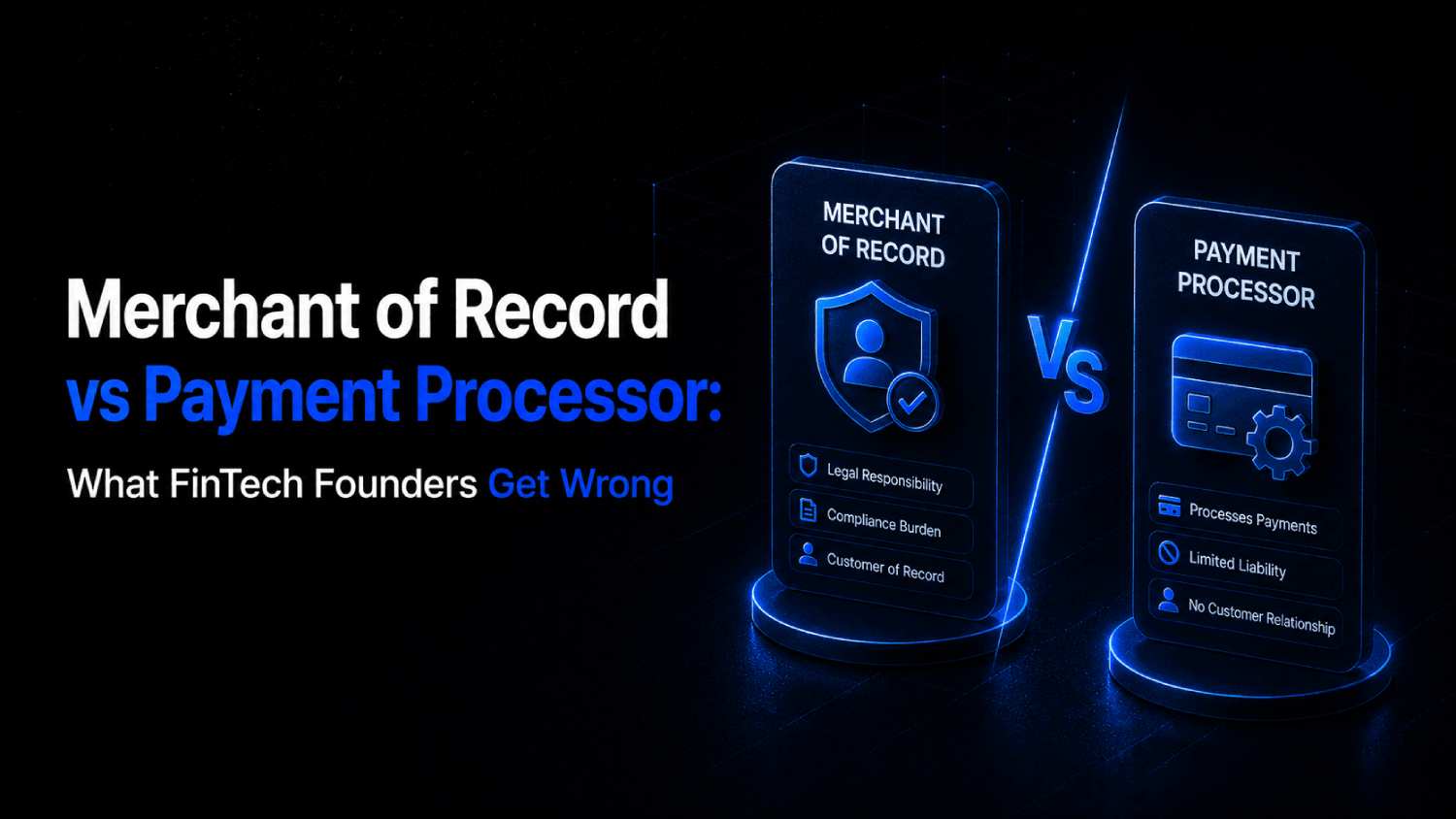

- A payment processor moves money. A merchant of record owns the legal relationship with the customer, including tax collection, compliance, and refund liability.
- Using Stripe or Braintree does not make you a merchant of record. You remain the seller of record, which means every VAT registration, sales tax nexus, and chargeback dispute lands on your balance sheet and legal team.
- For SaaS companies selling to consumers or SMBs across multiple countries, a merchant of record like Paddle or Lemon Squeezy shifts that entire compliance surface area off your books.
- This is an architecture decision. Choosing wrong at $500K ARR costs you six months of cleanup at $3M ARR.
- The right answer depends on four variables: geography of your customers, whether they are B2B or B2C, your current ARR, and how much tax exposure you can absorb.
The merchant of record vs payment processor decision is one of the most consequential infrastructure choices a SaaS founder makes, and one of the most commonly deferred. A merchant of record (MoR) is the legal entity named as the seller in a transaction. It collects payment, remits taxes, issues receipts, and absorbs liability for chargebacks and refunds. A payment processor is the technical infrastructure that moves money between a buyer’s bank and a seller’s account. The processor never owns the sale. The merchant of record always does.
Why Most Fintech Founders Misread This Decision
Most early-stage founders treat payment infrastructure as a plumbing problem. Pick Stripe, connect the API, ship. That works when you are selling to US-based customers and your transaction volume is low enough that sales tax nexus is not yet triggered. It stops working the moment you sell a SaaS subscription to a customer in Germany, the UK, or Canada.
The common belief is that a merchant of record is just a more expensive payment processor with extra features. It is not. It is a different entity in the legal chain of a transaction. When you use a payment processor, you are still the seller. You owe the VAT. You handle the chargebacks. You file the tax returns. When you use a merchant of record, that entity becomes the seller, and those obligations transfer to them contractually.
That distinction does not matter at $200K ARR. It starts to matter at $1M. It becomes a liability if you ignore it at $5M and above, especially if you are selling internationally. Many founders discover the gap during a fundraise or acquisition due diligence, when a buyer’s legal team asks for tax filings across 40 jurisdictions and the answer is silence.
What Is a Merchant of Record, Exactly?
A merchant of record is the legal entity responsible for a sale to an end customer. On a customer’s bank statement, the MoR’s name appears as the merchant. The MoR collects payment, applies the correct tax rate for the buyer’s jurisdiction, remits that tax to the relevant authority, issues a compliant receipt, and manages disputes. The software company behind the product is effectively a supplier to the MoR, not the seller.
Companies like Paddle, Lemon Squeezy, and FastSpring operate as merchant of record platforms. When a customer buys a SaaS subscription through Paddle, Paddle is the seller. Paddle collects the money, calculates and remits EU VAT, UK VAT, Australian GST, and US sales tax where applicable. The SaaS company receives a net payout and none of the tax headaches.
This is not a feature of a payment processor. It is a contractual and legal structure built on top of payment processing.
What Is a Payment Processor, and What Does It Actually Do?
A payment processor handles the technical movement of funds. When a customer enters a card number, the processor authorizes the transaction with the card network (Visa, Mastercard), communicates with the issuing bank, and settles funds to the merchant’s account. That is the scope of the job.
Stripe, Braintree, Adyen, and payment service providers in general do not become the seller of record. They handle the payment on behalf of the merchant. The merchant remains legally responsible for the sale in every jurisdiction where that sale occurs.
Stripe does offer tools for tax calculation through Stripe Tax, which can calculate and collect the right amount of sales tax or VAT at checkout. But Stripe Tax calculates and collects. It does not remit or file on your behalf across all jurisdictions. The legal obligation still sits with your company. According to Stripe’s own documentation, Stripe Tax helps you collect taxes but the responsibility to register, report, and remit remains yours.
The Core Difference: Where Legal Liability Sits
| Responsibility | Payment Processor (e.g. Stripe) | Merchant of Record (e.g. Paddle) |
|---|---|---|
| Appears on customer bank statement | Merchant’s name | MoR’s name (e.g. Paddle) |
| Legal seller in transaction | Your company | MoR entity |
| Collects sales tax / VAT | Via tools (your liability) | MoR (their liability) |
| Remits and files taxes | Your company | MoR |
| Handles chargebacks | Your company | MoR (absorbs first line) |
| Maintains merchant agreements with card networks | Your company | MoR |
| Requires PCI DSS compliance from you | Yes (varies by integration) | Reduced (MoR handles cardholder data) |
| International tax registration required from you | Yes, per jurisdiction | No |
The single biggest operational difference is international tax. A SaaS company selling to customers in the EU is required to register for VAT in each member state where it exceeds certain thresholds, or register under the EU’s One Stop Shop (OSS) scheme, or use a merchant of record who handles it. For most early-stage companies, building an internal tax compliance function for 40-plus jurisdictions is economically irrational when an MoR charges a percentage of revenue to absorb that entire function.
MoR vs PSP: Is There a Middle Ground?
Some founders confuse the question by mixing in payment facilitators, PSPs, and payment orchestrators. A payment service provider (PSP) like Stripe or Square onboards merchants under their own master merchant account and processes payments on their behalf. This is faster to set up than a direct acquiring relationship, but it still leaves legal responsibility with the merchant.
A payment facilitator (PayFac) is a specific model where a company like Stripe or Square is themselves the merchant of record for their sub-merchants. In practice, this still means your company is the sub-merchant and you retain sales and tax obligations.
There is no middle ground between “you are the seller” and “an MoR is the seller.” Either your company’s legal entity is responsible for a transaction, or it is not. Tools and features within payment processors can help you manage the compliance burden, but they do not transfer the liability.
When Does a SaaS Company Actually Need a Merchant of Record?
The answer is almost always tied to geography and customer type. Use this decision framework to find the right architecture for your stage.
Decision Framework: Which Model Is Right for You?
- Where are your customers? If more than 10% of your revenue comes from outside the US, international tax compliance is already your problem. An MoR removes it.
- Are your customers B2B or B2C? B2B transactions between VAT-registered businesses in the EU use the reverse charge mechanism, which reduces your VAT exposure significantly. B2C sales to consumers in the EU trigger VAT obligations in the buyer’s country. Consumer-facing SaaS is where MoR economics get compelling fast.
- What is your current ARR and runway? Below $500K ARR, the MoR fee (typically a percentage of revenue, higher than standard processing rates) often outweighs the compliance savings unless you are already international. This $500K threshold is a practical decision framework based on where internal compliance costs typically begin to exceed MoR fee premiums, it is not a published regulatory benchmark. Between $500K and $3M ARR selling internationally, an MoR is almost always the right call. Above $5M ARR with a global customer base, you may want to evaluate whether building internal tax infrastructure makes economic sense, or negotiate better MoR rates.
- Do you have existing contracts that specify billing entity? Enterprise contracts often specify the contracting entity. If your enterprise clients require your company name on the invoice rather than Paddle’s or Lemon Squeezy’s, an MoR may not fit your sales motion without workarounds.
- How much chargeback risk does your product carry? Consumer SaaS with subscription billing and high refund rates benefits from MoR chargeback handling. Developer tools with low refund rates lose less by managing disputes in-house.
| Scenario | Recommended Architecture | Why |
|---|---|---|
| US-only B2B SaaS, under $1M ARR | Payment processor (Stripe) | Low international tax exposure, simple compliance |
| Global B2C SaaS, any ARR | Merchant of record | Consumer VAT in 40+ jurisdictions is unmanageable manually |
| Global B2B SaaS, under $2M ARR | Merchant of record | Cost of internal tax compliance exceeds MoR fee |
| Global B2B SaaS, over $5M ARR with enterprise contracts | Payment processor + tax tool (Stripe + Stripe Tax or Avalara) | Enterprise contracts require your entity as seller; can afford tax function |
| Marketplace or platform product | Depends on who owns the seller relationship | Sub-merchant structure may require PayFac model |
Stripe vs Merchant of Record: Which One for SaaS?
Stripe is the default choice for most SaaS founders, and for good reason. The API is mature, the documentation is excellent, and the integration surface is enormous. The range of tools built on top of Stripe, billing, fraud detection, revenue recovery, is hard to match at the same level of out-of-box integration. For a founder who understands the trade-offs and accepts ownership of tax compliance, Stripe is a legitimate long-term choice.
The problem is that most founders using Stripe do not understand the trade-offs. They assume Stripe Tax covers them. It helps, but it does not eliminate the need to register in jurisdictions where you have nexus, and it does not file returns on your behalf. For a direct comparison of how Stripe and Adyen stack up as payment processors for B2B SaaS, the trade-offs go well beyond tax, but neither platform solves the seller-of-record problem.
Paddle positions itself explicitly as the Stripe alternative for SaaS companies who want to avoid the compliance surface. Paddle charges a higher effective rate than Stripe’s standard processing fees, but that rate includes global tax remittance, VAT compliance, and chargeback handling. Whether that premium is worth it depends on how many jurisdictions you serve and what your internal compliance cost would otherwise be.
For a deeper comparison of specific MoR platforms, the breakdown of Stripe vs Paddle vs Lemon Squeezy vs Polar covers the pricing and feature trade-offs in detail.
What Happens to Tax Compliance When You Use a Merchant of Record?
When an MoR is the seller of record, the MoR is legally responsible for calculating, collecting, and remitting indirect taxes. This includes EU VAT, UK VAT, Australian GST, Canadian GST/HST, and US sales tax in states where the MoR has nexus. The SaaS company does not need to register for VAT in Germany or file a sales tax return in Texas, because the MoR is the legal seller, not the SaaS company.
This is the core reason an MoR is not just a pricing feature. It represents a transfer of legal status in a transaction. Your company becomes a supplier to the MoR. The MoR sells to your customer. Your company never touches the tax obligation at all.
Getting this wrong is one of the compliance mistakes that can destroy an early-stage fintech startup. Retroactive VAT liability across multiple EU jurisdictions, combined with penalties for late registration, can generate a tax bill that is disproportionate to the revenue that caused it.
The Hidden Costs of Getting This Wrong
Founders who choose a payment processor under the assumption that “tax is something to figure out later” tend to encounter three compounding problems.
First, retroactive tax liability. If you have been selling to EU consumers for two years without VAT registration, the liability is real and does not disappear because you did not know about it. Many jurisdictions allow tax authorities to assess back taxes plus penalties for the full period.
Second, due diligence friction. Acquirers and institutional investors review tax compliance as a standard part of financial due diligence. Undisclosed multi-jurisdiction tax exposure is a common deal-blocker or valuation reducer at Series B and beyond. These are the kinds of hidden costs that erode SaaS margins in ways that never appear on a pitch deck.
Third, operational complexity that compounds with scale. The more jurisdictions you add, the more tax registrations, filings, and reconciliations your finance team must manage. What starts as manageable overhead at $1M ARR becomes a multi-person compliance function at $5M ARR if you do not address the architecture early. This is one of the growth bottlenecks that compound after $10M ARR in ways founders do not anticipate.
What Are the Trade-offs of Using a Merchant of Record?
Using an MoR is not cost-free. The fee structure is almost always higher than raw payment processing rates. Paddle, for example, charges a percentage of revenue that is publicly available on their pricing page. That rate is meaningfully higher than Stripe’s standard card processing fee. At scale, the delta becomes significant.
There is also the customer relationship issue. When Paddle or Lemon Squeezy appears on a customer’s bank statement instead of your company name, some customers are confused. Support tickets go to the wrong entity. This is manageable but adds friction to customer success workflows.
Enterprise sales present a harder constraint. Large enterprise buyers often require the seller entity to match the contracting entity for procurement, legal, and accounting purposes. An MoR model can create friction in those deals because the invoicing entity is Paddle or FastSpring, not your company. Some MoR platforms offer invoice customization to mitigate this, but it varies by platform.
For companies building complex payment infrastructure or fintech products, the range of payment infrastructure tools available to SaaS founders extends well beyond the MoR vs processor binary, and it is worth mapping the full stack before committing to an architecture.
Frequently Asked Questions
1. What is the difference between a merchant of record and a payment processor?
A payment processor moves money between a buyer’s bank and a seller’s account. It handles the transaction technically but does not own the sale. A merchant of record is the legal entity named as the seller. It collects payment, remits taxes, handles refunds and chargebacks, and holds liability for the transaction. The two roles can be combined in one platform or separated entirely.
2. Do I need a merchant of record for my SaaS business?
If you sell to customers in multiple countries, especially consumers in the EU, UK, or Australia, you almost certainly need either a merchant of record or a substantial internal tax compliance function. An MoR removes the need to register for VAT or GST in each jurisdiction where you have customers. If you only sell to US B2B customers and your volume is below economic nexus thresholds in most states, a payment processor with Stripe Tax may be sufficient for now.
3. Who handles VAT and sales tax with a merchant of record?
The merchant of record handles all indirect tax obligations. It calculates the correct tax rate for the buyer’s jurisdiction, collects the tax at checkout, files the returns, and remits the tax to the relevant authority. Your company receives a net payout with no direct tax obligation on those transactions. This is the primary reason SaaS companies choose an MoR when selling internationally to consumers.
4. Is Stripe a merchant of record?
No. Stripe is a payment service provider, not a merchant of record. When you use Stripe, your company is the seller of record. Stripe processes the payment on your behalf, but legal responsibility for the sale, including tax collection and filing, remains with your company. Stripe Tax can help calculate and collect the right amount of tax, but it does not file or remit taxes across all jurisdictions on your behalf.
5. Can a company use both a merchant of record and a payment processor at the same time?
Yes, and many companies do. A common hybrid architecture is using an MoR like Paddle for consumer and SMB subscriptions sold internationally, while using Stripe directly for enterprise deals where the contracting entity must be the software company itself. This approach adds some operational complexity but gives you the compliance benefits of an MoR for high-volume international sales while preserving flexibility for large enterprise contracts that require your company as the named seller. For founders weighing this split, the Fintech SaaS Scale Checklist covers the infrastructure sequencing decisions that tend to surface as companies approach $10M ARR.
6. What is the difference between MoR and PSP?
A payment service provider (PSP) handles the technical processing of transactions. It operates under a master merchant account and allows businesses to accept payments without a direct acquiring relationship. The business remains the legal seller. A merchant of record goes further: it becomes the legal seller in place of the business, absorbing tax, compliance, and chargeback responsibility entirely. PSPs and MoRs can use overlapping payment infrastructure, but they occupy different legal positions in a transaction.
7. What does MoR mean on a bank statement?
When “MoR” or a platform name like “Paddle” appears on a bank statement, it means the merchant of record for that transaction processed and owned the sale. The product or service may have been provided by a different company, but the MoR entity was the legal seller. This is expected when buying software through platforms like Paddle or FastSpring, which act as the seller of record on behalf of the underlying software company.
8. When should a fintech startup switch from Stripe to a merchant of record?
The clearest trigger is international expansion to consumer markets. When more than 10-15% of your revenue comes from countries with VAT or GST obligations (EU, UK, Australia, Canada), the cost of managing compliance internally begins to exceed the MoR fee premium. A secondary trigger is fundraising due diligence, where undisclosed tax exposure becomes a deal risk. Most SaaS companies should evaluate the switch between $500K and $1M ARR if they are seeing meaningful international traction.
The Architecture Decision That Compounds Over Time
Choosing between a merchant of record and a payment processor is not a question about which has better API documentation or nicer dashboards. It is a question about who owns the legal surface area of your business. Every international sale you make creates a tax event somewhere. The only question is whether your company is responsible for managing that event or whether you have contractually transferred it to an entity built specifically to handle it.
Most founders who get this wrong do so because the consequences are invisible until they are not. Sales tax nexus does not send you a warning. VAT obligations do not appear in your Stripe dashboard. They accumulate quietly until an audit, a fundraise, or an acquisition surfaces them. At that point, the cost of remediation almost always exceeds the cumulative cost of an MoR fee from day one.
The useful mental model is this: a payment processor is infrastructure, like cloud hosting. A merchant of record is a structural choice about where your company sits in the legal chain of commerce. You can change your cloud provider. Changing your tax compliance architecture retroactively, after years of international sales, is significantly harder. Make the architecture decision deliberately, early, and with an honest read of where your customers actually are.