
- KYC vendor choice directly affects onboarding conversion, fraud loss, manual review cost, and regulatory exposure , not just price per check.
- Pass rate and false positive rate matter more than list price: a cheaper vendor that flags 20% of legitimate users costs more in support overhead and lost revenue than a pricier one that passes them cleanly.
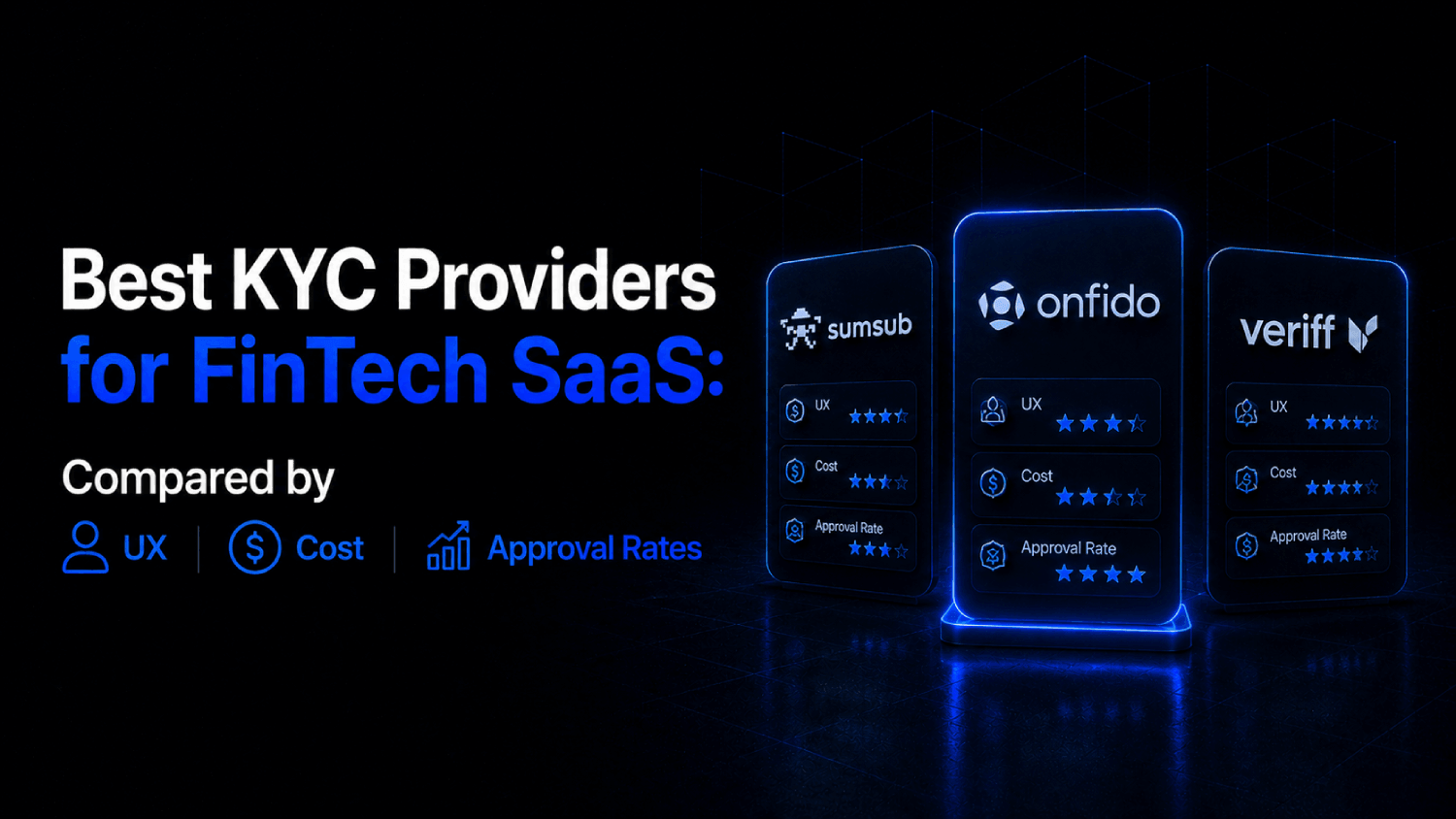
- The major vendors , Sumsub, Veriff, Onfido, Jumio, Persona, IDenfy, and ComplyCube , serve meaningfully different use cases and company stages.
- Startups building in regulated fintech verticals should evaluate API maturity and compliance support depth before UX, because fixing a poor integration mid-audit is far more expensive than a higher monthly bill at launch.
The best KYC providers for fintech SaaS are Sumsub, Veriff, Onfido, Jumio, Persona, IDenfy, and ComplyCube. Each serves different stages and use cases: Sumsub covers the widest compliance surface, Veriff leads on document UX, Persona offers the most flexible workflow builder, IDenfy is the strongest value option for startups under 5,000 verifications per month, and Jumio suits large enterprises that need a single global vendor with SLA guarantees.
Why KYC Provider Choice Is an Engineering and Revenue Problem, Not Just a Compliance Box
Most fintech founders shop KYC the wrong way. They compare price per verification, look for SOC 2 compliance, and pick whoever integrates fastest. Two things get ignored: what happens when a user fails a check, and what the vendor’s false positive rate actually is in production.
A false positive , a real user incorrectly flagged for manual review , triggers a support ticket, a wait period, and often an abandoned signup. At any meaningful scale, that friction compounds. A vendor with a 5% false positive rate on 10,000 monthly verifications generates 500 manual reviews. If your ops team handles 50 per day, you now have a 10-day queue and a conversion problem that looks like a product problem until you trace it back to the KYC layer.
Pass rate, false positive rate, and manual review load are the three numbers that actually determine whether your KYC vendor is working for your business or against it. Pricing is fourth on that list. For more on how compliance choices drive operational cost, the breakdown of the real cost of compliance in fintech SaaS by stage is worth reading before you sign any vendor contract.
What Criteria Actually Matter When Comparing KYC Vendors
Seven criteria separate a vendor that works from one that quietly erodes your margins. Not all of them are visible in a demo.
Pass Rate and Approval Accuracy
Pass rate is the percentage of legitimate users who get through verification without hitting a manual review queue or hard rejection. Vendors rarely publish this number by vertical, which means you need to ask for it directly , specifically for your target geography and user demographic. A vendor optimized for Western European passports may perform worse on Latin American national IDs.
False Positive Rate
The false positive rate measures how often legitimate users get flagged. High false positive rates destroy onboarding conversion and generate manual review cost. This is the metric vendors are least eager to discuss. Push for it in any vendor evaluation.
Manual Review Load and Process
Some vendors offer managed manual review as part of their service. Others pass the queue back to you. If you are a 15-person team, a vendor that hands you 300 manual reviews per week is not a solution , it is a staffing problem. Understand exactly what happens to a flagged user before you sign.
Geographic and Document Coverage
Coverage gaps create hard blocks for international users. Jumio and Sumsub both claim broad global coverage, but the quality of that coverage varies by region. A vendor might technically support a country while having a high error rate on its documents. Ask for country-level accuracy data, not just a country list.
API Maturity and SDK Quality
A poorly documented SDK adds engineering days to the integration and makes every update a maintenance burden. Evaluate the quality of the developer documentation, the availability of sandbox environments, and how frequently breaking changes appear in the changelog. Persona and Onfido consistently receive strong marks from engineering teams on API quality.
Compliance Support Depth
This includes AML screening, PEP and sanctions list coverage, KYB (Know Your Business) capabilities, and support for ongoing monitoring , not just point-in-time verification. If your product operates in crypto, lending, or cross-border payments, you likely need more than document verification. You need a vendor with active compliance expertise, not just a feature checkbox.
Pricing Structure
Most enterprise KYC vendors do not publish pricing. Volume tiers, verification type bundles, and add-on costs for AML screening or ongoing monitoring all affect the real number. IDenfy and ComplyCube are more transparent on public pricing than Jumio, Sumsub, or Onfido at enterprise tiers. Budget for the full stack cost including manual review fees, not just per-verification rates.
The Seven KYC Providers Worth Evaluating
Sumsub
Sumsub covers the widest compliance surface of any vendor in this comparison. It handles identity verification, AML screening, KYB checks, ongoing monitoring, and fraud prevention in a single platform. That breadth is its primary advantage for fintech companies that need a unified compliance stack rather than stitched-together point solutions.
The tradeoff is cost and integration complexity. Sumsub is not cheap, and the platform depth that makes it powerful also makes it slower to configure for simple use cases. Engineering teams report the documentation is solid, but customizing flows to match product UX requires real effort. For a Series B fintech with a compliance team, that tradeoff is reasonable. For a seed-stage team moving fast, it may not be.
Veriff
Veriff is the strongest vendor on document verification UX. Its capture flow is notably better than most competitors, which translates to higher first-attempt pass rates for users who are real but dealing with lighting issues, older documents, or low-end phone cameras. For consumer-facing fintech products where onboarding conversion directly affects revenue, that UX quality gap has a measurable dollar value.
Veriff’s pricing is not publicly listed, and several operators report being surprised by costs once AML features and ongoing monitoring are added on top of base verification pricing. Get a full cost projection before committing, including every add-on your compliance posture actually requires. Coverage is strong in Europe and North America but thinner in parts of Southeast Asia and sub-Saharan Africa.
Onfido
Onfido, now part of Entrust, is among the most mature platforms in the market. Its document and biometric verification is well-regarded, and its API quality is consistently praised by engineering teams. The developer documentation is thorough, and the SDK is stable enough that teams report minimal maintenance burden after initial integration.
The cost is premium-tier. Onfido does not publish pricing, and it targets mid-market to enterprise clients rather than early-stage startups. If you are pre-revenue or doing under a few thousand verifications per month, you will likely find the minimum contract value steep relative to your volume. For companies past Series A with compliance-heavy products, Onfido earns its price.
Jumio

Jumio is the legacy enterprise choice. It supports document verification across a wide range of countries and document types, and it has the institutional relationships that matter for large financial services clients. Enterprise SLAs, dedicated support, and a long track record with regulated entities are its differentiated value.
It is also the most expensive vendor in this comparison. Engineering teams describe the integration as heavier than newer alternatives, and the product moves slower than Persona or Veriff on UX iteration. For a startup, Jumio is almost certainly the wrong choice on price and agility grounds alone. For a company processing millions of verifications per year that needs a single global vendor with contractual guarantees, it remains a viable option.
Persona
Persona is the most configurable KYC platform available. Its workflow builder allows product teams to design verification flows without writing code, and its case management tooling for manual review is considerably better than most competitors. Teams that want fine-grained control over what gets triggered, when, and for which user segments will find Persona’s flexibility genuinely useful rather than just marketed.
Persona does not publish its full pricing schedule, though it scales with usage and is generally accessible to growth-stage companies without enterprise-scale minimums. The platform handles identity verification, document checks, database verification, and custom rule logic, making it a strong choice for products with complex user segmentation or risk-tiered onboarding flows. It is particularly well-suited to fintech companies building in lending, crypto, or marketplace verticals where verification logic is not uniform across users.
IDenfy
IDenfy is the strongest option for startups on cost grounds. Operators in fintech communities on Reddit report that IDenfy’s KYC and AML tools were straightforward to implement, provided clear risk scoring, and flagged suspicious accounts early without generating excessive false positives , consistent with the broader pattern of feedback on the platform. The SDK is described as easy to integrate, which matters for small engineering teams who cannot afford a multi-week KYC implementation.
IDenfy publicly lists pricing on its website, which is unusual in this market. That transparency alone is worth factoring into a vendor shortlist if you are pre-Series A and cannot afford a long procurement process. Coverage is solid for Europe and North America; less extensive for Asia-Pacific. It does not match Sumsub on compliance depth, but for a company that needs document verification and AML screening without enterprise complexity, it is the most practical starting point.
ComplyCube
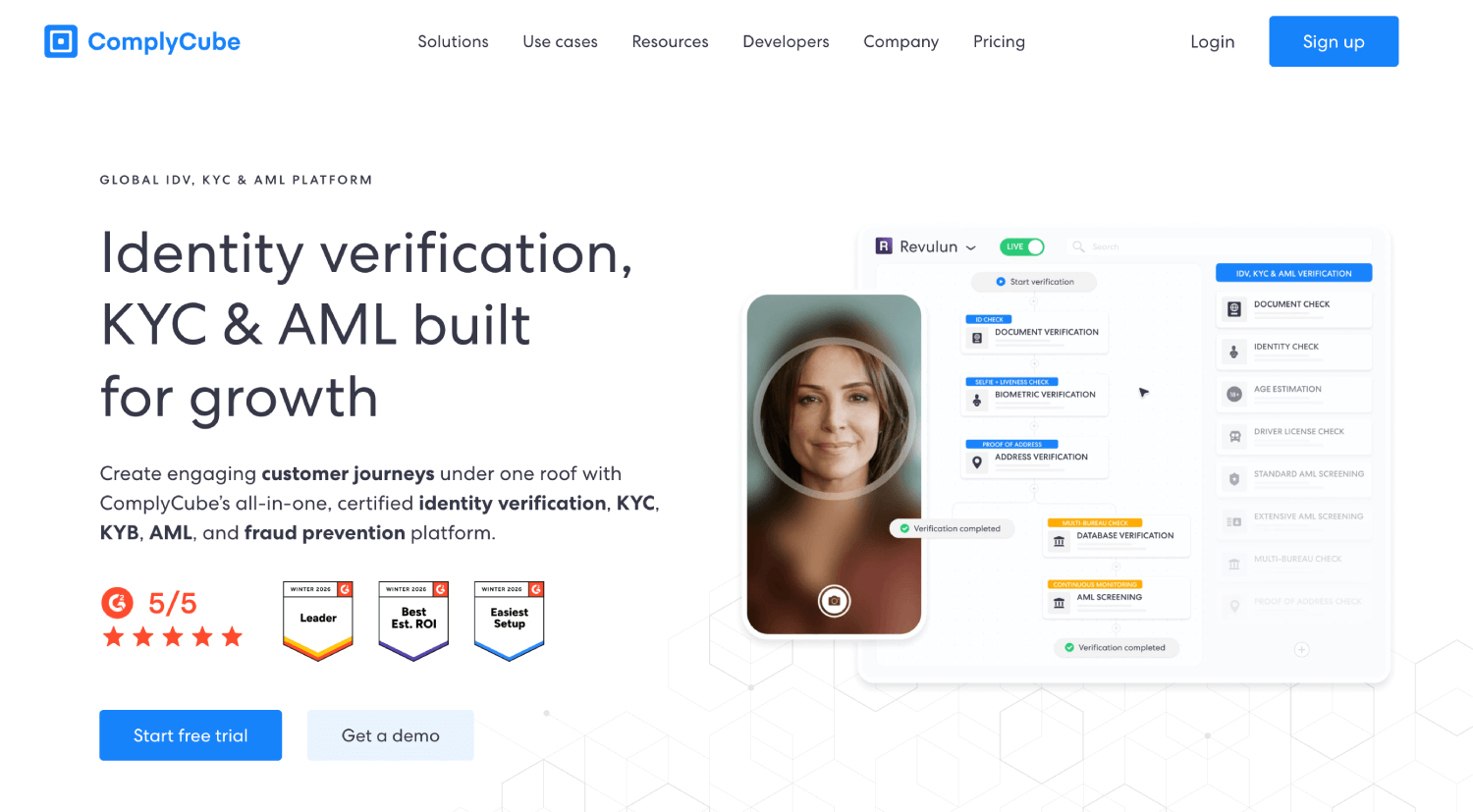
ComplyCube positions itself as a modular KYC and AML solution aimed at cost-conscious startups and mid-size fintechs. It offers identity verification, AML screening, PEP and sanctions checks, and KYB in a pay-as-you-go model that avoids the large minimum commitments of Sumsub or Jumio. The API documentation is clear and the integration path is shorter than the enterprise platforms.
ComplyCube does not have the brand recognition of Onfido or Veriff among compliance officers at larger institutions, which can matter during due diligence with enterprise partners. For companies building B2C products or working with smaller business clients, that reputational factor is largely irrelevant. Its modular pricing makes it easy to start with document verification and add AML checks when the business stage requires it.
KYC Vendor Comparison: Features, Coverage, and Pricing
| Vendor | Best For | KYB | AML Screening | Ongoing Monitoring | API Quality | Public Pricing | Approx. Cost Tier |
|---|---|---|---|---|---|---|---|
| Sumsub | Series A+ needing full compliance stack | Yes | Yes | Yes | Strong | No | Mid-to-high |
| Veriff | Consumer fintech with UX-sensitive onboarding | Limited | Add-on | Add-on | Strong | No | Mid-to-high |
| Onfido | Mid-market, compliance-heavy products | Limited | Add-on | Add-on | Very strong | No | High |
| Jumio | Enterprise, global regulated entities | Yes | Yes | Yes | Moderate | No | Highest |
| Persona | Products needing configurable risk logic | Yes | Yes | Yes | Very strong | Partial | Mid |
| IDenfy | Startups and SMBs, cost-controlled growth | Yes | Yes | Yes | Good | Yes | Low-to-mid |
| ComplyCube | Early-stage fintechs, modular build-out | Yes | Yes | Yes | Good | Yes | Low-to-mid |
How Pass Rate, False Positives, and Manual Review Interact in Practice
These three variables do not operate independently. A vendor that achieves a high auto-approval rate by loosening its fraud detection threshold is not actually helping you , it is shifting fraud loss risk onto you while making its conversion metrics look good. The goal is a high pass rate on legitimate users combined with a low false positive rate on the same population.
The only way to evaluate this honestly is to request a proof-of-concept or sandbox test with a representative sample of your actual user demographics. Vendors will show you aggregate pass rates, but aggregate data masks the variation between user populations. A vendor with 95% overall approval might have 75% approval for users presenting Latin American IDs, which is the only number that matters if that is your target market.
Manual review processes also differ significantly between vendors. Sumsub and Persona both offer case management tooling that routes flagged users efficiently. Veriff offers assisted review. Smaller vendors like IDenfy and ComplyCube pass more of the manual review burden back to your team. Factor in how many verifications per month you expect to hit manual review, and build that labor cost into your true cost-per-verification calculation. This compounds fast, and it is one of the hidden costs that erode fintech SaaS margins before founders notice them.
Which KYC Vendor Is Right for Which Stage
| Company Stage | Recommended Vendor(s) | Primary Reason |
|---|---|---|
| Pre-seed / Seed | IDenfy, ComplyCube | Transparent pricing, fast integration, no large minimums |
| Series A (consumer fintech) | Veriff, Persona | UX quality and configurable flows improve conversion at scale |
| Series A (B2B / lending / crypto) | Sumsub, Persona | KYB, AML, and ongoing monitoring in a single platform |
| Series B+ | Onfido, Sumsub | Enterprise support, audit trail quality, compliance depth |
| Enterprise / Global regulated | Jumio | Global document coverage, contractual SLAs, institutional credibility |
What to Ask Every KYC Vendor Before Signing
Vendor demos are optimized for closing deals, not for revealing operational weaknesses. These questions cut through that.
- What is your auto-approval rate for [specific user demographic and geography]? Not aggregate , by the user population I described.
- What is your false positive rate, and how do you define a false positive in your SLA?
- What happens to a flagged user , who handles the review, and what is the SLA for manual review resolution?
- What are your full-stack costs including AML screening, ongoing monitoring, and KYB if I need them?
- What is your uptime SLA for the verification API, and what is your incident response process?
- How do you handle regulatory changes in the jurisdictions where I operate?
- What does your audit trail look like, and how do you support customers during regulatory examinations?
The answers to questions two, three, and four will tell you more about whether a vendor will work for your business than anything in a feature comparison table. If a vendor cannot answer question two with a specific number, that is itself a signal.
How KYC Connects to Your Broader Onboarding and Compliance Stack
KYC is one layer of an onboarding architecture that includes fraud detection, identity proofing, account risk scoring, and ongoing transaction monitoring. A KYC vendor that does not integrate cleanly with your fraud detection tooling creates gaps where verified-but-risky users slip through. A compliance posture that handles point-in-time KYC but ignores ongoing monitoring creates regulatory exposure in jurisdictions that require continuous watchlist screening.
Sumsub and Persona both address the ongoing monitoring gap within their platforms. If you are using a point-solution KYC vendor like Veriff for its UX quality, you will need a separate AML and fraud layer , which is fine architecturally but increases integration complexity and total vendor cost. Understanding where your KYC vendor’s scope ends and your fraud and risk tooling begins is a foundational infrastructure decision. The best fraud detection and risk tools for fintech startups covers what that adjacent layer looks like in practice.
For fintechs building on banking-as-a-service infrastructure, some BaaS providers include KYC as part of their bundled offering. That bundling is convenient but often constrains your ability to optimize the verification flow. It is worth knowing whether your BaaS provider’s included KYC layer is the right fit for your user population, or whether unbundling and using a dedicated vendor produces better pass rates. For context on what that infrastructure decision involves, the comparison of the best banking-as-a-service platforms for fintech startups is relevant here.
Common KYC Implementation Mistakes That Hurt Conversion
The vendor choice matters, but so does the implementation. Several mistakes appear consistently across fintech onboarding flows regardless of which provider is underneath.
Triggering full document verification too early in the funnel is the most common error. Users who have not yet seen product value are far more likely to abandon when hit with a camera-and-document request on step two of signup. Most KYC platforms, including Persona and Sumsub, support tiered or progressive verification , collect basic identity first, trigger document verification only when a user reaches a threshold that requires it. This pattern consistently improves onboarding conversion.
The second mistake is not communicating what happens after a user is flagged. A user who submits documents and then hears nothing for 48 hours does not know whether they have been rejected or are in a queue. Transparent status communication during manual review reduces support volume and reduces abandonment. These patterns are covered in more detail in why fintech users drop off during onboarding , the KYC friction point is one of the most cited reasons.
Frequently Asked Questions
1. Who is the top provider of modular KYC and AML in fintech?
Persona is the most configurable modular platform, allowing teams to mix document verification, database checks, biometrics, and custom rule logic in a single workflow builder. ComplyCube offers a similarly modular approach at a lower price point and is better suited to early-stage companies. Sumsub covers the widest compliance surface for teams that need KYB, ongoing monitoring, and AML in one contract. The right choice depends on how much customization your verification logic requires versus how much compliance depth your regulatory environment demands.
2. What is the best KYC software for fintech startups?
IDenfy is the strongest starting point for seed-stage fintechs. It publishes pricing publicly, the integration is fast, risk scoring is clear, and it covers the core use cases , document verification and AML screening , without requiring enterprise contract minimums. ComplyCube is a close second with a pay-as-you-go model that scales cleanly. Both are more practical for early-stage teams than Sumsub or Onfido, which are sized for companies with larger compliance teams and budgets.
3. How do I compare KYC vendors beyond price?
Request auto-approval rates and false positive rates for your specific user geography and document types , not aggregate figures. Ask what happens operationally when a user is flagged: who reviews it, how long it takes, and what cost that generates for you. Evaluate API documentation quality and SDK stability using the vendor’s developer portal before committing. Per-verification cost is the last metric to optimize, not the first , the full picture includes manual review labor, engineering maintenance, and revenue lost to drop-off.
4. Does KYC vendor choice affect onboarding conversion rates?
Yes, meaningfully. The quality of the document capture flow, the auto-approval rate for legitimate users, and the speed of any manual review queue all directly affect how many users complete onboarding. Veriff is consistently cited for strong capture UX that reduces first-attempt failures. A vendor with a high false positive rate on your specific user demographic generates manual review queues that slow or block real users, which shows up as onboarding drop-off in your product analytics before it is traced back to the verification layer.
5. What is the difference between KYC and KYB, and do fintech SaaS companies need both?
KYC (Know Your Customer) verifies individual identities. KYB (Know Your Business) verifies the legal entity, beneficial ownership structure, and registration status of business customers. Fintech SaaS companies serving other businesses , lenders, payment platforms, embedded finance products , typically need KYB to comply with BSA/AML requirements for business account opening. Sumsub, Persona, Jumio, IDenfy, and ComplyCube all offer KYB. Veriff and Onfido are stronger on individual KYC and treat KYB as a secondary offering.
6. Is it worth building KYC in-house instead of using a vendor?
Almost never for a fintech SaaS company. Building compliant document verification requires maintaining integrations with global identity databases, managing a manual review operation, updating for regulatory changes across jurisdictions, and handling audit trail requirements. The total cost of building and maintaining that infrastructure exceeds vendor costs at virtually every stage. The few companies that build proprietary KYC are large enough that their transaction volume makes the economics justify it, which is not the situation any seed-to-Series B company is in.
7. How does ongoing monitoring differ from point-in-time KYC?
Point-in-time KYC verifies a user at onboarding. Ongoing monitoring continuously screens existing customers against updated sanctions lists, PEP lists, and adverse media sources after they are already onboarded. Regulators in the US, UK, and EU increasingly expect both. Sumsub, Jumio, Persona, and ComplyCube include ongoing monitoring in their platforms. Veriff and Onfido focus primarily on the point-in-time verification step, requiring a separate vendor or integration for ongoing monitoring if your compliance program requires it.
8. What compliance standards should a KYC vendor meet?
At minimum, look for SOC 2 Type II certification, GDPR compliance for any EU data processing, and ISO 27001 for information security. For US-regulated entities, the vendor should support BSA/AML compliance requirements. For crypto or financial services, FATF guideline alignment matters. Ask whether the vendor has been through a regulatory examination alongside a customer , vendors with that experience have documentation and audit trail processes that have been stress-tested in practice, not just on paper.
The Decision Most Teams Get Wrong
Fintech teams routinely anchor on per-verification cost and miss the complete picture. The real cost of a KYC vendor is the sum of verification fees, manual review labor, engineering maintenance time, and the revenue lost to users who abandon during a friction-heavy or slow verification flow. A vendor that charges 30% more per verification but cuts manual review volume by half and improves pass rates on legitimate users can easily produce a lower total cost at scale.
The second thing teams underestimate is migration cost. Switching KYC vendors after you have 50,000 users in the system means handling existing verification records, rebuilding compliance audit trails, re-integrating the new SDK, and potentially re-verifying users depending on your regulatory requirements. The fintech infrastructure decisions that look most reversible at seed stage are often the least reversible by Series B. That logic applies directly here, and it is covered in the broader context of critical mistakes when choosing fintech infrastructure.
Pick a vendor for where you will be in 18 months, not where you are today. For most seed-stage teams, that means IDenfy or ComplyCube with the intention to evaluate Sumsub, Persona, or Onfido at Series A when your compliance requirements and verification volume both justify a more capable platform. The upgrade path is manageable. Choosing Jumio at seed because it sounds enterprise-grade, then discovering the minimum contract value exceeds your compliance budget, is not.