
- Founder-led sales works in fintech because trust, technical credibility, and regulatory fluency close deals that a junior AE cannot.
- Enterprise sales in fintech requires compliance documentation, security review responses, and procurement cycles that take months. Most early-stage teams are not equipped for that.
- The right moment to hire enterprise sales is after you have repeatable sales, documented implementation playbooks, and at least a partial answer to every security questionnaire.
- Moving to enterprise too early bleeds cash, distracts founders, and often produces one or two large contracts that mask weak product-market fit.
- Stage matters more than deal size. A $50K ACV deal with a community bank and a $50K ACV deal with a Fortune 500 insurance company are completely different sales motions.
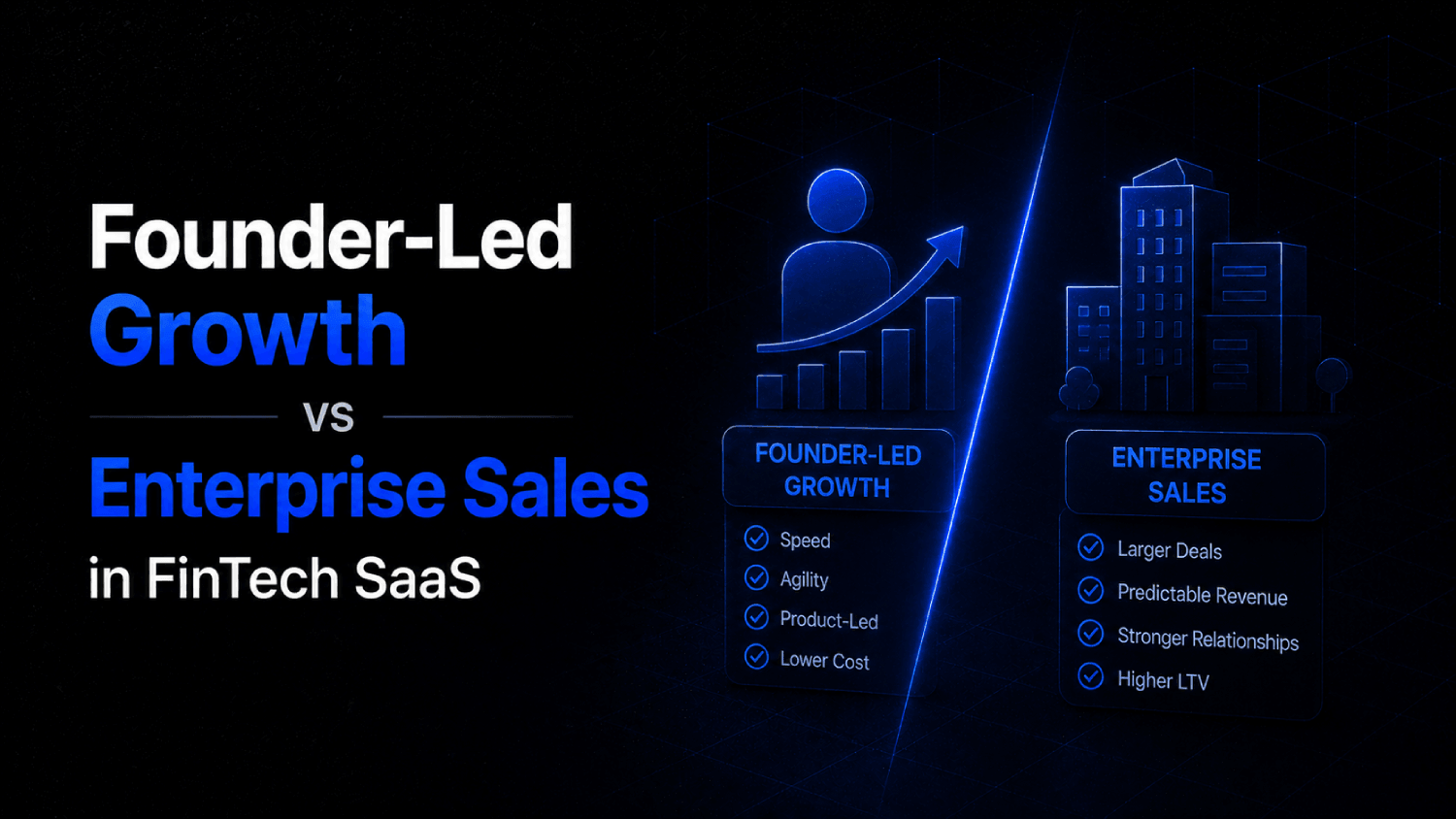
The tension between founder-led growth vs enterprise sales in fintech SaaS comes down to timing and readiness, not ambition. Founder-led growth is the right sales motion for most fintech SaaS companies until they have closed at least 10 to 15 deals through a repeatable process, can document every step of the sales cycle, and have compliance and security responses that do not require the founder to write from scratch for each prospect. Enterprise sales should follow proof, not ambition.
Why Fintech SaaS Founders Misread the Signal to Hire Enterprise Sales
A few founder-led deals close at $80K or $120K ACV and the board starts asking about enterprise sales capacity. That pattern feels like a signal. It usually is not.
What those deals often represent is the founder’s personal network, their ability to answer hard questions about compliance and architecture, and the trust that comes from speaking directly with the person building the product. None of those things transfer automatically to a sales hire. A founding AE who closes two deals before burning out in six months is a common outcome in fintech, not an edge case.
The mistake is treating sales headcount as the constraint. In fintech SaaS, the real constraint at the early stage is almost always proof of repeatability, which is different from proof that the founder can sell. These two things feel identical from the inside and look very different from the outside.
What Makes Fintech Sales Different From Standard B2B SaaS
In most B2B SaaS categories, a capable AE can learn the product and run a discovery-to-close cycle within 60 to 90 days. Fintech adds layers that reset that timeline.
Enterprise buyers in financial services, whether that is a bank, a credit union, an insurance carrier, or a payroll processor, arrive with security questionnaires that run 200 to 400 questions. They want SOC 2 Type II. They may ask for penetration test results, data residency documentation, and a vendor risk assessment before procurement will even schedule a call. A founder with deep technical knowledge can handle that. A new AE cannot without substantial support infrastructure.
Regulatory fluency is equally important. When a compliance officer at a regional bank asks how your product handles BSA/AML obligations or what happens to customer data under a state money transmission license, the answer needs to be specific and confident. Vague answers from a salesperson kill fintech deals. This is one reason founder-led sales outperforms earlier than it does in less regulated software categories.
For a practical look at what compliance readiness actually requires before you can sell to regulated buyers, the Fintech Product and Compliance Readiness Checklist on FintechSpecs breaks down what needs to be in place by stage.
The Four-Stage GTM Matrix for Fintech SaaS
The right sales motion depends entirely on where the company sits. The framework below is an editorial tool for mapping stage to motion , it reflects patterns observed across fintech SaaS GTM decisions, not findings from a formal study. Use it as a starting point for your own assessment.
| Stage | Right Sales Motion | Deal Profile | Gate to Next Stage |
|---|---|---|---|
| Pre-PMF | Founder only, design partners | 5 to 10 pilots, flexible pricing, high customization | 3+ customers renew or expand without being asked |
| Early Traction | Founder-led with light SDR support | $10K to $60K ACV, ICP defined, 10 to 20 closed deals | Sales cycle and objections are predictable; founder can write the playbook |
| Repeatable Sales | First AE hire, founder stays in late-stage and strategic deals | $40K to $150K ACV, documented process, security package ready | AE closes 2+ deals without founder involvement from intro to close |
| Enterprise Expansion | Dedicated enterprise sales, SE support, CSM for expansion | $150K+ ACV, multi-stakeholder, 6 to 18 month cycles | Implementation playbook, legal templates, compliance FAQ library all exist |
Most fintech SaaS founders are in Stage 1 or Stage 2 when they start hearing advice about building enterprise sales capacity. That advice is right for Stage 4. Applied to Stage 2, it pulls the founder away from the only thing that is working and puts salary burn against a motion the company is not ready to support.
What Founder-Led Sales Actually Looks Like in Fintech
Founder-led sales in fintech is not just about being present on calls. It is about being the person who can speak to product roadmap, answer a CISO’s question about encryption at rest, and describe exactly how the implementation will go because you have done it yourself twice before.
At the pre-PMF and early traction stages, the founder is doing several jobs simultaneously: qualifying, demoing, handling security reviews, negotiating terms, and often managing onboarding. That is not a scalable model, but it is not supposed to be yet. The goal of this phase is to accumulate enough pattern recognition to eventually extract a repeatable process.
Concrete outputs from this phase matter. After 15 founder-led deals, you should be able to write down: who the buyer is, what their top three objections are, what makes them say yes, how long each stage of the sales cycle takes, and what questions come up during implementation. If you cannot write that down, you do not have a sales process yet. You have a series of individual founder relationships.
When Founder-Led Sales Stalls
The ceiling on founder-led sales is founder time. At some point, inbound volume, existing customer expansion, and product demands compete for the same calendar. The founder starts deprioritizing early-stage prospects and deals slow down.
This is the moment most teams misinterpret. The temptation is to hire enterprise AEs. The better move, at this stage, is usually to hire one strong SDR or sales engineer who can handle qualification and prep work, while the founder stays on mid-to-late stage calls. That extends the founder’s selling capacity without requiring a full enterprise motion to be in place.
When Should Fintech Founders Actually Hire Enterprise Sales?
The right time is after three specific things exist: a documented sales playbook that someone other than the founder can follow, a security and compliance package that answers 80% of inbound questionnaires without custom writing, and at least one closed deal where the founder was not the primary relationship.
Enterprise sales in fintech SaaS is expensive to staff correctly. A strong enterprise AE with financial services experience typically carries a total compensation package well above $150K OTE , compensation benchmarks vary by market and experience level, so verify current ranges against sources like Levels.fyi or OTE data from fintech-focused recruiters. Adding a sales engineer who can handle technical diligence adds more. If those hires close two or three deals per year at $150K ACV, the math only works if the deal velocity can increase. That requires infrastructure: marketing that generates pipeline, a BDR function, a legal team that can turn contracts quickly, and an implementation team that does not require founder involvement.
Bringing in enterprise sales before that infrastructure exists creates a specific failure mode: the AE generates interest, surfaces large prospects, and then stalls because the compliance package is incomplete, implementation timelines are unclear, or the founder has to get involved to close anyway. That AE burns out or leaves within 12 months. To illustrate the cost: between base salary, OTE, benefits, and recruiting fees, a failed enterprise AE hire in fintech can consume several hundred thousand dollars over 12 months , for one or two deals the founder might have closed independently. The exact figure varies by market and seniority, but the structural problem is the same regardless of the number.
The broader GTM considerations that apply at this stage are worth mapping out carefully. The piece on go-to-market strategies for fintech SaaS covers how different sales motions interact with buyer acquisition at scale.
What Enterprise Sales in Fintech SaaS Actually Requires
Enterprise sales in regulated industries is not a sales skill problem. It is a company readiness problem. A good enterprise AE will surface requirements your organization does not yet meet, and then leave when those gaps are not filled.
Here is what enterprise buyers in fintech consistently require before signing:
- SOC 2 Type II report, current within 12 months
- Completed vendor risk assessment or the ability to complete one on request
- Data processing agreements and DPA templates for CCPA and GLBA
- Business continuity and disaster recovery documentation
- Defined SLA commitments with financial remedies
- Integration and implementation timeline with named resources
- References from comparable customers in the same vertical or regulatory environment
Most pre-Series B fintech SaaS companies have some of these and not others. Enterprise sales stalls at the due diligence stage when critical documents are missing, not because the AE is underperforming. Founders who have not been through this cycle often attribute the stall to sales execution when the real issue is company readiness.
The compliance cost picture is more significant than most founders initially budget for. The real cost of compliance in fintech SaaS broken down by stage gives a clearer view of what that investment actually looks like at different ARR levels.
Product-Led Growth as a Third Path in Fintech
The conversation about founder-led versus enterprise sales misses a third motion that works for a specific subset of fintech SaaS products: product-led growth, where free tiers, self-serve onboarding, and usage-based expansion replace or supplement direct sales.
PLG works in fintech when the product can be evaluated without human involvement, when onboarding does not require compliance review from the buyer, and when individual users inside a company can adopt before procurement gets involved. Developer tools, API-first products, and financial analytics software can fit this model. Core banking replacements, payments infrastructure for regulated entities, and compliance software almost never do.
The hybrid model, where PLG generates pipeline and founders or AEs close expansion deals, is the version most applicable to fintech SaaS. But PLG does not eliminate the need for founder involvement in early sales. It changes where in the funnel the founder gets involved, typically at the expansion or contract stage rather than the first demo.
How to Move From Founder Sales to a Sales Team in Fintech
The transition is a handoff problem, not a hiring problem. Most founders try to hire their way out of the problem before they have documented what they actually do to close deals.
The process that works in practice has four steps:
- Extract the playbook first. Before posting a job description, write down your sales process in enough detail that someone could run a call without you. What questions do you ask in discovery? What objections come up and how do you handle them? What does your demo sequence look like? What happens between demo and close?
- Build the compliance and security package. Assemble your security documentation, draft your standard DPA, and prepare a response library for the 20 to 30 questions that come up on every enterprise questionnaire. This does not need to be perfect. It needs to exist.
- Hire a sales engineer or AE who is strong on technical diligence, not just quota attainment. In fintech, the sales hire who understands API architecture and can speak to data handling often outperforms a high-volume SaaS closer who cannot get through a security review.
- Stay in strategic and late-stage deals for longer than feels comfortable. The founder should not exit deals entirely for at least the first six months after the AE is hired. The transition works when the AE demonstrates they can close without the founder, not when the founder stops showing up.
Missteps in this transition are common and expensive. The GTM mistakes that slow down fintech SaaS growth covers several that show up specifically in the founder-to-sales-team handoff.
Buyer Segmentation: Why the Same Deal Size Can Mean Different Sales Motions
A $75K ACV deal with a Series B proptech startup and a $75K ACV deal with a mid-market insurance company have almost nothing in common from a sales process perspective. The proptech founder signs after two calls and a Stripe link. The insurance company has a vendor onboarding committee, a security review team, legal redlines, and a finance sign-off process that takes four months.
Fintech founders who segment only by deal size get this wrong. Buyer type, regulatory environment, and internal procurement complexity determine which sales motion applies, not ACV alone.
Selling to regulated financial institutions specifically, including banks, credit unions, broker-dealers, and insurance carriers, always behaves like enterprise sales regardless of deal size. Selling to tech-native buyers like fintechs, neobanks, or growth-stage startups often behaves like SMB or mid-market sales even when the ACV is substantial. These two segments require different materials, different timelines, and different founder involvement profiles.
Pricing Model Alignment by Sales Motion
Sales motion and pricing structure are connected. Founder-led deals at early stages often use flat subscription pricing because it is easy to explain and negotiate. Enterprise deals in fintech frequently require usage-based or tiered pricing that can flex with the customer’s transaction volume or employee count.
Getting pricing wrong at the enterprise stage can undermine deals that are otherwise ready to close. A detailed breakdown of how fintech SaaS pricing models interact with different buyer types is covered in the best pricing models for fintech SaaS.
The Hidden Cost of Moving to Enterprise Too Early
Beyond the salary cost of premature enterprise hires, there is a softer cost that is harder to see in real time: the founder gets pulled into sales support for deals they should not be involved in yet, product velocity slows, and the company starts building features for one or two enterprise prospects instead of the product that serves 50 smaller customers.
Enterprise customers in fintech are demanding at implementation. They have integration requirements, custom reporting needs, and service-level expectations that consume engineering time. When those customers represent a disproportionate share of ARR at early stages, they also have disproportionate influence over the product roadmap. That is sometimes fine. When it causes the product to drift away from its core ICP, it is one of the more damaging things that can happen to a fintech SaaS company before it reaches scale.
The full picture of what scaling looks like, and where margin and operational pressure tend to appear, is worth reviewing before committing to an enterprise motion. The Fintech SaaS Scale Checklist for reaching $10M ARR addresses this in the context of sustainable growth.
Frequently Asked Questions
1. When should a fintech founder stop being the primary salesperson?
When the founder can write a complete sales playbook, close rates are consistent across a defined ICP, and the company has completed a security and compliance documentation package. That usually happens somewhere between 10 and 20 closed deals. Before that point, removing the founder from sales typically reduces close rates because buyers in fintech place significant weight on direct access to product leadership during evaluation.
2. What is the biggest mistake fintech startups make when hiring enterprise sales?
Hiring before the infrastructure exists to support a long enterprise sales cycle. Enterprise AEs in fintech need security documentation, implementation timelines, reference customers, and legal templates to close deals. Without those, even a strong AE stalls during due diligence. The company spends 12 months of AE salary to learn that the problem was not sales capacity but organizational readiness.
3. Does product-led growth work for fintech SaaS?
It works for specific product types, primarily developer tools, API products, and financial analytics platforms that buyers can evaluate without compliance review. It does not work well for core banking infrastructure, payments processing for regulated entities, or compliance software, where procurement involvement is required before any trial or usage can begin. Many fintech SaaS companies use a hybrid: PLG for pipeline generation and direct sales for contract and expansion.
4. How long do enterprise sales cycles take in financial services?
Six to eighteen months is common for enterprise deals with banks, insurance carriers, or other regulated institutions. Security reviews alone can take 60 to 90 days. Procurement, legal, and finance sign-off add more time on top. Fintech founders who have closed SMB or mid-market deals in 30 to 60 days are often unprepared for this when they move upmarket, and the cash flow implications of an 18-month sales cycle need to be reflected in runway planning.
5. What role should a fintech founder play after hiring an enterprise AE?
Strategic deals, late-stage technical questions, and relationship-building with C-level buyers. The founder should not disappear from sales entirely. In financial services, buyers are particularly sensitive to vendor stability and leadership access, and founder presence in critical deals can be a differentiator. The goal is a gradual handoff where the AE manages the process and the founder shows up for specific moments, not a clean exit at the point of hire.
6. How does buyer type affect fintech sales motion more than deal size?
A $100K deal with a technology-native buyer like a neobank or growth-stage startup can close in 30 to 45 days with minimal documentation. The same dollar value with a regional bank or insurance company can take four to six months and require vendor risk assessments, security reviews, and multiple stakeholder approvals. Segmenting prospects by regulatory environment and procurement complexity, not just ACV, is what determines which sales motion to apply.
When the Right Motion Becomes Clear
The clearest sign that a fintech SaaS company is ready for enterprise sales is not deal size or board pressure. It is when the founder can leave the room, and the deal still closes. That happens after the playbook exists, the compliance package is ready, and at least one person on the team has successfully completed a full enterprise sales cycle without founder intervention from start to finish.
Until that moment, founder-led sales is not a limitation to work around. It is the asset. Buyers in regulated financial services trust founders in a way they do not trust AEs they have never met, and that trust is what gets deals across the line when everything else is uncertain. The goal of the founder-led phase is not to close every possible deal. It is to generate enough pattern recognition to eventually make the motion transferable.
Enterprise sales will come. The companies that wait until they are genuinely ready for it move faster and waste less capital than the ones that hire toward ambition instead of readiness.