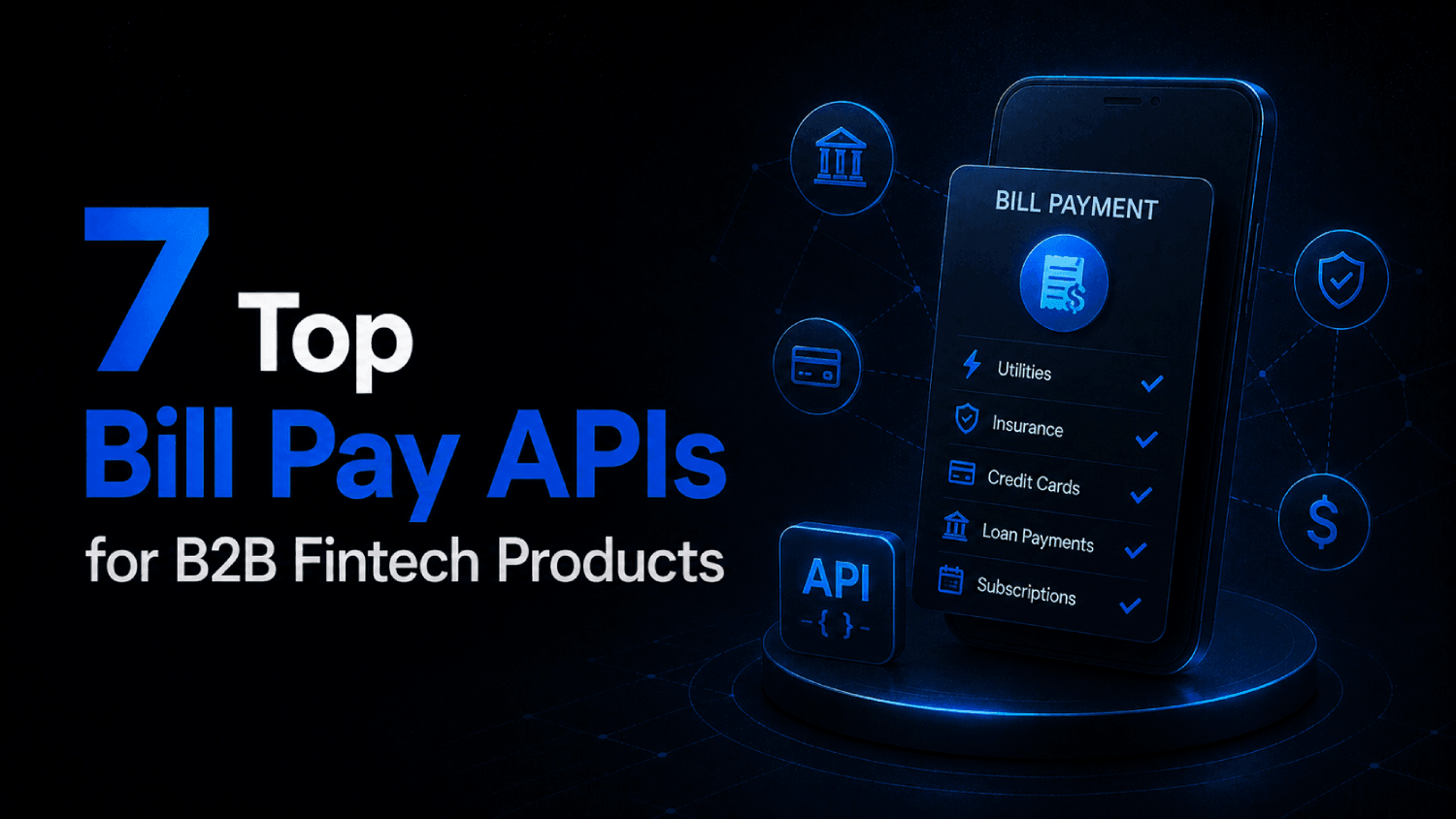

- Bill pay APIs are not a commodity add-on. For B2B fintech products, they are a monetization surface and a retention mechanism when built correctly into the product workflow.
- The meaningful differentiation between providers is not rail coverage. It is how deeply the API handles invoice intake, approval routing, ERP sync, and reconciliation without forcing your team to build that logic from scratch.
- BILL, Monite, Stripe, Modernfi, Melio, Airwallex, and ACI Worldwide each occupy a different position on the spectrum from raw payment rail access to full AP workflow-as-a-service.
- Embedded bill pay inside a B2B product can shift user behavior from monthly logins to daily ones, which changes the entire retention profile of the product.
- Pricing structures vary significantly across providers and not all publish rates publicly. Factor in per-transaction costs, monthly minimums, and the engineering hours required to close workflow gaps the API leaves open.
The top bill pay APIs for B2B fintech products include BILL’s developer API, Monite’s AP automation embedding layer, Stripe’s invoice payment infrastructure, Melio’s partner API, Airwallex’s payables product, ACI Worldwide’s bill payment API, and Modernfi’s bank-native bill pay infrastructure. Each supports ACH or check payment rails at minimum, but they differ sharply on invoice intake, approval workflows, ERP sync depth, and how much workflow logic ships with the API versus what the integrating team must build.
Why Product Leaders Keep Underestimating Bill Pay APIs
Most product teams treat bill pay as a feature request from accounting. Someone on the customer’s finance team asks whether vendors can be paid inside the platform, a ticket gets filed, and the discussion ends at “we’ll consider it in Q3.” That framing costs real retention.
When bill pay lives inside a B2B SaaS product, it stops being an accounting utility and starts being a daily workflow. A finance manager who processes vendor payments inside your platform every Tuesday morning is not churning to a competitor that handles only reporting. The stickiness is structural, not emotional. This dynamic is worth understanding before evaluating any API, because it reframes the build decision from cost center to product strategy. If you are already thinking about how fintech companies monetize payments without friction, bill pay is one of the cleaner opportunities on the table.
The technical reality is that bill pay is a workflow problem, not a rails problem. ACH is commodity infrastructure. What separates providers is whether the API ships with invoice parsing, multi-level approval routing, payment scheduling, vendor bank account verification, and two-way ERP sync out of the box, or whether your engineering team has to assemble all of that from primitive endpoints.
What Is the FintechSpecs Bill Pay Stack Test?
Before comparing providers, it helps to have a consistent evaluation framework. The FintechSpecs Bill Pay Stack Test is a four-layer check that maps every bill pay API against the actual workflow a B2B finance team runs. Every layer that the API covers natively is a layer your team does not have to build.
Layer 1: Intake. Can the API ingest invoices via email forwarding, PDF upload, or OCR extraction? Or does it expect pre-structured JSON from the start?
Layer 2: Approval routing. Does the API support configurable approval chains, spending thresholds, and role-based permissions? A flat approval model forces product teams to build routing logic on top.
Layer 3: Rail flexibility. ACH is the baseline. Check, virtual card, RTP, and international wires separate the full-stack providers from the bare-rail ones.
Layer 4: Reconciliation sync. Does the API push payment status and remittance data back to QuickBooks, NetSuite, Xero, or Sage automatically, or does the user have to export a CSV?
Run every provider below through these four layers. The gaps in each are more informative than the feature marketing.
Which Bill Pay APIs Are Worth Evaluating for B2B Fintech Products?
| Provider | Invoice Intake | Approval Routing | Payment Rails | ERP Sync | Best For |
|---|---|---|---|---|---|
| BILL API | Yes (OCR, email) | Yes (multi-level) | ACH, check, card, wire | QuickBooks, Xero, Sage, NetSuite | Full AP workflow embedding |
| Monite | Yes (OCR) | Yes (configurable) | ACH, SEPA, card | Via webhooks/API | Platforms building AP as a product feature |
| Stripe Invoicing API | Structured data only | No native routing | Card, ACH debit, bank transfer | Stripe data model only | SaaS billing that extends to vendor payments |
| Melio Partner API | Yes (partial) | Yes (role-based) | ACH, check, card | QuickBooks, Xero | SMB-facing accounting platforms |
| Airwallex Payables | Limited | Yes (approval flows) | ACH, wire, SWIFT, local rails | Xero, NetSuite (limited) | Cross-border vendor payment use cases |
| ACI Worldwide | No (payment-stage only) | No | ACH, real-time, check | Custom/enterprise | Banks and billers needing raw payment processing |
| Modernfi | No (bank-native) | No | ACH, check, RTP | Core banking systems | Banks embedding bill pay for account holders |
BILL API: The Most Complete AP Workflow for Embedded Use Cases
BILL’s developer API is the most complete off-the-shelf option for product teams that want to embed a full accounts payable workflow rather than wire together separate services. It covers the entire lifecycle: invoice capture via email or PDF upload with OCR extraction, multi-level approval routing with configurable thresholds, and payment execution across ACH, check, virtual card, and international wire. The ERP sync coverage is broad, including QuickBooks Online, QuickBooks Desktop, Xero, Sage Intacct, and Oracle NetSuite.
The practical implication is that a product team using BILL’s API can offer their end users something that looks and feels like a complete AP department, not a payment button. That depth comes with a trade-off: BILL’s API is not a raw infrastructure layer. It brings its own opinions about data models, vendor management, and payment workflows, which creates friction if your product already has strong opinions in those areas.
BILL does not publish API pricing publicly. Pricing for embedded or partner integrations is negotiated directly, and the structure typically involves a revenue share or per-transaction fee arrangement. Any budget estimate requires a direct conversation with their partnerships team.
Monite: The AP Automation API Built Specifically for Embedding
Monite is one of the few providers that explicitly positions its AP automation API as an embedding layer for B2B platforms rather than a standalone product. The API ships with invoice management, OCR-based document parsing, approval workflow configuration, payment execution, and counterpart (vendor) management. As the SERP data from Apideck confirms, Monite ranks among the primary options when developers search specifically for AP automation API integration.
What makes Monite distinct from BILL for a product team is the white-label orientation. BILL’s API still carries BILL’s brand and data model conventions in meaningful ways. Monite is designed to disappear into your product. The counterpart management endpoints let you build a vendor database that lives in your data model. The approval workflow engine is configurable via API rather than through a BILL-hosted interface. For a fintech platform that wants to own the user experience end to end, that difference matters more than any individual feature.
Payment rail coverage in North America includes ACH and card. SEPA support makes Monite a reasonable option for platforms with European customers. ERP sync is handled via webhooks and API pushes rather than native connectors, so the integration work is real but the flexibility is higher.
Stripe Invoicing and Payment APIs: The Right Choice in a Narrow Scenario
Stripe’s invoice and payment APIs are genuinely excellent for what they are designed to do, which is structured billing between known parties with predictable data formats. A SaaS company that already runs its own billing on Stripe and wants to extend payment capabilities to vendor invoices can do this without introducing a second vendor relationship. The integration surface is familiar, the documentation is thorough, and the uptime record is strong.
The limitation appears at Layer 1 and Layer 2 of the Bill Pay Stack Test. Stripe does not parse unstructured invoices. It does not route approvals. It expects you to arrive at the API with clean, structured payment data already prepared. For a product team building a simple “pay this vendor” button inside a platform where invoices are already digitized and approvals happen elsewhere, Stripe works. For a team trying to replace a company’s actual AP process, it does not cover enough of the workflow.
As of Stripe’s public pricing page, card processing is listed at 2.9% plus 30 cents per transaction. ACH direct debit is listed at 0.8% capped at $5. These are standard rates and apply to direct integrations; custom pricing is available at volume.
Melio Partner API: Built for SMB Accounting Platform Integrations
Melio’s partner API targets a specific integration pattern: accounting software, bookkeeping platforms, and financial management tools serving small and mid-sized businesses. The product covers ACH, check, and card payments, with approval workflows and role-based access baked in. The QuickBooks and Xero sync is native and battle-tested, which matters to any platform whose customers are already living in those tools.
Melio’s positioning as an SMB-first network means its vendor database is well-populated with the suppliers that smaller businesses actually pay. This reduces friction during vendor onboarding because many payees are already in the system with verified bank account details. For a platform serving businesses with under 50 employees, that pre-populated network is a real time savings versus a provider where every vendor must be manually enrolled.
The constraint is scale. Melio’s workflow model works well for straightforward AP processes, but platforms with enterprise customers that need complex approval hierarchies, ERP-grade audit trails, or global payment rails will find the product thin in those areas. Melio does not publish its partner API pricing publicly.
Airwallex Payables: The Strongest Option for Cross-Border Vendor Payments
Airwallex Payables solves a specific problem that most US-centric bill pay APIs handle poorly: paying vendors in multiple currencies across multiple countries without paying correspondent banking fees on every transaction. The product supports local payment rails in over 150 countries, which means a US-based platform whose customers pay suppliers in Asia, Europe, or Latin America can do so at exchange rates and fees that are structurally better than a wire through a domestic bank.
The approval workflow layer is present and functional. The ERP sync story is more limited than BILL or Melio, with native connectors for Xero and partial NetSuite support, but it is not the core reason to choose Airwallex. If your platform’s customer base is geographically contained within North America and paying domestic vendors, Airwallex is not the obvious choice. If cross-border is a meaningful use case in your user base, it is probably the strongest single option on this list for that specific workflow.
Airwallex does not publicly publish a standard pricing page for its payables product. Fees vary by corridor, payment rail, and integration structure.
ACI Worldwide: Enterprise-Grade Rails Without the Workflow Layer
ACI Worldwide’s bill payment API occupies a different part of the market than the other providers on this list. As their documentation describes, the product is designed for outsourced payment processing while the client maintains control of the user interface. This is infrastructure for banks, billers, and payment processors, not a workflow tool for AP departments.
ACI handles authorization, processing, and remittance at scale, with support for ACH, real-time payments, and check. The product is built for transaction volume and reliability at a level that most B2B SaaS platforms do not require. If you are building a fintech product that needs to process consumer utility payments at high volume, or if you are a bank adding bill pay to a digital banking product, ACI belongs in the evaluation. If you are a B2B SaaS company trying to let your SMB customers pay their suppliers, ACI is the wrong level of abstraction for the problem.
Pricing for ACI is enterprise and negotiated. No public rates are listed.
Modernfi: Bank-Native Bill Pay Infrastructure
Modernfi targets a narrower buyer than the others: financial institutions that want to offer bill pay to their account holders without building or maintaining the underlying infrastructure. The product handles ACH, check, and real-time payment rails and integrates with core banking systems at the infrastructure level.
For a bank or credit union that has fallen behind on the bill pay experience its mobile app delivers, Modernfi is a genuine modernization path. For a non-bank B2B SaaS platform, it is not the right entry point. There is no invoice management layer, no approval workflow, and no embedded UX toolkit. It is payment rails and core system integration, which is exactly what a community bank needs and exactly what a vertical SaaS product does not.
Modernfi does not publish pricing publicly. Engagements are structured for institutional clients.
How Do These APIs Handle the Full AP Workflow, End to End?
The table above shows feature coverage, but the real test is whether these APIs can support a workflow that a finance team would actually use daily. Consider a mid-market software company processing 80 to 120 vendor invoices per month. Invoices arrive via email as PDFs. Each invoice over $5,000 requires sign-off from two approvers before payment. Payments go out on Tuesday and Friday. The accounting team reconciles in NetSuite at month end.
With BILL’s API, that entire workflow is supportable natively: email-based invoice ingestion, OCR line-item extraction, configurable dual-approval thresholds, scheduled payment runs on ACH or check, and two-way NetSuite sync for reconciliation. The embedded product team’s job is building the UI on top of BILL’s endpoints rather than building any of the logic. With Stripe, that same workflow requires the product team to build invoice parsing, approval routing, payment scheduling, and reconciliation push separately, likely pulling in additional vendors for each layer. The total engineering cost difference is substantial, even before factoring in ongoing maintenance.
This is the core trade-off across all of these providers. More complete workflow coverage means fewer engineering decisions but more dependency on the vendor’s opinions about how AP should work. A raw rail provider like ACI gives maximum control and maximum build requirement. A full-stack provider like BILL gives maximum coverage and maximum lock-in. Most B2B fintech products land somewhere in the middle, which is why Monite’s white-label embedding model attracts teams that want coverage without the brand dependency.
If you are still early in thinking through your overall payment infrastructure architecture, the analysis in payment infrastructure tools for SaaS founders covers the broader decision space before you narrow to a bill pay-specific provider.
What Should You Actually Evaluate Before Choosing a Bill Pay API?
Provider selection at this stage comes down to four practical questions, none of which appear on a feature comparison page.
First, how much of the AP workflow does your product need to own? If your platform already handles invoice management and approval routing through existing modules, you may only need rail access, which makes a provider like Stripe or even direct ACH network access more appropriate than a full AP stack. If you are starting from zero, BILL or Monite likely saves more engineering time than their costs justify avoiding.
Second, what does your customer’s ERP stack look like? A product serving QuickBooks-heavy SMBs and a product serving NetSuite-heavy mid-market companies have different sync requirements, and the native connector coverage across providers varies enough to make this a disqualifying factor in some cases.
Third, what is the cross-border exposure? If more than 20% of your customers pay international vendors regularly, Airwallex belongs in the evaluation even if its domestic AP workflow features are thinner than BILL’s. Getting currency conversion wrong is expensive for the end user and creates support volume for your team.
Fourth, what is the actual all-in cost per transaction at your expected volume? Per-transaction fees compound quickly in AP workflows. A platform processing 10,000 vendor payments per month at $0.50 per transaction pays $5,000 monthly in processing fees alone, before any platform or subscription costs. This math belongs in your unit economics model before you sign a partner agreement. The analysis of hidden costs that compress fintech margins is worth reviewing in that context.
Frequently Asked Questions About Bill Pay APIs
What is a bill pay API and how does it differ from a payment API?
A bill pay API handles the full lifecycle of paying a vendor or biller: invoice intake, approval routing, payment execution, and reconciliation. A generic payment API, like Stripe’s charge endpoint, handles payment execution only. The distinction matters in B2B contexts where the payment is just one step in a longer process that starts with a received invoice and ends with a closed line item in an ERP. Most product teams underestimate how much workflow logic sits outside the actual payment transaction.
Can I embed bill pay into a SaaS product without a money transmitter license?
In most cases, yes, if you use a provider that holds the required money transmission licenses and you are operating as an authorized agent or reseller of their services. Providers like BILL, Melio, and Monite handle licensing at their layer. Your product essentially white-labels their licensed infrastructure. That said, the specifics vary by state, transaction type, and integration structure. Legal review is required before launch. The fintech product and compliance readiness checklist is a useful starting point for understanding what that review should cover.
What payment rails do most bill pay APIs support?
ACH is the standard baseline. Most providers also support check (physical or virtual). Card-based vendor payments, which let buyers pay via credit card while vendors receive ACH, are available from BILL, Melio, and Monite. Real-time payment rails (RTP, FedNow) are available from a smaller set of providers and are worth asking about explicitly if payment speed is a customer requirement. International wire and local rail support outside the US is largely limited to Airwallex on this list.
How does ERP sync work with a bill pay API?
ERP sync typically works in one of two ways: native connectors that the provider maintains directly with QuickBooks, Xero, NetSuite, or Sage, or webhook-based integrations where the API posts payment status events that the integrating team maps to their own ERP data model. Native connectors are faster to implement and require less maintenance. Webhook-based sync gives more control but requires ongoing engineering attention. BILL and Melio have the most mature native connector coverage for SMB-tier ERPs. Enterprise-grade ERP integration, particularly for NetSuite and SAP, typically requires custom work regardless of provider.
What is the difference between an AP automation API and a bill pay API?
AP automation API is a broader term that includes the full accounts payable workflow: vendor onboarding, invoice intake, coding, approval, and payment. A bill pay API often refers more narrowly to the payment execution layer, though the terms are used interchangeably by many providers. When evaluating a vendor, ignore the label and map their product against the four layers of the Bill Pay Stack Test: intake, approval routing, rail access, and reconciliation sync. That comparison is more useful than any category name.
How do bill pay API providers typically charge for embedded integrations?
Pricing structures vary and most providers do not publish embedded partner pricing publicly. Common models include per-transaction fees (flat or percentage), monthly platform fees plus per-transaction charges, and revenue share arrangements where the platform takes a cut of payment processing revenue. The revenue share model is common with providers like BILL and Melio in their partner programs, but the specific terms are negotiated. Volume minimums and ramp commitments are typical at enterprise tiers.
Which bill pay API is best for a fintech startup at seed or Series A?
Melio’s partner API or Monite are the most practical starting points for early-stage products. Both are designed for embedding, have documented partner programs, and do not require the enterprise procurement process that BILL or ACI typically involve. Monite is stronger if you need the white-label UX flexibility. Melio is stronger if your customer base is QuickBooks-centric SMBs. Neither requires building invoice parsing or approval routing from scratch, which matters when engineering resources are constrained. The top fintech APIs for SaaS products covers the broader infrastructure decision for teams at this stage.
The Actual Opportunity Here Is Not Efficiency, It Is Retention
Every provider on this list pitches efficiency: faster payments, fewer manual steps, less time in spreadsheets. That is a true benefit, but it is not the reason a B2B fintech product should care about bill pay infrastructure. The reason is behavioral. A product that processes payroll sits at the core of a company’s operations. A product that processes vendor payments sits one layer deeper. When bill pay is embedded in your platform, the finance team’s daily work happens inside your product, not alongside it.
That behavioral shift changes the churn calculus fundamentally. Monthly active usage becomes weekly or daily. Switching costs rise not because of data lock-in but because the workflow itself has moved. Understanding how AP automation API providers can function as outbound payment infrastructure for B2B products clarifies why this category deserves product strategy attention, not just vendor evaluation.
The providers differ on workflow depth, rail coverage, and integration complexity, but the underlying decision is always the same: how much of the AP workflow should the API handle, and how much should your team build? For most product teams, the answer that minimizes risk and time to market is to start with a provider that covers all four Stack Test layers natively, even if you rebuild specific layers later as product volume justifies it. The gap between “we support bill pay” as a checkbox feature and “our bill pay is why customers stay” is almost entirely determined by that choice.