
- KYB is not KYC with a business name substituted in. Verifying a company means confirming legal registration, ownership structure, beneficial owners, and sanctions exposure , each a distinct data problem with its own failure modes.
- US business registry coverage is fragmented across 50 states, and no single KYB provider has perfect real-time access to all of them. Understanding each vendor’s coverage gaps is as important as understanding their features.
- The most common mistake is buying a KYC platform and expecting it to handle corporate onboarding. Automated UBO discovery and multi-jurisdiction registry checks require purpose-built KYB infrastructure.
- Pricing models differ sharply: some vendors charge per verification, others per API call, others on a platform fee. The right model depends on your onboarding volume and how often you re-verify existing customers.
- For US-focused fintech, the shortlist typically comes down to Middesk, Socure, and Persona for most company profiles , but edge cases around trust companies, tribal entities, and foreign-owned US LLCs will break any of them if you have not tested coverage first.
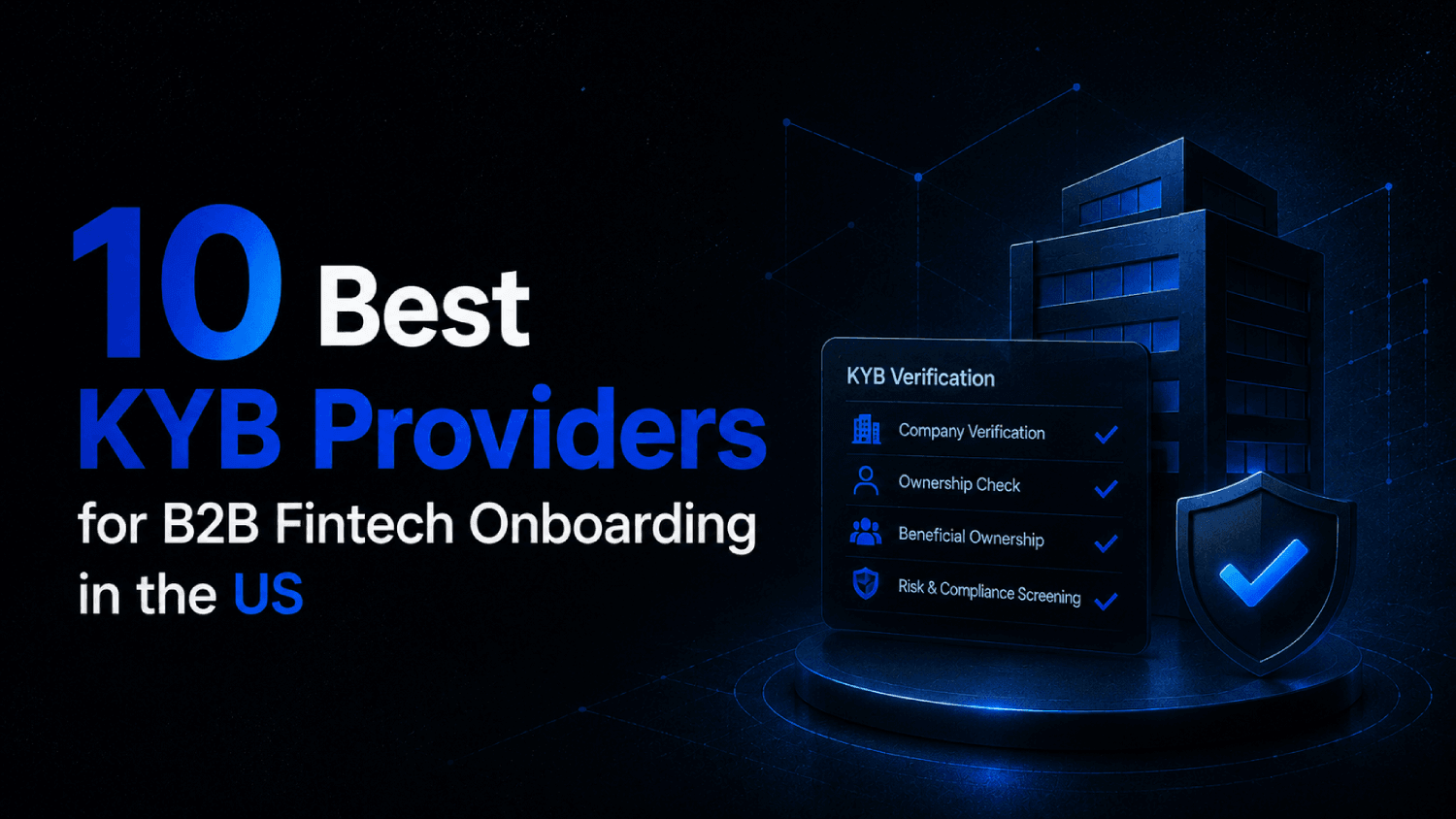
The best KYB providers for B2B fintech onboarding in the US are Middesk, Socure, Persona, Sumsub, Alloy, Comply Advantage, Trulioo, LexisNexis Risk Solutions, Onfido (now part of Entrust), and Veriff. Each handles the core workflow of business registration checks, UBO verification, and sanctions screening differently. Middesk leads on US Secretary of State coverage depth. Socure and Persona win on workflow flexibility and developer experience. Sumsub and Trulioo are stronger for cross-border onboarding. The right choice depends on your entity type mix, verification volume, and tolerance for manual review.
Why KYB Is a Different Problem Than KYC
Most founding teams conflate the two, and the conflation is expensive. KYC providers built for individual identity verification check a government-issued ID against a selfie, run the name through a watchlist, and return a pass/fail. That covers one person at one moment. KYB has to answer a more complex set of questions: Is this legal entity actually registered? Who owns it, directly and beneficially? Does anyone in that ownership chain appear on OFAC, FinCEN, or international sanctions lists? Has the company’s status changed since it was first verified?
Those are four separate data problems. The first requires real-time or near-real-time access to Secretary of State filings, which are updated at different frequencies in different states and are not exposed through a single federal API. The second requires either automated parsing of ownership documents or a structured UBO discovery workflow. The third requires AML and sanctions databases with global coverage. The fourth requires ongoing monitoring, not a one-time check.
A company selling through a B2B SaaS platform, applying for a business bank account, or enrolling as a marketplace vendor needs all four. Sending them through a standard KYC flow handles none of them adequately.
What the FintechSpecs KYB Coverage Test Actually Checks
Before comparing vendors, it helps to have a consistent way to evaluate them. The framework below , which we call the FintechSpecs KYB Coverage Test , breaks evaluation into five dimensions that product and compliance teams should run against any shortlisted provider before signing a contract.
- Registry depth: How many US states does the provider pull from directly, and are those pulls real-time or batched? Does coverage extend to foreign-owned US entities and registered agents?
- UBO discovery automation: Can the system extract and structure beneficial ownership data from uploaded documents, or does it require manual review? What percentage of UBO chains does it resolve without human intervention?
- Entity type coverage: Does the provider handle LLCs, S-corps, C-corps, partnerships, nonprofits, trusts, tribal entities, and sole proprietors? Many providers handle the first three and quietly fail on the rest.
- Sanctions and adverse media screening: Does the system screen the entity itself, its directors, and its beneficial owners against OFAC, EU, UN, and domestic watchlists? Does it include adverse media, or only structured lists?
- Workflow controls: Can you configure risk thresholds, define manual review queues, set re-verification triggers, and integrate the decision into your existing onboarding flow via API or webhook?
Run each vendor through these five checks before looking at pricing. A provider with cheaper per-verification rates but weak entity type coverage will generate more manual exceptions than a slightly pricier alternative with deeper registry access.
The 10 Best KYB Providers for US Fintech: Side-by-Side
| Provider | Best For | US Registry Coverage | UBO Automation | Sanctions Screening | Pricing Model |
|---|---|---|---|---|---|
| Middesk | US-focused fintechs, lenders, BaaS | All 50 states, direct pulls | Moderate | Yes (OFAC, FinCEN) | Per verification + platform |
| Socure | High-volume onboarding, fraud overlay | Strong | Good | Yes | Enterprise contract |
| Persona | Product teams needing full workflow control | Good | Good | Yes | Usage-based + platform fee |
| Sumsub | Cross-border onboarding, crypto, neobanks | Moderate (US gaps exist) | Strong (automated doc reading) | Yes (global) | Per verification / custom |
| Alloy | BaaS platforms, embedded finance orchestration | Good (via integrations) | Good | Yes | Platform + per decision |
| ComplyAdvantage | AML-heavy use cases, ongoing monitoring | Via third parties | Moderate | Strong (AI-powered, global) | Custom / volume tiers |
| Trulioo | Multi-jurisdiction, global coverage | Good | Moderate | Yes | Per verification / custom |
| LexisNexis Risk Solutions | Regulated banks, insurance, high-risk verticals | Extensive (proprietary data) | Strong | Yes (global) | Enterprise only |
| Onfido (Entrust) | European-primary fintechs with US expansion | Moderate | Good | Yes | Per verification / custom |
| Veriff | Identity-forward KYB with director verification | Moderate | Moderate | Yes | Per verification / custom |
Which KYB Provider Works Best for Each Fintech Use Case?
Middesk: Best for US-Only Business Verification
Middesk built its product specifically around Secretary of State data, and that focus shows. The platform pulls directly from all 50 states, cross-references IRS EIN data, and provides structured outputs that downstream systems can act on without manual parsing. For a US lender or BaaS platform onboarding small businesses, Middesk reduces the most common registry-level failure mode: a business that appears legitimate in one state’s filing but has lapsed status or a different registered agent on record in another.
UBO discovery is not Middesk’s strongest dimension. For entities with complex ownership chains or foreign parent companies, teams often layer Middesk’s registry data with a separate UBO or AML provider. The developer documentation is clear and the API is REST-based, which most engineering teams can implement quickly.
Socure: Best for High-Volume Onboarding with Fraud Overlay
Socure combines business verification with its broader identity graph, which means a single API call can return both entity-level KYB signals and fraud risk signals about the individual controlling that entity. For platforms processing thousands of new business accounts per month, that combination reduces the number of vendors in the stack. Pricing is enterprise-contract only, which makes Socure a poor fit for early-stage companies that need predictable per-verification costs.
Persona: Best for Product Teams That Need Full Workflow Flexibility
Persona is the most configurable option on this list. Product teams can build multi-step onboarding flows that combine business verification, director identity checks, document collection, and manual review queues in a single no-code workflow editor, with API hooks at every decision point. That flexibility comes with a tradeoff: Persona requires more configuration time upfront than a purpose-built KYB tool. For teams that want to own the onboarding UX entirely rather than embed a third-party flow, it is the right choice.
Persona’s KYB coverage for complex entity types , trusts, nonprofits, tribal entities , is better than most, but not unlimited. Testing against your specific entity distribution before committing is non-negotiable. Pricing is usage-based with a platform fee, and public pricing information is available on Persona’s pricing page.
Sumsub: Best for Cross-Border KYB with Strong Document Automation
According to Sumsub’s documentation, its platform supports automated corporate document reading, registry checks, UBO verification, and AML screening across more than 200 countries and territories. For a crypto exchange, neobank, or payments company onboarding businesses in Europe, Latin America, or Southeast Asia alongside US entities, Sumsub’s global registry coverage is a genuine differentiator. Within the US specifically, coverage depth is thinner than Middesk’s, so teams with a predominantly domestic book should factor that in.
Alloy: Best for BaaS and Embedded Finance Orchestration
Alloy sits in the orchestration layer: rather than being a primary KYB data source, it routes verification decisions across multiple underlying providers and applies configurable rule sets to determine outcomes. For a banking-as-a-service platform that needs to run different verification workflows for different customer segments or risk tiers, Alloy’s model reduces the engineering overhead of managing multiple vendor integrations. It also supports ongoing monitoring and re-verification triggers, which matter for compliance teams that need to demonstrate periodic review without manual scheduling.
ComplyAdvantage: Best for AML-Intensive Use Cases
ComplyAdvantage is less a KYB registry provider and more an AML intelligence layer. Its core product is a continuously updated database of sanctions lists, PEP (politically exposed person) registries, and adverse media, accessed via API. For a fintech that already has business registration data but needs to screen entities and their owners against global watchlists in real time, ComplyAdvantage fits cleanly into an existing stack. For teams that need end-to-end KYB including registry checks, it requires pairing with another provider.
Trulioo: Best for Global Entity Verification at Scale
Trulioo covers business verification across more than 200 countries and pulls from commercial registries, government databases, and third-party data sources. Its API abstraction layer means teams integrate once and get normalized outputs regardless of source country, which significantly reduces engineering complexity for platforms with global ambitions. US coverage is solid but not as granular as Middesk’s state-level depth. Trulioo is the right default for any fintech where more than 20% of business applicants are non-US entities.
LexisNexis Risk Solutions: Best for Regulated Financial Institutions
LexisNexis Risk Solutions has proprietary data assets built up over a long institutional history , public records, commercial registries, and licensed third-party sources , that no API-first startup can replicate quickly. Its business verification product draws from this depth to resolve entity identity even for businesses with minimal digital footprint. The platform is not designed for startup integration cycles: expect enterprise procurement, custom contracts, and onboarding timelines measured in weeks. For a regulated bank, insurance carrier, or high-risk lending platform that needs deep data and a proven audit trail, LexisNexis is the institutional-grade option.
Onfido (Entrust): Best for European Fintechs Expanding into the US
Onfido, now operating under Entrust, built its reputation on AI-powered document and biometric verification. Following its acquisition, it has maintained its developer-friendly API while gaining access to Entrust’s broader identity infrastructure. For a European fintech that already uses Onfido for KYC and is expanding its B2B product into US markets, staying with Onfido for KYB reduces integration overhead. US registry coverage is moderate compared to Middesk, but the director identity verification workflow is strong.
Veriff: Best for Identity-First KYB with Director Verification
Veriff approaches KYB from the identity layer outward: it leads with strong director and UBO identity verification and layered document checks before connecting to business registry data. For platforms where the identity of the controlling individual matters as much as the business’s legal status , lending, payroll, B2B payments , that emphasis is the right priority order. Veriff’s US business registry coverage is not the deepest on this list, but its identity verification accuracy is consistently rated among the best available.
Where US Business Registry Coverage Actually Breaks Down
No KYB provider has truly real-time access to all 50 Secretary of State databases. Some states update weekly. Some require manual scraping. A few have restricted API access entirely. This is not a vendor failure , it is a structural gap in US business registration infrastructure that every provider works around differently.
The entities most likely to fall through coverage gaps are: foreign-owned US LLCs registered in Delaware or Wyoming as privacy-preserving holding structures, tribal entities operating under sovereign nation charters, professional associations and cooperatives, and sole proprietors who have registered a DBA but not a formal business entity. If your customer profile includes any of these categories at meaningful volume, test your shortlisted vendor against a sample of real applicants in those categories before signing.
This gap is also why teams building compliance infrastructure should read past the vendor’s headline coverage claim and ask specifically: “How do you handle an applicant who has a valid EIN, a registered agent address, but whose state filing is more than six months stale?” The answer reveals how the provider handles ambiguity, which is where most real-world onboarding complexity lives. Building this kind of resilience into your stack is part of what the fintech product and compliance readiness checklist covers in more depth.
How Should Fintech Teams Think About KYB Pricing?
KYB pricing has four common structures, and the right one depends on your volume and re-verification frequency.
- Per-verification pricing (Middesk, Sumsub, Trulioo, Veriff): each API call costs a fixed amount. Predictable for low-volume products, expensive at scale if you re-verify frequently or run multiple checks per onboarding.
- Platform plus usage (Persona, Alloy): a monthly platform fee covers the workflow infrastructure, and per-event charges apply for each verification or decision. Appropriate for teams that need workflow tooling, not just raw verification calls.
- Enterprise contracts (Socure, LexisNexis, ComplyAdvantage): pricing is negotiated based on volume commitments and data access needs. No public list price. Not suitable for companies that need cost visibility before Series B.
- API call pricing: some providers charge per API call rather than per completed verification, which matters if your flow involves multiple partial checks per applicant.
Of the vendors that publish pricing publicly, Persona is the most transparent: its public pricing page lists a starter plan with per-inquiry costs, giving early-stage teams a concrete baseline for budgeting before entering a sales conversation. Most other KYB vendors require a discovery call before any number is on the table.
One thing product teams miss: the cost of ongoing monitoring is separate from the cost of initial verification at most vendors. If your compliance program requires re-screening existing business customers against sanctions lists on a periodic basis, that is a separate line item. Price it explicitly during vendor negotiations, because it can easily equal or exceed the initial verification cost for a large book of business customers.
For a concrete picture of how compliance costs compound as you scale, the real cost of compliance in fintech SaaS broken down by stage shows what teams typically spend at each growth inflection point.
An Illustrative Scenario: Series A Lending Platform Choosing Between Middesk and Alloy
Consider a Series A business lender processing around 400 new business loan applications per month, primarily small LLCs and S-corps across 12 states. The team is choosing between Middesk for direct registry verification and Alloy for orchestrated decision-making across multiple data sources.
At 400 verifications per month, the per-verification cost difference between the two is meaningful but not decisive. What matters more is the exception rate. Say Middesk resolves 88% of applications automatically and sends 12% to manual review. Alloy, routing through multiple sources, might resolve 93% automatically but carries a higher platform fee. At 400 applications per month, the 5% difference means about 20 fewer manual reviews. If a manual review costs the lending team 30 minutes of analyst time, that is 10 hours per month , roughly $600 to $1,000 in operational cost depending on labor rates. That math shifts decisively as volume grows.
The more important factor for this lender is re-verification. If loan covenants require annual business status checks for the existing portfolio, and that portfolio grows to 2,000 active borrowers within 18 months, the ongoing monitoring cost at per-verification pricing becomes the dominant cost driver. Alloy’s platform model may be cheaper for that scenario even if it is more expensive per initial verification.
What Entity Types Expose KYB Coverage Gaps Most Often?
LLCs are well-covered by every provider on this list. C-corps and S-corps are similarly straightforward. The coverage quality diverges on five entity types that appear more frequently in B2B fintech than most teams anticipate:
- Foreign-owned US LLCs: Common in cross-border e-commerce and marketplace platforms. Ownership chains run through foreign parent companies, and UBO discovery requires tracing beyond the US entity.
- Statutory trusts and business trusts: Used by real estate funds, asset managers, and some payment processors. Most providers have limited structured handling for this entity type.
- Tribal entities: Businesses chartered under tribal law do not appear in state Secretary of State databases and require specialized verification workflows.
- Nonprofits and 501(c)(3) organizations: Some KYB providers handle these; others return an error or an inconclusive result. Relevant for any platform serving community development financial institutions or social enterprises.
- Sole proprietors with DBAs: A significant portion of gig economy contractors and small service businesses. Most do not have an EIN. Verification relies on personal identity data, blurring the KYB/KYC line.
Testing against all five categories before selecting a vendor is the single most common step teams skip , and the one most likely to create compliance gaps after launch. Early-stage fintech compliance blind spots covers this class of problem in more detail.
How Does KYB Fit Into a Broader Fintech Compliance Stack?
KYB handles entity verification and ownership checks, but it sits inside a larger compliance architecture. A fintech platform also needs transaction monitoring, fraud detection, and ongoing AML screening running in parallel. KYB is typically the front door: it determines whether a business is allowed to onboard at all. Everything else monitors behavior after that decision is made.
For platforms building this stack from scratch, the integration sequence matters. KYB should run before account creation, not after. UBO screening should be completed before any financial transaction is permitted. Ongoing monitoring should trigger automatically on sanctions list updates, not on a fixed calendar schedule. These are workflow decisions, not vendor decisions, but they affect which vendor architecture fits. Teams thinking through fraud detection and risk tooling for fintech alongside KYB will recognize that the two stacks share data , watchlist hits from KYB screening inform fraud scoring downstream.
The providers that handle all of this under one roof , Socure, Alloy, LexisNexis , trade configuration flexibility for consolidated vendor management. The providers that handle one layer well , Middesk for registry data, ComplyAdvantage for AML monitoring , require more integration work but let teams choose best-in-category at each layer. Neither is inherently better. The right answer depends on your team’s engineering capacity and your compliance program’s complexity.
Frequently Asked Questions About KYB Providers for Fintech
What is the difference between KYB and KYC for fintech platforms?
KYC (Know Your Customer) verifies the identity of an individual using government-issued documents and biometric checks. KYB (Know Your Business) verifies the legal existence of a company, its ownership structure including beneficial owners, and screens the entity and its principals against sanctions and watchlists. B2B fintech platforms need both: KYC for the humans controlling the business, and KYB for the business entity itself. They are separate compliance workflows that most purpose-built KYC tools do not cover adequately for business onboarding.
Which KYB API has the best US business registry coverage?
Middesk has the deepest direct coverage of US Secretary of State databases, pulling from all 50 states. LexisNexis Risk Solutions has broad proprietary data coverage including public records beyond official registries. For most US-focused fintechs, Middesk is the default choice for registry depth. Teams needing global coverage alongside US should evaluate Trulioo or Sumsub, which trade some US granularity for broader international reach.
How do KYB providers handle UBO verification for complex ownership structures?
UBO (Ultimate Beneficial Owner) discovery approaches vary significantly. Sumsub and LexisNexis use automated document reading to extract and structure ownership chains from corporate filings. Persona and Alloy provide configurable workflows where complex cases route to manual review queues. Middesk’s UBO capabilities are more limited and often require supplementation with a dedicated AML or UBO provider for entities with more than one or two ownership layers. No provider handles all UBO structures automatically without any manual intervention.
What should fintech teams test before selecting a KYB vendor?
Run a sample of 50 to 100 real business applicants from your target customer profile through each shortlisted vendor and measure: auto-approval rate, manual review rate, error rate for edge-case entity types, and API response time. Pay specific attention to entity types that represent your long-tail customers , trusts, nonprofits, foreign-owned LLCs, sole proprietors , since those are where coverage gaps are most common. Also test re-verification behavior by submitting a previously approved entity with a changed registered agent address to see how the system handles the discrepancy.
Is Middesk or Alloy better for a US lending platform?
Middesk is better if your primary need is accurate, fast US business registry verification and you are comfortable managing AML screening separately. Alloy is better if you need to orchestrate multiple data sources, apply custom risk rules across different customer segments, and manage the entire KYB decision workflow inside a single platform. At lower volumes, Middesk is simpler and cheaper. As a lending portfolio grows past a few thousand active accounts, Alloy’s orchestration capabilities and ongoing monitoring features tend to justify the platform cost.
Do KYB providers cover ongoing monitoring, or just initial verification?
Most KYB providers offer ongoing monitoring as an add-on, not as part of base pricing. ComplyAdvantage specializes in continuous AML monitoring with real-time alerts on sanctions list changes, adverse media, and PEP status updates. Alloy supports re-verification triggers built into its decision engine. Middesk and Persona offer monitoring features but they vary in alerting granularity. When budgeting for a KYB vendor, price the ongoing monitoring component explicitly for your expected portfolio size, since it often exceeds the initial verification cost at scale.
What is the typical API integration timeline for a KYB provider?
Developer-friendly providers like Persona, Middesk, and Sumsub typically support sandbox-to-production integration in two to four weeks for a basic implementation. Complex workflows with custom rules, multiple entity types, and manual review queue integration take four to eight weeks. Enterprise providers like LexisNexis and Socure have longer onboarding cycles due to contract requirements and configuration support, often six to twelve weeks from contract signing to production. Factor integration timeline into vendor selection if you are working against a compliance deadline or product launch date.
The Most Important Thing to Get Right
The KYB vendor decision is a compliance decision, an engineering decision, and an ops decision simultaneously. Teams that treat it as purely a vendor procurement exercise tend to discover the gaps after launch, at the worst possible moment. The work of mapping your actual entity type distribution, testing coverage against real edge cases, and pricing ongoing monitoring at realistic future portfolio scale takes a few weeks before contract signing. It saves months of remediation afterward.
The providers at the top of this list are differentiated enough that there is rarely a single correct answer for all fintechs. Middesk, Persona, and Alloy cluster as the strongest choices for US-first product teams. Sumsub and Trulioo pull ahead when the business is globally distributed. LexisNexis and Socure are the right answer when the risk and compliance requirements of the institution leave no room for coverage uncertainty.
Choosing the wrong provider is not primarily a cost problem. It is a throughput problem. Every applicant your verification stack cannot resolve automatically becomes a manual review, a delayed activation, or a conversion failure. Business onboarding drop-off is usually a UX symptom of an underlying verification coverage problem. Fixing the vendor selection fixes the funnel.