
- Fiat AML tools flag suspicious dollar amounts. Crypto AML tools trace wallet clusters, chain hops, and mixer interactions across multiple blockchains simultaneously, which are fundamentally different data models.
- The FATF Travel Rule requires virtual asset service providers to share originator and beneficiary data on transfers above $3,000 (US threshold). General AML vendors do not handle this.
- Chain coverage matters more than feature lists. A tool that monitors Ethereum but misses Tron or Solana leaves real exposure gaps, since illicit flows route to wherever coverage is thinnest.
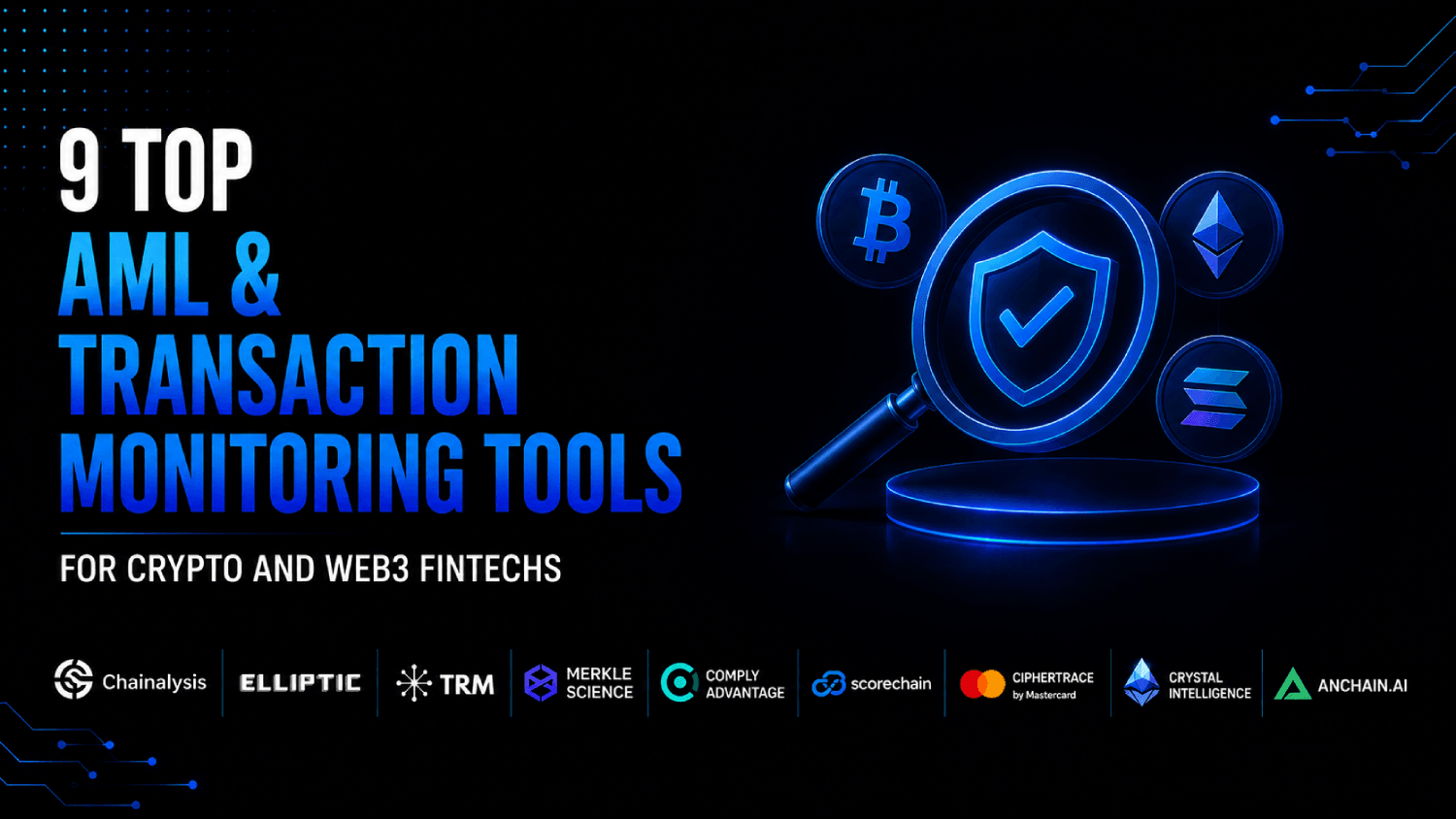
- The leading crypto AML tools split into two categories: blockchain analytics platforms (Chainalysis, Elliptic, TRM Labs) and compliance workflow tools with chain-native risk scoring (Merkle Science, ComplyAdvantage, Scorechain, and others). That distinction is called out explicitly in the vendor sections below.
- For most crypto exchanges and Web3 fintechs at seed to Series C, the right choice depends on three factors: chain coverage, Travel Rule support, and whether you need a wallet screening API or a full analyst workbench.
The best crypto AML tools for exchanges and Web3 fintechs are Chainalysis, Elliptic, TRM Labs, Merkle Science, and ComplyAdvantage. Each addresses blockchain-specific risks that fiat AML systems cannot handle: on-chain tracing across multiple blockchains, wallet risk scoring, FATF Travel Rule compliance, and smart contract exposure analysis. The right choice depends on your chain coverage requirements, transaction volume, and whether you need a full investigation workbench or a lightweight wallet screening API.
Why Fiat AML Tools Fail for Crypto and Web3
A traditional AML platform sees a transaction as a dollar amount moving between two account numbers. It applies rule-based thresholds, screens names against sanctions lists, and files a SAR if a pattern looks wrong. That model works for bank wires. It breaks completely for on-chain activity.
On-chain transactions involve pseudonymous addresses, not named accounts. A single entity may control thousands of wallets. Funds can move through mixers, bridges, and cross-chain swaps in minutes, making the source unrecognizable to any tool that only sees your exchange’s deposit ledger. A fiat AML system sees a deposit. A crypto AML tool sees that the deposit originated from a Tornado Cash cluster, passed through three intermediate wallets, and shares address-reuse patterns with a known ransomware wallet.
The compliance gap is not theoretical. FinCEN, OFAC, and state regulators have all taken enforcement actions against crypto businesses that relied on inadequate monitoring. If you are building a crypto exchange, a Web3 payment rail, or a stablecoin product, your fintech compliance readiness depends on chain-native tooling, not a repurposed banking AML product.
What Is the FintechSpecs Crypto AML Coverage Test?
Before evaluating individual vendors, apply what we call the FintechSpecs Crypto AML Coverage Test: four checks that separate genuine crypto-native tooling from fiat AML vendors with a blockchain module bolted on.
- Chain depth: Does the tool cover the specific chains your users transact on, including Layer 2s (L2s) like Arbitrum, Base, and Optimism, not just Ethereum mainnet and Bitcoin?
- Attribution breadth: How many named entities (exchanges, mixers, darknet markets, sanction addresses) does the vendor’s intelligence database cover, and how frequently is it updated?
- Travel Rule integration: Does the tool include a built-in Travel Rule messaging protocol, or do you need a separate VASP data solution to share originator/beneficiary information?
- API-first access: Can you call a wallet screening API in real time at deposit or withdrawal, or is the tooling primarily a dashboard for analysts after the fact?
A vendor that clears all four is a crypto AML tool. A vendor that clears two or three may still be the right fit depending on your workflow, but you need to know which gaps you are accepting.
How Do These 9 Tools Compare on Chain Coverage, Travel Rule, and API Access?
The table below maps each vendor against the four Coverage Test dimensions. The Category column reflects the distinction from the lead: blockchain analytics platforms versus compliance workflow tools with chain-native risk scoring. L2s refers to EVM-compatible Layer 2 networks, specifically Arbitrum, Base, and Optimism.
| Vendor | Category | BTC | ETH / EVM | Tron | Solana | L2s (Arbitrum, Base) | Travel Rule | Wallet Screening API | Best For |
|---|---|---|---|---|---|---|---|---|---|
| Chainalysis | Blockchain analytics | Yes | Yes | Yes | Yes | Partial | Yes (Chainalysis KYT + Business Data) | Yes | Enterprise exchanges, regulators |
| Elliptic | Blockchain analytics | Yes | Yes | Yes | Yes | Growing | Yes (Elliptic Navigator) | Yes | Global VASPs, DeFi exposure |
| TRM Labs | Blockchain analytics | Yes | Yes | Yes | Yes | Yes | Yes (TRM Travel Rule) | Yes | Mid-market exchanges, broad chain coverage |
| Merkle Science | Compliance workflow | Yes | Yes | Yes | Yes | Partial | Yes | Yes | APAC/MENA fintechs, custom risk rules |
| ComplyAdvantage | Compliance workflow | Yes | Yes | Limited | Limited | No | No (fiat-focused) | Yes (fiat + crypto screening) | Hybrid fiat/crypto compliance teams |
| Scorechain | Compliance workflow | Yes | Yes | Yes | Yes | Partial | Yes | Yes | EU-regulated VASPs, DORA readiness |
| CipherTrace (Mastercard) | Compliance workflow | Yes | Yes | Yes | Limited | No | Yes (CipherTrace Armada) | Yes | Financial institutions entering crypto |
| Crystal Intelligence | Blockchain analytics | Yes | Yes | Yes | Partial | No | Yes | Yes | Investigators, law enforcement partners |
| AnChain.AI | Blockchain analytics | Limited | Yes | Limited | Yes | Yes | No | Yes | DeFi protocols, smart contract auditing |
Chain coverage data reflects publicly available vendor documentation. L2 support is the fastest-moving area. Verify current coverage directly with vendors before signing a contract, since Solana and Base coverage in particular has changed significantly in the past 12 months across all providers.
Chainalysis: The Market Standard for Enterprise Crypto Exchanges
Category: Blockchain analytics platform.
Chainalysis is the most widely deployed blockchain analytics platform among regulated US exchanges. Its core product, Chainalysis KYT (Know Your Transaction), screens transactions in real time and flags exposure to sanctioned entities, darknet markets, ransomware wallets, and mixers. The company maintains one of the largest proprietary blockchain attribution databases in the industry, covering hundreds of millions of named wallet clusters.
For Travel Rule compliance, Chainalysis offers Business Data, a VASP directory service that connects to counterparty exchanges during transfers. The pricing is not publicly disclosed and scales with transaction volume. For very high-volume exchanges, Chainalysis is the default enterprise choice, partly because regulators and law enforcement are already familiar with its reports.
The trade-off: it is priced for enterprises. Early-stage crypto fintechs processing under $10M monthly in transactions often find the contract minimums too high relative to the value at early volumes.
Elliptic: The Best Choice for DeFi and Cross-Chain Exposure
Category: Blockchain analytics platform.
Elliptic was one of the first blockchain analytics firms to build serious cross-chain tracing capabilities, meaning it can follow funds as they move from Bitcoin to Ethereum via a bridge and then into a DeFi protocol. For fintechs that offer DeFi integrations, wrap tokens, or cross-chain bridging, Elliptic’s coverage of these exposure vectors is more mature than most competitors.
Elliptic Navigator handles Travel Rule messaging and VASP identification. The platform also includes Elliptic Lens for wallet screening and Elliptic Investigator for analyst workflows. Like Chainalysis, pricing is enterprise contract-based and not publicly listed. Elliptic has strong coverage in both the US and UK/EU markets, making it a good fit for VASPs operating across jurisdictions.
TRM Labs: The Strongest Mid-Market Option for Multi-Chain Fintechs
Category: Blockchain analytics platform.
TRM Labs has gained significant adoption among mid-market crypto exchanges and Web3 fintechs because it combines broad chain coverage with a developer-friendly API. Its wallet screening API returns risk scores and entity attribution in a single call, which integrates cleanly into deposit and withdrawal flows without requiring an analyst in the loop.
TRM covers over 30 blockchains as of its public documentation, including Solana, Tron, Avalanche, and several EVM-compatible Layer 2s (L2s), giving it one of the widest coverage footprints among the three major blockchain analytics vendors. TRM Travel Rule provides counterparty VASP identification and Travel Rule messaging. Pricing is not publicly disclosed, but TRM is generally positioned as more accessible than Chainalysis for pre-Series B companies.
Merkle Science: The Right Fit for Custom Risk Rules and APAC Exposure
Category: Compliance workflow tool with chain-native risk scoring.
Merkle Science differentiates on its Compass platform, which allows compliance teams to define custom risk rules rather than relying solely on vendor-defined categories. For a crypto exchange with a specific risk appetite, say one that wants to flag exposure to any wallet that has ever touched a mixer at two or more hops removed, Compass can encode that logic without a developer change request to the vendor.
Merkle Science has strong traction in Singapore, the UAE, and other APAC/MENA markets where its regulatory coverage is particularly detailed. Travel Rule compliance is included. For US fintechs with global user bases, the combination of custom rule logic and multi-jurisdictional regulatory mapping makes Merkle Science a compelling alternative to the larger platforms.
ComplyAdvantage: Best for Teams That Need Fiat and Crypto Screening Together
Category: Compliance workflow tool with chain-native risk scoring.

ComplyAdvantage is primarily a fiat AML platform that has added crypto screening capabilities. It covers Bitcoin and Ethereum well, but Tron and Solana coverage is more limited, and it does not offer a Travel Rule solution. What it does offer is a unified sanctions screening, PEP screening, and adverse media service that spans both fiat and crypto transactions from a single API.
For a hybrid fintech, one that handles both bank account onboarding and crypto wallets, ComplyAdvantage reduces vendor count. The trade-off is accepting narrower chain coverage in exchange for operational simplicity. The ComplyAdvantage crypto AML page outlines the product scope, and pricing is available on request. For pure-play crypto exchanges, ComplyAdvantage is not the primary tool. For fintechs building on top of stablecoin payment rails while also running standard KYC flows, it is worth evaluating alongside a dedicated blockchain analytics tool.
If you are actively building a stablecoin payments layer, see the leading stablecoin payment APIs for context on what compliance integrations those platforms already include.
Scorechain: The EU-Regulated VASP’s Preferred Tool
Category: Compliance workflow tool with chain-native risk scoring.
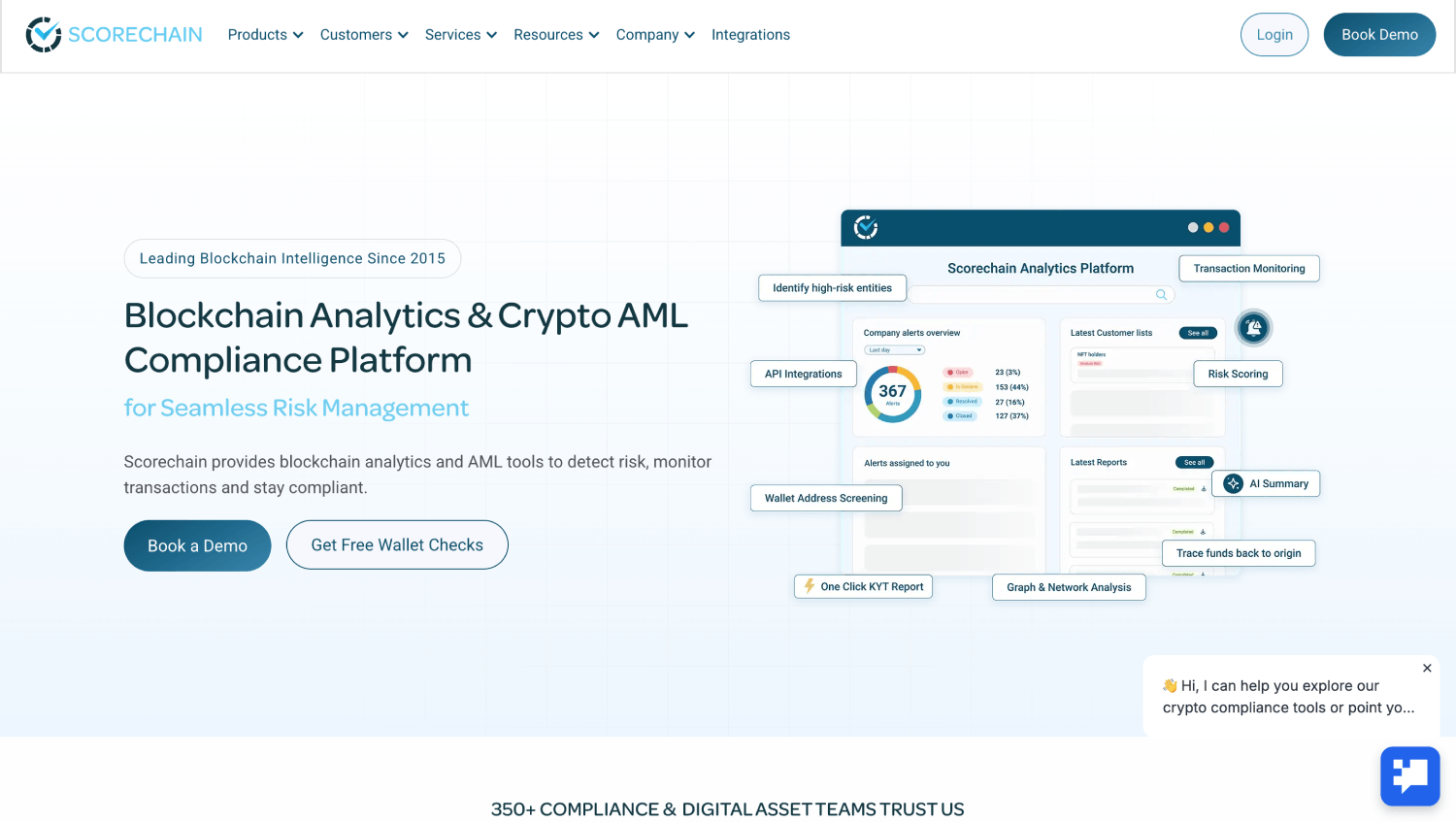
Scorechain is a Luxembourg-based blockchain analytics and compliance platform with deep coverage of European regulatory requirements, including MiCA (Markets in Crypto-Assets Regulation) and DORA (Digital Operational Resilience Act). It covers over 50 blockchains per its public documentation and includes Travel Rule messaging through its integrated VASP directory.
For US-based crypto fintechs expanding into European markets, Scorechain’s MiCA-ready compliance workflows can reduce the time to regulatory approval in EU member states. Its risk scoring engine is configurable, and the API is well-documented for developer integration. Pricing is available on request.
CipherTrace (Mastercard): The Enterprise Financial Institution Play
Category: Compliance workflow tool with chain-native risk scoring.
CipherTrace, acquired by Mastercard in 2021, is positioned primarily for traditional financial institutions that are adding crypto services to existing products. Its CipherTrace Armada platform handles Travel Rule compliance, and its blockchain analytics cover the major chains. One differentiator that sets it apart from pure-play crypto AML vendors: integration with Mastercard’s broader financial intelligence and fraud network gives financial institutions a single relationship that spans both card-based and on-chain risk monitoring. For a bank or payment network adding crypto custody or on-ramp services, that consolidated data relationship is a genuine procurement advantage, not just a sales convenience.
For a crypto-native startup, CipherTrace is rarely the first choice. The Mastercard connection is less relevant when you are not also running a card program, and the enterprise sales cycle reflects its institutional focus.
Crystal Intelligence: Built for Investigators and Law Enforcement-Grade Tracing
Category: Blockchain analytics platform.
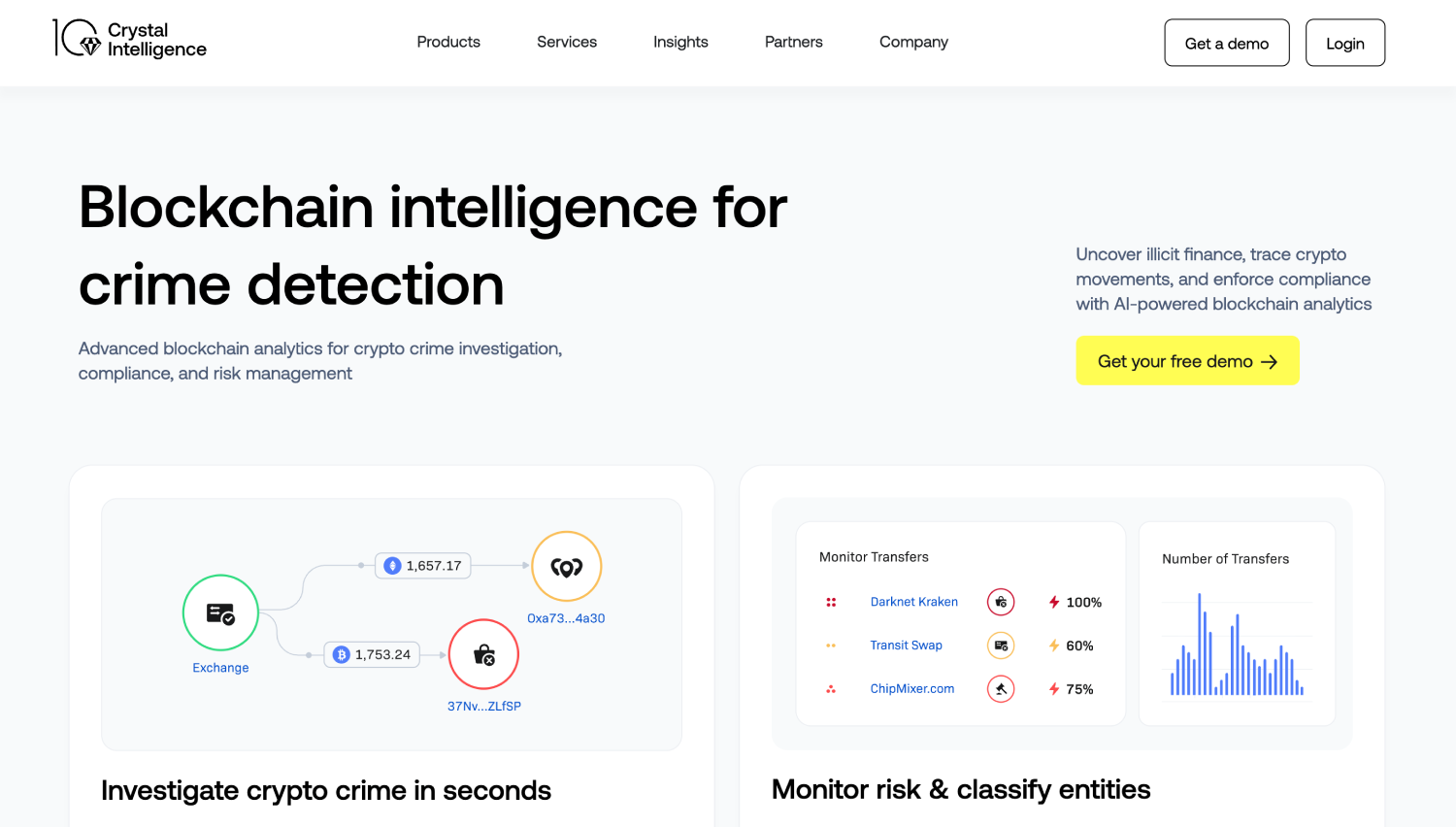
Crystal Intelligence (formerly Crystal Blockchain) is built around forensic investigation workflows rather than real-time screening. Its visualization tools for tracing fund flows are among the most detailed available, and it has a strong track record with law enforcement partnerships in Europe and the US.
For a crypto compliance team that handles SAR preparation, law enforcement information requests, or post-incident forensics, Crystal is worth evaluating alongside a real-time monitoring tool. It is not typically used as a primary wallet screening layer. It functions better as the second tool in a two-tool stack: one for real-time transaction monitoring at deposit, one for deep investigation when an alert fires.
AnChain.AI: The Smart Contract and DeFi Protocol Choice
Category: Blockchain analytics platform, narrowly focused on EVM and DeFi risk.
AnChain.AI takes a different approach from traditional blockchain analytics vendors. It focuses on smart contract behavior analysis, DeFi protocol risk, and EVM-chain coverage, including L2 support for Arbitrum and Base, making it relevant for Web3 fintechs that need to monitor complex on-chain interactions rather than simple transfer flows. That EVM-and-L2 depth is where it earns its place on the list.
For a platform that lets users interact with DeFi protocols, provides smart contract-based escrow, or runs a Web3 gaming or NFT marketplace with payment flows, AnChain.AI surfaces risks that a transaction-level blockchain scanner would miss, such as a smart contract that has been exploited or holds funds flagged in a prior hack. Chain coverage outside EVM is limited, so it works best alongside a broader blockchain analytics platform rather than as a standalone AML solution.
What Is the FATF Travel Rule, and Which Tools Actually Solve It for US VASPs?
The FATF Travel Rule requires that virtual asset service providers collect and transmit originator and beneficiary information on crypto transfers above a threshold. In the US, FinCEN’s proposed rules set that threshold at $3,000, mirroring the Bank Secrecy Act’s existing wire transfer rule. For crypto exchanges, this means identifying not just your own user but the counterparty VASP on the receiving end of a transfer.
The practical problem: there is no single shared ledger of VASP identifiers. Three interoperability protocols have emerged to solve this. The IVMS101 data standard defines what information gets transmitted. The Travel Rule Protocol (TRP), developed by a consortium of banks and crypto firms, handles the messaging layer. TRISA (Travel Rule Information Sharing Architecture) is an open-source alternative championed by several blockchain analytics vendors.
Of the nine tools above, Chainalysis, Elliptic, TRM Labs, Merkle Science, Scorechain, CipherTrace, and Crystal Intelligence all offer some form of Travel Rule solution. ComplyAdvantage and AnChain.AI do not. If Travel Rule compliance is a current or near-term requirement for your exchange, filter your shortlist to vendors that support it natively. Building a custom Travel Rule integration is expensive and introduces operational risk that a specialist vendor eliminates.
Travel Rule compliance is one of the more frequent compliance mistakes that destroy early-stage fintech startups, particularly for crypto teams that assume their existing KYC vendor covers it.
How Should a Seed-to-Series B Crypto Fintech Choose Between These Tools?
At seed stage, the realistic choice is between a lighter-weight API-first tool like TRM Labs or Merkle Science and a larger platform like Chainalysis. The decision comes down to contract minimums and chain coverage. If your users primarily transact on Bitcoin and Ethereum, most tools cover you adequately. If you support Solana, Tron, or any EVM Layer 2 (L2), verify coverage explicitly before signing.
At Series A, the calculus shifts. By this point you likely have a compliance team member or are about to hire one. That person will want an analyst workbench, not just an API. Chainalysis KYT and Elliptic Investigator are built for analyst workflows. TRM’s platform has improved its investigation tooling significantly. Merkle Science is a strong option if you want configurable risk rules without waiting on the vendor’s roadmap.
At Series B and beyond, your regulator relationships start to shape the decision. US regulators are familiar with Chainalysis reports. If you are in a regulatory gray area and anticipate examination or inquiry, being able to show that your monitoring tool is the same one federal agencies use carries real weight. That is not a product feature. It is a regulatory risk management decision.
For context on how compliance costs evolve at each stage, the real cost of compliance in fintech SaaS broken down by stage covers the financial model behind these decisions.
What Does a Wallet Screening API Integration Actually Look Like?
Consider a Series A crypto exchange processing $8M in monthly deposits. The compliance team screens every incoming wallet at deposit initiation and every destination wallet at withdrawal. Without a wallet screening API, that screening is manual or batch-processed overnight, which means high-risk deposits clear before anyone reviews them.
With a wallet screening API, the exchange makes a synchronous API call at deposit submission. The call returns a risk score, entity attribution (for example, “Binance,” “Unknown mixer,” “Sanctioned entity”), and a list of specific risk categories. If the score exceeds a threshold, the deposit is held for manual review. If it is clean, it auto-approves. The entire check adds under 200 milliseconds to the user flow.
TRM Labs, Elliptic, and Chainalysis all publish developer documentation for this workflow. Merkle Science and Scorechain also offer it. The key API design differences to evaluate: does the endpoint return a structured risk category list or only a numeric score? Does it include hop-level attribution (where the funds came from three addresses back) or only direct counterparty information? Hop-level attribution costs more compute and sometimes more money, but it is the difference between catching a well-laundered deposit and missing it.
For teams building broader fraud and compliance stacks, the best fraud detection and risk tools for fintech startups covers the adjacent fraud layer that sits on top of AML monitoring.
Frequently Asked Questions
What are AML solutions for crypto?
Crypto AML solutions are software platforms that monitor blockchain transactions, screen wallet addresses against sanctions and risk databases, trace the origin and destination of funds across multiple chains, and help exchanges file Suspicious Activity Reports. They differ from fiat AML tools in that they analyze pseudonymous on-chain data using blockchain attribution techniques rather than account-level transaction records. The leading providers are Chainalysis, Elliptic, TRM Labs, Merkle Science, and Scorechain.
What is the difference between blockchain analytics and transaction monitoring for crypto?
Blockchain analytics is the broader discipline of analyzing on-chain data to attribute wallet addresses to entities, trace fund flows, and identify risk exposures. Transaction monitoring is the compliance workflow layer that fires alerts when incoming or outgoing transactions meet certain risk criteria. Most enterprise crypto AML tools combine both: blockchain analytics provides the intelligence, and transaction monitoring provides the real-time alerting and case management workflow that compliance teams use daily.
How does the Travel Rule work for crypto exchanges?
The FATF Travel Rule requires VASPs to collect, verify, and transmit originator and beneficiary information when transferring virtual assets above a jurisdiction-specific threshold. In the US, FinCEN’s proposed rules set that threshold at $3,000. In practice, this means a sending exchange must identify its user and share that information with the receiving exchange before or during the transfer. Vendors like Chainalysis, TRM Labs, Elliptic, and Scorechain handle the VASP directory lookup and secure message transmission required to comply.
Does the Travel Rule apply to stablecoins?
Yes. The FATF Travel Rule applies to transfers of any virtual asset, including stablecoins like USDC and USDT, when those transfers occur between VASPs. On-chain stablecoin transfers above the threshold require the same originator and beneficiary data transmission as Bitcoin or Ethereum transfers. Fintechs operating stablecoin payment rails between custodial wallets need Travel Rule tooling, not just standard KYC. The obligation applies to the VASPs facilitating the transfer, not to the stablecoin issuer.
Can I use a general AML tool like Sardine or Unit21 for crypto monitoring?
Sardine and Unit21 are transaction monitoring platforms built primarily for fiat payment flows. They can ingest crypto transaction data you feed them, but they do not perform on-chain blockchain analytics, wallet attribution, or chain-native risk scoring. For crypto-specific risk, you need a dedicated blockchain analytics layer from a vendor like Chainalysis or TRM Labs feeding risk signals into your transaction monitoring workflow. Many crypto fintechs use both: a blockchain analytics tool for on-chain risk and a fiat-oriented transaction monitoring tool for behavioral and payment-flow anomaly detection.
What chains should my crypto AML tool cover?
At minimum, a crypto AML tool must cover Bitcoin, Ethereum, Tron (which carries a large share of USDT volume), and Solana. If you support EVM Layer 2 networks like Arbitrum, Base, Optimism, or Polygon, verify those explicitly. Coverage gaps in high-volume chains are where illicit actors route funds. TRM Labs currently offers the broadest publicly documented chain coverage among the major vendors, covering over 30 blockchains. Always confirm current chain coverage directly with the vendor, since new chains are added frequently and vendor pages may lag actual capability.
What is the best crypto AML tool for a small crypto exchange?
For a small or early-stage crypto exchange, TRM Labs and Merkle Science are generally the most accessible starting points. Both offer developer-friendly wallet screening APIs, cover the major chains, and include Travel Rule support. Chainalysis and Elliptic are more capable but are priced for higher transaction volumes. If your monthly transaction volume is under $5M and you need a fast integration timeline, start with TRM Labs or Merkle Science, then reassess as volume and regulatory complexity grow.
The Bigger Picture on Crypto AML Tooling
The underlying mistake most crypto fintechs make is treating AML as a single-vendor problem. In practice, a mature crypto compliance stack has at least two layers: a blockchain analytics tool that screens wallets and traces on-chain flows, and a transaction monitoring platform that models behavioral patterns and manages case workflows. These are different problems. Trying to solve both with one tool usually means accepting a mediocre solution to one of them.
The vendors at the top of this list, Chainalysis, Elliptic, and TRM Labs, compete on the quality of their attribution databases. That intelligence layer is genuinely hard to replicate. A smaller vendor with identical features but a thinner attribution database will surface fewer true positives and generate more false alerts. Over time, the cost of analyst hours spent on false positives from a weaker intelligence database often exceeds the price difference between vendors.
The sharpest insight from the FintechSpecs Crypto AML Coverage Test is this: chain coverage gaps are not just a compliance problem. They are a product liability. If your exchange clears a deposit from a sanctioned wallet because your AML tool does not track the chain it transited, the enforcement exposure falls on you, not your vendor. The right way to evaluate any crypto AML tool is to map it against your exact chain list, your exact Travel Rule obligations, and your analyst workflow needs, in that order, before the feature checklist ever comes out.