
- Most fintech startups treat document verification as a checkbox inside their KYC vendor. That is the gap fraudsters count on.
- Dedicated fake document detection tools analyze font inconsistencies, metadata anomalies, print pattern defects, and AI-generation signatures that general KYC stacks simply do not check.
- The attack surface has widened: fraudsters now submit AI-generated bank statements, synthetic ID composites, and digitally altered payslips that pass basic liveness checks but fail document forensics.
- Choosing the right tool depends on your document types (identity documents vs. financial documents vs. business filings), your fraud volume, and whether you need real-time decisioning or async review queues.
- Use the FintechSpecs Document Fraud Stress Test below before signing any vendor contract.
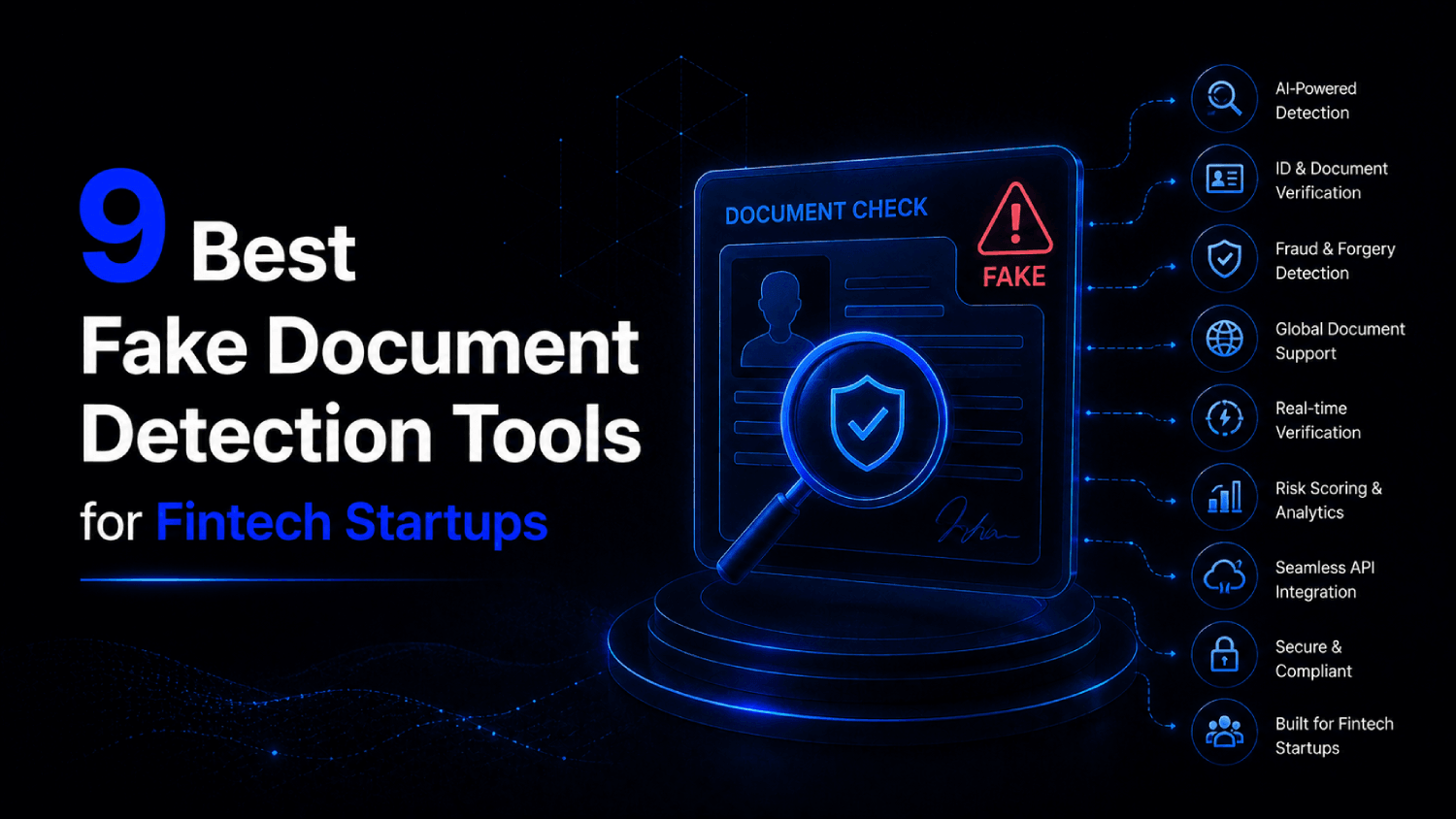
The best fake document detection tools for fintech startups are Inscribe, Resistant AI, Mitek, ABBYY, Veryfi, Attestiv, VerifyPDF, Jumio, and Onfido. Each targets a different layer of document fraud: some specialize in AI-generated financial documents, others in physical ID forensics, and a few in metadata and print-pattern analysis. The right choice depends on what document types your onboarding flow accepts and where in the funnel fraud is entering.
Why Generic KYC Vendors Miss Document Fraud
A standard KYC integration checks that a document exists, matches a name, and passes a liveness selfie comparison. That handles straightforward cases. It does not handle a PDF bank statement where a fraudster changed the balance field in Adobe Acrobat, or a driver’s license assembled from real data belonging to three different people.
Document fraud has branched into at least four distinct attack vectors your KYC vendor was not built for. The first is digital manipulation: altering text, numbers, or dates in an otherwise authentic PDF or image. The second is AI-generated document creation: producing a realistic-looking bank statement, payslip, or tax return from scratch using generative models. The third is synthetic identity construction: combining a real Social Security number (often belonging to a child or recent immigrant with no credit history) with fabricated name and address data to build a persona that passes bureau checks. The fourth is document template fraud: purchasing blank templates of real financial institutions and populating them with invented figures.
General KYC stacks typically check the first vector poorly and ignore the other three entirely. That gap is measurable in fraud losses, not in abstract risk scores. Teams building lending products, neobanks, or expense platforms that accept uploaded financial documents need a dedicated detection layer, separate from or layered under their existing KYC provider. The broader fraud detection stack for fintech startups is worth reviewing alongside this list, since document fraud tools rarely operate in isolation.
What Document Types Are Actually Being Faked?
Knowing which documents fraudsters target most often shapes which tool you evaluate first. Bank statements are the highest-volume target in consumer lending and BNPL onboarding, because they directly influence credit decisions and are easy to edit in PDF form. Pay stubs and tax returns (W-2s, 1099s) follow closely, particularly in income verification flows. Utility bills and lease agreements get faked for address verification bypasses.
On the identity document side, passports and state-issued driver’s licenses are the primary targets. Fraudsters either tamper with genuine documents or construct composites using real document templates with altered biographical data. Business filings, including Articles of Incorporation and EIN confirmation letters, are increasingly faked during business account onboarding, a vector most B2B fintech platforms underestimate.
If your platform accepts any of the above during onboarding or underwriting, a dedicated document fraud detection layer is not optional. Teams building out their full compliance stack should also review the fintech product and compliance readiness checklist to catch adjacent gaps.
The FintechSpecs Document Fraud Stress Test
Before evaluating any vendor, run each candidate through this four-part framework. It is designed to expose gaps that sales demos do not show.
1. Signal Depth Check
Ask the vendor to list every signal layer their system analyzes. A credible tool should cover at minimum: metadata extraction (creation date, modification history, software used), font and character consistency analysis, pixel-level manipulation detection, template fingerprinting against known authentic documents, and AI-generation likelihood scoring. A vendor who lists three of five should be treated with caution.
2. Attack Vector Coverage Matrix
Give the vendor four document samples representing each attack vector described above. A digitally altered PDF, an AI-generated bank statement, a synthetic ID, and a populated template. Ask for the detection output on each. If they cannot demonstrate detection on all four, they have gaps. Document which gaps exist before any contract conversation starts.
3. False Positive Rate Under Realistic Volume
False positives in document verification create onboarding drop-off, and drop-off has a direct revenue cost. Ask vendors for their false positive rate on documents submitted by legitimate users, not just their detection rate on known fraud. A tool that flags 40% of real documents as suspicious will cost you conversions before it saves you fraud losses. This is the trade-off most evaluations skip.
4. Integration Latency and Decision Mode
Real-time onboarding flows cannot tolerate 30-second analysis windows. Ask whether the tool returns a synchronous result or queues for async review. Both models are valid for different use cases: real-time for consumer onboarding, async batch processing for underwriting review queues. Make sure the decision mode matches your flow before you build an integration. The full KYC provider comparison covers integration architecture in more depth if your document tool needs to sit inside a broader identity stack.
9 Best Fake Document Detection Tools for Fintech Startups
| Tool | Primary Strength | Best For | Document Types Covered | Pricing Model |
|---|---|---|---|---|
| Inscribe | AI-generated financial document detection | Lenders, BNPL, neobanks | Bank statements, payslips, tax returns | Usage-based (not publicly disclosed) |
| Resistant AI | Deep document forensics, manipulation history | Risk teams with high document volume | Financial docs, IDs, contracts | Enterprise (not publicly disclosed) |
| Mitek | Deep learning ensemble for ID manipulation | ID-heavy onboarding flows | Government IDs, passports, driver’s licenses | Enterprise (not publicly disclosed) |
| ABBYY | Document AI with fraud classification | Back-office and underwriting automation | Broad document types including business filings | Volume-based (not publicly disclosed) |
| Veryfi | OCR-based AI receipt and financial doc detection | Expense platforms, B2B reimbursement tools | Receipts, invoices, payslips | API tiers, starts at free for low volume |
| Attestiv | AI-based document analysis and reporting | Cross-industry compliance teams | Broad document types | Not publicly disclosed |
| VerifyPDF | Fast PDF manipulation and AI-generation detection | Startups needing quick integration | PDFs: bank statements, payslips, tax returns | API-based, pay-per-check model available |
| Jumio | End-to-end identity verification with document forensics | Regulated financial products requiring full KYC | Government IDs, passports, residence permits | Enterprise (not publicly disclosed) |
| Onfido | Atlas AI platform, ID document + biometric combined | Consumer fintechs with high onboarding volume | Government IDs, passports | Usage-based, not publicly disclosed |
1. Inscribe
Inscribe is the most purpose-built tool on this list for detecting AI-generated and forged financial documents. Its focus is the specific fraud vector that has grown fastest in the last two years: fraudsters using generative AI to produce realistic bank statements, payslips, and tax returns that look authentic at the pixel level but carry detectable structural and metadata signatures.
Inscribe gives risk teams a decisioning output rather than a raw score, which reduces analyst workload in review queues. It integrates as an API layer and returns results in seconds, making it compatible with real-time onboarding flows. The primary limitation is pricing opacity: Inscribe does not publish rates publicly, so budget planning requires a sales conversation.
Best for: Lending platforms, BNPL operators, and neobanks where income and bank statement verification drives credit decisions.
2. Resistant AI
Resistant AI takes a forensics-first approach, analyzing the complete history of a document rather than just its current state. The platform reconstructs whether a PDF was modified after creation, which software was used, and whether the modifications match the document’s claimed origin. This is particularly effective against the digitally altered PDF attack vector.
Resistant AI is built for teams with meaningful fraud volume and a dedicated risk function. The implementation depth is higher than most tools here, and the pricing is enterprise-tier. For a Series A fintech with a small compliance team, the operational overhead may outweigh the detection benefit until volume justifies it.
Best for: Established risk teams at Series B and beyond, or any platform where loan origination volume makes document forensics an ROI-positive investment.
3. Mitek
Mitek uses an ensemble of deep learning models specifically trained to spot manipulations in physical identity documents. According to Mitek’s product documentation, the system layers multiple detection signals rather than relying on a single classifier, which reduces the likelihood that a well-crafted fake defeats the system by optimizing against one model.
Mitek’s strength is ID document forensics: driver’s licenses, passports, and national identity cards. It is not the right primary tool for financial document fraud (bank statements, payslips), but it belongs in any stack where ID verification is a primary fraud entry point. It integrates well with broader KYC orchestration layers.
Best for: Consumer onboarding flows with high government ID volume, and any regulated product requiring proof of identity before account opening.
4. ABBYY
ABBYY’s Document AI platform combines optical character recognition with fraud classification across a broad range of document types. Its strength is coverage breadth: the platform handles financial documents, identity documents, and business filings within a single integration. For B2B fintech platforms that accept entity documents during business account onboarding, this breadth matters.
ABBYY is more commonly deployed in back-office and underwriting automation workflows than in real-time consumer onboarding, which makes it a strong fit for platforms with async review queues or periodic document re-verification processes. Teams evaluating B2B onboarding and KYB providers may find ABBYY relevant as a document verification layer on top of their entity data checks.
Best for: B2B fintech platforms, lenders with underwriting teams, and any operation processing business filings at scale.
5. Veryfi
Veryfi started as an OCR API for receipts and invoices, and it has expanded into AI fake document detection for financial documents. Its particular use case is expense reimbursement fraud: detecting digitally concocted receipts submitted through corporate expense platforms. According to Veryfi’s product documentation, the API can identify AI-generated receipts and manipulated invoices as part of its standard OCR processing pipeline.
Veryfi offers a tiered API pricing model with a free tier for low volume, which makes it accessible for early-stage startups that cannot yet justify enterprise contract minimums. The trade-off is that its detection coverage is narrower than tools like Inscribe or Resistant AI. It is strong on receipts and invoices, less comprehensive on bank statements and identity documents.
Best for: Expense management platforms, corporate card products, and B2B tools where receipt and invoice fraud is the primary attack surface.
6. Attestiv
Attestiv provides AI-based document analysis with a reporting layer designed for compliance workflows. According to Attestiv’s public product materials, the platform covers document fraud detection across industries and generates analysis reports suitable for audit trails and regulatory review. That reporting function distinguishes it from pure API tools that return a score without documentation.
Attestiv is positioned more broadly than most tools on this list, serving insurance, legal, and financial services verticals. For fintech teams that need a documented evidence trail alongside detection (relevant in regulated lending or insurance-adjacent products), the reporting layer adds value that raw API responses do not.
Best for: Compliance-heavy fintech products where audit documentation of fraud decisions is a regulatory requirement.
7. VerifyPDF
VerifyPDF markets itself as an online service and API focused specifically on PDF-based document fraud: manipulated bank statements, payslips, and tax returns. According to VerifyPDF’s public-facing product description, the service returns a detection result within approximately five seconds, making it one of the faster synchronous options for real-time onboarding flows.
VerifyPDF offers a pay-per-check model based on its public pricing page, which is useful for startups that want to test detection quality without a minimum volume commitment. The narrower focus on PDFs is both a strength and a constraint: it performs well on the most common document fraud format in consumer lending, but it does not cover physical identity document forensics.
Best for: Early-stage lending and income verification products where PDF bank statements are the primary document type, and the team needs fast integration without enterprise procurement.
8. Jumio
Jumio is an end-to-end identity verification platform with document forensics built into its core pipeline. It checks identity documents against a global database of authentic document templates, analyzes physical security features, and cross-references the extracted data against biometric verification. For regulated financial products that require full KYC, Jumio handles the complete identity verification workflow rather than just document analysis.
The platform is enterprise-oriented and priced accordingly. For a pre-Series A startup with limited onboarding volume, the contract structure may be disproportionate. But for any fintech operating under bank-level compliance requirements, the depth of Jumio’s coverage reduces the need to layer multiple vendors together.
Best for: Regulated neobanks, money services businesses, and any fintech with a bank partner that mandates specific identity verification standards.
9. Onfido
Onfido built its Atlas AI platform to combine document verification with biometric analysis in a single decisioning engine. The document verification component checks ID documents against global templates and flags anomalies in fonts, holograms, and security features. Onfido’s competitive position is the combination of document and biometric signals, which makes synthetic identity fraud harder to execute because both the document and the person presenting it must be convincing simultaneously.
Onfido is usage-based but does not publish public pricing. It works well for consumer fintech products with high onboarding volume, particularly those operating across multiple geographies where document template coverage breadth matters. Teams evaluating the broader question of fraud prevention trade-offs against conversion should also consider the fraud prevention versus user experience tension that comes with any document verification layer added to onboarding.
Best for: Consumer fintech with multinational users, and any product where biometric and document signals need to be evaluated together rather than in separate systems.
How Do You Detect a Fake Document in Practice?
Detection happens across three levels. The first is visual and structural analysis: examining font consistency, character spacing, alignment, and whether the document’s layout matches known authentic templates for the claimed issuer. The second is metadata analysis: checking whether a PDF’s creation date, modification history, and software identifiers match what would be expected from the claimed source. A bank statement that claims to be from a major institution but was last modified in a PDF editing tool two days before submission is a red flag at the metadata level, not the visual level.
The third level is behavioral and contextual analysis: comparing the submitted document against the broader application data. An income figure on a payslip that is inconsistent with the user’s stated occupation, or a bank statement with perfectly round transaction amounts and no weekday spending patterns, suggests AI generation even if the document passes visual and metadata checks.
The strongest tools combine all three levels. A team relying on one level alone will miss fraud that has been optimized against that single signal. This is why the ensemble approach Mitek uses for ID documents, and the multi-signal pipeline Inscribe uses for financial documents, outperforms single-check tools on sophisticated fraud cases.
Can AI Both Create and Detect Fake Documents?
Yes, and this creates an escalating dynamic that matters for tool selection. Generative models can now produce bank statements, payslips, and tax forms that fool basic visual inspection. The same class of models, when trained on large datasets of authentic and fraudulent documents, can detect the patterns left behind by the generation process: statistical regularities in text distribution, inconsistencies in pixel-level noise, and font rendering artifacts that differ from authentic documents printed or digitally produced by real financial institutions.
The practical implication for fintech teams is that detection model age matters. A tool trained on fraud patterns from 18 months ago may not perform well against current generative techniques. During vendor evaluation, ask when training datasets were last updated and how the vendor incorporates newly observed fraud patterns into model updates. Vendors who cannot answer this question specifically are likely running static models.
What Questions Should You Ask a Vendor Before Buying?
Sales demos show best-case detection performance on pre-selected samples. These eight questions reveal what the demo does not.
- What attack vectors does your system detect, and which ones fall outside your coverage?
- How frequently are your detection models retrained, and against what data sources?
- What is your documented false positive rate on legitimate documents submitted by real users?
- Can you provide detection accuracy data segmented by document type (bank statements vs. government IDs vs. payslips)?
- Does your system return synchronous results, async results, or both, and what is your median latency?
- What is your coverage for non-US document templates, and which countries are outside your template library?
- How do you handle disputes when your system incorrectly flags a legitimate document?
- What does your API output include beyond a pass/fail signal, and can we access the underlying signal breakdown?
Teams that skip vendor due diligence at this stage often discover gaps after fraud losses occur rather than before. The most expensive risk mistakes fintech founders make often come from trusting vendor claims without stress-testing the actual detection coverage.
How Should a Fintech Startup Layer Document Fraud Detection Into Its Stack?
The most common architecture mistake is treating document fraud detection as a replacement for KYC rather than a layer on top of it. KYC handles identity matching, watchlist screening, and basic document existence checks. Document fraud detection handles document authenticity, manipulation history, and AI-generation likelihood. They answer different questions and should sit in sequence, not competition.
For a startup processing consumer applications, a reasonable stack is: a document fraud detection layer (Inscribe or VerifyPDF for financial documents, Mitek or Onfido for government IDs) that returns a signal before the KYC step. If the document fails authenticity checks, the application does not proceed to identity matching. This order prevents fraudulent documents from consuming KYC API calls and analyst time.
For a B2B platform onboarding businesses, the layer expands: business filing verification (ABBYY or Resistant AI) sits alongside entity verification from a KYB provider. Neither replaces the other. Teams building this architecture for the first time should map the document types accepted at each step of their onboarding flow before selecting vendors, since coverage gaps at any step can be exploited. The drop-off patterns that appear during fintech onboarding are often tied directly to where document friction is highest, which means stack design affects conversion as much as security.
Frequently Asked Questions
How can you detect a fake document without specialized software?
Manual detection is limited but possible at a surface level. Check whether fonts are consistent throughout the document, whether spacing and alignment match what a machine-produced document would have, and whether the metadata on a PDF matches the claimed source and date. Cross-reference specific data points (account numbers, employer names, tax ID formats) against known patterns. Manual review catches unsophisticated fraud but misses AI-generated documents and skilled digital alterations. Any fintech processing more than a few hundred documents per month needs automated tooling.
Can AI detect AI-generated fake documents?
Yes. Detection models trained on large datasets of both authentic and AI-generated documents can identify statistical and structural patterns left by generative processes. Vendors like Inscribe and Veryfi specifically address AI-generated financial documents. The limitation is model recency: detection tools must be retrained against new generative techniques as they emerge, so a tool that was effective 18 months ago may have lower accuracy against current methods. Ask vendors specifically about training data freshness during evaluation.
What is a synthetic identity and why is it hard to detect through document checks alone?
A synthetic identity combines a real Social Security number (typically from someone with no credit history) with fabricated name, address, and date of birth data. The resulting identity may pass bureau checks because the SSN is genuine, even though the person does not exist as described. Document checks help at the margins: a synthetic identity’s supporting documents often show inconsistencies in address history or employment records that a forensics tool can flag. But synthetic identity detection primarily requires cross-referencing data across multiple sources, not just analyzing a single document in isolation.
Which fake document detection tool is best for a pre-Series A startup?
VerifyPDF and Veryfi are the most accessible starting points for early-stage teams. Both offer API-based access without enterprise contract minimums, and both return fast synchronous results suitable for consumer onboarding flows. VerifyPDF covers PDF financial documents specifically. Veryfi covers receipts, invoices, and payslips. For identity document verification at early stages, Onfido’s usage-based model scales with volume. All three can be replaced or supplemented with more sophisticated tooling as fraud volume and team capacity grow.
Do these tools work on mobile-captured document images, not just uploaded PDFs?
Most do, with varying accuracy. Mitek, Jumio, and Onfido are specifically designed for mobile-captured identity document images and handle camera angle variation, lighting artifacts, and compression artifacts from phone cameras. For financial documents captured on mobile, accuracy depends on image resolution and whether the tool was trained on mobile-captured samples versus scanner-produced files. Ask vendors for accuracy data specifically on mobile-captured images if that is your primary submission channel.
Is document fraud detection the same as ID document verification?
They overlap but are not the same. ID document verification confirms that a document belongs to a real person and that the person presenting it matches the document biometrically. Document fraud detection determines whether the document itself is authentic, unaltered, and not AI-generated. A fraudster can present a real, unaltered government ID belonging to someone else and pass document fraud detection while failing identity verification. A complete stack requires both layers operating in sequence.
The Signal Gap Most Startups Ignore Until It Is Too Late
The default assumption that a KYC vendor handles document authenticity is not a small miscalculation. It is a structural gap that fraudsters have been mapping and exploiting for years. The vendors in this list exist precisely because general identity platforms were not built to analyze whether a PDF was modified in Photoshop last Thursday, or whether a bank statement’s transaction history has the statistical signature of a language model rather than a real account.
Dedicated document fraud detection tools do not replace KYC. They sit in front of it, catching fraud before it consumes downstream resources and before an account gets opened. The cost of adding a document authenticity layer is a per-check API fee. The cost of skipping it shows up in charge-off rates, regulatory inquiries, and bank partner friction that is much harder to reverse once it starts.
The startups that treat document fraud detection as a compliance checkbox will keep discovering new attack vectors after the losses. The ones that map their document intake flows, run the stress test above against two or three vendors, and build a layered stack will spend less time explaining fraud spikes to their board and more time building the product.