
- Stripe Billing handles straightforward subscriptions well, but its metered billing tooling requires manual event aggregation, custom webhook logic, and significant engineering overhead for anything beyond simple seat counts.
- Usage-based and hybrid pricing models, common in API SaaS, AI tooling, and fintech infrastructure, need dedicated metering layers that Stripe does not provide natively , making purpose-built Stripe Billing alternatives for usage-based pricing the faster path for most teams at scale.
- The 21 platforms below split into three categories: purpose-built usage billing engines, subscription management suites with metering add-ons, and open-source options for teams that want infrastructure control.
- Migration from Stripe Billing is rarely a rip-and-replace. Most platforms run alongside Stripe as the payment processor while taking over metering, rating, and invoicing.
- The right choice depends on whether your bottleneck is event ingestion volume, revenue recognition complexity, self-hosting requirements, or enterprise contract flexibility.
The best Stripe Billing alternatives for usage-based pricing include Orb, Metronome, Lago, Amberflo, and m3ter for dedicated metering and rating engines; Chargebee, Maxio, Recurly, and Zuora for subscription management suites with usage modules; and OpenMeter, Flexprice, and Stigg for open-source or composable approaches. Which platform fits depends on your pricing model complexity, engineering capacity, and whether you need the vendor to own revenue recognition or just metering.
Why Does Stripe Billing Fall Short for Usage-Based Pricing?
Stripe Billing was built for recurring subscriptions. Flat monthly fees, per-seat pricing, and annual contracts all work cleanly inside it. Where it breaks is when pricing depends on what a customer actually consumed during a billing period.
According to Stripe’s own documentation, usage-based pricing with Stripe requires you to report usage events via API, aggregate them yourself or through a metering library, and then pass the totals to a subscription item before the billing cycle closes. There is no built-in event streaming infrastructure, no real-time entitlement checks, and no native support for tiered rating logic that changes mid-period. For an API SaaS company billing on millions of daily events, that architecture puts the burden on your engineering team to build and maintain the aggregation layer.
The deeper issue is hybrid pricing. Many fintech and API SaaS companies charge a platform fee plus variable consumption, or they offer committed use discounts with overage rates, or they bill different product lines at different cadences. Stripe can approximate some of these models, but each combination requires custom code, and the complexity compounds as the product grows. As discussed in hidden costs that erode fintech SaaS margins, billing infrastructure debt is one of the least visible but most expensive problems a scaling company can accumulate.
How to Evaluate a Usage-Based Billing Platform Before You Commit
Most vendor comparison lists rank platforms by feature count. That method fails because a platform with 40 features you do not need is worse than one with 10 features that match your architecture. The FintechSpecs Billing Stack Stress Test cuts through the noise with four specific checks , each targeting a failure mode we see repeatedly when teams migrate off Stripe.
Check 1: Event ingestion architecture. Ask how the platform ingests usage events. Does it offer a dedicated SDK, a REST API, or does it require a Kafka integration? At high volume (tens of millions of events per day), batching limits and latency guarantees matter more than the feature list. Vendors that cannot answer this question with specifics are selling you a metering product built on top of a database, not an event streaming architecture.
Check 2: Rating engine flexibility. Can the platform handle tiered pricing, volume discounts, pay-in-advance credits, and multi-dimensional pricing (e.g., both API calls and data transfer) in a single invoice? If the answer requires custom workarounds, that cost moves to your engineering team. Ask for a live demo of a pricing model with at least three variables before you sign anything.
Check 3: Revenue recognition readiness. ASC 606 compliance for usage-based revenue is genuinely complex. Platforms vary widely on whether they provide native rev rec reporting, rely on integrations with NetSuite or Salesforce, or leave the problem to you entirely. The gap between “we support rev rec” and “we have a tested ASC 606 module your auditors will accept” is significant. Get the specific answer in writing during the sales process.
Check 4: Migration path from Stripe. Almost no one migrates cleanly. Ask specifically whether the platform can run dual-write during transition, whether it takes over as the payment processor or sits above Stripe, and how it handles mid-cycle customer migrations. Vendors that make this sound simple have not actually done it with a complex pricing model.
Which Platforms Are Purpose-Built Metering and Rating Engines?
Orb
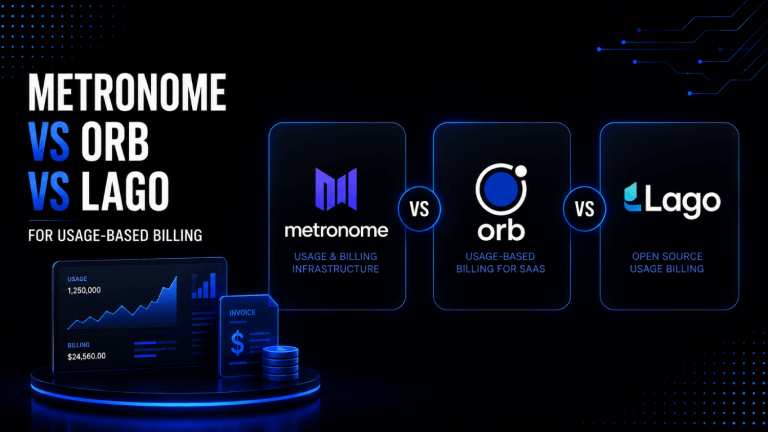
Orb is purpose-built for consumption pricing at scale. It handles event ingestion, billing cycle management, and complex rating logic including tiered, volume, and matrix pricing. Its architecture treats usage data as a first-class object rather than a Stripe subscription add-on. Orb is best suited for API companies and AI platforms with complex pricing models that generate high event volumes. Pricing is not publicly disclosed; Orb operates on sales-led contracts.
Metronome
Metronome targets high-growth infrastructure and AI companies. It offers real-time usage tracking, contract management with committed use discounts, and prepaid credit ledgers. Metronome’s strength is enterprise contract flexibility, including ramp deals and custom rate cards that match how enterprise buyers actually want to purchase. Like Orb, pricing is available on request.
Amberflo
Amberflo focuses on real-time metering with sub-second event processing. It supports multi-dimensional pricing and offers a customer-facing usage dashboard, which reduces support tickets from customers asking why their bill is what it is. Amberflo’s public documentation explicitly compares its architecture to Stripe Billing’s metering limitations, making the positioning clear without requiring a sales call to understand the fit.
m3ter
m3ter bills itself as a usage-based pricing engine built for enterprise complexity. It handles event ingestion, aggregation, rating, and statement generation, and integrates with billing systems like Stripe and Zuora rather than replacing them entirely. This composable approach appeals to companies that already have a finance stack and need to layer in metering without replacing everything downstream.
Lago
Lago is an open-source billing API that supports both cloud and self-hosted deployments. It handles subscription billing, usage-based charges, and prepaid credits. Its open-source nature makes it unusual in this space: engineering teams can inspect the code, contribute, and host it on their own infrastructure. Lago offers a cloud version with paid tiers alongside the self-hosted option.
OpenMeter
OpenMeter is an open-source usage metering platform built around event streaming infrastructure. It is not a full billing system; it is the metering layer that feeds into billing. Teams that want to own their metering pipeline, integrate with Kafka or ClickHouse, and control data residency will find OpenMeter a better architectural fit than a managed SaaS billing tool.
Flexprice
Flexprice is an open-source billing engine with strong invoicing and usage-based pricing support. According to their public documentation, Flexprice supports subscription management alongside consumption billing, positioning it as a more complete alternative to Lago for teams that want the full billing layer self-hosted.
Which Subscription Management Suites Support Usage-Based Pricing?
Chargebee
Chargebee is one of the most widely used subscription management platforms in B2B SaaS. It supports metered billing through usage-based pricing components that can be added to subscription plans. Chargebee’s real strength is its surrounding feature set: dunning automation, revenue recognition, CPQ integrations, and a mature API. It works well for companies that need both subscription management and basic usage billing without adopting a dedicated metering engine. Chargebee’s public pricing page shows tiered plans that scale with billing volume, starting with a free launch tier , which makes it one of the few platforms in this comparison where you can evaluate the full product before committing to a sales conversation.
Maxio
Maxio (formed from the merger of Chargify and SaaSOptics) targets B2B SaaS companies specifically, with usage-based billing support alongside subscription management and SaaS financial reporting. Its revenue recognition and financial reporting tooling is more developed for companies with complex deferred revenue situations than what Chargebee offers at comparable price points. Maxio’s billing handles components like metered and event-based charges alongside recurring fees; their public product documentation covers metered component configuration in detail.
Recurly
Recurly handles subscription billing for mid-market and enterprise companies, including usage-based and hybrid models. It supports tiered and volume pricing, overage charges, and prepaid add-ons. Recurly has a long track record in media and SaaS, and its failed payment recovery tooling , marketed as Revenue Recovery , is stronger than most competitors in the space. Recurly’s public pricing page lists plans as a percentage of revenue plus a base fee, which makes cost modeling straightforward before a sales conversation.
Zuora
Zuora is enterprise subscription management at the high end. It handles complex pricing constructs including usage-based, ramp deals, and multi-element arrangements, and it has deep integrations with Salesforce, NetSuite, and SAP. Zuora is overkill for a Series A company but appropriate for a business with a large enterprise sales motion, complex contracts, and a finance team that needs ASC 606 and IFRS 15 reporting without custom spreadsheet work.
Zoho Subscriptions
Zoho Subscriptions (now part of Zoho Billing) supports metered billing alongside flat subscriptions. It sits at the lower end of the price range and integrates cleanly with the broader Zoho suite. For early-stage companies already inside the Zoho product suite, it is a reasonable starting point before pricing complexity demands a dedicated engine. Zoho publishes per-organization monthly pricing publicly, making it one of the more transparent options in the category.
Paddle
Paddle operates as a merchant of record, which means it handles tax compliance globally in addition to billing. It supports usage-based pricing components within its billing system. Paddle is worth evaluating if your international tax exposure is significant and you want to solve billing and MoR in one vendor. For a deeper look at the MoR tradeoff, see this comparison of Stripe, Paddle, Lemon Squeezy, and Polar as merchant of record options.
Stripe Billing with Meter Events
It is worth noting that Stripe’s own billing has evolved. Stripe introduced Meter Events as a structured way to report usage without manual aggregation, and it supports more complex pricing via its Prices API. For companies with moderate usage billing needs and an existing Stripe integration, the question is whether the added complexity of migrating to a dedicated platform outweighs Stripe’s convenience. For many teams, the honest answer is that it does not, until volume and pricing complexity cross a threshold.
Which Platforms Handle AI and API SaaS Billing Specifically Well?
Stigg
Stigg is a product monetization platform focused on real-time entitlement management and credit orchestration. Rather than replacing billing entirely, Stigg sits between your product and your billing system, handling plan enforcement, feature gating, and credit drawdown in real time. For AI SaaS products that sell token-based or credit-based access, Stigg’s architecture matches the problem more directly than a generic billing platform does.
Schematic
Schematic targets SaaS companies that need feature flagging and entitlement management connected to their billing model. According to Schematic’s public documentation, it helps teams manage what customers can access based on their plan without hardcoding plan logic into product code. For API products where access tiers change frequently, this separation of entitlement from billing logic reduces engineering overhead.
Octane
Octane (billing product) handles usage-based pricing for software companies selling AI and API products. It supports prepaid credits, overage billing, and real-time usage reporting. Like Amberflo, it positions itself as a solution to the Stripe metering gap specifically.
Togai
Togai is a usage-based pricing platform designed for engineering and finance teams working on API and platform products. It supports event ingestion, custom aggregations, pricing experimentation, and invoice generation. Togai’s pricing experimentation feature, which lets teams model the revenue impact of pricing changes before applying them, is less common in this category and useful for companies in active pricing discovery.
Which Platforms Are Best for Open-Source or Infrastructure-First Teams?
Hyperline
Hyperline is a European billing platform for B2B SaaS that supports hybrid pricing models including per-seat plus usage. It handles invoicing, tax, and integrates with Stripe as the payment processor. It is not as widely known in the US market as Orb or Chargebee but has traction among European API-first companies.
Kana (Credit and Usage APIs for AI Billing)
Kana provides credit and usage management APIs designed specifically for AI product monetization , think token budgets, credit grants, and real-time balance checks rather than traditional invoice generation. It is not a full billing platform; it is a metering and entitlement primitive that sits upstream of billing. Teams building AI infrastructure products with credit-based consumption models use it to handle the usage accounting layer while routing final charges through Stripe or another processor. The tradeoff is integration overhead: Kana handles metering cleanly but requires additional work to connect to invoicing, dunning, and financial reporting. For teams evaluating dedicated metering layers versus full billing suites, Kana belongs in the same evaluation pass as OpenMeter , both are infrastructure primitives, not finished billing products.
BillingPlatform
BillingPlatform targets enterprises with highly complex rating and revenue management needs, including telecommunications-style usage billing. It is expensive and implementation-heavy. For a Series A fintech startup, it is the wrong tool. For a company processing billions of usage events per month with complex regulatory reporting, it is worth evaluating.
How Do You Actually Migrate Away from Stripe Billing?
Migration from Stripe Billing is almost never a clean cutover. The practical reality is that most platforms run Stripe as the underlying payment processor and take over the metering, rating, and invoicing layer on top of it. Customers do not see a payment change; what changes is how usage is tracked and how invoices are generated.
The dual-write period is the most fragile part. During migration, usage events typically need to be sent to both systems simultaneously to validate that the new platform produces the same billing output as Stripe before going live. Teams that skip this validation step regularly discover edge cases in their pricing logic mid-cycle, which creates billing disputes with customers. Plan for two to four weeks of parallel operation depending on pricing model complexity.
Mid-cycle customer migrations deserve special attention. Moving a customer who is 15 days into a 30-day billing period requires both systems to agree on what was consumed in that partial period. Most dedicated billing platforms handle this with a prorated credit or a period close-out event, but you need to define the behavior explicitly before migration starts. This is particularly important for fintech API products where customers may be processing payments or running transactions in real time, since a billing interruption can cascade into a service dispute. See the most common fintech infrastructure mistakes for a broader view of where these transitions go wrong.
Platform Comparison: Stripe Billing Alternatives
| Platform | Best For | Usage Billing Depth | Open Source | Pricing Model |
|---|---|---|---|---|
| Orb | API SaaS, high-volume event billing | Deep (native metering) | No | Sales-led, not public |
| Metronome | Enterprise infra, committed use contracts | Deep (contract-aware) | No | Sales-led, not public |
| Amberflo | Real-time metering, customer usage dashboards | Deep (real-time) | No | Usage-tiered, contact sales |
| m3ter | Enterprise, composable metering layer | Deep (composable) | No | Sales-led, not public |
| Lago | Self-hosted or cloud, open-source billing | Strong (full billing) | Yes | Free (self-hosted), paid cloud tiers |
| OpenMeter | Metering layer only, event streaming | Metering only | Yes | Free (self-hosted), cloud available |
| Flexprice | Open-source full billing with invoicing | Strong | Yes | Open-source, cloud tier available |
| Chargebee | B2B SaaS, subscription + basic usage | Moderate (addon-based) | No | Tiered, starts free, scales by revenue |
| Maxio | B2B SaaS, financial reporting + usage | Moderate | No | Contact sales |
| Recurly | Mid-market SaaS, failed payment recovery | Moderate | No | Percentage of revenue + base fee |
| Zuora | Enterprise, complex contracts, rev rec | Strong (enterprise scale) | No | Enterprise, not public |
| Zoho Subscriptions | Early-stage, Zoho product suite | Basic | No | Per-org monthly, publicly priced |
| Paddle | Global SaaS, MoR + usage billing | Basic to moderate | No | Percentage of revenue |
| Stigg | Entitlement management, credit-based AI SaaS | Entitlements + credits | No | Tiered, free plan available |
| Schematic | Feature flagging + entitlements | Entitlements only | No | Tiered, free plan available |
| Togai | API SaaS, pricing experimentation | Deep | No | Contact sales |
| Hyperline | European B2B SaaS, hybrid pricing | Moderate | No | Contact sales |
| Kana | AI billing, credit/token metering layer | Metering + credits only | No | Contact sales |
| BillingPlatform | Enterprise, telco-grade complexity | Deep (enterprise) | No | Enterprise, not public |
What Does a Realistic Usage-Based Billing Migration Actually Cost?
Consider a fintech API company processing roughly 50 million metering events per month, billing on a combination of API calls and data volume with three customer tiers. On Stripe Billing, the engineering team maintains a custom aggregation service that pulls raw event data, groups it by customer and billing period, and pushes totals to Stripe before invoices close. That service requires ongoing maintenance and breaks when pricing model changes are made.
Migrating to a dedicated platform like Orb or Metronome in this scenario typically involves four to six weeks of engineering time: two weeks to build the event ingestion pipeline to the new platform, one to two weeks of dual-write validation, and one to two weeks of cutover and monitoring. The ongoing maintenance burden for the aggregation service disappears, replaced by whatever API integration the new platform requires. For teams billing more than a few hundred customers, the reduction in engineering overhead usually justifies the platform fee within two to three quarters. For more context on how these infrastructure decisions affect margins at scale, see the fintech SaaS scale checklist for reaching $10M ARR.
Open-source options like Lago or OpenMeter change the cost structure but not the engineering demand. Self-hosting eliminates the platform fee but adds infrastructure costs (compute, storage for event data, ops time) and removes vendor support. For a team of two engineers building a billing layer from scratch, a managed platform is almost always cheaper in total cost than self-hosting a billing engine before product-market fit is clear.
Frequently Asked Questions
What is metered billing and how does it differ from usage-based billing?
Metered billing means customers are charged based on measured consumption of a resource, such as API calls, gigabytes of data, or compute minutes, rather than a flat recurring fee. Usage-based billing is the broader category that includes metered billing, prepaid credits with drawdown, tiered consumption pricing, and hybrid models combining fixed fees with variable usage charges. In practice, most practitioners use the terms interchangeably, though metered billing more precisely refers to post-consumption measurement and invoicing.
Can Stripe Billing handle usage-based pricing at all?
Stripe Billing does support usage reporting via its Meter Events API and can aggregate events into subscription charges. It works adequately for simple cases: a single metered dimension, straightforward tier logic, and low event volumes. Where it breaks down is multi-dimensional pricing, real-time entitlement enforcement, enterprise contract structures with committed use discounts, and high-volume event ingestion that requires dedicated streaming infrastructure. Teams with complex pricing models consistently outgrow Stripe’s metering capabilities before they outgrow its payment processing.
Which usage-based billing platform is best for early-stage API SaaS companies?
Lago is the strongest starting point for early-stage teams that want full billing control without a large platform fee. It is open-source, supports both self-hosted and managed cloud deployments, and handles subscription billing alongside usage-based charges. For teams that do not want infrastructure responsibility, Chargebee’s lower tiers offer a managed alternative with adequate metering support. Dedicated engines like Orb and Metronome are better suited for companies with existing pricing complexity or high event volumes that justify the sales-led pricing model.
How does revenue recognition work with usage-based billing platforms?
Revenue recognition for usage-based billing under ASC 606 requires recognizing revenue as performance obligations are satisfied, which for consumption-based pricing means as usage occurs. Platforms like Zuora and Maxio have built-in ASC 606 and IFRS 15 reporting modules. Chargebee integrates with RevRec tools. Purpose-built engines like Orb and Metronome focus more on billing accuracy than rev rec reporting, so companies with complex revenue recognition needs often connect them to a dedicated rev rec system or ERP. Confirming this integration before signing a contract is one of the most commonly skipped due diligence steps.
What is the difference between a billing engine and a subscription management platform?
A billing engine handles metering, rating, and invoice generation: it takes raw usage events, applies pricing rules, and produces a charge. A subscription management platform handles the broader customer lifecycle including plan management, customer portal, dunning, upgrades and downgrades, and financial reporting. Orb, Metronome, and Lago are billing engines. Chargebee, Maxio, and Zuora are subscription management platforms that include billing engines. Some companies use both: a dedicated metering engine feeding into a subscription platform that handles finance workflows downstream.
Do usage-based billing platforms replace Stripe as a payment processor?
Most do not. Platforms like Orb, Metronome, Lago, Chargebee, and Maxio integrate with Stripe (and other processors) as the payment collection layer. They take over metering, rating, and invoice generation, then pass the final charge amount to Stripe to process the actual payment. Paddle is the main exception in this list, operating as a merchant of record that handles both billing and payment collection. Choosing to keep Stripe as the processor simplifies migration because existing payment methods, customer records, and dispute history remain in place.
How should fintech and API SaaS companies think about pricing model complexity before choosing a billing platform?
The key question is how many independent variables drive a customer’s bill. A company charging per API call with one tier has low complexity. A company charging per API call plus data volume, with committed use discounts for enterprise customers, overage rates after a threshold, and different rates for different product lines, has high complexity. Low complexity is well-served by Stripe Billing or Chargebee. High complexity needs a dedicated rating engine. Pricing model complexity tends to grow over time as products mature, so choosing a platform with headroom for the pricing model two years from now is smarter than optimizing only for today’s structure. The most effective pricing models in fintech SaaS explores this complexity curve in more detail.
The Real Reason Most Teams Stick with Stripe Too Long
Migrating billing infrastructure is genuinely disruptive. It touches product, engineering, finance, and customer communications simultaneously, and a billing error that results in an incorrect customer invoice is one of the fastest ways to damage trust in a B2B relationship. Most teams stay on Stripe Billing longer than their pricing model justifies because the migration cost is visible and immediate, while the cost of the workarounds is distributed and invisible across multiple teams. That calculus eventually inverts, usually around the time finance asks engineering to rebuild the usage aggregation service for the third time.
The companies that make this transition cleanly share one practice: they define their target pricing model completely before evaluating platforms, rather than evaluating platforms and then fitting their pricing into whatever the platform supports. When the pricing model drives the platform selection, the build is cleaner and the migration scope is known in advance. When the platform drives the pricing model, you end up constrained by vendor architecture at the worst possible time.
Usage-based pricing is now the default commercial model for API SaaS, AI tooling, and fintech infrastructure. The billing platform question is not a back-office infrastructure choice. It is a revenue architecture decision that affects how you can price, how fast you can experiment, and how your enterprise customers experience their commercial relationship with your product. Choosing the right platform early means that choice stays invisible to customers, which is exactly the goal. For teams thinking through the full payment infrastructure picture alongside billing, the best payment infrastructure tools for SaaS founders covers the adjacent decisions that affect how billing fits into the broader stack.