
- AutoRek is built for high-volume financial services reconciliation, and its pricing and implementation timeline reflect that. For most fintech teams under 200 people, the cost-to-value ratio rarely works out.
- The strongest alternatives split into four distinct categories: payment-native reconciliation, financial close automation, ledger-layer tools, and data-pipeline-first platforms. Picking the wrong category is more expensive than picking the wrong vendor.
- Migration risk is real but manageable. Finance teams consistently report that the biggest variable is not data export but audit trail continuity. Most buyers underestimate this until they are mid-migration.
- At least three vendors on this list can be live in under 60 days. AutoRek’s implementation timeline is measured in months, sometimes quarters.
- One platform below is featured as a sponsored profile. It is clearly labeled and scored on the same criteria as every other entry.
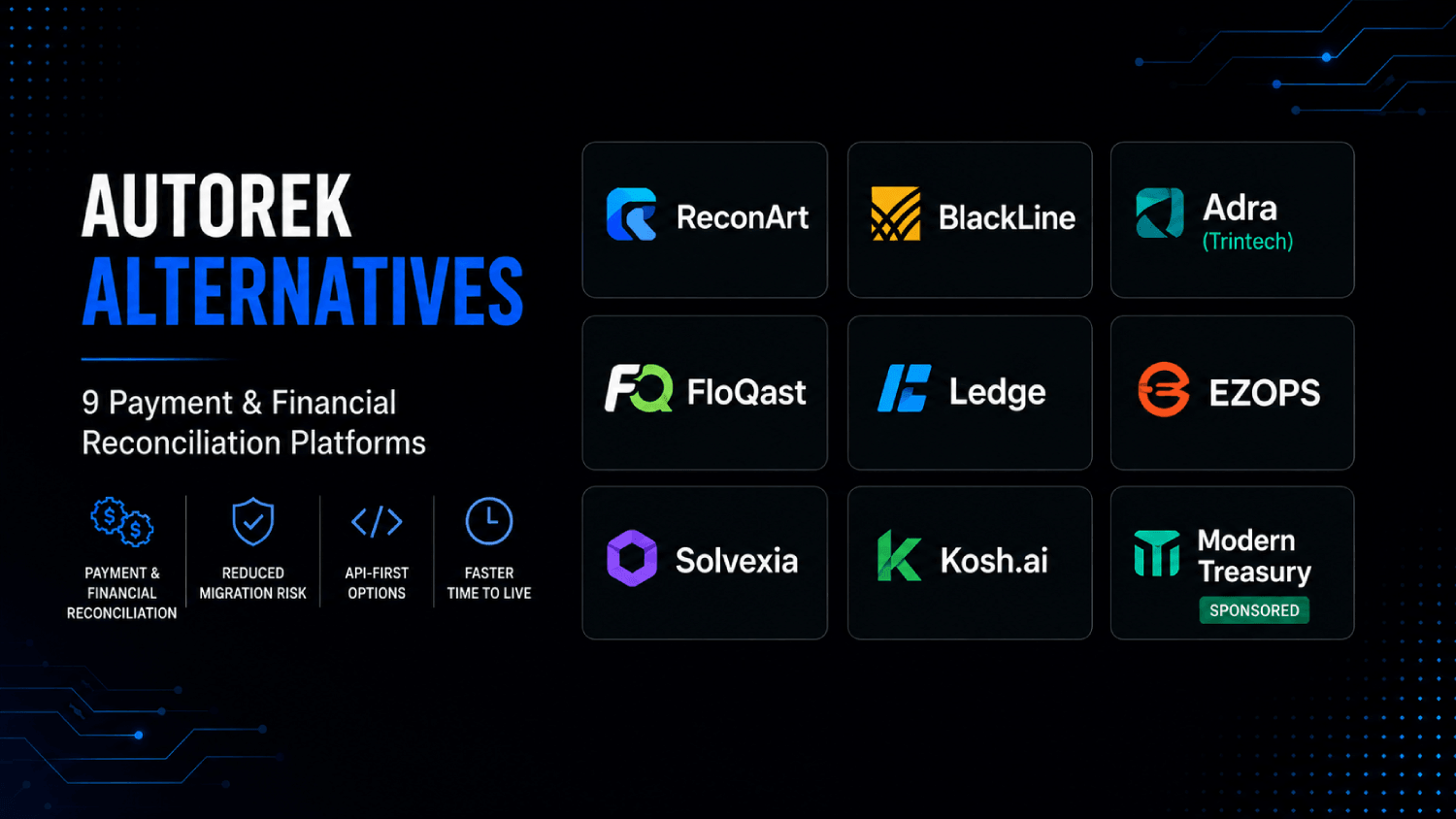
The strongest AutoRek alternatives for fintech finance teams are ReconArt, Adra (Trintech), BlackLine, Ledge, and EZOPS, depending on company stage and use case. ReconArt fits high-volume payment operations at mid-market companies. BlackLine suits enterprise financial close teams. Ledge and EZOPS are better fits for Series A through C fintechs that need fast implementation and API-native connectivity. AutoRek’s capabilities are legitimate, but its implementation complexity and contract structure eliminate it as a practical option for most companies below $100M in annual revenue.
Why Finance Teams Actually Leave AutoRek
AutoRek has a defensible position in regulated financial services. It handles high-volume transaction matching, supports complex waterfall logic, and has genuine depth for asset managers, custodians, and banks running reconciliation across multiple asset classes. The problem is that this depth comes with a cost structure and implementation model designed for those buyers.
Finance teams cite three recurring exit reasons. First, implementation timelines that stretch 6 to 12 months, requiring dedicated internal project resources most fintech ops teams do not have available. Second, pricing that is enterprise-anchored with annual contracts and seat-based or volume-based components that are difficult to predict before go-live. Third, a UI and workflow model that finance professionals describe as powerful but not self-service. Every configuration change goes through a services engagement.
The fourth reason is subtler: AutoRek was designed primarily for securities and asset management reconciliation. Payment operations teams at fintechs, neobanks, and payment companies often need different matching logic, faster API connectivity to processors like Stripe or Adyen, and reporting oriented toward ops rather than finance. AutoRek can do this work, but it is not what the platform was optimized for.
None of this makes AutoRek a bad product. It makes it the wrong product for a specific set of buyers. If you are reading an alternatives page, you are probably in that set.
The FintechSpecs Reconciliation Fit Matrix
Before evaluating individual platforms, it helps to locate your actual buying category. Most comparison pages list ten near-identical tools and call them all “reconciliation software.” That framing misses the structural difference between four genuinely distinct categories, each serving a different part of the finance stack.
Payment-native reconciliation tools are built around matching payment processor data, bank statement data, and internal ledger records. They have pre-built connectors to Stripe, Adyen, Braintree, PayPal, and similar processors. This is where most fintech payment ops teams belong.
Financial close automation platforms focus on the month-end close workflow: account reconciliations, intercompany eliminations, journal entry approvals, and close checklists. BlackLine and FloQast live here. They overlap with reconciliation but are fundamentally close-management tools.
Ledger-layer tools sit between your payment processors and your ERP. They maintain a real-time sub-ledger, handle revenue recognition, and generate reconciled data as a byproduct of clean bookkeeping. Modern Treasury and similar platforms operate in this space.
Data-pipeline-first platforms ingest raw data from any source, apply matching rules, and surface exceptions. They are less opinionated about accounting workflows and more flexible for custom use cases. EZOPS and Ledge fit here.
Buying a financial close tool when you need payment-native reconciliation is a category error that no amount of configuration will fix. Run this classification before you schedule a demo.
9 AutoRek Alternatives Segmented by Use Case
1. ReconArt
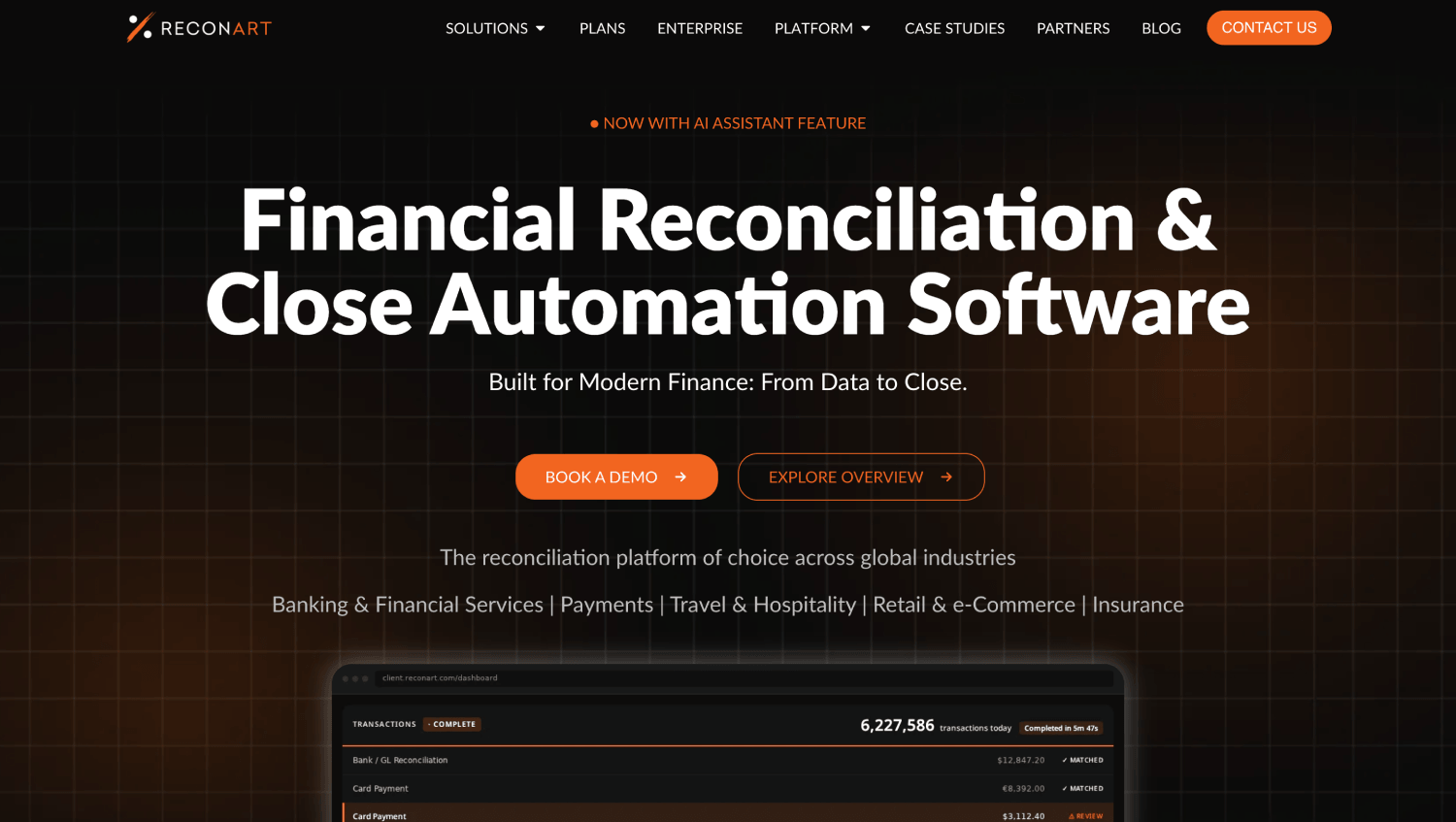
ReconArt is the closest functional alternative to AutoRek for mid-market fintech companies that need enterprise-grade matching logic without enterprise-scale implementation overhead. It handles high-volume transaction reconciliation, supports multi-entity and multi-currency environments, and has a configurable rules engine that finance teams can modify without vendor involvement on every change.
The platform supports bank reconciliation, payment reconciliation, intercompany matching, and general ledger reconciliation in a single environment. Pre-built connectors exist for major ERP systems including NetSuite and SAP. Implementation typically runs 8 to 16 weeks, shorter than AutoRek’s typical engagement but still a meaningful commitment.
| Dimension | Detail |
|---|---|
| Best for | Mid-market fintechs needing broad reconciliation coverage with configurable rules |
| Migration risk | Medium. Matching rule translation requires documentation of existing AutoRek logic |
| Pricing model | Not publicly disclosed. Requires direct quote |
| Implementation time | 8 to 16 weeks typical |
| API-first? | Partial. REST API available but connector library is narrower than payment-native tools |
FintechSpecs covered the ReconArt versus AutoRek comparison in depth. For a direct head-to-head, see our ReconArt vs AutoRek reconciliation platform comparison.
2. BlackLine
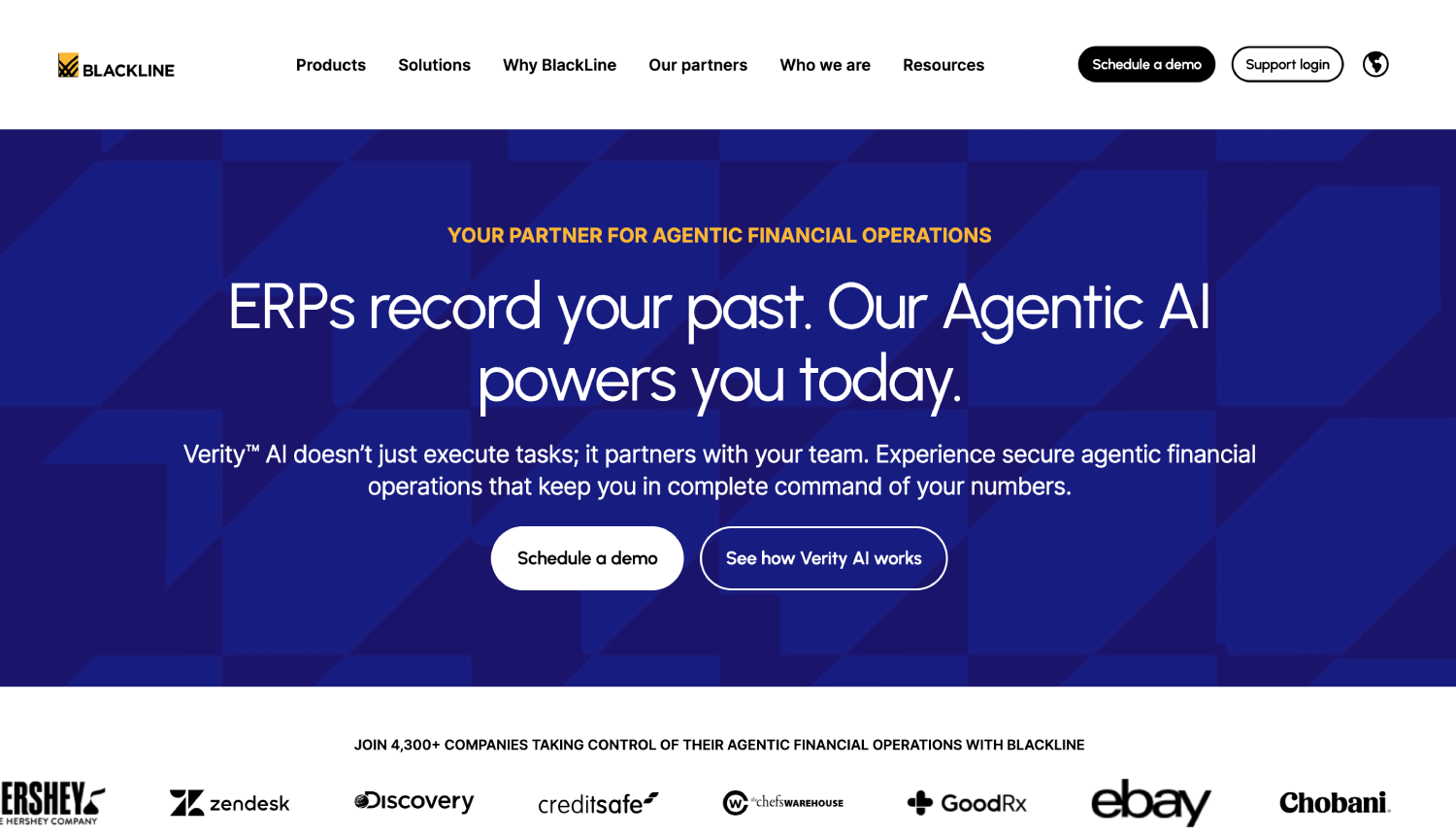
BlackLine dominates the financial close automation segment and appears on nearly every AutoRek alternatives list for that reason. Its account reconciliation module is mature, widely deployed, and tightly integrated with SAP and Oracle ERP systems. For companies on SAP S/4HANA, BlackLine’s native integration is a meaningful advantage.
The honest framing: BlackLine is a financial close platform first. Its reconciliation capabilities are strong for GL account reconciliation and balance sheet substantiation, but payment operations teams running high-volume transaction matching will find the tool less suited to their workflow. If your primary need is month-end close efficiency rather than real-time transaction matching, BlackLine deserves serious evaluation. If you need to match 500,000 payment processor records against bank statements daily, look elsewhere.
| Dimension | Detail |
|---|---|
| Best for | Enterprise finance teams running SAP or Oracle with a focus on financial close |
| Migration risk | High. BlackLine’s data model is opinionated. Historical reconciliation data migration requires planning |
| Pricing model | Not publicly disclosed. Enterprise contracts, typically annual |
| Implementation time | 3 to 6 months typical |
| API-first? | No. Workflow-driven with integration via connectors |
3. Adra by Trintech
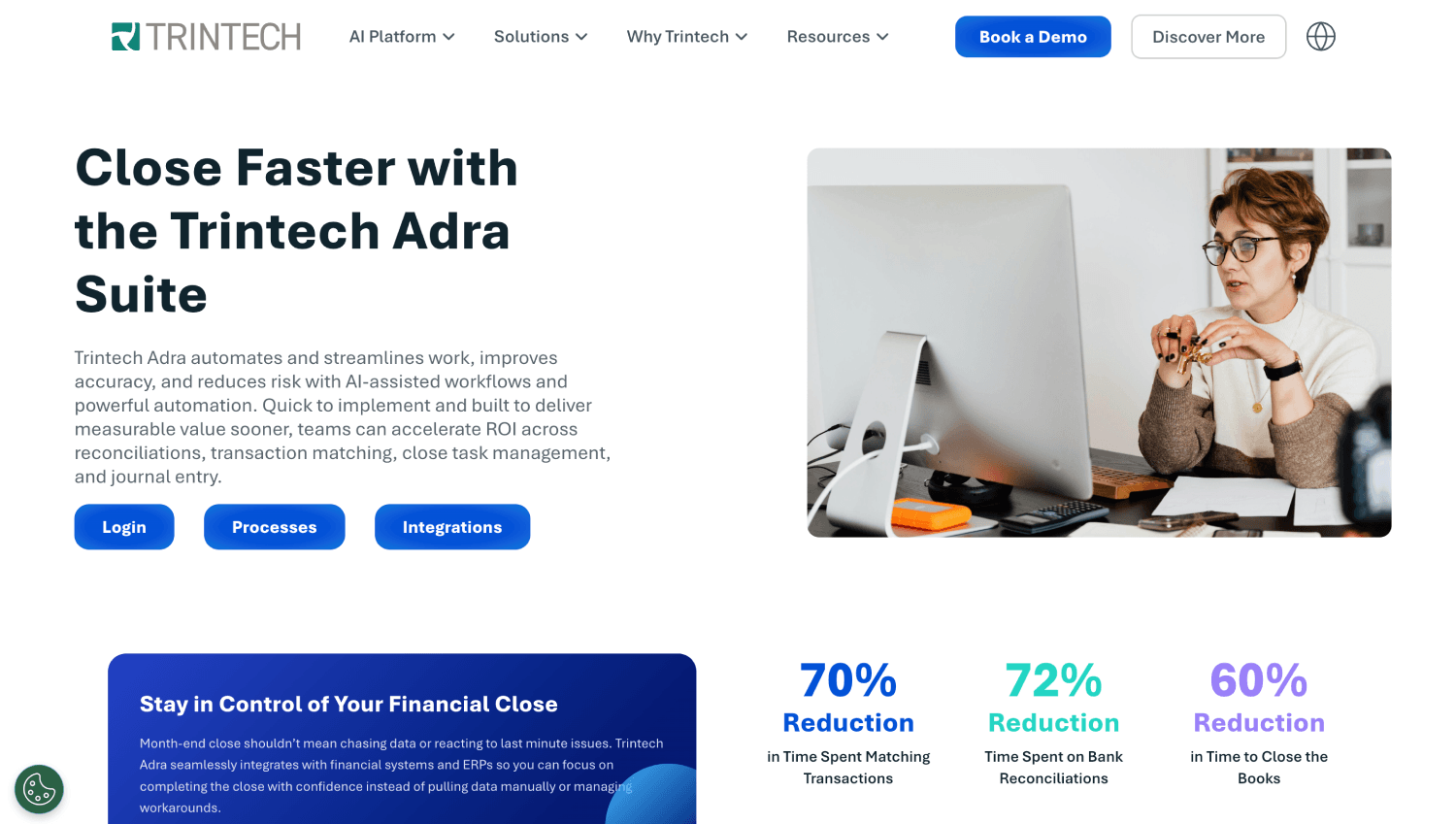
Adra is Trintech’s mid-market financial close and reconciliation product, positioned below their enterprise Cadency platform. It covers account reconciliation, task management, and close workflows in a lighter package that mid-sized finance teams can deploy without a multi-month professional services engagement.
Adra’s strength is balance sheet reconciliation with automated matching for accounts that have moderate transaction volume. It is not built for the kind of high-volume payment matching that AutoRek targets in financial services, but for a 50-person company running a standard monthly close, it covers more than enough ground. Pricing is not publicly listed, but the product is generally positioned at a lower price point than BlackLine or AutoRek.
| Dimension | Detail |
|---|---|
| Best for | Mid-market finance teams needing close automation without full-scale enterprise deployment |
| Migration risk | Low to medium. Adra imports standard file formats and connects to common ERP systems |
| Pricing model | Not publicly disclosed |
| Implementation time | 4 to 8 weeks typical |
| API-first? | No. UI-driven with standard file import and ERP connectors |
4. FloQast
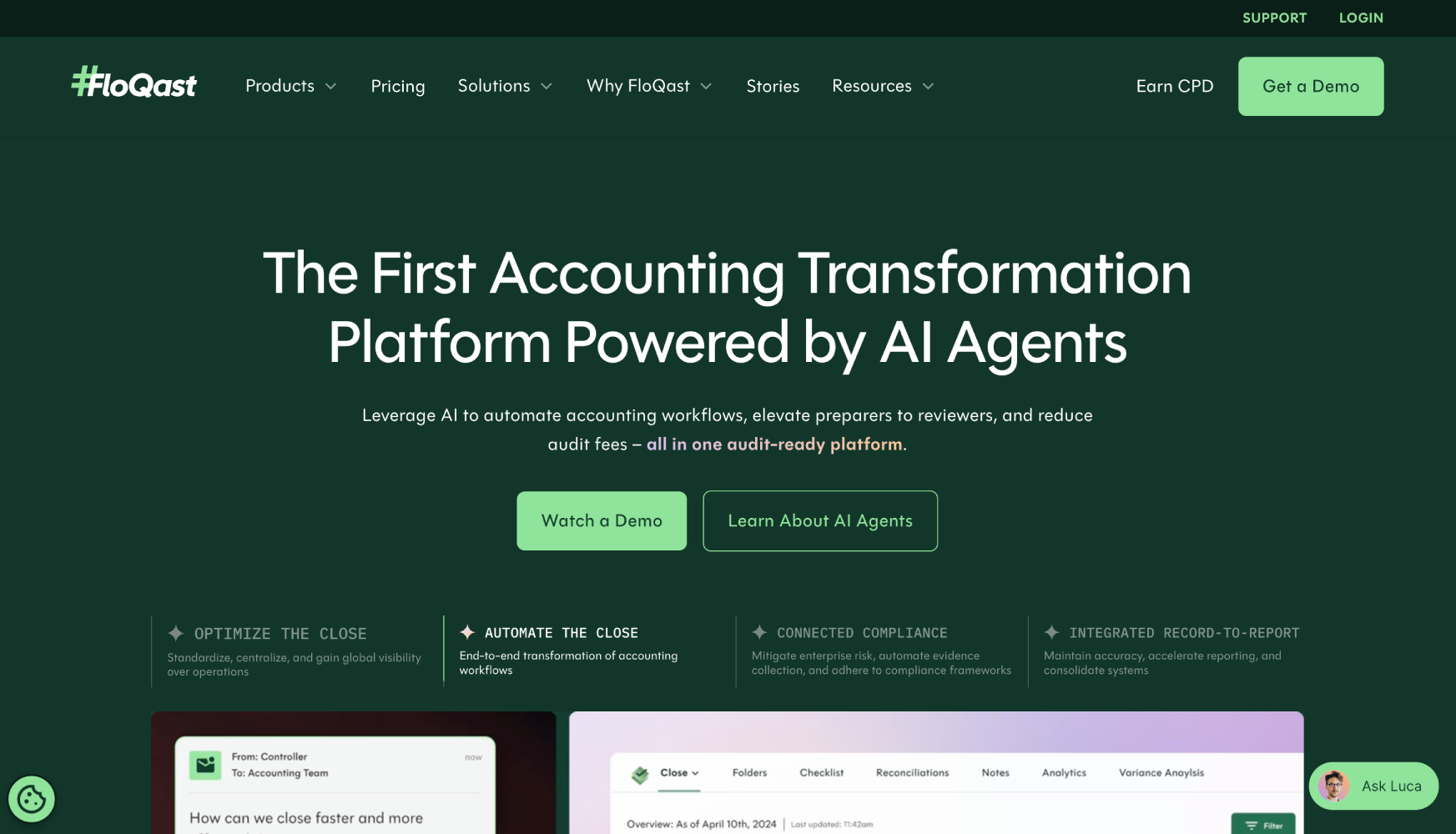
FloQast targets accounting teams that live in spreadsheets and are not ready for a full financial close platform. Its reconciliation module sits inside a broader close management product that includes checklists, flux analysis, and Slack-style collaboration for distributed accounting teams. The product deliberately mirrors how accountants already work rather than forcing them into a new workflow model.
For AutoRek switchers, FloQast is the right choice when the primary frustration is close visibility and workflow coordination rather than transaction matching volume. Companies with relatively clean source data that want faster closes and better audit trails will find FloQast much faster to implement than AutoRek. It integrates with NetSuite, Sage Intacct, QuickBooks Online, and other mid-market ERP systems. Pricing is not published, but the company targets Series B and later accounting teams.
| Dimension | Detail |
|---|---|
| Best for | Accounting teams that need close workflow management and moderate reconciliation automation |
| Migration risk | Low. FloQast does not require data migration of historical records to get started |
| Pricing model | Not publicly disclosed |
| Implementation time | 2 to 6 weeks typical |
| API-first? | No. Accounting-workflow-first with ERP sync |
5. Ledge
Ledge takes a different architectural approach. Rather than starting from an accounting workflow, it starts from data: ingesting raw financial data from any source, normalizing it, applying configurable matching rules, and surfacing exceptions. The result is a payment reconciliation layer that can sit between your payment processors, banking partners, and ERP without requiring you to route everything through a new workflow tool.
For fintech companies running multiple payment rails, managing payouts across markets, or dealing with complex waterfall matching between processor settlements and bank credits, Ledge’s data-first model is more flexible than close-automation tools. Implementation is faster than AutoRek because the configuration model is code-adjacent: rules are defined in a structured format that an ops engineer or technical finance analyst can manage without a professional services team. Pricing is not publicly listed.
| Dimension | Detail |
|---|---|
| Best for | Payment-heavy fintechs and neobanks with complex multi-rail matching requirements |
| Migration risk | Low to medium. Data ingestion is flexible, but rule translation requires internal documentation |
| Pricing model | Not publicly disclosed |
| Implementation time | 3 to 8 weeks typical |
| API-first? | Yes. API-native data ingestion and rule management |
6. EZOPS
EZOPS positions itself specifically at capital markets and financial services firms running complex reconciliation across securities, cash, and derivative positions. It uses machine learning to suggest matching rules and flag anomalies, reducing the configuration burden that comes with setting up reconciliation for novel instrument types.
For AutoRek users in capital markets, EZOPS is the most direct functional replacement. Both platforms serve the same buyer segment. EZOPS differentiates on the ML layer, which is genuinely useful when you are reconciling positions that do not follow clean one-to-one matching patterns. Implementation requires dedicated resources and is not self-service, but the company is more willing to discuss flexible engagement models than AutoRek’s traditional services-heavy approach. Pricing is not publicly disclosed.
| Dimension | Detail |
|---|---|
| Best for | Capital markets firms and asset managers replacing AutoRek’s securities reconciliation |
| Migration risk | Medium to high. Complex position data requires careful mapping and validation |
| Pricing model | Not publicly disclosed. Enterprise contracts |
| Implementation time | 8 to 20 weeks typical |
| API-first? | Partial. Flexible data ingestion with some API support |
7. Solvexia
Solvexia is a process automation platform with strong reconciliation capabilities built on top of a data orchestration layer. Finance teams that spend significant time on manual data preparation before they can even run reconciliation will find Solvexia’s upstream automation more valuable than the matching engine alone.
The product handles data collection from multiple sources, transformation, reconciliation matching, exception management, and reporting in a single workflow. It is particularly well-suited to finance teams where the reconciliation problem is actually a data consolidation problem dressed in reconciliation clothing. Pricing is not publicly listed. The company targets mid-market and enterprise finance operations teams, primarily in Australia and the US.
| Dimension | Detail |
|---|---|
| Best for | Finance teams where data prep is 40% or more of reconciliation time |
| Migration risk | Medium. Data workflow redesign required to get full value from the automation layer |
| Pricing model | Not publicly disclosed |
| Implementation time | 4 to 10 weeks typical |
| API-first? | No. Workflow-first with broad data source connectivity |
8. Kosh.ai
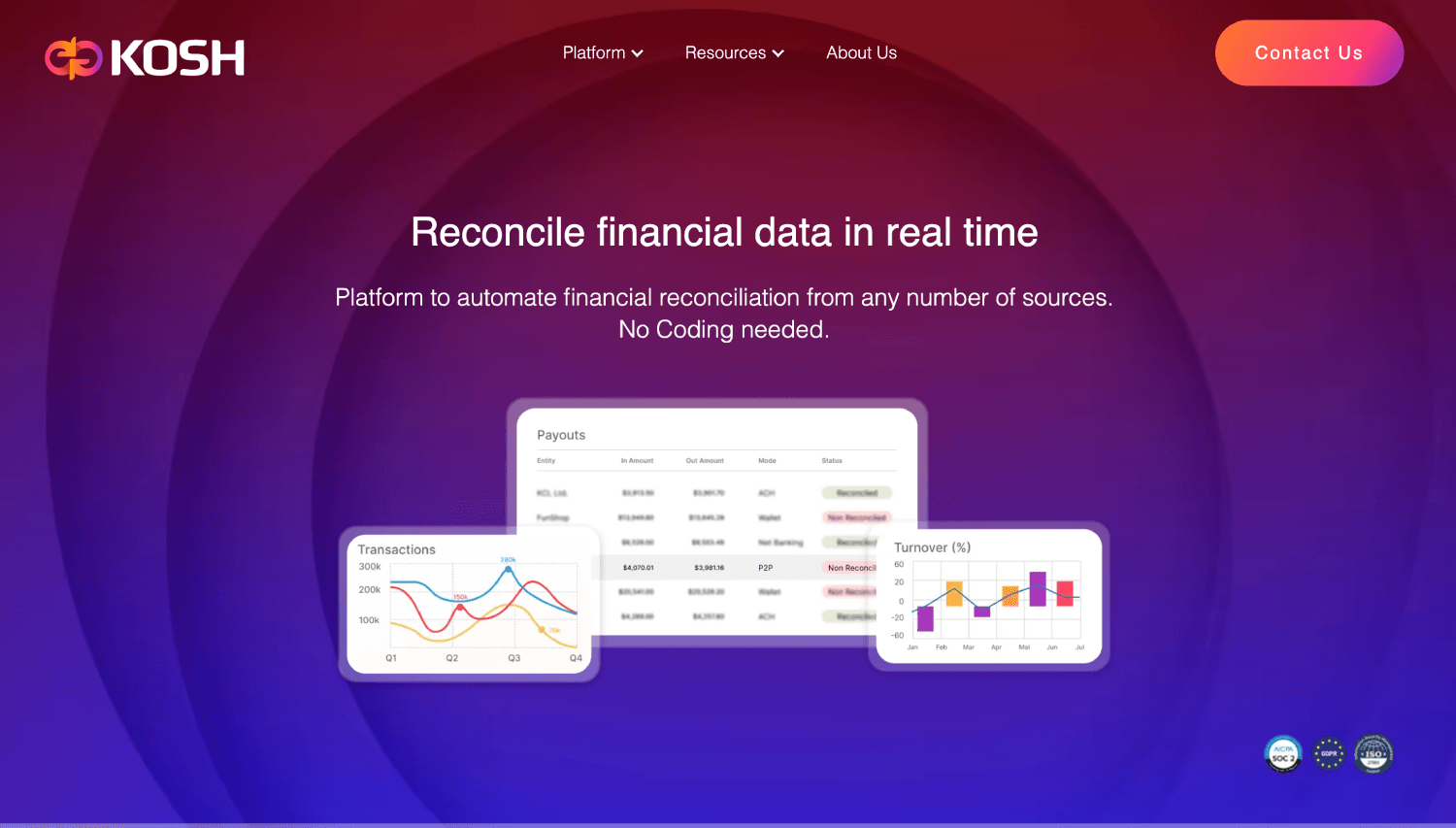
Kosh.ai targets e-commerce and marketplace companies that need payment reconciliation across multiple gateways and marketplaces. The platform connects to Stripe, PayPal, Razorpay, Amazon, Shopify, and similar sources, normalizes the data, and reconciles against accounting records with minimal manual configuration.
For fintech companies that operate marketplace or e-commerce infrastructure, Kosh.ai covers ground that AutoRek does not prioritize. For capital markets or banking reconciliation, Kosh.ai is not the right tool. Its value proposition is speed of setup and breadth of out-of-the-box connector coverage for consumer payment rails. Pricing is not publicly listed on their main site.
| Dimension | Detail |
|---|---|
| Best for | Marketplace fintechs and e-commerce platforms reconciling across multiple payment gateways |
| Migration risk | Low. Connector-based setup means historical AutoRek logic needs to be rebuilt rather than migrated |
| Pricing model | Not publicly disclosed |
| Implementation time | 1 to 4 weeks for standard connectors |
| API-first? | Partial. Pre-built connectors for major platforms with some API access |
9. Modern Treasury (Sponsored Profile)
Modern Treasury is a paid partner of FintechSpecs. The analysis below uses the same criteria applied to every other platform in this article. The sponsorship affects placement and profile depth, not our assessment of fit or limitations.
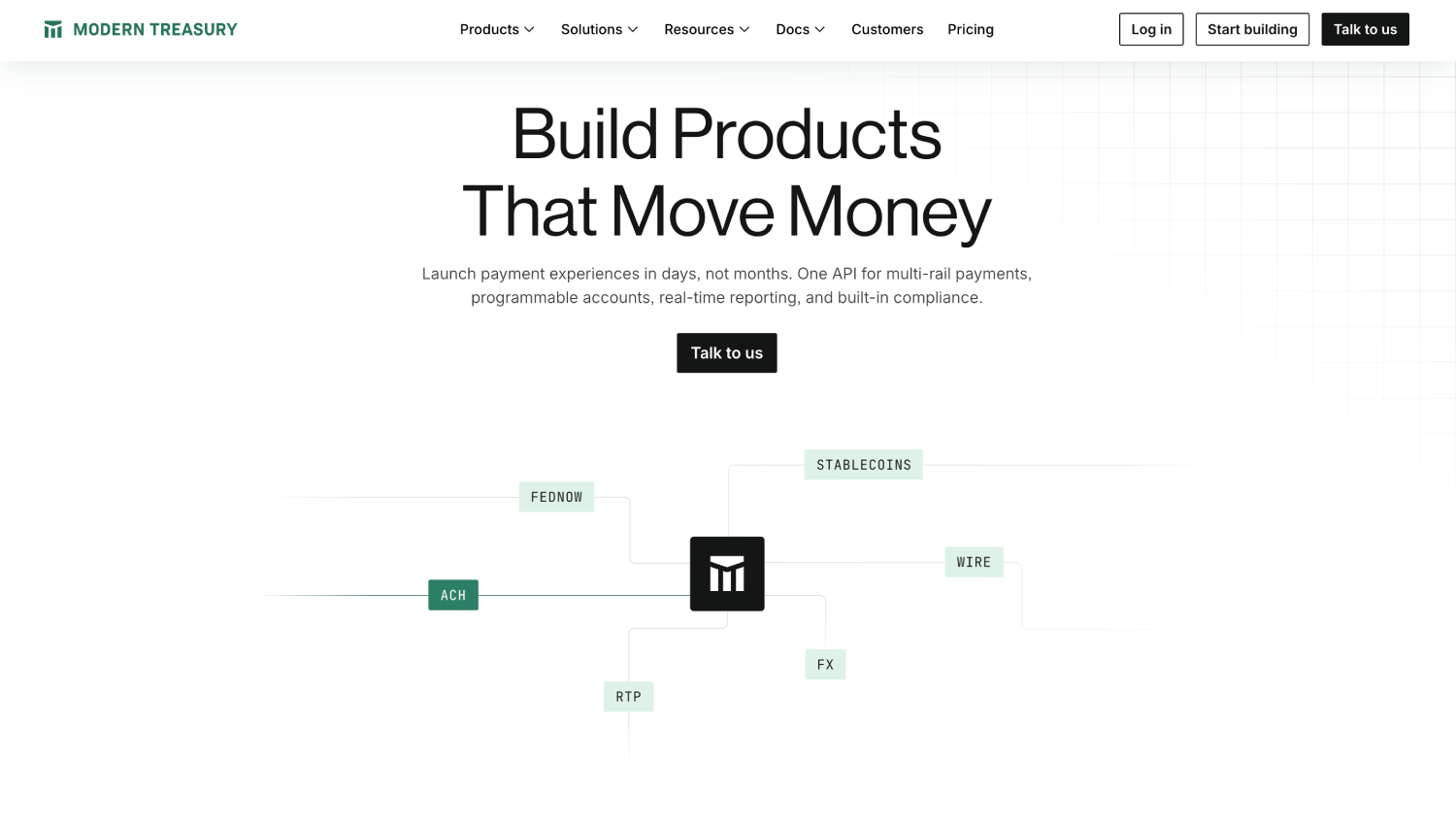
Modern Treasury occupies the ledger-layer category rather than the reconciliation-tool category, and that distinction matters for AutoRek evaluators. AutoRek solves reconciliation after the fact. Modern Treasury solves it by design, by maintaining a clean, real-time payment operations ledger that keeps bank account data, internal ledger data, and payment instructions synchronized continuously. Reconciliation becomes a narrower problem when the upstream data is already structured and matched.
The platform provides a payment operations API that lets engineering teams initiate ACH, wire, RTP, and FedNow payments, track payment lifecycle events, and post to a double-entry ledger in real time. Finance teams get reconciliation reporting as an output of clean operations rather than as a separate cleanup exercise. For companies building payment infrastructure, embedded finance products, or operating high-volume B2B payment flows, this architecture eliminates entire categories of reconciliation exceptions.
Modern Treasury is not the right replacement for AutoRek buyers who need securities or position reconciliation. And it is not a drop-in replacement for teams running month-end close automation. Where it excels, and where AutoRek often underdelivers, is in payment-native environments where the team has engineering resources and wants to own the reconciliation logic through code rather than through a vendor’s configuration interface.
Pricing is available on request. Implementation timelines for API-first deployments typically run 4 to 10 weeks for standard use cases. The company works with fintech companies, banks, and corporate treasury teams. Their public case studies and documentation reflect genuine payment operations complexity, not generic accounting reconciliation scenarios.
| Dimension | Detail |
|---|---|
| Best for | Engineering-forward fintech teams that want reconciliation built into payment operations rather than layered on top |
| Migration risk | Low to medium. API-native setup means AutoRek logic is rebuilt in code, not migrated. Requires engineering involvement |
| Pricing model | Not publicly disclosed. Available on request |
| Implementation time | 4 to 10 weeks for standard API deployments |
| API-first? | Yes. API-first by design |
For a deeper look at how Modern Treasury compares with another payment operations backbone, see the FintechSpecs analysis of Modern Treasury vs Increase for payment operations.
How Do These Alternatives Compare Side by Side?
| Platform | Category | Best for | Migration risk | API-first? | Est. time to live |
|---|---|---|---|---|---|
| ReconArt | Payment + GL reconciliation | Mid-market fintechs needing broad coverage | Medium | Partial | 8 to 16 weeks |
| BlackLine | Financial close automation | Enterprise teams on SAP/Oracle | High | No | 3 to 6 months |
| Adra (Trintech) | Financial close automation | Mid-market monthly close | Low to medium | No | 4 to 8 weeks |
| FloQast | Financial close automation | Accounting teams needing workflow management | Low | No | 2 to 6 weeks |
| Ledge | Data-pipeline reconciliation | Multi-rail payment fintechs | Low to medium | Yes | 3 to 8 weeks |
| EZOPS | Capital markets reconciliation | Asset managers replacing AutoRek directly | Medium to high | Partial | 8 to 20 weeks |
| Solvexia | Process automation + reconciliation | Teams with heavy data prep burden | Medium | No | 4 to 10 weeks |
| Kosh.ai | Payment reconciliation | Marketplace and e-commerce fintechs | Low | Partial | 1 to 4 weeks |
| Modern Treasury (Sponsored) | Ledger-layer / payment ops | Engineering-forward fintech teams | Low to medium | Yes | 4 to 10 weeks |
What Does Migration from AutoRek Actually Involve?
The most underestimated part of any AutoRek migration is audit trail continuity. Finance teams are often surprised to learn that their historical reconciliation records, exception logs, and approval trails sit inside AutoRek’s data model, not in their ERP or general ledger. Before signing with any alternative, confirm exactly how historical records export and what format they take.
A realistic migration breaks into four phases. First, document every active reconciliation workflow, including matching tolerance rules, exception escalation paths, and approval chains. AutoRek configurations often contain institutional knowledge that was never written down. Second, export and validate historical data. Prioritize the last 24 months, which covers most audit and regulatory lookback windows. Third, run parallel processing for at least one full close cycle. Do not cut over before you have validated that the new platform produces identical exception counts on the same source data. Fourth, confirm ERP journal entry continuity. Any break in the posting chain during cutover creates reconciling items that will take weeks to clear.
Companies that treat migration as a technical project rather than a finance project consistently underestimate the second and third phases. Assigning a senior finance operations lead to own the validation step, not just an IT project manager, is the single biggest predictor of a clean cutover. For a broader framework on evaluating and switching fintech vendors without disrupting operations, the FintechSpecs fintech vendor evaluation framework covers the key diligence steps before you sign.
Which AutoRek Alternative Is Best for Payment Operations Specifically?
Payment operations teams at fintechs have a different problem than accounting teams running month-end close. The challenge is matching high volumes of individual transactions, often hundreds of thousands per day, across multiple data sources with different timestamps, formats, and settlement delays. AutoRek’s architecture handles this, but its configuration model assumes a financial services firm with dedicated reconciliation staff.
For a Series B fintech with a 3-person finance team and engineering resources, Ledge or Modern Treasury will get to production faster and at lower total cost. For a Series C company with a larger finance function that needs a GUI-driven tool its accounting staff can configure without engineering, ReconArt is the strongest option. Kosh.ai serves the specific case of marketplace payment reconciliation well, but it does not scale to the complexity of multi-entity or multi-currency environments without significant customization.
Consider a company processing $15M per month across Stripe, ACH, and international wire transfers, with settlements hitting three different bank accounts. The reconciliation task involves matching Stripe payouts to bank credits (which arrive with different reference formats), matching ACH settlements to origination files, and reconciling FX-converted wire receipts against invoiced amounts. AutoRek can handle all of this, but a team that knows its data model could configure Ledge or Modern Treasury to do the same work in 6 weeks rather than 6 months, at a cost structure proportionate to their revenue. That trade-off is worth making explicitly, not discovering after a 90-day implementation discovery.
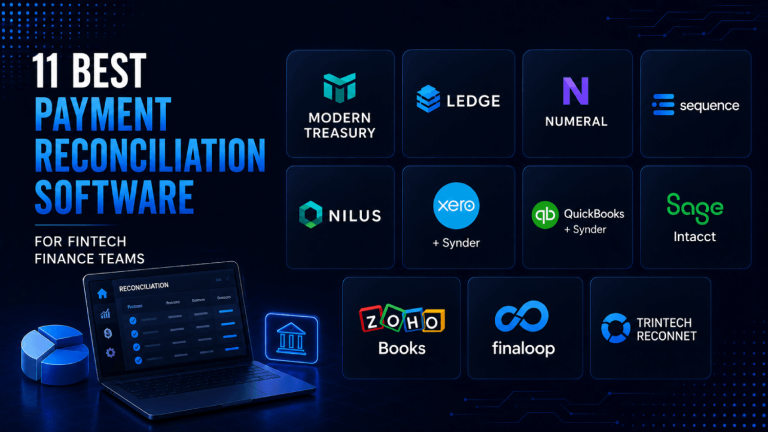
Payment infrastructure decisions at this layer connect to broader stack choices. The payment reconciliation software guide for fintech finance teams covers the broader category with scoring across more platforms.
Do You Actually Need AutoRek-Level Complexity?
Most fintech companies evaluating AutoRek do not. AutoRek’s depth, in position reconciliation, custody data matching, complex waterfall logic across multiple counterparties, is purpose-built for regulated entities running books of business across asset classes. A Series B payments company or neobank has reconciliation complexity, but it is a different kind of complexity.
The tell is in where your reconciliation exceptions come from. If exceptions are primarily timing differences between processor settlement and bank credit, the tool that solves them is a well-configured payment reconciliation platform with the right connectors, not a capital markets reconciliation engine. If exceptions involve broken trades, failed settlements across counterparties, or position breaks in custody accounts, that is when AutoRek’s depth starts to earn its cost.
Fintech ops teams that have grown beyond spreadsheets but are evaluating AutoRek because it was recommended by an advisor or in an RFP template should pressure-test that recommendation. The most common fintech infrastructure mistakes include buying for projected complexity rather than current complexity, and reconciliation software is one of the categories where this mistake is most expensive.
Frequently Asked Questions
What is the best AutoRek alternative for a fintech startup?
For early-stage and Series A fintechs, Ledge or Kosh.ai are the most practical starting points. Both offer faster implementation, lower initial cost, and API-native connectivity to payment processors without requiring a dedicated project team. If your finance function is primarily accounting-focused rather than payment-ops-focused, FloQast gives you close automation with light reconciliation capabilities at a faster deployment timeline than AutoRek.
Can you migrate reconciliation history out of AutoRek?
AutoRek does support data export, but the format and completeness depend on your contract and configuration. Historical exception logs and approval trails are the most commonly missed data types in migration planning. Request a full data export specification from AutoRek before signing with an alternative, and validate that the export covers your regulatory lookback window, typically 24 to 60 months depending on your regulatory environment.
What is the difference between payment reconciliation and financial close reconciliation?
Payment reconciliation matches individual transaction records across sources, such as matching a processor payout file to a bank credit, in real time or near real time. Financial close reconciliation is a periodic process that substantiates general ledger account balances at period end, often using summary-level data rather than transaction-level data. Most AutoRek alternatives specialize in one or the other. Buying a close automation tool when you need transaction-level payment matching is a common and expensive category error.
How long does it take to replace AutoRek?
Realistically, 8 to 20 weeks for a structured replacement with parallel processing and validation. The fastest migrations, which skip parallel processing, create audit risk that typically surfaces 2 to 3 months post-cutover during a close or an audit. Companies that run a full parallel cycle, covering at least one complete month-end close, consistently report fewer post-migration reconciling items than those that go straight to cutover.
Is BlackLine a direct AutoRek competitor?
BlackLine competes with AutoRek in financial close automation and balance sheet reconciliation, but the two products target different use cases. AutoRek’s core strength is high-volume transaction matching for capital markets and financial services. BlackLine’s core strength is GL account reconciliation, journal entry management, and close workflow for enterprise accounting teams. For a capital markets team running AutoRek, BlackLine is not a drop-in replacement. For an enterprise finance team using AutoRek primarily for balance sheet reconciliation, BlackLine is a credible alternative.
What should I look for in an AutoRek replacement?
Four things determine fit: the type of reconciliation you run (payment-native, GL close, or position-level), your team’s technical capacity (whether you need a GUI or can configure via API), the volume and source diversity of your data, and your audit trail requirements. A platform that excels on three of these dimensions but fails on one will cause problems at the worst possible time, during an audit or a close under pressure. Run a structured proof of concept with your actual data before signing.