
- Most payment reconciliation software implementations fail not at the technology layer but at data mapping, where processor settlement files use different field names, date conventions, and fee structures than your internal ledger expects.
- Finance teams that skip a parallel-run period, where both old and new systems process the same period simultaneously, routinely discover systematic mismatches only after they have already closed a month on bad numbers.
- Ownership gaps between engineering, finance, and operations are the most common reason implementations drag past their deadlines, not vendor delays.
- A staged rollout with defined go/no-go gates at each phase cuts remediation costs compared to a big-bang cutover, where every problem surfaces at once in production.
- Post-launch monitoring of break rates, exception aging, and settlement timing drift tells you within two weeks whether your implementation is actually working.
Implementing payment reconciliation software takes between six and sixteen weeks for most fintech and SaaS companies, depending on the number of payment processors connected, data quality in existing ledger systems, and whether the team builds in a structured parallel-run phase. The critical success factors are processor settlement data mapping completed before go-live, a named owner for each reconciliation control, rollout gates that block advancement when exception rates exceed defined thresholds, and post-launch monitoring for at least 30 days before decommissioning any legacy process.
Why Implementation Is Harder Than the Sales Process Suggested
Every payment reconciliation vendor demo shows clean data flowing into a dashboard. What the demo does not show is that your Stripe settlement file calls the field net_amount, your Adyen batch calls it bookingValue, and your internal ledger expects settlement_net_usd. None of them match. Your implementation starts the moment you have to reconcile those three naming conventions into one schema.
The assumption that implementation is a straightforward API project comes from treating reconciliation software like a reporting tool. It is not. It sits between your payment processors, your bank accounts, and your general ledger, which means every discrepancy it surfaces becomes a potential accounting control failure if the system is misconfigured. Finance cannot close the month on numbers the reconciliation engine produced incorrectly, and discovering that two quarters after go-live is genuinely expensive.
The SERP landscape for reconciliation software is dominated by vendor comparison pages and feature lists. Almost nothing exists that addresses the operational mechanics of the rollout itself, which is precisely where teams get stuck. This guide covers the full implementation arc: data mapping, owner assignment, test cases, rollout gates, failure scenarios, and the post-launch metrics that tell you the system is actually working.
What Does a Payment Reconciliation Implementation Actually Involve?
At its core, reconciliation software matches records from three data sources: processor settlement reports, bank statements, and your internal transaction or billing records. The software needs to ingest all three, normalize them to a common schema, apply matching rules, flag exceptions, and push matched results to your general ledger or ERP.
Each of those steps has real complexity. Processor settlement files arrive in different formats, on different schedules, covering different date ranges. Stripe’s payouts, for example, batch transactions from multiple days into a single settlement, which means a payout received on Tuesday might include charges from the previous Friday through Monday. Adyen’s settlement reports arrive per merchant account. PayPal separates fees from gross amounts in ways that require specific field-level mapping to produce accurate net figures. If you operate through a merchant of record rather than a direct payment processor, the settlement structure changes again, because the MoR handles tax remittance and may net out VAT before you ever see the deposit.
Bank statement matching adds another layer. Automated Clearing House timing, wire confirmation delays, and multi-currency FX conversion all create timing mismatches that look like discrepancies but are not. Your reconciliation software needs rules to distinguish a genuine break from a timing difference that will resolve in 24 hours.
The FintechSpecs Settlement-to-Ledger Mapping Audit: Five Fields That Break Most Implementations
Before any configuration work begins, finance and engineering need to complete what we call the Settlement-to-Ledger Mapping Audit. This is not a standard vendor exercise. It is a systematic review of five field categories that cause the majority of implementation failures, conducted against your actual production data, not sample data the vendor provides.
1. Gross-to-Net Fee Decomposition
Most processors send a gross transaction amount and a separate fee line. Some send only the net. Some bundle interchange, assessment fees, and processor margins into a single fee field. Your general ledger almost certainly wants them separated for accurate cost accounting. If your chart of accounts has separate lines for payment processing costs and interchange pass-through, and your processor bundles them, you will need a mapping rule that splits or estimates the decomposition. Document this before configuration, not after your first month-end close.
2. Settlement Date vs. Transaction Date
Your billing system records the charge at the moment the customer pays. The processor settles one to three business days later. Your bank receives the funds on yet another date. If your reconciliation logic matches on settlement date by default but your internal records use transaction date, every match will look like an exception. This is the single most common source of “false breaks” in the first 60 days of a new implementation.
3. Refund and Dispute Netting
Some processors net refunds and dispute reversals against the current settlement period. Others report them as separate negative line items in a future settlement. If your matching logic expects refunds to appear in the same settlement as the original charge, a processor that nets them a week later will create persistent open items in your exception queue. Map this behavior per processor before go-live.
4. Currency and FX Handling
If you accept payments in currencies other than USD, your processor likely converts at a rate that differs slightly from your accounting system’s daily rate. The delta is not an error; it is an expected FX variance. Define an acceptable variance threshold per currency pair in your matching rules, or your exception queue will fill with non-issues that require manual review on every close cycle.
5. Payout Aggregation Logic
A single bank payout often covers hundreds or thousands of transactions. Your reconciliation software needs to explode each payout into its component transactions to match at the transaction level, or it needs to match at the payout level if your ledger only records the batch. Mixing these approaches across processors creates a schema inconsistency that is difficult to debug months later. Decide your matching granularity early and apply it uniformly.
Implementation Phases and a Realistic Timeline
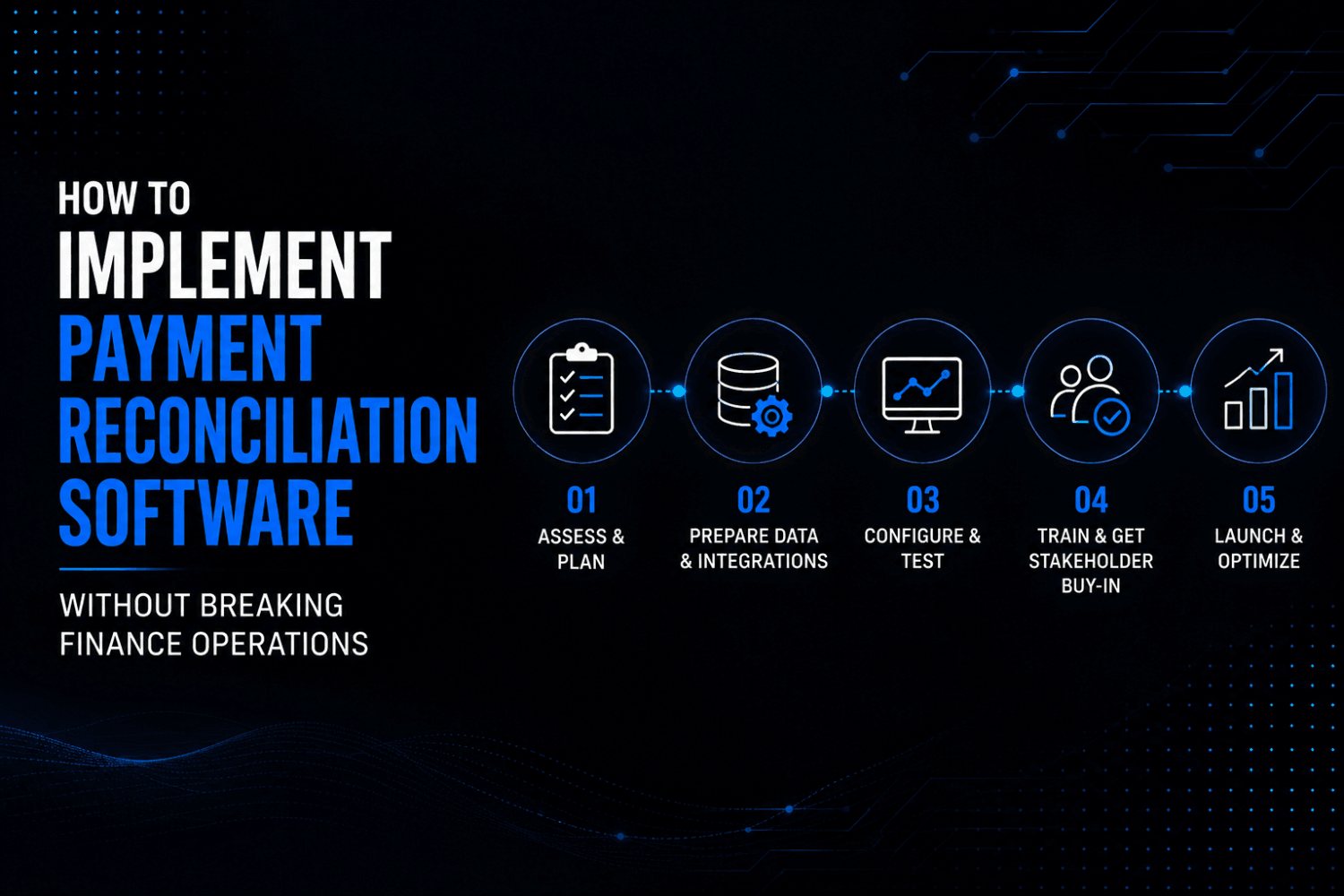
The timeline below reflects what teams with one to five payment processors typically experience. Companies with more processors, multi-entity structures, or legacy ERP integrations should add two to four weeks per major complication.
| Phase | Activities | Typical Duration | Go/No-Go Gate |
|---|---|---|---|
| Phase 1: Discovery and Data Audit | Inventory all payment processors, settlement file formats, bank accounts, and ledger schemas. Complete the Settlement-to-Ledger Mapping Audit for each processor. | 1 to 2 weeks | All five mapping fields documented for every processor before Phase 2 begins |
| Phase 2: Configuration and Schema Build | Configure ingestion connectors, define matching rules, set FX tolerance thresholds, map exception categories, and configure ledger push format. | 2 to 4 weeks | Synthetic test data passes matching rules with less than 2% false breaks before Phase 3 |
| Phase 3: Historical Backfill Test | Run 60 to 90 days of historical production data through the new system. Compare outputs to your existing reconciliation results. Investigate every discrepancy. | 1 to 2 weeks | Unexplained variance below defined threshold (typically less than 0.1% of transaction volume) before Phase 4 |
| Phase 4: Parallel Run | Run old and new systems simultaneously for a full calendar month. Finance signs off on new system outputs before any action is taken on them. | 4 to 6 weeks (minimum one full close cycle) | Zero unexplained discrepancies over $500 between systems before Phase 5 |
| Phase 5: Controlled Cutover | Decommission legacy process for lowest-risk processor first. Expand to remaining processors over two to four weeks. Maintain fallback access to legacy system for 30 days. | 2 to 4 weeks | Exception break rate below 1% for three consecutive business days per processor before full cutover |
| Phase 6: Stabilization and Monitoring | Daily monitoring of break rates, exception aging, and settlement timing. Tune matching rules based on observed patterns. Conduct 30-day post-launch review. | 4 to 6 weeks | 30-day average break rate below 0.5% before removing legacy fallback entirely |
Total range: six to sixteen weeks for most implementations. Teams that compress Phase 4 to less than one full close cycle consistently report post-launch incidents requiring emergency rule changes. That phase is where you discover what the configuration missed, and you want to discover it while your old process is still running in parallel.
Who Owns What: The Implementation Owner Matrix
Every delayed or failed reconciliation implementation has a common trait: nobody owned the decision when something unexpected surfaced. The Owner Matrix below assigns clear accountability for each implementation activity. If your org does not have all of these roles, assign them to existing team members explicitly. Leaving them blank is what causes a three-week delay when a single edge case appears in the processor data.
| Activity | Primary Owner | Approver | Consulted |
|---|---|---|---|
| Settlement file format documentation | Engineering / Payment Ops | Finance | Vendor implementation team |
| Matching rule configuration | Finance / FinOps | Controller or VP Finance | Engineering |
| FX tolerance thresholds | Finance | Controller | Treasury |
| Exception workflow design | Payment Ops | Finance | Engineering |
| Ledger push format and GL mapping | Finance | Controller | Engineering |
| Parallel run sign-off | Controller or VP Finance | CFO | Payment Ops |
| Go-live decision | CFO or VP Finance | CEO (for companies under $20M ARR) | Engineering lead, Payment Ops lead |
| Post-launch monitoring and tuning | Payment Ops | Finance | Vendor support |
| Legacy system decommission | Engineering | Finance, Controller | Compliance (if applicable) |
One pattern worth flagging: engineering often owns the data pipeline to the reconciliation tool and assumes finance owns the configuration. Finance assumes engineering set it up correctly. When a mismatch appears in the exception queue, both teams look at each other. Naming a single Payment Ops lead who sits between both teams and owns the exception queue resolution process eliminates this gap. For teams building out their payment operations function, the tools fintech ops teams actually use daily gives a useful reference for the broader stack that surrounds reconciliation.
The Implementation Checklist: Data, Controls, and Configuration
Data Readiness Checklist
- All processor settlement file formats documented with sample files from the last 90 days of production data
- Payout aggregation logic confirmed per processor (transaction-level vs. batch-level matching)
- Gross-to-net fee decomposition mapped for each processor, including interchange, assessment, and processor fee components
- Refund and dispute netting behavior confirmed per processor
- Settlement date lag documented per processor (typically T+1 to T+3 business days)
- Multi-currency processors identified, FX rate source confirmed (processor rate vs. accounting rate), and acceptable variance thresholds defined
- Bank account list complete, with account numbers, currencies, and entity ownership recorded
- Internal transaction IDs confirmed as stable and available in settlement data (orphaned transactions without IDs require a fallback matching strategy)
- Historical data availability confirmed for at least 90 days of backfill testing
Controls Checklist
- Exception escalation path defined: who receives an alert when an unmatched item ages past 24 hours, 48 hours, and 72 hours
- Dollar threshold for mandatory manual review established (a common starting point is any single unmatched item over $1,000)
- Automated duplicate detection rule configured and tested
- Role-based access controls set: who can approve exception resolutions vs. who can only flag them
- Audit log retention confirmed to meet your compliance requirements (PCI DSS, SOX if applicable)
- Ledger push reviewed for idempotency: confirm that a retry cannot double-post a journal entry
- Reconciliation period lock mechanism confirmed: once a period is closed, no retroactive changes without controller approval
Configuration Checklist
- Matching rules reviewed and approved by finance, not just configured by engineering
- Exception categories named and defined (timing difference, fee variance, missing transaction, duplicate, FX difference, pending dispute)
- Reporting output format confirmed matches what finance needs for month-end close
- Vendor support SLA documented: what happens if the ingestion pipeline fails on the last business day of the month
- API rate limits reviewed against your peak transaction volume
- Webhook or polling mechanism confirmed for real-time vs. batch processing as appropriate for your close timeline
What Processor Settlement Data Mapping Actually Looks Like in Practice
Consider a SaaS company processing $2M per month across Stripe for US card payments, Adyen for European card payments, and ACH via a bank partner. Three processors, three settlement formats, three timing conventions, two currencies.
Stripe sends a CSV payout report that covers a rolling window of transactions. Each row includes a charge ID, created timestamp, amount, fee, and net. The payout lands in the bank account two business days after the transactions settle. Adyen sends a tab-delimited settlement detail file per merchant account, with batch references that tie to the bank credit. The ACH processor may send a NACHA-formatted file or a proprietary CSV. None of these formats share a common field name for the gross transaction amount.
The reconciliation software needs a field mapping configuration for each source that says: “Stripe’s amount field equals gross transaction value; Adyen’s grossDebit field equals the same concept; ACH’s origAmout field equals the same concept.” Those mappings must be validated against actual production files, not sample files from vendor documentation, because processor report formats change with product updates and the documentation frequently lags the actual output.
Teams using both Stripe and Adyen should confirm field-level mapping against their most recent 30 days of actual settlement files before any configuration is locked. Vendor documentation describes the general format; it does not reflect every custom configuration or account-specific variation.
Failure Scenarios and How to Prepare for Each
Pipeline Failure on Close Day
If the ingestion pipeline from a processor fails on the last business day of the month, finance cannot close on time. The fallback is not “wait for the pipeline to recover.” The fallback is a documented manual process: who downloads the settlement file directly from the processor portal, in what format, and how it gets loaded into the system or used for a manual count. Write this procedure before go-live and store it somewhere the controller can find it without asking engineering.
Matching Rule Produces Systematic False Breaks
A misconfigured date window or a tolerance threshold that is too tight will flood the exception queue with items that are not actually errors. The signal is an unusually high exception rate in the first week of production, combined with all exceptions being resolved as “timing difference” or “within tolerance.” If your break rate exceeds 3% of transaction count in the first two weeks, stop and audit the matching rules before the queue grows unmanageable.
Processor Changes Settlement File Format
Payment processors update their settlement file formats with varying notice, sometimes with 30 days of advance warning, sometimes with a changelog buried in a developer newsletter. Your ingestion connector will fail silently or mismap fields if the format changes. Subscribe to developer changelogs for every processor you connect. Adyen, Stripe, and most major processors publish these; assign someone to review them monthly. This is an operational discipline, not a technical one.
Ledger Push Creates Duplicate Journal Entries
If your reconciliation software pushes matched transactions to your general ledger and the push fails partway through, a retry may re-post entries that already landed. This creates a duplicate that inflates revenue or liability figures until caught. The fix is an idempotency key on every ledger push, so a retry recognizes already-posted entries and skips them. Confirm this is implemented before go-live, not after your first retry event.
Historical Backfill Reveals Systematic Prior Errors
Running historical data through a properly configured reconciliation system sometimes reveals that prior periods had systematic errors in the manual process, errors that were never caught because the old process lacked the matching fidelity the new system provides. This is actually a success scenario, not a failure, but it triggers a conversation with the controller about whether prior periods need to be restated. Know in advance who makes that call and what the materiality threshold is.
Test Cases to Run Before Each Go/No-Go Gate
| Test Case | What It Validates | Pass Condition |
|---|---|---|
| Standard transaction match | Normal charge matches processor settlement and bank credit correctly | Match rate above 98% on synthetic dataset |
| Same-day refund | Refund issued same day as charge is handled correctly and does not create two open items | Refund nets against original charge, no exception created |
| Cross-period refund | Refund issued in a different period than the original charge is matched correctly | Refund exception flagged with correct category, not treated as an unmatched debit |
| Dispute and chargeback | Chargeback debit from processor is matched to the original charge and flagged correctly | Chargeback appears in exception queue with “dispute” category, original charge updated |
| FX variance within tolerance | EUR transaction converted to USD at a slightly different rate than accounting rate | Item matched with FX variance note, not flagged as a break |
| FX variance exceeding tolerance | EUR transaction with FX variance above defined threshold | Item flagged for manual review with variance amount shown |
| Batch payout reconciliation | Single bank payout covering 500 transactions matches all component transactions | All 500 transactions matched to payout, payout marked settled |
| Duplicate transaction ID | Processor sends duplicate row in settlement file | Duplicate detected, flagged, not double-counted |
| Missing transaction ID | Settlement row without a transaction ID (common in some legacy processor formats) | Fallback matching rule applied, item flagged with “matched by amount and date” note |
| Pipeline failure and retry | Ingestion fails midway, retry is triggered | No duplicate entries in ledger after retry completes |
| Period close lock | Attempt to modify a reconciled closed period | System rejects modification or requires controller approval workflow |
Run every test case against production-like data, not synthetic data fabricated for the test. The most reliable source is a copy of your last 90 days of actual settlement files, anonymized if necessary for security. Tests against sample data consistently miss edge cases that production data surfaces immediately.
How Specific Vendors Handle Implementation Complexity
Several reconciliation platforms have distinct implementation approaches worth understanding before you commit. This is not a ranking. It is a description of how their implementation models differ, because the right fit depends on your processor mix and internal technical capacity.
ReconArt is built around configurable matching templates and has pre-built connectors for common processors. Implementation typically involves working within their template framework, which accelerates setup for standard processor combinations but adds configuration effort for unusual file formats. Their implementation model assumes a finance-led configuration process with vendor support, so teams without dedicated FinOps capacity may need more professional services hours than the base estimate suggests. For a detailed comparison of ReconArt against AutoRek specifically, the ReconArt vs AutoRek reconciliation platform comparison on FintechSpecs covers each platform’s implementation model in detail.
AutoRek skews toward financial institutions and larger fintech operations. Their data ingestion layer is flexible enough to handle complex settlement formats, but the configuration requires more upfront technical work. Teams with dedicated engineering capacity tend to get AutoRek configured faster than teams expecting the vendor to do most of the mapping work.
Modern Treasury approaches reconciliation as part of a broader payment operations layer, connecting payment initiation, reconciliation, and ledgering in a single API surface. If your team is already using Modern Treasury for payment initiation, adding reconciliation is substantially faster because the data is already in their system. If you are not, the implementation scope is larger because you are connecting a new payment operations layer, not just a reconciliation tool. For teams evaluating Modern Treasury against alternatives for their payment operations backbone, the Modern Treasury vs Increase comparison is worth reading before finalizing that decision.
Adyen’s native reconciliation reporting covers Adyen transactions well and requires no third-party tool for single-processor Adyen operations. The limitation appears when you add other processors: Adyen’s reporting does not ingest Stripe or ACH data, so multi-processor companies still need a dedicated reconciliation layer above it.
Post-Launch Metrics That Tell You the Implementation Is Working
Going live is not the end of the implementation. The 30 days after go-live are when you discover whether the configuration is actually production-stable. Monitor these metrics daily for the first four weeks.
| Metric | Definition | Healthy Range | Action Threshold |
|---|---|---|---|
| Break rate | Percentage of transactions flagged as exceptions vs. total transactions processed | Below 1% at 30 days post-launch | Audit matching rules if above 2% at any point after day 7 |
| Exception age | Median age of open exceptions in the queue | Under 48 hours for timing differences; under 24 hours for genuine breaks | Escalate to finance lead if median age exceeds 72 hours |
| False break rate | Percentage of exceptions resolved as “no action needed” (timing difference, within tolerance) | Below 40% of total exceptions at steady state | Tighten matching rules if false break rate exceeds 60% of exception volume |
| Settlement timing drift | Actual settlement lag vs. expected lag per processor, tracked weekly | Consistent with documented processor SLA | Investigate with processor if settlement lag extends more than one business day beyond normal |
| Ledger push success rate | Percentage of matched items successfully posted to the general ledger without error | Above 99.5% | Investigate integration with GL vendor if below 99% |
| Close cycle time | Hours from period end to reconciliation sign-off | Measure and record for first three months to establish baseline | Flag if close time exceeds pre-implementation baseline at 60 days post-launch |
The break rate and exception age metrics together tell you whether the system is catching real problems or generating noise. A low break rate with high exception age suggests the queue is being ignored, which is a process failure. A high break rate with fast resolution suggests the matching rules are too tight, which is a configuration issue. Both are fixable, but only if you are watching the right metrics in the first four weeks.
For teams building out the broader financial reporting and monitoring stack, the fintech metrics that actually matter beyond vanity growth provides useful context on which operational metrics connect to business health over time.
When to Slow Down or Stop the Rollout
Not every go-live needs to be pushed through on schedule. The following are legitimate reasons to pause at a phase gate, address the issue, and restart. Pushing through them to meet a deadline is how teams end up with months of incorrect financial data that require manual remediation.
- Historical backfill test reveals unexplained variance above 0.1% of transaction volume with no identified root cause
- Parallel run surfaces a discrepancy above $500 that cannot be traced to a known configuration issue within 48 hours
- Exception break rate exceeds 3% in the first week of production, suggesting a systemic matching rule problem
- Ledger push success rate falls below 99% during testing or early production
- Any processor changes its settlement file format during the rollout period, requiring re-mapping before cutover continues
- A key owner (Controller, Payment Ops lead) leaves the company during the implementation and no replacement is designated
These pause conditions are not failures. They are the system working as designed. The alternative, discovering these issues after full cutover with legacy systems decommissioned, is the actual failure mode that costs finance teams weeks of remediation.
The Connection Between Reconciliation Implementation and Broader Financial Controls
Payment reconciliation sits inside a larger set of financial controls that determine whether your finance function can support an audit, a fundraise, or an acquisition process. A poorly implemented reconciliation system creates control gaps that show up in due diligence as red flags, not just as operational annoyances. For companies that have already selected a vendor and are now implementing, this is the moment to build those controls correctly, before the first external audit or data room request surfaces the gaps. The fintech product and compliance readiness checklist covers the audit-trail and control requirements that a reconciliation implementation should satisfy from day one.
The hidden cost of a weak implementation is not just the time spent on manual reconciliation. It is the cost of delayed closes, auditor findings, and the compounding difficulty of cleaning historical data that was never correctly matched. Teams that front-load the mapping audit and parallel run period pay for it in weeks. Teams that skip it pay for it in quarters.
Frequently Asked Questions
How long does payment reconciliation software implementation take?
Most implementations take six to sixteen weeks from kickoff to full cutover, with the range driven primarily by the number of processors connected, data quality in the existing system, and whether the team runs a full parallel period. Teams with a single processor and clean internal data can complete implementation in six to eight weeks. Teams with three or more processors, multi-currency operations, or complex ERP integrations should budget twelve to sixteen weeks. Compressing the parallel run phase below one full close cycle is the most common source of post-launch incidents.
What is processor settlement data mapping and why does it matter for implementation?
Processor settlement data mapping is the process of translating each payment processor’s field names, date conventions, fee structures, and payout logic into a common schema your reconciliation software can use. Stripe, Adyen, PayPal, and ACH processors all use different field names for the same concept, such as gross transaction amount or settlement date. Without accurate mapping, your matching rules will produce false exceptions or miss real breaks. Mapping must be completed against actual production settlement files, not sample data from vendor documentation.
What is a reconciliation software rollout plan?
A rollout plan for reconciliation software is a phased implementation schedule that moves from data audit through configuration, historical backfill testing, parallel running, controlled cutover, and stabilization monitoring. Each phase has a defined go/no-go gate with measurable criteria, such as a break rate below a specified threshold or zero unexplained discrepancies above a dollar amount. The plan also assigns a named owner for every activity category so that decision authority is clear when unexpected issues arise, which they will.
Should I implement reconciliation software with a big-bang cutover or a phased approach?
A phased approach is almost always preferable for payment reconciliation. A big-bang cutover, where all processors go live simultaneously on a single date, means every configuration error surfaces at once in production with no fallback. A phased approach activates one processor at a time, validates the matching logic against live data, and catches systemic issues before they affect your full transaction volume. The only situation where big-bang makes sense is a single-processor operation with a very clean historical dataset and a complete parallel run already completed.
What post-launch metrics indicate a reconciliation implementation is working correctly?
Track six metrics daily for the first 30 days: break rate (target below 1% by day 30), exception age (median under 48 hours), false break rate (below 40% of exceptions), settlement timing drift (consistent with processor SLA), ledger push success rate (above 99.5%), and close cycle time compared to your pre-implementation baseline. If break rate exceeds 2% after day 7 or ledger push success falls below 99%, treat those as investigation triggers rather than acceptable variance.
What payment reconciliation controls should be in place before go-live?
Five controls are non-negotiable before go-live: an escalation path for exceptions aging past 24, 48, and 72 hours; a dollar threshold for mandatory manual review; duplicate detection on all ingested settlement records; idempotency keys on every ledger push to prevent double-posting; and a period lock mechanism that prevents retroactive changes to closed periods without controller approval. Audit log retention should also be confirmed to meet applicable compliance requirements, including PCI DSS standards for companies processing card payments.
Can the implementation proceed while the finance team is mid-close?
Running configuration or testing work during an active month-end close is risky, because finance capacity is fully consumed and the people who need to validate matching rule decisions are unavailable. The parallel run and cutover phases should be scheduled to start at the beginning of a new period, not in the final two weeks of a close cycle. Discovery and data audit work can happen at any time, but any phase that requires finance sign-off should be timed around the close calendar.
What Implementation Actually Determines
The vendor you selected matters less, at this stage, than how thoroughly you complete the mapping audit and whether you build in a genuine parallel run. Two companies can use the same reconciliation software and have completely different experiences based solely on how carefully they documented their processor settlement formats before configuration began. The software does not know what Stripe’s settlement file says about fee decomposition. You have to tell it.
The parallel run is the single most skipped step in reconciliation implementations, and it is the single most valuable one. Running both systems for a full month-end close is not redundant effort; it is the only reliable way to discover whether the new system’s output is trustworthy enough to close financial statements on. Finance teams that defend this phase against schedule pressure consistently report smoother cutover experiences than those who abbreviate it.
Once the implementation is stable, reconciliation stops being a project and becomes an operational function. At that point, the metrics that matter shift from break rate to close cycle time and exception resolution speed. A well-implemented system shortens your financial close, produces a cleaner audit trail, and frees the people who were doing manual matching to work on higher-signal problems. That is the actual outcome worth building toward, and every decision in the implementation process should be evaluated against whether it gets you there faster or creates risk that defers it.