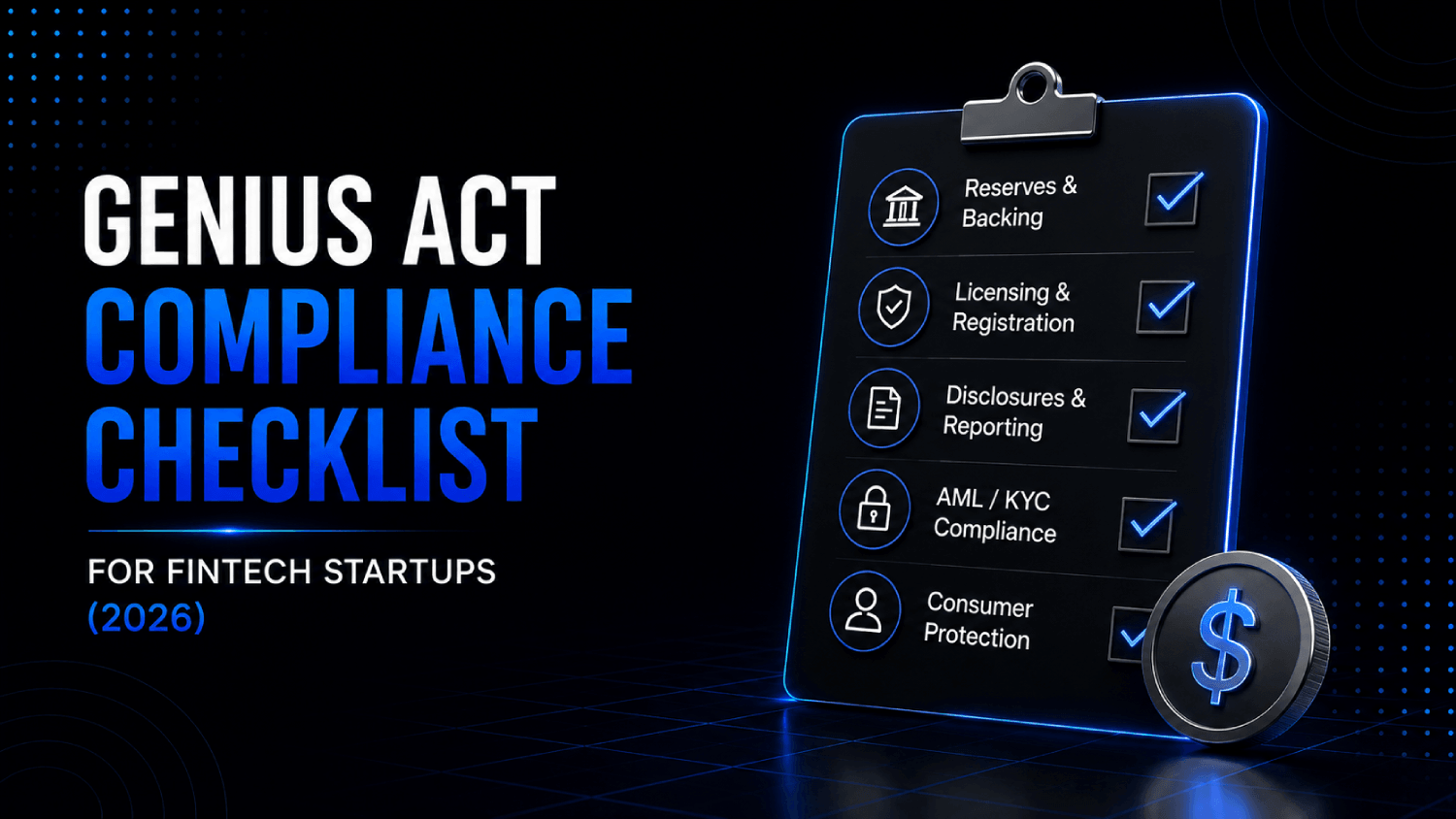

- The GENIUS Act is now signed law, establishing the first federal framework for stablecoin issuers in the US and ending years of regulatory ambiguity.
- Companies that issue stablecoins face the heaviest obligations: licensing, reserve backing, redemption rights, and AML/sanctions programs with real teeth.
- Fintechs that only use stablecoins via payment APIs or custody partners have lighter direct obligations, but their vendor’s compliance status becomes their risk.
- The federal-versus-state pathway is a real strategic decision, not a formality, and it depends on issuance volume and existing charter status.
- Choosing infrastructure providers that are already GENIUS Act-compliant is the fastest way to de-risk stablecoin operations without building a compliance team from scratch.
The GENIUS Act is the first bipartisan federal law in the US that establishes clear, enforceable standards for stablecoins. It creates two licensing pathways for issuers, mandates 1:1 reserve backing in high-quality liquid assets, requires redemption at par on demand, and imposes AML, sanctions, and consumer protection obligations across the stablecoin stack. Fintechs that issue stablecoins need a federal or state license. Fintechs that use stablecoins through third-party infrastructure inherit their provider’s compliance posture as counterparty risk.
What Does the GENIUS Act Actually Regulate?
The GENIUS Act regulates permitted payment stablecoin issuers (PPSIs), which is the statute’s term for any entity legally authorized to issue payment stablecoins in the United States. A payment stablecoin is a digital asset designed to maintain a stable value relative to a fixed monetary denomination, primarily the US dollar, and used primarily for payments or settlement.
The law draws a hard line between issuers and users. If your product mints, distributes, or redeems stablecoins directly on behalf of customers, you are almost certainly in issuer territory and need a license. If your product accepts or transmits stablecoins issued by a licensed PPSI, the regulatory burden is lighter, but not zero.
The Act also addresses consumer protection, interoperability between federal and state-chartered systems, and the integration of stablecoin activity into existing AML and sanctions frameworks administered by OFAC and FinCEN. Treasury’s proposed rulemaking, published after enactment, would require PPSIs to adopt and maintain effective sanctions compliance programs as a condition of operation.
Who Has to Register or Get Licensed Under the GENIUS Act?
Any entity that issues payment stablecoins in the US must qualify as a PPSI. The Act establishes two pathways to get there.
The Federal Pathway
Large issuers and those seeking national reach typically pursue federal licensing through the Office of the Comptroller of the Currency (OCC). Federally chartered entities, including national banks and federal savings associations already holding OCC charters, can apply to become PPSIs under federal supervision. The federal route preempts conflicting state money transmission laws, which is meaningful if you operate across many states.
The State Pathway
Issuers with outstanding stablecoin volume below a threshold set in the statute can elect state-level licensing instead of federal. The Conference of State Bank Supervisors (CSBS) has noted that the Act adds additional conditions for state approval and places the burden of demonstrating those conditions on the applicant. State-licensed PPSIs operate under their home state’s regulatory framework, which must meet minimum federal standards set by the Act. States that have not yet adopted conforming frameworks create uncertainty for issuers trying to use this pathway today.
Nonbank Issuers
Nonbank fintechs that want to issue stablecoins without holding a bank charter can apply for a new OCC-issued PPSI charter. This is the category most early-stage fintech founders fall into. It is also the most demanding path operationally, since it requires building compliance infrastructure from scratch rather than layering onto an existing bank relationship.
What Are the Core GENIUS Act Reserve Requirements?
Reserve requirements are the operational heart of the GENIUS Act and the area where most early-stage teams underestimate the implementation lift.
Every PPSI must hold reserves equal to at least 100% of outstanding stablecoin obligations. Eligible reserve assets are limited to high-quality, liquid instruments. Based on the statute’s text, these include US Treasury bills and notes with short maturities, deposits at federally insured institutions, and certain repurchase agreements backed by Treasuries. Longer-duration bonds, money market funds, and other instruments that might feel “safe” do not necessarily qualify unless they meet the specific criteria in the Act and any subsequent rulemaking.
Reserves must be held in a segregated manner, meaning they cannot be commingled with the issuer’s general operating funds or used as collateral for the issuer’s own borrowings. This structural segregation is not just an accounting convention. It requires custodial arrangements that can prove segregation to regulators, which has direct implications for which custody providers you can work with. For a comparison of institutional custody options, see this overview of institutional digital asset custody providers.
Issuers are also required to publish monthly disclosures of reserve composition. The disclosure obligation is public-facing, not just regulatory, which means your reserve portfolio becomes visible to counterparties, customers, and competitors on a regular basis.
What Redemption Rights Does the GENIUS Act Require?
Holders of stablecoins issued by a PPSI have the legal right to redeem at par, meaning they can exchange one dollar of stablecoin for one dollar of fiat, on demand. The Act, according to its statutory text on Congress.gov, requires that issuers have the technological capability to comply with lawful orders, including the ability to freeze or burn tokens at the direction of law enforcement or regulators.
The redemption-at-par requirement has two practical consequences. First, it eliminates the business model of earning yield on reserves and passing it to token holders, since the issuer must always be able to return full face value. Second, it creates a liquidity management problem during periods of high redemption demand, which is why the reserve asset restrictions lean so heavily toward short-duration, highly liquid instruments.
Fintechs building products on top of licensed stablecoins like USDC or those issued by other PPSIs should confirm that their user agreements accurately represent redemption mechanics. If your product holds stablecoins in an omnibus wallet and your users cannot redeem directly with the issuer, you may be creating an intermediary layer that raises its own regulatory questions.
What AML Obligations Apply Under the GENIUS Act?
The GENIUS Act does not create a parallel AML regime. It integrates stablecoin issuers into the existing Bank Secrecy Act framework and adds stablecoin-specific requirements on top of it. PPSIs are treated as financial institutions for BSA purposes, which means they must establish written AML/CFT programs, conduct customer due diligence, file Suspicious Activity Reports (SARs), file Currency Transaction Reports (CTRs) where applicable, and maintain records that FinCEN can examine.
The Act also adds explicit sanctions compliance obligations. Treasury’s proposed rulemaking states that PPSIs must adopt and maintain an effective sanctions compliance program, and OFAC’s standard framework for financial institutions applies. In practice, this means screening all customers, transactions, and counterparties against OFAC’s Specially Designated Nationals (SDN) list and sector-based sanctions lists in real time.
Does the GENIUS Act require KYC? Yes, effectively. Because PPSIs are treated as financial institutions under the BSA, they must implement Customer Identification Programs (CIPs) that satisfy FinCEN’s requirements. KYC is not optional language in the Act. It is a structural consequence of the BSA classification. For issuers building this stack, purpose-built KYC verification providers and AML screening APIs are the natural starting point.
The FintechSpecs GENIUS Act Compliance Tier Map
Most compliance guides treat every fintech touching stablecoins the same. They should not. The actual obligation set differs sharply depending on what your product does. The tier map below is organized around a single question regulators will ask first: does your product mint, or does it move? That distinction determines your licensing exposure, your reserve obligation, and which vendors you can safely rely on versus which ones become your liability.
| Tier | Company Type | Primary Obligation | Licensing Required? | Reserve Obligation? | Vendor Risk Exposure |
|---|---|---|---|---|---|
| 1 | Direct stablecoin issuer (mints and redeems) | Full PPSI registration, reserve backing, redemption rights, AML program, monthly disclosures | Yes, federal (OCC) or state | Yes , 100% in qualifying assets, segregated, publicly disclosed monthly | You are the vendor others rely on. Your compliance posture is their counterparty risk. |
| 2 | Stablecoin distributor or reseller (sells licensed stablecoins, does not mint) | BSA compliance, OFAC screening, possible state money transmission license | Possibly , depends on state activity and custody structure | No | High. Must verify PPSI status of every stablecoin you distribute. An unlicensed issuer upstream is your problem. |
| 3 | Payment app accepting/sending stablecoins via licensed PPSI APIs | Counterparty due diligence, end-user AML, OFAC screening at transaction layer | No direct PPSI license , but state MTL may apply depending on custody structure | No | Medium. Vendor selection is effectively your compliance strategy. A non-PPSI acting like one is a liability inside your product. |
| 4 | SaaS platform with no stablecoin issuance or transmission (e.g., analytics, compliance tooling) | Standard vendor compliance , no PPSI-specific obligations | No | No | Low. Standard vendor due diligence applies. |
Tier 1 carries the full statutory burden. Tier 3 and 4 companies inherit their PPSI vendor’s compliance posture, which means your due diligence on stablecoin infrastructure partners is effectively your compliance strategy. A vendor who is not a licensed PPSI but behaves like one is a regulatory liability sitting inside your product.
What Does the GENIUS Act Require If You Are Not Issuing Stablecoins?
This is the question that most compliance guides skip entirely. The majority of fintech startups interacting with stablecoins are not issuers. They are using stablecoin payment APIs for B2B settlement, cross-border payouts, or treasury operations. Their compliance exposure is real but different.
For a Tier 3 company, the core obligation is transactional. You must screen counterparties against OFAC sanctions lists. You must apply your existing AML program to stablecoin transactions with the same rigor as fiat transactions. If you are holding stablecoins on behalf of customers, even in an omnibus wallet, you may be engaging in money transmission under state law, which would require state money transmitter licenses (MTLs) independent of the GENIUS Act.
The MTL question is not resolved by the GENIUS Act. State-by-state MTL requirements still apply to stablecoin intermediaries unless federal preemption explicitly covers your activity. A Tier 3 company using a licensed PPSI’s API does not automatically inherit that PPSI’s federal preemption benefit. The money transmitter license cost by state varies significantly, and the analysis of whether you need one is fact-specific to your product architecture.
The practical answer for most Tier 3 fintechs: use a licensed PPSI’s infrastructure, apply your standard AML and OFAC screening stack to every stablecoin transaction, get a legal opinion on whether your custody arrangement triggers MTL requirements in your top states, and document all of this in your compliance program.
GENIUS Act Compliance Checklist by Tier
For Stablecoin Issuers (Tier 1)
- Determine your licensing pathway: federal (OCC) or state, based on issuance volume and existing charter status.
- File for PPSI status with the appropriate regulator before issuing any payment stablecoins to US customers.
- Establish a segregated reserve account holding 100% of outstanding stablecoin obligations in qualifying assets (short-duration Treasuries, insured deposits, eligible repos).
- Build or contract a reserve custodian that can produce regular attestations and support monthly public disclosures of reserve composition.
- Implement a written AML/CFT program meeting BSA requirements: CIP, CDD, SAR filing, CTR filing, recordkeeping.
- Implement real-time OFAC sanctions screening for all customers and transactions, including wallet address screening.
- Build technical infrastructure for freeze and burn capabilities, as required for compliance with lawful orders under the Act’s statutory text.
- Establish redemption-at-par procedures, including liquidity stress testing for high-redemption scenarios.
- Prepare monthly reserve disclosure reports for public publication.
- Designate a BSA Officer and establish a board-level compliance oversight function.
For Stablecoin API Users and Distributors (Tiers 2 and 3)
- Confirm that every stablecoin you accept or transmit is issued by a licensed PPSI. Ask for documentation, not just a claim on a website.
- Apply existing AML program (transaction monitoring, SAR filing) to stablecoin transactions at the same threshold as fiat.
- Screen all counterparty wallet addresses and customer identities against OFAC SDN lists.
- Get a legal opinion on whether your stablecoin custody or omnibus wallet structure triggers state money transmission licensing obligations.
- Add PPSI licensing status to your standard vendor due diligence process. For a structured approach to this, the fintech vendor evaluation framework covers the key due diligence checkpoints.
- Update your user-facing terms of service to accurately describe stablecoin redemption mechanics and any intermediary role your product plays.
- Document stablecoin transaction flows in your compliance program and make them available for examiner review.
Federal vs State Pathway: How Do You Choose?
The statute creates a bifurcated system, and neither path is clearly better for every issuer. The federal OCC pathway offers national preemption of state money transmission laws, which means a single federal charter covers you in all 50 states. For an issuer with ambitions beyond a single regional market, that is operationally significant. The federal path also carries heavier scrutiny during the application process, including capital adequacy reviews and operational standards the OCC will impose through rulemaking.
The state pathway is available to issuers below a certain outstanding stablecoin volume threshold. CSBS has noted that state applicants bear the burden of demonstrating they meet the Act’s conditions, and that the Act imposes additional approval requirements beyond what existing state money transmission licensing alone would require. If your target state has not yet adopted a conforming framework, the state path may not be available in practice until that state updates its rules.
For most seed-to-Series A issuers, the realistic near-term path is state licensing in one or two jurisdictions with conforming frameworks, with a plan to port to federal as volume grows. The GENIUS Act does not eliminate the need to track fintech product and compliance readiness at the state level.
How Does the GENIUS Act Interact with Existing Fintech Compliance Programs?
If you already operate under a bank partnership or sponsor bank arrangement, your compliance posture may partially satisfy GENIUS Act requirements, but it does not automatically make you a PPSI. The GENIUS Act creates a distinct legal status that requires affirmative application and approval. Existing bank-fintech arrangements under Banking-as-a-Service structures do not transfer PPSI status to the fintech partner. The BaaS bank is a separate regulated entity, and the fintech typically cannot use the bank’s charter to issue its own stablecoins.
Companies already running well-built AML programs with transaction monitoring, SAR filing, and OFAC screening are well-positioned to extend those systems to cover stablecoin activity. The GENIUS Act does not invent new AML mechanics. It applies existing ones to a new asset class. For teams that have not yet built this layer, AML transaction monitoring software built for real-time digital asset flows is the practical starting point.
One area where existing programs often fall short: wallet address screening. Traditional BSA programs screen legal entity names and individual identities. Stablecoin compliance also requires screening blockchain wallet addresses against OFAC’s list of specially designated entities, some of whom are identified by wallet address rather than name. This is a gap in most fintechs’ current OFAC programs that the GENIUS Act’s sanctions compliance requirement makes mandatory to close.
Which Stablecoin Infrastructure Providers Are Already Positioned for GENIUS Act Compliance?
The fastest path to GENIUS Act compliance for a Tier 3 fintech is selecting infrastructure providers that are either already licensed PPSIs or are actively pursuing that status. Circle, the issuer of USDC, has publicly stated that the GENIUS Act is the first bipartisan federal law establishing enforceable standards for stablecoins and has positioned USDC as aligned with that framework. Paxos, the issuer of USDP and other regulated stablecoins, operates under existing state trust company charters and has engaged directly with federal regulators on PPSI status.
For fintechs evaluating stablecoin payment APIs and issuance platforms, the GENIUS Act compliance posture of each provider is now a procurement criterion, not a nice-to-have. A complete comparison of the infrastructure options appears in our overview of stablecoin infrastructure providers for fintechs , which covers PPSI licensing status, reserve attestation practices, and freeze/burn capability by vendor. For teams considering issuance specifically, the stablecoin issuance platform comparison breaks down each platform’s current regulatory posture, OCC engagement, and technical readiness for GENIUS Act compliance.
Frequently Asked Questions About GENIUS Act Compliance
What is a permitted payment stablecoin issuer under the GENIUS Act?
A permitted payment stablecoin issuer (PPSI) is any entity that has received authorization under the GENIUS Act to issue payment stablecoins in the United States. Eligible entities include federally chartered banks and savings associations approved by the OCC, state-chartered entities whose home state has adopted a GENIUS Act-conforming framework, and nonbank applicants that receive a new PPSI charter from the OCC. Only PPSIs may legally issue payment stablecoins to US customers after the Act’s compliance deadlines take effect. This matters for procurement decisions: a stablecoin product that cannot name its PPSI authorization is a product you cannot safely build on.
Do I need a license to hold customer stablecoins under the GENIUS Act?
Holding customer stablecoins is not the same as issuing them, so PPSI licensing is not automatically required for custodians. However, if you hold stablecoins in an omnibus wallet on behalf of customers and they cannot redeem directly with the issuer, you may be engaging in money transmission under state law, which triggers state MTL requirements. The GENIUS Act does not preempt state MTL obligations for entities that are not themselves PPSIs. A legal opinion specific to your custody architecture is necessary before concluding you do not need a license.
Does the GENIUS Act require KYC for stablecoin issuers?
Yes, effectively. The Act treats permitted payment stablecoin issuers as financial institutions under the Bank Secrecy Act. That classification requires a Customer Identification Program, which is the statutory basis for KYC. Issuers must verify customer identities at onboarding, conduct ongoing customer due diligence, and maintain records that regulators can examine. There is no GENIUS Act exemption from BSA identity verification requirements for any volume tier or issuer type.
What are the reserve requirements for stablecoin issuers under the GENIUS Act?
PPSIs must hold reserves equal to at least 100% of outstanding stablecoin obligations. Qualifying reserve assets are limited to short-duration US Treasury securities, deposits at federally insured depository institutions, and certain Treasury-backed repurchase agreements. Reserves must be held in a segregated account, not commingled with operating funds, and cannot be pledged as collateral for the issuer’s own obligations. PPSIs must publish monthly disclosures of reserve composition , these are public-facing documents, not just regulatory filings, which means your reserve choices are visible to counterparties and customers.
Can a startup fintech become a stablecoin issuer under the GENIUS Act without a bank charter?
Yes. The GENIUS Act creates a nonbank PPSI charter pathway administered by the OCC. A nonbank fintech can apply for this charter without first obtaining a full bank charter. However, the application process includes meeting operational and compliance standards set by the OCC through rulemaking, and the burden of demonstrating eligibility rests entirely on the applicant. Most early-stage teams find it faster to use a licensed PPSI’s infrastructure via API while the nonbank charter pathway matures through rulemaking. That is also what the fintech compliance readiness checklist recommends for teams at the pre-Series B stage.
What is the difference between the federal and state licensing pathways for stablecoin issuers?
The federal pathway, administered by the OCC, grants national preemption of conflicting state money transmission laws and applies to larger issuers or those seeking multi-state reach without managing separate state licenses. The state pathway is available to issuers below a volume threshold specified in the statute and requires the issuer’s home state to have adopted a GENIUS Act-conforming regulatory framework. States that have not yet updated their frameworks make the state pathway unavailable for new applicants until they do. CSBS is coordinating state implementation, but timing varies by state. Tracking both tracks simultaneously is standard practice for any team with multi-state ambitions.
How does the GENIUS Act affect fintechs that use stablecoins for B2B payments but do not issue them?
Fintechs using licensed stablecoin payment APIs for B2B settlement, cross-border payouts, or treasury operations are not directly subject to PPSI licensing requirements. Their primary obligations are: verifying that their stablecoin provider is a licensed PPSI, applying their existing AML and OFAC screening programs to stablecoin transactions, determining whether their product constitutes money transmission under state law, and documenting stablecoin transaction flows within their compliance program. Vendor selection becomes a compliance decision, not just a product decision. The fintech vendor evaluation framework includes a due diligence structure that applies directly to this scenario.
When does GENIUS Act compliance actually take effect?
The GENIUS Act was signed into law, but many specific requirements depend on final rulemakings from the OCC, FinCEN, and Treasury. The proposed rule on sanctions compliance programs for PPSIs is in public comment as of mid-2026. Issuers should track the rulemaking timeline through the CSBS GENIUS Act implementation tracker and FinCEN’s rulemaking calendar. Operating as if final rules are already in effect is the conservative and, for most issuers, the correct default posture.
What the GENIUS Act Really Changes for Fintech Infrastructure Decisions
For the past several years, the standard advice to fintech founders considering stablecoins was to wait. The regulatory environment was genuinely unsettled. That advice is no longer correct. The GENIUS Act gives every team enough specificity to make real engineering and vendor decisions today, even while some final rulemaking details are still in process.
The most underappreciated implication is that vendor selection is now a compliance act. A Tier 3 fintech that routes stablecoin transactions through an unlicensed intermediary does not inherit a compliance problem somewhere down the road. It has one right now, because it cannot demonstrate to a regulator that its counterparty is an authorized PPSI. That due diligence requirement is not a future obligation waiting for a rule to finalize. It is a current best-practice expectation that regulators would apply today under existing BSA frameworks.
The teams that move fastest are the ones that treat GENIUS Act compliance as a product requirement, not a legal department task. That means building PPSI verification into vendor onboarding, extending AML transaction monitoring to cover stablecoin flows, and choosing infrastructure providers that are already doing the regulatory work rather than ones that will start when the rules are final.