
- AI agents buying on behalf of shoppers cannot complete a standard checkout , they hit CAPTCHA walls, session timeouts, and login gates that silently drop the order with no error message to the merchant.
- Agent-ready infrastructure means exposing structured product data, cart APIs, and payment credential acceptance that an autonomous agent can call without simulating a browser session.
- Rye’s seven-layer commerce framework is the clearest public taxonomy for what “agent-ready” actually requires at the technical level , it is a vendor-published taxonomy, not an independent standard, but it maps usefully onto the gaps in standard merchant infrastructure. Merchant adoption of that stack determines whether agent-referred traffic converts or disappears.
- Being findable in AI search and being buyable by agents are two sides of the same problem: one gets you discovered inside ChatGPT or Perplexity, the other closes the sale once the agent decides to buy.
- The merchants who build agent-ready checkout now face almost no competition for that traffic channel; the ones who wait will retrofit under pressure.
Agentic checkout is the infrastructure layer that lets an autonomous AI agent , acting on behalf of a shopper , authenticate, add to cart, apply payment credentials, and confirm an order without any human interaction at the browser level. The tools that support it expose structured APIs, support agent identity protocols, and accept delegated payment credentials rather than requiring a logged-in human session. Merchants without this infrastructure do not receive error messages when agents fail to complete purchases; the orders simply never happen.
Why Your Existing Checkout Fails AI Agent Traffic Silently
Standard ecommerce checkouts were designed around a single assumption: a human is watching the screen. Every friction point that UX designers added to prevent bots , CAPTCHAs, session cookies, one-time passwords, address autocomplete , also blocks a legitimate AI agent that is trying to complete a purchase on a shopper’s behalf.
The failure mode is invisible. When an AI agent hits a checkout that requires human interaction to proceed, it does not return an error to the merchant’s analytics stack. The cart is abandoned, the conversion is lost, and the merchant’s dashboard shows nothing unusual. This is structurally different from a human abandoning a checkout, where retargeting emails and session replays at least surface the problem.
There is also an identity problem. Current checkouts validate buyers through email/password combinations, OAuth sessions, or saved payment methods tied to a browser profile. An AI agent operating as a third party has none of these. It cannot log in as the user, it cannot pass two-factor authentication, and it cannot access the user’s saved Stripe or Apple Pay credentials. Protocols like the W3C Payment Request API and emerging agent credential frameworks from providers like Checkout.com are beginning to address the credential layer, but they require explicit merchant adoption.
What Does “Agent-Ready Checkout” Actually Require at the Technical Level?
Rye, the commerce API company, has published what is currently the most cited public taxonomy for agentic commerce readiness. Their framework breaks merchant-side agent readiness into seven layers: product discovery (structured data feeds), inventory and availability (real-time API responses), cart creation (programmatic add-to-cart without browser session), pricing and promotions (API-exposed discounts, not checkout-page popups), shipping calculation (upfront API quotes, not post-cart reveal), payment execution (delegated credentials or tokenized payment methods), and order confirmation (machine-readable receipts, not HTML email).
Because this taxonomy originates from Rye’s own product documentation, it reflects how they have structured their API surface , which is worth noting when using it as a diagnostic against a different vendor’s stack. That said, the seven layers map cleanly onto the gaps in standard merchant infrastructure, and no comparable independent taxonomy has been published.
Most merchants today satisfy roughly two of these seven layers , product discovery through Google Shopping feeds, and order confirmation through transactional email. The five middle layers are the gap. An agent that cannot retrieve real-time inventory, build a cart programmatically, or execute payment with a delegated token will stall out at different points depending on which layer fails first.
For merchants evaluating their own readiness, this seven-layer structure works as a diagnostic. Running through each layer against your current stack tells you exactly where agent traffic drops off , not in aggregate, but at the specific step where the infrastructure assumption breaks.
The FintechSpecs Agent-Readiness Audit: Five Checks Before You Evaluate Any Tool
Before shortlisting vendors, a merchant needs to know what they are actually missing. The following five checks map directly to the layers where most standard checkouts fail agent traffic. These are not sales-funnel questions , they are infrastructure questions with binary answers.
- Cart API exposure: Can a third-party application create and modify a cart via API without an active browser session or user login? If your cart requires a session cookie, agents cannot use it.
- Structured product data: Do your product pages expose machine-readable schema markup (Schema.org Product, Offer, and Availability fields) that an agent can parse without scraping HTML? Agents that discover products in AI search need structured data to confirm price and availability before initiating purchase.
- Delegated payment credential support: Does your payment processor accept tokenized or delegated payment credentials from a third-party agent on behalf of a customer? Standard card-present and card-not-present flows were not designed for this.
- Webhook and confirmation API: Can an agent receive machine-readable order confirmation , not just an HTML email , so it can report back to the shopper that the purchase completed?
- Bot detection configuration: Is your fraud and bot-detection layer configured to distinguish a credentialed AI agent from a malicious scraper? Most out-of-the-box rules block both equally.
If you answered “no” to three or more of these, a vendor solution is necessary before your store can capture agent-referred orders. Answering “yes” to all five means you need a protocol layer and agent identity support, but the plumbing is mostly there. For context on how fraud detection interacts with agent traffic, the analysis in fraud prevention versus user experience in fintech covers the same tension between security rules and legitimate non-human traffic.
Which Tools Actually Make a Store Buyable Inside ChatGPT or Perplexity?
The tools below are evaluated on four criteria: protocol support (what agent communication standards they implement), merchant integration effort (low, medium, or high), payment credential handling (how they manage delegated or agent-initiated payment), and current maturity (production-ready versus early access). Pricing is noted only where publicly disclosed.
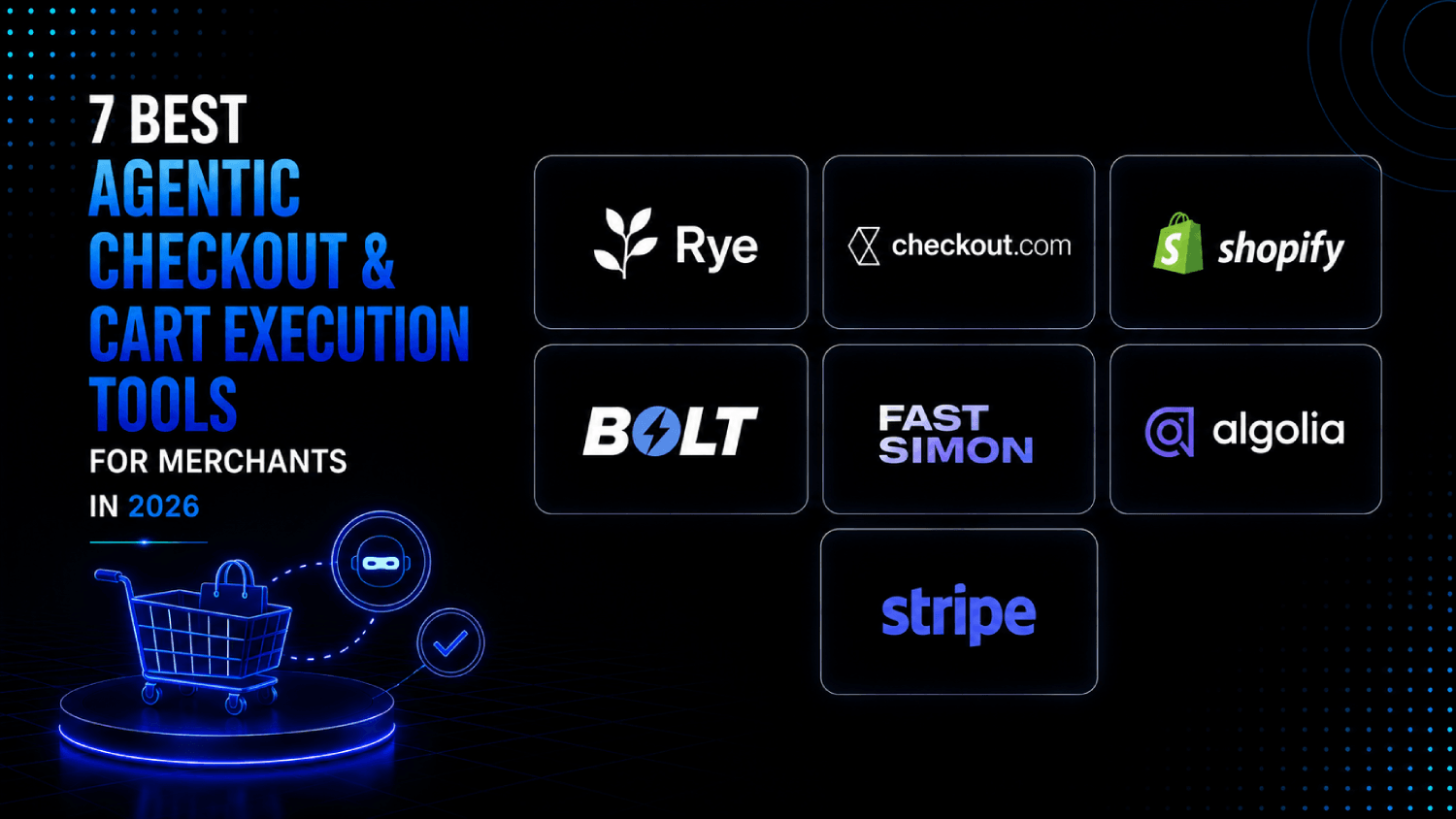
| Tool | Protocol Support | Integration Effort | Payment Credential Handling | Maturity |
|---|---|---|---|---|
| Rye | ACP, custom API | Medium | Tokenized, delegated | Production |
| Checkout.com Agentic Credentials | Proprietary framework | Medium-High | Agent credential issuance | Early access |
| Shopify Storefront API + Hydrogen | GraphQL, headless | Low-Medium | Storefront tokens | Production |
| Bolt | Proprietary one-click | Low | Shopper network credentials | Production |
| Fast Simon (Commerce AI) | REST API, feeds | Low-Medium | Via processor integration | Production |
| CommerceIQ / Algolia Predict | API-first search and cart | Medium | Via processor integration | Production |
| Stripe Payment Links + Agent Mode | REST, Stripe Agent Toolkit | Low | Stripe credentials, native | Production (toolkit beta) |
1. Rye
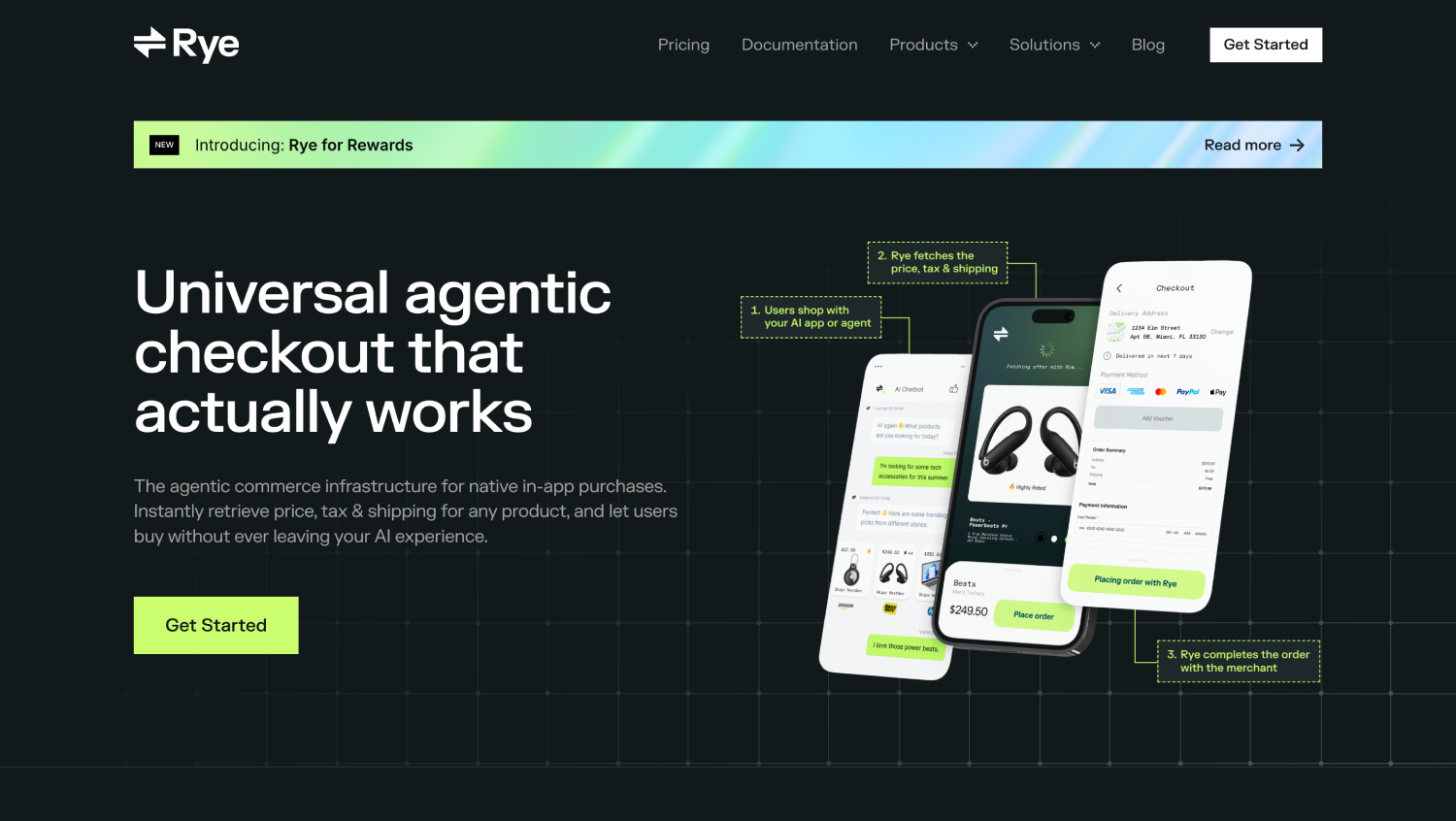
Rye is purpose-built for agentic commerce. Their API gives developers programmatic access to add-to-cart, checkout initiation, and order execution across a catalog of merchants without requiring a browser session. Their seven-layer framework, mentioned above, is not just marketing , it is the actual structure of their API surface, and it maps directly to the gaps in standard merchant infrastructure.
The integration is a REST API with SDKs for JavaScript and Python. Merchants who want their products to be buyable through Rye’s network implement their product feed and configure delegated payment handling. For merchants on the receiving end of agent traffic, Rye handles the credential and session complexity at the infrastructure layer. Pricing is not publicly listed; Rye operates on a revenue-share model for transactions processed through their network.
The honest trade-off: Rye’s catalog coverage is strong for DTC and physical goods merchants, thinner for B2B and digital goods. If your catalog is predominantly software licenses or subscriptions, the fit is less direct.
2. Checkout.com Agentic Credentials Framework

Checkout.com is developing what they call an Agentic Credentials Framework, which issues AI agents a specific credential type matched to the transaction context , rather than passing through stored human credentials. The design logic is that different agents (a shopping assistant, a corporate procurement bot, a subscription manager) should receive different credential scopes, with different spending limits and merchant category restrictions built in.
This is the right architectural direction. A credential that carries its own policy rules , spend cap, allowed merchant categories, expiration , is more secure than a bare tokenized card, because it limits the blast radius if the agent credential is misused. The framework is in early access, so production readiness for most merchants depends on when Checkout.com expands availability , merchants building agent-facing checkout infrastructure now should track this closely and confirm current status directly with Checkout.com before planning around it.
3. Shopify Storefront API and Hydrogen
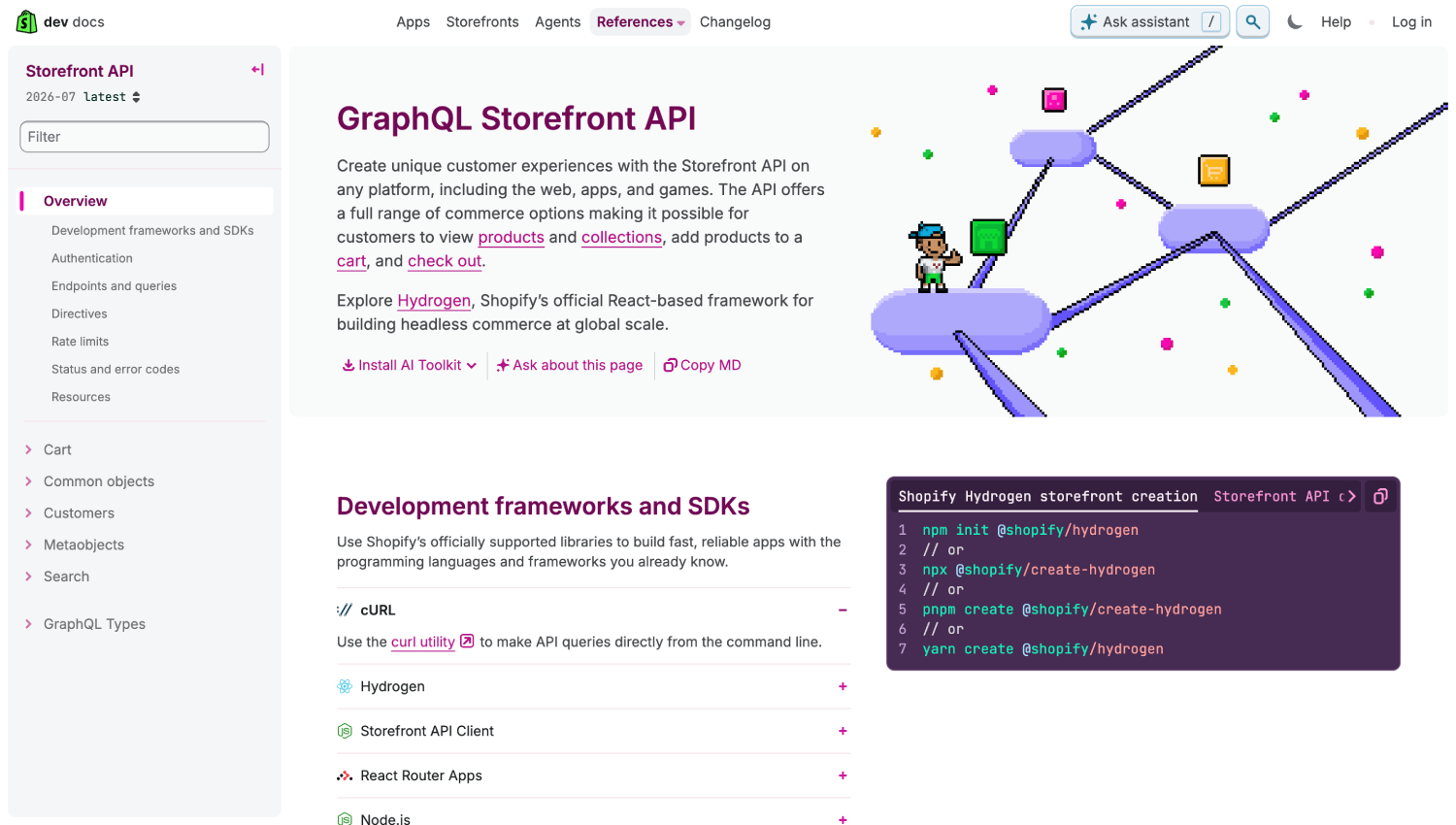
Shopify’s Storefront API is already the closest thing to a widely-deployed agent-ready checkout infrastructure, even though it was not originally designed for that purpose. The GraphQL API allows programmatic cart creation, line item management, and checkout initiation using a storefront access token , no active browser session required. Hydrogen, Shopify’s React-based headless commerce framework, makes it straightforward to expose a fully API-driven front end that an AI agent can interact with.
Shopify merchants who have already moved to headless architecture are closer to agent-ready than they realize. The remaining gap is on the payment execution side , completing a checkout still requires payment credential handling that most implementations route through Shopify Payments or Stripe, neither of which currently accepts delegated agent credentials natively. Bolt or a Stripe Agent Toolkit integration closes that gap.
4. Bolt
Bolt built its core product around a shopper network , a database of verified payment credentials linked to shopper accounts across merchants. That architecture turns out to be useful for agent checkout, because an agent that has been authorized to act on behalf of a Bolt network shopper can trigger payment execution without re-entering card details or logging into an account.
The integration is a JavaScript embed or API, and Bolt’s merchant count means their shopper network credential coverage is broad enough to matter for DTC merchants. The limitation is that Bolt’s model requires the buyer to have a Bolt account, which adds a dependency on consumer adoption of a third-party network. For merchants whose customers skew toward tech-forward buyers who are already using AI shopping assistants, that dependency is less of a friction point.
5. Fast Simon
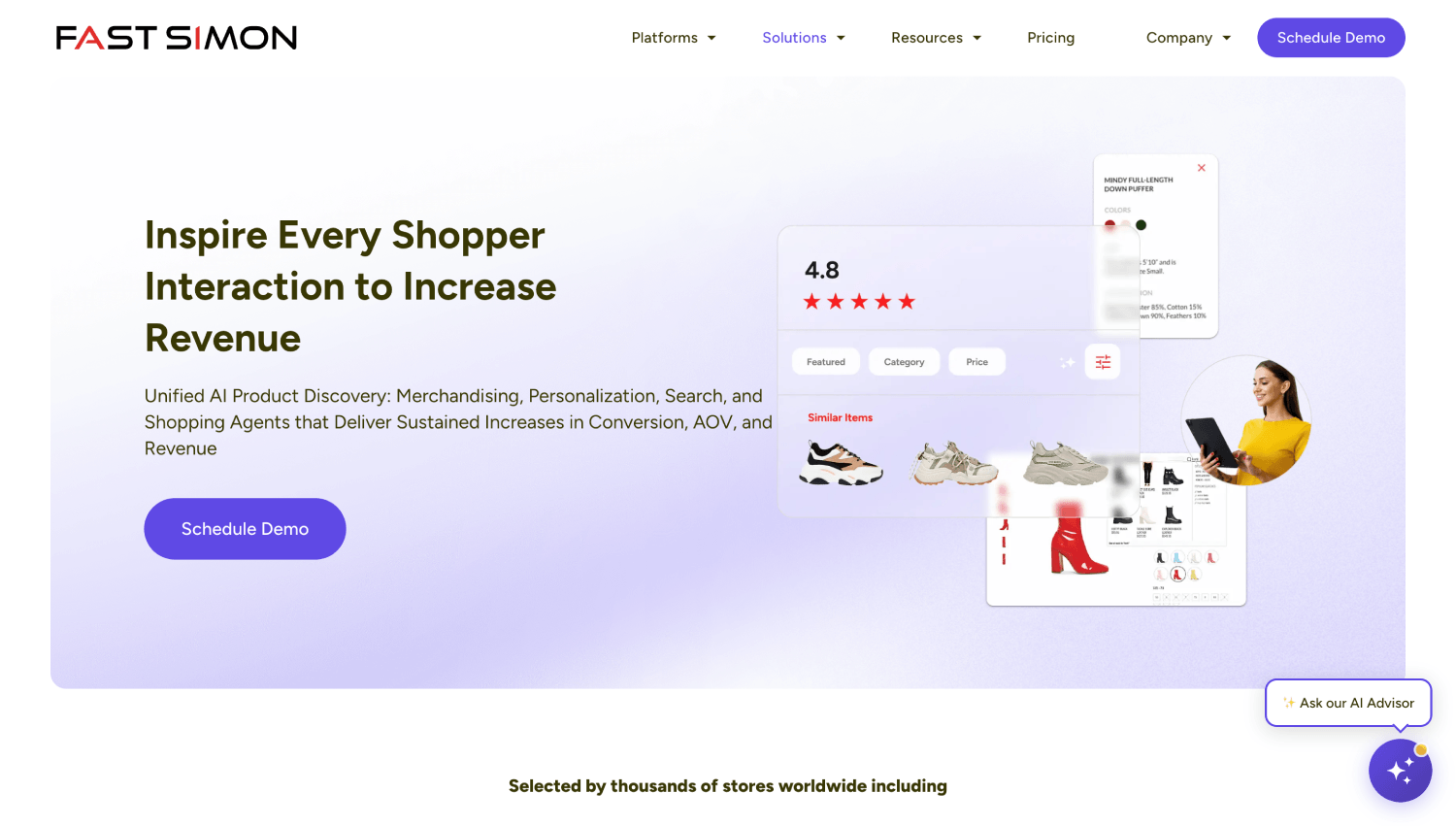
Fast Simon positions itself as an AI commerce platform, with product discovery, merchandising, and personalization layers built on top of a merchant’s existing catalog. The relevance for agentic checkout is on the discovery and structured data side: Fast Simon exposes product feeds and search APIs that AI agents can query to confirm inventory, pricing, and availability before initiating purchase , satisfying the first two layers of Rye’s framework.
Fast Simon does not handle payment execution directly. Merchants who want full agent-to-order capability need to pair Fast Simon’s catalog layer with a checkout API from Shopify, Stripe, or a similar processor. That makes Fast Simon a strong piece of the stack for merchants who want to start with discovery and structured data before tackling the payment execution problem.
6. Algolia AI Search and Commerce
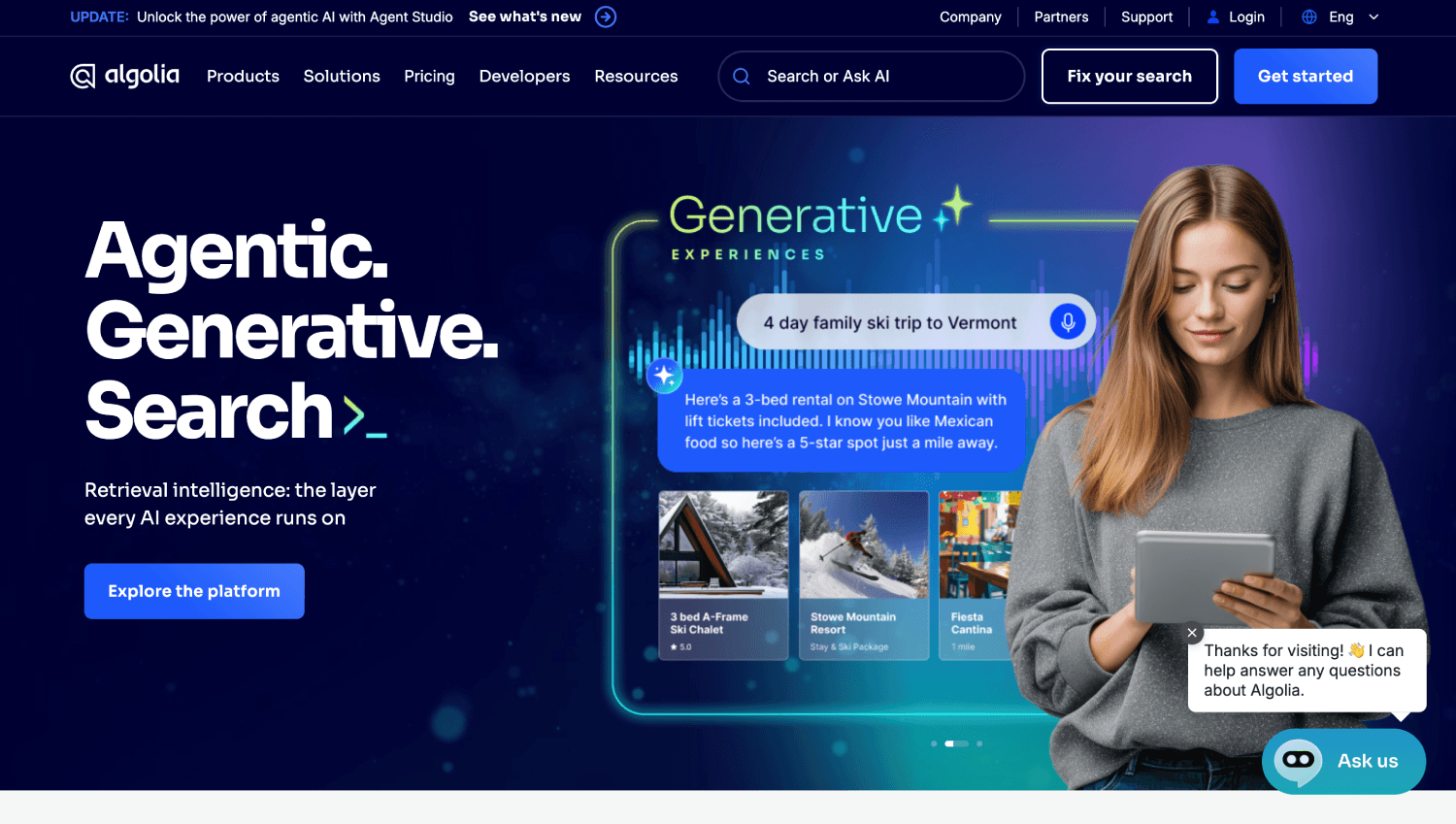
Algolia is primarily a search API, but their NeuralSearch and Predict products add behavioral signals and real-time availability to the search layer. For agentic checkout, the relevant capability is machine-readable search responses that return structured product data , price, SKU, inventory status , in a format an agent can parse directly without scraping a rendered HTML page.
Algolia’s integration effort is medium: the API is well-documented, SDKs are available for every major language, and the developer experience is consistently cited as strong. Like Fast Simon, Algolia handles the discovery layer but passes off to a checkout API for cart and payment execution. The combination of Algolia for discovery plus Shopify Storefront API for cart creation covers five of Rye’s seven layers for merchants already on Shopify.
7. Stripe Agent Toolkit
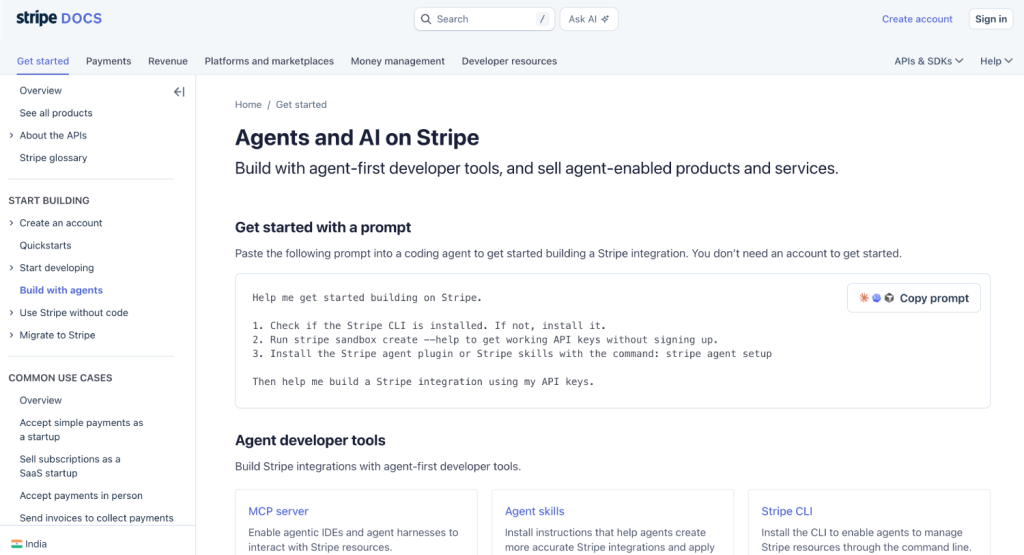
Stripe’s Agent Toolkit gives AI agent developers a set of tools for calling Stripe APIs in a structured way , creating payment intents, retrieving customer records, confirming charges , from within an agent workflow. For merchants who are already on Stripe, this is the lowest-friction path to agent-initiated payment execution.
The toolkit is in beta. It works by giving an agent access to Stripe API keys scoped to specific operations, with the agent handling the payment step in a checkout flow that the merchant exposes via their own cart API. Merchants who pair a Shopify Storefront API cart with Stripe Agent Toolkit payment execution have a reasonably complete agent-ready stack using tools they may already be paying for.
The gap is agent identity , Stripe’s toolkit does not yet issue agent-specific credentials with embedded policy rules the way Checkout.com’s framework aims to. That is a meaningful security consideration: a broad Stripe API key passed to an agent has more blast radius than a scoped credential. For a broader view of how payment infrastructure choices interact with this kind of build-versus-buy decision, the payment infrastructure tools comparison for SaaS founders covers the underlying trade-offs in detail.
How Do Merchants Accept AI Agent Purchases Without Rebuilding Their Entire Stack?
The practical answer for most merchants is a layered approach rather than a full rebuild. Start with the discovery layer , Schema.org markup, a structured product feed, and a search API , because that investment pays off in regular SEO and AI search visibility regardless of whether agent checkout traffic materializes immediately. The connection between being findable in AI search and being buyable by agents is direct: getting surfaced inside ChatGPT or Perplexity is a GEO problem, and how generative engine optimization works for fintech and SaaS describes the content and structured data requirements in detail.
Once discovery is solid, move to the cart API layer. Shopify merchants should activate the Storefront API if they have not already. Custom-stack merchants need to expose a cart creation endpoint that does not require a user session. Payment execution is the hardest layer and is fine to tackle last , the tooling is still maturing, and a merchant who has the discovery and cart layers working will still capture far more agent-referred orders than one who has none of them.
The one thing not to defer is bot detection configuration. Merchants who tighten fraud rules in response to increased bot traffic risk blocking legitimate agent-initiated purchases at the same time. Reviewing allowlist logic with your fraud vendor before agent traffic scales is worth doing now rather than after you have already blocked orders you never knew you lost. For context on how fraud rules interact with non-human traffic patterns, the analysis in fraud detection tools for fintech startups covers the behavioral signals that distinguish malicious bots from credentialed agents.
Do Merchants Need New Checkout Infrastructure for Agent Traffic, or Can Existing Tools Adapt?
Existing tools can partially adapt, but not without deliberate configuration. Shopify’s Storefront API, Stripe’s payment infrastructure, and Algolia’s search layer are all capable of supporting agent workflows with the right integration work. What they cannot do without new tooling is handle agent identity , issuing and validating credentials that prove an AI is acting on behalf of an authorized buyer , or accept delegated payment credentials natively.
The infrastructure investment required breaks down by merchant type. Shopify merchants on headless architecture need the least work: activate the Storefront API, add Stripe Agent Toolkit for payment execution, and configure schema markup. Shopify merchants on standard themes need more work on the cart API layer. Custom-stack merchants or those on legacy platforms (Magento 2, WooCommerce without REST API configuration) face the most rebuild work, and for them a purpose-built agentic commerce layer like Rye is more practical than trying to retrofit existing checkout code.
The choice of payment processor matters here more than it might appear. Merchants on Stripe have a near-term path to agent-initiated payment execution through the Agent Toolkit. Merchants on other processors should check whether their processor has a documented agent commerce roadmap before assuming the payment layer will adapt on its own. For merchants evaluating their full payment stack in this context, the Stripe versus Adyen comparison for B2B SaaS covers the infrastructure trade-offs that affect long-term agent-readiness.
What Is ACP Integration and Why Do Merchant Tools Need to Support It?
ACP, or the Agentic Commerce Protocol, is an emerging standard for how AI agents communicate with merchant systems to discover products, initiate carts, and execute purchases. It is not yet a formal W3C standard, but several commerce infrastructure companies are converging on similar protocol patterns , structured JSON responses, standardized endpoint naming, and defined authentication flows for agent credentials.
Merchants whose checkout tools explicitly support ACP-style patterns will be readable by a broader range of agents without custom integration work. Tools that do not support these patterns require either a middleware adapter or a custom one-off integration for each AI agent platform that wants to transact with that merchant. The long-term economics favor ACP adoption: one integration that works for every agent versus repeated one-off integrations for each new AI shopping tool that emerges.
The current state is that no single ACP specification has been formally ratified. Rye’s API surface and Checkout.com’s credential framework both reflect the direction the protocol is moving, but merchants should expect some specification churn over the next 12 to 18 months. Building on API-first, headless checkout infrastructure is the right hedge: it is flexible enough to adopt whatever protocol wins without requiring a full rebuild.
Frequently Asked Questions
What is an agentic checkout?
Agentic checkout is any transaction in which an autonomous AI agent , not a human manually interacting with a browser , completes a purchase on a shopper’s behalf. The agent discovers products, builds a cart, applies payment credentials, and confirms the order through APIs rather than through a web interface. It requires merchants to expose structured data, cart APIs, and payment credential acceptance that work without a human session.
How do AI agents pay for purchases without accessing a buyer’s saved card details?
The emerging approach uses delegated payment credentials , tokenized or agent-scoped payment methods that a buyer authorizes in advance and an agent uses at purchase time. Checkout.com’s Agentic Credentials Framework and Stripe’s Agent Toolkit are both building toward this model. The credential carries embedded rules (spending limits, allowed merchants, expiration) rather than exposing the buyer’s raw card details to the agent.
Which checkout tools make my store buyable inside ChatGPT or Perplexity?
Being buyable inside AI interfaces requires two layers working together. The discovery layer , Schema.org markup, structured product feeds, and a search API , makes your products readable by AI systems. The execution layer , a programmatic cart API and agent-compatible payment execution , completes the transaction. Rye covers both layers in one API. Shopify Storefront API plus Stripe Agent Toolkit covers both layers for Shopify merchants already on Stripe, at lower integration cost for merchants who are already on that stack.
Will my existing bot detection block legitimate AI agent purchases?
It can, and this is one of the most common silent failures in early agent commerce deployments. Standard bot detection rules flag non-browser HTTP requests, rapid sequential actions, and sessions without cookie history , all of which describe a legitimate agent operating correctly. Merchants need to work with their fraud vendor to define allowlist rules for credentialed agent traffic before agent purchases scale, not after. Most fraud platforms support IP and credential allowlisting that can be scoped to known agent endpoints.
What is the cart API and why does it matter for agentic checkout?
A cart API is a programmatic interface that allows an external application to create a shopping cart, add or remove items, apply discounts, and initiate checkout without requiring a browser session or logged-in user. It is the core infrastructure requirement for agent-initiated commerce. Without a cart API, an agent must simulate browser behavior to add items and checkout, which triggers bot detection and fails on CAPTCHA gates. Every agentic checkout tool either exposes a cart API directly or requires the merchant’s platform to expose one.
How does agentic checkout relate to AI search visibility (GEO)?
They are adjacent problems in the same revenue chain. Generative engine optimization (GEO) determines whether your products get surfaced inside AI search responses from ChatGPT, Perplexity, or Google AI Overviews. Agentic checkout determines whether, once surfaced, an agent can complete a purchase without human intervention. A merchant who is findable but not buyable loses the sale at the last step. A merchant who is neither findable nor buyable is invisible to agent-driven commerce entirely. Both require structured data investment, which is why the two are often built together.
Are agentic checkout tools relevant for B2B SaaS merchants, or only for ecommerce?
The immediate use case is strongest in physical goods ecommerce, where Rye and Bolt have the most traction. B2B SaaS merchants face a different version of the same problem: procurement agents operating on behalf of buyers need to evaluate, trial-initiate, and purchase software licenses without going through a standard sales-assisted flow. Stripe’s Agent Toolkit is directly relevant for SaaS merchants on Stripe billing, because it allows agents to create and confirm payment intents programmatically. The underlying infrastructure needs , structured product data, API-driven checkout, delegated credentials , are the same across both categories.
What Should Merchants Prioritize When Building Agent-Ready Checkout?
The merchants who treat agent-ready checkout as an infrastructure project , not a features checklist , will build something durable. The right mental model is that agentic commerce is not a new channel requiring a new platform; it is a new access pattern requiring your existing platform to be machine-readable at every step it previously assumed a human would be watching.
Start where the return is highest: Schema.org markup and a structured product feed are low effort and pay dividends in AI search visibility before a single agent-initiated purchase arrives. Then expose a cart API. Then sort out payment credential handling with your processor. The sequence matters because each layer depends on the one below it, and building in the wrong order means rebuilding.
The window where being early in agent commerce is a competitive advantage is real but not unlimited. The merchants who get agent-ready checkout working cleanly in the next 12 months will have trained agent systems to recognize and prefer their stores. The ones who wait will face both a technical retrofit and a cold-start problem , arriving late to a channel where trust signals are already established elsewhere. That is a harder problem than building the infrastructure before the traffic arrives.