
- ReconArt targets finance teams that need flexible, self-configured reconciliation across multiple data sources without heavy IT involvement. AutoRek targets regulated financial services firms that need auditor-ready controls and proven integration with capital markets and insurance data feeds.
- AutoRek’s strongest differentiator is its compliance architecture: built-in audit trails, segregation of duties, and FCA-familiar reporting structures that hold up under regulatory scrutiny. ReconArt wins on configurability and total cost of ownership for mid-market teams.
- Neither vendor publishes list pricing publicly. Both require a demo and scoping call before any number appears, which makes head-to-head cost comparison difficult without a formal RFP.
- Integration effort is the most underestimated switching cost for both platforms. AutoRek’s pre-built connectors favor firms already running legacy banking or insurance back-office stacks. ReconArt’s open data model is more amenable to SaaS-native environments with REST APIs and flat-file exports.
- If you are a payment operations team at a Series B fintech, ReconArt is the more practical starting point. If you are a regulated institution with existing relationships inside UK financial services infrastructure, AutoRek is the safer bet.
ReconArt and AutoRek both automate financial reconciliation, but they are built for different operators. ReconArt is a configurable, web-based platform suited to mid-market finance teams and fintech payment operations that need multi-source matching without a long IT project. AutoRek is a compliance-forward platform built for regulated financial institutions, particularly in capital markets and insurance, where audit trails and control frameworks matter as much as match rates. Choosing between them depends on your regulatory environment, your existing data infrastructure, and how much configuration work your team can own.
ReconArt vs AutoRek: Choose One Based on These Criteria
Most buyers reading vendor feature pages will find the same words repeated back at them: automated matching, exception management, audit trail, multi-source data. That similarity is real, but it obscures a meaningful architectural difference between the two platforms.
| Criterion | Choose ReconArt if… | Choose AutoRek if… |
|---|---|---|
| Team profile | Finance/ops team owns configuration; limited IT bandwidth | IT or operations team will manage deployment and connector builds |
| Regulatory environment | SOX, internal audit, fintech compliance | FCA, PRA, insurance, capital markets, EMIR reporting |
| Data sources | Diverse SaaS stack, PSPs, ERP flat files, bank feeds | Legacy banking systems, custodian feeds, settlement platforms |
| Integration model | Open data model, REST-friendly, flat-file ingestion | Pre-built connectors for financial services back-office systems |
| Implementation speed | Faster self-service setup for standard reconciliation types | Longer implementation, higher configuration support from vendor |
| Pricing model | Not publicly disclosed; contact for quote | Not publicly disclosed; contact for quote |
| Primary geography | US, Canada, global SaaS customers | UK, Europe, increasingly US financial services |
| Best for | Fintech payment ops, mid-market finance teams | Regulated banks, insurers, asset managers |
What Is ReconArt and Who Actually Uses It?
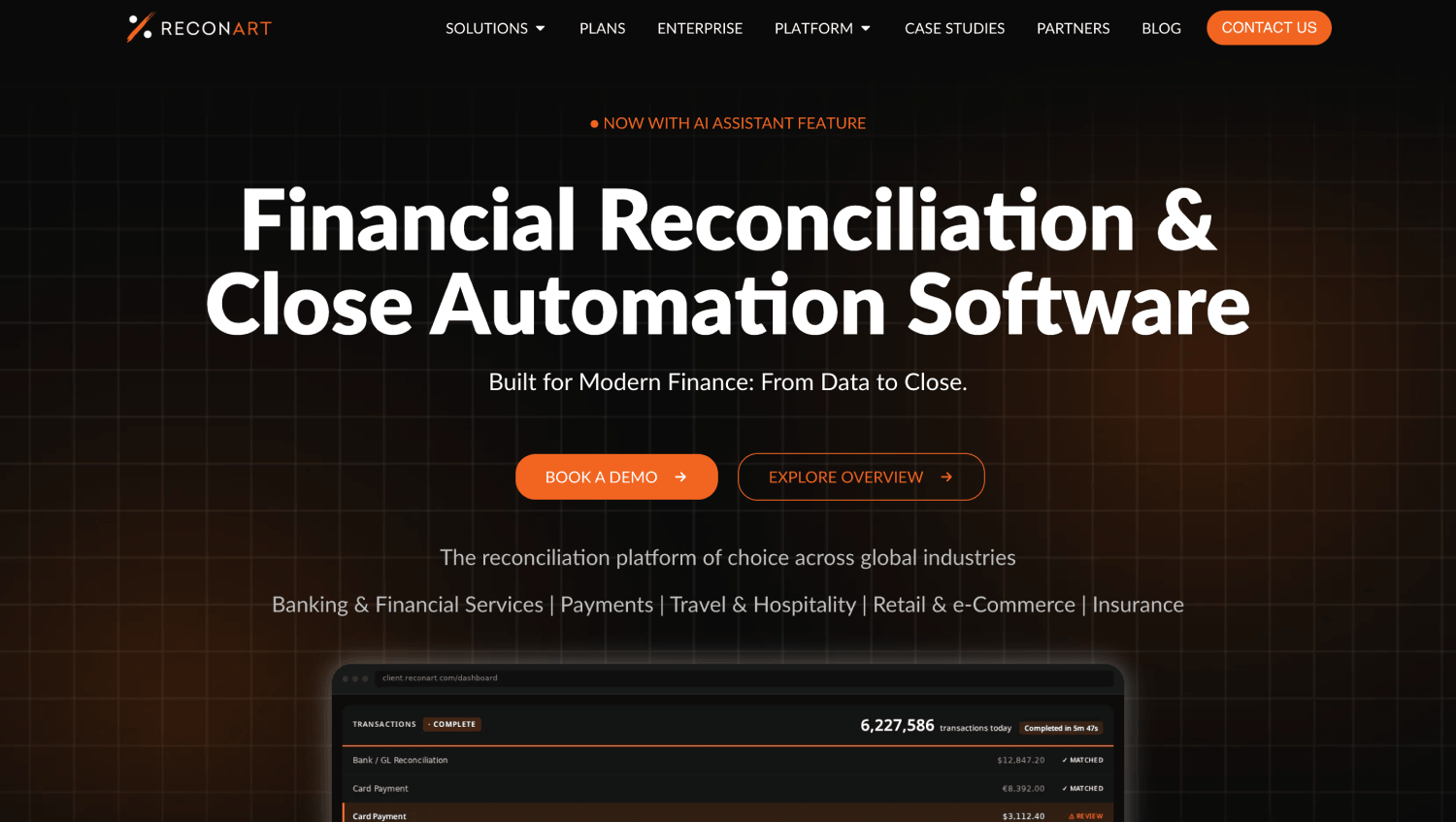
ReconArt is an enterprise-class, web-based reconciliation and financial close automation platform. It covers end-to-end automation of data reconciliation processes, from bank reconciliation and intercompany matching to payment reconciliation and balance sheet substantiation. The company positions itself as a solution for finance teams that want to own their reconciliation configuration without writing code or logging tickets with an IT department.
Its architecture is deliberately open. Finance users can build reconciliation workflows using a point-and-click interface, define matching rules, set tolerance thresholds, and route exceptions without vendor assistance. That matters in practice: at a Series B fintech with a three-person finance team, waiting three weeks for a vendor’s professional services team to adjust a matching rule is not viable.
ReconArt’s customer base skews toward mid-market companies and fintech operators in North America. It handles payment reconciliation across multiple payment service providers, bank statement matching, and intercompany balances. For teams processing high-volume payment transactions across Stripe, Adyen, or ACH rails, its ability to ingest flat files and structured data from multiple sources simultaneously is a practical strength. If you are evaluating the broader toolset around payment infrastructure, the comparison of payment infrastructure tools for SaaS founders gives useful context on where reconciliation fits in the stack.
What Is AutoRek and Who Actually Uses It?
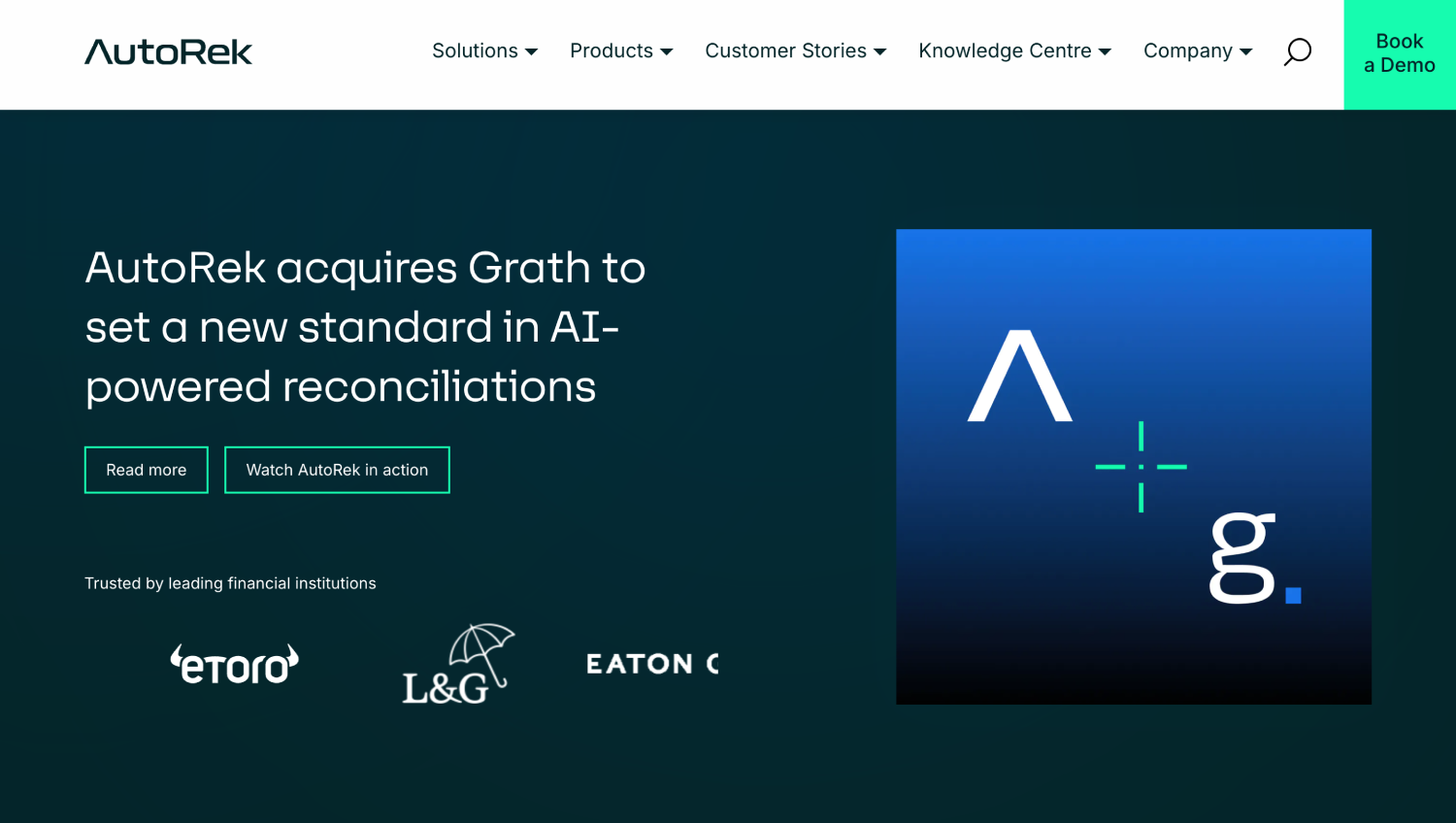
AutoRek is a financial controls and automated reconciliation platform with deep roots in UK financial services. AutoRek’s own positioning states the platform helps firms reduce back-office costs associated with reconciliations and financial controls, with a claimed ROI timeline of nine months or less, a figure that reflects their marketing positioning rather than an independently verified benchmark. It handles data matching, exception management, and financial reporting across high-volume transaction environments.
AutoRek’s historical strength is regulated financial institutions: banks, insurers, investment managers, and payment firms operating under FCA or PRA oversight. Its control framework is designed for environments where an auditor will scrutinize not just the output but the process. Segregation of duties, full audit trails on every configuration change, and pre-built report templates for regulatory submissions are built into the core product rather than bolted on.
AutoRek has been expanding into the US market, and it does have US customers in financial services. Its integration library includes connectors for custodian systems, settlement platforms, and legacy banking infrastructure that most SaaS-native fintechs will never touch. For a regulated institution migrating off spreadsheet-based reconciliation in a compliance-sensitive environment, that pre-built connector library shortens implementation substantially.
How Do ReconArt and AutoRek Handle Payment Reconciliation Specifically?
Payment reconciliation is a distinct use case from general ledger reconciliation or bank statement matching. It requires matching transaction-level data across multiple external parties, PSPs, card networks, bank settlement files, and internal records, often at high volume with same-day or next-day settlement windows. Both platforms support this, but they approach it differently.
ReconArt’s strength in payment reconciliation is its flexibility in ingesting data from diverse sources. A fintech processing payments across multiple acquirers or PSPs can configure matching rules for each feed independently. Tolerance controls, suspense account routing, and exception escalation paths are all user-configurable. The platform supports multi-currency reconciliation, which matters for any payment operation touching international rails.
AutoRek handles payment reconciliation with a stronger emphasis on automated controls verification. The platform is designed to confirm not just that amounts match, but that the controls surrounding the reconciliation process itself are documented and defensible. For a payments firm under FCA client money rules or operating under PSD2 obligations, that distinction is material. AutoRek’s platform identifies, investigates, and resolves discrepancies in financial records with features built around exception management and audit documentation rather than just match-rate optimization.
Integration and Implementation: Where the Real Costs Hide
Feature parity on a demo is not the same as implementation parity in production. The integration story is where these two platforms diverge most sharply, and where buyers most consistently underestimate total cost.
ReconArt’s integration model is built around data ingestion flexibility. The platform accepts flat files, SFTP feeds, direct database connections, and API-based imports. For a fintech running a modern SaaS stack, Stripe exports, NetSuite GL data, and bank statement files can be piped in without custom connector development. Finance teams with basic SQL or data operations skills can own this work themselves. That self-service posture reduces implementation time and dependency on vendor professional services.
AutoRek’s integration strength is the opposite: a library of pre-built connectors for the systems its core customer base already runs. If your environment includes Bloomberg, SWIFT messaging, custodian platforms, or legacy banking cores, AutoRek’s connectors reduce integration effort substantially compared to building from scratch. For a SaaS fintech that does not run any of those systems, those connectors provide zero value, and the integration work looks more similar to ReconArt’s than the marketing suggests.
Implementation timelines are not publicly disclosed by either vendor. Based on AutoRek’s public positioning around complexity and compliance depth, expect a longer scoping and deployment process than with ReconArt, particularly for regulated use cases. ReconArt’s web-based architecture and user-configurable design allows faster initial deployment for standard reconciliation types, though complex multi-entity or multi-currency setups will still require meaningful configuration work. The FintechSpecs vendor evaluation framework includes integration scoping as a first-tier check for exactly this reason.
What Does Each Platform Cost? Pricing Model and Contract Structure
Neither ReconArt nor AutoRek publishes pricing on their websites. Both require a discovery call and scoping process before any quote is generated, which is standard for enterprise reconciliation software but frustrating for buyers trying to run a realistic budget comparison before investing time in demos.
ReconArt’s pricing is structured around the scope of deployment: number of users, reconciliation types configured, and data volume. The company targets mid-market and enterprise customers, and its pricing reflects that positioning. There is no publicly available starter tier.
AutoRek’s pricing is similarly opaque. The platform targets larger regulated institutions, and its total cost of ownership includes not just licensing but implementation services, particularly for complex connector builds and compliance reporting setup. AutoRek’s stated nine-month ROI claim is vendor positioning, it implies a material upfront investment that pays back within a defined window, not a lightweight monthly SaaS fee, though the actual timeline will vary by deployment complexity.
For fintech finance teams evaluating either platform, the most practical approach is to run parallel RFP processes with both vendors simultaneously. That creates competitive pressure and surfaces accurate scoping estimates. Contract minimums and renewal terms are negotiable at both vendors; ask specifically about data export rights at contract end, since switching costs are a function not just of contract length but of how easily you can extract your historical reconciliation data if you move to another platform. This is a detail that surfaces in broader hidden costs in fintech SaaS margins that operators routinely miss until renewal time.
How Do Compliance Controls and Audit Readiness Compare?
This is the dimension where AutoRek has a genuine, structural advantage over ReconArt for regulated use cases. AutoRek’s control framework is built to satisfy requirements that originate in FCA supervision, not retrofitted onto a reconciliation engine designed for operational efficiency. That means segregation of duties enforcement at the system level, not just the policy level. It means every configuration change is logged with user, timestamp, and before/after state. It means exception resolution workflows are documented in a way that satisfies an auditor reviewing controls, not just a manager reviewing match rates.
ReconArt provides audit trail functionality and supports SOX compliance workflows. Its exception management and workflow routing tools allow finance teams to document their reconciliation process in a way that satisfies internal audit and external review. For a US-based fintech operating under SOX or internal financial controls requirements, ReconArt’s controls are generally adequate.
Where ReconArt falls short relative to AutoRek is in environments where the control framework itself is under regulatory scrutiny, not just the output. An FCA-regulated payment institution, an insurer under Solvency II, or a custodian with client money segregation obligations needs controls that are auditable at the process level. AutoRek was designed for exactly that environment. ReconArt was not.
For fintech teams earlier in their compliance maturity, the broader Fintech Product and Compliance Readiness Checklist is worth running through before selecting a reconciliation platform, since your compliance obligations directly determine which product’s control architecture you actually need.
US Coverage and Geographic Fit
ReconArt is US-headquartered and its product development reflects a North American customer base. Its integration patterns, support hours, and sales process are oriented toward US and Canadian buyers. For a fintech payment operation running on US banking rails, ACH, FedNow, or RTP, ReconArt’s data ingestion model handles those feed formats without needing specialized connector work.
AutoRek is UK-headquartered and its deepest customer density is in UK and European financial services. The company has US operations and US customers, but its product priorities and integration library reflect its UK origins. For a US payment operation that does not interact with UK or European settlement infrastructure, some of AutoRek’s specialized capabilities are irrelevant to the use case.
Geography matters for support, too. A US finance team running month-end close on Eastern Time benefits from vendor support that is actually available during those hours. ReconArt’s US base means support alignment is straightforward. AutoRek’s UK-centric team means US customers may face response time lags depending on contract tier and time zone overlap.
The FintechSpecs Reconciliation Selection Test
To cut through the feature-page similarity problem, FintechSpecs applies a four-question diagnostic we call the Reconciliation Selection Test. Run your team through these before requesting a demo from either vendor.
Question 1: Who owns configuration after go-live? If the answer is your finance team with no IT support, ReconArt’s self-service model is a better fit. If the answer is a dedicated operations or IT team, AutoRek’s deeper configuration tooling becomes manageable.
Question 2: Which regulator reviews your reconciliation controls? If the answer is the FCA, PRA, or a European prudential regulator, AutoRek’s control architecture is purpose-built for that scrutiny. If the answer is internal audit, SOX auditors, or no external regulator yet, ReconArt’s controls are sufficient.
Question 3: What systems generate your source data? If your data comes from modern SaaS platforms, PSPs, and bank feeds, ReconArt’s open ingestion model is more practical. If it comes from legacy banking cores, custodians, or settlement platforms with proprietary formats, AutoRek’s connector library saves significant integration time.
Question 4: What is your switching cost tolerance? Both platforms create meaningful data lock-in through historical reconciliation records and configured matching logic. AutoRek’s deeper institutional integration makes switching harder and more expensive. If you want optionality at contract renewal, ReconArt’s more modular architecture is the lower-friction choice.
Data Quality and Matching Logic: What Finance Teams Actually See
Match rate is the headline metric for any reconciliation platform, but it is also the most easily manipulated in a demo environment. What matters operationally is what happens to the exceptions: how they are surfaced, routed, investigated, and resolved, and how long that process takes.
ReconArt’s exception management workflow allows finance teams to configure escalation rules, assign exceptions to specific users, and track resolution status through a dashboard. The platform supports tolerance-based matching, partial matching, and one-to-many and many-to-one transaction matching, covering the common scenarios in payment reconciliation where settlement batches do not map neatly to individual transactions.
AutoRek’s exception management is similarly capable but adds an investigation layer designed for compliance documentation. Exceptions in AutoRek carry a resolution audit trail that records who reviewed the exception, what action was taken, and what supporting documentation was attached. For a regulated firm where exception resolution is itself a compliance event, that documentation layer has real value. For a fintech finance team whose primary concern is closing the books accurately and on time, it adds process overhead without proportional benefit.
Support Model and Vendor Stability
AutoRek has been operating for over 25 years and has an established customer base in UK financial services. That longevity is a reasonable proxy for platform stability, though it also means the product carries some legacy architecture decisions from an earlier era of financial technology. The company does not publicly disclose revenue or customer count figures.
ReconArt has been operating since 2007 and is a privately held company. Like AutoRek, it does not publish revenue or customer count data. Its public presence is primarily through its product website and third-party software review platforms, where it has accumulated customer feedback across various segments.
Support quality at both vendors is tiered by contract level, which is standard for enterprise software. What is not standard is whether you can get a live person during your close window. Before signing with either vendor, ask specifically: what is the SLA for critical issue response, what channel handles it (email versus phone versus dedicated CSM), and what has the actual response time been for customers at your contract tier. Get references from customers who have experienced a support incident during month-end close. That scenario is more revealing than any demo.
Frequently Asked Questions
What is ReconArt used for?
ReconArt is used for automated financial reconciliation across multiple data sources. Common use cases include bank reconciliation, payment reconciliation across PSPs and acquirers, intercompany matching, and balance sheet substantiation. It is designed as a web-based, self-configurable platform that finance teams can operate without ongoing IT support. Its primary market is mid-market companies and fintech payment operations in North America.
What is AutoRek used for?
AutoRek is used for automated reconciliation and financial controls in regulated financial services environments. It handles transaction matching, exception management, and regulatory reporting for firms operating under FCA, PRA, or similar oversight. It is particularly strong in capital markets, insurance, and payments regulation contexts where the control framework surrounding reconciliation is as important as the match results themselves. AutoRek positions its platform as targeting ROI within nine months of deployment, though that figure reflects their own stated positioning.
How does ReconArt vs AutoRek pricing compare?
Neither vendor publishes pricing publicly. Both require a scoping call before generating a quote. ReconArt pricing is structured around user count, reconciliation types, and data volume. AutoRek’s total cost of ownership typically includes licensing plus implementation services, which are more substantial for complex regulated deployments. Running a parallel RFP with both vendors is the only reliable way to generate comparable cost estimates for your specific use case.
Which reconciliation platform is easier to implement?
ReconArt is generally faster to implement for standard reconciliation use cases because its user-configurable design reduces dependency on vendor professional services. Finance teams with data operations skills can own setup for common scenarios. AutoRek’s implementation is typically more involved, particularly for customers using its pre-built connectors for legacy financial systems. AutoRek’s complexity is a feature rather than a bug for regulated institutions where configuration must itself be auditable.
Which is better for payment reconciliation specifically?
For fintech payment operations running on modern SaaS infrastructure, Stripe, Adyen, ACH, or similar rails, ReconArt is the more practical choice. Its open data ingestion model handles diverse PSP feed formats without specialized connector work, and its self-service configuration allows finance teams to adjust matching rules as payment flows change. AutoRek is better suited to payment firms operating under regulatory obligations where the reconciliation control framework is subject to direct regulatory review.
Does AutoRek work for US-based companies?
AutoRek does serve US customers and has US operations. Its product and integration library, however, reflects its UK financial services origins. US companies in capital markets, insurance, or payments that interact with UK or European infrastructure will find AutoRek’s connectors and compliance templates more relevant. US fintechs running a domestic SaaS stack will find fewer pre-built integrations and may face support time zone friction compared to working with a US-headquartered vendor.
What are the switching costs for either platform?
Switching costs for both platforms are meaningful. Historical reconciliation records, configured matching logic, exception resolution documentation, and workflow configurations all create migration complexity. AutoRek’s deeper integration with institutional back-office systems tends to create higher switching costs than ReconArt’s more modular architecture. Before signing either contract, negotiate explicit data export rights and confirm the format in which historical data can be extracted. That single clause determines whether switching is a three-week project or a six-month one.
Which reconciliation platform is better for a Series B fintech?
ReconArt is the better starting point for most Series B fintechs. Its self-service configuration model fits lean finance teams, its integration approach handles modern SaaS data sources, and its US-centric support model aligns with domestic operations. AutoRek is overbuilt for early-stage fintech environments unless the company is already operating under FCA or equivalent regulatory supervision and needs auditor-ready control documentation from day one.
What Should You Actually Do After This Comparison?
The vendors look interchangeable on paper because their marketing teams are describing similar outcomes rather than different architectures. The architecture difference is real: ReconArt is built around configurability and finance-team ownership; AutoRek is built around compliance-grade control documentation. Those are not the same product with different branding.
Run the Reconciliation Selection Test above before requesting any demo. Your answers to those four questions will make the shortlist obvious. If your regulatory environment and data infrastructure point clearly toward one vendor, go deep on that one first rather than investing equal time in both. If the answers genuinely split, run a parallel RFP and use the competitive dynamic to get real pricing from both sides.
For fintech teams building toward scale, reconciliation platform selection is an infrastructure decision with a three-to-five year time horizon, not a quarterly software subscription. The platform you pick will shape your close process, your audit posture, and your ability to add new payment data sources as your operation grows. The right choice is the one that fits where you are now and where your regulatory obligations are heading, not the one with the more impressive demo environment. Teams tracking broader financial operations tooling will find the payment reconciliation software comparison for fintech finance teams useful for context on how both platforms fit into the wider category.