
- Kyriba’s pricing and multi-year contract structure make it a poor fit for Series A to Series C companies that need treasury infrastructure without a six-figure annual commitment.
- Several credible alternatives cover 80 to 100 percent of Kyriba’s core functionality at a fraction of the cost, and some outperform it on API connectivity, real-time cash visibility, and bank integration breadth.
- The right replacement depends on four factors: company size, multi-entity complexity, ERP integration requirements, and how much of treasury you want to automate versus configure manually.
- Migration risk is real but manageable. The biggest risk is not switching platforms; it is switching without auditing your bank connectivity and data mapping first.
- One platform in this list is a paid featured partner. It is labeled as such. The editorial scoring for all ten platforms is independent.
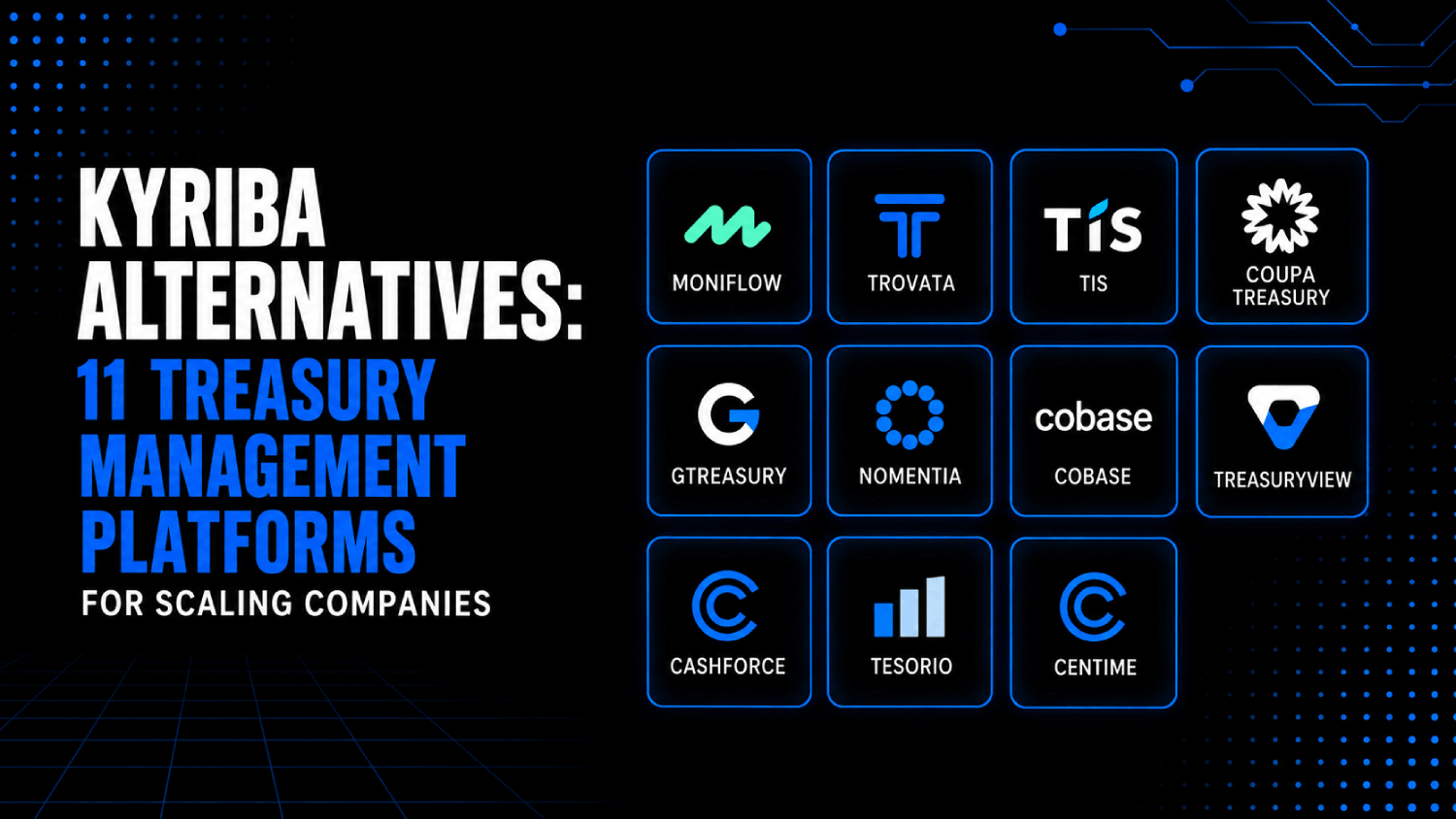
The most credible Kyriba alternatives for scaling companies are Trovata, TIS (Treasury Intelligence Solutions), Coupa Treasury, GTreasury, Nomentia, Cobase, TreasuryView, Cashforce, Tesorio, and Centime. Each solves a different version of the treasury problem. Trovata leads on API-first bank connectivity; TIS leads on global payment execution; GTreasury and Coupa suit companies managing complex entities and FX exposure; Nomentia and Cobase serve mid-market European and North American companies with lighter IT overhead.
Why Do Companies Actually Leave Kyriba?
Kyriba is the default recommendation in most enterprise treasury RFPs because it has deep functionality, a large customer base, and a well-known brand. The problem is that “enterprise” is doing a lot of work in that sentence. Kyriba is designed for large corporations with dedicated treasury teams, and its contract structure, implementation timeline, and pricing reflect that.
The complaints that show up consistently from buyers who have left or are evaluating replacements fall into three categories. First, implementation takes longer than sold. A six to twelve month deployment timeline is common, and consulting fees often exceed the software license cost in year one. Second, the pricing model is opaque. Kyriba does not publish pricing, and buyers frequently report that the total cost of ownership is significantly higher than the initial quote once modules, bank connections, and user seats are added. Third, the platform is over-engineered for companies that do not need every feature. A Series B fintech with twenty bank accounts does not need the same treasury infrastructure as a Fortune 500 with four hundred.
None of this means Kyriba is bad software. For a large enterprise treasury team that needs SWIFT connectivity, multi-bank payment factories, and complex FX hedging workflows all in one platform, it is genuinely competitive. The issue is that most companies evaluating it are not that company, and the alternatives have gotten good enough that the gap has closed considerably.
The FintechSpecs Treasury Stack Audit: Four Checks Before You Switch
Before evaluating any Kyriba alternative, run what we call the FintechSpecs Treasury Stack Audit. This is a four-point internal check designed to identify where your current system is actually failing versus where your team is frustrated with workflow. Switching platforms without this audit is how companies end up rebuilding the same problems on a new contract.
Bank connectivity audit: List every bank account your treasury team touches, including foreign subsidiaries. Count how many connect via direct API, how many via SFTP/BAI2 file transfer, and how many are manual. Any alternative must match or beat your current connection count on day one.
Data ownership check: Who owns your historical transaction data, cash position history, and forecasting models? Some vendors make data export painful. Confirm your contractual right to a full data export before you give notice.
ERP dependency map: Document every integration between your TMS and your ERP (SAP, Oracle, NetSuite, Microsoft Dynamics). ERP integrations are where migrations break. A new platform that cannot replicate your AP/AR sync will create a manual reconciliation burden that costs more than the software savings.
Compliance and audit trail check: If you are in a regulated industry, confirm that any alternative produces the same audit trails and reporting outputs your auditors expect. Changing formats mid-year creates unnecessary friction with external auditors.
Only after completing this audit should you map your requirements to the platforms below. Readers building out their broader fintech infrastructure stack can also review the complete fintech infrastructure stack map for context on where treasury fits relative to payment rails, data layers, and compliance tooling.
How Do the Ten Alternatives Compare?
| Platform | Best For | Pricing Model | Migration Risk | ERP Integration | API-First? |
|---|---|---|---|---|---|
| Moniflow | Mid market groups paying across Portugal, Angola, Brazil and China corridors | Published: platform fee, one time setup, share of verified savings | Low (read only Scan first, banks connected fresh) | PRIMAVERA, SAP Business One, TOTVS | Partial (bank APIs plus host to host, SFTP, SWIFT; MCP tools) |
| Trovata | Series A to C, API-native cash visibility | SaaS subscription, not publicly disclosed | Low | NetSuite, SAP, Workday, Oracle | Yes |
| TIS | Global payment execution, multi-bank | Not publicly disclosed | Medium | SAP, Oracle, Microsoft Dynamics | Partial |
| Coupa Treasury | Mid-market to enterprise, FX exposure | Not publicly disclosed | Medium to High | Coupa BSM suite, SAP, Oracle | Partial |
| GTreasury | Multi-entity, debt/investment mgmt | Not publicly disclosed | Medium | SAP, Oracle, NetSuite | Partial |
| Nomentia | European-heavy, mid-market, payments | Not publicly disclosed | Low to Medium | SAP, Microsoft Dynamics | Partial |
| Cobase | Multi-bank connectivity, lean teams | Not publicly disclosed | Low | Limited native; API connectors available | Yes |
| TreasuryView | SMB to mid-market, fast deployment | Not publicly disclosed | Low | NetSuite, Xero, QuickBooks | Yes |
| Cashforce | Cash forecasting accuracy, FP&A alignment | Not publicly disclosed | Low | SAP, Oracle, Microsoft Dynamics | Partial |
| Tesorio | AR-driven cash forecasting, SaaS companies | Not publicly disclosed | Low | NetSuite, Salesforce, QuickBooks | Yes |
| Centime | Small to mid-market, cash flow + credit | Not publicly disclosed | Low | QuickBooks, NetSuite | Yes |
None of the platforms above publicly disclose pricing. All quotes require a demo and discovery call. This is standard in enterprise and mid-market treasury software. Any vendor that gives you an instant online quote is likely selling you a lighter-weight tool than you need.
Which Kyriba Alternative Is Best for API-First Companies?
Moniflow
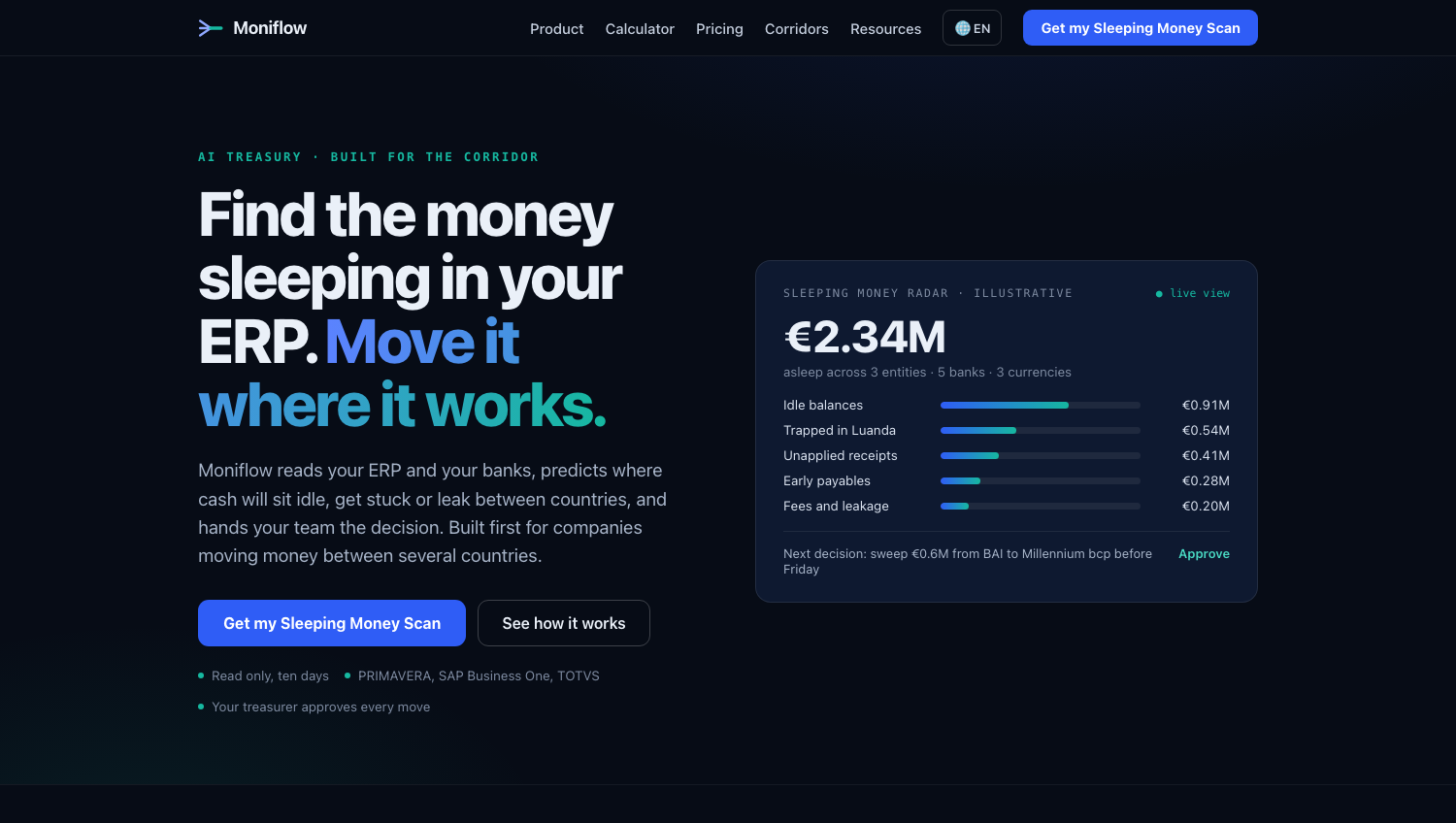
Moniflow is an AI treasury management system for mid market groups whose money crosses
borders, built first for corridors where regulator paperwork decides when money moves: Portugal and Angola, China and Europe, Europe and Brazil, Angola and China. It reads the ERP (PRIMAVERA, SAP Business One or TOTVS) and every bank the group runs, over bank APIs, host to host, SFTP and SWIFT, from more than 200 bank sources, reconciles statements automatically and builds one live cash position by entity, bank, currency and country. Payment runs leave the ERP with the documentation each regulator expects: BNA rules in Angola, CIPS and SAFE for China, BCB exchange contracts for Brazil. A person approves every payment.
Moniflow Super Flow Treasury runs six capabilities on the same data, permissions and audit trail: analytics you can question in plain language, an independent AI forecast that sits next to your own so you see where the numbers disagree, AI agents that answer from permission scoped live data while the maths stays in deterministic services, multilateral intercompany netting, hedge accounting for FX and interest rate cash flow hedges under IFRS or local GAAP, and scenario analysis that keeps guarantees in view.
Where it is not the right fit: groups on NetSuite, Oracle or Workday, since Moniflow reads
PRIMAVERA, SAP Business One and TOTVS today, and buyers who need a long reference list, since it is in early access with a founding customer cohort.
Migration risk is low. Banks are connected fresh, onboarding runs in weeks, and the first step is a free, ten day, read only Sleeping Money Scan that measures idle, trapped and leaking cash on the group’s own ERP and bank data. Unlike the other platforms here, the pricing model is published: a monthly platform fee, a one time setup and a share of verified savings that starts only once savings cover the fee and falls from 20 to 15 to 10 percent.
Trovata
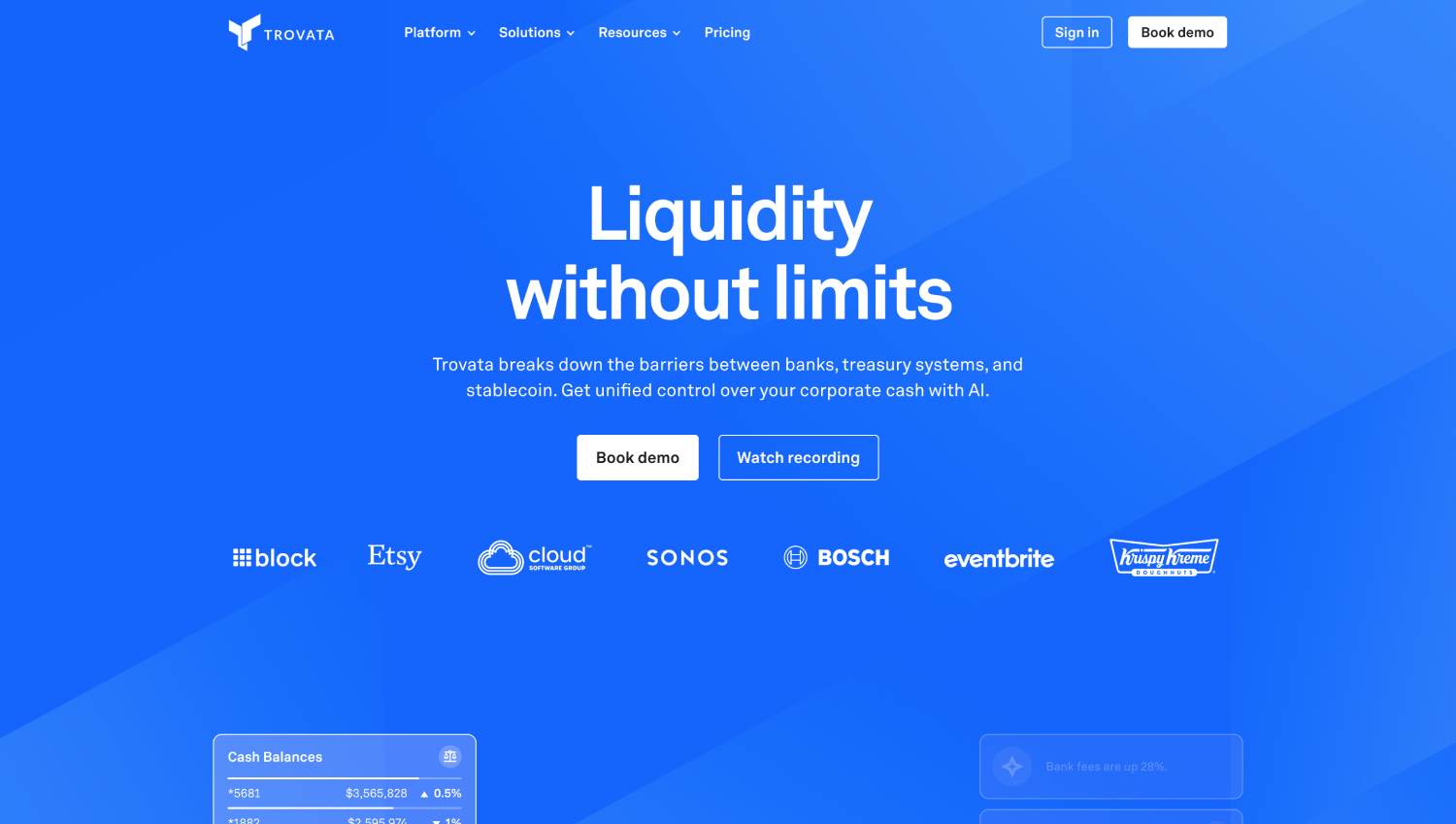
Trovata is the cleanest answer for companies that want real-time cash visibility without the implementation overhead of a traditional TMS. The platform connects directly to bank APIs across major US and international banks, pulling transaction data automatically rather than relying on SFTP file transfers or manual BAI2 imports. For a treasury team of two to five people managing twenty to a hundred bank accounts, that connectivity difference is the entire argument.
Trovata’s cash forecasting uses historical transaction data to generate forward-looking cash positions, which is useful but not a substitute for driver-based FX hedging models. If your treasury mandate includes managing significant foreign exchange exposure or issuing commercial paper, Trovata is not the right fit. If your mandate is accurate daily cash visibility and fast bank reconciliation, it outperforms Kyriba for teams in that range on both speed to value and total cost.
Migration risk is low. Because Trovata connects via bank APIs rather than requiring a complex data migration from a legacy TMS, the main setup task is authorizing bank connections and configuring your cash categories. Most implementations complete in weeks, not months.
TreasuryView

TreasuryView is worth examining for companies at the lower end of mid-market that need a recognizable TMS feature set without an enterprise contract. The platform covers cash positioning, payment management, and basic FX tracking, and it integrates with cloud ERPs including NetSuite, Xero, and QuickBooks. Implementation is faster than most TMS vendors, which matters if your team does not have a dedicated treasury systems analyst.
The trade-off is depth. TreasuryView does not match Kyriba or GTreasury on complex debt management, multi-currency netting, or SWIFT integration. For a company with straightforward treasury needs, that gap is irrelevant. For a company with cross-border payment complexity or structured finance requirements, it is a dealbreaker.
Which Alternative Handles Global Payment Execution Best?
TIS (Treasury Intelligence Solutions)
TIS is the strongest Kyriba competitor for companies whose primary treasury pain point is multi-bank payment execution across geographies. TIS’s published materials cite connections to over 11,000 banks globally, though this figure could not be independently verified from a third-party source. The platform handles SEPA, SWIFT, and domestic payment rails, and includes payment status tracking and bank fee analysis. For a company running payment factories or managing subsidiaries across five or more countries, TIS is a direct substitute for Kyriba’s payment hub functionality.
Where TIS loses ground is on the cash forecasting and investment management side. It is fundamentally a payment and bank connectivity platform, not a full treasury workstation. Companies that need both payment execution and sophisticated forecasting often end up using TIS alongside a separate forecasting tool, which adds integration complexity. Whether that modular approach beats Kyriba’s all-in-one model depends on your team’s tolerance for operating multiple point solutions.
Migration risk is medium. The bank connectivity setup requires dedicated IT resources. Plan for a two to four month implementation if you are migrating from Kyriba’s payment workflows.
Nomentia
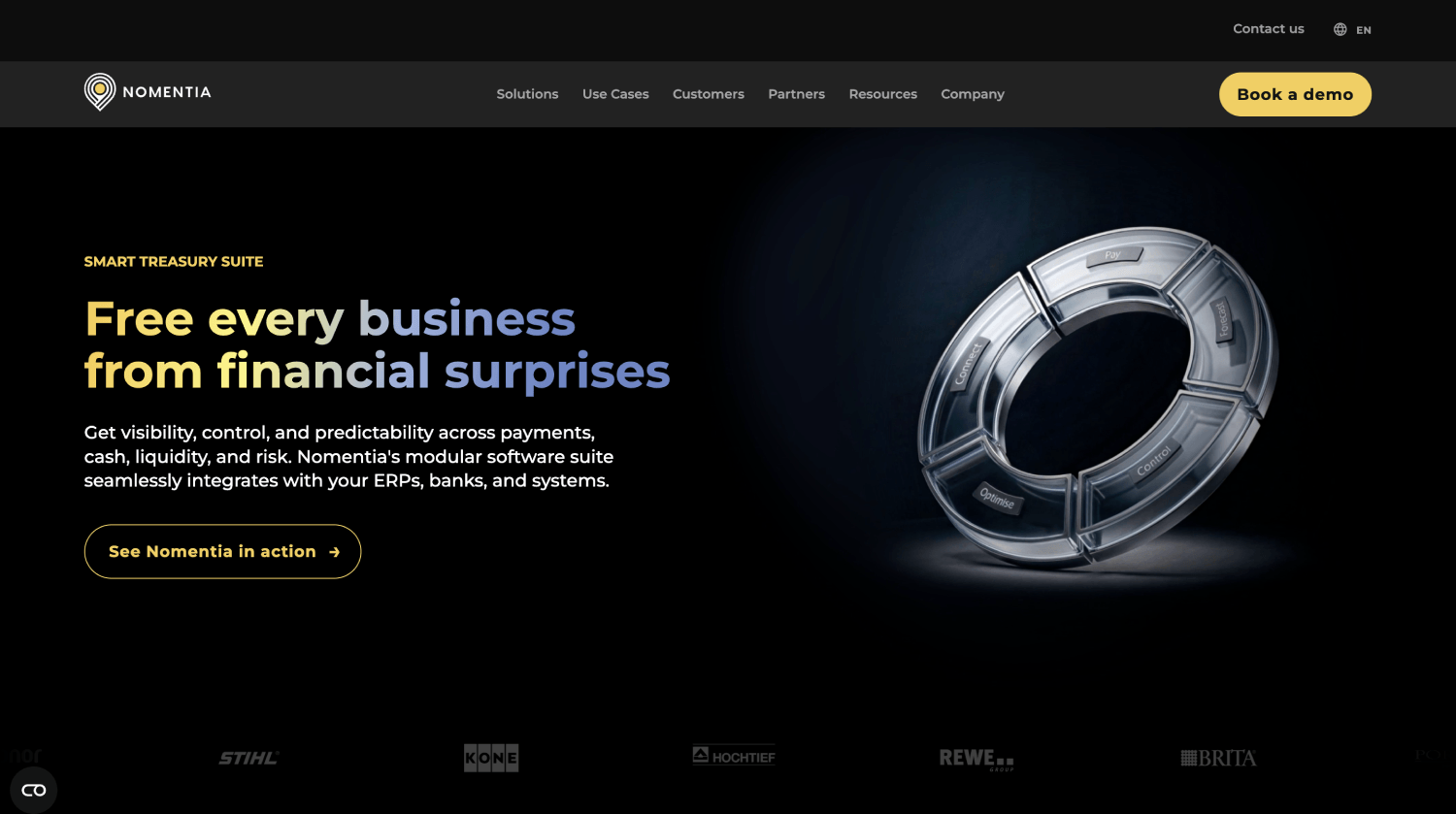
Nomentia covers payment management, cash management, bank connectivity, and basic FX hedging in a platform that is particularly strong for companies with European banking relationships. The vendor is frequently cited alongside TIS and Cobase as a mid-market alternative to Kyriba for companies that find Kyriba’s complexity excessive. Nomentia’s implementation is generally faster than Kyriba’s, and the pricing structure is more predictable for companies that cannot absorb the open-ended consulting fees that enterprise TMS implementations often carry.
Which Alternative Is Best for Companies with Complex Entities or FX Exposure?
GTreasury
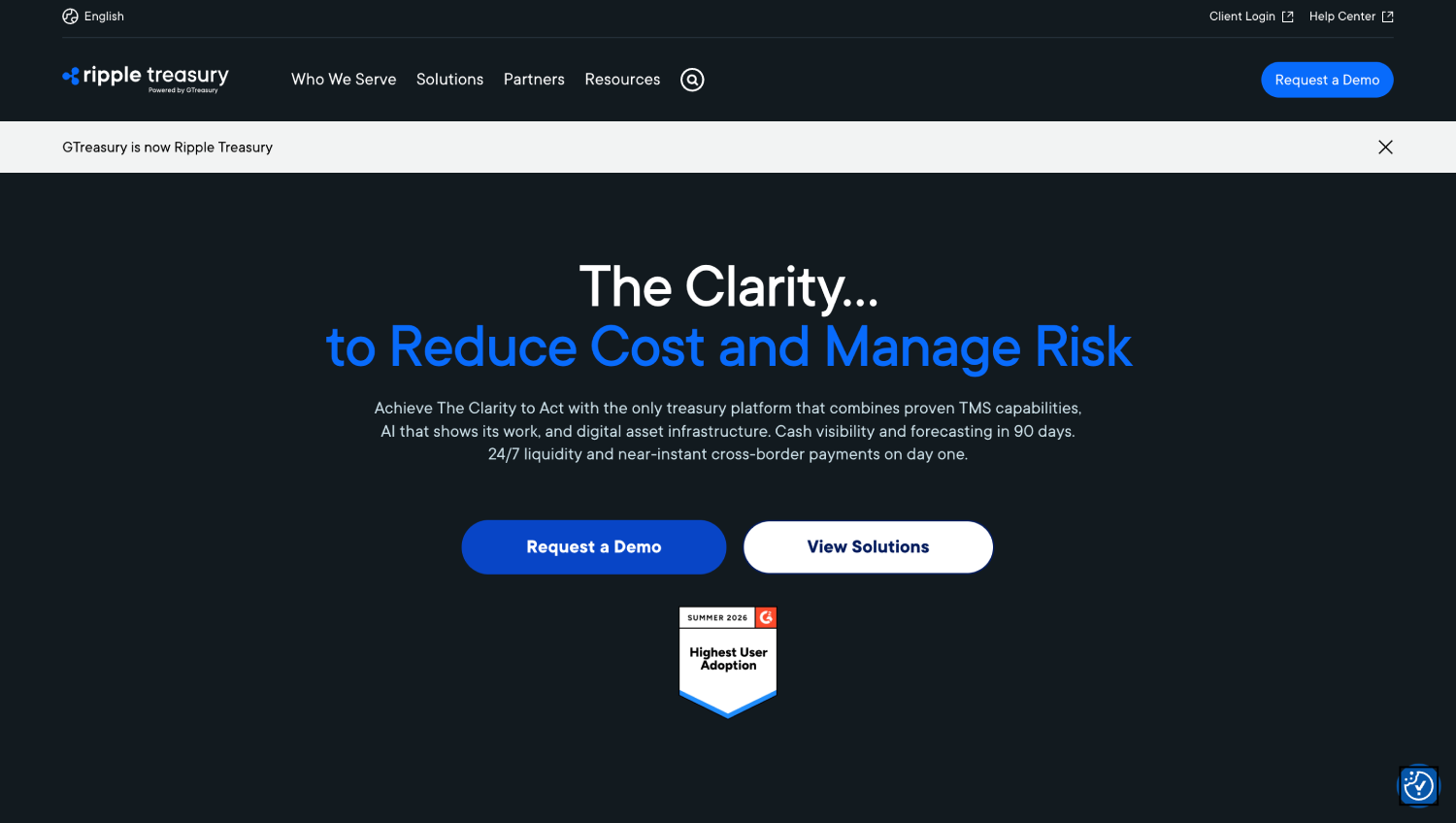
GTreasury , now operating as Ripple Treasury, Powered by GTreasury , is the alternative most similar to Kyriba in functional breadth. The platform covers cash and liquidity management, debt and investment management, FX risk management, and payment processing. It has also positioned digital asset infrastructure as a core differentiator: the official product page highlights an enterprise digital wallet, stablecoin integration, and related capabilities that are not present in traditional TMS platforms. That makes it a genuine full-replacement candidate for companies that have outgrown lighter tools and need the depth of a traditional TMS, and a potentially differentiated option for treasury teams with digital asset exposure or stablecoin treasury requirements.
GTreasury is frequently recommended for mid-to-large companies managing complex capital structures, intercompany lending, or structured debt portfolios. It is not the right entry point for a Series B company with basic cash management needs; the platform has enough depth that you will pay for capabilities you will not use for years.
Migration risk is medium. GTreasury has standard connectors for SAP and Oracle, but migrating debt and investment schedules from Kyriba requires careful data mapping and should be treated as a mini-project with dedicated finance and IT resources.
Coupa Treasury (formerly Bellin)

Coupa Treasury, built on the acquired Bellin platform, is the strongest choice for companies already using Coupa’s broader business spend management suite. The native data flow between Coupa’s AP, procurement, and treasury modules eliminates integration work that every other alternative requires you to build separately. Outside the Coupa platform, the value proposition weakens, because the integration advantages disappear and the platform competes as a standalone TMS against GTreasury and Kyriba directly.
Migration risk is medium to high, primarily because Coupa Treasury implementations tend to follow the broader Coupa BSM deployment timeline, which can extend the project significantly if you are not already a Coupa customer. If you are, this is likely your best path.
Which Alternatives Work Best for Lean Finance Teams?
Cobase
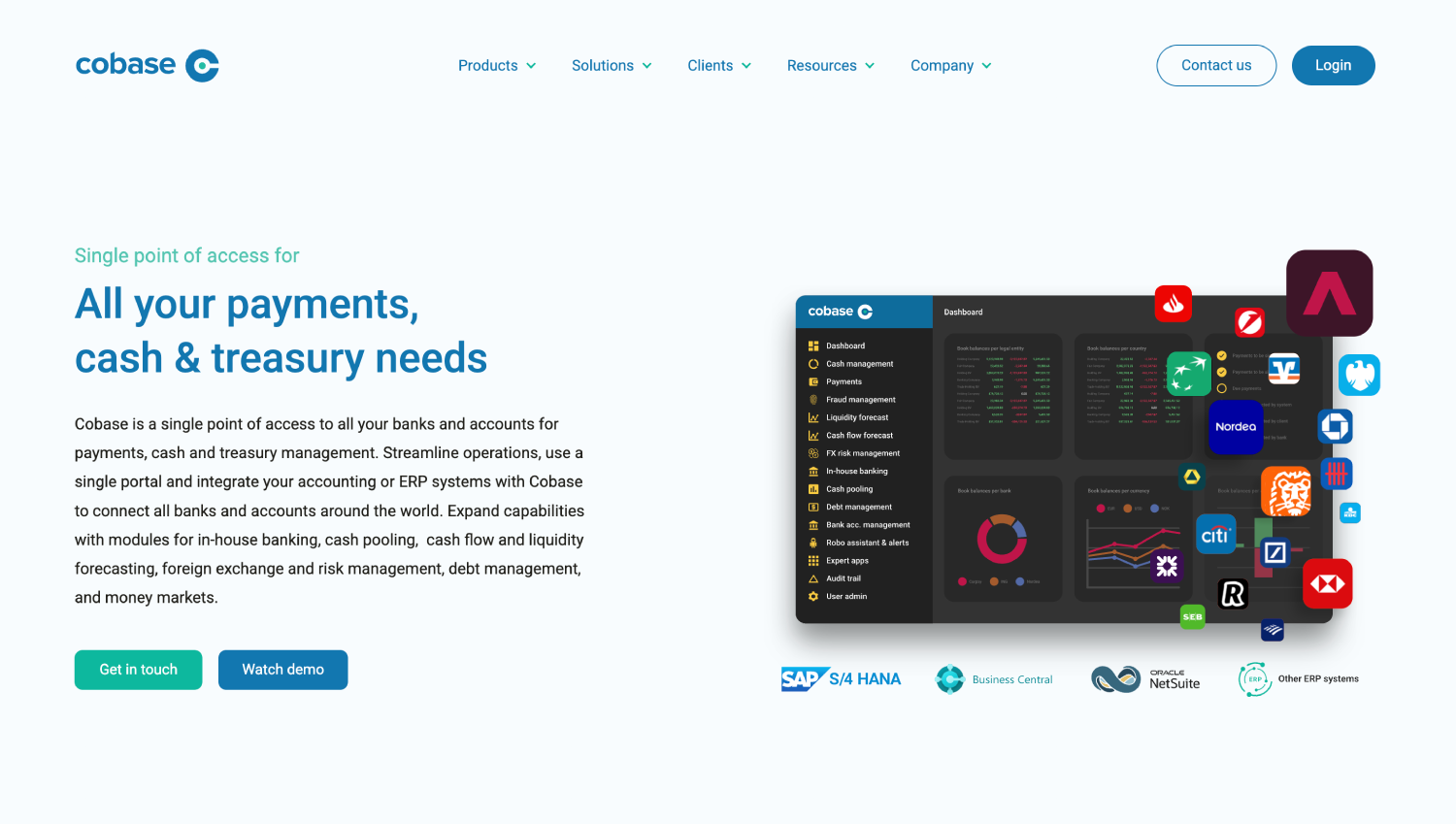
Cobase is designed for companies that need multi-bank connectivity and payment management without the configuration overhead of a full TMS. The platform aggregates banking relationships across banks, provides a single payment portal, and delivers cash visibility without requiring a six-month implementation. For a fintech or scaling SaaS company with a small finance team, Cobase solves the most common treasury frustration (scattered bank access and manual cash consolidation) without over-engineering the solution.
Cobase does not offer the FX risk management, debt management, or complex forecasting modules that Kyriba provides. That is a deliberate scope decision, not a gap. If your treasury team’s daily work is consolidating positions and processing payments across multiple banks, Cobase is fast to deploy and operationally lighter than any of the full-TMS alternatives. Teams evaluating their broader payment tooling alongside treasury consolidation may also want to review the best payment infrastructure tools for SaaS founders for adjacent decisions.
Centime
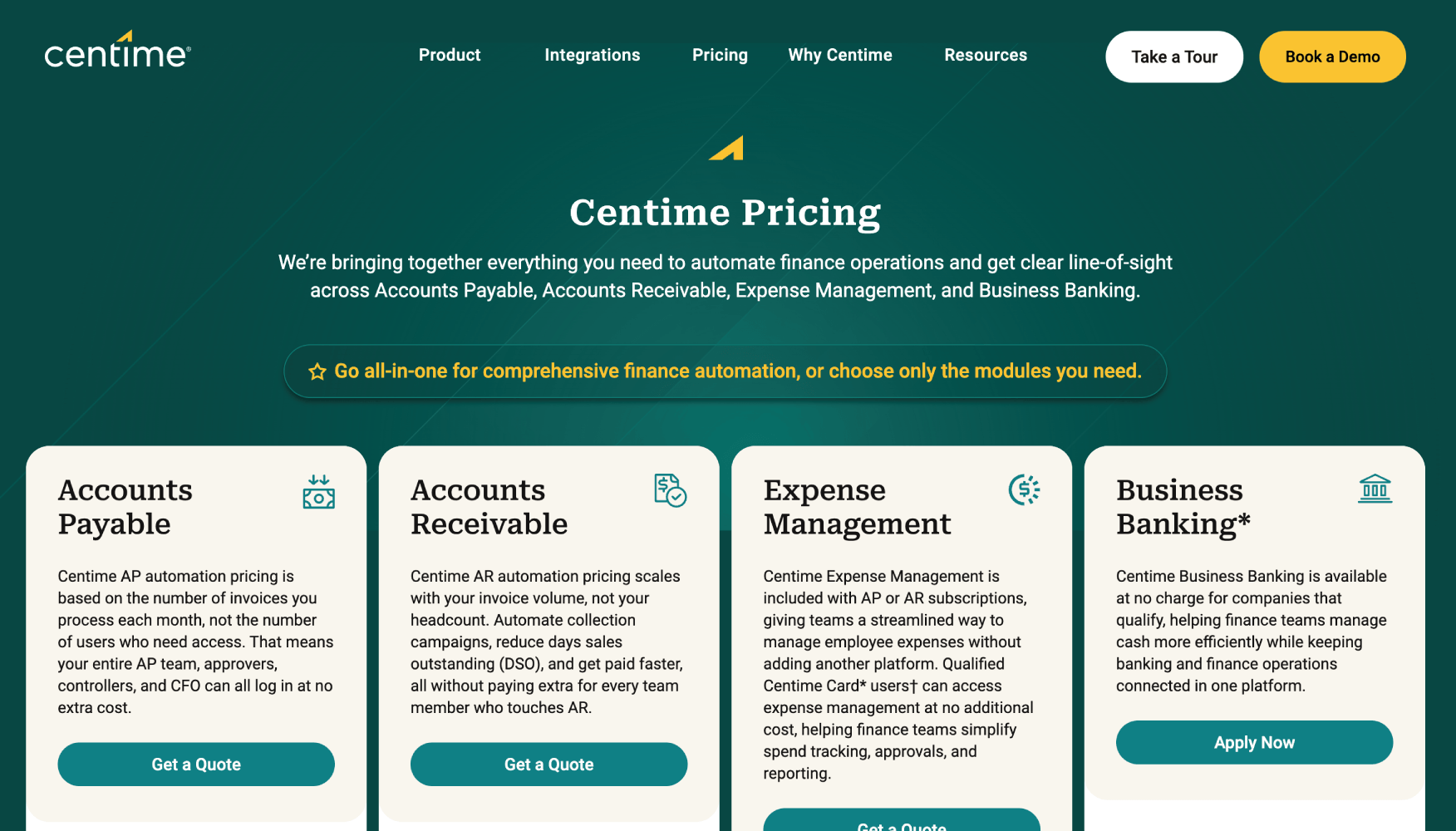
Centime is the most accessible entry point on this list, targeting small to mid-market companies that need cash flow visibility, AP/AR integration, and access to credit lines in a single platform. It is not a TMS in the traditional sense; it does not handle SWIFT payments, debt management, or FX hedging. It is a cash management platform with a credit component, which is exactly what a $5 million to $50 million revenue company often needs before formal treasury management becomes necessary.
Migration risk is low because Centime is typically an addition to or replacement for spreadsheet-based cash management, not a migration from a mature TMS. If you are currently on Kyriba and running at scale, Centime is not a lateral move; it is a step down in capability. If you are on Kyriba because someone recommended it and you are using 20 percent of its features, Centime might be exactly the right scope reduction.
Which Alternative Is Best for Cash Forecasting Accuracy?
Cashforce
Cashforce is built around a specific problem: improving the accuracy and granularity of cash forecasting by pulling data from ERP systems at the transaction level rather than relying on aggregated ledger summaries. The platform integrates deeply with SAP, Oracle, and Microsoft Dynamics, and it is designed to bridge the gap between the FP&A team’s forecast models and the treasury team’s actual cash positions. For companies where the treasury forecast and the FP&A forecast tell different stories every month, Cashforce directly addresses the data quality issue rather than layering more forecasting logic on top of bad inputs.
Cashforce does not replace a full TMS. It is most commonly deployed alongside an ERP or a lighter treasury tool rather than as a standalone treasury management system. That positioning makes it complementary to several platforms on this list rather than a direct Kyriba replacement on its own.
Tesorio
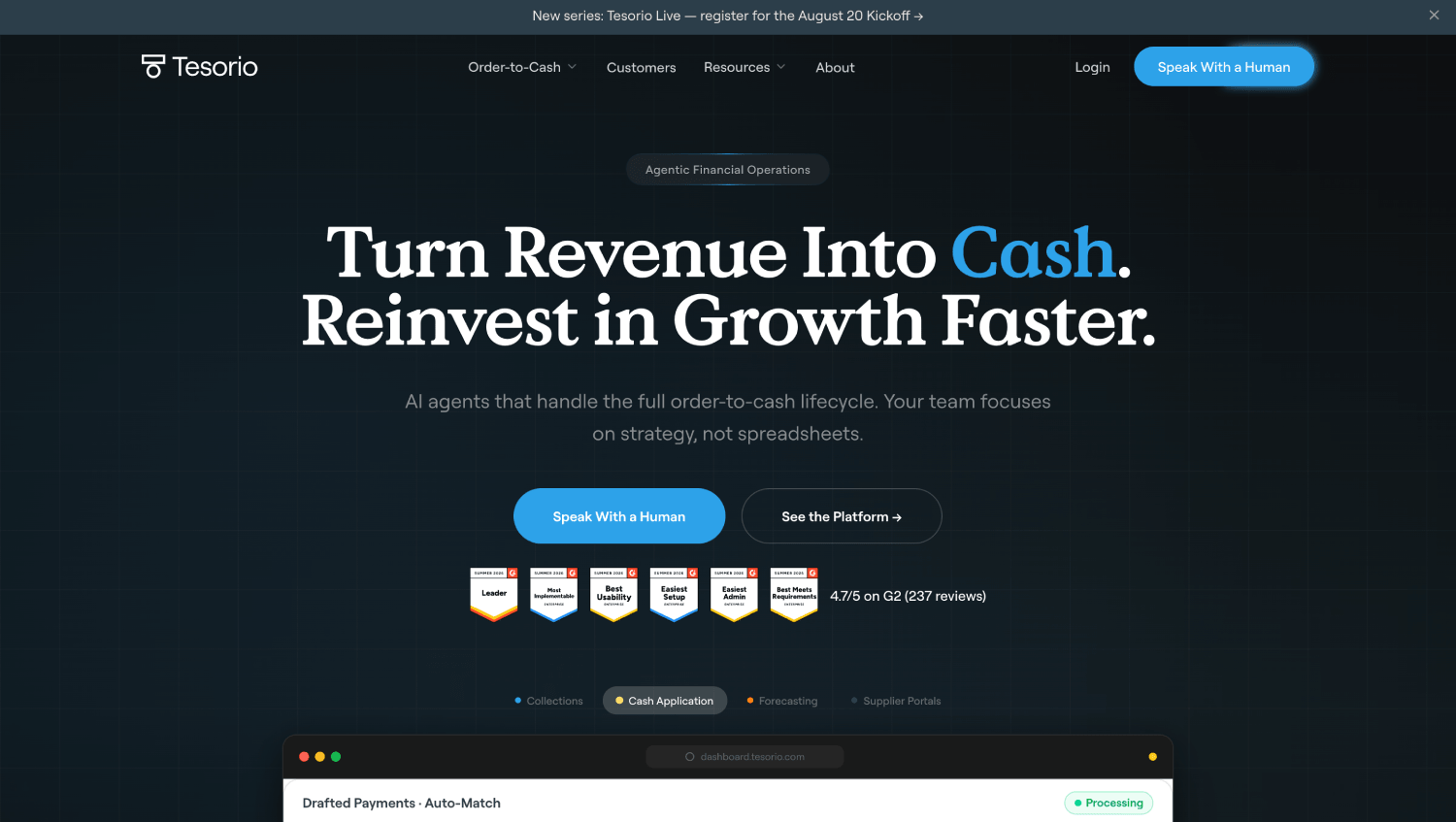
Tesorio approaches cash forecasting from the AR side, which makes it unusual on this list. The platform uses machine learning to predict when outstanding invoices will actually be paid, improving cash flow forecast accuracy for companies where AR timing is the primary driver of cash position uncertainty. For SaaS companies with annual or quarterly billing cycles, Tesorio’s AR-led forecasting is often more accurate than traditional transaction-history-based models because it accounts for customer payment behavior patterns.
Tesorio integrates with NetSuite, Salesforce, and QuickBooks, which aligns it with the ERP stack of most Series B and Series C SaaS companies. Like Cashforce, it is not a full TMS replacement for companies with complex payment or FX needs. It is a precision instrument for one part of the treasury problem. Companies tracking the fintech metrics that actually drive business outcomes will recognize DSO reduction and AR forecast variance as the KPIs Tesorio directly moves.
⭐ Featured Partner: GTreasury
GTreasury is a paid featured partner of FintechSpecs. The editorial assessment above was written independently. The expanded profile below reflects additional context provided by GTreasury and is labeled as sponsored content.
GTreasury , now operating as Ripple Treasury, Powered by GTreasury , serves treasury teams that have moved past spreadsheets and lighter cash management tools and need a platform that grows with them through Series C and beyond. The platform covers the full treasury workstation: cash and liquidity management, FX risk, debt and investment management, and bank connectivity across hundreds of banking relationships globally. GTreasury also emphasizes digital asset infrastructure as a differentiator, including an enterprise digital wallet and stablecoin integration capabilities featured prominently on its product pages , a meaningful distinction for treasury teams with digital asset exposure that most traditional TMS vendors do not address.
GTreasury’s approach to implementation is notably different from Kyriba’s. Rather than a monolithic deployment that requires every module to go live simultaneously, GTreasury reports that its phased rollout model lets treasury teams get core cash visibility running within ninety days, with FX or debt modules added on a second-phase timeline. For companies that have been burned by long TMS implementations before, this sequencing reduces the risk of a failed cutover.
The platform integrates natively with SAP, Oracle, and NetSuite, and GTreasury maintains a dedicated implementation and customer success function rather than routing all post-sale support through a consulting partner. Pricing is not publicly disclosed and requires a discovery call, but GTreasury is generally positioned below Kyriba’s price point for comparable functionality at mid-market scale. Teams considering GTreasury should request a sandbox environment and run the FintechSpecs Treasury Stack Audit against their current bank connections before signing.
How Do You Evaluate Migration Risk Before Switching?
The FintechSpecs Treasury Stack Audit above identifies what to check. Here is how to weight the risks by platform type.
API-native platforms (Trovata, Cobase, TreasuryView) carry the lowest migration risk because they connect to your existing bank accounts fresh rather than requiring a data migration from your old TMS. The main risk is bank connectivity gaps if you have relationships with smaller regional banks or international banks that the new platform does not yet support directly.
Full TMS replacements (GTreasury, Coupa Treasury, TIS) carry medium to high migration risk depending on how much structured data lives in Kyriba: debt schedules, investment portfolios, FX trade histories, and bank fee analyses all require careful export, transformation, and re-import. Budget one to two FTEs of finance and IT time for six to ten weeks regardless of what the vendor’s implementation timeline says.
Forecasting-layer tools (Cashforce, Tesorio, Centime) carry low migration risk because they are additive rather than replacement. The risk is integration quality with your ERP, not a data migration from Kyriba. Reviewing a structured fintech vendor evaluation framework before signing any new contract will surface contract, data portability, and SLA gaps that matter regardless of platform type.
What Does Kyriba Actually Cost, and How Does It Compare?
Kyriba does not publish pricing. Based on publicly available buyer community discussions and RFP data shared in treasury forums, Kyriba contracts for mid-market companies typically start in the six-figure annual range and increase significantly with additional modules (FX risk, in-house banking, payment factory) and bank connections. Implementation costs through Kyriba’s consulting partners often add 50 to 100 percent of the first-year license cost before the platform is fully live.
None of the alternatives on this list publish pricing either. The honest benchmark is that API-native platforms like Trovata and TreasuryView tend to come in below Kyriba for equivalent bank connection counts, while full TMS platforms like GTreasury and Coupa Treasury compete in a similar range. The real cost advantage of most alternatives is implementation time: a platform that deploys in eight weeks instead of eight months saves two quarters of parallel-running costs and finance team distraction.
For companies tracking where treasury tooling fits within the larger picture of fintech infrastructure costs, the hidden costs that compress fintech SaaS margins covers adjacent cost centers that often surprise finance teams at the same growth stage.
Frequently Asked Questions
How much does Kyriba cost?
Kyriba does not publish pricing. Contracts for mid-market companies are generally in the six-figure annual range based on publicly available buyer discussions, with implementation costs through certified consulting partners adding substantially to year-one total cost. The exact figure depends on the number of modules, bank connections, users, and entities. Any vendor that quotes you a Kyriba price without a full discovery process is estimating, not quoting.
Which companies use Kyriba?
Kyriba’s customer base skews toward large enterprises and multinational corporations with complex treasury operations, dedicated treasury teams, and significant FX or debt management requirements. Mid-market companies use Kyriba but frequently report that the platform’s depth exceeds their operational needs and their team’s capacity to configure and maintain it. Kyriba does not publish a comprehensive customer list, but case studies on its site include companies across manufacturing, retail, and financial services.
Does Kyriba use AI?
Kyriba has introduced AI-assisted features in its liquidity intelligence and cash forecasting modules. The company markets these capabilities as part of its liquidity performance platform. The practical maturity of these features relative to AI-native forecasting tools like Cashforce or Tesorio is something buyers should evaluate in a proof-of-concept environment rather than on the basis of marketing materials alone. AI features in TMS platforms are often more valuable as workflow accelerators than as autonomous forecasting engines.
What is the best Kyriba alternative for groups with operations in Angola, Brazil or China?
Moniflow is built for that case. It reads PRIMAVERA, SAP Business One or TOTVS and every
bank the group runs, reconciles statements automatically and issues payment runs with the
documentation each corridor needs: BNA rules for Angola, CIPS and SAFE for China, BCB
exchange contracts for Brazil. Groups can start with a free, ten day, read only Sleeping Money Scan.
What is the difference between an ERP and a treasury management system?
An ERP (SAP, Oracle, NetSuite) manages the full financial record of a business including accounting, AP, AR, payroll, and reporting. A treasury management system sits on top of or beside the ERP and handles the cash-specific layer: real-time bank connectivity, cash positioning, payment execution, FX risk management, and liquidity forecasting. ERPs have basic treasury modules, but they are rarely sufficient for companies with multiple bank relationships, cross-border exposure, or active FX hedging requirements. A TMS pulls data from the ERP and from banks simultaneously.
What are the four pillars of treasury management?
Treasury management is generally organized around four core functions: liquidity management (knowing where your cash is and forecasting where it will be), payment and bank relationship management (executing payments efficiently across banking relationships), risk management (managing FX, interest rate, and counterparty exposures), and capital and funding management (managing debt, investments, and intercompany lending). Most TMS platforms cover all four; most cash management tools cover only the first one or two. Choosing a platform without mapping your actual requirements against these four functions is the most common evaluation mistake.
Is switching from Kyriba to a competitor a significant operational risk?
It depends on how deeply Kyriba is embedded in your payment workflows and bank connectivity. Companies using Kyriba primarily for cash visibility and basic payments can migrate to an API-native alternative in six to ten weeks with low disruption. Companies running Kyriba as a payment factory, using its SWIFT bureau, or relying on it for complex FX trade capture face a genuine migration project. Running the FintechSpecs Treasury Stack Audit before starting any vendor evaluation will identify your actual dependency level within a few hours of internal work.
What is the best Kyriba alternative for a Series B SaaS company?
Trovata is the strongest starting point for a Series B SaaS company with fewer than fifty bank accounts and no significant FX hedging requirement. It deploys faster than any full TMS, connects directly to bank APIs, and provides the cash visibility and forecasting accuracy that most treasury teams at that stage actually need. GTreasury becomes relevant if the company has multi-entity complexity, structured debt, or active FX exposure that justifies a full treasury workstation. Centime or Tesorio work if the primary problem is cash flow forecasting rather than bank connectivity or payment execution.
Can a company genuinely be over-configured for its treasury platform?
Yes, and it happens more often than vendors acknowledge. A TMS configured for a company twice your size does not just waste money; it creates maintenance overhead, slows down workflows that should be fast, and makes it harder to onboard new finance team members who have to learn a system built for a different operational reality. Several companies in this comparison , Centime, Cobase, TreasuryView , exist precisely because there is a real market of organizations that were sold complexity they did not need and are now looking for an exit. Buying the most capable platform available is not always the right call; buying the most capable platform you will actually use is.