
- Visa announced its intention to acquire BioCatch for $2.4 billion, introducing real questions about pricing independence, contract terms, and where the product roadmap goes next inside a card network.
- Several credible behavioral biometrics platforms exist that serve specific use cases better than BioCatch does, including session intelligence, mobile-first fraud, and mid-market pricing tiers.
- Migration risk is lower than most buyers assume if you plan for a parallel-run window and have clear signal coverage baselines before you cut over.
- The best alternative depends on three variables: whether you need pure behavioral biometrics or a broader risk decisioning layer, how much signal your traffic volume generates, and whether your contract can support enterprise minimum commitments.
- This article segments alternatives by use case rather than listing nine near-identical tools, and includes an honest migration-risk column for each.
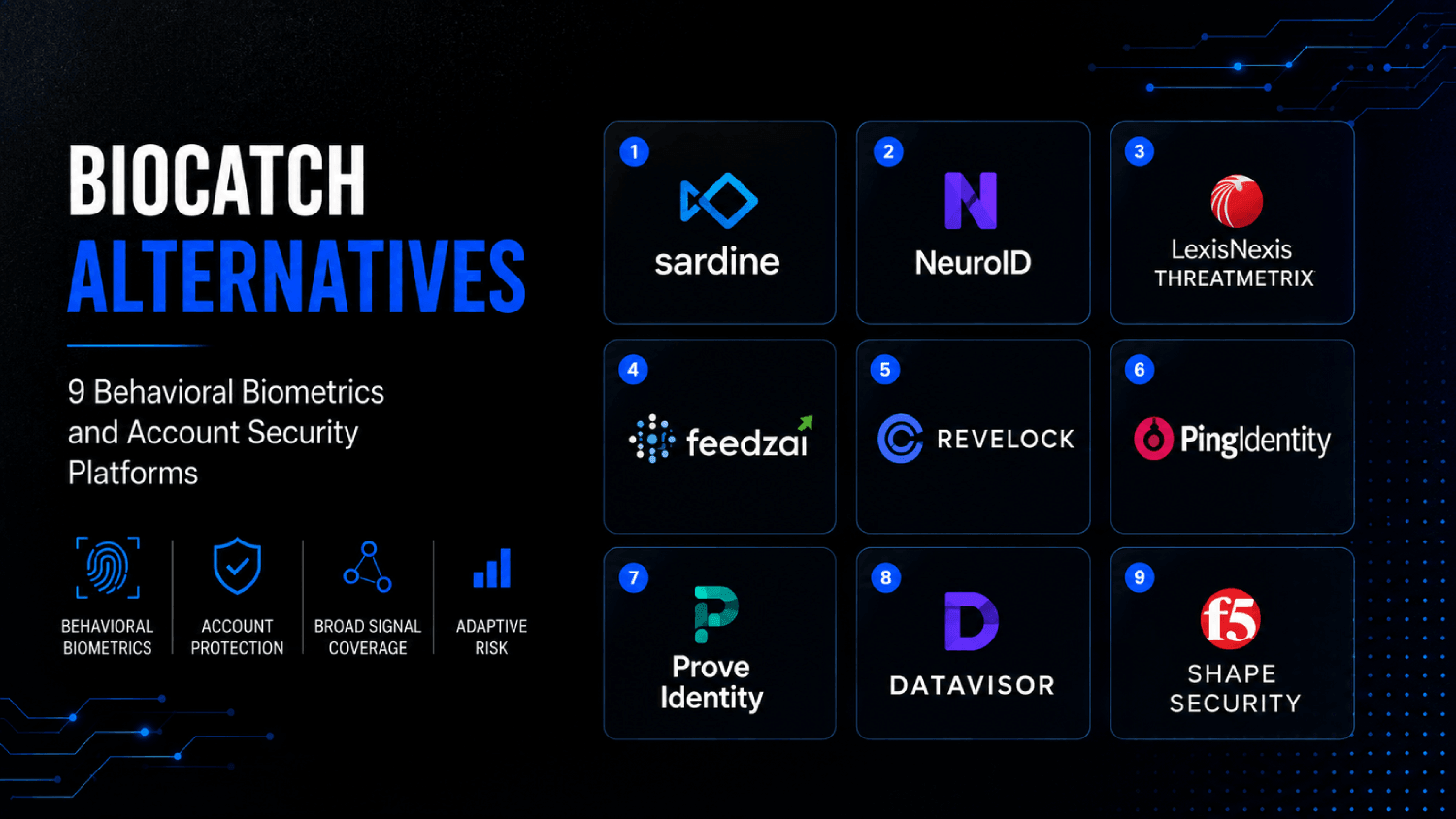
The best BioCatch alternatives for banks and fintech apps include Sardine, NeuroID, ThreatMetrix (now LexisNexis Risk Solutions), Feedzai, Revelock, Ping Identity, Prove Identity, Datavisor, and F5 Shape Security. Each fits a different profile: Sardine for API-first fintechs, NeuroID for onboarding fraud at the application layer, LexisNexis for banks that need consortium data alongside behavioral signals, and Feedzai for real-time transaction risk at scale.
Why Buyers Are Looking for BioCatch Replacements Right Now
BioCatch built its reputation on a genuine technical insight: that how a person types, swipes, and holds a device is harder to fake than a password. The platform became the default recommendation for Tier 1 banks and large fintech platforms for exactly that reason. Then Visa announced its acquisition of BioCatch for $2.4 billion, and the calculus changed for a segment of the market.
The concerns are practical, not hypothetical. Banks that compete directly with Visa’s issuing relationships worry about data sharing. Fintechs building on top of multiple card rails wonder whether a Visa-owned behavioral layer creates a conflict. Smaller companies object to the contract minimums that come with a platform designed for institutions processing millions of sessions per month.
There is also a product direction question. Acquisitions at this scale rarely accelerate roadmap investment in the acquired company’s differentiated capabilities. More often, the acquirer integrates the technology into its existing risk stack and the standalone product becomes a line item inside a bigger bundle. Buyers evaluating a multi-year contract are right to ask where BioCatch’s independent product development goes from here.
None of this means BioCatch is a bad product today. It means the switching cost calculus has changed, and a short evaluation of alternatives is now rational rather than speculative.
How to Evaluate Behavioral Biometrics Platforms Before You Switch
Most comparison articles list features. This one uses what we call the FintechSpecs Behavioral Signal Stack Test, a four-part evaluation framework for assessing whether a behavioral biometrics platform can actually replace your current provider without creating coverage gaps.
Signal breadth: Does the platform capture device telemetry, interaction patterns (keystroke dynamics, touch pressure, scroll behavior), session context, and environmental signals (network, geolocation, device orientation)? A platform that only does keystroke dynamics is not a full BioCatch replacement.
Model transparency: Can your fraud team see why a session was flagged? Black-box scores are hard to defend to regulators and hard to tune when your customer mix shifts. Explainability is not a nice-to-have in a regulated environment.
Consortium data access: BioCatch’s value partly comes from cross-client signal sharing. A replacement that only learns from your traffic will have a cold-start problem if your session volume is below roughly 500,000 monthly active users.
Integration surface: Does the platform require a native SDK, a JavaScript tag, a server-side API call, or all three? The answer determines how long your engineering team owns the migration and how much of your mobile release cycle gets consumed by the swap.
Run a potential replacement through all four before you request pricing. If it fails on signal breadth or consortium data, no contract discount fixes the detection gap. You can read more about evaluating fintech vendors across the full procurement process in this fintech vendor evaluation framework that covers due diligence across the stack.
Which BioCatch Competitors Are Worth Evaluating in 2026?
The table below maps each alternative to its primary use case, signal coverage, migration risk, and the buyer profile where it genuinely wins. Migration risk is rated Low, Medium, or High based on SDK complexity, session volume requirements, and whether a parallel-run period is supported.
| Platform | Primary Use Case | Signal Coverage | Migration Risk | Best For |
|---|---|---|---|---|
| Sardine | Device + behavior + AML in one layer | Broad (device, behavior, network, KYC) | Low | API-first fintechs, Series A-C |
| NeuroID | Application-layer behavioral signals | Onboarding-focused (form behavior) | Low | Lenders and onboarding-heavy flows |
| LexisNexis ThreatMetrix | Global device identity + behavior | Very broad (consortium of 5B+ devices) | Medium | Banks needing consortium data depth |
| Feedzai | Real-time transaction risk + behavior | Broad (transaction + behavioral context) | High | Large banks replacing full risk stacks |
| Revelock | Behavioral biometrics for session auth | Session-focused (interaction patterns) | Medium | Banks running continuous authentication |
| Ping Identity | Identity security + adaptive auth | Medium (signals tied to identity graph) | Medium | Enterprises with existing Ping IAM |
| Prove Identity | Phone intelligence + behavioral auth | Medium (phone-first signals) | Low | Mobile-first banks and neobanks |
| Datavisor | ML-driven fraud detection + behavior | Broad (unsupervised ML, behavior layer) | Medium | Platforms with complex fraud rings |
| F5 Shape Security | Bot detection + account takeover | Session and network-focused | Low | Web-heavy platforms with bot exposure |
Sardine: Best BioCatch Alternative for API-First Fintechs
Sardine bundles device intelligence, behavioral biometrics, AML transaction monitoring, and identity signals into a single API. That matters because most BioCatch alternatives require you to assemble separate vendors for device fingerprinting, behavioral signals, and downstream risk decisioning. Sardine collapses that stack into one integration surface.
For a Series B fintech processing account openings, money transfers, or crypto purchases, Sardine’s architecture means one SDK, one data agreement, and one model feedback loop. The migration risk is low because Sardine supports a parallel-run deployment where you can compare its output against your existing signals before you cut over.
Pricing is not publicly disclosed, but Sardine has historically published usage-based models oriented toward transaction volume rather than session minimums, which makes it more accessible to companies below the session volumes that BioCatch’s enterprise contracts typically require. The trade-off: Sardine’s behavioral biometrics layer is not as deeply specialized as BioCatch’s standalone product. If continuous authentication in logged-in sessions is your primary use case rather than onboarding fraud, Sardine is strong but not the deepest option on the list.
NeuroID: Best for Application and Onboarding Fraud

NeuroID focuses specifically on the behavioral signals generated during form completion. It captures how applicants interact with fields before they submit, which catches synthetic identity fraud and bot-driven application abuse at the moment it matters most. This is a narrower scope than BioCatch’s full session coverage, but for lenders, card issuers, and account-opening flows, it is the right scope.
The platform integrates via JavaScript tag for web and SDK for mobile. The migration lift is genuinely low because NeuroID sits alongside your existing stack rather than replacing it wholesale. You do not need to deprecate your current fraud tooling to run NeuroID on your onboarding flow.
The limitation worth naming: NeuroID does not cover post-login session behavior or authenticated account activity in the way BioCatch does. If you are trying to detect account takeover during active banking sessions, NeuroID alone leaves that window uncovered. It is an excellent complement to a broader risk stack, and an excellent primary tool if onboarding fraud is your dominant threat vector. Lenders evaluating behavioral biometrics alongside identity verification should also look at the top application fraud and synthetic identity tools for lenders on this site for additional context.
LexisNexis ThreatMetrix: Best for Banks That Need Consortium Depth

LexisNexis ThreatMetrix is the platform most frequently cited as a direct BioCatch alternative for large financial institutions. Its device intelligence network covers an enormous volume of global devices and sessions, and it layers behavioral signals on top of that device graph. For a bank that processes millions of login events per month, the consortium signal depth is a genuine competitive advantage.
Migration risk sits at Medium because ThreatMetrix typically requires a meaningful integration project and tuning period to translate your existing risk policies into its rule and model framework. The behavioral biometrics component is also less specialized than BioCatch’s: ThreatMetrix does more in device identity and network intelligence than it does in interaction-level behavioral analysis like keystroke dynamics.
The honest trade-off is that you get broader data coverage but shallower behavioral signal fidelity. For banks where the primary threat is account takeover via credential stuffing rather than sophisticated session manipulation, ThreatMetrix often covers enough of the behavioral surface to justify the switch, especially when the alternative is continuing a contract with a Visa-owned vendor you have concerns about.
Feedzai: Best for Large Banks Replacing a Full Risk Stack

Feedzai is not a behavioral biometrics specialist. It is a real-time financial crime platform that incorporates behavioral signals as one layer within a broader machine learning risk engine. That distinction matters for the right buyer.
If you are a bank that wants to consolidate transaction fraud, behavioral authentication, and case management into one platform, Feedzai competes at a different level than most alternatives on this list. If you only need to replace the behavioral biometrics component, Feedzai is likely oversized and the migration cost will reflect that. The implementation complexity earns the High migration risk rating in the table above.
Feedzai does not publish pricing publicly. Given its target market of Tier 1 and Tier 2 banks, the contract structure involves multi-year commitments with volume-based pricing. It appears in multiple competitor comparison lists for BioCatch because it is the most capable platform for banks rebuilding their entire fraud detection architecture, not because it is a simple drop-in replacement for behavioral signal coverage.
Revelock: Best for Continuous Session Authentication
Revelock was built specifically around behavioral biometrics for continuous authentication. It creates a behavioral profile for each user and silently re-authenticates them throughout a session by comparing live interaction patterns against that profile. This is the use case closest to BioCatch’s core differentiation. Note: available sources do not confirm the precise nature of Revelock’s current relationship with Outseer; verify current branding and product availability directly with the vendor before beginning an evaluation.
For banks running online or mobile banking applications where the threat model includes session hijacking and remote access trojans, Revelock’s continuous authentication approach competes directly with BioCatch at the product level. The migration risk is Medium because you need to build behavioral profiles from scratch during the ramp-up period, and detection accuracy will be lower until the platform has accumulated sufficient baseline data for your user population.
Outseer’s broader portfolio includes 3-D Secure and fraud manager products, which means you can potentially consolidate multiple point solutions if you are already evaluating broader authentication and fraud tooling. Revelock is a legitimate BioCatch competitor for the continuous authentication use case specifically.
Ping Identity: Best for Enterprises Already in the Ping IAM Stack

Ping Identity approaches behavioral biometrics from the identity side rather than the fraud side. Its adaptive authentication product incorporates behavioral signals, device context, and risk scoring into access management decisions. If your organization already runs Ping for SSO, MFA, or customer identity, adding behavioral risk signals through Ping is a lower-friction path than a net-new vendor relationship.
The platform is not a pure behavioral biometrics replacement for BioCatch if your threat model is primarily financial fraud. Ping’s strength is in access control and authentication policy enforcement, not in detecting in-session money movement fraud or social engineering patterns. But for enterprises where the primary use case is step-up authentication rather than transaction risk, Ping often wins on total integration cost.
Prove Identity: Best for Mobile-First Banks and Neobanks

Prove Identity builds its risk signals around phone intelligence rather than device fingerprinting or interaction-level behavioral analysis. It uses phone number tenure, carrier data, SIM swap history, and possession signals to authenticate users, and layers behavioral context on top of that.
For a neobank where the user relationship is almost entirely mobile, Prove’s phone-centric signal model often captures risk signals that device-only or behavior-only platforms miss. SIM swapping is a real attack vector in mobile banking, and Prove’s consortium data on phone number history addresses that gap directly. Migration risk is Low because Prove integrates via API rather than requiring a heavy SDK implementation.
The coverage limitation is on web channels. If your platform serves a significant portion of users on desktop browsers, Prove’s phone-intelligence model covers less of your attack surface than BioCatch’s full session behavioral approach.
Datavisor: Best for Platforms Facing Organized Fraud Rings
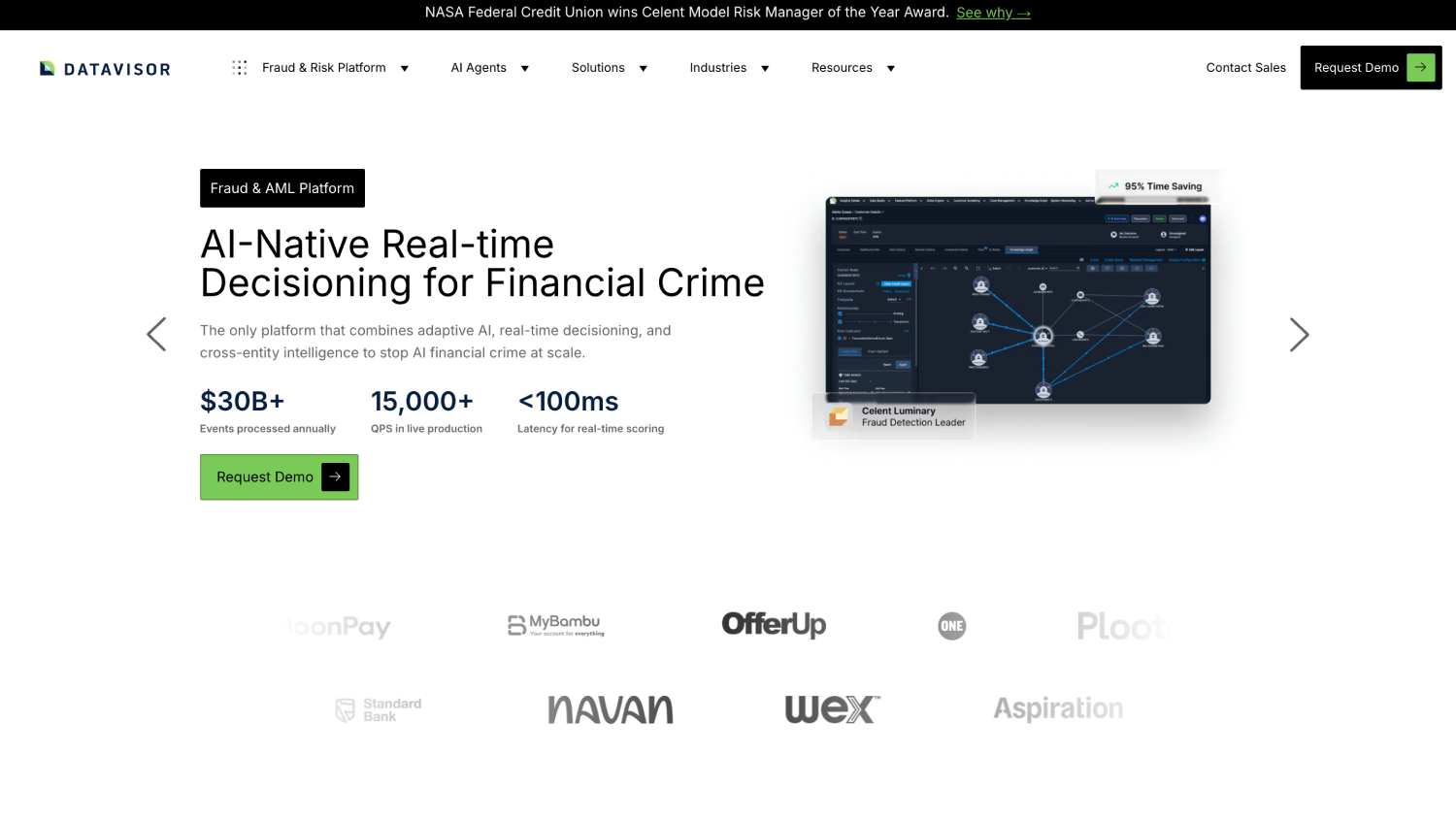
Datavisor is built around unsupervised machine learning, which means it detects fraud patterns without requiring labeled historical fraud data to train on. For platforms that have experienced a surge in synthetic accounts, referral abuse, or organized bot-driven fraud, Datavisor’s approach to finding previously unknown attack patterns is genuinely differentiated.
It incorporates behavioral signals as part of a broader entity graph that connects accounts, devices, and behaviors. The migration risk is Medium because tuning an unsupervised model to your environment requires time and a clear feedback loop from your fraud operations team. The payoff is that the platform gets better faster when it encounters novel fraud patterns rather than waiting for labeled examples. For fintech platforms running promotions, referral programs, or marketplace features where fraud ring behavior is the primary threat, Datavisor belongs in the evaluation.
F5 Shape Security: Best for Web-Heavy Platforms with Bot Exposure
F5 Shape Security is a bot mitigation and account takeover prevention platform that uses behavioral signals primarily to distinguish human from automated traffic. Its strength is at the perimeter: credential stuffing attacks, login abuse, and sophisticated bots that mimic human behavior.
If your primary concern is BioCatch’s session behavioral layer for detecting account takeover via stolen credentials, Shape Security covers that vector well. It does not offer the same depth of individual user behavioral profiling that BioCatch provides for detecting social engineering or authorized push payment fraud, but for platforms where bot-driven attacks are the dominant threat, Shape is often the most cost-effective replacement. The migration risk is Low because Shape typically operates as a reverse proxy or JavaScript injection layer that does not require deep SDK integration into your application code.
What Does Migration Actually Look Like When Switching from BioCatch?
The migration risk ratings in the table above reflect a specific scenario: a fintech or bank that is actively logging sessions through BioCatch and wants to switch to a new provider without a detection gap. The risk is not primarily technical. It is about the cold-start problem.
Behavioral biometrics platforms learn what “normal” looks like for your user population over time. When you switch platforms, the new vendor starts with no historical baselines. For the first 30 to 90 days of a new deployment, detection rates for subtle behavioral anomalies will be lower than they were on a mature BioCatch deployment. That window is real fraud risk.
The mitigation is a parallel-run period: run both platforms simultaneously, compare outputs, and use the overlap period to build baselines on the new platform before you shut down the old one. This requires your current contract to allow it, which is worth negotiating explicitly if you are approaching a BioCatch renewal. If the new platform does not support parallel scoring via API, that is a significant practical disadvantage worth weighing against any pricing benefit.
Teams going through a platform migration of this kind should also read this site’s guide to build vs buy fraud orchestration, which covers the decision logic for when to add a new vendor versus absorbing the capability internally.
Frequently Asked Questions About BioCatch Alternatives
Who are BioCatch’s main competitors?
The most frequently cited BioCatch competitors include LexisNexis ThreatMetrix, Feedzai, Outseer (which markets Revelock), F5 Shape Security, Sardine, NeuroID, Prove Identity, Ping Identity, and Datavisor. The right competitor depends heavily on your use case: ThreatMetrix and Feedzai are the most common enterprise bank alternatives, while Sardine and NeuroID fit API-first fintechs at earlier stages. No single competitor covers every BioCatch use case equally well.
Who acquired BioCatch and what does that mean for customers?
Visa announced its intention to acquire BioCatch for $2.4 billion. According to BioCatch’s official website, the company is set “to join Visa,” though the site does not specify a confirmed completion date for the transaction. For existing customers, the near-term product impact has been limited, but the strategic concern is real: buyers considering a multi-year contract are right to ask about pricing independence, data sharing policies with Visa’s broader network, and where the standalone product roadmap goes inside a card network organization. Those questions are worth putting directly to BioCatch’s sales team before signing.
What is behavioral biometrics and how does it differ from traditional fraud detection?
Behavioral biometrics analyzes how a person physically interacts with a device: typing rhythm, mouse movement, touch pressure, scroll speed, and device orientation patterns. Unlike static credentials or device fingerprints, behavioral patterns are continuous and difficult to replicate. Traditional fraud detection flags anomalies in transaction data after the fact. Behavioral biometrics detects anomalies in real time during the session, which means it can catch account takeover attempts, remote access trojans, and social engineering attacks before a fraudulent transaction completes.
What banks use BioCatch?
BioCatch does not publish a complete client list, but the company has publicly referenced partnerships with large global financial institutions. Given its price point and contract structure, its customer base skews toward Tier 1 and Tier 2 banks rather than community banks or early-stage fintechs. The Visa acquisition announcement has not changed the platform’s go-to-market focus, which remains institutional.
How long does it take to migrate from BioCatch to an alternative platform?
A realistic migration timeline for a bank or established fintech runs 60 to 180 days depending on integration complexity, the number of channels covered, and whether you run a parallel deployment. The technical integration itself is often faster than that range; the delay comes from the baseline-building period where the new platform needs enough session data to produce accurate behavioral models. Attempting to cut over without a parallel-run period meaningfully increases fraud exposure during the transition window.
Is there a behavioral biometrics platform designed specifically for smaller fintechs?
NeuroID and Sardine are the two platforms most accessible to fintechs at the Series A to Series C stage. Both offer usage-based or API-call pricing rather than session minimums, and both support lower-volume onboarding rather than requiring the millions of monthly sessions that make BioCatch’s enterprise contracts cost-effective. NeuroID focuses specifically on application-layer signals, while Sardine covers a broader risk surface including device intelligence and transaction monitoring.
Can behavioral biometrics platforms detect social engineering and authorized push payment fraud?
This is where BioCatch has genuine differentiation, and where most alternatives have gaps. BioCatch built specific models for detecting behavioral anomalies that occur when a victim is being coached by a fraudster, such as unusual hesitation patterns, copy-paste behavior, or atypical navigation sequences. Most alternatives on this list detect credential-based account takeover and bot traffic better than they detect social engineering. If authorized push payment fraud is your primary threat, evaluate each vendor’s specific claims in this area carefully and ask for published detection rate data on that use case type.
Which BioCatch Alternative Should You Actually Choose?
If you are a bank evaluating a full risk stack replacement and need consortium-depth device intelligence alongside behavioral signals, LexisNexis ThreatMetrix is the most direct BioCatch competitor at scale. If you are a fintech at Series A to Series C and want to consolidate device, behavior, and AML signals into one contract, Sardine is the cleaner architectural choice. If your threat model is dominated by application and onboarding fraud, NeuroID solves that specific problem more efficiently than a full BioCatch deployment would.
The vendors that do not belong in a shortlist for most buyers: Feedzai if you are not replacing a full risk stack, Ping Identity if behavioral fraud is your primary concern rather than access management, and F5 Shape Security if your traffic is predominantly mobile rather than web-based. Including platforms in an evaluation just because they appear on competitor lists is how procurement processes stretch to six months without producing a better decision.
The acquisition context also deserves direct treatment in your vendor conversation. If the concern is data independence from Visa, that is a negotiable contractual question, not just a strategic anxiety. Ask explicitly about data sharing provisions, pricing escalation clauses post-acquisition, and what happens to your contract if BioCatch’s product is folded into Visa’s existing risk platform. Those answers, more than any feature comparison, will tell you whether staying or switching is the right call for your organization’s specific risk tolerance and competitive position. For broader context on how fraud infrastructure decisions fit into your fintech product roadmap, the fintech product and compliance readiness checklist covers the governance questions that should run parallel to any vendor evaluation of this kind.