
- Most KYB tools are built for US business registries. International coverage is a separate technical capability that requires direct data source integrations, not just API resellers.
- Cross-border KYB providers differ significantly in which countries they pull from authoritative government registries versus third-party aggregators, and the difference matters for regulatory defensibility.
- The right vendor depends on your primary geography mix. A provider strong in Europe and the UK may have thin coverage in Southeast Asia or Latin America.
- Registry freshness, UBO resolution depth, and fallback document collection are the three variables that separate enterprise-grade global KYB from basic name-matching.
- Pricing for cross-border KYB is rarely published. Most vendors require scoping calls, but several publish starting tiers worth knowing before you negotiate.
The best KYB providers for cross-border business verification include Trulioo, Middesk, Comply Advantage, Dun and Bradstreet, Sumsub, Bureau van Dijk (Orbis), and LexisNexis Risk Solutions. These vendors offer direct registry connections, UBO identification, and ongoing monitoring across multiple jurisdictions. Coverage depth, registry sourcing, and UBO resolution vary by vendor and region, so the right choice depends on which geographies your onboarding pipeline actually touches.
Why Cross-Border KYB Is a Different Product Category Than Domestic KYB
Domestic KYB in the US is relatively tractable. Vendors pull from Secretary of State filings, IRS EIN databases, and credit bureau business records. The data is structured, largely digital, and frequently updated. Cross-border KYB is a fundamentally different problem.
Business registries outside the US vary by country in format, update frequency, legal authority, and accessibility. Some EU member states publish real-time registry APIs. Others still require manual document requests through local chambers of commerce. A vendor claiming “global coverage” in 100 countries may source half of those countries from third-party aggregators rather than authoritative government registries. That distinction is what your compliance team will be asked about during a regulatory exam.
The Registry Authority Score is a useful internal framing when evaluating any cross-border KYB provider: for each target country, what percentage of that vendor’s data comes from a government-authoritative source versus a commercial aggregator or self-reported database? Vendors rarely publish this breakdown, but you can ask for it directly in a proof of concept. Any vendor unwilling to answer that question by country is telling you something.
If your product touches international business onboarding, the Fintech Product and Compliance Readiness Checklist covers the broader framework for evaluating whether your compliance stack is actually defensible before you sign with a vendor.
What Does Real Cross-Border KYB Actually Cover?
Full-spectrum international business verification involves at least four distinct data layers. Most vendors cover the first two. Fewer cover all four.
- Entity existence and good standing. Confirming the legal entity exists in the jurisdiction, is currently registered, and is in good standing with local authorities.
- Beneficial ownership (UBO) resolution. Identifying natural persons who own or control 25% or more of the business, including through layered holding structures. EU 4AMLD and 5AMLD set this threshold; FATF guidelines apply internationally.
- Adverse media and sanctions screening. Cross-referencing the entity and its principals against OFAC, UN, EU, and local sanctions lists, plus negative news.
- Ongoing monitoring and change alerts. Detecting registry changes, new UBO disclosures, director changes, or adverse media after initial onboarding. This is sometimes called perpetual KYB.
Not every use case requires all four. A marketplace doing light cross-border merchant onboarding may only need layers one and three. A regulated financial institution onboarding corporate counterparties typically needs all four. Know which layers you need before evaluating vendors, because pricing and feasibility differ significantly.
The FintechSpecs Cross-Border KYB Coverage Matrix
Below is a comparison of the major global KYB providers across the dimensions that matter most for international onboarding. Coverage claims are based on each vendor’s publicly available documentation and product pages. Registry sourcing depth and UBO resolution capability are qualitative assessments based on vendor-published materials.
| Vendor | Claimed Country Coverage | Registry Source Depth | UBO Resolution | Ongoing Monitoring | API Available | Best For |
|---|---|---|---|---|---|---|
| Trulioo | 195+ countries | Mix of authoritative and aggregated | Yes, with document collection fallback | Yes | Yes | Global onboarding at scale, regulated fintechs |
| Middesk | US-primary, limited international | Authoritative for US | US only | Yes (US) | Yes | US-focused platforms needing deep domestic coverage |
| Sumsub | 200+ countries | Registry plus document verification | Yes, including UBO chains | Yes | Yes | Cross-border fintechs needing KYB plus KYC in one platform |
| ComplyAdvantage | Global | Sanctions and adverse media focus | PEP and UBO screening | Real-time | Yes | AML-heavy workflows, sanctions screening at scale |
| Dun and Bradstreet | 200+ countries | Proprietary DUNS network | Partial, varies by country | Yes | Yes | Enterprise procurement and commercial credit teams |
| Bureau van Dijk (Orbis) | 400M+ companies globally | Deep registry sourcing, especially EU | Yes, ownership chains | Yes | Yes (Moody’s Analytics API) | Financial institutions needing deep ownership chain analysis |
| LexisNexis Risk Solutions | Global | Registry plus proprietary data assets | Yes | Yes | Yes | Banks and insurers with complex compliance requirements |
| Kyckr | 200+ jurisdictions | Direct registry connections emphasized | Yes | Yes | Yes | Teams prioritizing authoritative-source registry data |
Which Providers Have the Strongest Cross-Border Registry Coverage?
Trulioo: Broadest Reach, With Caveats

Trulioo’s GlobalGateway for business verification covers over 195 countries and pulls from a combination of government registries, commercial databases, and document verification fallbacks. The breadth is genuine. The depth is uneven. For UK Companies House, EU member state registries, and major APAC markets like Australia and Singapore, Trulioo connects to authoritative sources. For thinner markets in sub-Saharan Africa or parts of Central Asia, the data often routes through commercial aggregators.
That is not necessarily a disqualifier. For most cross-border onboarding flows, registry-level verification is only achievable in the top 50 to 80 jurisdictions anyway. Trulioo’s document collection fallback covers the rest. Pricing is not publicly disclosed and requires direct engagement with their sales team.
Sumsub: Best for Combined KYB and KYC in One Vendor
Sumsub stands out because it handles both entity verification and individual identity verification in a single workflow. For platforms onboarding SMBs internationally, where you need to verify both the business and its beneficial owners in the same session, avoiding two separate vendor integrations saves significant engineering overhead. Sumsub covers 200-plus countries and offers automated UBO chain resolution, which is particularly useful for EU compliance under 5AMLD.
The trade-off is that Sumsub’s registry sourcing depth is not as granular as a specialist like Bureau van Dijk for complex ownership structures. If your use case involves onboarding large corporate entities with multi-layered holding structures, Sumsub may need to be paired with a secondary data source. For SMB-heavy cross-border flows, it is the most complete single-vendor option in the market.
The comparison between Trulioo vs Sumsub for KYB and KYC fintech onboarding goes deeper on the specific trade-offs between these two vendors if your shortlist comes down to those two.
Bureau van Dijk (Orbis): Deepest Ownership Chain Data
Bureau van Dijk’s Orbis database, now part of Moody’s Analytics, covers over 400 million companies globally with particular strength in European ownership chain data. If your compliance team needs to trace UBO chains through multiple holding structures across jurisdictions, Orbis is the reference-grade dataset. It is the tool large banks and financial institutions use when they cannot rely on self-reported UBO disclosures alone.
The API access is available through Moody’s Analytics and is priced for enterprise use. This is not a vendor you integrate for a quick 90-day pilot. Implementation is complex, pricing involves licensing agreements, and the use case is specifically corporate due diligence rather than high-volume real-time onboarding. If you need to verify thousands of SMBs per month, Trulioo or Sumsub will serve you better operationally.
Kyckr: Direct Registry Access as a Core Differentiator
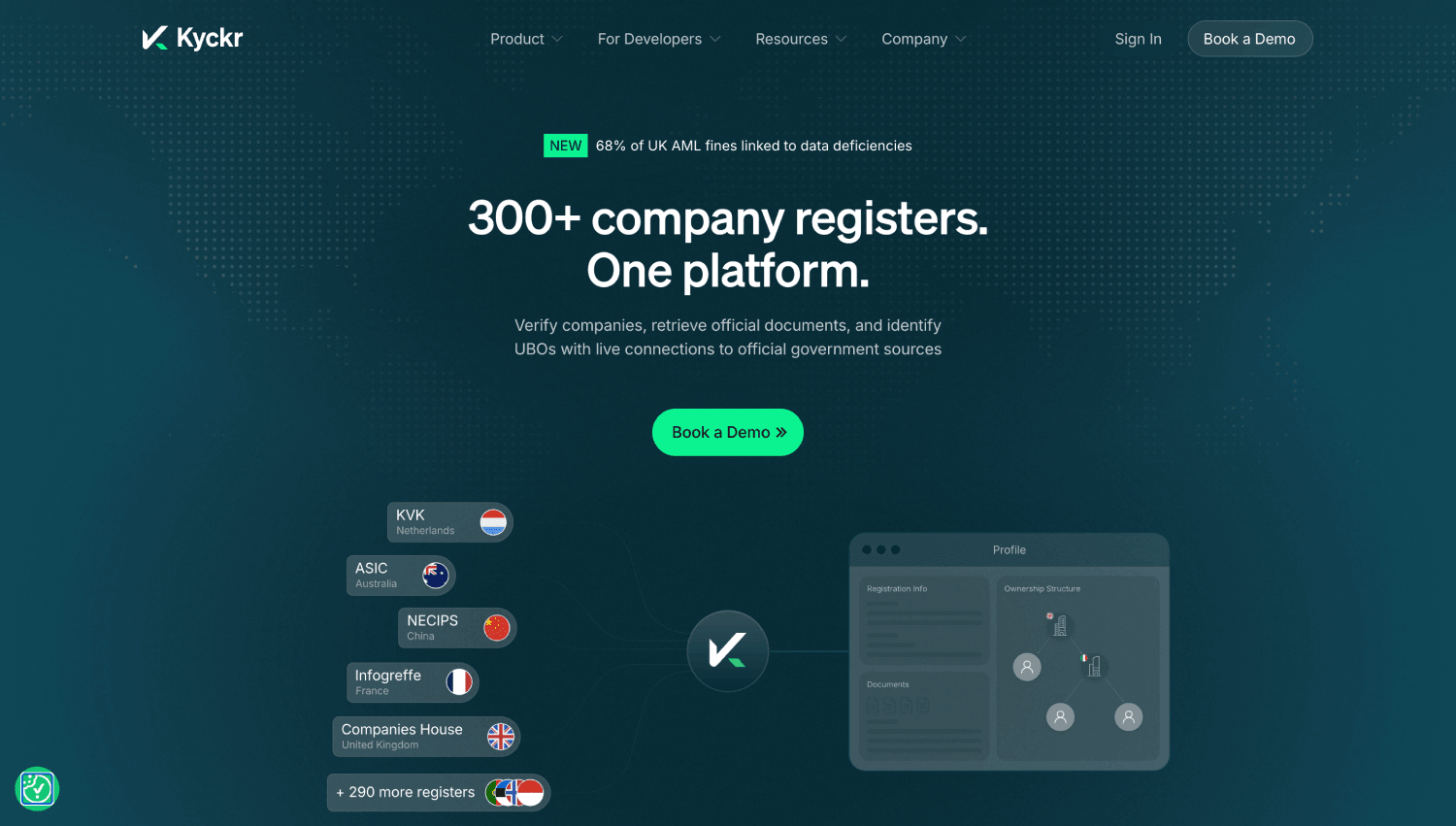
Kyckr positions itself explicitly around direct connections to government company registries across 200-plus jurisdictions. The company publishes its registry source list, which is useful when you need to document to a regulator or auditor exactly where your verification data came from. That transparency is a genuine differentiator in a market where most vendors are vague about their data supply chain.
Kyckr is particularly strong in the UK, Ireland, Australia, and EU markets. For teams operating primarily in these geographies with specific regulatory reporting requirements, the direct-source audit trail Kyckr provides has real compliance value. Coverage thins in emerging markets, consistent with the broader industry pattern.
ComplyAdvantage: The Right Tool for AML-Led Workflows
ComplyAdvantage approaches KYB from an AML and sanctions screening starting point rather than a registry verification starting point. That distinction matters for how you architect your compliance workflow. ComplyAdvantage excels at real-time adverse media monitoring, PEP screening, and sanctions list coverage across OFAC, EU, UN, and country-specific lists. It also does UBO screening. Where it is weaker is in raw registry verification for entity existence and good standing in thin markets.
Most cross-border KYB programs end up using ComplyAdvantage or a similar AML screening layer on top of a registry verification vendor rather than as a replacement for one. Pairing it with Trulioo or Sumsub for registry data and using ComplyAdvantage for ongoing monitoring and sanctions screening is a common enterprise architecture.
LexisNexis Risk Solutions: Enterprise-Only, Comprehensive

LexisNexis Risk Solutions offers global business verification through its World Compliance and Bridger Insight products. Coverage is genuinely global and data depth is strong, drawing on their proprietary data assets alongside registry sources. Implementation complexity and pricing reflect enterprise positioning. If your compliance program requires OFAC, BSA, and international AML coverage in a single vendor, LexisNexis Risk Solutions is a credible option. For seed-to-Series B fintech companies, the cost and integration overhead are usually out of proportion to the need.
Middesk: The Honest Domestic Specialist
Middesk does not pretend to be a global KYB platform. Its coverage is US-centric, pulling from Secretary of State filings, IRS data, and USPS address records with strong authoritative sourcing. For US platforms onboarding domestic businesses with occasional international counterparties, Middesk is the strongest pure-play domestic option and pairs well with a global provider for non-US entities.
If your cross-border volume is under 10 to 15% of total business onboarding, a dual-vendor setup of Middesk for US plus Trulioo or Sumsub for international is often more cost-effective than a single global vendor that does both less precisely. For a detailed look at how these two platforms compare, the Middesk vs Baselayer KYB platform comparison covers the domestic high-risk onboarding angle specifically.
How Do You Evaluate a Cross-Border KYB API Before You Sign?
The FintechSpecs Five-Country Test is a structured evaluation method for cross-border KYB vendors before you commit. Run it in any proof of concept.
- Pick your top five international markets by volume. These should be real countries where you have or expect onboarding traffic, not hypothetical ones.
- Request the vendor’s specific data source for each country. Ask for the name of the registry or data partner, not just “we cover this country.” A vendor confident in their sourcing will answer. A vendor that says “proprietary network” without specifics is using aggregators and does not want you to know.
- Run test verifications on five real, publicly known companies in each country. Use entities with publicly available registry information. Check whether the returned data matches the official registry, and how current it is.
- Test the UBO resolution path. Pick two entities with known ownership structures. Ask what the API returns and whether it resolves through holding companies or stops at the first layer.
- Evaluate the fallback. For thin markets where registry data is unavailable, what does the vendor actually do? Document collection, manual review, or simply return a no-data result? All three are acceptable depending on your risk appetite, but you need to know before you build the integration.
This test takes about two weeks to run properly and almost always surfaces coverage gaps that were not visible in the vendor’s sales materials. Budget for it before you sign anything.
What Does Cross-Border KYB Cost?
Most global KYB providers do not publish pricing publicly. Trulioo, Sumsub, ComplyAdvantage, Bureau van Dijk, LexisNexis Risk Solutions, and Kyckr all require direct engagement for pricing. Middesk publishes pricing for its US products but not for any international extensions.
That said, the pricing variables are consistent across vendors:
- Per-verification fee, which typically varies by country (EU verifications cost less than manual-fallback markets)
- Monthly or annual platform fee separate from per-check costs
- Ongoing monitoring fees, usually charged as a monthly fee per monitored entity
- UBO chain resolution fees, sometimes charged per additional ownership layer resolved
- Volume tiers that reduce per-check cost above certain monthly thresholds
Expect meaningful price differences between EU and US markets versus emerging market verifications, because the underlying data acquisition costs differ. A market where the vendor must use a document collection fallback instead of an automated registry check almost always costs more per verification. Get this country-level pricing breakdown in your initial scoping call, not after you have built the integration.
For broader context on how compliance infrastructure costs scale by company stage, the real cost of compliance in FinTech SaaS broken down by stage is a useful reference before you go into vendor negotiations.
Which Cross-Border KYB Vendor Fits Which Buyer?
| Buyer Profile | Recommended Vendor | Reason |
|---|---|---|
| Seed-stage fintech, primarily US with some EU onboarding | Middesk (US) + Sumsub (international) | Middesk’s authoritative US data plus Sumsub’s combined KYB and KYC for international keeps complexity low |
| Series A-B fintech onboarding SMBs across 20-plus countries | Sumsub or Trulioo | Both handle broad coverage with automated flows; Sumsub wins if you also need individual KYC in the same platform |
| Regulated financial institution, corporate due diligence | Bureau van Dijk (Orbis) or LexisNexis Risk Solutions | Ownership chain depth and audit trail quality exceed what API-first vendors offer |
| High AML risk profile, crypto or payments | ComplyAdvantage plus registry vendor | Real-time sanctions and adverse media monitoring at scale, paired with Trulioo or Kyckr for registry data |
| EU-primary fintech with 5AMLD/6AMLD obligations | Kyckr or Sumsub | Kyckr’s direct registry sourcing satisfies EU audit requirements; Sumsub for combined UBO and KYC workflows |
| Enterprise procurement or commercial credit | Dun and Bradstreet | D-U-N-S network breadth and commercial credit data layer makes it the standard for trade finance due diligence |
Does Your Cross-Border KYB Provider Need to Handle Ongoing Monitoring?
Initial verification covers who a business is at the moment of onboarding. Perpetual KYB covers who they become afterward. Regulatory expectations in the US, UK, and EU are increasingly explicit that financial institutions and regulated fintechs must monitor business customers for material changes after onboarding, not just at the point of relationship initiation.
Material changes that require detection include director changes, UBO changes, significant ownership transfers, new sanctions designations, adverse media, and registry status changes (like dissolution or administrative strike-off). Not all KYB vendors offer ongoing monitoring with the same depth as their initial verification capability. ComplyAdvantage is the strongest standalone option for real-time ongoing monitoring. Sumsub and Trulioo both offer monitoring modules. Bureau van Dijk offers portfolio monitoring for entities in its database.
If you onboard businesses and then do not monitor them through any systematic process, you have a compliance gap regardless of how strong your initial KYB was. For a deeper look at platforms built specifically around this problem, the guide to the best perpetual KYB and ongoing monitoring platforms covers the vendors purpose-built for post-onboarding surveillance.
Frequently Asked Questions
What is cross-border KYB and how is it different from standard KYB?
Cross-border KYB is the process of verifying a business entity registered in a foreign jurisdiction, including confirming legal existence, ownership structure, and regulatory status using that country’s official records. Standard domestic KYB pulls from a single country’s registries, usually with well-structured digital access. Cross-border KYB requires integrations with multiple registry systems across different legal frameworks, languages, and data formats. The registry access method, data freshness, and UBO resolution depth all vary by country, making it technically and operationally more complex than US-only verification.
How many countries do leading global KYB providers actually cover?
Trulioo and Sumsub both publicly claim coverage in 195 to 200-plus countries. Bureau van Dijk covers over 400 million companies across its global database. However, coverage claims describe the number of countries where some verification is possible, not the number of countries where authoritative registry data is returned. In practice, most vendors offer deep authoritative coverage in 50 to 100 markets and rely on document collection fallbacks or commercial aggregators in the rest. Always ask vendors to specify their data source by country for your specific target markets.
Can a single KYB API handle both entity verification and UBO resolution across borders?
Yes, but with varying depth depending on the country. Sumsub and Trulioo both offer automated UBO chain resolution as part of their cross-border KYB APIs. Bureau van Dijk’s Orbis platform offers the deepest ownership chain data, particularly for EU entities. The practical limitation is that UBO registries are not universally available or up to date. Several EU member states require beneficial ownership disclosure under 5AMLD, which improves automated resolution. In other jurisdictions, the vendor must rely on self-reported UBO data or fallback to document collection, which reduces automation rates.
What should I ask a cross-border KYB vendor in a proof of concept?
Ask for the specific registry or data source used for each of your top five target countries. Ask for the average data freshness or lag for each country. Run test verifications on publicly known companies and compare results to official registry records. Test the UBO resolution depth by using entities with known multi-layer ownership. Ask what the system returns when registry data is unavailable, whether that is a document request, a manual review flag, or a no-data result. These five questions surface more useful information than any sales demo will.
Is cross-border KYB required by law or just best practice?
Both, depending on your regulatory context. If you are a regulated financial institution subject to BSA or AML program requirements in the US, FinCEN’s Customer Due Diligence rule requires verification of legal entities and beneficial owners at onboarding regardless of domicile. EU-regulated entities face similar requirements under 4AMLD and 5AMLD. For non-regulated platforms, cross-border KYB is increasingly a contractual requirement from sponsor banks, payment processors, and enterprise clients. The practical answer is that operating a financial product involving international business counterparties without KYB creates regulatory, reputational, and partner risk whether or not there is a specific statute mandating it for your category.
What is the difference between KYB and AML screening for international businesses?
KYB confirms that a business exists, is legally registered, and identifies who owns and controls it. AML screening checks the business and its principals against sanctions lists, watchlists, PEP databases, and adverse media. Both are required for a complete compliance workflow, but they answer different questions. A business can pass KYB (it exists and is registered) and fail AML screening (a beneficial owner is on an OFAC list). Vendors like ComplyAdvantage specialize in AML screening, while Trulioo and Sumsub handle both. Most enterprise programs layer both capabilities regardless of whether one vendor handles it all.
The Vendor Decision Is Really a Coverage Decision
Every vendor on this list will tell you they do global KYB. The question worth pressing is not whether they cover a country but how they cover it, and whether that sourcing method satisfies your specific regulatory and operational requirements. A vendor pulling from an authoritative government registry gives you defensible compliance documentation. A vendor routing through a third-party aggregator gives you coverage that looks identical in a demo but may not hold up during a regulatory review or a disputed onboarding decision.
The practical implication is that most serious cross-border programs end up using at least two vendors: a registry-and-entity specialist for initial verification in major markets, and an AML and monitoring layer for ongoing surveillance. That is not a failure of the market. It reflects the genuine complexity of business verification across 190-plus legal systems. Building your stack around that reality from the start is cheaper than discovering the gap after your first regulator inquiry.
If you are building the broader compliance infrastructure that sits around KYB, including fraud detection, transaction monitoring, and onboarding orchestration, the 10 Best KYB Providers for B2B Fintech Onboarding in the US covers the domestic side of that stack, and the 7 Best AML Screening APIs for US Fintech Companies covers the monitoring layer that should sit alongside any KYB program.