
TLDR
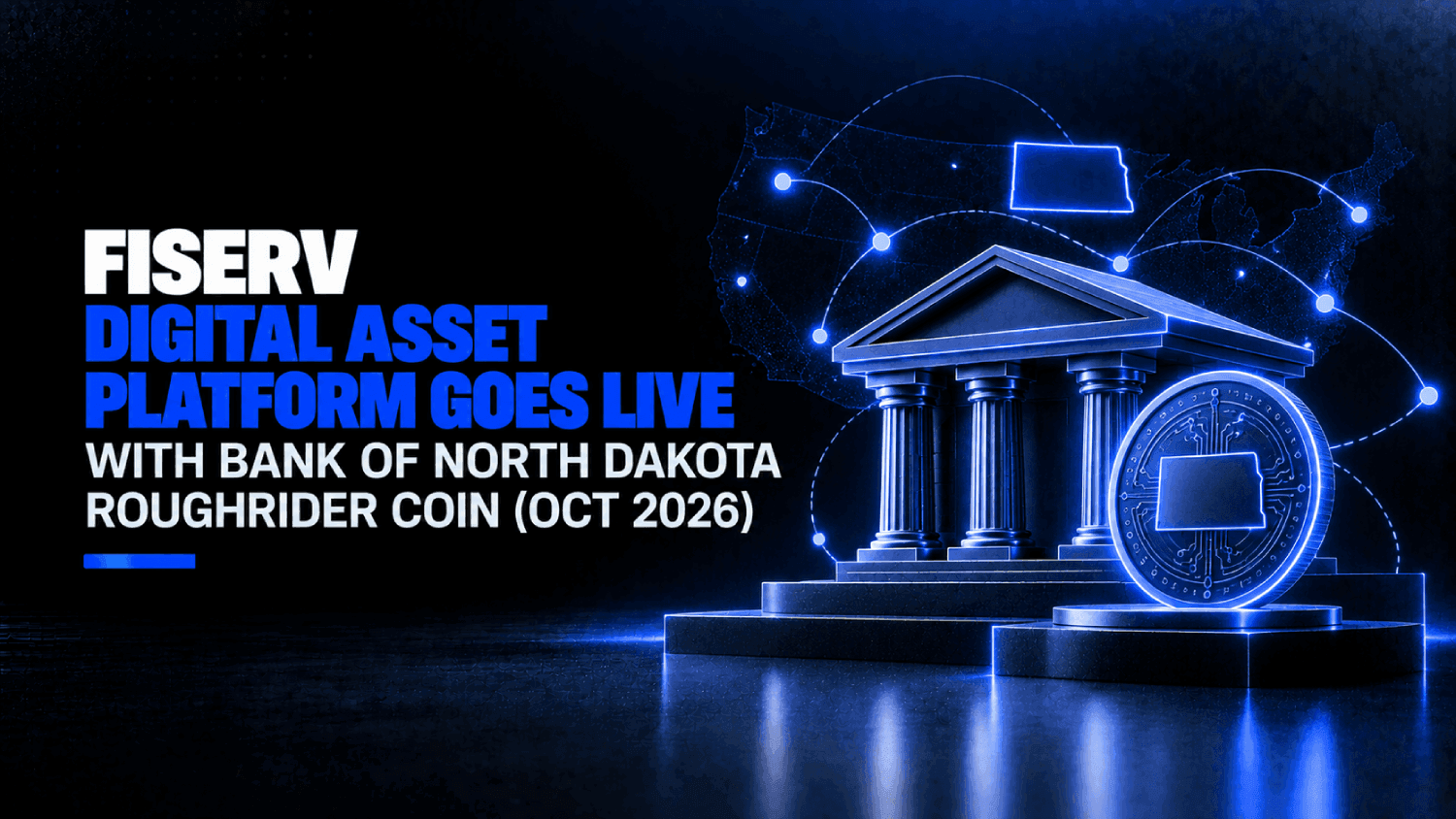
- On Oct. 1, 2026, Fiserv said its digital asset platform is live with financial institution clients, moving stablecoin-enabled banking from concept to production infrastructure.
- The first live use case is Roughrider Coin, Bank of North Dakota’s dollar-backed stablecoin for more efficient money movement across the state’s interbank network. More than 90 participating banks and credit unions can access it through Fiserv’s Commercial Center.
- Stack named in the release: VersaBank as issuer, Fireblocks for digital asset infrastructure and tokenization, and settlement on the Solana blockchain. Fiserv supplies issuance, reserve, custody, and settlement infrastructure.
- This is a news explainer on processor-hosted FI stablecoin rails for interbank settlement. Distinct from Citi × Coinbase Virtual Accounts / Spring, SoFi × Mastercard SoFiUSD, Fed GENIUS Act NPRs, and stablecoin infrastructure shortlists.
Oct. 1, 2026 is the day a major U.S. payments processor claimed production, not pilots, for stablecoin banking rails inside the software banks already use for commercial money movement. Fiserv said its digital asset platform is live with FI clients, with Bank of North Dakota’s Roughrider Coin as the first live use case on that stack.
For FintechSpecs operators, the buyer question is who hosts issuance, custody, and settlement when a bank or credit union wants dollar-backed interbank stablecoin rails, not merchant checkout acceptance and not card-network settlement of a bank’s own coin. Ask what sits in Commercial Center today, who is the regulated issuer of record, which chain carries the transfers, and how that maps to your GENIUS Act and third-party risk program.
What Fiserv announced on Oct. 1
Per the Fiserv GlobeNewswire release (Oct. 1, 2026, 08:30 ET):
- Fiserv’s digital asset platform is live with financial institution clients.
- First live use case: Roughrider Coin, Bank of North Dakota’s dollar-backed stablecoin for interbank money movement in the state.
- VersaBank issues Roughrider Coin and provides custody; roles include minting, burning, custody, and reserve asset management.
- Fireblocks provides secure digital asset infrastructure and tokenization services; transactions process on Solana.
- Participating banks and credit unions access Roughrider Coin through Commercial Center, Fiserv’s commercial online banking system already used for traditional interbank money movement.
- Fiserv positions the platform for broader use cases beyond this state network: stablecoin card issuance, cross-border payments, programmable commerce, treasury automation, tokenized deposits, and global currency account services (including U.S. dollar accounts for FIs worldwide).
Sunil Sachdev, Head of Embedded Finance and Digital Assets at Fiserv, said: “The launch of our digital asset platform is an important milestone for Fiserv and the financial institutions we serve. By moving from concept to production with leading institutions, we are helping clients unlock new efficiencies in banking and payments while maintaining the trust, security and regulatory standards they expect.”
Payments Dive (Oct. 1, 2026) reported a Fiserv spokesperson saying the new platform went live that week, and noted that Fiserv’s previously announced FIUSD stablecoin was not mentioned in the Thursday release.
Note: Treat FIUSD status as unverified from this announcement. Diligence separately if your roadmap assumed Fiserv’s own coin rather than hosting a partner-state or partner-bank coin.
Roughrider Coin: what Bank of North Dakota is actually launching
Bank of North Dakota is using Fiserv’s issuance, reserve, custody, and settlement infrastructure to deploy Roughrider Coin across the state’s banking and payments workflows. The release says the dollar-backed stablecoin gives more than 90 participating banks and credit unions a more efficient way to conduct bank-to-bank transactions, while establishing a foundation for additional digital money use cases.
Don Morgan, CEO of Bank of North Dakota, said the launch builds on the bank’s role with partner community banks and credit unions and gives them a new tool to move money more efficiently across North Dakota’s interbank network.
Payments Dive notes North Dakota became the second U.S. state to launch its own digital currency after Wyoming’s Frontier Stable Token, and that Roughrider was previously framed for state participation in global money movement and as another merchant payment option. This Oct. 1 story’s concrete production claim is FI access via Fiserv Commercial Center for interbank transfers, not a national merchant-acceptance roll-out.
Operator take: This is a state bank + processor + regulated issuer + custody infra + L1 stack for community FI interbank settlement. It is not the same product story as a money-center bank wiring Coinbase into Spring checkout (Citi × Coinbase).
The stack operators should map on a single diagram
| Layer | Named party | Job on Roughrider / platform |
|---|---|---|
| Network / host bank program | Bank of North Dakota | State bank program owner; Roughrider Coin use case across ND partner FIs |
| Core / digital banking access | Fiserv Commercial Center | Where participating banks/CUs access the coin alongside traditional interbank money movement |
| Platform infrastructure | Fiserv Digital Asset Platform | Issuance, reserve, custody, and settlement infrastructure; broader stablecoin / tokenized deposit / FX account roadmap |
| Issuer + custody of coin | VersaBank | Mint, burn, custody, reserve asset management under a nationally regulated digital banking / digital asset posture (per release framing) |
| Wallet / tokenization infra | Fireblocks | Secure digital asset infrastructure and tokenization services |
| Settlement chain | Solana | Transaction processing chain named in the release |
David Taylor, Founder and President of VersaBank, said pairing Fiserv’s scale with VersaBank’s regulated digital asset capabilities gives the industry a trusted foundation to bring stablecoins into established banking and payment systems.
Keep best stablecoin infrastructure providers and best stablecoin issuance platforms as the vendor shortlist URLs. This post is the processor production news URL: Fiserv hosting a live state-bank coin with named issuer, custody, and chain partners.
How this differs from Citi × Coinbase, SoFi × Mastercard, and GENIUS rulemaking
Recent FintechSpecs coverage already has merchant acceptance, card settlement, and federal NPR stories. Keep those URLs. Do not merge.
Contrast map
- Oct. 1 Fiserv + Roughrider (this post): Processor digital asset platform live; state bank dollar-backed coin for ND interbank; Commercial Center access; VersaBank issuer + Fireblocks + Solana. Buyer question: can my FI move bank-to-bank value on processor-hosted stablecoin rails without rebuilding core?
- Sept. 28 Citi × Coinbase: Bank BaaS Virtual Account Wallet for Coinbase Virtual Accounts (auto fiat→stablecoin) + Spring by Citi merchant acceptance with Coinbase Payments and Citi as bank of record. Buyer question: merchant checkout + corporate on/off-ramp with a money-center bank.
- Sept. 22 SoFi × Mastercard SoFiUSD: Live card-program settlement in a bank-issued stablecoin on Mastercard’s network. Buyer question: network settlement asset for an issuer’s own card volume.
- Sept. 24 Fed GENIUS Act NPRs: Prudential and application rulemaking for Board-supervised payment stablecoin issuers. Buyer question: reserve, capital, custody, and application clocks, not a product launch.
Also keep GENIUS Act compliance checklist as the evergreen compliance URL and stablecoin on/off-ramp providers when the buyer wants fiat ramps rather than FI interbank rails.
Why Commercial Center access matters more than the token logo
The operational tell in the Fiserv release is not a new consumer wallet. It is distribution inside Commercial Center, the commercial online banking surface FIs already use for traditional interbank money movement.
That is the same pattern operators should watch across embedded finance: stablecoin features that only ship in a separate portal stay pilot-shaped. Features that appear next to existing wire, ACH, and treasury workflows are what treasury and correspondent banking teams will actually touch.
Operator take: Diligence the UI and entitlement model. Who at the FI can initiate Roughrider transfers, what dual control exists, how returns and failed burns/mints are handled, and whether audit logs meet your BSA/AML evidence standard.
Risk, controls, and diligence questions
Processor-hosted stablecoin rails fail when the diagram is clear in a press release and muddy in your third-party risk file.
What Fiserv put on the table
- Digital asset platform live with FI clients
- Roughrider Coin as first live use case for ND interbank efficiency
- Access path: Commercial Center
- Infrastructure roles: Fiserv (issuance/reserve/custody/settlement platform), VersaBank (issuer + custody services), Fireblocks (infra/tokenization), Solana (chain)
- Roadmap language for cards, cross-border, programmable commerce, treasury automation, tokenized deposits, global currency accounts
What operators should still design for
- Issuer of record vs platform host. VersaBank is named as issuer. Confirm legal issuer, reserve custody chain, redemption at par, and how that maps to GENIUS Act PPSI expectations (Fed GENIUS NPRs).
- Chain and operational risk. Solana is named. Document finality assumptions, outage playbooks, and whether FI ops can fall back to fiat rails inside Commercial Center.
- Geographic and program scope. Roughrider is framed for North Dakota’s interbank network and 90+ participating FIs. Do not overclaim national merchant acceptance from this release alone.
- FIUSD and other Fiserv coins. Payments Dive reported FIUSD was absent from the Oct. 1 release. Separate diligence if your board pack assumed Fiserv’s own coin.
- Third-party concentration. Fiserv + VersaBank + Fireblocks is three material vendors. Update vendor risk, subcontracting, and exit plans.
- AML, sanctions, and travel-rule style obligations. Stablecoin interbank transfers still need your BSA program’s transaction monitoring, sanctions screening, and investigation workflows.
- Card and treasury roadmap claims. Stablecoin card issuance, cross-border, and treasury automation are platform positioning. Ask for GA markets, supported assets, and FI eligibility before roadmaping product.
- Do not cannibalize listicles. This news URL explains a live processor stack. Keep best stablecoin infrastructure providers and best stablecoin issuance platforms for vendor selection.
Who should care, and what to ask
Prioritize a deep read if you:
- Run digital banking, treasury, or correspondent products at a community bank or credit union on Fiserv rails
- Own embedded finance or digital assets partnerships at a processor, core, or BaaS provider
- Build stablecoin settlement or issuance products and need a production reference architecture with a state bank program
- Map GENIUS Act issuer/custody obligations against real FI deployments rather than white papers
Concrete questions for Fiserv, VersaBank, Fireblocks, Bank of North Dakota, and counsel
- Which entitlements in Commercial Center control Roughrider initiation, approval, and reporting today?
- What are the mint/burn SLAs, cutoffs, and failure modes when chain or custody infra is degraded?
- Who is the legal issuer of Roughrider Coin for GENIUS Act / state oversight purposes, and where are reserves held?
- What reserve composition, attestation cadence, and redemption rights apply to participating FIs?
- How do BSA/AML alerts for Roughrider transfers land in the FI’s existing case management tools?
- Is Roughrider available only for ND interbank corridors, or are corporate/cross-border use cases GA for non-ND FIs on the same platform?
- What is the status of FIUSD versus hosting partner coins on the digital asset platform?
- What contractual exit path exists if the FI needs to leave Fiserv Commercial Center or change custody providers?
The take: processor production beats another pilot headline
The Oct. 1 Fiserv release matters because it claims production hosting for FI stablecoin infrastructure, with a named state-bank coin, regulated issuer, custody stack, chain, and distribution inside Commercial Center. That is a clearer operator artifact than another bilateral pilot with no access path into day-to-day bank software.
Operator take: The lesson is sharper: stablecoin banking scales when it shows up next to the interbank workflows FIs already run, with a crisp issuer-of-record and custody diagram, not when every vendor only announces another “platform.”
Treat this as processor-hosted FI stablecoin production news. Diligence Commercial Center entitlements, issuer/reserve legal facts, chain ops, and GENIUS mapping before you promise treasury teams 24/7 interbank rails.
For merchant acceptance and bank-of-record checkout, keep Citi × Coinbase. For card-network settlement in a bank-issued coin, keep SoFi × Mastercard SoFiUSD. For federal rulemaking, keep Fed GENIUS Act NPRs. For vendor shortlists, keep stablecoin infrastructure and issuance platforms.
FAQ
When did Fiserv say its digital asset platform went live?
Oct. 1, 2026, in a GlobeNewswire / Fiserv release. Payments Dive reported a spokesperson saying the platform went live that week.
What is Roughrider Coin?
Bank of North Dakota’s dollar-backed stablecoin, described as enabling more efficient bank-to-bank money movement across North Dakota’s interbank network for more than 90 participating banks and credit unions.
Who issues Roughrider Coin?
VersaBank, per the Fiserv release. VersaBank’s named roles include minting, burning, custody, and reserve asset management.
What roles do Fireblocks and Solana play?
Fireblocks provides secure digital asset infrastructure and tokenization services. Transactions are processed on the Solana blockchain, per the release.
How do banks access Roughrider Coin?
Through Fiserv Commercial Center, Fiserv’s commercial online banking system used for traditional interbank money movement.
Is this the same as Citi × Coinbase or SoFi × Mastercard SoFiUSD?
No. Citi × Coinbase is bank BaaS virtual accounts and merchant stablecoin acceptance with fiat settlement. SoFi × Mastercard is live card-program settlement in SoFiUSD. This story is Fiserv hosting a state-bank coin for ND interbank access via Commercial Center.
Did Fiserv launch FIUSD in this announcement?
No. The Oct. 1 release does not mention FIUSD. Payments Dive noted the absence and that a spokesperson did not immediately comment on FIUSD status.
Does this replace GENIUS Act compliance work?
No. Production infrastructure does not remove reserve, capital, custody, or application obligations under the GENIUS Act track. Keep the Fed NPR explainer and compliance checklist separate.