
- Your ramp provider determines FX spread, corridor coverage, and payment method availability , not just the wallet UI sitting on top of it.
- A 50 basis point spread difference between providers compounds fast: on $500,000 in monthly volume, that is $2,500 per month leaving your margin silently.
- The ramp-versus-aggregator decision matters more than most fintech teams realize: direct integrations offer tighter spreads, aggregators offer faster corridor expansion without rebuilding compliance stacks.
- Most PSPs that “support stablecoins” are proxying a single ramp provider under the hood , you are paying that provider’s spread plus your PSP’s margin on top.
- US fintechs evaluating this layer should score providers on four dimensions: corridor coverage, settlement speed, licensing depth, and spread transparency.
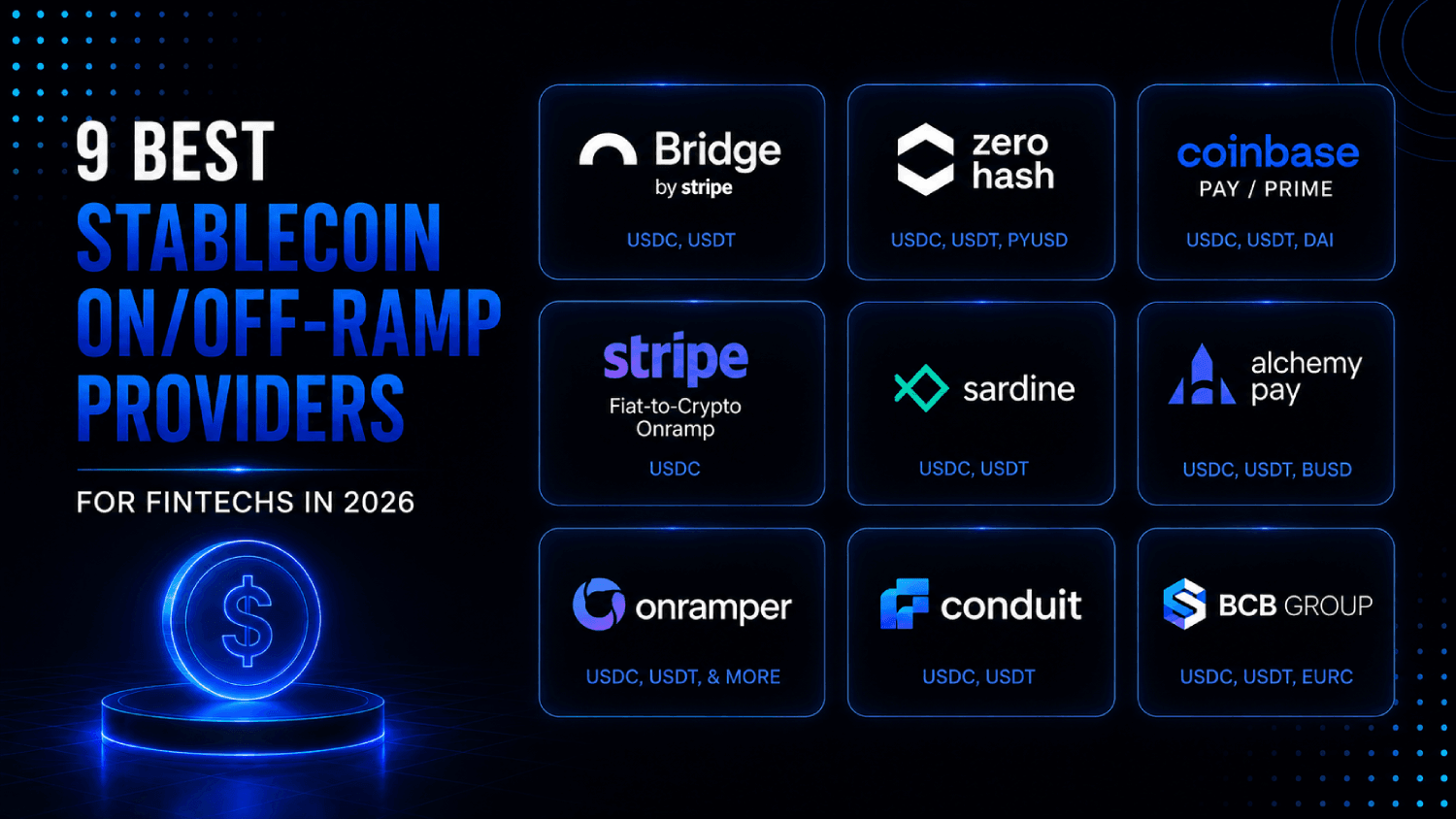
The best stablecoin on-ramp providers for fintechs are Bridge (for US-first corridor depth and API-first design), Zero Hash (for institutional compliance and white-label flexibility), Coinbase Pay, Stripe’s fiat-to-crypto onramp, Alchemy Pay, Sardine, Onramper (as an aggregator layer), Conduit, and BCB Group (for institutional off-ramp and OTC settlement). Each serves a different buyer profile based on settlement speed, licensing geography, and spread structure.
Why Your Ramp Choice Is a Revenue Decision, Not an Infrastructure Detail
Most fintech teams evaluate ramp providers the same way they evaluate a logging library: as long as it works, it does not matter which one. That framing is wrong, and it costs money every day it persists.
Consider a concrete scenario. Say a Series A neobank is converting $300,000 per month from ACH deposits into USDC for cross-border settlement. Provider A charges a 1.0% spread on the fiat-to-stablecoin conversion. Provider B charges 0.5%. The delta is $1,500 per month, $18,000 per year, at that volume alone , before the company scales. That is not a rounding error. That is a marketing budget.
Spread is only part of it. If your ramp provider does not support the local payment methods your end users actually have , SPEI in Mexico, PIX in Brazil, UPI in India, Interac in Canada , your conversion funnel breaks before a single transaction completes. No payment method, no conversion. No conversion, no product.
The fintech infrastructure stack has a ramp layer, and it sits between your banking partner and your stablecoin settlement logic. Treating it as interchangeable with the wallet SDK it ships inside is one of the more expensive fintech infrastructure mistakes a builder can make. Here is how to actually evaluate it.
How to Score a Ramp Provider: The FintechSpecs Ramp Audit Grid
Before the list of providers, a framework. The FintechSpecs Ramp Audit Grid is a four-dimension scoring model for comparing on/off-ramp vendors at the infrastructure layer. It forces specificity where most vendor evaluations stay vague.
Dimension 1: Corridor Coverage Score. Map every fiat corridor you need today and every corridor in your 18-month roadmap. Score each provider by what percentage of those corridors it covers natively , not through a third-party aggregator it wraps. Native coverage means tighter spreads and faster debugging when rails go down.
Dimension 2: Spread Transparency Rating. Does the provider publish its FX spread on its public pricing page? Does it distinguish between network fees and its own margin? Providers that bundle everything into a single percentage make it impossible to audit your actual cost. Prefer providers that show the interbank rate and their markup separately.
Dimension 3: Licensing Depth. In the US, a legitimate ramp provider needs money transmitter licenses (MTLs) in most or all states where it operates, plus FinCEN registration. Some providers operate under a partner bank’s license and have geographic restrictions they do not advertise prominently. Verify the license map before you sign.
Dimension 4: Settlement Speed by Rail Type. Same-day ACH, RTP via FedNow, wire, and card each have different settlement windows. A provider that only supports next-day ACH for fiat ingestion adds 24 hours to every on-ramp transaction. Know the exact settlement timeline by rail before you benchmark conversion rates.
What Is the Difference Between a Direct Ramp and a Ramp Aggregator?
A direct ramp connects your platform to a single provider’s liquidity pool, compliance stack, and payment rails. A ramp aggregator sits in front of multiple direct ramps and routes each transaction to whichever provider offers the best rate, coverage, or conversion likelihood for that user’s geography and payment method.
Direct ramps typically offer lower spreads because you are not paying an aggregation margin. They require you to negotiate and integrate one provider at a time, and gaps in their corridor coverage become your problem. Aggregators solve corridor gaps fast , you integrate once and get access to whatever network of providers the aggregator has assembled , but that convenience has a cost embedded in the spread or a per-transaction fee.
For a US fintech focused on domestic USDC settlement with occasional Latin America corridors, a single direct provider likely outperforms. For a platform building multi-region cross-border flow from day one, an aggregator layer is often the faster path to coverage, with the option to renegotiate direct terms once volume justifies it. The fintech infrastructure stack shows exactly where this layer sits relative to banking and settlement.
The 9 Best Stablecoin On-Ramp Providers for US Fintechs
| Provider | Best For | US MTL Coverage | Spread Transparency | Aggregator or Direct | Key Stablecoins |
|---|---|---|---|---|---|
| Bridge (Stripe) | API-first US fintechs, embedded finance | Broad | Moderate | Direct | USDC, USDT |
| Zero Hash | Institutional, white-label, B2B2C | Broad | High | Direct | USDC, USDT, PYUSD |
| Coinbase Pay / Coinbase Prime | High volume, exchange liquidity depth | Broad | Moderate | Direct | USDC, USDT, DAI |
| Stripe Fiat-to-Crypto Onramp | SaaS and marketplace builders on Stripe | Broad (US focus) | Low (bundled) | Direct via Stripe | USDC |
| Sardine | Fraud-sensitive ramp flows, compliance-heavy | Broad | Moderate | Direct | USDC, USDT |
| Alchemy Pay | Global local payment methods, crypto-native apps | Partial | Low | Direct + partner network | USDC, USDT, BUSD |
| Onramper | Aggregation, corridor breadth, fastest time-to-market | Via partners | Variable | Aggregator | USDC, USDT, and more |
| Conduit | Stablecoin-native cross-border settlement for B2B | Growing | Moderate | Direct | USDC, USDT |
| BCB Group | Institutional off-ramp, OTC desk access | Partial (EU primary) | High | Direct | USDC, USDT, EURC |
1. Bridge (now part of Stripe)
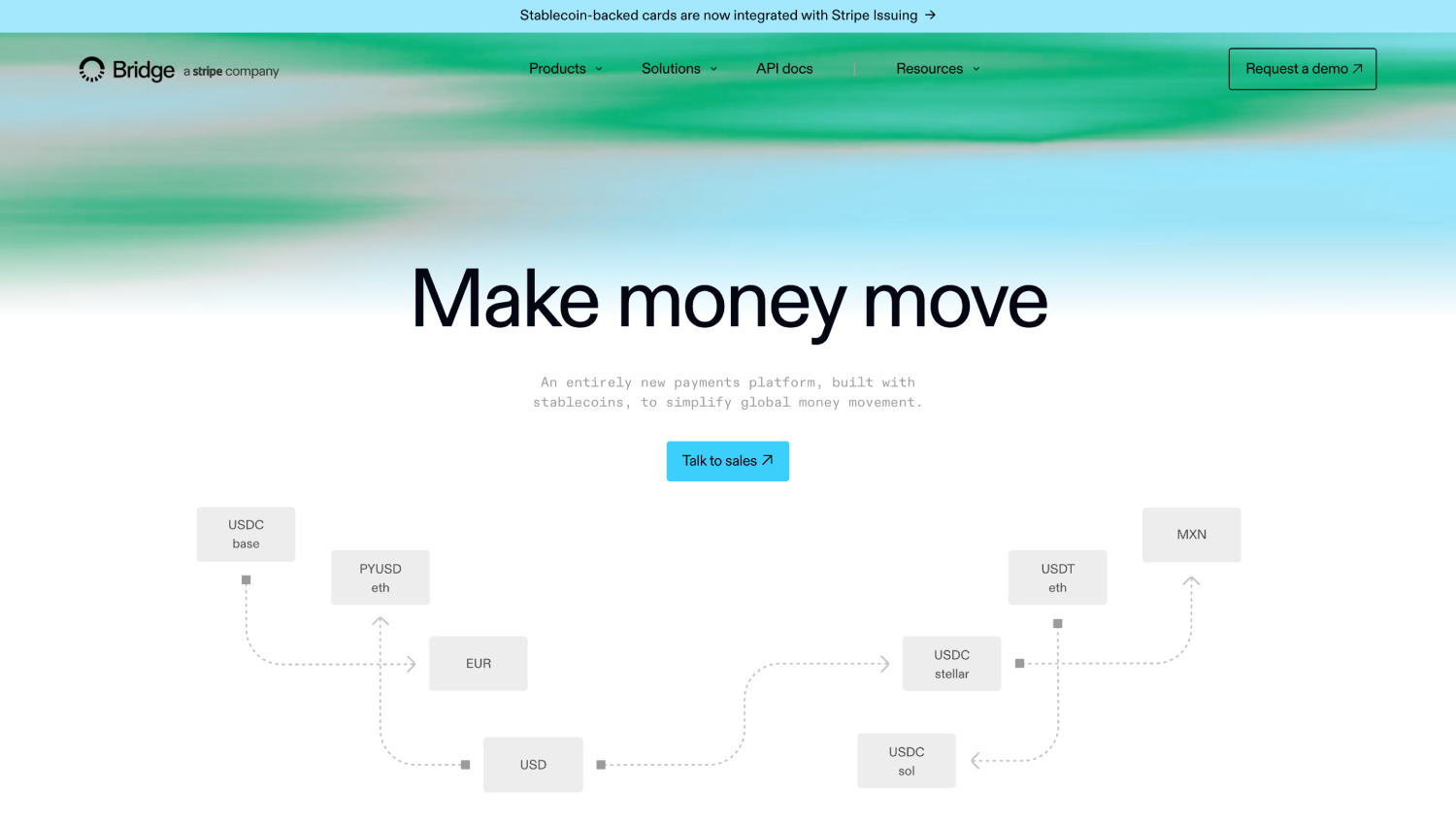
Bridge is the closest thing the market has to a purpose-built stablecoin rails company aimed at fintech developers. Stripe acquired Bridge in 2024, and the product has since been positioned as the stablecoin settlement backbone for platforms that want USDC and USDT flows embedded directly into their product rather than bolted on. According to Stripe’s public announcements, Ramp’s stablecoin accounts are powered by Bridge’s infrastructure alongside Privy and Stripe’s own rails.
The API is developer-oriented, with virtual account issuance for fiat ingestion and programmable routing to stablecoin wallets. For a US fintech that wants to give business customers a USD-denominated stablecoin account with ACH and wire on-ramp and USDC settlement on the back end, Bridge is the most direct path. The Stripe acquisition adds card rails and an established compliance organization, though pricing is not fully transparent on Bridge’s public pages , teams should expect to negotiate on volume.
The one structural consideration: being inside the Stripe orbit means your ramp strategy is partly tied to Stripe’s roadmap. That is fine if you are already deeply on Stripe. If you are not, evaluate independence before committing.
2. Zero Hash
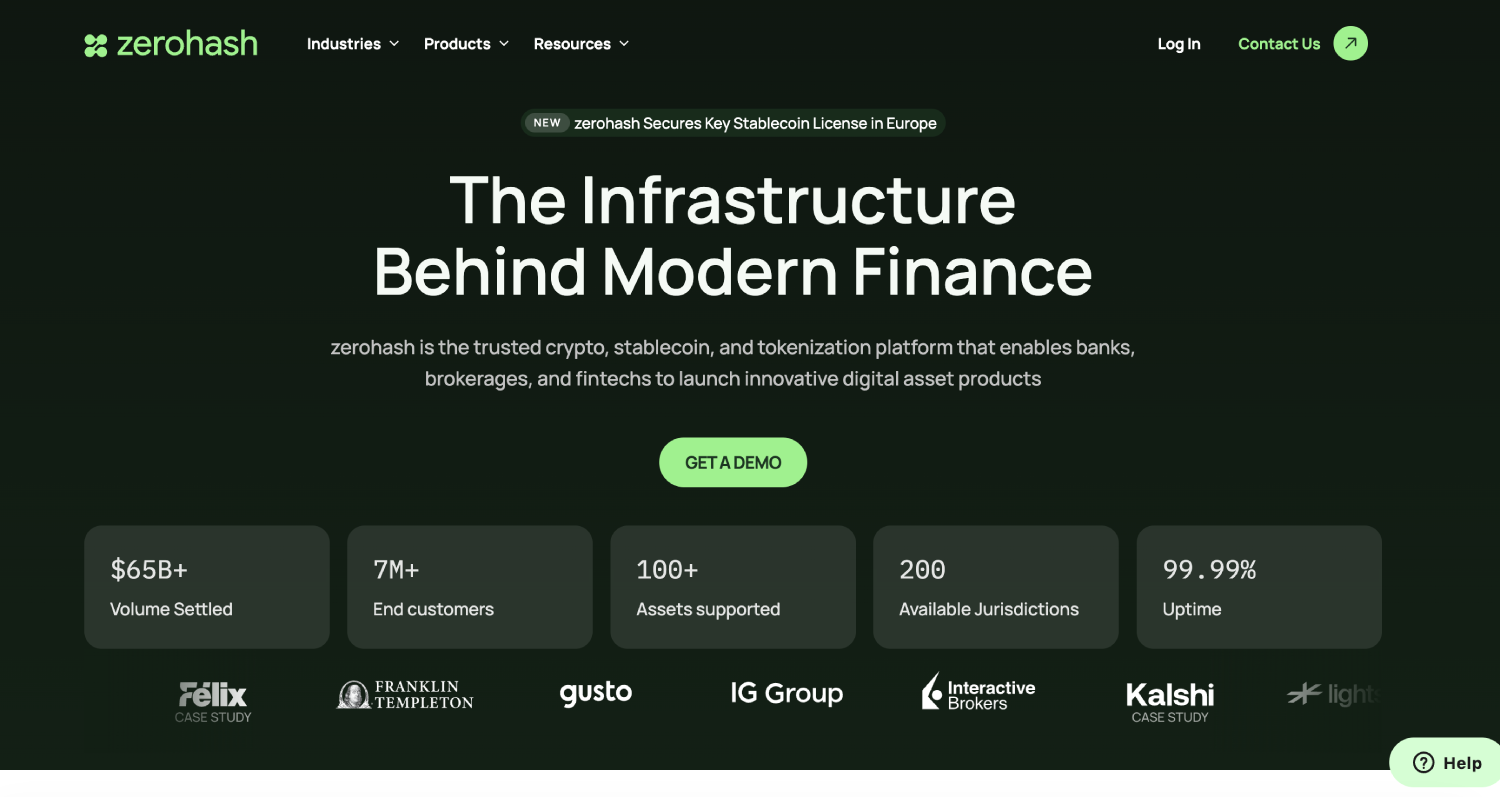
Zero Hash operates as a regulated digital asset infrastructure provider, meaning it holds the licenses and maintains the compliance stack while its clients (fintechs, neobanks, exchanges) build product on top. It holds money transmitter licenses across US states and is designed explicitly for the B2B2C model , your platform is the customer-facing product, Zero Hash is the white-labeled engine underneath.
The spread transparency here is better than most. Zero Hash publishes its fee structure more openly than competitors, distinguishing network fees from its own margin. Settlement speed depends on the rail, but the platform supports same-day settlement in some corridors. For an embedded finance product where your users buy stablecoins through your UI without knowing Zero Hash exists, this is one of the cleaner infrastructure fits in the market.
Zero Hash also supports PayPal USD (PYUSD) alongside USDC and USDT, which matters if your user base overlaps with PayPal’s consumer base and you want interoperability. The platform’s compliance posture is notably strong , it was built for institutional adoption from day one, not retrofitted for compliance after the fact.
3. Coinbase Pay and Coinbase Prime
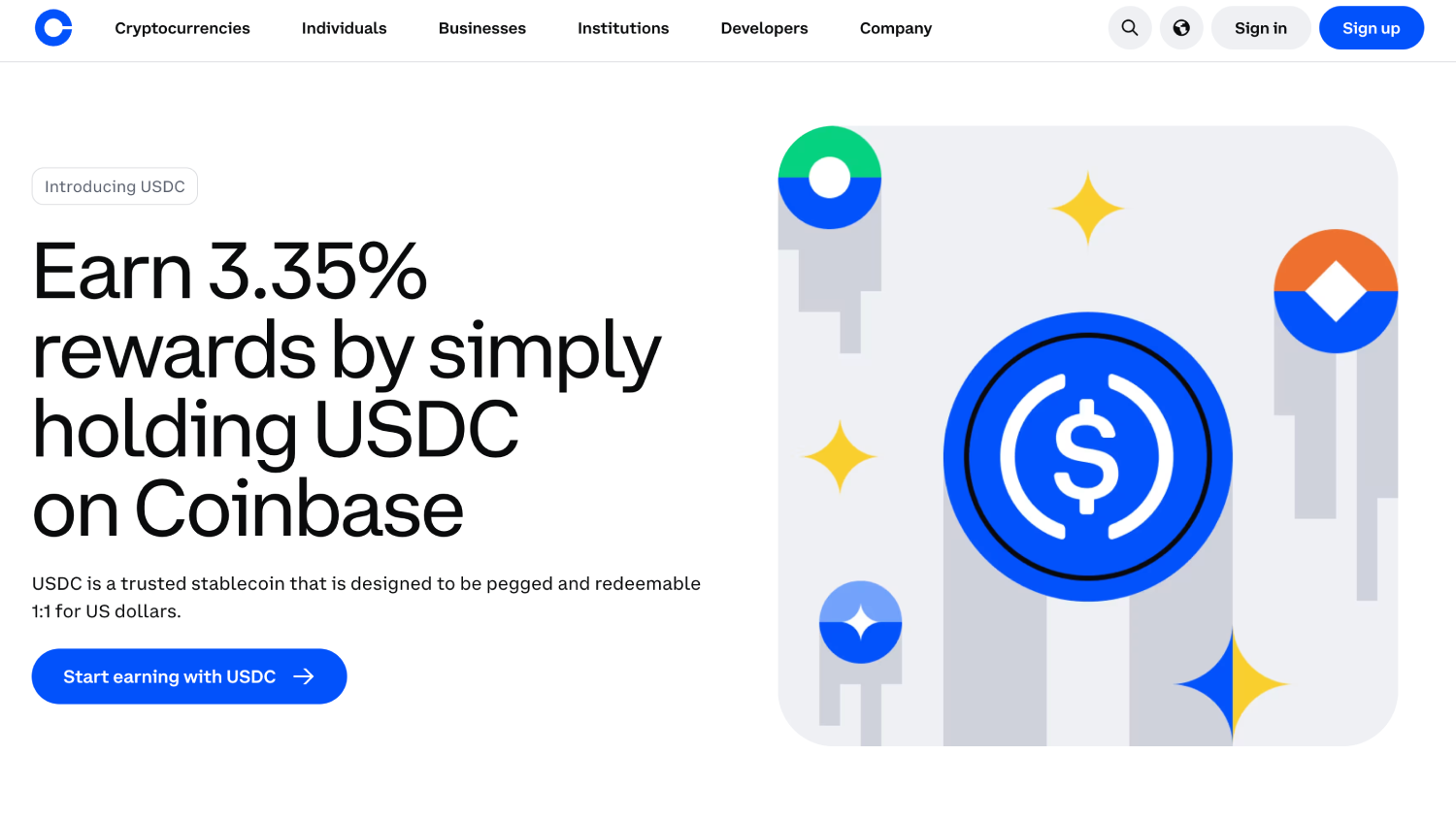
Coinbase Pay gives retail-facing products a fast on-ramp into USDC using Coinbase’s existing user base , if a customer has a Coinbase account, they can fund your platform product without re-entering payment details or going through KYC again. That re-use of existing identity is the core value proposition, and it is real.
Coinbase Prime is the institutional layer for platforms with higher volume and custody requirements. Liquidity depth is a genuine advantage here , Coinbase’s exchange order book means you are not fighting thin liquidity on large USDC conversions. For a platform moving $5 million or more per month in stablecoin volume, Coinbase Prime’s liquidity access is worth comparing against broker quotes from Zero Hash or Bridge.
The downside is lock-in. Coinbase’s ramp infrastructure works best when your users are also on Coinbase. For platforms serving users who have never touched a crypto exchange, the Coinbase Pay flow adds friction rather than removing it. Spread disclosure is also less granular than Zero Hash , the all-in fee is easier to find than the interbank rate markup.
4. Stripe Fiat-to-Crypto Onramp
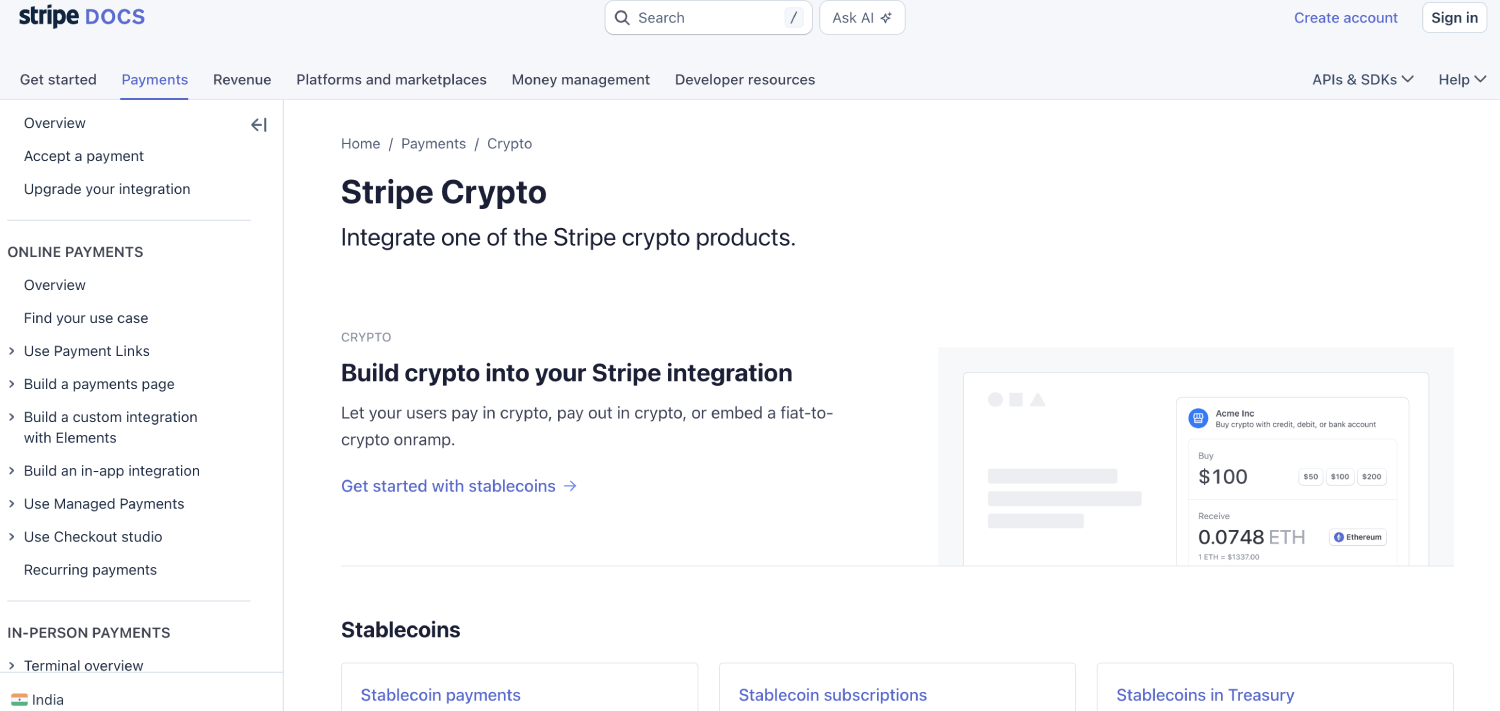
Stripe’s fiat-to-crypto onramp is the most obvious choice for any platform already running payments through Stripe. The product allows users to convert fiat to USDC directly inside your UI, with Stripe handling KYC, fraud checks, and compliance. The integration is documented and relatively fast to ship.
The trade-off is cost opacity. Stripe bundles its fee structure in a way that makes it hard to isolate the FX spread from the payment processing fee and the network gas costs. For teams doing forensic margin analysis , which any fintech at Series B or later should be doing , this bundling makes auditing difficult. Stripe’s model works best when convenience and speed to market matter more than basis-point optimization. It is genuinely the fastest path to live stablecoin on-ramp for a Stripe-native product, and that speed has real value.
5. Sardine
Sardine started as a fraud and compliance infrastructure company and built its ramp product around that capability. The implication for fintechs: if your on-ramp flow has high fraud exposure , think consumer-facing USDC purchases funded by debit card or bank account , Sardine’s fraud detection runs inline with the conversion, not as a separate check after the transaction clears.
This matters because most ramp providers run fraud checks that are generic rather than stablecoin-specific. Sardine’s device intelligence, behavior analytics, and bank account verification are designed for exactly this transaction type. The spread is competitive but not publicly listed in granular form , expect a sales conversation to get real numbers. For compliance-heavy regulated products, the all-in cost of a Sardine integration (ramp plus fraud, in one vendor) often beats the cost of assembling those two capabilities separately.
Sardine is a strong fit for US consumer fintech apps where fraud on the on-ramp is a real operational concern. If your users are institutional or your fraud rates are already low, the premium for Sardine’s fraud layer may not be warranted. Pairing a ramp evaluation with a broader look at fraud detection and risk tools is worth doing before finalizing this decision.
6. Alchemy Pay
Alchemy Pay differentiates primarily through its local payment method coverage. The platform supports payment methods across Southeast Asia, Europe, and Latin America , more regional variety than most US-first providers. For a US fintech with a meaningful non-US user base, Alchemy Pay’s coverage can fill corridors that Bridge or Zero Hash do not natively cover.
The US MTL coverage is partial rather than comprehensive, which is a real constraint for products that need 50-state coverage. Spread transparency is limited , the public-facing documentation is lighter on fee specifics than competitors. Alchemy Pay is best evaluated as a supplemental provider for corridors your primary US ramp does not reach, rather than as a US-first primary provider.
7. Onramper (Aggregator)
Onramper is the clearest example of the aggregator model in this market. It routes transactions across a network of direct ramp providers , including some providers on this list , and selects the best available option for each transaction based on geography, payment method, and conversion likelihood. The stated benefit is coverage breadth: corridors that no single direct provider covers fully are often reachable through Onramper’s partner network.
The cost is layered. Onramper charges a fee on top of whatever the underlying provider charges, so your effective spread is always higher than it would be with a direct integration on the same provider. For early-stage teams that want to launch in five corridors on day one without five separate compliance integrations, Onramper’s convenience is worth the premium. For teams that have volume data and know exactly which corridors matter, moving to direct provider relationships will reduce cost at the expense of integration work.
Onramper is a time-to-market trade. Buy it early, refinance it later. That is a legitimate strategy as long as you build in a corridor review at the 12-month mark.
8. Conduit
Conduit targets B2B cross-border stablecoin settlement specifically. Rather than focusing on consumer on-ramp flows, Conduit is built for platforms that need to move USDC or USDT between business accounts across borders, settle to local fiat on the receiving end, and reconcile at scale. The product is more infrastructure-layer than widget.
For a US fintech running a B2B marketplace or a cross-border payout product, Conduit’s stablecoin-native rail approach is worth evaluating alongside traditional wire and ACH payout options. This is especially relevant for teams already thinking about cross-border payout APIs as a core infrastructure component. Settlement speed and corridor coverage are still growing, so teams with established, high-volume corridors should benchmark Conduit against a mature provider before committing.
9. BCB Group
BCB Group is a London-headquartered regulated financial services firm that operates as an institutional-grade off-ramp and OTC settlement provider. If your platform needs to convert large stablecoin positions back into fiat efficiently , think treasury operations, settlement of accumulated USDC balances, or providing crypto-to-fiat for institutional counterparties , BCB’s OTC desk access and direct banking relationships matter more than the consumer-facing UX of the other providers on this list.
BCB Group holds its primary regulatory authorizations in Europe, which limits applicability for US-domestic consumer use cases. For US fintechs with cross-Atlantic institutional flow , or for any platform managing stablecoin treasury positions that need to be liquidated reliably without market impact , BCB is a legitimate option at the institutional layer. The pricing is negotiated, not published.
Do You Need a Ramp Provider If Your PSP Already Supports Stablecoins?
This is the most common shortcut teams take, and it almost always costs more than the team realizes. When a PSP tells you it “supports stablecoins,” that statement typically means one of two things: it has a white-label integration with one of the providers on this list, or it has built a thin wrapper around a single exchange’s API. In both cases, you are paying the PSP’s margin on top of the underlying ramp provider’s spread.
The PSP layer adds value in areas like reconciliation, billing, and customer support. It does not add value in areas like FX pricing, corridor coverage, or settlement speed , those are determined by the ramp underneath. Buying the ramp through your PSP is convenient but expensive once volume grows past a point where the margin delta matters.
A reasonable test: ask your PSP to disclose which ramp provider it uses for stablecoin conversion and what spread it passes through versus what it marks up. If the PSP cannot or will not answer that question, you are paying an opaque blended fee that benefits the PSP, not your margin. This is part of a broader pattern described in the FintechSpecs analysis of hidden costs in fintech SaaS margins.
Which Stablecoin On-Ramp Providers Cover the Most US Payment Methods?
For a US fintech, local payment method coverage means ACH, RTP (FedNow and The Clearing House RTP), wire, and debit card on the fiat-ingestion side. Most providers on this list support all four, but the nuances matter.
Same-day ACH carries a per-transaction limit of $1 million, per Nacha’s published rules. RTP via FedNow or TCH carries the same $1 million per-transaction limit, per The Clearing House’s published RTP documentation. Wire has no practical cap but costs more per transaction. If your on-ramp use case involves large individual transactions, confirming that your provider supports wire ingestion at competitive pricing is non-negotiable.
Card-funded on-ramps (debit card to USDC) carry a different cost structure entirely. Card interchange on the funding side can add 1.5% to 2.5% before any ramp spread is applied. Providers that allow card funding are generally passing that cost to the end user through a higher visible fee. That is disclosed more clearly by some providers (Zero Hash, for example) than others. For business-to-business use cases, card funding is rarely the right rail anyway , ACH or wire funding is standard.
How Does FX Spread on a Stablecoin Ramp Actually Work?
When a user sends $1,000 USD via ACH and expects to receive $1,000 worth of USDC, the ramp provider takes a cut in one of three ways: a visible percentage fee shown at checkout, a spread embedded in the exchange rate (so the user receives $980 of USDC for $1,000 of fiat), or a combination of both.
The embedded-in-rate model is the one to watch. It looks like a 1:1 conversion on the surface, but the rate the provider quotes is not the interbank rate , it is the interbank rate minus the provider’s margin. This is structurally identical to how most consumer FX products work, and it is why “zero-fee” on-ramps still generate revenue. Providers that show the interbank rate alongside their fee (Zero Hash does this more transparently than most) let you audit the real cost of conversion. Providers that show only the output amount make that audit nearly impossible without running the calculation yourself using a live mid-market rate from a source like the ECB or Xe.
For any fintech building a product where the stablecoin conversion is a visible step to the end user, spread transparency at the UI layer is also a trust question. Ramp UX that obscures the spread drives churn. The trust-breaking mistakes fintech products make almost always include opaque fee structures at moments of conversion.
What Compliance Considerations Apply to Stablecoin Ramp Integrations in the US?
Every on/off-ramp provider operating in the US that converts between fiat and digital assets is conducting money transmission under FinCEN guidance. That means your ramp provider needs FinCEN registration and, in most states, individual money transmitter licenses. As of writing, MTL requirements vary significantly by state , New York’s BitLicense adds a layer on top of the standard MTL regime that most smaller providers do not hold.
When you integrate a ramp provider, you are relying on their license coverage, not your own. If a provider lacks coverage in a state where your users reside, transactions from those users may not be legally permissible through that provider. This is not theoretical , it is one of the reasons several ramp providers exclude New York residents from their products. Verify the license map for every provider you evaluate before you launch, and treat license gaps the same way you would treat a payment rail gap. Building a fintech compliance readiness checklist before selecting infrastructure vendors is the right sequence.
KYC requirements flow from the same regulatory regime. Most ramp providers handle KYC for the conversion transaction itself. If your platform has already KYC’d the user, you may be able to pass that verification through to the ramp provider under a shared KYC or reliance arrangement , but this depends entirely on the provider’s compliance posture and your own legal agreements with them. Do not assume it works this way without explicit confirmation in the contract.
Frequently Asked Questions
What is a stablecoin on-ramp for fintech?
A stablecoin on-ramp converts fiat currency , usually USD via ACH, wire, or debit card , into a stablecoin like USDC or USDT. For fintechs, a stablecoin on-ramp provider handles the conversion mechanics, KYC compliance, and often the custody or wallet infrastructure underneath. The on-ramp is the entry point into stablecoin-denominated settlement or payment rails. Without it, your platform cannot accept fiat and settle in stablecoin without building that conversion logic from scratch against exchange APIs.
What is a crypto off-ramp for business use?
A crypto off-ramp converts stablecoins or other digital assets back into fiat and deposits the proceeds into a bank account via ACH or wire. For businesses, off-ramps are used to liquidate stablecoin treasury balances, pay vendors in fiat from a USDC-denominated account, or settle accumulated stablecoin revenue. The off-ramp provider handles the conversion, compliance reporting, and fiat settlement. BCB Group and Zero Hash are both used for institutional off-ramp at scale. Settlement timelines range from same-day to T+2 depending on the provider and rail.
Do I need a separate ramp provider if my payment processor already handles stablecoins?
Not necessarily, but you should know what your PSP is doing under the hood. Most PSPs that offer stablecoin support are white-labeling one of the dedicated ramp providers and marking up the spread. If your volume is low and the convenience of a single vendor matters more than margin optimization, the PSP route is acceptable. Past roughly $100,000 per month in stablecoin conversion volume, the cost of the PSP’s margin on top of the underlying provider’s spread usually exceeds the integration cost of going direct to the ramp provider. The break-even point depends on your PSP’s specific fee structure.
Which ramp provider covers the most local payment methods for US fintechs?
For US-domestic payment methods (ACH, RTP, wire, debit card), Bridge, Zero Hash, and Coinbase Pay all offer comprehensive coverage. For non-US local payment methods , SPEI, PIX, UPI, Interac, SEPA , Alchemy Pay and the Onramper aggregator offer broader corridor reach than US-first direct providers. US fintechs serving global users typically combine a US-first direct provider for domestic volume with an aggregator or Alchemy Pay for international corridors, rather than trying to find one provider that covers everything at competitive spreads.
How long does stablecoin on-ramp settlement take?
Settlement speed depends on the fiat rail used to fund the on-ramp. ACH standard settlement takes one to three business days. Same-day ACH settles within hours but has cutoff windows. RTP via FedNow or TCH settles in seconds, 24/7, but provider support for RTP as a funding rail is still limited , Bridge and Zero Hash both support it, but not every provider does. Wire funding is typically same-day if sent before the provider’s cutoff. Card-funded on-ramps are the fastest from a user-experience standpoint but carry the highest cost.
What is the difference between USDC and USDT for an on-ramp integration?
USDC is issued by Circle and is audited monthly for reserve backing. USDT is issued by Tether and operates on a broader set of blockchains. For US fintechs, USDC is generally the preferred stablecoin for regulated product integrations due to Circle’s compliance posture and its alignment with institutional counterparties. Most ramp providers support both. The technical integration is similar , the difference is who holds the reserve and what attestation you can present to compliance teams, auditors, or banking partners who ask about the stablecoin your platform holds.
What licenses does a stablecoin ramp provider need to operate in the US?
At minimum: FinCEN registration as a money services business. In most states: a state money transmitter license. In New York: a BitLicense issued by NYDFS, which is a separate and more demanding regime. Providers without a New York BitLicense cannot legally service New York residents for fiat-to-crypto conversion. Some providers operate under an agreement with a licensed partner bank rather than holding MTLs themselves , this model can work but introduces additional counterparty dependency that you should evaluate as part of your vendor risk assessment.
What is a ramp aggregator and when does it make sense?
A ramp aggregator sits in front of multiple direct ramp providers and routes each transaction to the best available option based on geography, payment method, and pricing. Onramper is the clearest example in the stablecoin market. Aggregators make sense when you need to launch quickly across many corridors and do not yet have the volume data to justify individual direct integrations. The trade-off is cost: the aggregator charges a layer on top of the underlying provider’s spread. Once you know which corridors drive the majority of your volume, replacing the aggregator with direct integrations on those high-volume corridors reduces cost while the aggregator handles the long tail.
What the Right Ramp Decision Actually Looks Like
The providers on this list are not interchangeable. Bridge and Zero Hash are direct competitors for the embedded finance, white-label use case , and the choice between them comes down to whether you are inside the Stripe orbit or building independently. Coinbase Pay is the right call when your users already have Coinbase accounts and you want to re-use their identity verification. Sardine is the right call when fraud on the conversion is your biggest operational risk, not cost. Onramper is the right call when you need coverage in fifteen countries on day one and you will trade margin for time.
The FintechSpecs Ramp Audit Grid forces the four questions that actually matter: which corridors, what spread, which licenses, and how fast. Run your shortlist of two or three providers through those four dimensions with real numbers from your transaction data, not hypothetical volume. The provider that wins that comparison is your provider , regardless of which one ships inside the wallet SDK your engineering team already has open in a browser tab.
Ramp infrastructure sits inside a broader payment layer that most fintech teams have not fully mapped. If the stablecoin rails question opened up questions about the rest of your payment stack, the analysis of payment infrastructure tools for SaaS founders covers the adjacent layers in comparable depth.