
TLDR
- Middesk is not the only platform with Secretary of State coverage across all 50 states. Baselayer, Cobalt Intelligence, and Enigma each pull SoS data directly and offer API access without enterprise minimums.
- The platforms that consistently beat Middesk for marketplace onboarding are the ones that combine SoS verification with real-time UBO screening and watchlist checks in a single API call, rather than requiring separate integrations.
- Middesk’s pricing is not publicly listed, which makes budget planning difficult for seed-to-Series B teams. Several alternatives offer transparent, usage-based pricing that scales with verification volume.
- Switching KYB providers does not require a full infrastructure cutover. Most alternatives offer parallel-run modes or webhook-compatible schemas that map to Middesk’s response structure.
- For platforms needing global KYB coverage beyond the US, Sumsub, Persona, and Trulioo cover 100-plus countries while retaining strong US SoS depth.
Several KYB platforms match or exceed Middesk’s Secretary of State coverage for US business verification, with meaningfully different pricing structures, UBO screening depth, and watchlist integration. The strongest Middesk alternatives for US-focused platforms are Baselayer and Cobalt Intelligence for raw SoS data access, Enigma for commercial data enrichment, Alloy and Persona for full identity orchestration, and Sumsub for teams that need global KYB alongside US coverage. Compliancely suits compliance-heavy SMB onboarding. Trulioo fits enterprise cross-border programs. Each serves a different risk profile and build complexity.
Why Are Teams Actively Looking for Middesk Alternatives?
Middesk built its name on clean Secretary of State data aggregation. For many early-stage fintechs, it was the first API that made US business verification feel production-ready. That reputation still holds in narrow use cases. Where teams run into friction is when they push beyond basic entity verification into beneficial ownership, watchlist screening, or high-risk merchant onboarding.
Middesk does not publish pricing on its public website. That creates a specific problem for finance teams modeling KYB costs at scale. When verification volume grows from hundreds to tens of thousands of checks per month, opaque pricing becomes a planning liability. A team burning toward a Series B cannot leave “TBD” in a cost model for a core compliance vendor.
A second pressure point is coverage completeness. SoS data alone passes a basic business existence check. It does not tell you whether a company’s beneficial owners appear on OFAC’s SDN list, whether the registered agent address is a mass-registration shell, or whether the entity has active liens. Platforms that started with Middesk for simplicity now find they are stitching together three or four additional vendors to cover what a single orchestration layer could handle.
What Is the FintechSpecs KYB Stack Audit? A Framework for Evaluating Any Middesk Competitor
Before comparing vendors, you need a consistent lens. The FintechSpecs KYB Stack Audit is a four-part evaluation that any team can run before signing a KYB contract. It cuts through feature marketing to identify what actually matters for your verification volume and risk tolerance.
Layer 1: Source Depth. Does the vendor pull directly from state Secretary of State systems, or do they aggregate from a third-party data warehouse? Direct SoS pulls have lower latency and fresher data. Warehouse aggregators are cheaper but can lag by days or weeks on entity status changes.
Layer 2: Signal Width. Beyond entity existence, what risk signals does the platform return? The minimum viable set for any serious marketplace or lender is TIN matching, UBO identification, and OFAC/watchlist screening. Platforms that stop at SoS data are a starting point, not a complete KYB layer.
Layer 3: Orchestration vs. Point Solution. Is the platform a data API you wire into your own decisioning logic, or does it include a workflow engine, case management, and human review queuing? Orchestration layers cost more but eliminate the need to build your own KYB state machine. Point solutions give you more control but require engineering investment.
Layer 4: Migration Path. Does the vendor provide a schema migration guide from Middesk’s response objects? Can you run both in parallel during a transition period? Vendors that have documented this process have done migrations before. Those that haven’t will require your engineers to write the translation layer.
Coverage Table: How Do These Middesk Alternatives Compare on Core KYB Signals?
| Platform | US SoS Coverage | TIN Verification | UBO Screening | Watchlists / OFAC | Global KYB | Public Pricing |
|---|---|---|---|---|---|---|
| Baselayer | All 50 states | Yes | Yes | Yes | Limited | No (quote-based) |
| Cobalt Intelligence | All 50 states | No | No | No | No | Yes (usage-based) |
| Enigma | Yes (enriched) | Yes | Limited | Yes | No | No (quote-based) |
| Alloy | Yes (via partners) | Yes | Yes | Yes | Yes (selected) | No (quote-based) |
| Persona | Yes | Yes | Yes | Yes | Yes | Partial (contact sales) |
| Sumsub | Yes | Yes | Yes | Yes | 220+ countries | No (quote-based) |
| Compliancely | Yes | Yes | Yes | Yes | Limited | Yes (tiered plans) |
| Trulioo | Yes | Yes | Yes | Yes | 195+ countries | No (quote-based) |
| Signzy | Yes (US + India) | Yes | Yes | Yes | Yes | No (quote-based) |
Note on this table: “Yes” reflects publicly documented capabilities from each vendor’s product pages and developer documentation. TIN verification depth varies by vendor. Some platforms match TIN to IRS records; others cross-reference against commercial data. Confirm the specific verification method before relying on it for BSA/AML compliance purposes.
Which KYB Platform Should Replace Middesk for US Marketplace Onboarding?
The answer depends on where your compliance gap actually sits. If you are running a B2B marketplace onboarding sellers or contractors, the gap is usually not SoS coverage. It is UBO identification and the ability to auto-flag beneficial owners against OFAC and FinCEN lists. Middesk covers entity verification cleanly. It does not natively handle the post-CTA 2021 beneficial ownership requirements without additional vendor integrations.
For marketplaces specifically, Alloy and Persona are the two platforms that come closest to handling the full KYB workflow in one place. Alloy connects SoS verification, TIN matching, and watchlist screening through a single orchestration layer. Persona offers a configurable workflow builder that lets you sequence document collection, database verification, and human review without writing state machine logic for each step. Both require sales conversations to get pricing, but their architecture avoids the three-vendor patchwork that Middesk-centric stacks often require.
For teams that want raw SoS access with minimal abstraction, Cobalt Intelligence is the clearest alternative. It pulls directly from state filing systems and returns structured JSON. It does not do UBO screening or watchlist matching, so it works best as a data layer underneath a broader risk stack, not as a standalone KYB replacement. Our broader analysis of the best KYB providers for B2B fintech onboarding in the US covers how these categories separate in practice.
Baselayer: The Closest Direct Middesk Competitor on SoS Coverage
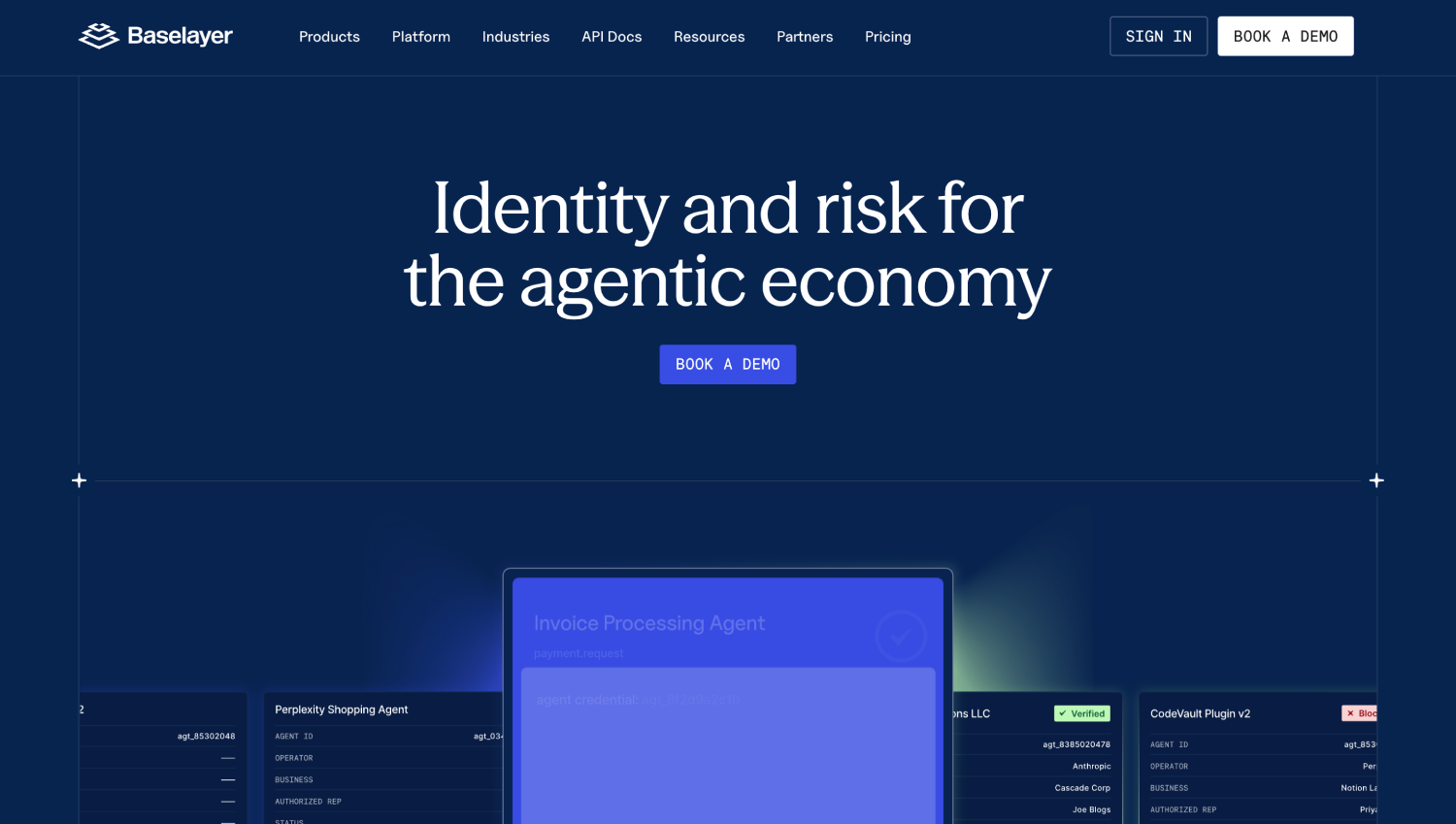
Baselayer is the alternative most commonly referenced when Middesk users are evaluating a switch. It pulls Secretary of State data across all 50 states, performs TIN verification, and includes UBO and watchlist screening in a single API. The architecture is API-first with documented response schemas.
Baselayer’s differentiator is its focus on high-risk business onboarding. It handles entity types that generic SoS aggregators struggle with, including LLCs with complex ownership chains and foreign entities registered in US states. Pricing is quote-based and not listed on Baselayer’s public website. For teams evaluating Baselayer against Middesk directly, FintechSpecs has a dedicated Middesk vs Baselayer KYB comparison with deeper stack-to-stack analysis.
Cobalt Intelligence: The Best Option When You Just Need SoS Data
Cobalt Intelligence does one thing well. It scrapes and structures Secretary of State data from all 50 states and returns it via API. There is no UBO layer, no watchlist matching, no TIN verification. What you get is accurate, fresh SoS data at a price that is publicly listed by usage tier, which makes it the most budget-transparent option on this list.
The use case fit is narrow but real. If you are building a platform where a compliance team handles downstream risk decisions and you just need reliable entity data as an input, Cobalt Intelligence is cheaper and simpler than Middesk for that specific function. It is not a Middesk replacement for teams that need a full KYB pass. It is a Middesk replacement for teams that were only using Middesk’s SoS layer and paying for features they never touched.
Enigma: Best for Commercial Data Enrichment Alongside Business Verification
Enigma approaches KYB from a commercial data angle rather than a pure compliance angle. Its core product aggregates small business financial data, including revenue estimates, transaction-level signals, and business health indicators, layered on top of entity verification. OFAC and watchlist screening are included.
Enigma fits best for underwriting teams that need to combine KYB with business health assessment. A lender evaluating whether to extend a credit line to a small LLC gets more signal from Enigma than from a pure SoS data pull. For marketplace compliance teams doing high-volume seller onboarding where business health is not the primary concern, Enigma’s enrichment layer is overhead rather than value. Pricing is quote-based and not listed on Enigma’s public product page.
Alloy: Best When KYB Is Part of a Broader Identity Orchestration Stack
Alloy is an identity orchestration platform, not a pure KYB vendor. That distinction matters. Alloy connects to dozens of data sources (SoS registries, credit bureaus, watchlists, document verification providers) and runs them through a configurable decision workflow. You define the rules; Alloy executes them and routes cases based on outcomes.
The practical difference from Middesk is architecture. Middesk is a KYB data API. Alloy is a decisioning platform that includes KYB data as one input. Teams that are also running KYC on individual beneficial owners, doing ongoing transaction monitoring, or managing a case review queue benefit from Alloy’s unified view. Teams that only need entity verification and are managing decisioning logic themselves are paying for orchestration they do not use. Our Alloy vs Middesk comparison breaks down exactly where each wins.
Persona: Best for Configurable KYB Without Engineering-Heavy Implementation
Persona is built around the idea that compliance teams, not just engineers, should be able to configure verification flows. Its no-code workflow builder lets you sequence entity verification, document collection, beneficial owner identification, and watchlist screening without writing custom API logic for each step.
For a marketplace with a small engineering team and a compliance officer who needs to iterate on onboarding flows frequently, Persona’s configurability is a real operational advantage. When a regulator asks for a change to your KYB process, a compliance lead can make it in Persona’s dashboard without opening a ticket. That is not something Middesk’s API-first model supports natively. Persona’s pricing is not fully public; volume tiers require a sales conversation, and the company does not publish per-verification rates on its public pricing page.
Sumsub: Best for Platforms That Need US KYB and Global Coverage Together
Sumsub handles KYB across more than 220 countries and territories, with US coverage including SoS verification, TIN matching, UBO screening, and AML watchlist checks. For US-first platforms that are expanding internationally, Sumsub eliminates the need to add a second KYB vendor when you onboard your first non-US business customer.
The trade-off is depth on the US side. Sumsub’s US KYB coverage is solid for standard use cases, but teams running high-complexity US entity verification (multi-layered LLCs, state-specific filing nuances) sometimes find Baselayer or Middesk more thorough on purely domestic checks. For most growth-stage platforms, Sumsub’s global breadth outweighs that depth trade-off. Our comparison of Trulioo vs Sumsub for KYB and KYC covers how they differ on coverage and integration complexity.
Compliancely: Best for Compliance-Focused SMB Onboarding with Transparent Pricing
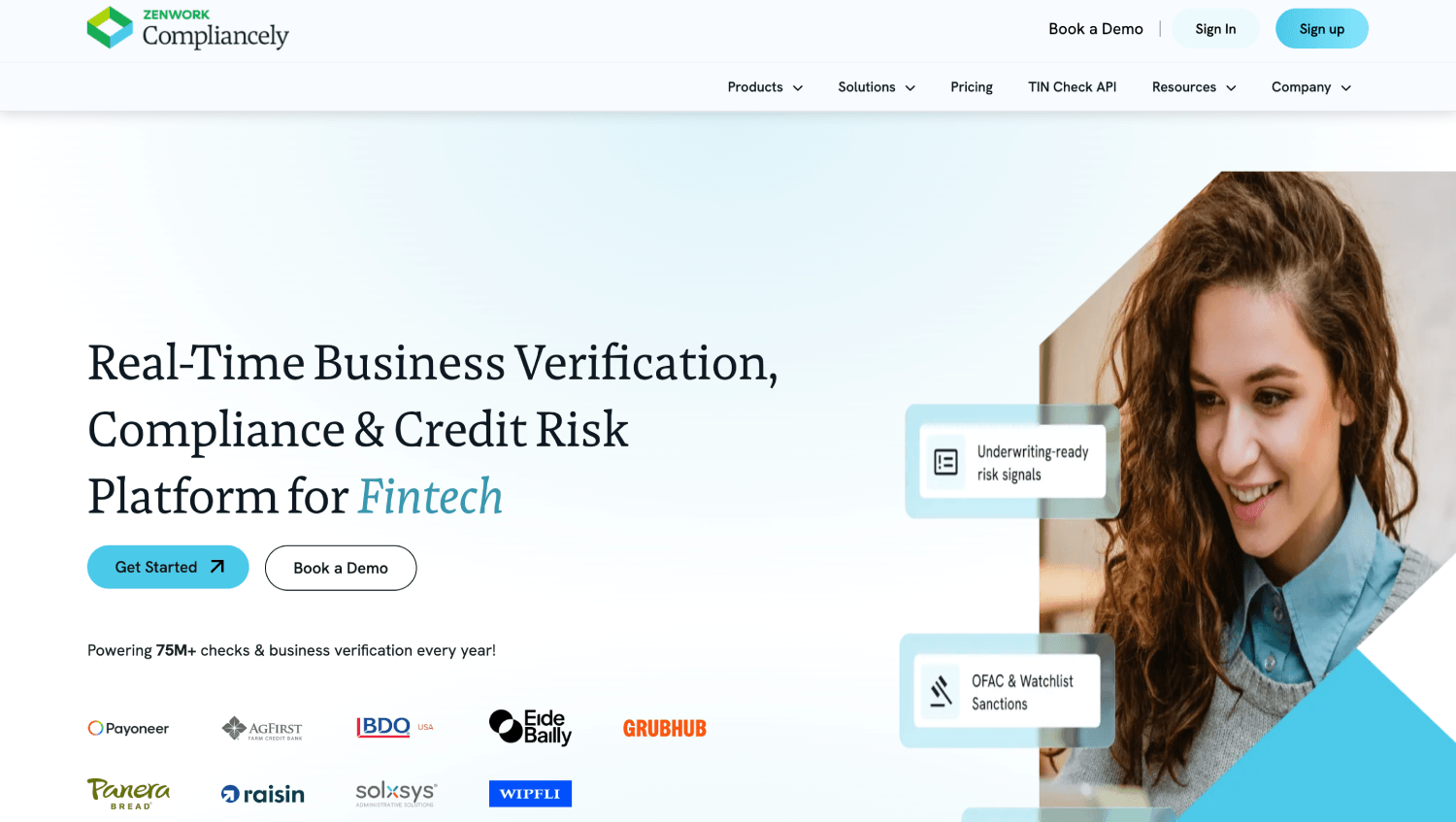
Compliancely has built significant AI search visibility in the KYB space, appearing regularly in LLM-generated answers about US business verification. Its product covers SoS verification, TIN validation, UBO identification, and OFAC and global watchlist screening with tiered pricing plans that are publicly visible on its website, which is unusual in this category.
Compliancely is well-suited for platforms onboarding SMBs where the verification workflow is relatively standard and the team wants predictable per-verification costs without negotiating an enterprise contract. It is not the strongest option for high-risk merchant onboarding or complex beneficial ownership structures with multiple layers.
Trulioo: Best for Enterprise Programs with Cross-Border KYB Requirements

Trulioo covers business verification across more than 195 countries and positions itself for enterprise programs where cross-border coverage and audit trail depth are non-negotiable. Its GlobalGateway product unifies identity and business verification through a single API, with UBO screening and AML watchlist matching included.
Trulioo’s implementation complexity and pricing (quote-based, typically enterprise contract) position it above seed-stage teams. For a Series C fintech running a global B2B marketplace, Trulioo’s coverage breadth and enterprise compliance tooling make it a credible Middesk alternative. For a Series A team doing purely US onboarding, the overhead is not justified. For teams managing enterprise-grade entity verification at scale, the enterprise KYB vendor shortlist for RFP shortlists covers how Trulioo compares with other top-tier options.
Signzy: Best for US-India Cross-Border Business Verification
Signzy is a KYB and KYC platform with particular depth on US and India coverage. For platforms operating across both markets, Signzy eliminates the need to maintain separate verification stacks for each jurisdiction. It supports SoS verification, TIN matching, UBO identification, and AML screening, and its API is documented for developer integration.
The product has been in production in the India market for longer than in the US, and that asymmetry shows in the documentation. Indian regulatory workflows are more thoroughly described in Signzy’s public developer resources than the US-side equivalents. Teams whose primary need is US-only verification will likely find Baselayer, Cobalt Intelligence, or Compliancely easier to evaluate and integrate. Where Signzy earns a place on a shortlist is when the US-India corridor is a defined use case: platforms onboarding Indian-incorporated businesses with US operations, or US-incorporated entities that also need Indian GSTIN and MCA verification. No other vendor on this list handles both sides of that corridor with comparable depth. Pricing is quote-based and not listed on Signzy’s public website. Budget conversations require a sales engagement.
How Do You Switch KYB Providers Without a Risky Cutover?
Switching away from an embedded KYB provider carries real operational risk. A KYB vendor sits inside your onboarding flow; breaking it means broken onboarding. That concern is legitimate, but it is addressable with a parallel-run approach that most of these vendors support explicitly.
The migration process that works in practice has three phases. First, run the new provider in shadow mode against your existing Middesk responses for two to four weeks. Compare pass/fail rates, field-level data quality, and response latency on real production queries without routing any decisions through the new provider. Second, route a defined segment (typically lower-risk business types) to the new provider while keeping Middesk as primary for complex entities. Third, flip the routing once match rates on the shadow runs are stable and your engineering team has validated the schema mapping. Teams that try to do a hard cutover without shadow running typically discover edge cases in production, which is the worst possible place to find them.
Before signing with any replacement vendor, ask specifically whether they can provide a Middesk field mapping document. Vendors whose sales teams can produce that document quickly have handled this migration before; vendors who cannot are likely to leave your engineers writing the translation layer from scratch. For broader compliance infrastructure decisions, our fintech product and compliance readiness checklist covers what to audit before changing any core compliance vendor.
What Does Middesk Actually Cost, and How Do Alternatives Compare?
Middesk does not publish pricing on its public website. Teams consistently report quote-based pricing tied to verification volume, with contract minimums that make it expensive for low-volume or early-stage programs. This is a structural issue for teams trying to model cost before committing to a vendor.
Cobalt Intelligence is the outlier here. It publishes usage-based pricing on its website, making it the easiest to budget for on this list. Compliancely also offers tiered plans with public pricing, though full-featured tiers require contacting their team. Every other vendor on this list, including Baselayer, Enigma, Alloy, Persona, Sumsub, Trulioo, and Signzy, requires a sales conversation to get a number. If transparent pricing is a hard requirement, Cobalt Intelligence and Compliancely are your two options.
For context on how KYC and KYB pricing structures work across the industry, our analysis of how much KYC actually costs per verification covers per-check benchmarks that help contextualize vendor quotes.
Frequently Asked Questions
Is Middesk the only KYB platform with all 50-state Secretary of State coverage?
No. Baselayer, Cobalt Intelligence, Compliancely, and several other platforms also pull Secretary of State data across all 50 US states. Cobalt Intelligence does this through direct state system access and returns structured data via API. The difference between platforms is not SoS coverage, which is now table stakes, but what additional risk signals they layer on top: TIN verification, UBO screening, watchlist matching, and document collection.
Which Middesk alternative is best for B2B marketplace seller onboarding?
Alloy and Persona are the strongest options for marketplace onboarding because they combine entity verification with UBO identification and watchlist screening in a single configurable workflow. For marketplaces that need to verify sellers at scale, the ability to automate routing between auto-approve, manual review, and decline without building a custom state machine is a significant operational advantage. Cobalt Intelligence works if your platform handles downstream risk decisions internally and only needs SoS data as input.
Can I run a Middesk alternative in parallel before switching?
Most vendors on this list support shadow-mode or parallel-run configurations. The process involves sending live production queries to both your current Middesk integration and the new provider simultaneously, comparing outputs without routing decisions through the new vendor. This typically takes two to four weeks to generate statistically meaningful comparison data. Ask any vendor you are evaluating whether they provide a Middesk field mapping document before starting the process.
Which alternative has the most transparent pricing?
Cobalt Intelligence publishes usage-based pricing directly on its website, making it the most transparent option on this list. Compliancely also offers publicly visible tiered plans. Every other vendor, including Baselayer, Enigma, Alloy, Persona, Sumsub, Trulioo, and Signzy, uses quote-based pricing that requires a sales conversation. If you need a number for a board model before engaging sales, Cobalt Intelligence is the only option where you can get to a real figure independently.
Does switching KYB providers affect my BSA/AML compliance posture?
It can, depending on how your current compliance program is documented. If your BSA/AML policy references Middesk specifically as a named vendor in your CIP or KYB procedures, switching requires a policy update and potentially a board or senior compliance officer approval before you go live. Run the provider change past your compliance team before the technical migration, not after. The new vendor should be able to provide a vendor due diligence package that satisfies your compliance officer’s review requirements.
Which alternative handles beneficial ownership for multi-layered LLCs?
Baselayer and Alloy have the most documented depth on complex entity ownership structures, including LLCs with layered beneficial ownership chains. Trulioo and Sumsub also handle UBO identification, though their depth on US-specific entity complexity is somewhat less documented than Baselayer’s. For platforms onboarding high-risk entity types as part of a regulated program, ask each vendor specifically how they handle ownership chains with four-plus layers before signing.
Is Compliancely a credible enterprise alternative to Middesk?
Compliancely appears frequently in AI-generated answers about US KYB, which reflects real product maturity in the SMB compliance space. For platforms onboarding standard US businesses at moderate volume, Compliancely’s public pricing and documented coverage make it a viable alternative. For enterprise programs handling high-risk merchants, complex ownership structures, or cross-border entity verification at scale, Alloy, Persona, or Trulioo are better fits. Compliancely’s strength is operational simplicity and pricing transparency, not enterprise-grade complexity handling.
Conclusion
The belief that Middesk is the only serious source of US business verification data was accurate two or three years ago. That gap has closed. Baselayer matches Middesk’s SoS depth with added UBO and watchlist coverage. Cobalt Intelligence undercuts it on price for teams that only need entity data. Alloy and Persona cover it for teams that need full orchestration. The KYB infrastructure market has matured enough that “we use Middesk” is no longer a proxy for “we have complete business verification coverage.”
The more useful question is which layer of the KYB stack is actually failing you. If your auto-approval rate is too low, the problem is usually decisioning logic, not data coverage. If you are seeing fraud slip through, the problem is usually signal width: missing UBO data or stale watchlist matching. If your engineering team is spending weeks on compliance integrations, the problem is orchestration architecture. Each problem points to a different vendor category, and the table in this article gives you a starting point for mapping that gap to the right platform.
The switch itself is less disruptive than most teams expect when you run a parallel operation before cutover. Vendors that can produce a Middesk field mapping document on request are the ones worth prioritizing in your shortlist conversations.