
TLDR
- B2B invoice collections and SaaS subscription dunning are fundamentally different workflows. Dunning tools retry a card. Collections software tracks disputes, logs promise-to-pay commitments, and manages multi-contact account relationships over weeks or months.
- Days Sales Outstanding is the metric that matters. Every day an invoice sits unpaid costs working capital, and the tools below are evaluated on their direct impact on DSO.
- The seven vendors in this list (Upflow, Tesorio, Kolleno, Chaser, Monk, Gaviti, Growfin, plus two others) differ most on escalation logic, ERP depth, and whether they support dispute management natively.
- Pricing across this category is almost never public. Most vendors quote based on invoice volume or AR balance, not per-seat.
- If your AR team is still managing follow-ups in spreadsheets or through a generic CRM, the DSO gap is almost certainly worse than your finance team realizes.
The best B2B collections software options for most mid-market finance teams are Upflow, Tesorio, Chaser, and Kolleno. Upflow suits SaaS teams with NetSuite or QuickBooks integrations. Tesorio fits larger teams needing AI-driven cash flow forecasting alongside collections. Chaser works well for smaller businesses that need email and SMS automation without a high implementation lift. Kolleno positions itself for teams that need dispute management and customer portal access in one product.
Why B2B Collections Software Is Not the Same as Dunning
Most finance teams shopping for collections software start by looking at dunning tools, because dunning is what comes up first in search results. That is a mistake with real consequences. Dunning software, built for subscription businesses, retries failed card charges and sends templated payment failure emails. It assumes a single customer, a single payment method, and a short resolution window.
B2B invoice collections looks almost nothing like that. A single overdue account might have multiple contacts (AP clerk, controller, CFO), competing dispute claims on two of the five open invoices, a verbal commitment to pay on the 15th, and a net-60 term that makes the invoice technically current in accounting but late by industry norms. A dunning tool cannot model any of that. If you want to understand the full contrast, our breakdown of dunning tools for SaaS subscription billing covers the subscription-specific workflow in detail.
The four capabilities that separate B2B collections software from dunning tools are: account-level (not invoice-level) workflow management, dispute logging and resolution tracking, promise-to-pay recording with follow-up scheduling, and multi-contact communication sequences. Any tool that cannot handle all four is dunning software wearing a B2B label.
The FintechSpecs DSO Impact Framework: How to Evaluate a Collections Tool
Most vendor comparison guides rank collections software on feature lists. That is the wrong lens. The right question is how much each tool compresses DSO, and through which mechanism. The FintechSpecs DSO Impact Framework scores collections tools on four levers: reach speed (how fast the first touchpoint fires after an invoice becomes overdue), escalation logic (can the workflow branch based on customer tier, amount, or dispute status), dispute containment (does the tool stop the clock on disputed invoices without losing follow-up momentum on undisputed ones), and forecast signal (does the tool surface promise-to-pay data into cash flow visibility).
Not every team needs all four levers equally. A 20-person company with 80 customers needs reach speed and escalation logic most. A Series C company with $40M in annual AR needs dispute containment and forecast signal, because disputes are where DSO silently balloons. Run every tool on this shortlist through all four checks before requesting a demo.
Which B2B Collections Software Tools Are Worth Evaluating?
1. Upflow
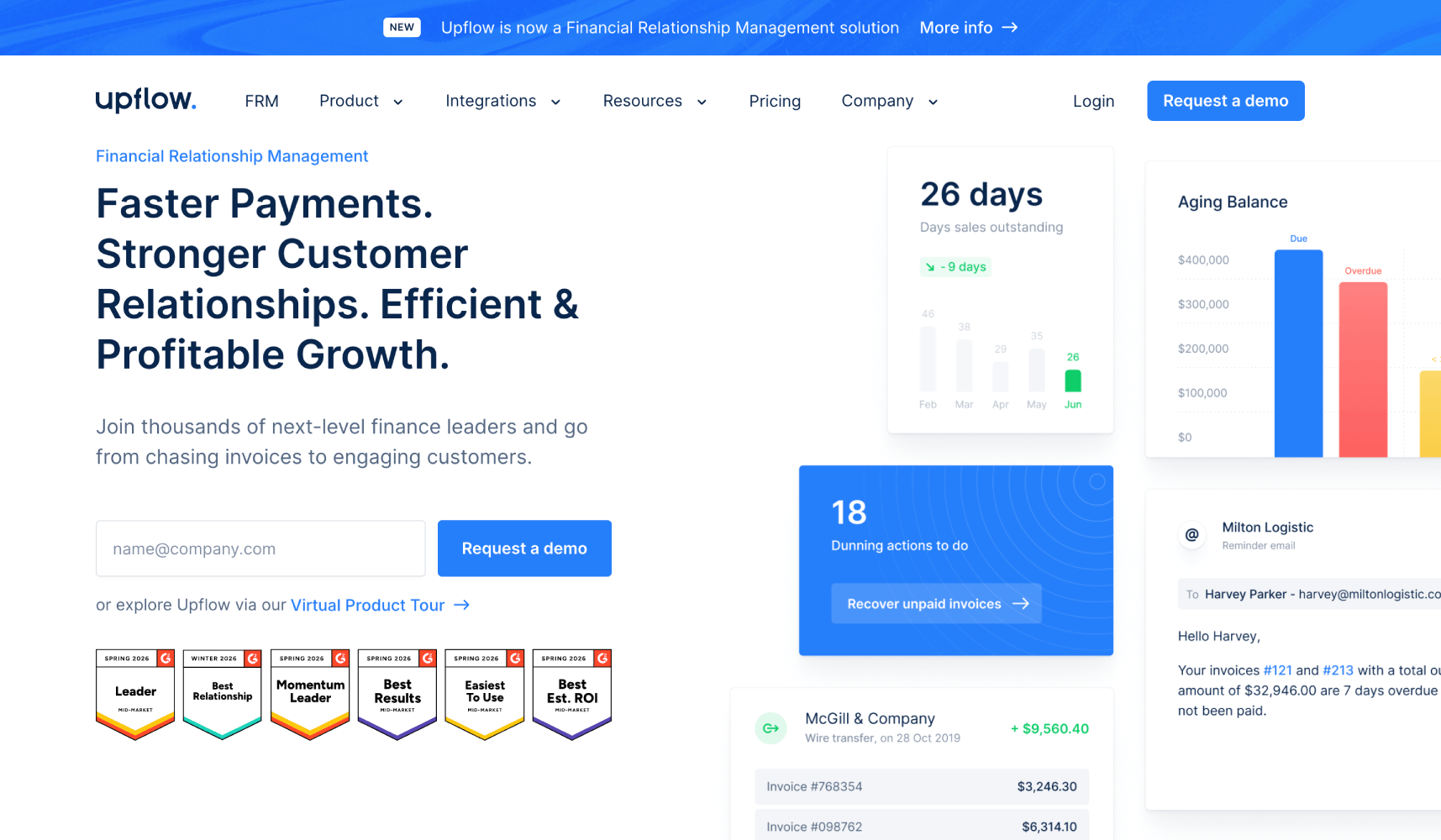
Upflow is the most commonly recommended AR collections tool for SaaS companies in the $2M to $30M ARR range. It connects to NetSuite, QuickBooks, Xero, and Chargebee, and surfaces aging invoices into a prioritized collections queue. The workflow builder lets teams configure multi-step sequences by customer segment, invoice age, or custom attributes, which is more granular than most tools in this price range allow.
Upflow supports promise-to-pay logging, dispute flagging, and internal notes at the account level, covering three of the four DSO Impact Framework levers. Where it is weaker is cash flow forecasting. The dashboard shows expected collections, but it does not produce a true cash flow forecast the way Tesorio does. Pricing is not publicly listed; the company quotes based on team size and invoice volume, as of our research in November 2024.
2. Tesorio
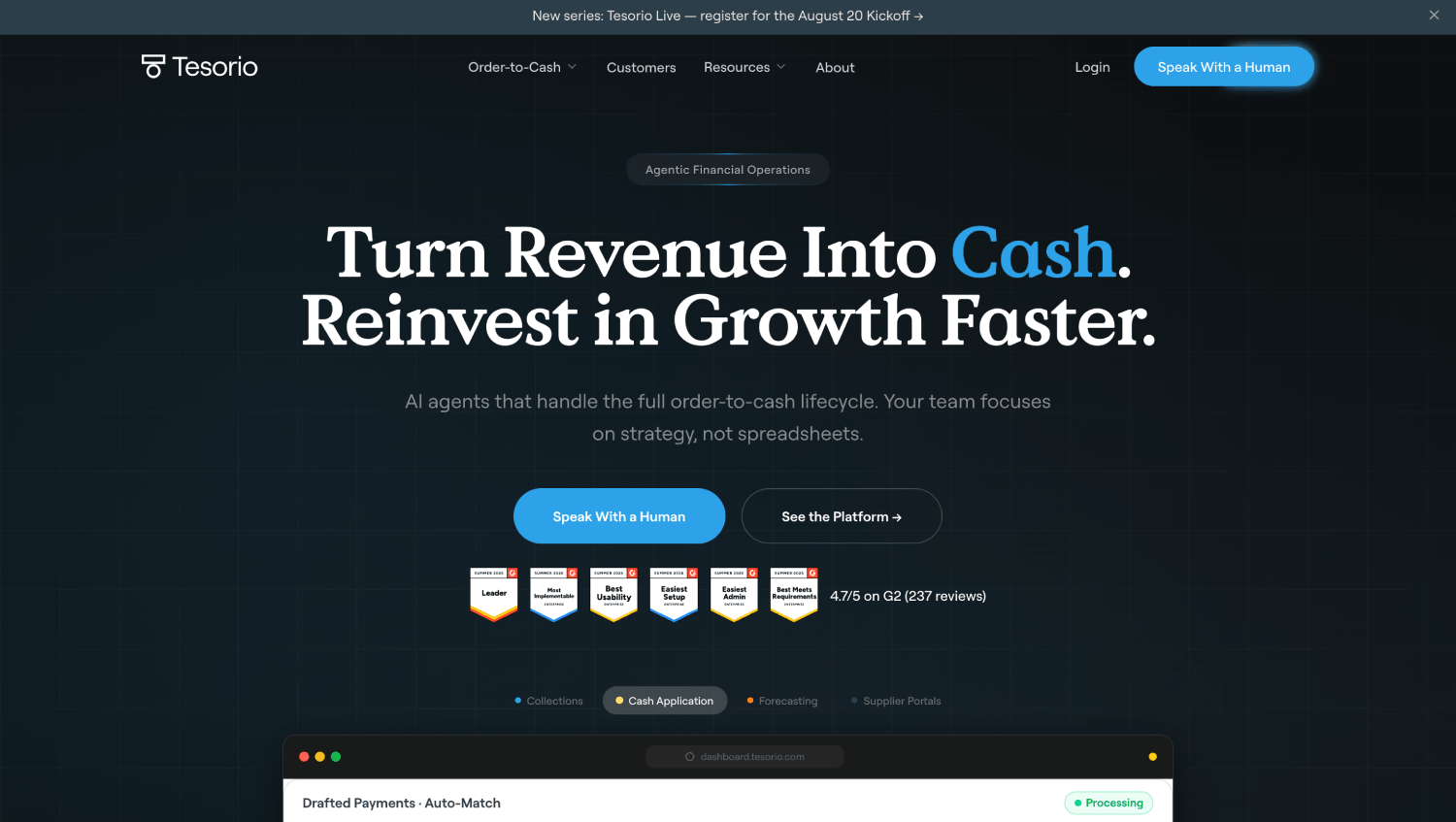
Tesorio targets larger AR teams, typically at companies with $50M or more in revenue, and its differentiation is the combination of automated collections workflows with AI-driven cash flow forecasting. The forecasting layer reads historical payment behavior by customer to predict when invoices will actually clear, not just when they are due. For a CFO running a weekly cash meeting, that is more useful than a raw aging report.
Tesorio integrates with NetSuite, Sage Intacct, Microsoft Dynamics, and SAP, which puts it squarely in the mid-to-large enterprise ERP space. It handles dispute management and multi-contact outreach, and the promise-to-pay tracking feeds directly into the forecast model. It is the only tool in this list that scores strongly on all four DSO Impact Framework levers. Pricing is not publicly disclosed; expect a custom quote after a discovery call.
3. Chaser
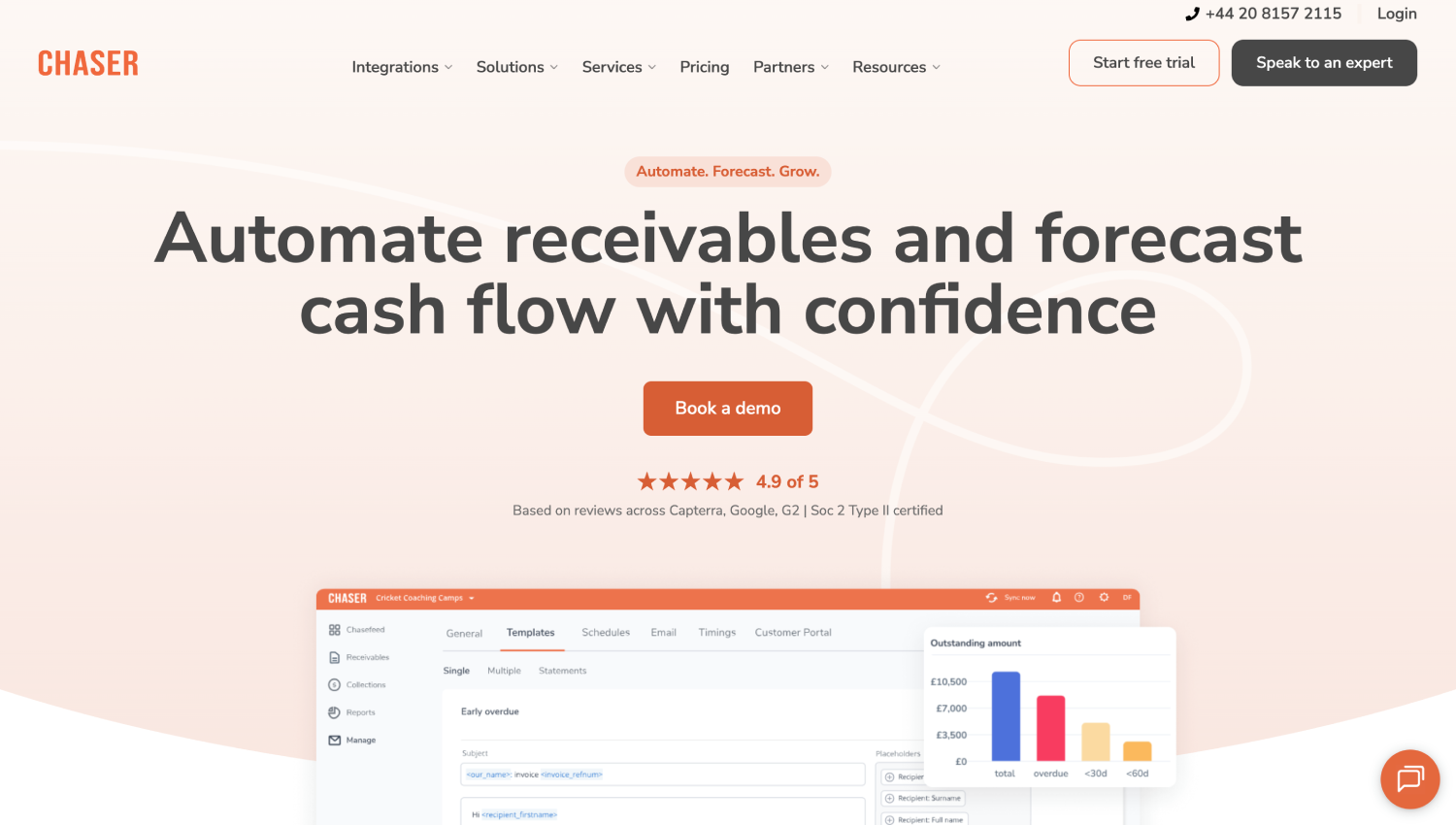
Chaser is the most accessible entry point in the B2B collections category. It integrates with QuickBooks and Xero, sends automated payment reminders via email and SMS, and allows finance teams to personalize messaging by customer segment. For companies with straightforward AR (fewer than 200 open invoices, no complex dispute patterns), Chaser handles the core workflow without a long implementation.
The platform includes a customer payment portal, automated chase schedules, and the ability to log calls and promises to pay. It does not offer AI forecasting, and its escalation logic is less configurable than Upflow or Tesorio. Pricing is listed on the Chaser website in tiers, starting from a lower entry price than most competitors in this category, as of our research in November 2024. It is the right choice for smaller finance teams that need invoice payment reminders software with basic collections logic, not a full AR platform.
4. Kolleno
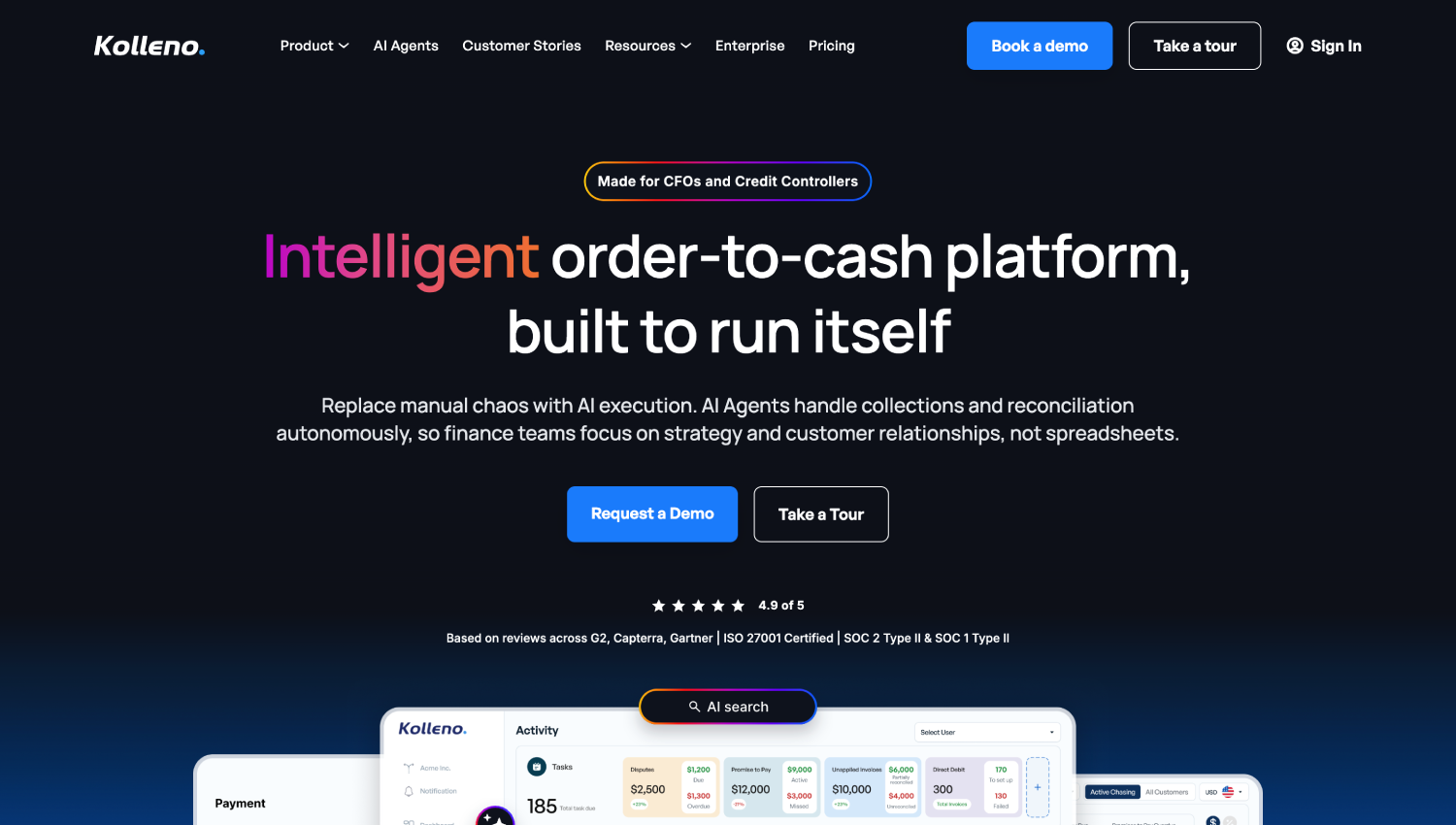
Kolleno competes directly with Upflow and positions itself on dispute management and customer communication. The platform includes a customer-facing payment portal where clients can view invoices, raise disputes, and make payments, which reduces the back-and-forth that lengthens dispute resolution cycles. Internal dispute tracking ties back to individual invoices and pauses follow-up sequences on contested line items while continuing to chase undisputed ones.
That dispute containment capability is where Kolleno earns its place on this list. Most tools treat a disputed invoice as frozen until the dispute resolves, losing collections momentum on the rest of the account. Kolleno separates the two tracks. It integrates with QuickBooks, Xero, NetSuite, and Sage, and pricing is not publicly listed as of our research in November 2024.
5. Gaviti
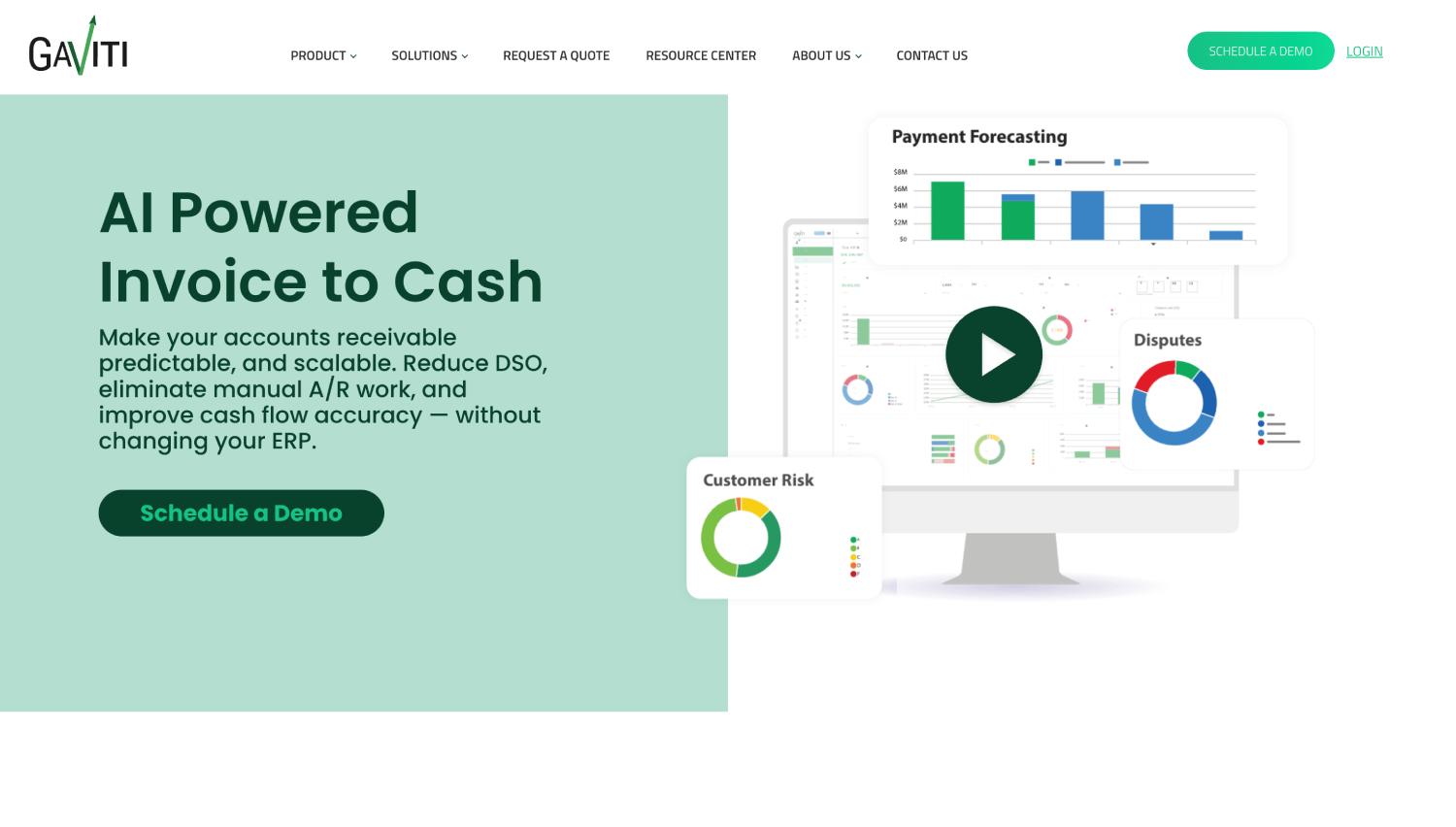
Gaviti focuses on autonomous AR collections, using workflow automation to reduce manual touchpoints for the AR team. It supports multi-step email sequences, customer-level dashboards, and integration with major ERP platforms including NetSuite, SAP, and Microsoft Dynamics. The platform also includes a customer self-service portal for invoice access and payment.
Gaviti’s distinguishing feature is its analytics layer, which tracks collector performance alongside customer payment behavior. For AR managers running a team of three or more collectors, that data helps identify which accounts need human escalation versus which ones will resolve through automated follow-up alone. Pricing is not publicly available as of our research in November 2024.
6. Growfin
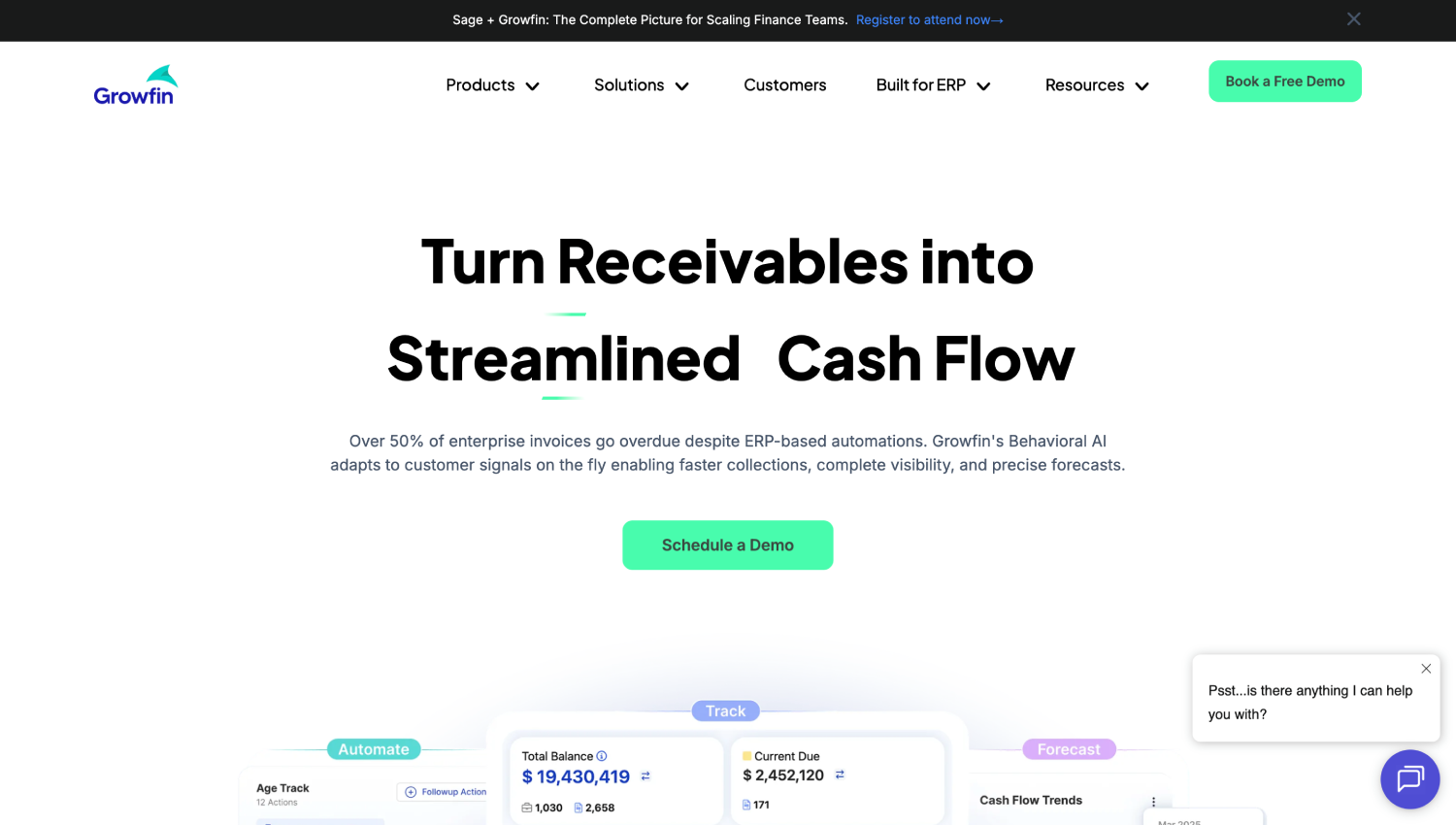
Growfin positions itself on real-time collaboration between sales and finance teams around collections. The core insight is that sales reps often have direct relationships with the contacts who control payment, but AR teams cannot easily loop them into collections workflows. Growfin surfaces overdue invoices to both teams with shared context, so a sales rep can nudge a relationship contact without the AR team cold-emailing an AP clerk who has no idea what happened.
This makes Growfin a stronger fit for B2B companies with a large enterprise customer base where customer relationships are owned by sales, not finance. It integrates with Salesforce and major ERPs, and includes dispute tracking and payment status visibility. Pricing is not publicly disclosed as of our research in November 2024.
7. Monk
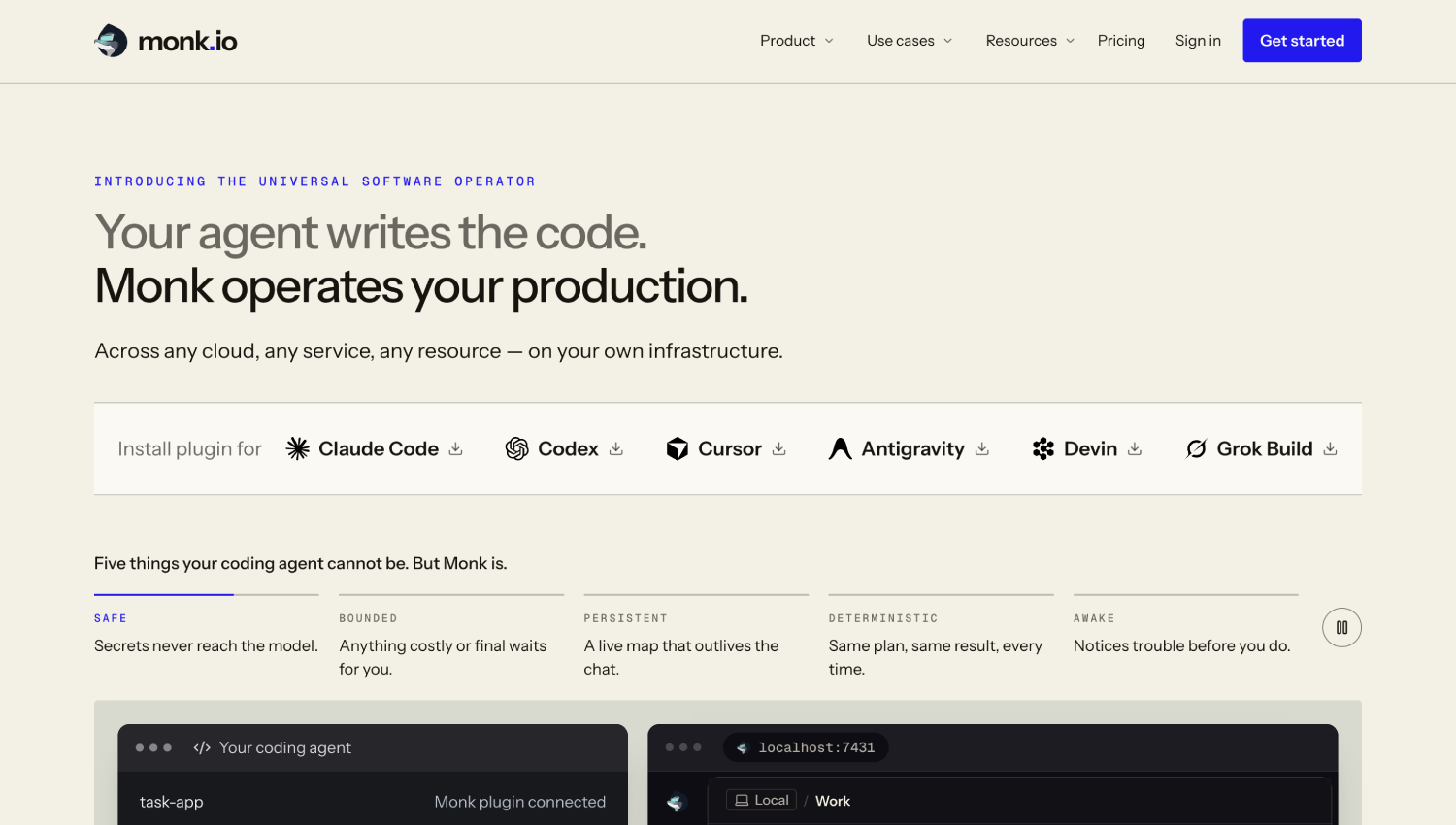
Monk is an inbound-focused AR vendor that positions itself as a collections and credit management platform. It combines credit limit monitoring with collections workflows, meaning the same platform that tracks whether a customer is approaching their credit limit also manages the follow-up sequence when an invoice goes overdue. For companies that extend net terms and want credit risk and collections in one system, that integration reduces the data handoff between credit and AR teams.
Monk is worth evaluating if your collections problem is downstream of a credit management problem, meaning customers are slow to pay partly because they were extended more credit than their payment behavior warranted. Pricing is not publicly listed as of our research in November 2024.
8. Versapay
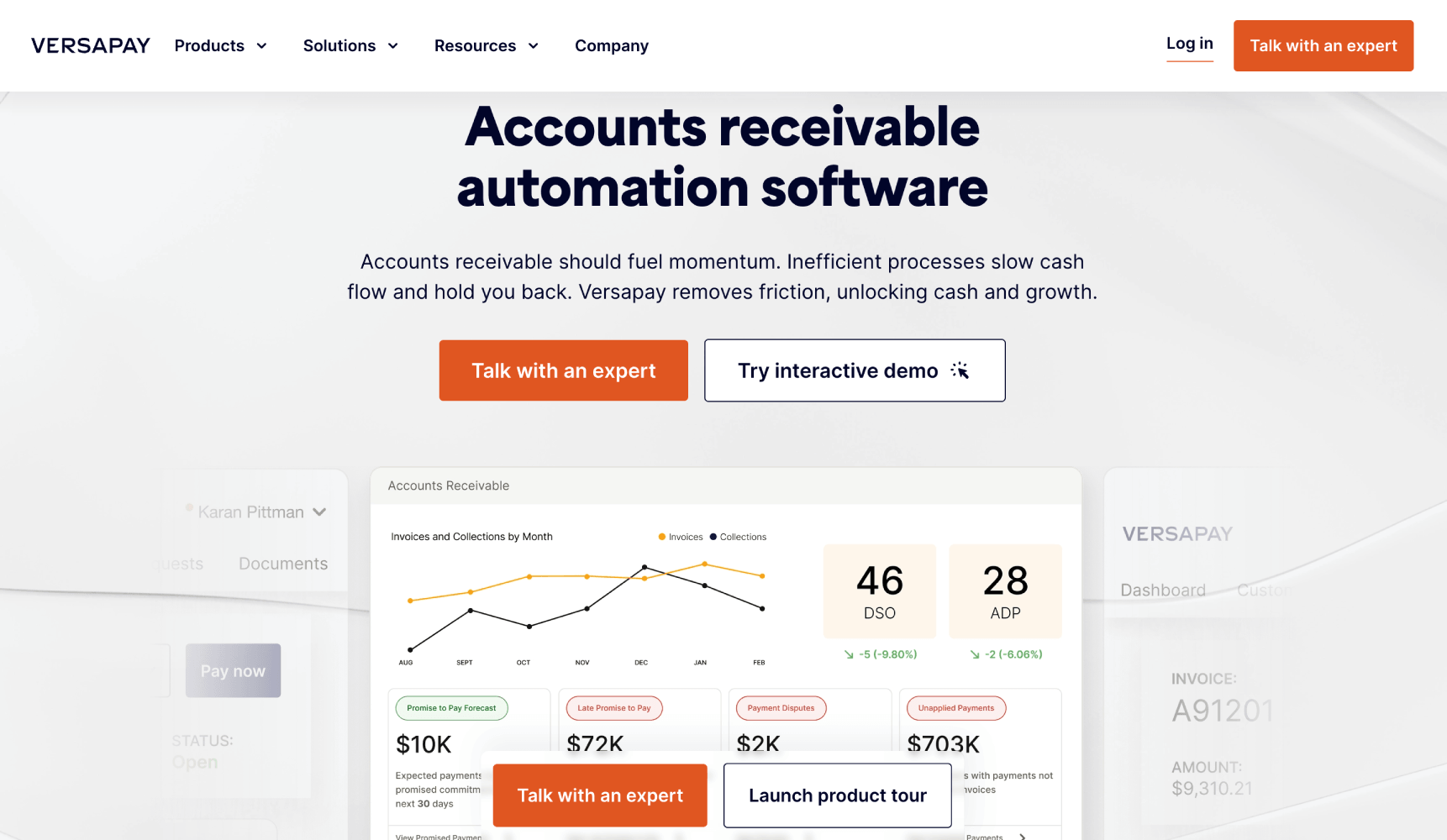
Versapay targets mid-market and enterprise companies and differentiates on its collaborative AR network, which connects suppliers and buyers on a shared platform so payment disputes and invoice approvals happen inside the tool rather than over email. For companies selling to large enterprise buyers with formal AP departments, that network effect can compress dispute resolution significantly.
Versapay integrates with major ERP systems and handles automated cash application alongside collections, which reduces the reconciliation work that typically follows payment. Our deeper look at how Versapay compares to Invoiced and Billtrust on AR automation covers the mid-market positioning in more detail. Pricing is not publicly listed as of our research in November 2024.
9. Billtrust
Billtrust is the largest and most enterprise-oriented platform on this list. It covers the full order-to-cash cycle, from e-invoicing and payment portals through cash application and collections. For companies with high transaction volumes selling to many enterprise accounts, the end-to-end coverage reduces the number of point solutions the AR team has to manage.
Billtrust’s collections module handles automated reminders, promise-to-pay tracking, and dispute management, but the real reason to consider it is the integrated cash application, which uses AI to match payments to open invoices at scale. Standalone collections tools leave cash application as a manual step; Billtrust closes that gap. Pricing is not publicly listed as of our research in November 2024.
How Do These Tools Affect DSO in Practice?
Consider a B2B SaaS company with $8M in annual revenue, net-30 payment terms, and an average of 120 open invoices per month. Their current DSO is 52 days, 22 days beyond terms. The AR coordinator spends roughly 12 hours per week on manual follow-up emails, dispute calls, and payment status checks in the ERP. (This is an illustrative scenario, not a verified case study.)
With a tool like Upflow or Chaser, the first automated reminder fires one day after the due date, not when the coordinator gets to it. Escalation sequences run automatically through day 15, day 30, and day 45. Promise-to-pay dates get logged and trigger a follow-up if the payment does not clear. In this scenario, the coordinator’s manual follow-up time drops substantially, and earlier outreach consistently moves more invoices into the 31-to-45 day bucket rather than the 60-plus bucket. The DSO compression does not come from magic. It comes from consistent, earlier contact.
| Tool | Best For | Dispute Tracking | Promise-to-Pay | Cash Flow Forecast | ERP Integrations |
|---|---|---|---|---|---|
| Upflow | SaaS, $2M-$30M ARR | Yes | Yes | Basic | NetSuite, QBO, Xero, Chargebee |
| Tesorio | Enterprise AR teams | Yes | Yes | AI-driven | NetSuite, Sage Intacct, SAP, Dynamics |
| Chaser | Small businesses, simple AR | Basic | Yes | No | QuickBooks, Xero |
| Kolleno | Teams with high dispute volume | Strong | Yes | No | QBO, Xero, NetSuite, Sage |
| Gaviti | Teams managing multiple collectors | Yes | Yes | Basic | NetSuite, SAP, Dynamics |
| Growfin | Enterprise with sales-owned relationships | Yes | Yes | No | Salesforce, major ERPs |
| Monk | Credit and collections combined | Yes | Yes | No | Not publicly specified |
| Versapay | Mid-market, buyer-supplier network | Yes | Yes | No | Major ERPs |
| Billtrust | Enterprise, high-volume order-to-cash | Yes | Yes | No | Major ERPs |
What Should a Finance Team Look for in AR Collections Software?
ERP integration depth matters more than most buyers realize when evaluating. A tool that syncs invoices once per day introduces a 24-hour lag in collections data. Tools that sync in near real-time keep the collections queue accurate without manual exports. Ask every vendor: how frequently does the ERP sync run, and is it bidirectional?
Multi-contact support at the account level is the second differentiator that separates purpose-built B2B collections software from generic CRM workarounds. A single enterprise customer might have an AP coordinator, a finance manager, and a VP of Finance who needs to be escalated to on invoices over $50,000. The tool needs to route each contact type to the right message at the right step, without the AR team manually managing the routing. Connecting your accounts receivable workflow to the broader payments infrastructure is also worth considering. Our comparison of accounts receivable automation tools that cut DSO for B2B SaaS covers this integration layer in more depth.
Credit management integration is underrated. If your customers are slow to pay partly because they are over-extended on credit, collections software that cannot see credit limits is fighting half the battle. Monk is the only tool in this list that combines both. For teams using separate credit management software, at minimum look for a vendor that can read credit hold status from your ERP and suppress collection sequences accordingly.
Does Automated Collections Software Work for Complex B2B Accounts?
Automated collections handles the 80% of overdue invoices that will pay if reminded consistently and early. The remaining 20%, typically large invoices, disputed amounts, or accounts with relationship complexity, still need a human. The best AR collections software does not try to automate those cases. It identifies them earlier and routes them to the right collector with full context: communication history, dispute notes, promise-to-pay date, and outstanding balance all visible in one screen.
The risk of over-automating is real. A large customer who receives seven automated emails on an invoice they flagged as disputed will escalate, and the relationship damage typically costs more than the invoice. Every platform on this list allows dispute flagging to pause automated sequences, but the configuration burden varies. Kolleno and Tesorio handle this most gracefully out of the box. Chaser requires more manual management of exception cases. For finance teams building out their broader automation stack, our guide to accounts payable automation tools covers the supplier-side workflow that often intersects with AR operations.
Frequently Asked Questions
What is B2B collections software?
B2B collections software automates the follow-up process for overdue business invoices. Unlike consumer debt collection tools governed by the FDCPA, B2B collections software manages account-level workflows, multi-contact outreach sequences, dispute tracking, and promise-to-pay logging. The primary goal is reducing Days Sales Outstanding by reaching the right contact at the right time with the right escalation step, without requiring the AR team to manage every touchpoint manually.
How is B2B collections software different from dunning software?
Dunning software is built for subscription businesses and retries failed card charges automatically. B2B collections software manages multi-invoice accounts, handles disputes, tracks verbal payment commitments, and routes escalations across multiple contacts at the same company. The two categories overlap in that both send payment reminders, but a dunning tool cannot manage the dispute and escalation complexity that is routine in B2B invoice collections.
What is a typical DSO reduction from using collections management software?
DSO reduction depends heavily on baseline performance, industry payment norms, and how consistently the tool is configured and used. Collections software compresses DSO primarily by moving first contact earlier (same day as due date rather than 7-14 days after) and by ensuring consistent follow-up without gaps. Companies starting from a high DSO baseline, typically 50-plus days on net-30 terms, tend to see the largest proportional improvements. Verifiable average reduction figures are not publicly disclosed by vendors in this category.
Do B2B collections tools integrate with NetSuite and Salesforce?
Most purpose-built B2B collections tools integrate with NetSuite. Tesorio, Gaviti, Versapay, Billtrust, and Kolleno all list NetSuite as a supported integration. Salesforce integration is less consistent. Growfin is the most explicitly sales-and-finance-aligned tool and offers Salesforce connectivity. Upflow and Chaser focus primarily on accounting software integrations rather than CRM. Confirm bidirectional sync depth, not just the existence of a connector, before committing.
Is invoice payment reminder software enough, or do I need a full collections platform?
Invoice reminder software, tools that send automated emails on a schedule, is enough if your AR is straightforward: fewer than 150 open invoices, low dispute rates, and single-contact accounts. Once you have multi-entity customers, significant dispute volume, or a need to track collector performance and cash forecasting, a full collections platform pays for itself in AR team time saved and DSO improvement. Chaser sits closest to the reminder-software end of the spectrum. Tesorio and Billtrust sit at the full-platform end.
How is AR collections software priced?
Most vendors in this category do not publish pricing publicly. Pricing typically depends on invoice volume, AR balance, or number of users, and is quoted after a discovery call. Chaser is an exception and publishes tiered pricing on its website. For all other vendors on this list, expect a custom quote. When comparing quotes, ask each vendor to price on the same invoice volume and user count so the comparison is apples-to-apples.
The Practical Shortcut for Choosing Between These Tools
The fastest way to narrow this list is to answer two questions before requesting any demos. First: what is your primary ERP, and which tools have a native, bidirectional sync with it? That alone eliminates several options for most teams. Second: does your AR team currently struggle more with follow-up volume (too many invoices to chase manually) or with dispute resolution (invoices that stall for weeks with no clear owner)? Follow-up volume points toward Chaser or Upflow. Dispute resolution points toward Kolleno or Tesorio.
The longer-term consideration is where AR fits in your broader finance stack. B2B collections software is one layer in an order-to-cash workflow that starts at invoicing and ends at cash application. Tools like Billtrust and Versapay cover more of that chain but come with more implementation complexity. Point solutions like Chaser and Upflow deploy faster but leave cash application and ERP reconciliation to other systems. Understanding where your biggest time-sink actually lives, whether that is the chase or the reconciliation, is the analysis that determines which category of tool you actually need. For teams evaluating the broader financial infrastructure around these decisions, the Fintech SaaS scale checklist covers how AR automation fits into a finance stack built for growth.
One more thing worth noting before you sign anything: collections software is only as effective as the workflow configured inside it. A tool that fires a generic “your invoice is overdue” email to every customer regardless of segment, relationship age, or invoice size will produce results barely better than no tool at all. Budget implementation time for workflow configuration, not just software setup, and treat the first 90 days as a calibration period rather than a finished deployment.