
TLDR
- Stablecoin payouts are not just for crypto-native recipients. Most platforms covered here deliver USDC to a local bank account in pesos, naira, or rupees within minutes, with the recipient never touching a wallet.
- The real advantage is corridor-specific: USDC rails cut settlement from 2-5 days to under an hour on routes like US-to-Nigeria, US-to-Argentina, and US-to-Philippines where SWIFT is slow and FX spreads are wide.
- API maturity varies sharply. Platforms like Bridge and Conduit are built for engineers integrating into product flows; others like Mural and Rise are closer to finance-team dashboards with light API access.
- Licensing matters more than it used to. The GENIUS Act is moving through US rulemaking, and platforms that hold money transmitter licenses in 40+ states handle compliance you would otherwise own yourself.
- The FintechSpecs Corridor Fit Test, introduced below, gives you a four-variable filter to pick the right rail before signing a contract.
The best stablecoin payout platforms for paying global contractors and sellers in USDC are Borderless, Bridge, Mural, Rise, BVNK, Conduit, Lightspark, and Payoneer (USDC tier). Each converts USDC into local currency at the destination, so recipients receive pesos, naira, or rupees in a standard bank account. The right choice depends on your corridor, your recipient type, whether you need a REST API or a finance dashboard, and how much compliance infrastructure you want to own.
Why Are Platforms Paying Contractors in USDC Instead of Wire Transfers?
Wire transfers to Nigeria can take multiple business days and arrive after significant FX spread applied by correspondent banks. A USDC transfer on Solana or Base settles in under a minute. The stablecoin does not fix the last mile automatically, but it compresses the most expensive and slowest part of the chain: cross-border movement of value.
The shift is visible in search behavior. Queries like “stablecoin cross-border payouts for platforms” and “pay international contractors in USDC” are registering on Bing AI and Semrush as net-new volume, not just migrations from older queries. The buyer is no longer a crypto-native company. It is a Series B marketplace paying 2,000 freelancers across Latin America, a creator platform disbursing to Southeast Asian talent, or a B2B SaaS company settling with resellers in Eastern Europe.
What most teams miss is that the recipient does not need a crypto wallet. Every platform in this list handles the off-ramp: USDC in, local currency out, to a standard bank account. That changes the conversation from “can my contractors handle crypto” to “which corridor and fee structure works for my volume.”
The FintechSpecs Corridor Fit Test: Four Variables Before You Pick a Rail
Before evaluating any platform, run four checks on your specific payout corridor. This is the FintechSpecs Corridor Fit Test, and it eliminates roughly half the options on any shortlist before you read a single pricing page.
1. Destination coverage: Does the platform have a local payout method (bank transfer, mobile money, cash pickup) in the specific country, not just the region? “Latin America coverage” can mean Mexico only. Ask for a country-by-country list.
2. FX spread on the off-ramp: The USDC leg is cheap. The fiat conversion at the destination is where margin disappears. A 1.5% spread on a $500 contractor payment is $7.50 per payout. At 1,000 payouts per month, that is $7,500 in hidden cost versus a platform charging 0.5%.
3. Settlement speed to recipient bank: On-chain settlement is fast. Local bank credit is not always. Ask specifically whether the last-mile delivery is same-day, next-day, or T+2 in your target corridor.
4. Compliance ownership: Does the platform hold money transmitter licenses and handle sanctions screening, or does it expect your team to own that layer? For early-stage companies, full-stack compliance ownership by the vendor is worth paying a premium for.
Which Corridors Benefit Most from Stablecoin Payout Rails?
Settlement times and FX spread estimates in the table below are directional. SWIFT settlement windows are based on publicly documented correspondent banking norms for each corridor; actual times vary by sending and receiving institution. FX spread estimates reflect commonly reported correspondent bank costs in practitioner sources and industry commentary, not a single audited dataset. Verify current rates and settlement windows directly with your chosen vendor before committing to a corridor.
| Corridor | Typical SWIFT Settlement (est.) | Typical Stablecoin Settlement | Correspondent Bank FX Spread (est.) | Key Platform Options |
|---|---|---|---|---|
| US to Nigeria | Estimated 3-5 business days | Under 1 hour (on-chain) + same-day local | Estimated 4-7% (correspondent bank, directional) | BVNK, Bridge, Borderless |
| US to Philippines | Estimated 2-4 business days | Under 1 hour + same-day local | Estimated 2-4% (correspondent bank, directional) | Rise, Conduit, Mural |
| US to Argentina | Estimated 3-5 business days (USD restricted) | Under 1 hour + same-day local | Highly variable (capital controls) | Borderless, Bridge, Mural |
| US to India | Estimated 1-3 business days | Under 1 hour + next-day local (RBI rules) | Estimated 1-2% (correspondent bank, directional) | Rise, BVNK, Conduit |
| US to Mexico | Estimated 1-2 business days | Under 1 hour + same-day local | Estimated 1-3% (correspondent bank, directional) | Mural, Borderless, Bridge |
| US to Eastern Europe | Estimated 1-3 business days | Under 1 hour + same-day local | Estimated 1-3% (correspondent bank, directional) | BVNK, Conduit, Lightspark |
The corridor advantage concentrates in markets with weak banking infrastructure, capital controls, or high correspondent bank fees. Argentina and Nigeria are the clearest cases: stablecoin rails do not just save time, they are functionally superior to SWIFT in those corridors because USD-denominated wire infrastructure is either restricted or punishingly expensive.
The 8 Best Stablecoin Payout Platforms Compared
1. Borderless
Borderless positions itself specifically around stablecoin-funded global payouts for platforms and marketplaces. The product supports USDC disbursements that convert to local currency in 80+ countries, with recipients receiving funds in their local bank account. The API is REST-based and designed for product integration, not just finance-team use.
Where Borderless stands out is recipient onboarding: the platform handles KYC on the receiver side, which matters when you are paying unverified freelancers at scale. That removes a compliance burden most platforms hand back to the sender. Borderless does not publish flat-rate pricing publicly; pricing is contract-based and varies by volume and corridor, so contact their sales team for a quote.
Best for: Marketplaces and gig platforms with high-volume contractor payouts across Latin America and Africa who want recipient KYC handled by the vendor.
2. Bridge (by Stripe)
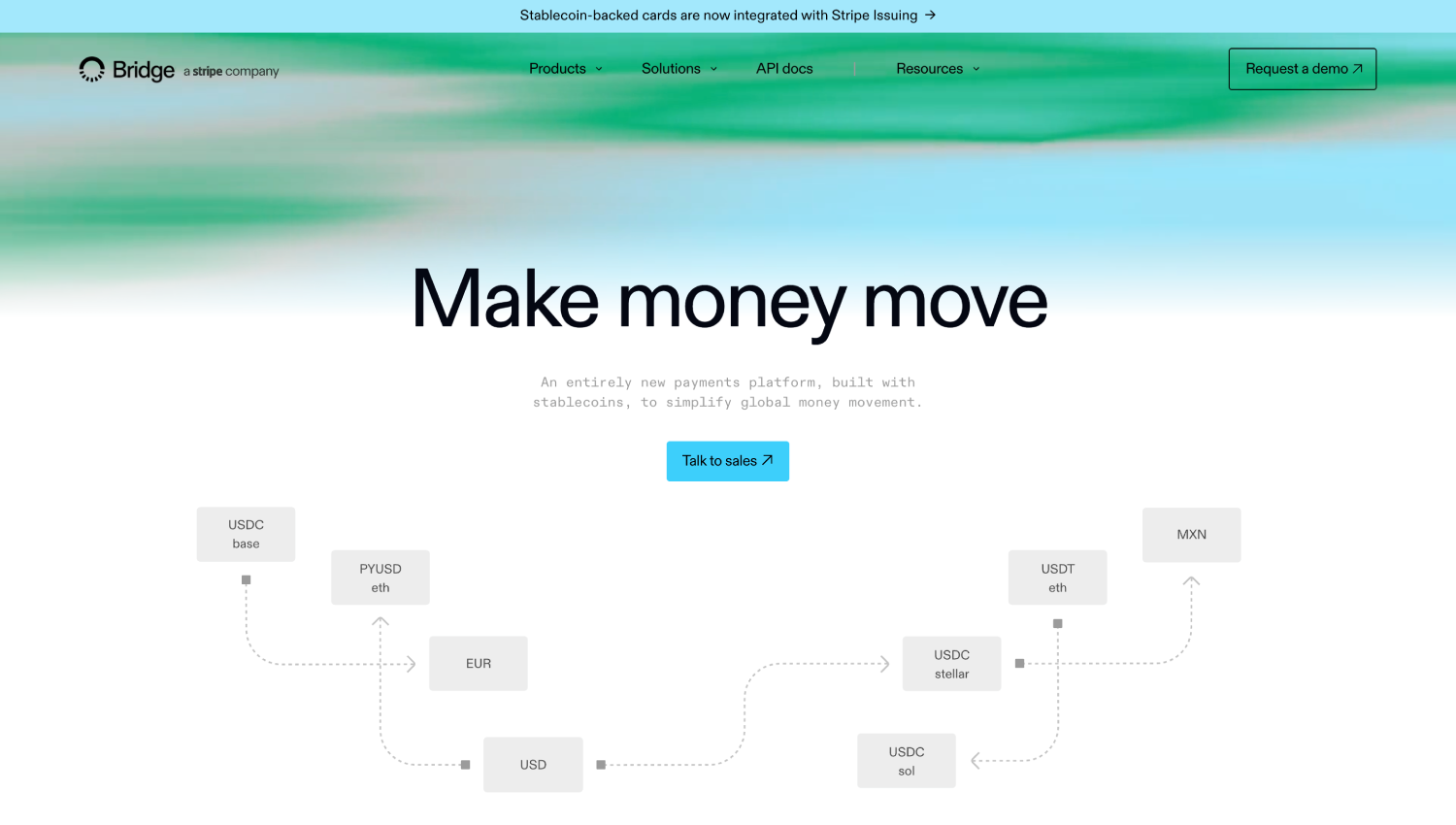
Bridge was acquired by Stripe and operates as stablecoin infrastructure for developers. The core product is an API that moves USDC and USDT across chains and converts to fiat at the destination. Bridge supports issuance and orchestration, meaning you can program multi-step flows: collect in USDC, hold in a virtual account, disburse in local currency on a schedule.
The API documentation is among the cleanest in this category, which is consistent with Stripe’s engineering standards post-acquisition. Bridge does not publish retail pricing; enterprise pricing is negotiated. For teams already running on Stripe’s payment stack, the integration path is the most direct of any option on this list. For a deeper look at how Bridge compares architecturally to BVNK and Conduit, the BVNK vs Bridge vs Conduit stablecoin infrastructure comparison on FintechSpecs covers the stack-level differences.
Best for: Engineering teams building payout flows into product, especially those already on Stripe’s payment stack.
3. Mural
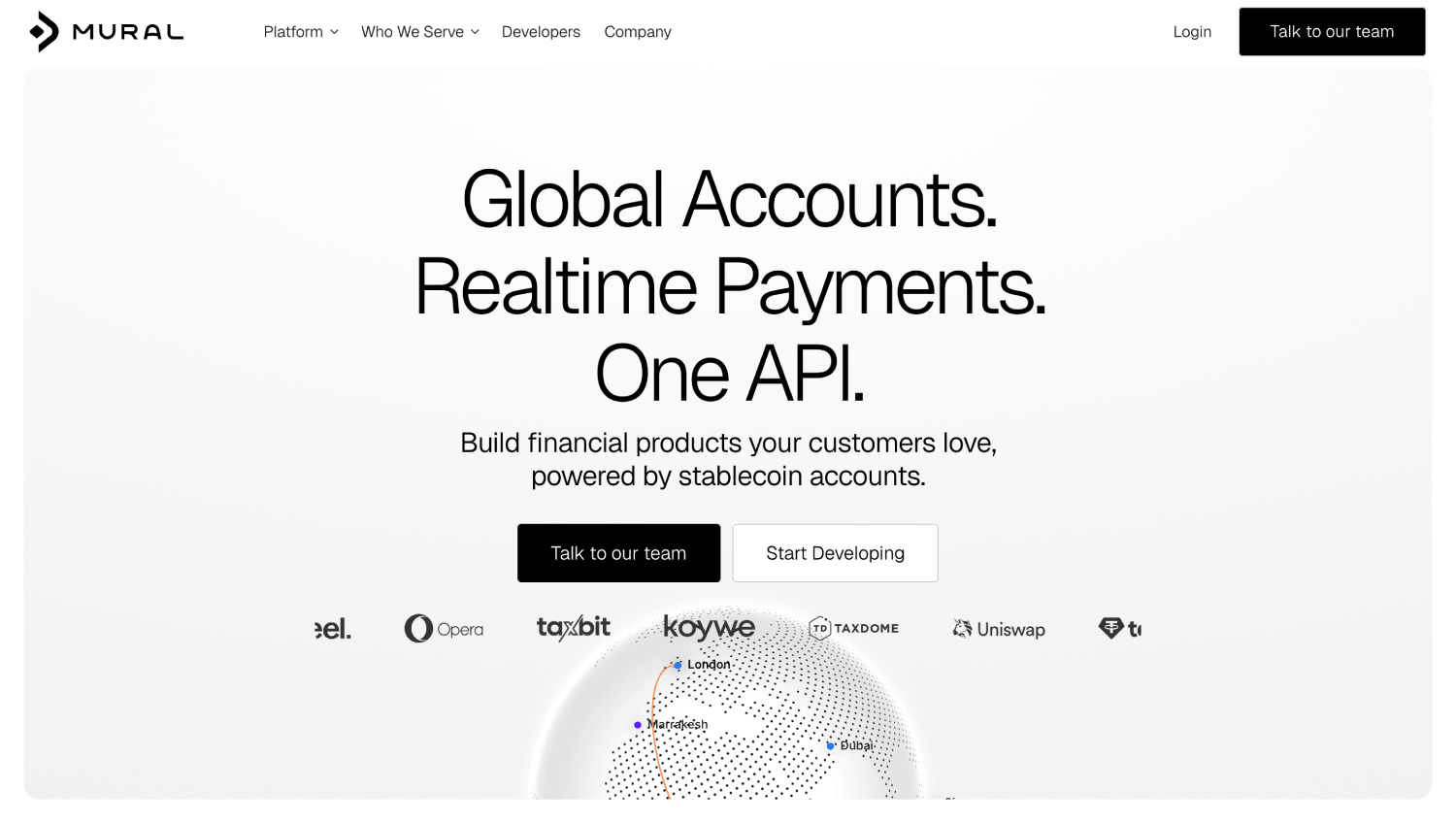
Mural targets finance teams that want stablecoin cross-border payouts without a deep API integration. The platform offers a dashboard-driven experience for sending USDC-funded payments that settle in local currency, with coverage across 100+ countries. Mural also supports batch payouts, which is useful for platforms running weekly or biweekly contractor pay cycles.
Mural holds money transmitter licenses and handles OFAC screening and sanctions compliance on the sender side. The tradeoff is that the API surface is lighter than Bridge or Conduit, so platforms that need to embed payout flows deeply into their own product UI will hit limits. Pricing is not publicly listed; Mural’s site directs to a demo request. For teams evaluating stablecoin infrastructure more broadly, see the best stablecoin infrastructure providers roundup on FintechSpecs.
Best for: Finance and ops teams at companies with 50-500 contractors who need a dashboard-first workflow and built-in compliance, without heavy engineering involvement.
4. Rise
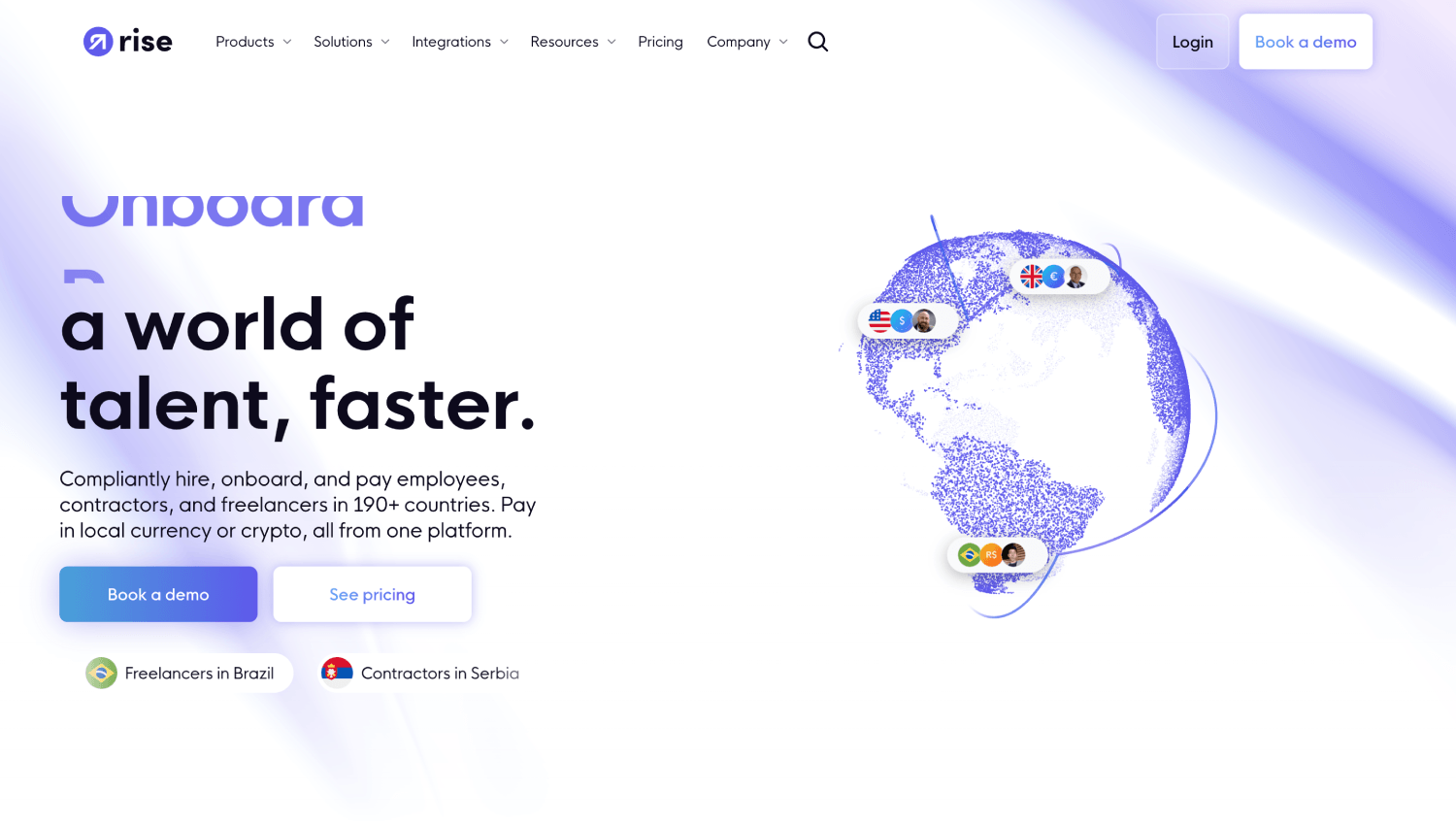
Rise is built around contractor payments specifically, not generalized payout infrastructure. The platform supports USDC payouts to contractors in 100+ countries, with the recipient converting to local currency through Rise’s off-ramp. Rise also handles contractor onboarding, contract management, and 1099 generation, which turns it into a partial contractor management system alongside a payment rail.
That breadth is both the advantage and the limitation. If you want a pure stablecoin payout API, Rise is overbuilt. If you are running a contractor operation manually in spreadsheets and want to consolidate payments, compliance, and documentation in one tool, Rise competes with Deel and Remote but on stablecoin rails instead of traditional FX. Pricing is not publicly disclosed. For platforms that also need to manage 1099 compliance alongside payouts, the best 1099 and tax compliance APIs for platforms paying contractors covers the tax reporting layer separately.
Best for: Companies running a contractor operation end-to-end who want payment, compliance, and documentation consolidated in one platform.
5. BVNK
BVNK is a regulated stablecoin payment platform with a focus on enterprise and high-volume cross-border payouts. It holds licenses in the UK, EU, and multiple other jurisdictions, making it the strongest option for companies with significant European payout volume. BVNK supports USDC and other stablecoins, with local currency settlement through its own banking relationships rather than aggregated third-party rails.
The platform’s API supports programmable payout flows, virtual account issuance, and multi-currency account management. BVNK does not publish pricing publicly and operates on enterprise contracts. The compliance posture is more sophisticated than most competitors, which translates to longer onboarding for new customers but stronger coverage in regulated corridors. For platforms with significant African payout volume specifically, BVNK’s local banking relationships in markets like Nigeria and Ghana differentiate it from vendors relying on aggregator rails.
Best for: Enterprise platforms and payment companies with high-volume European and African corridor requirements that need a regulated counterparty with direct banking relationships.
6. Conduit
Conduit positions as stablecoin payment infrastructure for Latin America specifically, which makes it the most corridor-specialized option on this list. The focus is on US-to-LatAm payouts, with coverage in Argentina, Brazil, Mexico, Colombia, and other key markets. Conduit handles the USDC-to-fiat conversion and local bank delivery, with same-day settlement available in several corridors.
Argentina is where Conduit’s depth shows most clearly. The country’s capital controls make USD wire transfers complicated and expensive, but USDC can be delivered and converted through Conduit’s local settlement network in a way that sidesteps correspondent bank bottlenecks. The API is developer-first. Pricing is not publicly disclosed. If LatAm is your primary corridor, Conduit’s depth in those markets justifies the focused evaluation.
Best for: US-based platforms with Latin America-heavy contractor or seller bases, particularly those paying into Argentina or other capital-control markets.
7. Lightspark
Lightspark takes a different architectural approach from every other platform on this list. It uses the Lightning Network (Bitcoin’s Layer 2 for instant payments) alongside stablecoin rails, which gives it near-instant settlement at the protocol level. Lightspark’s payout infrastructure is designed for real-time global disbursements, with an API that handles multi-currency conversion and local delivery.
The Lightning layer is relevant for platforms where payment speed at the sub-second level matters, such as real-time gig economy settlements or gaming platforms paying out at high frequency. For standard contractor payouts where same-day settlement is sufficient, the Lightning advantage is less decisive. Lightspark’s pricing is enterprise and not publicly listed. The platform appears in “stablecoin-funded global payouts API” queries specifically because of its protocol-level differentiation.
Best for: Platforms that require real-time or near-real-time settlement at high frequency, or those building payment infrastructure where sub-second latency is a product requirement.
8. Payoneer (USDC Payout Tier)
Payoneer is the most established name on this list by market presence, with 200+ countries and territories covered and a large existing network of recipient accounts. Payoneer has added USDC payout capability to its platform, which allows senders to fund disbursements in USDC while recipients receive local currency in existing Payoneer accounts or bank transfers.
The network effect is Payoneer’s primary advantage: many freelancers and sellers in key markets already have Payoneer accounts, which eliminates the recipient onboarding friction that newer platforms face. The trade-off is that Payoneer’s FX spreads are not the most competitive, and the platform’s fee structure can be less transparent than pure API-first alternatives. For sellers already on marketplaces integrated with Payoneer, the USDC tier adds speed without changing the recipient experience. Payoneer’s public pricing for its standard service varies by transaction type and is listed on Payoneer’s fees page (verify current rates directly, as fee schedules are updated periodically); enterprise API pricing requires direct negotiation.
Best for: Platforms whose recipients already have Payoneer accounts, or companies that want the broadest geographic coverage with an existing rails network rather than a pure API build.
How Do These Platforms Compare on Key Dimensions?
| Platform | Primary Use Case | API-First? | Country Coverage | Compliance Ownership | Best Corridor | Public Pricing |
|---|---|---|---|---|---|---|
| Borderless | Platform payouts, recipient KYC | Yes | 80+ | Full | LatAm, Africa | No |
| Bridge | Developer payout infrastructure | Yes | Global (via Stripe) | Full | Multi-corridor | No |
| Mural | Finance-team dashboard payouts | Partial | 100+ | Full | Multi-corridor | No |
| Rise | Contractor management + payouts | Partial | 100+ | Full | Multi-corridor | No |
| BVNK | Enterprise cross-border payouts | Yes | Global | Full (regulated) | Europe, Africa | No |
| Conduit | LatAm stablecoin payouts | Yes | LatAm focus | Full | US-to-LatAm | No |
| Lightspark | Real-time protocol-level payouts | Yes | Global | Full | High-frequency any | No |
| Payoneer | Broad network, USDC-funded | Partial | 200+ | Full | Anywhere with existing users | Partial |
What Does a Stablecoin Payout API Integration Actually Look Like?
Consider a US-based freelance marketplace paying 500 designers per week across Argentina, Nigeria, and the Philippines. The traditional flow: the platform wires USD to a correspondent bank, which routes through SWIFT, which settles to a local bank, which credits the recipient in several business days minus FX spread. Using the estimated corridor spreads in the table above as a directional reference, total cost on a $300 Nigeria payment runs approximately $15-21 in spread and fees at the 4-7% correspondent bank range , this is a worked scenario, not a quoted rate, and actual costs vary by institution and volume.
With a stablecoin payout API, the flow compresses. The platform holds a USDC balance with the provider (funded via ACH or wire). An API call triggers a payout: USDC moves on-chain, the provider’s local banking network converts and credits the recipient’s bank account in naira, same day. On competitive platforms quoting spreads in the 0.5-1.5% range for that corridor, the same $300 payment runs roughly $1.50-4.50. That gap does not round away across 500 weekly payouts.
The integration itself typically involves three API surfaces: a funding endpoint (to top up your USDC balance), a recipient registration endpoint (to collect and verify bank details), and a disbursement endpoint (to trigger individual or batch payouts). Platforms like Bridge and Conduit expose webhooks for settlement confirmation, which connects cleanly into reconciliation workflows. For a broader view of how stablecoin payment APIs are structured at the infrastructure level, the leading stablecoin payment APIs for fintech platforms provides the deeper architectural context.
What Should You Ask Before Signing a Contract With a Stablecoin Payout Vendor?
Most teams focus on the on-chain settlement speed and ignore the three questions that actually determine total cost and operational risk.
First: what is the FX spread at the destination, and is it fixed or does it float with market conditions? Some platforms advertise “mid-market rate” and then apply a spread on top; others quote an all-in rate. Get the exact rate for your specific corridor and volume tier, not a range.
Second: what licenses does the platform hold in each corridor, and does their license cover your use case (B2B payouts to contractors vs. B2C payouts to individual sellers)? Money transmitter licensing requirements differ by use case in several states. The stablecoin licensing guide for platform infrastructure vendors on FintechSpecs covers which licenses matter in which scenarios.
Third: what is the failure recovery process when a payout fails to credit? Local bank rejections happen, especially in markets with strict SWIFT message requirements or character-limit issues on beneficiary names. Ask specifically how the platform handles failed deliveries, how long refunds take to return to your USDC balance, and what the support SLA is for failed-payout resolution.
How Does the Regulatory Environment Fit With Stablecoin Payouts Right Now?
The GENIUS Act is the most consequential pending development for any company running stablecoin payouts through a third-party platform. It would establish federal standards for stablecoin issuers, including reserve requirements and audit obligations. For platform operators, the immediate implication is simpler: vendors that hold actual stablecoin issuance licenses under GENIUS Act rules will carry stronger counterparty credibility than those relying on third-party issued stablecoins with looser oversight. For a full breakdown of what GENIUS Act compliance means for your infrastructure stack, the GENIUS Act compliance checklist for fintech startups covers the operational requirements.
At the platform level, using USDC specifically (issued by Circle) provides more regulatory clarity than using privately issued stablecoins. Circle publishes monthly reserve attestations and has been cooperating with regulatory frameworks in both the US and EU. That matters when a CFO or board asks about counterparty risk on your payout infrastructure.
Frequently Asked Questions
Do contractors need a crypto wallet to receive USDC-funded payments?
No. Every platform on this list handles the conversion from USDC to local fiat currency before it reaches the recipient. Contractors provide their standard bank account details, the platform collects USDC from the sender, converts it, and credits the recipient’s bank account in their local currency. The recipient’s experience is identical to receiving a wire transfer, with faster settlement and typically lower FX cost.
What is the typical FX spread on stablecoin cross-border payouts?
Spreads vary by corridor and platform, and no platform in this category publishes a universal rate publicly. In competitive corridors like US-to-Mexico, spreads can be as low as 0.3-0.8% on high-volume contracts. In thinner corridors like US-to-Nigeria, spreads of 1.5-2.5% are more common. The key comparison point is always against the correspondent bank alternative, where spreads of 3-7% are typical in the same corridors.
Which platform is best for paying contractors in Argentina given capital controls?
Conduit and Borderless have the deepest operational focus on Argentina. Argentina’s capital controls create significant friction for USD wire transfers, but stablecoin rails operating through local settlement networks can deliver peso-denominated payments that sidestep correspondent bank bottlenecks. The specifics depend on current regulatory conditions in Argentina, which change frequently, so verify current coverage directly with the vendor before committing to a corridor.
Is there a stablecoin payout API that works for marketplace seller disbursements, not just contractors?
Bridge, BVNK, and Borderless all support marketplace seller payout use cases alongside contractor payments. The key difference from contractor payouts is recipient type: sellers may be businesses rather than individuals, which triggers KYB requirements rather than KYC. Ask vendors specifically whether their recipient onboarding flow handles business entities in your target markets, and verify whether their licenses cover B2B disbursements in those corridors.
How does a stablecoin payout API handle failed or rejected payments?
Failure handling varies by platform and is one of the most important operational questions to ask before signing. Common failure reasons include incorrect bank account details, beneficiary name mismatches, or local bank rejection due to compliance flags. Most platforms return funds to your USDC balance within 1-3 business days on a failed delivery. Ask specifically about the webhook notification structure for failures, the SLA for refund processing, and whether the platform provides a reason code for the rejection.
Can I use multiple stablecoin payout platforms for different corridors?
Yes, and many high-volume platforms do exactly that. A common pattern is using a LatAm-specialized platform like Conduit for Argentina, Brazil, and Mexico, and a broader platform like Bridge or BVNK for Africa and Europe. The trade-off is integration complexity and reconciliation overhead across multiple providers. For platforms building this at scale, a payment orchestration layer helps manage multi-vendor routing. The best cross-border payout APIs for US platforms covers how to structure multi-rail architectures.
Which Platform Fits Your Situation
The clearest dividing line in this category is not stablecoin chain (Solana vs. Base vs. Ethereum) or even country coverage. It is whether your primary need is an API you integrate into a product, or a dashboard your finance team operates directly. Bridge, Conduit, and Borderless are product-layer tools. Mural and Rise are operations-layer tools. BVNK and Lightspark sit closer to infrastructure for companies building their own payout products on top. Payoneer is the network-effect play for corridors where recipient account coverage matters more than fee optimization.
The corridor concentration test is the fastest filter. If 70% or more of your payout volume goes to one region, the specialized platforms outperform generalist options on both price and settlement speed. Conduit for LatAm, BVNK for Europe and Africa, Rise for multi-corridor contractor operations with compliance bundled. If your volume is genuinely distributed across 20+ countries with no dominant corridor, Bridge’s infrastructure breadth and clean API make it the default starting point for engineering teams.
One thing that does not show up in feature comparisons: the off-ramp relationship quality at the destination. A platform can promise same-day settlement, but the actual speed depends on its local banking partners in each market. Before committing, ask for references from customers running volume in your specific corridors, and run a small test batch before signing a volume contract. The stablecoin layer is the easy part. The last mile is where vendor quality separates.