
TLDR
- Solana is the highest-throughput option but carries validator concentration risk and no native stablecoin issuer backing at the chain level.
- Tempo and Arc are purpose-built payment chains with sub-cent fees and near-instant finality, but both are relatively new and network depth is thinner than Solana.
- Plasma is a Bitcoin-anchored EVM chain designed specifically for stablecoin settlement, with USDT as its primary asset and a focus on institutional-grade finality.
- Chain choice changes your fee economics, finality guarantees, and compliance posture in ways that directly affect unit economics, not just developer experience.
- For most fintech builders sending USDC at volume, the fee-and-finality trade-off between Solana and Tempo is the real decision; Arc and Plasma suit narrower use cases.
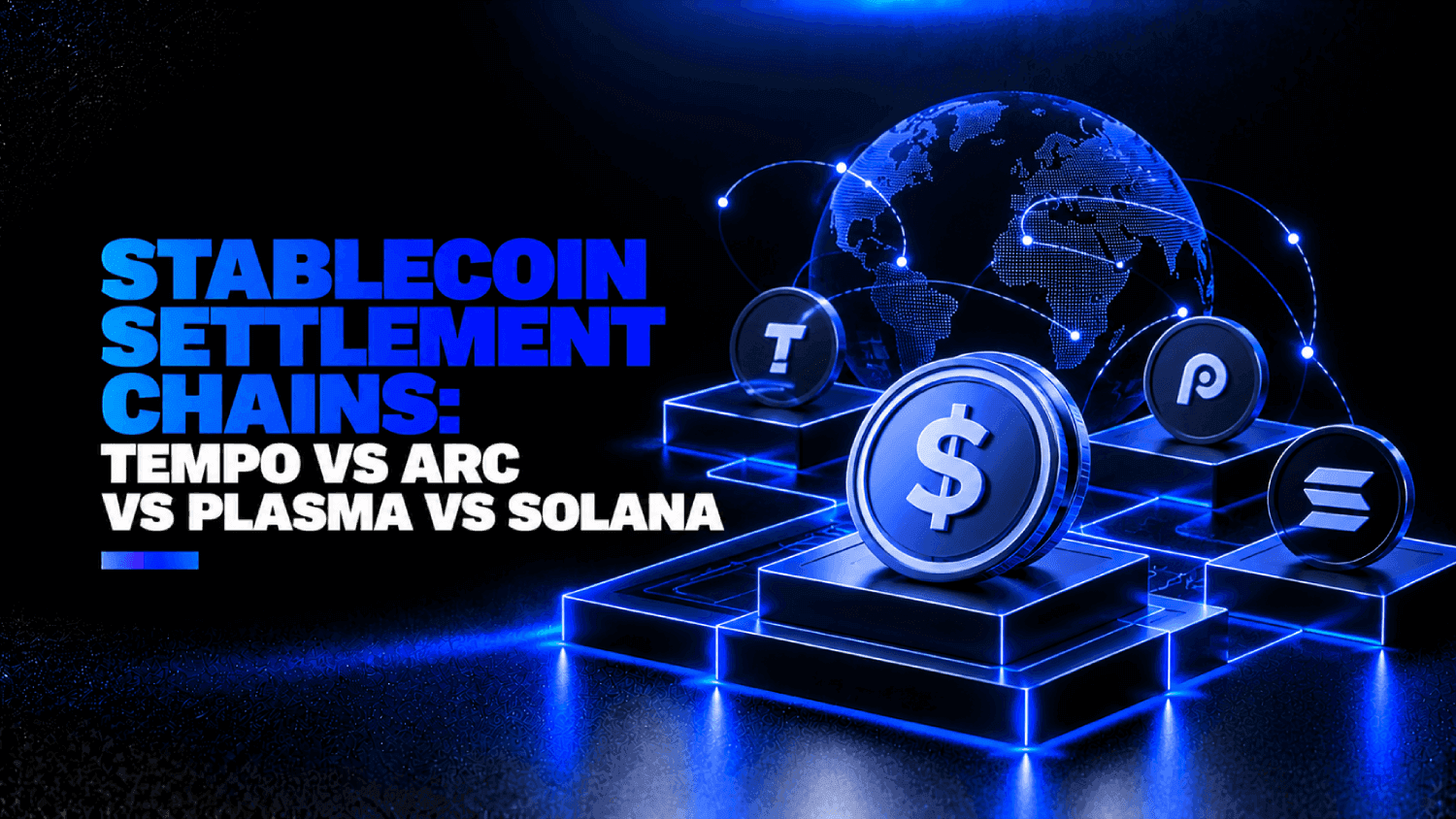
For fintech teams building stablecoin payment flows, the best blockchain for stablecoin payments depends on three variables: transaction fee per transfer, time to finality, and which stablecoin issuers have native support on that chain. Solana handles thousands of transactions per second with fees under a fraction of a cent and native USDC via Circle. Tempo is a purpose-built payment chain targeting cross-border corridors with near-zero fees. Arc is an Avalanche-based network focused on regulated payment flows. Plasma is a Bitcoin-secured EVM chain built specifically for USDT settlement. Each optimizes for a different operational constraint.
Why Chain Choice Is a Business Decision, Not a Developer Detail
Most founders treat blockchain selection as an infrastructure footnote, something to hand off to the backend team after the product decision is made. That framing is wrong, and it shows up in the numbers.
A payment product moving $10 million per month in stablecoin transfers at 0.01 cents per transaction pays roughly $10 in monthly chain fees. The same volume on a chain charging 0.1 cents per transaction costs $100. At $100 million per month, that gap becomes $1,000 versus $100. Fee structure compounds with scale in ways that matter to a finance team even if they are invisible to a developer writing the first integration.
Finality time has a different kind of cost. A chain with probabilistic finality after 32 block confirmations introduces settlement risk that a B2B payment product cannot absorb the way a consumer app might. If you are building a payout product that promises same-day settlement to contractors or merchants, the chain’s finality model is part of your product’s reliability guarantee, not a backend detail. You can read more about how stablecoin infrastructure providers handle these guarantees at the product layer, but the chain underneath sets the floor.
What Are Tempo, Arc, Plasma, and Solana Built to Do?
Solana
Solana is a high-performance Layer 1 blockchain using a proof-of-stake consensus combined with a proof-of-history mechanism that allows validators to sequence transactions without waiting for network-wide agreement. Throughput has been demonstrated at tens of thousands of transactions per second in testing, though real-world sustained throughput is lower. According to Solana’s public documentation, base transaction fees are typically a fraction of a cent per transaction, with the network’s fee schedule targeting approximately $0.00025 per signature under normal conditions , though fees fluctuate with network load and should be verified against Solana’s current fee documentation before modeling unit economics. Circle’s USDC is natively issued on Solana, and Solana has native USDC support through Circle’s Cross-Chain Transfer Protocol.
The network has had well-documented outages in prior years. Validator concentration is a legitimate concern: a relatively small number of validators control a significant share of stake, which creates a governance and decentralization risk that compliance teams at larger institutions flag. For most seed-to-Series B fintech builders, Solana’s performance and USDC availability are hard to argue against.
Tempo
Tempo is a Layer 1 blockchain designed from the ground up for payment settlement. It targets cross-border use cases where traditional correspondent banking is slow and expensive. The chain is built to process stablecoin transfers with sub-cent fees and finality measured in seconds. Tempo’s positioning is narrow on purpose: it is not trying to be a general-purpose smart contract platform. That architectural choice reduces complexity and keeps fee structures predictable.
Tempo has been reported as live and processing transactions, though independent third-party verification of its current transaction volumes and operational status is limited. Teams evaluating Tempo should confirm current network status and mainnet activity directly with the Tempo team before building production integrations. Developer tooling and third-party infrastructure remain thinner than Solana’s. Teams building on Tempo need to evaluate whether the payment-specific design justifies the integration overhead relative to a more mature network.
Arc

Arc in the stablecoin payment context refers to a regulated payment network built on Avalanche’s subnet architecture. Avalanche’s subnet model lets teams deploy custom chains that share security with the main Avalanche network while setting their own validator requirements, fee structures, and compliance rules. A payment network built this way can require validators to be permissioned entities, which matters for products operating under money transmission regulations. Note that Arc as described here refers to this architectural pattern on Avalanche , teams should independently verify which specific named products or networks have launched under this model before committing to an integration, as product naming in this space changes frequently.
The trade-off is that a permissioned subnet has a smaller, more controlled validator set. That is a feature for regulated use cases and a limitation for anyone needing the credible neutrality of a fully public chain. Fees on Avalanche subnets can be set to near-zero by the subnet operator, making the economics favorable at scale, but the subnet operator also bears the cost of running validators.
Plasma
Plasma is a Bitcoin-secured EVM-compatible chain built specifically for stablecoin settlement, with Tether’s USDT as the primary asset. It uses Bitcoin as its base security layer through a mechanism that anchors Plasma’s chain state to Bitcoin’s proof-of-work. That anchoring is what the team positions as institutional-grade finality: once a transaction is sufficiently buried in Bitcoin’s chain, it inherits Bitcoin’s security guarantees. Teams evaluating Plasma should verify current mainnet launch status and USDT issuance agreements directly with the Plasma team, as independent confirmation of production readiness was not available at time of writing.
Plasma is EVM-compatible, so Solidity developers can deploy contracts without rewriting code. Its focus on USDT rather than USDC is worth noting for teams that have already chosen their stablecoin: if you are building on USDC, Plasma is not the natural home. If your counterparties, corridors, or partners run on USDT, Plasma’s design is more purposeful than a general-purpose chain would be.
Fee and Finality Comparison: The Numbers That Move Unit Economics
The table below uses publicly available information and documented chain characteristics. Transaction fees on public blockchains fluctuate with network congestion. The figures here represent typical low-congestion conditions, which is the relevant baseline for a payment product that needs predictable fee economics. Fees for Tempo and Plasma are described by those projects as sub-cent but have not been independently verified against a public fee schedule; treat those figures as directional rather than contractual.
| Chain | Typical Tx Fee (USD) | Finality Time | Primary Stablecoin | Consensus Type | EVM Compatible |
|---|---|---|---|---|---|
| Solana | ~$0.00025 (per Solana docs; verify current) | ~0.4 seconds (slot confirmation), ~12-13 seconds (finalized) | USDC (native), USDT | Proof-of-Stake + Proof-of-History | No (SVM) |
| Tempo | Sub-cent (operator-set; not independently published) | Seconds (chain-level) | USDC, multi-stablecoin | Purpose-built payment consensus | No |
| Arc (Avalanche Subnet) | Near-zero (subnet operator controls) | Under 2 seconds (Avalanche consensus) | USDC, USDT, operator-defined | Avalanche Snowman (PoS variant) | Yes (C-Chain compatible) |
| Plasma | Sub-cent (per project positioning; not independently published) | Fast at chain level; Bitcoin-anchored finality takes longer | USDT (primary) | Bitcoin-secured PoS | Yes |
One thing this table cannot capture: finality at the chain level is different from settlement finality in a regulatory or product sense. A payment orchestration layer may add its own confirmation requirements on top of what the chain reports. Teams building on any of these chains should confirm with their infrastructure provider how they define “settled” before promising that term to customers or counterparties.
Which Chain Is Best for USDC Payments?
Solana is the strongest option for USDC payments today. Circle natively issues USDC on Solana, Circle’s Cross-Chain Transfer Protocol supports Solana, and the network of wallets, custody providers, and infrastructure tools is mature relative to the alternatives here. If you are building a product that accepts or sends USDC and you need developer tooling, third-party integrations, and on/off-ramp support, Solana is where that infrastructure already exists.
Tempo is the better argument if your use case is specifically cross-border payment corridors and you are willing to integrate with a newer chain in exchange for a payment-native design. Tempo does not carry the general-purpose complexity of Solana’s validator network and fee market. For a team building a remittance or B2B payout product where the chain is invisible to the end user, that simplicity has real value.
Arc makes sense if your compliance team requires permissioned validators. A money transmitter or regulated payments company that cannot put funds on a fully public chain, or that needs to contractually bind validators to compliance requirements, will find the Avalanche subnet model more workable. The cost is network maturity. For broader context on how stablecoin payment APIs abstract away chain-level decisions, that layer of tooling matters significantly here.
The FintechSpecs Settlement Chain Stress Test
Before committing to a chain, put your proposed settlement chain through four checks. This framework, the FintechSpecs Settlement Chain Stress Test, is designed for fintech product and finance teams evaluating stablecoin rails, not for general Web3 developers.
1. Issuer Native Support: Does the stablecoin issuer you have chosen (Circle for USDC, Tether for USDT, PayPal for PYUSD) natively issue on this chain, or are you relying on a bridged or wrapped version? Bridged stablecoins introduce smart contract risk and depegging scenarios that native issuance does not. Solana and Ethereum have Circle’s native USDC. Plasma has Tether’s native USDT support as a design goal. Tempo and Arc depend on which issuers agree to support those chains over time.
2. Finality Type: Is the chain’s finality probabilistic or deterministic? Probabilistic finality (Bitcoin, early Ethereum PoW) means the probability of reversal decreases with each block but never formally reaches zero. Deterministic finality (Avalanche, Solana’s post-Firedancer path) means that once a block is finalized, validators cannot mathematically reverse it without violating the protocol. For payment products, deterministic finality is materially safer.
3. Fee Volatility: Can you model your fee structure six months out? Solana’s fees are extremely low on average but have spiked during high-demand periods. Subnet models like Arc allow the operator to set fees independently of network congestion, which gives a payment product more predictable fee economics. Plasma and Tempo are both designed for low, stable fees, but their track records at sustained high volume are shorter than Solana’s.
4. Infrastructure Depth: How many custody providers, wallets, compliance tools, and on/off-ramp providers support this chain today? Solana is supported by every major institutional custodian. Newer chains like Tempo and Plasma have narrower support, which means you may be limited in your choice of custody or on-ramp partners. For regulated fintech companies, this is not a minor concern.
What Does Stablecoin Chain Choice Actually Cost at Scale?
Consider a B2B payout platform processing 500,000 transactions per month, each averaging $200 in USDC. The dollar volume is $100 million monthly. Here is how fee economics differ across chains at that scale. Solana’s figure uses its publicly documented base fee. Tempo and Plasma fees are directional estimates based on each project’s “sub-cent” positioning; no public fee schedule was available to verify a precise figure, so the table uses a labeled assumption.
| Chain | Estimated Fee Per Tx | Monthly Fee at 500K Tx | Annual Fee |
|---|---|---|---|
| Solana | ~$0.00025 (per Solana docs) | ~$125 | ~$1,500 |
| Tempo | Sub-cent (illustrative: $0.001) | ~$500 | ~$6,000 |
| Arc (subnet) | Near-zero (operator-absorbed) | Validator operating cost, not per-tx | Validator infra cost |
| Plasma | Sub-cent (illustrative: $0.001) | ~$500 | ~$6,000 |
| Ethereum L1 (reference) | $0.50 to $5.00 (variable) | $250,000 to $2,500,000 | Not viable at this volume |
This scenario is illustrative. The real differentiator at 500,000 transactions per month is not chain fees at all. It is infrastructure cost: custody, on/off-ramp fees, compliance tooling, and developer time. Chain fees on any of the four options here are rounding errors against those line items. The hidden costs killing your fintech SaaS margins are more likely to come from your custody and compliance stack than from choosing Solana over Tempo.
How Does Compliance Posture Differ by Chain?
Compliance considerations are where the chains diverge most sharply in ways that are not obvious from a technical spec sheet.
Solana’s public, permissionless nature means any wallet can transact on the chain. For a regulated payment product, that requires your compliance layer to do more work: OFAC screening, transaction monitoring, and wallet blacklisting all happen at the application layer because the chain itself cannot enforce them. Tools like Chainalysis and TRM Labs provide on-chain analytics for Solana, but integrating them is your team’s responsibility. You can see how those tools compare in the Chainalysis vs TRM Labs breakdown.
Arc’s permissioned subnet model flips that dynamic. If validators are contractually required to be regulated entities, and if the subnet can enforce address allowlists at the protocol level, then some compliance controls move down the stack. That is genuinely useful for a company operating under state money transmitter licenses or a federal charter, where demonstrating control over the payment rails matters to regulators. The GENIUS Act compliance checklist is worth reviewing alongside any chain evaluation, since federal stablecoin rules now impose reserve, disclosure, and AML requirements at the issuer level regardless of which chain you choose.
Plasma’s Bitcoin-anchoring argument is primarily a finality and security claim, not a compliance one. It does not meaningfully reduce your AML or sanctions screening burden compared to a standard EVM chain. It does give you an argument for settlement finality that is harder to dispute, which matters in certain institutional or cross-border contexts where finality disputes between counterparties are a real operational headache.
Which Chain for USDC Payments: The Actual Recommendation
For a fintech team building a USDC payment product today, Solana is the default choice unless a specific constraint pushes you elsewhere. The network depth, native USDC issuance, sub-cent fees, and institutional custody support make it the path of least resistance for most builders. The reliability concerns from prior years are real but have improved.
Choose Tempo if your product is a cross-border payment corridor and you want a chain designed for that use case from the ground up. Tempo’s trade-off is network thinness now in exchange for payment-specific design and more predictable fee economics. That is a reasonable trade for a team that values simplicity over integrations.
Choose Arc if your regulatory environment requires permissioned validators. The compliance architecture justifies the overhead for a money transmitter or licensed entity that cannot operate on a fully public chain.
Choose Plasma if your primary stablecoin is USDT and you need a Bitcoin-secured finality argument for institutional counterparties. It is not the right choice for USDC-native products. Exploring the USDC vs USDT comparison for business payments first will clarify whether the stablecoin choice drives you to Plasma or away from it.
Frequently Asked Questions
Which blockchain is best for building a stablecoin payment product?
Solana is the strongest general-purpose choice for stablecoin payment products today. It offers native USDC issuance through Circle, sub-cent transaction fees per Solana’s published fee schedule, and the broadest network of custody, compliance, and on/off-ramp infrastructure. Tempo is the better fit for cross-border-specific flows where payment-native stablecoin settlement is the priority. Arc suits regulated teams that need permissioned validators and want to enforce compliance controls at the protocol level. Plasma targets USDT settlement with Bitcoin-backed finality for institutional use cases.
What is the difference between Tempo and Solana for stablecoin payments?
Solana is a general-purpose Layer 1 with a large developer network and native USDC support, operating at thousands of transactions per second with fees documented by Solana at approximately $0.00025 per transaction under normal conditions. Tempo is a purpose-built payment chain that strips away smart contract complexity in favor of predictable, near-zero fees and payment-native design. Solana has more tooling; Tempo has a simpler architecture for pure payment use cases. Network maturity favors Solana for most teams today. Teams considering Tempo should verify current mainnet activity and fee schedules directly with the project before committing to production.
What is Plasma in the context of stablecoin settlement?
Plasma is a Bitcoin-secured, EVM-compatible blockchain designed for stablecoin settlement with USDT as its primary asset. It anchors chain state to Bitcoin’s proof-of-work to provide what it describes as institutional-grade finality. It is not the same as the older Ethereum Plasma scaling research. Plasma is EVM-compatible, meaning Solidity developers can deploy contracts without rewriting code, but its network depth and third-party support are narrower than Ethereum or Solana. Teams should verify current mainnet launch status directly with the Plasma team before building on it.
Does stablecoin chain choice affect compliance requirements?
Yes, materially. Permissionless chains like Solana require all compliance controls , OFAC screening, transaction monitoring, wallet blacklisting , to be implemented at the application layer. Permissioned subnet models like Arc can enforce some controls at the protocol level, which simplifies compliance architecture for regulated entities. Regardless of chain, federal GENIUS Act rules now impose reserve and AML requirements on stablecoin issuers, which affects which stablecoins are available on each chain.
Are bridged stablecoins safe to use for payment settlement?
Bridged stablecoins carry smart contract risk and bridge hack risk that native issuance does not. A bridge can be exploited, causing the bridged token to depeg from its underlying asset. For payment settlement products, native issuer support on a given chain is strongly preferable. Circle natively issues USDC on Solana and Ethereum. Tether natively issues USDT on multiple chains including Tron and Ethereum. Before settling on a chain, confirm whether your chosen stablecoin has native issuance there or relies on a bridge.
What is the Arc stablecoin chain?
Arc in the stablecoin payment context refers to a regulated payment network built on Avalanche’s subnet architecture. Avalanche’s subnet model lets operators deploy custom chains with their own validator requirements, fee structures, and compliance rules. This allows a payment company to require that all validators be permissioned or regulated entities, which supports AML and sanctions compliance at the protocol level. The trade-off is smaller validator sets and thinner third-party support compared to public chains. Teams should independently verify which specific named products have launched under this architecture before committing to an integration.
How do transaction fees compare across Tempo, Arc, Plasma, and Solana?
Solana’s typical per-transaction fee is approximately $0.00025 per its published documentation, though this fluctuates with network load. Tempo, Arc, and Plasma are all positioned as sub-cent, with Arc allowing subnet operators to absorb fees entirely rather than charging per transaction. Tempo and Plasma have not published formal fee schedules independently verifiable at time of writing; treat their “sub-cent” positioning as directional. At consumer or SMB payment volumes, fee differences across these four chains are commercially insignificant. At institutional volume, fee predictability and infrastructure costs , custody, compliance tooling, on-ramp fees , dwarf base chain fees as cost drivers.
Should I choose a chain based on which stablecoin I want to use?
Yes. The stablecoin issuer and chain must be matched carefully. USDC is natively issued on Solana and Ethereum, which makes those chains the natural fit for USDC-native products. USDT has native issuance on Tron, Ethereum, and increasingly on chains like Plasma. PYUSD from PayPal is issued on Ethereum and Solana. Using a stablecoin on a chain without native issuer support means relying on a bridge, which introduces smart contract and depegging risk inappropriate for payment settlement use cases.
The decision most teams make too late
Fintech builders typically choose a stablecoin first and then treat the chain as an afterthought. That sequencing creates problems downstream. A team that commits to USDC for brand and compliance reasons, then discovers their chain of choice does not have native Circle issuance, either accepts bridge risk or migrates infrastructure mid-build. Either outcome is expensive.
The more productive sequence is to run the FintechSpecs Settlement Chain Stress Test before writing a line of integration code: confirm issuer native support, confirm finality type, model fee volatility under load, and inventory the infrastructure partners that support that chain today. That four-check process takes an afternoon and eliminates the most common source of chain-switching costs later. For teams also choosing a stablecoin payment gateway alongside their chain, the best stablecoin payment gateways for USDC breakdown covers how the gateway layer interacts with chain selection. Evaluating your full infrastructure approach early also reduces the risk of discovering mismatches at scale, which the 10 critical mistakes when choosing fintech infrastructure article documents in detail.
The honest conclusion is that Solana, Tempo, Arc, and Plasma are not competing for the same customer. Solana is the general-purpose payment chain with mature tooling. Tempo is the payment-specialist chain for corridor use cases where stablecoin settlement speed and fee economics matter most. Arc is the compliance-architecture choice for regulated operators. Plasma is the USDT-native, Bitcoin-secured option for institutional settlement where finality guarantees must be airtight. Matching the chain to your stablecoin, your regulatory posture, and your infrastructure partners is the work. The chain itself is not a business strategy. How you use it is.