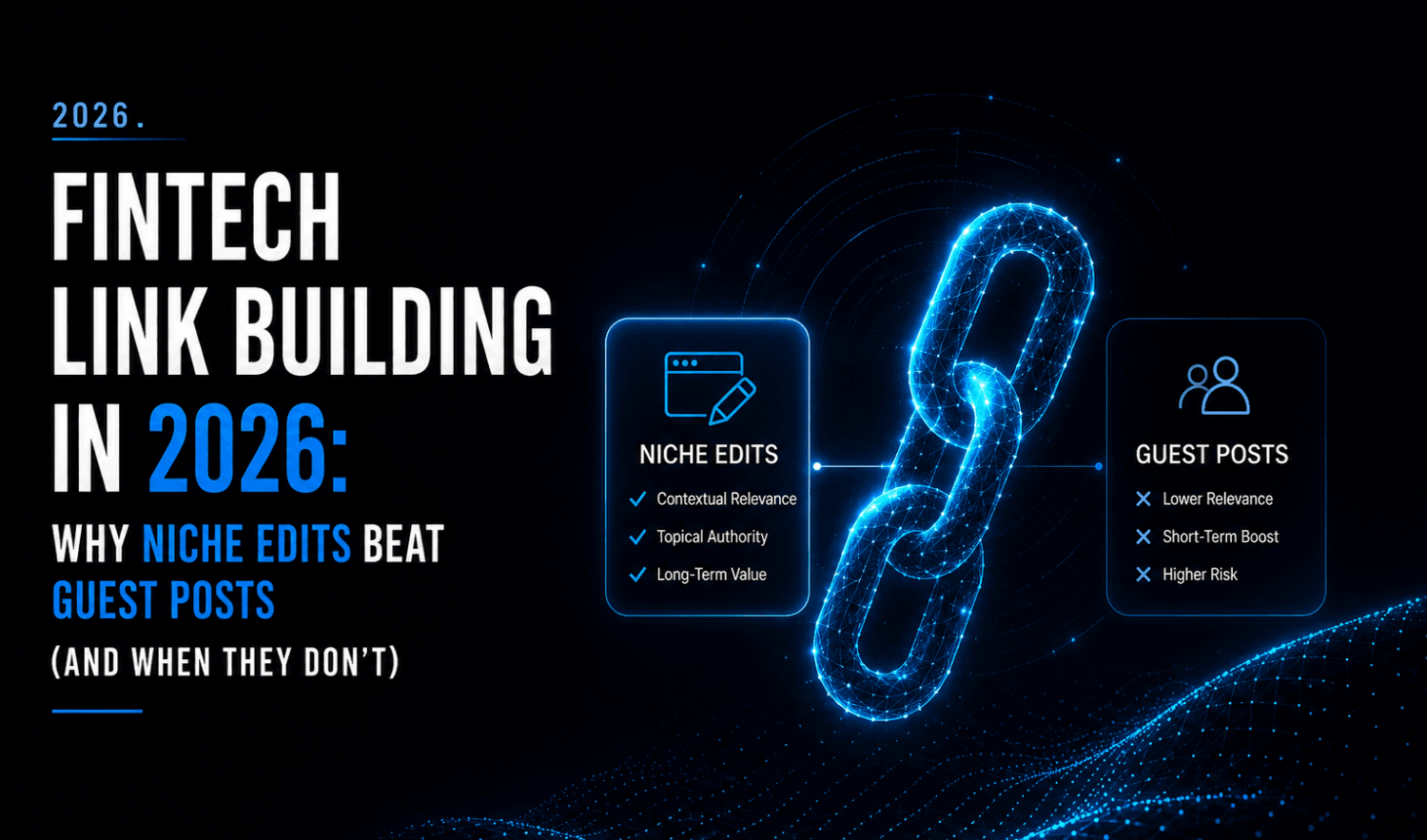

- Niche edits on aged, topically relevant fintech pages outperform most guest posts because the page already has backlinks, traffic, and trust signals Google has already indexed.
- Domain rating is a proxy metric. Page-level traffic, topical fit, and link neighborhood are what actually move rankings.
- Guest posts win in two specific cases: when you need anchor text control on a fresh topic, or when the publication has genuine editorial traffic and readership.
- The fintech vertical has a spam problem. A large share of “DR 50+ fintech guest post” placements live on private blog networks or thin-content sites with zero organic traffic.
- Use the FintechSpecs Placement Signal Stack before buying any link. Four checks, five minutes, no spreadsheet required.
For fintech link building, niche edits on aged, traffic-verified pages in financial services outperform guest posts in the majority of scenarios because aged pages carry existing PageRank flow and topical trust that new guest post pages lack. Guest posts are still worth buying when anchor text precision matters or when the target publication has documented editorial traffic. Domain rating alone predicts almost nothing about whether a link will move rankings.
Why Most Fintech Link Building Spend Gets Wasted
The standard approach: find a link vendor, sort by domain rating, buy the highest DR you can afford, repeat. It sounds rational. It does not work consistently, especially in fintech, where regulators, journalists, and Google all apply more scrutiny to financial content than to any other vertical.
The problem is that domain rating measures the backlink profile of an entire domain, not the page where your link will live. A DR 60 site with one high-traffic page and 4,000 thin pages passes almost no equity to a link buried in a newly published post that gets zero organic visitors. Vendors know this and exploit the gap between what DR implies and what the link actually delivers.
Fintech makes this worse. The niche attracts disproportionate link spam because financial keywords carry high commercial value. Publishers charge more, which attracts more thin-content operators trying to cash in. A meaningful share of what gets sold as “fintech guest post placements” lives on sites that rank for nothing and pass no meaningful signal. If you are building links for a fintech SaaS product and wondering why movement is slow, start here before adjusting your content or technical setup.
What Are Niche Edits and Why Do They Matter in Fintech?
Niche edits (also called link insertions) are backlinks placed inside existing, already-published content on another site. You pay the publisher to insert a contextual link into a post that already exists, already has backlinks pointing to it, and in good cases, already receives organic traffic. No new article is created.
The SEO case for niche edits in fintech is direct. An aged page on a financial site about, say, ACH payment processing has already accumulated referring domains, dwell time signals, and indexing history. When your link goes into that page, you inherit some of that equity immediately. A brand-new guest post on the same domain starts at zero page-level authority and may take months to accumulate any signals, if it ever does.
This does not mean niche edits are automatically superior. The aged page still needs to meet baseline quality criteria. A 2018 post with three paragraphs, no organic traffic, and links from 40 other paid placements is not an aged asset. It is a liability dressed up in years.
The FintechSpecs Placement Signal Stack
Before buying any placement, run these four checks in order. If a placement fails any one of them, walk away regardless of price or the vendor’s pitch.
Check 1: Page-Level Organic Traffic
Pull the specific URL (not the domain) into Ahrefs or Semrush and check estimated monthly organic traffic. For niche edits, you want the target page to have at least some organic visitors. The exact threshold depends on the niche: a personal finance page with 200 monthly visitors is meaningful; a mortgage page with 200 monthly visitors in a high-competition keyword space may indicate something is suppressing it. Zero traffic on an aged page is a red flag, not a neutral signal.
Check 2: Topical Relevance of the Surrounding Content
Does the host page cover a topic that a fintech buyer, user, or investor would plausibly read? A link to your payment infrastructure tool placed inside a post about cryptocurrency tax reporting is tangentially related at best. Google’s helpful content systems evaluate whether links make editorial sense in context. “Finance” is not a sufficient topical match for fintech. Payments, banking, lending, compliance, and SaaS billing are topically tight. Personal budgeting and credit card rewards are not.
Check 3: Link Neighborhood Analysis
Check what other external links exist on the page and in the surrounding content. If the outbound links on a single post point to five competing fintech SaaS companies, two crypto exchanges, and a payday loan aggregator, the page is a link farm regardless of its DR score. Each outbound link on a page dilutes the equity passed to every other link. Pages with 15 or more paid outbound links pass negligible value per placement.
Check 4: Traffic Source Verification
Use SimilarWeb or the site’s own publicly shared analytics (some publishers share these for media kit purposes) to confirm that site traffic is predominantly organic search, not direct or referral traffic from a single source. Sites with 90% direct traffic and minimal search presence often inflate their metrics through bot traffic or internal redirects. Organic search traffic is the only traffic that validates genuine editorial reach.
Guest Posts vs Niche Edits: A Direct Comparison for Fintech SaaS
| Factor | Niche Edits | Guest Posts |
|---|---|---|
| Page authority at placement | Inherited from existing page | Starts at zero, builds slowly |
| Anchor text control | Moderate (editor may constrain) | High (you write the draft) |
| Speed of link equity | Faster (page already indexed) | Slower (new URL needs indexing) |
| Content creation cost | None or minimal | Writing cost plus placement fee |
| Spam risk in fintech | Medium (requires traffic check) | High (thin content sites common) |
| Topical fit control | Lower (depends on existing content) | Higher (you frame the topic) |
| Best for | Competitive keyword ranking, authority transfer | Brand new topics, precise anchor text |
Guest posts earn their place in specific situations. If you are targeting a keyword cluster that has no existing content on your target domains, a well-written guest post creates that topical footprint. If you need exact-match or partial-match anchor text and niche edit placements are too editorially constrained to accommodate it, a guest post gives you full control over the copy. And if the publication genuinely has editorial authority in fintech (think a publication that financial journalists actually read and cite), the brand signal from a guest byline may matter as much as the link itself.
Outside those cases, niche edits on verified, traffic-positive pages are the higher-efficiency play for fintech link building. You pay once, you get immediate equity from an aged asset, and you skip the content production overhead.
What Does Fintech Link Building Actually Cost?
Pricing in this space is opaque and vendor-dependent, but publicly available rate cards and marketplace data show a consistent range. These figures reflect what reputable link building agencies and marketplaces publish openly, not guaranteed outcomes.
| Placement Type | Typical Price Range (per link) | What Drives the High End |
|---|---|---|
| Niche edit on DR 30-50 fintech page | $150 to $400 | Organic traffic on the specific page |
| Niche edit on DR 50-70 fintech page | $400 to $900 | Traffic + topical authority + low outbound link count |
| Guest post on DR 30-50 site | $200 to $600 | Editorial standards, turnaround time |
| Guest post on DR 50-70 fintech site | $500 to $1,500 | Real editorial audience, traffic verification |
| Placement on high-DA financial media | $1,500 to $5,000+ | Genuine readership, editorial gatekeeping |
The price ranges above are illustrative based on what major link building marketplaces and agencies list publicly. Individual vendors vary considerably. Anything priced below $100 for a fintech placement should be treated as high-risk until verified through the Placement Signal Stack. The sub-$100 segment is where private blog networks concentrate.
One useful calibration exercise: take the cost of a niche edit placement and divide it by the organic traffic the page receives monthly. A $300 placement on a page with 1,000 monthly visitors costs $0.30 per monthly visitor reached. A $300 placement on a page with 50 monthly visitors costs $6 per monthly visitor. The traffic-cost ratio exposes placements that look affordable in absolute terms but deliver almost no audience signal.
Red Flags That Indicate a Bad Fintech Link Placement
Vendors rarely volunteer this information. Here is what to look for before you send payment.
- The site’s “write for us” or “sponsored content” page is publicly indexed and linked from the homepage. Google reads those pages too.
- The domain has a large number of outbound links in the fintech category relative to its content volume. Pull the site-wide outbound link count in Ahrefs and divide by total indexed pages. More than three commercial outbound links per page on average is a strong signal of a link farm.
- The vendor guarantees placement within 24-48 hours on a site claiming editorial review. Real editorial gatekeeping takes time.
- The referring domain list for the site includes predominantly other known link networks rather than organic press, directories, or genuine industry publications.
- The site publishes more than two or three fintech-adjacent articles per week with no bylined author and no social presence for those bylines.
One pattern that appears repeatedly in fintech specifically: sites that were once legitimate financial blogs but pivoted to selling placements after their organic traffic declined. They retain historical DR from their legitimate period while the actual page traffic has collapsed. The DR looks credible. The Semrush traffic estimate tells the real story. Always check both.
When Should Fintech Companies Buy Links vs Earn Them?
Most fintech companies need both, but the mix depends on where they are in their growth stage. A seed-stage fintech with no domain authority should prioritize earned links through original data, product launches covered by press, and genuine partnerships before spending heavily on paid placements. Paid links into a domain with no existing authority and no organic content provide diminishing returns because there is nothing for the equity to amplify.
Once a fintech has some organic rankings and a content base, paid link building accelerates what already works. Think of it as buying a signal multiplier, not a signal creator. A Series B fintech with established product pages targeting competitive keywords like “ACH payment API” or “embedded lending platform” will see more movement from a well-placed niche edit than from another piece of content that earns one backlink naturally in six months.
For fintech SaaS teams specifically, the content most likely to earn organic links includes original benchmark data (API uptime comparisons, pricing analyses, compliance cost breakdowns), comparison pages that rank independently, and technical explainers that developers cite in forums and documentation. FintechSpecs covers several of these content categories in depth, including infrastructure reliability benchmarking and per-verification KYC cost data, both of which attract organic citations from practitioners.
Does Google Penalize Paid Links in Fintech?
Google’s spam policies explicitly prohibit buying or selling links that pass PageRank. In practice, manual penalties for paid link building are uncommon but real, and they disproportionately affect sites in YMYL (Your Money Your Life) categories, which include all fintech verticals. Financial sites receive more manual review than most other categories.
The practical risk profile: links on sites that are clearly link farms (many outbound commercial links, thin content, no organic traffic) carry higher penalty risk than contextual placements on legitimate publications that happen to accept sponsored content. The former looks manipulative to a manual reviewer. The latter looks like normal publishing economics. The distinction matters operationally.
Niche edits on real, trafficked pages in genuine financial publications carry lower risk than guest posts on thin sites specifically because they blend into existing content rather than creating new pages that pattern-match to link schemes. That said, high volume of any link type from low-quality sources is the fastest path to a manual action in fintech. Thirty mediocre links will hurt more than three strong ones help.
How AI Search Changes the Link-Building Equation for Fintech
AI search tools like Perplexity and ChatGPT do not cite based on backlink counts. They cite based on whether a page contains authoritative, specific, and well-structured information that matches the query. This creates a separation between traditional SEO link building and what drives AI citations, a topic covered in more depth in the GEO vs SEO breakdown for B2B SaaS.
For fintech marketers thinking about both Google rankings and AI visibility, the implication is this: links still matter for Google search, but the content those links point to needs to be structured for AI extraction. A link into a page with thin content does not help with AI citations even if it moves the page’s Google ranking. The two systems reward different things. Investing in placements on pages with substantive, structured content serves both goals simultaneously, which is another argument for prioritizing niche edits on high-quality existing content over guest posts on thin new pages.
If AI search visibility is a primary concern alongside organic rankings, the fintech GEO agency comparison covers teams that work specifically at this intersection.
Link Placement Quality Checklist for Fintech Marketers
Use this before approving any placement order.
- Pull the target URL in Ahrefs or Semrush. Confirm organic traffic greater than zero, ideally with a trend that is stable or growing.
- Read the page. Confirm it covers a topic genuinely relevant to your product category, not just broadly financial.
- Count the external links already on the page. More than ten to twelve commercial outbound links is a warning sign.
- Check the site’s referring domain list. Confirm it includes real press, industry directories, or legitimate publications alongside whatever link network placements exist.
- Search the site name in Google News or a press database. If it has never been mentioned editorially by any real outlet, treat it as zero editorial authority.
- Confirm the anchor text being used is natural and contextually appropriate. Exact-match anchor text on commercial terms at high volume is a Google spam signal.
- Verify the link will be a followed (dofollow) link. Sponsored or nofollow links have no PageRank value, regardless of the placement quality.
Frequently Asked Questions About Fintech Link Building
Are niche edits worth it for fintech SaaS companies?
Yes, in most cases. A niche edit on an aged, traffic-positive fintech page transfers link equity faster than a new guest post because the host page already has indexing history, existing backlinks, and organic traffic. The critical caveat is verification: the specific page must have actual organic visitors, topical relevance to your product, and a manageable outbound link count. DR alone is not sufficient to evaluate a niche edit placement in fintech.
What makes fintech link building different from standard SaaS link building?
Fintech sits in Google’s YMYL category, which means financial content receives more scrutiny from both algorithmic systems and human quality reviewers. Sites in the financial space face higher editorial standards for ranking, which raises the bar for what constitutes a quality host page. It also means that low-quality placements carry greater penalty risk than they would in less regulated verticals like marketing or productivity SaaS. The link spam problem in fintech is also more acute because high keyword values attract more operators selling fake authority.
How many links does a fintech SaaS company need to rank competitively?
There is no fixed number, and any vendor who gives you one is guessing. Competitive fintech keyword clusters require relative authority against the pages currently ranking, which varies by term. “ACH API” has different competitive dynamics than “embedded lending software.” The practical approach is to analyze the backlink profiles of the top three to five ranking pages for your target keywords in Ahrefs and benchmark the referring domain count and quality of those pages. That gives you a realistic target rather than a generic recommendation.
Should fintech companies use link building agencies or buy links directly?
Agencies add value if they have genuine relationships with real fintech publishers and apply quality controls before placement. Direct buying from marketplaces like Fat Joe, GetMentioned, or similar platforms can work if you apply the Placement Signal Stack yourself. The risk with agencies is that many act as resellers of the same low-quality inventory you could access directly. Ask any agency prospect to share the specific URLs they would target before you pay, not after.
What anchor text strategy works best for fintech link building?
A natural anchor text distribution includes a mix of branded anchors (your company name), partial match anchors (a word or two from your target keyword), generic anchors (like “this report” in editorial contexts), and bare URLs. Over-indexing on exact-match commercial anchors, for example using “ACH payment API” repeatedly across many placements, is a clear spam pattern. Google’s link evaluation systems flag unnatural anchor text distributions, particularly in financial verticals. Aim for your anchor profile to look like what would happen if people linked to you organically across a variety of contexts.
Is buying backlinks for fintech legal and safe?
Buying links is not illegal. It violates Google’s webmaster guidelines, which creates a penalty risk rather than a legal one. The risk level depends on placement quality: a paid contextual link in a genuine financial publication is vastly different from a bulk purchase of 50 links across obvious link farms. Fintech companies with regulatory relationships or reputational exposure should be especially conservative here. A Google manual action or significant ranking drop is a recoverable SEO problem; the reputational dimension of being associated with low-quality financial content is harder to unwind.
How do I find legitimate fintech sites for guest posts or niche edits?
Start with the sites that already rank for your target keywords. The top three to ten results for terms adjacent to your product are legitimate by definition. Check if they accept contributed content or link insertions. Beyond that, Respona, Pitchbox, and manual prospecting through Ahrefs’ Content Explorer are reliable ways to build a qualified target list. Filter by organic traffic, not domain rating, when building your prospect list for fintech specifically.
Does link building still matter if we are investing in GEO and AI visibility?
Yes. Google organic search still drives substantial traffic to fintech content, and links remain a primary ranking signal for Google. GEO (generative engine optimization) addresses a different distribution channel: AI search tools that generate cited responses. The two strategies are complementary. Links help your pages rank in Google and get indexed, which is a prerequisite for AI crawlers discovering and citing your content. Teams building only for AI visibility without organic search authority will have less content for AI systems to find and trust. The operational complexity of fintech content makes it worth building a durable distribution foundation rather than chasing any single channel.
The Link That Moves Rankings vs the Link That Looks Good in a Report
The fintech link building market has a vendor incentive structure that works against buyers. Vendors are paid per placement, not per ranking improvement. A DR 55 placement on a page with zero organic traffic closes a deal and generates revenue for the vendor. It generates almost nothing for you. The gap between what looks credible in a monthly report and what actually passes equity is where most link building budgets disappear.
The way to close that gap is to evaluate placements the same way Google does: by what is actually on the page, who links to the page, and whether anyone reads it. The Placement Signal Stack described above takes roughly five minutes per URL. At $300 to $900 per placement, five minutes of verification is not optional due diligence. It is basic spend hygiene. Fintech marketers who internalize this distinction, between page-level equity and domain-level vanity metrics, outperform their categories with fewer links and lower budgets than competitors chasing DR numbers.
For fintech SaaS teams scaling past $5M ARR and building out their growth infrastructure, link building does not operate in isolation. It amplifies content that already has clarity of purpose: clear product positioning, well-structured comparison pages, and technical content that practitioners actually need. A site like FintechSpecs exists partly because the fintech industry needs editorial coverage that serves buyers rather than vendors. That same principle applies to every link you build: the placement should serve a reader who might actually land on it, not just a crawler that passes through.
If you are publishing in the fintech space and want to understand what placements on genuinely trafficked, topically authoritative fintech content look like in practice, the fintech GTM stack and fintech metrics that move business outcomes are the kinds of content that attract real editorial citations, not because they were optimized for link acquisition, but because they say something specific enough to be worth citing.