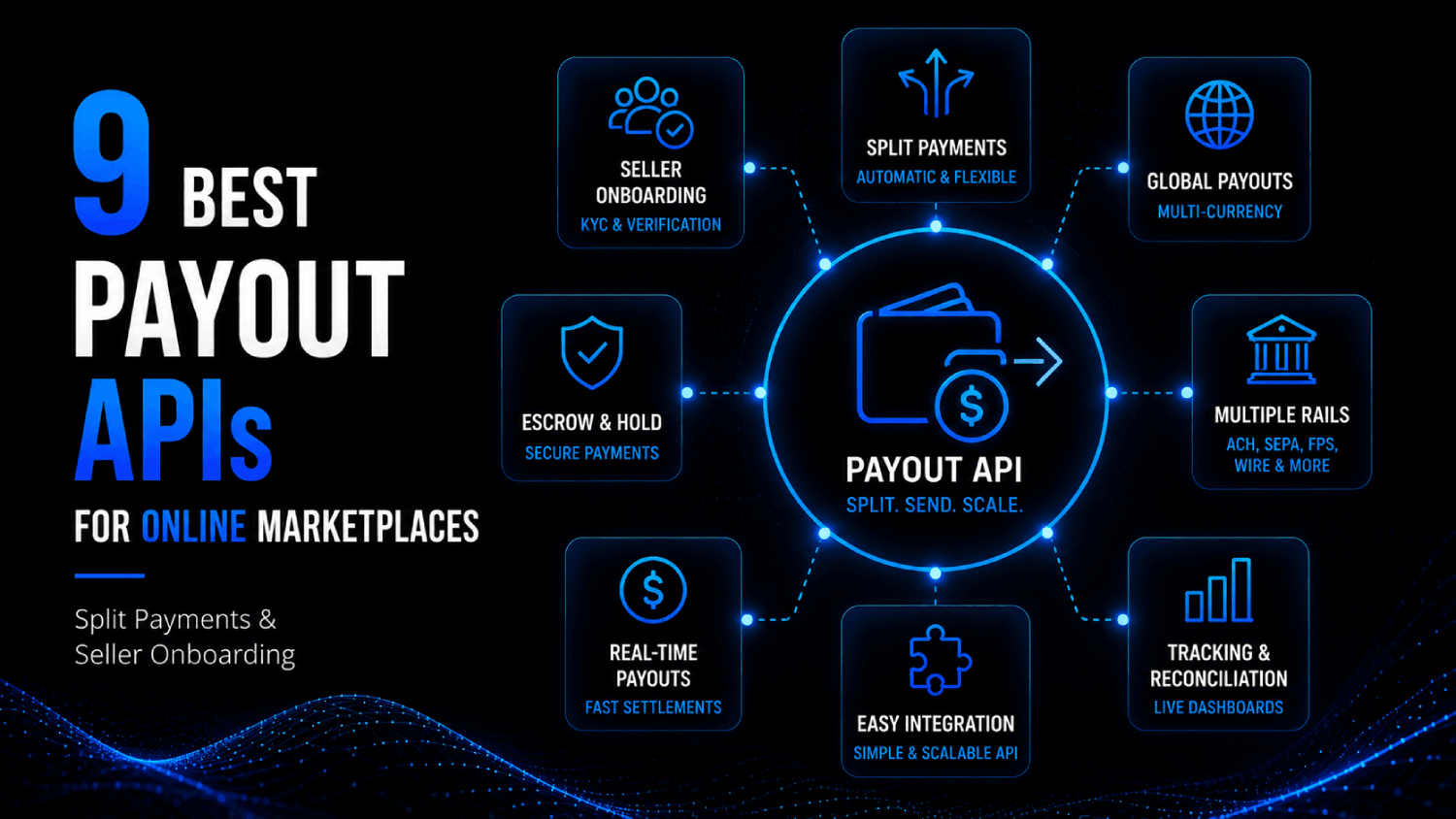

- A standard payments API accepts money and moves it. A marketplace payout API splits that money across multiple sellers, holds funds for dispute windows, and onboards each seller as a verified sub-merchant before a single dollar moves.
- Most general-purpose APIs break at two points: split payout logic at checkout and compliant seller KYC. The providers on this list handle both natively.
- Stripe Connect and Adyen for Platforms are the most complete end-to-end options, but each comes with trade-offs in pricing complexity and onboarding friction that matter at different scales.
- Hold and release controls, the ability to delay seller payouts until after a buyer dispute window closes, are a compliance and operational necessity that only specialized marketplace APIs expose cleanly.
- For cross-border seller payouts and mass disbursements, Trolley and Tipalti solve problems that Stripe and Adyen were not designed for.
The best marketplace payout API depends on whether you need end-to-end payment facilitation with built-in KYC, or a disbursement layer you drop on top of existing payment infrastructure. Stripe Connect handles both for US-heavy platforms and charges 0.25% plus $0.25 per payout for Express accounts. Adyen for Platforms is better suited for enterprise volume across multiple countries. Trolley and Tipalti lead on mass cross-border payouts to contractors and sellers who need multiple local payout rails. For smaller marketplaces needing fast setup, PayPal Commerce Platform and Mangopay offer faster onboarding with less custom integration work.
Why a Standard Payments API Fails for Marketplace Payouts
When a buyer pays $200 on a marketplace, three things need to happen simultaneously: the platform collects its fee, the seller receives their cut, and the transaction is held long enough to cover a potential dispute or chargeback. A standard payments API like basic Stripe or Braintree handles step one cleanly. Steps two and three require purpose-built infrastructure that most developers do not discover is missing until they are already in production.
The technical gap shows up in three places. First, split logic: routing a single charge to multiple destination accounts requires a dedicated accounts model (Stripe calls them Connected Accounts, Adyen calls them Account Holders). Second, sub-merchant onboarding: each seller on your platform is effectively a merchant in the eyes of card networks, which means KYC, KYB for business sellers, and 1099-K tax reporting in the US. Third, hold and release: marketplaces need to delay payouts until after the buyer dispute window closes, often 2 to 7 days, and that requires a reserve or escrow mechanism the underlying API must expose explicitly.
These are the three filters that narrow the field. The nine providers below all pass them to varying degrees. Understanding where each one falls short is the only way to match them to your actual architecture. For a broader view of how embedded payments fit into a full SaaS product, the top embedded payments providers for B2B SaaS platforms covers the category one level up.
The FintechSpecs Marketplace Payout Stack Test
Before the full list, every provider here was evaluated against four criteria we call the Marketplace Payout Stack Test. This framework is designed to expose exactly where a general-purpose API runs out of runway for marketplace-specific requirements: split logic, sub-merchant compliance, hold controls, and payout rail breadth. Each of the nine providers below is assessed against these four gates in the same order, and the comparison table that follows is the output of that assessment rather than a feature summary. The worked example later in this article (a $500 home services payment across three architectures) shows concretely what each gate looks like in production.
Split logic at charge time asks whether you can define the split when the transaction is created, not after settlement. Providers that require a second API call to move funds post-settlement add reconciliation risk and payout delay. It also covers how the split itself is defined: whether you can set a fixed amount, a percentage of the transaction, or a different rate per seller or product category, and whether that rate can change per transaction without touching the account configuration.
Sub-merchant onboarding completeness looks at whether KYC, identity verification, bank account validation, and 1099-K generation are handled by the provider or pushed back to you to build.
Hold and release controls tests whether the API exposes a programmable delay between charge capture and payout initiation, and whether that window can be set per transaction or only at the account level.
Payout rail breadth covers whether sellers can be paid via ACH, same-day ACH, wire, instant transfer, prepaid card, or international local rails, and which of those are available without add-on contracts. Rail availability is only half the question. Uptime on the rails you depend on is the other half, and it is rarely in a vendor’s own materials; the fintech API uptime and infrastructure reliability report tracks published incident history across payment infrastructure providers.
Split Payout Capability Comparison
| Provider | Split at Charge Time | Sub-Merchant KYC | Hold / Release Control | 1099-K Generation | US Payout Rails | Cross-Border Payouts |
|---|---|---|---|---|---|---|
| Stripe Connect | Yes (Destination / Direct) | Built-in (Express, Custom) | Yes (delay_days param) | Yes | ACH, Instant, Debit | 40+ countries |
| Adyen for Platforms | Yes (Split object) | Built-in (Account Holders) | Yes (Transfer Instruments) | Yes (US) | ACH, Wire | 30+ countries |
| PayPal Commerce Platform | Yes (Order Split) | Partial (PayPal account) | Limited | Yes | PayPal, ACH, Debit | 200+ countries |
| Trolley | No (disbursement layer only) | Built-in (Recipient KYC) | Approval workflows | Yes (1099-NEC/MISC too) | ACH, Wire, Check | 210+ countries |
| Tipalti | No (disbursement layer only) | Built-in (payee portal) | Approval-based holds | Yes (1099 full suite) | ACH, Wire, Check, Card | 196+ countries |
| Mangopay | Yes (Wallets) | Built-in (EU/US KYC) | Yes (e-wallet holds) | Limited | ACH, Wire | 30+ countries |
| Payoneer | Partial | Built-in (Payoneer ID) | Limited | Partial | ACH, Wire, Card | 190+ countries |
| Hyperwallet (PayPal) | No (disbursement layer) | Built-in | Configurable holds | Yes | ACH, Check, Wire, Card | 200+ countries |
| Dots | Yes | Built-in (US KYC) | Yes | Yes | ACH, Venmo, PayPal, Check | Limited |
Which Provider Is Actually Best for Each Marketplace Type?
Stripe Connect: Best for US-first marketplaces building on top of Stripe’s payment stack
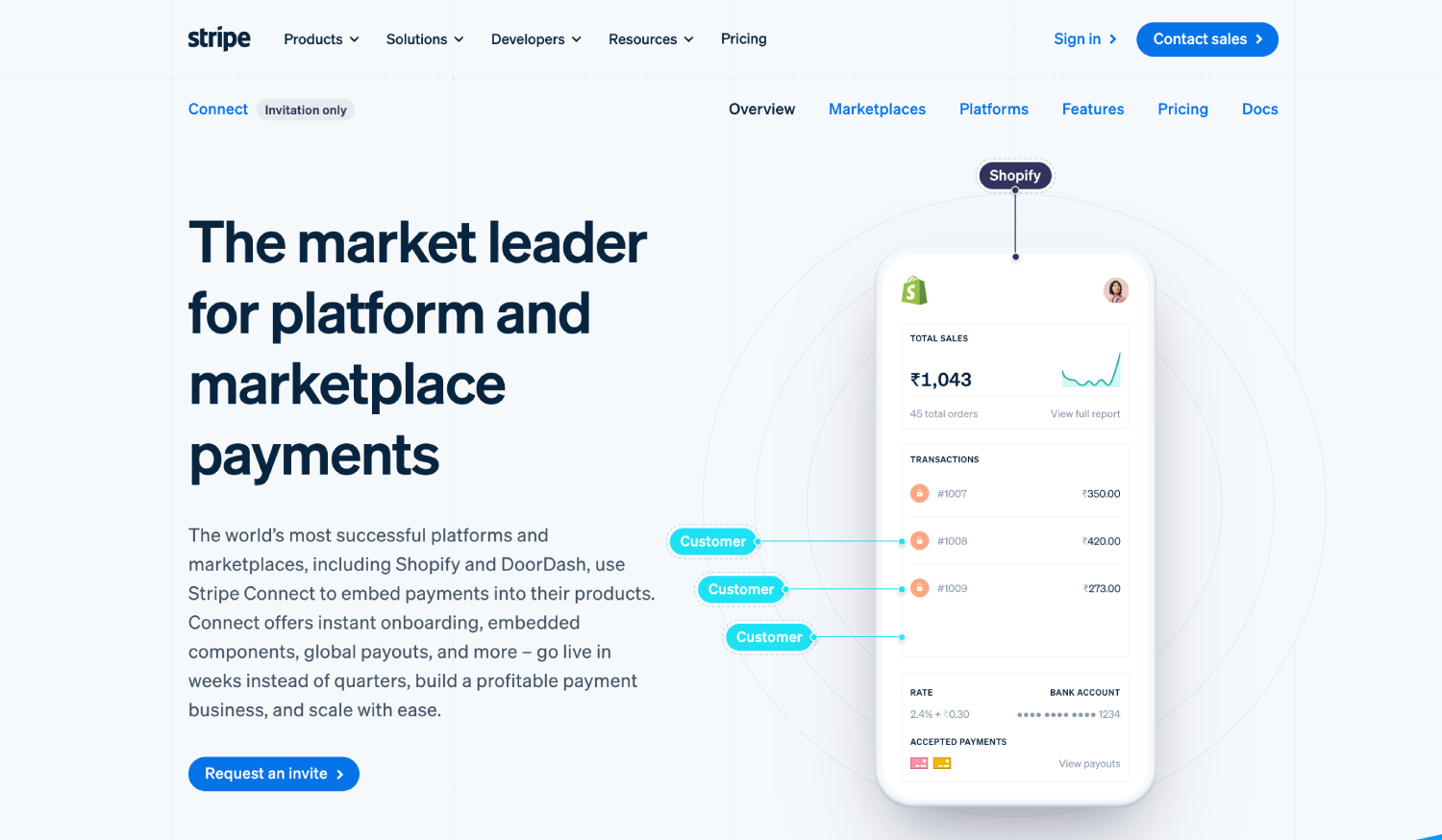
Stripe Connect is the most complete end-to-end marketplace payout API for teams already invested in the Stripe payment stack. The three account types, Standard, Express, and Custom, map directly to how much onboarding UX you want to own. Express handles KYC natively inside a Stripe-hosted flow. Custom gives you full UI control but puts more compliance responsibility on your team.
The split mechanics are cleanest here. You define the destination account and application fee at charge creation with a single parameter. The delay_days setting on each connected account controls the hold window before payout initiation. According to Stripe’s public pricing page, Express payouts cost $0.25 plus 0.25% per payout, and Instant Payouts add 1% with a $0.50 minimum. That adds up fast on high-volume, low-average-order marketplaces.
Where Stripe Connect shows limits: enterprise-scale negotiated pricing is harder to access than with Adyen, and Custom account compliance work is underestimated by most engineering teams. The PayFac-as-a-Service provider comparison covers how Stripe Connect compares to purpose-built PayFac platforms for cases where compliance ownership is a real concern.
Adyen for Platforms: Best for enterprise marketplaces with global volume and custom pricing needs
Adyen for Platforms is the enterprise-grade alternative. The account holder and balance account model maps cleanly to marketplace fund flows, and the split object in the payment API request lets you route funds at the transaction level across multiple account holders in a single API call.
Adyen does not publish standard pricing, which means every deal is negotiated. That is a feature for large platforms ($5M+ monthly processing volume) and a friction point for early-stage companies. Onboarding as an Adyen platform also requires more technical scoping than Stripe Connect. The upside is interchange-plus pricing that becomes significantly cheaper at volume, direct acquiring relationships in more countries, and enterprise-grade SLAs.
For a direct head-to-head on where Stripe and Adyen each break down for scaling B2B SaaS, the Stripe vs Adyen payment stack comparison goes deeper on the infrastructure trade-offs.
PayPal Commerce Platform: Best for consumer marketplaces where sellers already have PayPal accounts
PayPal Commerce Platform handles split payments at the order level and can route funds to seller PayPal accounts across 200+ countries without requiring bank account details from sellers. That frictionless payer experience is its core advantage.
The hold and release controls are less flexible than Stripe Connect or Mangopay. PayPal’s chargeback and dispute process is also more seller-unfavorable than card network disputes in some categories. According to PayPal’s public pricing page, the platform charges a standard 3.49% plus $0.49 per transaction for online checkout, with seller fees varying by country. For marketplaces where many sellers are gig workers or individuals reluctant to set up a bank account connection, PayPal’s install base makes conversion on the seller side meaningfully easier.
Trolley: Best for marketplaces paying contractors, creators, or international freelancers at scale
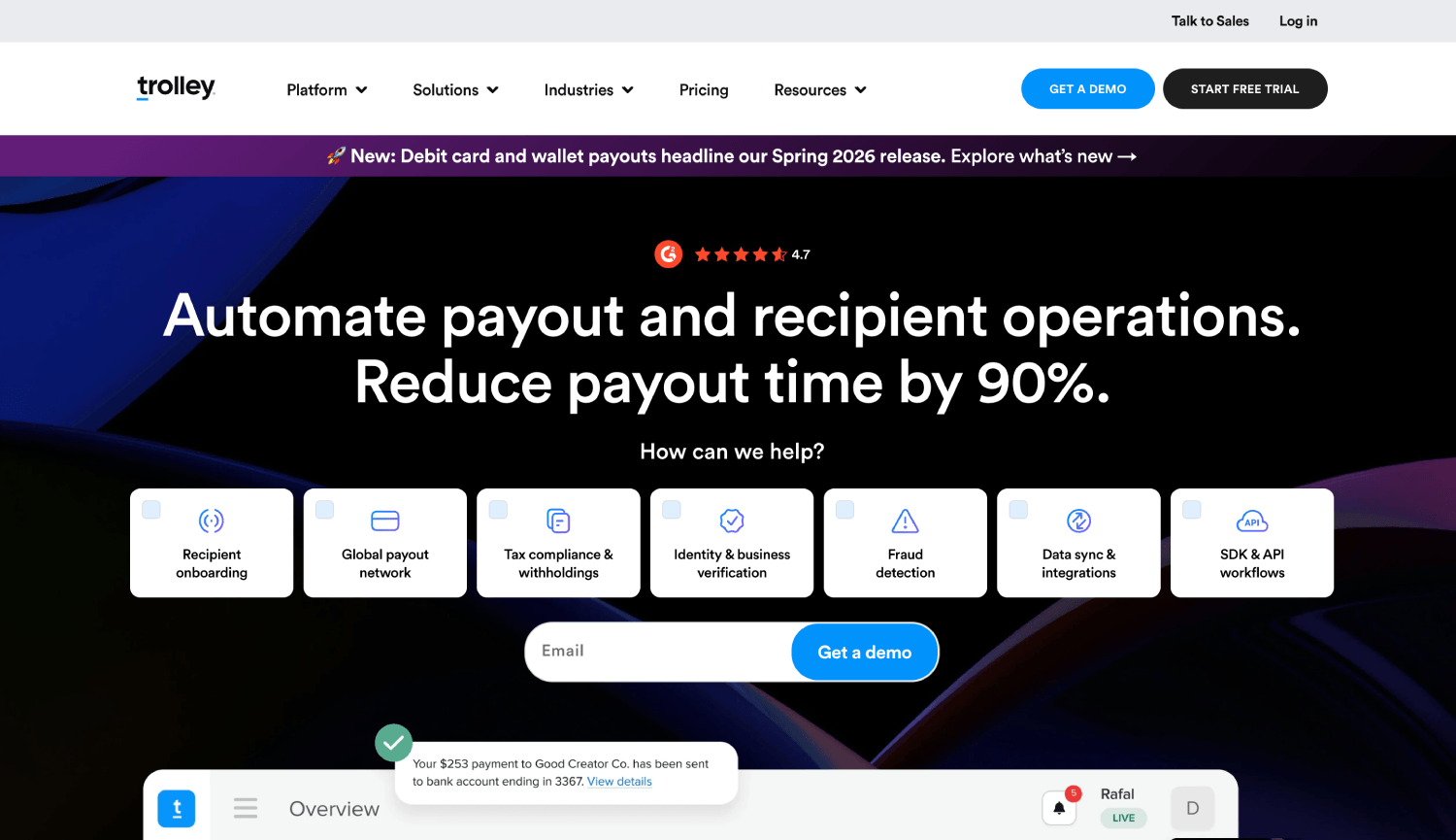
Trolley is not a payment processor. It is a payout and tax compliance platform, and that distinction matters for how you architect your stack. Trolley sits downstream of your payment processor, takes funds from your bank or payment account, and handles recipient KYC, tax form collection (W-9, W-8BEN, 1099-NEC, 1099-MISC), and disbursement to 210+ countries across ACH, wire, PayPal, and check.
The platform’s recipient portal lets sellers self-serve their payment method preferences, tax status, and payout history without touching your support team. According to Trolley’s public pricing page, plans start at a free tier with per-transaction fees, scaling to enterprise plans with volume pricing. Trolley’s strength is 1099 tax compliance automation at scale. For marketplaces paying thousands of US-based contractors per year, the tax form workflow alone justifies the integration. The gap is that Trolley does not process the buyer-side payment, so you need a separate payment processor.
Tipalti: Best for B2B marketplaces and platforms with high-value seller payments requiring approval workflows
Tipalti is the most compliance-heavy option on this list, which makes it the right fit for platforms where payees are businesses rather than individuals, and where finance teams need approval controls, audit trails, and AP automation before a payment leaves the platform. Like Trolley, it operates as a disbursement layer rather than a full payment processor.
Tipalti handles global supplier payments across 196 countries, supports ACH, wire, check, prepaid debit, and local bank transfers, and generates the full suite of 1099 forms automatically. The payee onboarding portal collects banking details, tax information, and identity documents in a white-labeled flow. Tipalti’s pricing is not publicly listed by tier, so you will need to request a quote. For B2B SaaS platforms looking at the full AP automation picture, the Bill.com vs Tipalti comparison provides context on where Tipalti fits relative to simpler AP tools.
Mangopay: Best for European marketplaces that need e-wallet infrastructure and flexible hold periods
Mangopay is built specifically for marketplaces, rental platforms, and crowdfunding products. Its wallet-based architecture means every buyer and seller gets a Mangopay e-wallet, funds flow into buyer wallets at checkout, and you control exactly when and how much moves to the seller wallet and then to their bank account.
That wallet model makes hold and release the most programmable of any provider on this list. You set hold durations per transaction, release partial amounts, or hold funds indefinitely pending a dispute resolution, all through the API. Mangopay’s KYC covers both EU and US sellers. The limitation is that Mangopay is less commonly used in the US and has a smaller developer community than Stripe Connect, so debugging and implementation support resources are thinner for US-based teams.
Payoneer: Best for marketplaces paying international sellers who need multi-currency receiving accounts
Payoneer excels when your sellers are globally distributed businesses that need to receive in their local currency without a US bank account. Sellers get a Payoneer balance account that accepts payments in USD, EUR, GBP, and other major currencies, and can then withdraw to their local bank at competitive FX rates.
Payoneer’s marketplace API covers mass payouts and recipient onboarding but is less suited for real-time split-at-checkout scenarios compared to Stripe Connect or Adyen. It works better as a disbursement network when your settlement cycle allows batch payouts rather than instant splits. The seller experience is strong for international recipients. The buyer-side checkout and hold/release controls are weaker.
Hyperwallet (PayPal): Best for enterprise platforms that need a white-label disbursement network with configurable holds
Hyperwallet, now part of PayPal, operates as a white-label payout platform aimed at gig economy companies, insurance platforms, and enterprise marketplaces. The key differentiator from PayPal Commerce Platform is the configurable hold period. Hyperwallet exposes hold duration controls at the account and transaction level, which makes it viable for platforms that need custom reserve policies per seller risk tier.
Hyperwallet handles onboarding, identity verification, and multi-channel disbursement (ACH, check, wire, prepaid card, PayPal) across 200+ countries. Pricing is not publicly listed. The integration is more complex than Stripe Connect and the documentation is less developer-friendly, but for enterprise platforms that have already outgrown Stripe Connect’s volume pricing, Hyperwallet’s configurable payout controls and PayPal’s global network behind it are meaningful advantages.
Trolley vs Tipalti vs Hyperwallet: Which Disbursement Layer?
All three sit downstream of your payment processor and none of them will split a payment at checkout, so the choice comes down to who your payees are rather than how your checkout works.
Choose Trolley when your payees are individuals and US tax forms are the operational burden. The 1099-NEC and 1099-MISC workflow and the self-serve recipient portal are what you are buying, and 210+ country reach comes with it.
Choose Tipalti when your payees are businesses and a finance team needs approval controls before money moves. Multi-step approvals, audit trails and AP automation are the differentiator, and they are overhead you do not want if your payees are individual sellers.
Choose Hyperwallet when you need per-seller reserve policies and a white-label payee experience at enterprise volume. Configurable holds at both account and transaction level are the reason to accept a heavier integration and thinner documentation.
The pattern across all three: Trolley optimizes for tax compliance, Tipalti for financial controls, Hyperwallet for payout configurability. If none of those three is your binding constraint, you probably need split logic at checkout instead, which puts you back with Stripe Connect, Adyen or Mangopay.
Dots: Best for US-based creator and gig marketplaces needing fast setup and multiple payout methods
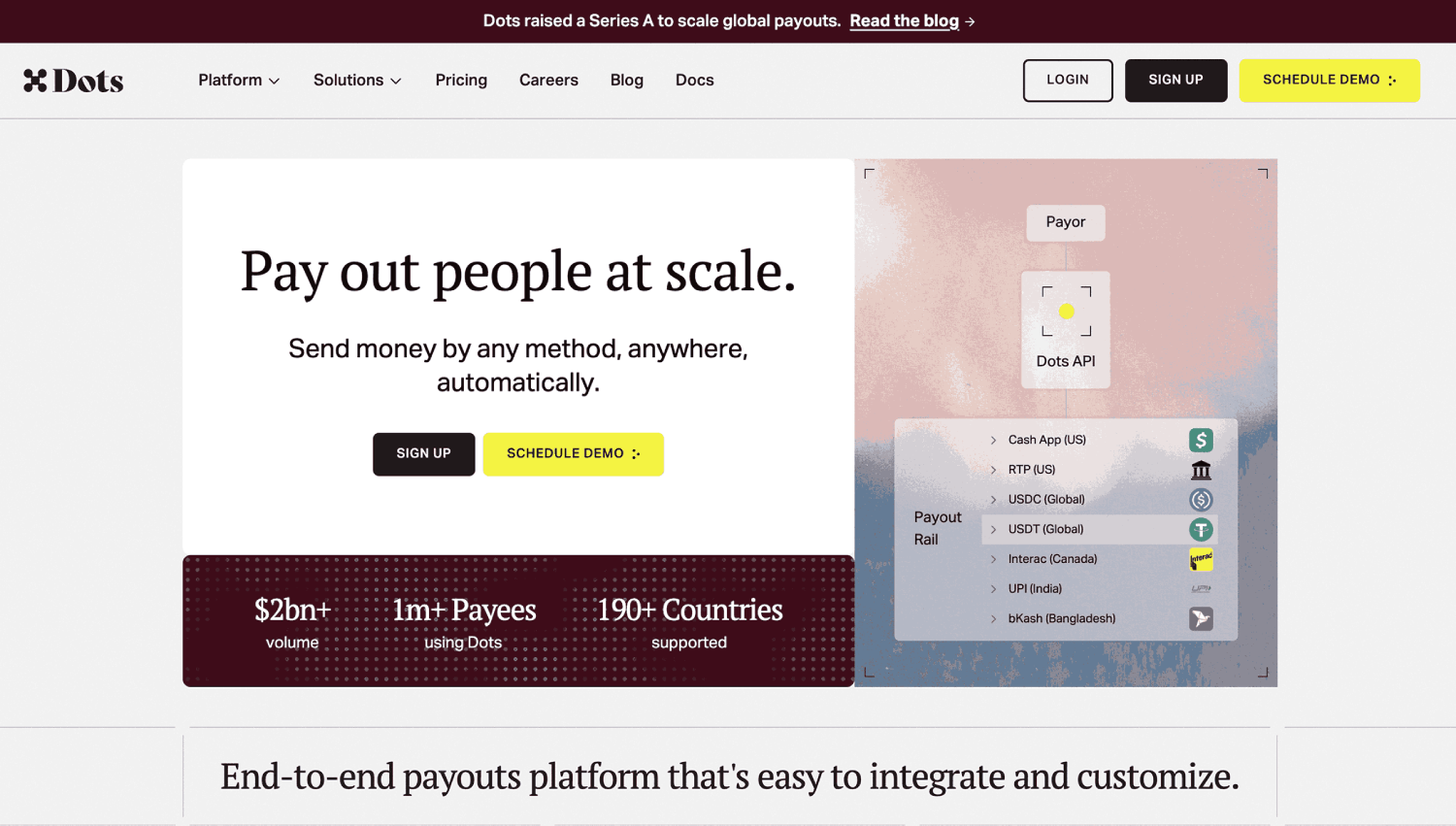
Dots is a newer marketplace payout API built specifically for platforms paying US-based creators, freelancers, and gig workers. The API handles split payouts, seller KYC, and 1099 tax forms, and disburses via ACH, Venmo, PayPal, Zelle, and check through a single integration. According to Dots, marketplaces can reduce support load by up to 70% through self-serve portals where sellers track payouts and manage tax forms without contacting the platform.
Dots is the fastest to launch of the US-focused options, with the company citing 1 to 2 week implementation timelines for standard marketplace setups. The limitation is geography. Cross-border payouts are limited compared to Trolley, Tipalti, or Hyperwallet, so it is best suited for platforms with predominantly US seller bases. Pricing is available on request.
For platforms where the primary requirement is payout speed to gig workers or creators rather than split logic at checkout, the instant payout providers for gig and creator platforms comparison is the closer match.
Can Each Seller Hold a Balance Without Opening a Bank Account?
Yes, and there are two ways to do it. Either you give each seller a wallet inside the payment provider, or you pay them into an account they already have. Both remove the bank-details requirement that stalls seller sign-up on small marketplaces, and they behave very differently once funds are sitting there.
The wallet route means every buyer and seller holds a balance inside the provider’s ledger. Mangopay is built this way, and Payoneer offers a related model in which the seller holds a multi-currency receiving balance rather than a platform-controlled wallet. Balances accumulate, you control release, and the seller connects a bank account only when they want to withdraw. This is the better fit if you need to hold funds between purchase and delivery.
The existing-account route means routing funds to a destination the seller already holds. PayPal Commerce Platform pays into a seller’s PayPal account across 200+ countries with no bank details collected from your side, and Dots reaches US recipients through Venmo, PayPal, Zelle or check. Sign-up friction is lowest here, because there is no new account for the seller to open at all.
For a marketplace with tens rather than thousands of sellers, the existing-account route is usually the right first choice. Wallet infrastructure carries fund-safeguarding and reconciliation obligations that are worth taking on when you need programmable holds, and are hard to justify when you do not.
How Does Sub-Merchant Onboarding Actually Work at Each Provider Tier?
Sub-merchant onboarding is the process of collecting, verifying, and storing seller identity and banking information before they can receive funds. Every provider on this list handles it differently, and those differences create real conversion differences on your seller sign-up flow.
Stripe Connect Express uses a Stripe-hosted onboarding flow that collects SSN or EIN, bank account details, and identity documents. The conversion rate on that hosted flow is Stripe’s problem to optimize, not yours. Stripe Custom flips that: you build the UI, you own the conversion, you own the compliance documentation. Most teams underestimate the ongoing compliance maintenance that comes with Custom accounts.
Adyen’s Account Holder onboarding is done via API calls to the Onboarding API, and KYC verification happens asynchronously. Sellers are put into a tiered limits system where they can receive small payouts before full KYC clears, which reduces onboarding friction for new sellers. Trolley and Tipalti both use a self-serve payee portal where sellers fill out their own banking and tax information, verified against IRS databases for US taxpayers. That self-serve model works well for platforms paying hundreds or thousands of sellers because it eliminates data entry on the platform side.
Getting seller onboarding right from the start is one of the areas where platforms most commonly create compliance blind spots. The fintech product and compliance readiness checklist covers what due diligence your onboarding flow should capture before you go live.
What Happens When a Seller Fails Verification?
Most sellers who fail verification have not failed permanently. They have failed a single check, and whether your provider treats that as a request for more documents or as a hard decline is the difference between a recoverable onboarding flow and a lost seller.
Verification is asynchronous at every provider on this list. You submit the seller’s details, the provider returns a pending status, and the outcome arrives later by webhook after identity, sanctions and business-registry checks complete. Your platform needs a state machine that handles at least four outcomes, not two: approved, pending additional documents, restricted with limits, and declined. Building only for approved and declined is the most common integration mistake in marketplace onboarding, because it strands every seller in the middle two states.
The four questions worth asking a provider before you integrate:
- Does a failed check produce a step-up request or a hard decline? Step-up means the provider asks the seller for a specific additional document, an address proof or a business registration certificate, and re-runs the check. Hard decline means the seller is finished and your support team inherits the problem.
- Can a pending seller transact at all? Some providers apply tiered limits, allowing a seller to receive small payouts while full verification completes. Adyen’s account holder model works this way. Others block all fund movement until the account clears.
- What decline reasons does the API actually return? Sanctions and watchlist hits, card-network denial-list matches, and business-registry mismatches are handled very differently, and only the first two are genuinely final. A provider that returns a generic failure code leaves you unable to tell a recoverable case from a permanent one.
- Can you re-submit, and how often? Retry limits and cooling-off periods vary, and a low limit turns a data-entry typo into a permanently blocked seller.
Ask for the decline breakdown by reason during the evaluation, not the headline approval rate. An approval rate tells you about the provider’s existing customer base. The decline breakdown tells you what your support team will be doing every week.
Which Tax Forms Does the Provider Collect, and Which Does It File?
Collecting a tax form and filing it are two different products, and providers price and describe them as if they were one. Confirm which side of that line each vendor sits on before you assume your year-end is covered.
Four capabilities to separate during evaluation:
- Collection at onboarding. W-9 for US persons and W-8BEN or W-8BEN-E for non-US recipients, validated at the point of entry rather than accepted as a file upload. Validation against IRS records at collection time is what prevents a year-end scramble over mismatched names and TINs.
- Threshold tracking through the year. Whether the provider monitors each payee against the current reporting threshold as payouts accumulate, and whether it adjusts when the threshold changes.
- Form generation and e-filing. Generating a 1099-K, 1099-NEC or 1042-S is not the same as transmitting it to the IRS and distributing copies to recipients. Ask specifically which of the three steps is included and which is an add-on.
- Withholding. Whether the provider can withhold at payout time when a payee’s tax status is missing or invalid, rather than paying in full and leaving the platform exposed.
What Does a Marketplace Split Payout Look Like in Practice?
Consider a home services marketplace where a homeowner pays $500 for a cleaning job. The platform charges 15%, so it keeps $75. The cleaner should receive $425, minus any payment processing fees. Here is how that flow works across three different architecture choices.
With Stripe Connect (Destination Charges): the platform creates a $500 charge with an application fee of $75 and a destination of the cleaner’s connected account ID. Stripe collects the full $500, holds the $75 for the platform, and queues $425 (minus Stripe’s processing fee) to the cleaner’s connected account. The payout to the cleaner’s bank account is delayed by the configured delay_days setting, typically 2 to 7 days. The platform sees all transaction data, manages disputes, and files 1099-K forms at year end.
With Trolley as the disbursement layer: the platform collects the $500 via its existing payment processor, deposits the net seller amount into its Trolley account, and creates a payout record for the cleaner recipient. Trolley verifies the recipient, checks their tax status, and disburses $425 via ACH or the cleaner’s preferred method. The platform controls exactly when the disbursement is triggered. This architecture is better for platforms that already have a payment processor they like and only need the outbound payout and tax compliance layer.
With Mangopay’s wallet model: the homeowner’s $500 goes into a buyer e-wallet. After the job is confirmed, the platform moves $425 to the cleaner’s e-wallet and $75 to its own platform wallet. Neither balance touches a bank account until explicitly requested. This hold period is fully programmable and reversible within the wallet layer, making dispute resolution before payout the simplest of the three architectures.
What Happens to a Split Payment When the Buyer Wants a Refund?
The refund unwinds in the reverse order of the split, and how cleanly it unwinds depends entirely on whether the seller’s money has already left the provider’s ledger. That timing, not the refund API itself, is what determines whether your platform absorbs the loss.
Take the same $500 cleaning job. If the homeowner requests a refund before the payout to the cleaner has settled, the platform reverses the charge, the provider claws back the queued $425, and the $75 platform fee is returned as part of the same reversal. Nothing leaves anyone’s bank account and reconciliation is a single entry. If the refund arrives after the $425 has settled to the cleaner’s bank, the provider debits the cleaner’s connected account, which goes negative, and recovery depends on that seller’s future earnings. If the seller never sells again, the platform is usually the party left holding the shortfall.
Three things to confirm with any provider, because the defaults differ:
- Is the platform fee refunded automatically? On some providers the application fee is returned by default with the refund; on others you must reverse it in a separate call, and forgetting to do so means the platform keeps a fee on a transaction that no longer exists.
- How are negative seller balances handled? Look for whether the provider nets a negative balance against future payouts automatically, whether it can debit the seller’s linked bank account directly, and what happens when neither is possible.
- Who absorbs a chargeback on funds already paid out? This is the same question the dispute window exists to prevent, and it is the reason hold and release is a loss-prevention control rather than a convenience feature.
This is also where the three architectures separate most clearly. A wallet model like Mangopay’s keeps both sides of the split inside the provider’s ledger until you explicitly release, so a pre-release refund is a ledger entry rather than a recovery problem. A disbursement layer such as Trolley or Tipalti sits downstream of the buyer-side refund entirely, which means your payment processor handles the refund and your payout system has no visibility into it unless you build that link yourself.
What Does a Marketplace Payout API Actually Cost?
Three of the nine providers here publish enough pricing to model a cost before you talk to sales: Stripe Connect, PayPal Commerce Platform and Trolley. Adyen for Platforms, Tipalti, Hyperwallet and Dots all quote on request, which in practice means your cost depends on payout volume, average payout size, rail mix and how much compliance work you hand over. Three cost lines drive almost all of the variance: the per-payout fee, the instant-payout premium, and the cross-border FX spread.
The per-payout fee is the one most teams model, and the one that matters least at low average payout values. A flat charge of a quarter of a dollar is negligible on a $400 seller payout and punitive on a $12 creator payout, so the number to run is fee as a percentage of your median payout, not your average transaction.
The instant-payout premium is charged separately by every provider that offers it, and it is usually a percentage rather than a flat fee. Offering instant payouts as a seller-paid option rather than a platform-absorbed cost is what keeps that line predictable.
The cross-border spread is the least visible and often the largest. FX margin is rarely quoted alongside the per-payout fee, and a provider with a low transaction fee and a wide spread can cost more than the reverse.
Pricing transparency varies enough across payment infrastructure that we track it as its own measure; the fintech pricing transparency index scores how much of a provider’s real cost structure is published before you enter a sales process.
What Should You Ask a Marketplace Payout API Provider Before You Sign?
Most providers answer the standard demo questions well. The questions that actually reveal fitness are the ones below, and they align directly with the Marketplace Payout Stack Test criteria.
First: what reserve mechanism exists, and how is it funded? A rolling reserve held from platform revenue and a per-seller reserve held from seller earnings put the chargeback loss in very different places, and only one of them protects your margin.
Second: what is the seller KYC decline rate on their existing platform book, broken down by reason? Step-up versus hard decline behaviour is a product question you can answer from the documentation. Decline volume by reason is published nowhere, and it is the number that tells you how much support load you are signing up for.
Third: how are 1099-K thresholds handled when the IRS changes the reporting rules? This is a live issue in the US, and providers that automate threshold tracking save meaningful compliance work annually.
Fourth: what does the payout status lifecycle look like, and how do you reconcile it? Ask for the full list of payout states the API can return, whether state changes arrive by webhook or require polling, and whether a settlement report can be exported per payout batch with the platform fee broken out. Platforms running more than one payout type at once, an instant payout to one seller and a batched ACH run to another on the same day, are the ones that discover reconciliation gaps late. If your finance team is already carrying that load manually, the payment reconciliation software comparison covers the tooling layer that sits downstream of the payout API.
For teams evaluating multiple infrastructure vendors across the full payment stack, the fintech vendor evaluation framework covers how to structure those conversations systematically before committing to a contract.
Frequently Asked Questions
What is a marketplace payout API?
A marketplace payout API is a programmable interface that lets a platform accept a single payment from a buyer and automatically split and distribute portions of that payment to multiple sellers or service providers. It includes sub-merchant onboarding (collecting and verifying seller identity and banking details), split payment logic at charge time, fund hold and release controls, and tax form generation. Standard payment APIs do not include these features natively.
How does split payments API work for marketplace transactions?
A split payments API accepts one transaction and routes portions to multiple destination accounts based on rules you define. In practice, you pass the destination account ID, the amount to be paid to the seller, and your platform fee within the same API request that creates the charge. The API handles the accounting between accounts, and each seller receives their portion according to your configured payout schedule. Stripe Connect and Adyen for Platforms both support split logic at charge creation time.
What is sub-merchant onboarding for a marketplace?
Sub-merchant onboarding is the process by which a marketplace collects, verifies, and registers each seller as a compliant payee before they can receive funds. It includes identity verification (KYC), business verification for entity sellers (KYB), bank account validation, and tax information collection (W-9 for US residents, W-8BEN for non-US). Platforms that process payouts to sellers are subject to card network rules that treat those sellers as sub-merchants, which creates legal and compliance obligations for the platform operator.
What is a hold and release control in marketplace payments?
Hold and release is the ability to delay a seller payout after a transaction clears until a specified condition is met, typically the expiration of the buyer dispute window. This protects the platform from chargeback losses on funds already paid out. Providers expose this differently: Stripe Connect uses a delay_days parameter per connected account, Mangopay holds funds in e-wallets until explicitly released, and Trolley uses approval-based disbursement workflows. Not all payment APIs expose this control programmatically.
Is a marketplace payout hold the same thing as escrow?
Not in the regulatory sense, and the distinction matters. A hold and release control delays a payout inside the provider’s own ledger while the funds remain under the provider’s licence and control. True escrow means funds are held by a third party under a legal escrow arrangement with defined release conditions, which in most US states requires separate licensing. Providers that market “escrow-like” wallet holds, including Mangopay and PayPal Commerce Platform, are offering the former. If your platform genuinely needs escrow, for example because a regulator or a large buyer requires it, confirm the legal structure with the provider in writing before launch rather than relying on product marketing language.
How do you pay sellers on a marketplace without building a payment processor?
You use a marketplace payout API that handles the disbursement layer while your existing payment processor or bank account holds the collected funds. Trolley, Tipalti, and Hyperwallet all operate this way: you send them batched payout instructions and recipient data, they handle KYC verification, tax form collection, and disbursement across multiple rails. This architecture is faster to launch than a full end-to-end marketplace payment facilitation integration and appropriate for platforms that already have a working checkout flow.
Which marketplace payout API has the best cross-border seller coverage?
Trolley (210+ countries), Tipalti (196 countries), and Hyperwallet (200+ countries) lead on cross-border coverage. Stripe Connect supports payouts to sellers in 40+ countries, and Adyen for Platforms covers roughly 30 countries with direct acquiring. PayPal Commerce Platform reaches sellers in 200+ countries but relies on PayPal account balances rather than direct local bank transfers in many markets, which creates friction for sellers who want bank-account-level access to their earnings.
Does a marketplace need a money transmitter license to pay sellers?
In most cases, using a licensed marketplace payout API provider means the provider holds the required money transmitter licenses (MTLs), not the marketplace. Stripe Connect, Adyen, PayPal, Trolley, and Tipalti all operate under their own US state money transmitter licenses and handle regulatory compliance for the disbursement flow. Marketplaces that build their own fund pooling infrastructure without a licensed intermediary may need their own MTLs. The specifics depend on fund flow architecture and the states where you operate, and legal counsel is required before launch.
What is the difference between Stripe Connect and Stripe Payments for a marketplace?
Stripe Payments is a standard payment processor for direct merchants. Stripe Connect extends that infrastructure to multi-party scenarios where a platform collects money on behalf of third-party sellers. Connect adds three features that Stripe Payments lacks: connected account creation and management (the sub-merchant layer), split payment routing at charge time via destination charges or transfer groups, and platform-level 1099-K tax reporting for sellers who meet reporting thresholds. Marketplaces cannot use standard Stripe Payments to legally hold and distribute funds to sellers.
How to Narrow the Field From Nine to One
The decision tree is shorter than most vendor comparison articles suggest. Start with fund flow architecture before you open a vendor’s pricing page. The single most important question is whether you need split logic at checkout (Stripe Connect, Adyen, Mangopay) or whether you are adding a disbursement and tax compliance layer to a working checkout flow (Trolley, Tipalti, Hyperwallet). Conflating those two architectural patterns is what leads teams to evaluate the wrong shortlist entirely.
If you are building or scaling a US-first marketplace and want a single integrated stack covering buyer checkout, split logic, seller onboarding, and tax reporting, Stripe Connect is the default choice up to the point where volume-based pricing negotiation becomes possible. That threshold, based on publicly available Stripe Connect pricing, is somewhere around $1M to $2M in monthly payout volume where Adyen’s negotiated interchange-plus pricing starts to close the gap.
If your sellers are internationally distributed contractors or businesses, and you already have a functional checkout flow you are not replacing, Trolley or Tipalti are the right surgical additions to your stack. They do one thing- disbursement and tax compliance- at a level of depth that Stripe Connect’s payouts product does not match, particularly on the 1099-NEC and 1099-MISC side for non-employee compensation. Cross-border reach, payee portal UX, and tax form automation are the differentiators there, not checkout capability. For a fuller picture of where payout APIs sit within the broader payment infrastructure layer, the outbound payment and payout API comparison and the cross-border payout API roundup cover adjacent options worth reviewing before you finalize a vendor.
Mangopay is the underrated choice for platforms where dispute resolution before payout is architecturally important, especially in categories with high refund rates like secondhand goods, rentals, or freelance services with deliverable disputes. The e-wallet hold model makes dispute-driven payout control native to the architecture rather than bolted on. For teams building in those categories, that architectural fit matters more than developer community size or documentation breadth. The right provider is not always the most well-known one. It is the one whose data model matches your fund flow before you write a single line of integration code.