
- Most fintechs holding USDC or USDT as operating reserves are leaving yield on the table while carrying reconciliation risk they do not need to carry.
- Purpose-built stablecoin treasury tools now offer multi-sig policy controls, tokenized money market fund access, and on-chain reporting that maps directly to existing treasury workflows.
- The tools in this list cover different operational profiles: some are built for teams managing large on-chain float, others for fintechs that need custody-grade key management baked into their treasury layer.
- Leaving stablecoin balances unmanaged is no longer a neutral choice. It is a choice to absorb idle cash drag, manual reconciliation overhead, and single-key custody risk simultaneously.
- Velocity, Fordefi, and Utila are the three anchors in this list. Each serves a meaningfully different operational posture.
The best stablecoin treasury management tools for fintechs in 2026 are Velocity, Fordefi, Utila, Fireblocks Treasury, Copper ClearLoop, Request Finance, and Coinshift. Each addresses a distinct slice of the problem: yield access on idle USDC balances, multi-sig approval workflows, on-chain reconciliation, and audit-ready reporting. The right choice depends on whether your team needs institutional custody controls, tokenized yield products, or accounting-layer integration built directly into an on-chain treasury platform.
Why Stablecoin Balances Have a Treasury Problem Right Now
A fintech holding $2 million in USDC as a settlement buffer is not holding cash. It is holding an on-chain asset with no yield, no approval workflow, and a reconciliation process that typically involves someone exporting wallet CSVs and matching them manually against a ledger. That is not a temporary gap. It is a structural mismatch between how on-chain assets behave and how corporate treasury tools were built.
Traditional treasury platforms do not understand wallet addresses. They do not poll RPC nodes for balance updates. They cannot enforce an approval policy that requires two signers before a transfer leaves a hot wallet. So fintechs that run stablecoin operations alongside fiat operations end up with two disconnected workflows, and the on-chain side is almost always the less governed one.
The category covered in this article sits at that gap. These are platforms built specifically for on-chain treasury management: they speak to blockchains natively, apply policy controls at the wallet layer, connect to yield-bearing instruments denominated in stablecoins, and produce the kind of reporting a CFO can sign off on. For a broader view of where this category sits in the fintech infrastructure stack, see FintechSpecs’ complete map of the fintech infrastructure stack in 2026.
What Should a Stablecoin Treasury Tool Actually Do?
Before comparing platforms, it helps to define what “treasury management” means in a stablecoin context specifically, not in a general corporate treasury sense.
A purpose-built on-chain treasury platform should handle four distinct functions. First, policy-layer controls: approval workflows, spending limits, and multi-sig requirements enforced at the signing layer, not just inside a dashboard. Second, idle cash yield: access to on-chain yield instruments such as tokenized money market funds or lending protocols, with enough transparency that a compliance team can assess the underlying risk. Third, reconciliation: automated matching of on-chain transactions to internal ledger entries, covering gas fees, token transfers, and settlement flows. Fourth, reporting and audit trail: exportable records with counterparty addresses, transaction hashes, timestamps, and approval histories that satisfy auditors and regulators.
Any platform that does only one or two of these is a point solution, not a treasury platform. That distinction matters when evaluating vendors.
The FintechSpecs On-Chain Treasury Scorecard
To evaluate tools consistently, FintechSpecs applied a four-dimension framework called the On-Chain Treasury Scorecard. Each platform is assessed against: Policy Depth (can controls be enforced at the signing layer, not just the UI layer?), Yield Surface (how many compliant idle-cash instruments can the platform access, and how transparent is their risk profile?), Reconciliation Fidelity (does the platform produce export-ready data that maps to standard accounting structures?), and Custody Architecture (is key management institutional-grade, and who controls the keys?). No single platform scores perfectly across all four. The right trade-off depends on your operational profile.
Which 7 Stablecoin Treasury Platforms Are Worth Evaluating in 2026?
| Platform | Policy Depth | Yield Surface | Reconciliation Fidelity | Custody Architecture | Best For |
|---|---|---|---|---|---|
| Velocity | High | High | High | MPC + multi-sig | Fintechs needing yield + controls in one layer |
| Fordefi | Very High | Medium | High | MPC, TEE-based | Security-first teams, DeFi policy enforcement |
| Utila | High | Medium | High | MPC | Ops-heavy fintechs scaling wallet infrastructure |
| Fireblocks Treasury | Very High | Medium | High | MPC + SGX | Enterprise fintechs with existing Fireblocks custody |
| Copper ClearLoop | High | Low-Medium | Medium | Off-exchange settlement | Firms prioritizing counterparty risk reduction |
| Request Finance | Medium | Low | High | Browser + hardware wallet | Teams needing on-chain AP/AR reconciliation |
| Coinshift | Medium | Medium | High | Gnosis Safe-based | Multi-sig treasury ops with accounting export |
1. Velocity
Velocity is built specifically for fintechs and crypto-native companies that want their stablecoin reserves to behave like a managed cash position, not a dormant wallet. The platform combines policy-layer controls with access to tokenized money market funds, meaning a team can set approval thresholds, route idle USDC into a yield-bearing instrument overnight, and pull it back for settlement without leaving the same interface.
The idle cash yield access is the most differentiated feature in the current competitive set. Most treasury tools in this space offer policy controls first and treat yield as an add-on. Velocity inverts that priority, which matters for fintechs where the opportunity cost of unmanaged float is a real line item on the P&L. Pricing is not publicly disclosed; Velocity sells through direct sales for institutional accounts.
The platform’s reconciliation output maps to standard accounting structures, which reduces the manual overhead that typically accompanies on-chain transaction matching. For fintechs already managing on-chain payment flows alongside fiat operations, this is the most operationally complete option in the list.
2. Fordefi
Fordefi leads on policy depth. The platform uses MPC key management inside a Trusted Execution Environment (TEE), which means the signing policy is enforced at the hardware level, not just inside the application layer. An approval rule that requires two authorized signers before a transaction broadcasts is not a UI check. It is a cryptographic enforcement that cannot be bypassed through the dashboard.
That architecture matters for fintechs that interact with DeFi protocols as part of their treasury strategy. Fordefi supports granular transaction policies: you can set rules that allow interaction with specific smart contract addresses while blocking all others, effectively creating an allowlist that governs which on-chain counterparties the treasury wallet can reach. No other tool in this list enforces policy at that level of granularity.
Yield surface is narrower than Velocity’s. Fordefi’s strength is access control, key management, and audit trail, not native yield product integration. For a fintech whose primary concern is preventing unauthorized outflows and maintaining a defensible custody architecture for regulators, Fordefi is the strongest choice. Pricing is enterprise and not publicly listed.
3. Utila
Utila targets the operational layer of on-chain treasury management. Where Fordefi focuses on security architecture and Velocity focuses on yield, Utila focuses on the infrastructure teams need to run high-volume wallet operations without building internal tooling from scratch.
The platform offers MPC-based key management, multi-sig approval workflows, and a wallet management interface built for teams running many wallets across multiple chains. That makes it well-suited for fintechs that issue wallets to end users or manage separate treasury wallets per entity or jurisdiction. Reconciliation data exports in formats compatible with standard accounting workflows.
Utila’s yield surface is more limited than Velocity’s, but its operational tooling for managing wallet infrastructure at scale is more developed. Teams that need a treasury layer that doubles as wallet infrastructure management will find Utila a more practical fit than platforms built purely for CFO-level reporting. Pricing is available on request. For a comparison of how wallet infrastructure layers connect to broader custody architecture, see FintechSpecs’ guide to institutional digital asset custody providers.
4. Fireblocks Treasury
Fireblocks is the incumbent in institutional digital asset operations, and its treasury module is an extension of the same MPC-over-SGX custody infrastructure that powers its core product. If a fintech is already running custody or transfer workflows on Fireblocks, adding the treasury layer is operationally straightforward. The policy engine is mature, the audit trail is detailed, and the network of counterparties connected through the Fireblocks Network reduces settlement friction.
The main trade-off is cost. Fireblocks is priced for enterprises and carries a minimum commitment that makes it prohibitive for seed or early Series A companies. For a Series B or Series C fintech that already owns a Fireblocks contract and is looking for on-chain treasury management inside the same governance layer, this is the lowest-friction expansion. For a company that does not yet have a Fireblocks relationship, starting with Fireblocks for treasury alone is likely oversized.
Yield surface is moderate. Fireblocks connects to tokenized asset issuers and some on-chain yield venues, but this is not the core product emphasis. The platform’s strength is policy enforcement and counterparty-grade settlement, not idle cash optimization.
5. Copper ClearLoop

Copper built ClearLoop around a specific problem: counterparty risk in crypto settlement. The platform holds assets in off-exchange custody and settles positions across connected exchanges and counterparties without moving collateral to those venues. For treasury use cases, this means a fintech can maintain a stablecoin position that is accessible for settlement financing without the exposure that comes from depositing assets at an exchange or custodian that is not under its own control.
That architecture is genuinely differentiated for firms where counterparty risk is the primary treasury concern, as it often is after several high-profile exchange collapses reshaped institutional thinking about where to hold on-chain assets. The trade-off is that ClearLoop is more of a settlement and custody product than a full treasury management platform. Reconciliation tooling is functional but less rich than Fireblocks or Utila’s. Yield access is limited by design. Pricing is institutional and not publicly disclosed.
6. Request Finance
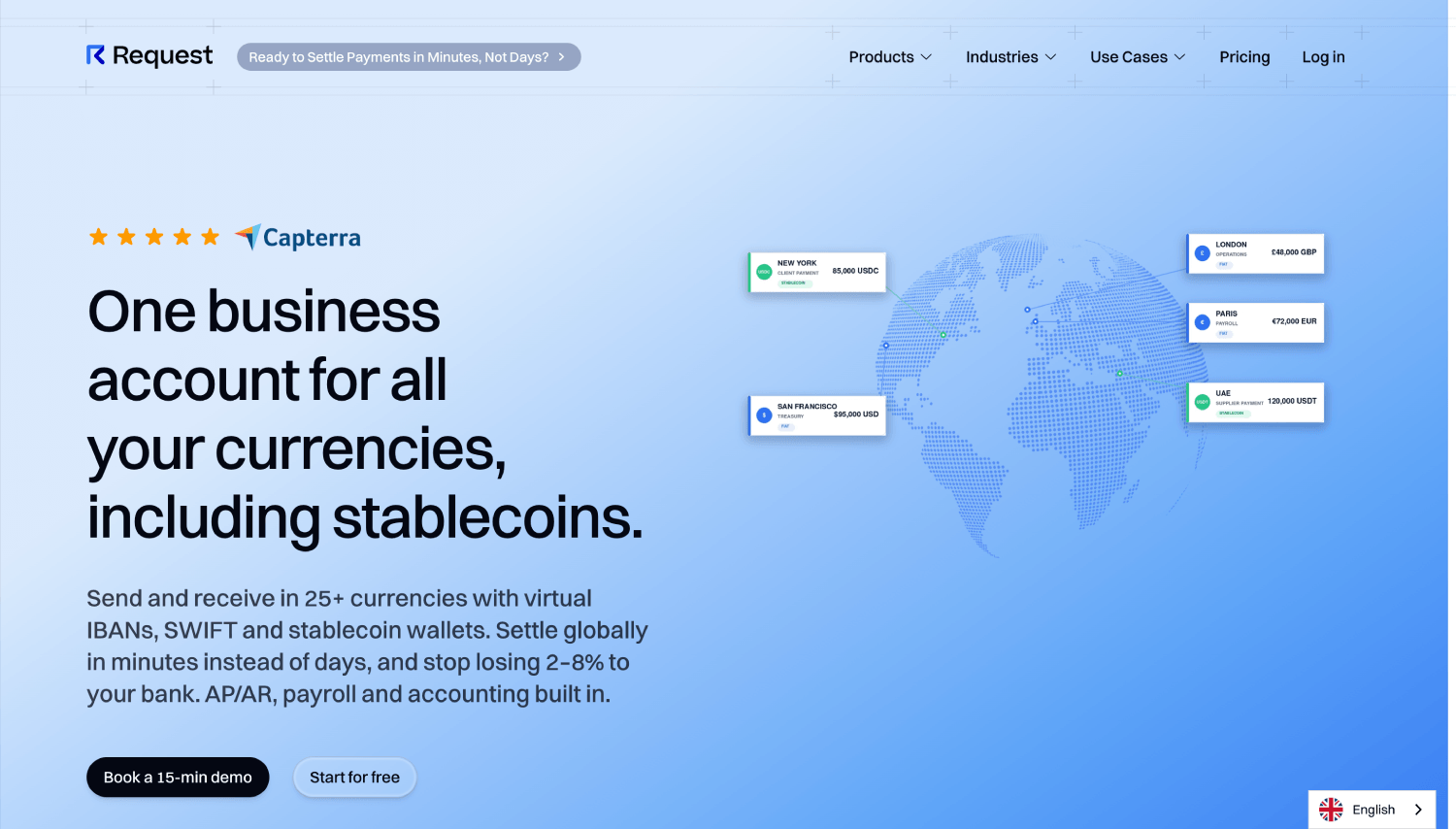
Request Finance approaches the problem from the accounts payable and accounts receivable angle rather than from custody or yield. The platform allows teams to create, send, and track invoices denominated in stablecoins, pay vendor bills from a connected wallet, and export a reconciliation report that matches on-chain transactions to invoice records.
For fintechs that pay contractors, vendors, or cross-border suppliers in USDC or USDT, Request Finance solves a real problem that pure treasury platforms do not: the gap between an on-chain payment and a record in the accounting system. The platform’s policy controls are lighter than Fordefi’s or Utila’s, and it is not designed for large-scale wallet infrastructure management. It sits in the same category as on-chain AP/AR tooling, not institutional treasury operations. For teams with simpler stablecoin cash management needs and a primary pain point around reconciliation and payment records, it is the most accessible entry point in this list.
7. Coinshift
Coinshift is built on top of Gnosis Safe and extends multi-sig treasury management with accounting integrations, bulk payment tooling, and on-chain reporting. The platform is widely used by crypto-native organizations managing DAO treasuries, but its accounting export functionality and approval workflow tooling translate directly to fintech treasury use cases.
The Gnosis Safe foundation means Coinshift inherits one of the most audited and widely deployed smart contract wallet architectures in the space. Multi-sig policy enforcement is native. The platform connects to on-chain yield venues, though with less curation than Velocity’s approach. Reconciliation exports cover transaction hashes, amounts, counterparty addresses, and timestamps in formats that connect to standard accounting workflows.
For a fintech that wants multi-sig controls and accounting-layer reconciliation without a full enterprise custody contract, Coinshift is the most cost-accessible option in the list. It is also the most transparent in terms of how the underlying wallet infrastructure works, which can simplify the technical due diligence conversation with auditors.
What Does Idle Cash Yield on Stablecoin Balances Actually Look Like?
Consider a fintech holding $3 million in USDC as a settlement reserve. The money sits in a hot wallet, accessible for outgoing payments within seconds. In a traditional fiat world, a treasury team would sweep idle cash overnight into a money market fund and earn yield on every dollar that is not actively working. In an unmanaged on-chain setup, that $3 million earns nothing.
Platforms like Velocity change that equation by connecting the treasury wallet to tokenized money market fund products. The underlying instruments vary: some are backed by short-duration US Treasuries, some by repo agreements, some by a mix of both. The key operational question is not just what yield is available, but how quickly assets can be redeemed for USDC when a settlement obligation hits. A treasury manager needs to know the redemption timeline before routing operating reserves into any yield instrument.
Yield rates on tokenized money market products track short-term interest rates and are not fixed. Platform fees reduce net yield further. Neither this article nor any vendor can quote a rate that will be accurate by the time a reader evaluates these tools. What matters operationally is whether the platform gives a finance team enough transparency on the instrument, the liquidity terms, and the fee structure to make a governed allocation decision. Platforms that obscure those details behind a single “earn yield” button are not giving treasury teams enough information to act compliantly.
How Should Stablecoin Treasury Controls Map to Existing Policy?
Most corporate treasury policies were written for fiat accounts. They cover things like dual authorization for payments above a threshold, bank account limits, counterparty credit risk assessments, and monthly reconciliation requirements. None of those concepts are conceptually alien to on-chain treasury management. They just need to be enforced differently.
On-chain, “dual authorization” is a 2-of-N multi-sig requirement on the wallet. “Payment above a threshold” is a policy rule that blocks any transaction over a specified USD equivalent without additional signers. “Counterparty credit risk” becomes an allowlist of approved wallet addresses or smart contract addresses that the treasury can interact with. “Reconciliation” is an automated export of on-chain transaction data matched to internal records.
The tools that score highest on Policy Depth in the On-Chain Treasury Scorecard are the ones that enforce these controls at the signing layer, not the dashboard layer. A dashboard-layer control can be circumvented if someone accesses the underlying wallet directly. A signing-layer control cannot. That distinction should be the first question in any vendor evaluation. For fintechs building their compliance infrastructure in parallel, FintechSpecs’ fintech product and compliance readiness checklist covers how to structure these policy reviews across your full stack.
How Do These Platforms Handle On-Chain Reconciliation?
Reconciliation is where most on-chain treasury operations break down in practice. A wallet receives USDC from three different counterparties in one day. Gas fees are paid in ETH. A yield position is redeemed and the proceeds land back in the same wallet. A traditional accounting system sees none of this automatically. Someone has to manually match blockchain transactions to expected entries, account for the gas fee as an expense, and confirm that the yield redemption amount matches the accrued figure.
The platforms in this list handle that problem at different levels of fidelity. Fordefi, Utila, and Fireblocks all produce structured transaction exports with enough metadata to feed directly into a reconciliation workflow. Request Finance is explicitly built around reconciliation as the core use case, matching on-chain payments to invoice records. Coinshift produces accounting exports that cover the standard fields an auditor would expect.
The gap between these platforms and a manual wallet export process is roughly the difference between a 30-minute close task and a half-day one. That matters at month-end and even more during an audit. Finance teams evaluating these tools should ask vendors specifically about their export format, which accounting systems they have tested integrations with, and whether the reconciliation data includes the wallet address of the counterparty, not just the transaction hash. Address-level data is what allows a team to confirm that a payment went to an approved counterparty, not just that a payment was made.
Which Stablecoin Treasury Tool Is Right for Which Fintech?
A fintech at the seed stage managing less than $500,000 in on-chain reserves does not need Fireblocks. The cost structure does not fit, and the operational complexity of onboarding to an enterprise custody platform outweighs the benefit. At that stage, Coinshift or Request Finance provides enough control and reconciliation tooling to manage the risk without a large platform commitment.
A Series A or Series B fintech holding $1 million or more in USDC float and processing regular on-chain settlements has a different profile. The opportunity cost of unmanaged idle cash is real. The risk of a single-key custody architecture is meaningful. At that stage, Velocity or Utila fits the operational profile: both provide multi-sig controls, reconciliation tooling, and enough yield surface to address idle cash drag without requiring an enterprise contract and a months-long implementation.
A Series C fintech or a crypto-native company with complex DeFi interactions in its treasury strategy should evaluate Fordefi or Fireblocks. The policy depth and audit trail these platforms provide is what allows a regulated entity to defend its on-chain treasury management to regulators and auditors. The cost is higher, but the governance surface these platforms provide justifies it at that scale. For teams evaluating stablecoin infrastructure more broadly, including payment and issuance layers, FintechSpecs’ guide to stablecoin infrastructure providers maps the full stack.
How Does Stablecoin Treasury Management Connect to Stablecoin Issuance and Custody?
Treasury management is one layer in a broader on-chain financial operations stack. The adjacent layers matter because the tools in this article sit between them. Upstream is stablecoin issuance: the platform or protocol that creates the stablecoin your company holds or issues. Downstream is stablecoin custody: the key management infrastructure that secures the assets at rest. FintechSpecs covers both in detail. The stablecoin issuance platforms guide covers the upstream layer, and the institutional digital asset custody guide covers the custody layer.
Some of the platforms in this article blur those boundaries. Fordefi and Fireblocks are fundamentally custody platforms that have extended into treasury management. Velocity and Utila are operationally focused platforms that rely on underlying custody infrastructure. Understanding which layer a vendor occupies helps a fintech avoid paying for duplicated functionality across two contracts and clarifies which vendor owns which part of the key management responsibility.
Frequently Asked Questions About Stablecoin Treasury Management
Can a fintech earn compliant yield on USDC balances held as operating reserves?
Yes, through platforms that provide access to tokenized money market funds or other regulated on-chain yield instruments. The compliance question is not whether yield is available but whether the underlying instrument is appropriate under the company’s investment policy, whether the redemption terms allow for the liquidity the operations team needs, and whether the yield access is documented with enough transparency for auditors. Platforms like Velocity surface this information at the product level. The allocation decision still belongs to the finance team.
What is the difference between multi-sig and MPC in a stablecoin treasury context?
Multi-sig requires multiple separate private keys to co-sign a transaction before it broadcasts. MPC (multi-party computation) distributes key shares across multiple parties so that no single party ever holds the full key, and signatures are computed collaboratively without ever assembling the complete key in one place. MPC is generally considered more flexible operationally because it does not leave a complete key on any single device, but both approaches are materially stronger than single-key custody. Most enterprise treasury platforms use MPC or a hybrid of MPC and multi-sig.
How does on-chain treasury reconciliation work in practice?
Purpose-built platforms export structured transaction data that includes the transaction hash, timestamp, token amount, USD equivalent at the time of the transaction, sending and receiving wallet addresses, and gas fees. This data feeds into a matching workflow against internal ledger entries. Platforms with higher reconciliation fidelity automate the matching step and flag unmatched transactions for human review, rather than requiring a finance team member to manually inspect each transaction on a block explorer. The output should be an accounting journal entry or export that can be imported into the company’s accounting system directly.
How does a stablecoin treasury policy differ from a fiat cash management policy?
The underlying principles are identical: approval thresholds, counterparty limits, liquidity tiers, and audit documentation. The implementation is different because controls are enforced at the wallet and smart contract layer rather than at the bank account layer. A fiat dual-authorization requirement is a bank’s internal workflow. An on-chain dual-authorization requirement is a multi-sig or MPC policy that prevents a transaction from being cryptographically valid without the required number of signers. This means the control is more tamper-resistant than a bank workflow but also means the policy must be configured correctly at setup, because changing it later requires wallet migration or a governance action.
What chains do these platforms support for corporate stablecoin treasury?
Ethereum and its L2s (Base, Arbitrum, Optimism) are supported by all platforms in this list. Solana support varies: Fireblocks and Fordefi both support Solana. TRON is supported by several platforms, largely because USDT volume on TRON remains high in cross-border payment contexts. Multi-chain support is relevant for fintechs that need treasury operations to span the same chains their payment flows run on. Evaluating a platform only on Ethereum support and then discovering a production payment flow runs on a different chain is a common and avoidable scoping error.
Are stablecoin balances subject to the same internal controls as fiat cash for audit purposes?
For most regulated fintechs, yes. Internal control frameworks like SOC 1 and SOC 2 do not exempt on-chain assets from the same segregation of duties, authorization, and reconciliation requirements that apply to fiat balances. Auditors are increasingly aware of on-chain treasury operations and will ask for evidence of approval workflows, counterparty documentation, and reconciliation records. Platforms that produce detailed audit trails and structured export data are materially easier to defend in an audit than self-custodied wallets managed through browser extensions.
The Actual Risk of Leaving Stablecoin Balances Unmanaged
Finance leads at fintechs often frame unmanaged stablecoin balances as a neutral state. The money is there, the payments run, the CFO does not ask questions. That framing underestimates three real costs: the opportunity cost of idle float earning nothing in a period when short-duration yields are meaningful, the operational risk of single-key custody for balances that represent operating capital, and the audit risk of balances that lack the reconciliation and approval documentation an auditor expects to see.
None of those costs are hypothetical. A fintech holding $2 million in unmanaged USDC in a single-key wallet is one compromised credential away from a total loss event with no counterparty to escalate to. That is not a theoretical risk profile that requires special circumstances to materialize. It is the default risk profile of unmanaged on-chain custody, and it is one the platforms in this article specifically exist to address.
The right platform is the one whose policy depth, yield surface, reconciliation fidelity, and custody architecture match where your company is operationally right now, not where it plans to be in two years. A Series A fintech deploying Velocity or Utila and growing into more of its feature set is better positioned than one waiting for the right moment to implement Fireblocks. On-chain treasury is not a future-state problem. The float is sitting there today.