
TLDR
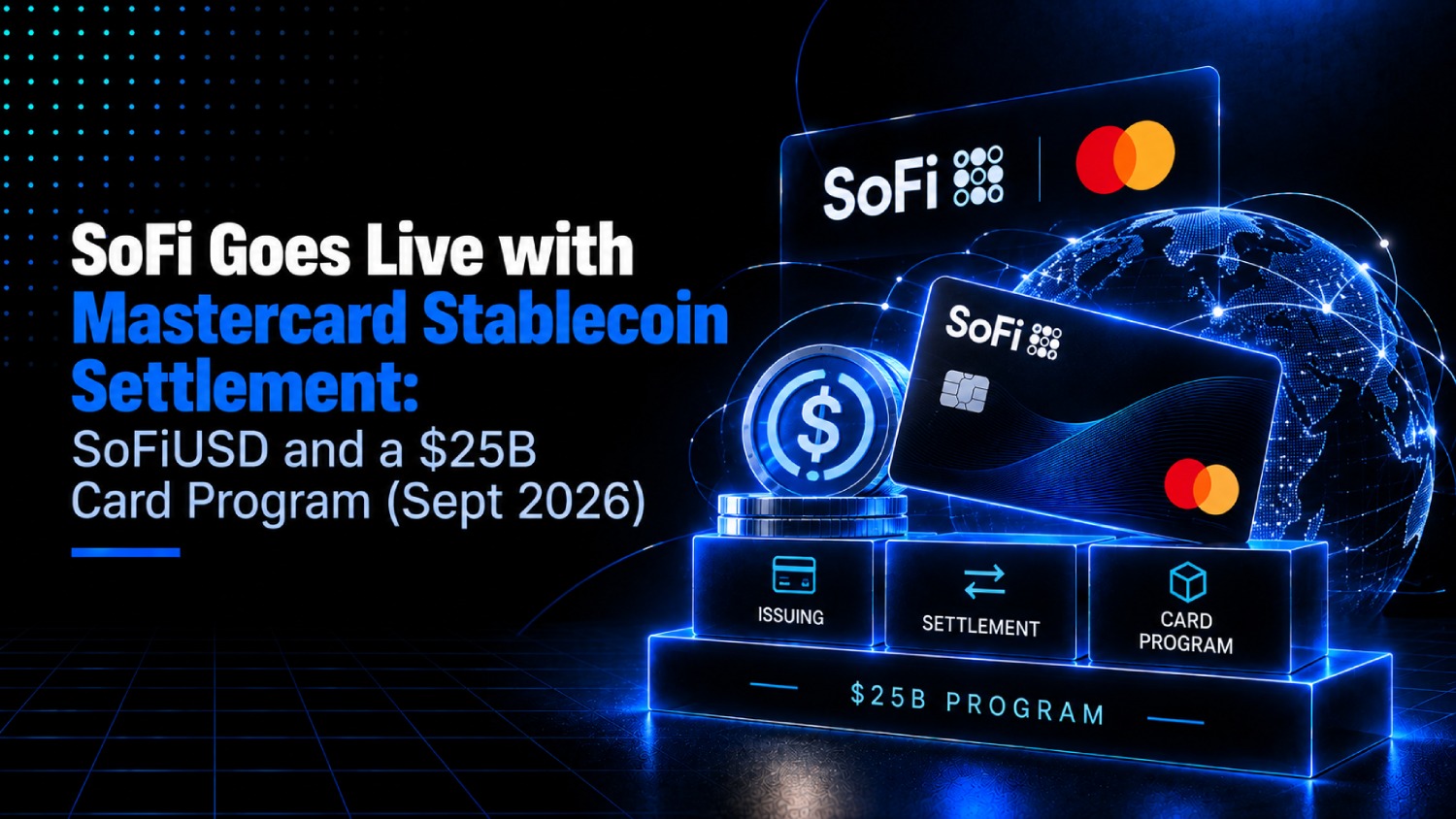
- On Sept. 22, 2026, SoFi and Mastercard said stablecoin settlement is live across SoFi Bank, N.A.’s debit and credit card program, using SoFiUSD on Mastercard’s global network (FinancialContent Business Wire mirror).
- SoFi says it is migrating its entire card program, expected to process more than $25 billion in annualized volume, to blockchain-based settlement in SoFiUSD, described as the first stablecoin issued by a U.S. nationally chartered bank. Transactions are stated as live on-chain today.
- Merchant UX claim: through SoFi’s Big Business Banking platform, merchants can receive settlement funds instantly in a SoFi Bank account and withdraw to cash around the clock at zero cost, without holding stablecoins or building new rails.
- SoFiUSD is issued by SoFi Bank, N.A. (OCC-regulated), framed as fully redeemable 1:1 for U.S. dollars and supported by reserves consisting primarily of cash. Disclosure language also states it is not a deposit, not FDIC/SIPC insured, and may lose value.
- This is a bank-issued stablecoin settlement go-live news explainer, not a rewrite of FintechSpecs’ stablecoin card platforms or Visa × Reap stablecoin credit cards pieces. Ask who settles what leg, when merchants see cash, and how this differs from card issuing infrastructure deals.
Sept. 22, 2026 moves stablecoin settlement from partnership slides into a production card program. SoFi and Mastercard announced that settlement using SoFiUSD is live for SoFi Bank’s debit and credit cards on Mastercard’s network, six months after their March 2026 partnership announcement (Business Wire; March Mastercard press page).
For FintechSpecs operators, the story is settlement and liquidity plumbing: a nationally chartered bank issuing the stablecoin, a global network accepting it for card settlement, and a merchant path that stays in bank accounts rather than forcing wallet ops. It sits next to stablecoin infrastructure, stablecoin payment APIs, and stablecoin card platforms, and it is distinct from the Visa × Reap issuing story published days earlier.
What SoFi and Mastercard announced
Per the Sept. 22, 2026 Business Wire release (also mirrored on FinancialContent):
- Stablecoin settlement is now live across SoFi Bank, N.A.’s debit and credit card program on Mastercard’s global payments network.
- Settlement asset: SoFiUSD, issued by a federally regulated bank.
- Volume framing: SoFi is migrating its entire card program, expected to process more than $25 billion in annualized volume, to SoFiUSD settlement.
- Status claim: transactions are live on the blockchain today.
- Positioning: bank-issued stablecoins operating alongside existing payment infrastructure for issuers, acquirers, and merchants.
Anthony Noto, CEO of SoFi, said: “In six months, SoFi and Mastercard took stablecoin settlement from an idea to a live product that materially improves how money moves for businesses. Merchants do not need to hold stablecoins, build new infrastructure or change how they operate. Through SoFi’s Big Business Banking platform, any merchant can receive settlement funds instantly in a SoFi Bank account and withdraw to cash around the clock and at zero cost. That means businesses have faster access to their money via the speed of blockchain, with the safeguards of a bank.”
Sherri Haymond, Global Head of Digital Commercialization, Mastercard, said: “Stablecoins become meaningful when they solve real problems that businesses face every day. With SoFi, we’re moving beyond exploration to implementation, bringing regulated stablecoin settlement into a live production environment while preserving the trust, scale and safeguards expected from Mastercard. This is another step toward giving businesses more choice in how money moves.”
Additional launch claims operators should separate from product facts:
- SoFi is in active discussions with large U.S. merchants (multinational retailers to tech platforms) about stablecoin-based settlement arrangements.
- SoFi and Mastercard will explore cross-border payments, remittances, and other money-movement use cases for SoFiUSD on Mastercard’s network.
- Mastercard frames this as part of a broader stablecoin settlement ecosystem of banks, fintechs, issuers, and partners.
Treat merchant discussions and future corridors as roadmap language until a second go-live is published.
What SoFiUSD is (and what the disclosure says)
SoFiUSD (also referenced as SOFID in disclosure copy) is issued by SoFi Bank, N.A., an OCC-regulated, nationally chartered bank. Launch materials say it is:
- Fully redeemable 1:1 for U.S. dollars
- Supported by reserves consisting primarily of cash
- Available for institutional use and for SoFi members for payments, settlement, and other financial applications
The same release’s disclosure block is equally important for compliance and treasury readers:
- SoFiUSD is not a deposit
- Not insured by the FDIC or SIPC
- Not bank guaranteed
- Not legal tender
- May lose value
- Redeemable 1:1 for U.S. dollars subject to applicable terms
That mix (bank issuer + non-deposit stablecoin) is the diligence surface. “Bank-issued” is not the same as “deposit.” Operators should keep those labels separate in risk memos and customer FAQ copy.
The March 2026 Mastercard partnership page also noted Galileo (SoFi’s technology platform) as expected among the first to offer payment-card clients and their issuing banks a choice to settle in SoFiUSD. The Sept. 22 release centers SoFi Bank’s own $25B program go-live; treat Galileo client enablement as a related distribution path still to confirm per issuer.
Settlement vs issuing: why this is not the Visa × Reap story
FintechSpecs already covered Visa and Reap’s stablecoin-linked Visa credit card programs across 100+ markets (Sept. 23, 2026 hub draft / live post). That story is mainly issuing infrastructure: Reap’s card issuance stack, partner programs, and Asia-Pacific stablecoin settlement pathways with Visa.
This SoFi × Mastercard piece is a different buyer question:
| Dimension | SoFi × Mastercard (Sept. 22) | Visa × Reap (Sept. 23) |
|---|---|---|
| Primary job | Live settlement of a bank’s own card volume in SoFiUSD | Issuing infrastructure so partners can launch stablecoin-linked Visa cards |
| Who issues the card program | SoFi Bank’s debit/credit program | Partner programs on Reap’s stack |
| Stablecoin role | Settlement asset for network obligations / liquidity | Cardholder funding / program treasury + settlement pathways |
| Scale claim called out | ~$25B annualized SoFi card volume migrating to SoFiUSD settlement | 100+ markets for partner issuance |
| Merchant message | Receive settlement in SoFi Bank account; optional cash-out; no need to hold crypto | Partner/issuer launch and settlement optionality |
Keep both posts. Do not merge URLs. Issuing and settlement are adjacent stacks, not the same explainer.
How this sits next to FintechSpecs stablecoin coverage
Use category posts for vendor shortlists. Use this post for what went live.
Related FintechSpecs depth (do not cannibalize)
- 7 Best Stablecoin Card Platforms
- 11 Best Stablecoin Infrastructure Providers (2026)
- 10 Leading Stablecoin Payment APIs for Fintech Platforms in 2026
- 9 Best Stablecoin On/Off-Ramp Providers for Fintechs
- Visa × Reap stablecoin credit cards (100+ markets)
- Mastercard × Alchemy Agent Pay (agent commerce, not card settlement)
Operator map for the Sept. 22 go-live
| Layer | What Sept. 22 mainly moves | What it does not replace |
|---|---|---|
| Network settlement choice | Mastercard accepting SoFiUSD settlement for SoFi Bank’s cards in production | Your acquirer/ISO contract terms or chargeback rules |
| Issuance of the settlement asset | OCC-regulated bank-issued SoFiUSD as the named settlement coin | USDC/USDT treasury policies you already run elsewhere |
| Merchant cash access | Instant SoFi Bank account credit + around-the-clock cash withdrawal claim | Merchant onboarding if they are not on SoFi Big Business Banking |
| Volume narrative | $25B annualized card program migration framing | Independent proof of how much volume has already settled on-chain |
| Roadmap language | Merchant discussions; cross-border / remittance exploration | A published multi-merchant settlement schedule |
Risk, controls, and diligence questions
Stablecoin settlement compresses liquidity timing while introducing asset, redemption, and disclosure risk that fiat ACH settlement did not put on the same page.
Controls and promises in launch materials
- Live production settlement on Mastercard’s network
- Bank issuer (SoFi Bank, N.A.) under OCC regulation
- 1:1 redeemability claim with cash-primary reserves
- Merchant path that does not require merchants to hold stablecoins
- Instant account credit and zero-cost cash withdrawal framing via Big Business Banking
What operators should still design for
- Settlement finality vs marketing “instant.” Ask when Mastercard settlement obligation is considered paid, when the merchant account is credited, and what happens on chain reorg, failed redemption, or weekend ops exceptions.
- Who must bank with SoFi. The merchant UX in the release rides SoFi Big Business Banking. Confirm whether non-SoFi merchants get the same path through their acquirer, or whether this benefit is SoFi-account-gated.
- Reserve and redemption ops. “Primarily cash” is a reserve composition claim. Ask for attestation cadence, redemption SLA, and who can redeem at scale (issuer, network, merchant, member).
- Disclosure mismatch risk. Marketing says bank safeguards; the legal block says not a deposit and not FDIC insured. Align customer, merchant, and board language with the disclosure, not the headline.
- $25B is a program size, not a settled-to-date metric. Treat annualized volume as the size of the program being migrated, unless SoFi publishes cumulative on-chain settlement totals.
- Issuing clients via Galileo are not automatically live. March materials pointed at Galileo client optionality. Sept. 22 centers SoFi Bank’s own cards. Ask for a separate issuer enablement list.
- Cross-border and remittance are exploration. Do not model FX corridors or remittance SLAs from this release alone.
Who should care, and what to ask
Prioritize a deep read if you:
- Run card issuing, acquiring, or merchant settlement product and need a live bank-stablecoin reference architecture
- Own treasury or liquidity for a card program comparing pre-funding vs continuous settlement
- Build B2B merchant banking or payout products that compete with faster access to card proceeds
- Evaluate stablecoin infrastructure vendors and need a production network settlement example beyond USDC/USDT API demos
Concrete questions for SoFi, Mastercard, your acquirer, and counsel
- For SoFi Bank’s program today, which settlement legs run in SoFiUSD versus fiat, and what share of daily volume is already on-chain?
- What is the merchant eligibility path if the merchant does not open a SoFi Big Business Banking account?
- What redemption SLA and attestation package back the 1:1 / cash-primary reserve claim?
- How are chargebacks, representments, and scheme fees handled when the settlement asset is SoFiUSD?
- What accounting and tax treatment do you use for SoFiUSD settlement balances that are not deposits?
- Which Galileo / SoFi Tech Solutions issuers can opt into SoFiUSD settlement in 2026, and on what commercial terms?
- What, if anything, is contractually live for cross-border or remittance settlement versus explore language?
- How does this interact with other Mastercard stablecoin settlement partners already in market?
The take: production settlement is the news; distribution is still gated
SoFi and Mastercard did the hard thing press releases usually skip: they put a bank-issued stablecoin into live card settlement for a named program with a $25B annualized volume frame. That is a stronger signal than another we-support-stablecoins partnership page.
The operator lesson is narrower. Faster merchant access still appears to ride a SoFi banking relationship, SoFiUSD remains a non-deposit instrument with explicit may-lose-value language, and multi-merchant plus cross-border expansion is still discussion and exploration. Treat Sept. 22 as proof that regulated bank stablecoin settlement can run in production on a major card network. Then diligence the merchant banking gate, redemption ops, and issuer rollout before you rewrite your settlement architecture around it.
For category depth after this news, start with best stablecoin card platforms and best stablecoin infrastructure providers. For the adjacent issuing story from the same week, keep Visa × Reap stablecoin credit cards as a separate URL.
FAQ
When did SoFi and Mastercard say stablecoin settlement went live?
Sept. 22, 2026, via Business Wire and the FinancialContent mirror.
What is SoFiUSD?
SoFiUSD is a payment stablecoin issued by SoFi Bank, N.A., described as the first stablecoin issued by a U.S. nationally chartered bank. Product page: sofi.com/crypto/sofiusd.
How large is the card program in the announcement?
SoFi says it is migrating its entire card program, expected to process more than $25 billion in annualized volume, to SoFiUSD settlement.
Do merchants have to hold stablecoins?
SoFi’s CEO quote says merchants do not need to hold stablecoins or build new infrastructure, and can receive settlement funds in a SoFi Bank account with around-the-clock cash withdrawal at zero cost via Big Business Banking. Confirm eligibility if you are not a SoFi banking customer.
Is SoFiUSD a bank deposit?
No. The release disclosure states SoFiUSD is not a deposit, not FDIC or SIPC insured, not bank guaranteed, not legal tender, and may lose value, while also stating 1:1 redeemability for U.S. dollars subject to terms.
How is this different from Visa × Reap?
Visa × Reap is primarily about partner card issuing infrastructure for stablecoin-linked Visa programs across 100+ markets. SoFi × Mastercard is about live settlement of SoFi Bank’s own debit/credit volume in SoFiUSD on Mastercard’s network.
Does this replace FintechSpecs’ stablecoin card or infrastructure listicles?
No. Those posts compare vendors and architectures. This piece explains what SoFi and Mastercard announced as live on Sept. 22, 2026, and which diligence questions operators should ask.
Are cross-border payments included today?
The release says SoFi and Mastercard will explore additional opportunities including cross-border payments and remittances. That is not the same as a live multi-corridor settlement schedule.