
TLDR
- VAT and GST obligations for SaaS companies begin with the first sale to a foreign customer, not after crossing an arbitrary revenue milestone.
- Most countries now apply destination-based taxation to digital services, meaning a US-based SaaS company selling one subscription to a German customer owes German VAT on that transaction.
- A merchant of record absorbs your entire indirect tax liability across dozens of countries for a single percentage fee, while a tax engine only calculates what you owe and still leaves registration, filing, and remittance to you.
- For companies with fewer than 10 active international markets and no enterprise net-terms requirements, an MoR is almost always cheaper than the combined cost of multi-country VAT registration and a tax engine subscription.
- The break-even point shifts when your revenue per customer is high enough that MoR percentage fees exceed the fixed cost of registrations and an accountant, typically somewhere above $5,000 average contract value in high-volume markets.
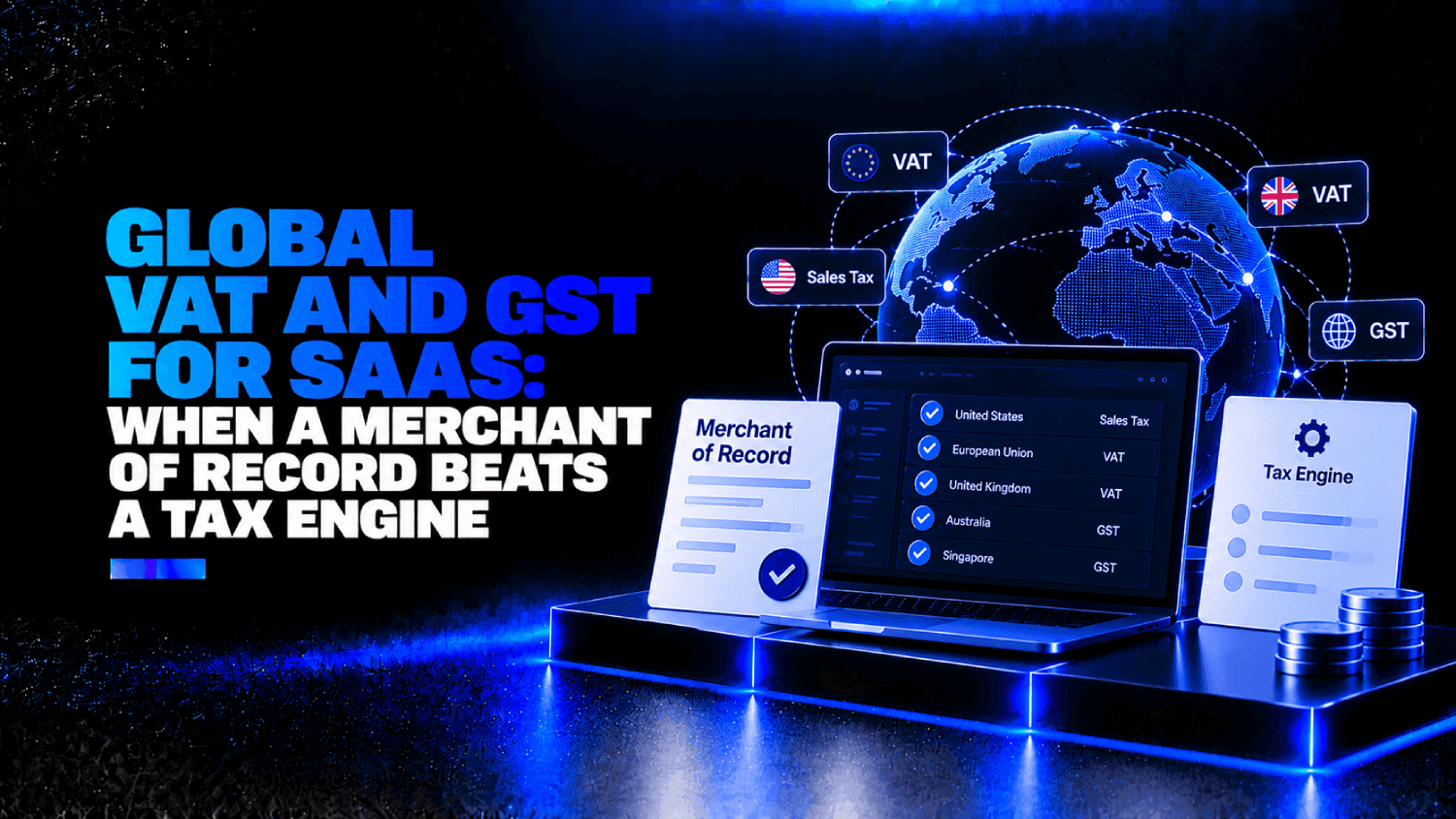
When a SaaS company makes its first sale to a customer in the EU, Australia, Canada, or the UK, it becomes liable for local indirect tax on that transaction immediately. A merchant of record eliminates that liability by becoming the legal seller of record in each jurisdiction, handling registration, collection, and remittance on your behalf. A tax engine calculates the correct tax rate at checkout but leaves every filing obligation with you. For most early-stage and growth-stage SaaS companies selling internationally, the MoR is cheaper and faster than managing global VAT for SaaS registration independently.
Why Does VAT Apply to SaaS Sales From the First Transaction?
The shift happened gradually between 2015 and 2020, as major economies rewrote their indirect tax laws to capture cross-border digital services. The EU’s 2015 digital services rules eliminated the old threshold that let small suppliers off the hook. Australia introduced GST on imported digital services in 2017. The UK applied VAT to foreign digital suppliers from 2020 onward after Brexit formalized its own framework. Canada’s GST rules for non-resident digital service providers took effect in 2021.
Each of these regimes operates on the same principle: tax follows the customer, not the seller. If your customer is in France, France is owed 20% VAT on that subscription. Your company’s location in Delaware, Ontario, or anywhere else is irrelevant to the French tax authority. The obligation is yours from transaction one.
The word “threshold” still appears in some frameworks, but it functions differently than US sales tax economic nexus thresholds. In the EU’s One Stop Shop system, for instance, there is a combined €10,000 annual cross-border threshold below which a seller can use their home country’s VAT rate, but only if their home country is within the EU. A US-based SaaS company has no EU home country, so the threshold does not apply. Registration is required before the first sale.
What Countries Require GST or VAT Registration for Foreign SaaS Sellers?
The list has grown steadily. Below are the major markets with active digital services tax regimes as of our last update, with their standard rates and registration requirements for non-resident digital suppliers.
| Country / Region | Tax Name | Standard Rate | Registration Required Before First Sale? | Simplified Registration Available? |
|---|---|---|---|---|
| European Union (27 countries) | VAT | Varies (17% to 27%) | Yes | Yes, via OSS (One Stop Shop) |
| United Kingdom | VAT | 20% | Yes | Yes, non-UK MOSS equivalent |
| Australia | GST | 10% | Yes, above AUD 75,000/year | Yes, simplified GST registration |
| Canada | GST/HST | 5% to 15% | Yes, above CAD 30,000/year | Yes, simplified registration |
| Norway | VAT | 25% | Yes, above NOK 50,000/year | Yes, VOEC scheme |
| New Zealand | GST | 15% | Yes, above NZD 60,000/year | Yes |
| India | GST | 18% | Yes (non-resident online service providers) | Simplified OIDAR registration |
| South Korea | VAT | 10% | Yes | Yes, simplified foreign supplier scheme |
| Japan | Consumption Tax | 10% | Yes | Yes, simplified registration |
| Singapore | GST | 9% | Yes, above SGD 1,000,000 global revenue | Yes, OVR scheme |
Australia’s AUD 75,000 threshold and Canada’s CAD 30,000 threshold give early-stage companies a brief runway. The EU does not. A US SaaS company making its first EU sale needs to register before collecting money, or it collects the money and remits it informally, which is not a compliant position if audited.
What Is the Difference Between a Merchant of Record and a Tax Engine for Global Compliance?
A merchant of record (MoR) is the legal entity that processes a sale and assumes all associated tax, refund, and compliance liability. When you sell through Paddle or FastSpring or Lemon Squeezy, the MoR shows up on the customer’s invoice, not your company. The MoR is registered in each applicable jurisdiction, collects the correct VAT or GST at checkout, files the returns, and remits the tax. You receive the net revenue after fees. You have zero direct tax liability in those countries.
A tax engine like Anrok, Avalara, or TaxJar integrates with your billing system and calculates the correct tax amount at the point of sale. It does not file anything, does not register you anywhere, and does not remit a dollar to any tax authority. It automates the calculation layer. Everything after that, registration, periodic filing, remittance, currency conversion, tax authority correspondence, is still your problem.
For a US-based comparison, our breakdown of Anrok vs Avalara vs TaxJar for SaaS subscription billing covers the calculation side in detail. The question this article answers is one step upstream: before you even need a tax engine, do you need to own your tax position at all?
What Does VAT Registration for SaaS Actually Cost Without an MoR?
This is where the “international tax only matters once you’re big” belief collapses fastest. The cost is not just accountant fees. Consider a US-based SaaS company selling to customers in Germany, France, the UK, and Australia. To handle this compliantly without an MoR, the company needs to:
- Register for EU VAT via the OSS scheme (one registration for all 27 EU member states, but still requires a fiscal representative in some countries if registering before having an EU establishment)
- Register separately with HMRC for UK VAT
- Register with the Australian Tax Office under the simplified GST scheme
- File quarterly VAT returns for the EU and the UK, and annual GST returns for Australia
- Maintain records of customer location evidence (IP address, billing address, bank country) for each transaction in case of audit
- Handle currency conversion of collected tax to each authority’s required currency at payment time
Specialist international VAT compliance firms charge between $500 and $1,500 per registration per country, and ongoing filing fees can run $200 to $600 per jurisdiction per quarter. Add a tax engine subscription on top, since you still need correct calculation at checkout, and the annual cost for four markets reaches $8,000 to $20,000 before accounting for staff time and error risk. An MoR like Paddle charges a percentage of revenue and covers all of that in the fee. Paddle’s public pricing page lists 5% plus $0.50 per transaction; verify the current rate at paddle.com before signing, as pricing can change.
The break-even math is straightforward. If your international revenue is under roughly $300,000 to $400,000 per year, the MoR percentage fee is almost certainly cheaper than the compliance infrastructure cost. Above that range, particularly for high-ACV enterprise deals, the fixed costs of self-managed compliance start to look more attractive per dollar of revenue.
The FintechSpecs Tax Ownership Decision Tree
This framework, which we call the Tax Ownership Decision Tree, gives SaaS founders a four-gate check to determine which approach fits their current situation. Run each gate in order. Stop when you hit a “no.”
Gate 1: Do you have enterprise customers requiring invoices in your company’s name?
Enterprise buyers, particularly in regulated industries, often require the supplier’s legal entity to appear on the invoice for procurement compliance reasons. An MoR issues invoices in its own name. If your customers require a vendor-of-record invoice from your company specifically, an MoR creates a contractual problem. Move to a tax engine and self-managed compliance, or find an MoR that supports white-label invoicing (some do, with limitations).
Gate 2: Is your international revenue above $500,000 per year in any single market?
At this revenue level in a single jurisdiction, the MoR’s percentage fee typically exceeds the fixed cost of a dedicated VAT registration, a local accountant, and a tax engine subscription in that market. It is often worth separating out that market and handling it directly while keeping the MoR for smaller or newer markets.
Gate 3: Do you sell to B2B buyers who can reclaim VAT?
VAT-registered business customers in the EU can reclaim input VAT on their returns. When you sell B2B, the effective tax burden falls on the tax authority, not your customer. In pure B2B SaaS sales with reverse charge (the mechanism by which the buyer accounts for VAT instead of the supplier), you may have no collection obligation at all if you obtain a valid VAT number from your customer. An MoR does not change this calculation, but it does verify VAT numbers and apply reverse charge automatically, which reduces the compliance burden significantly.
Gate 4: Are you currently selling to more than five active international markets?
Each additional market adds registration, filing cadence, currency handling, and audit exposure. At fewer than five markets, the per-market cost of self-management may be manageable. At ten or more active markets, the operational overhead of self-managed compliance typically exceeds any savings versus an MoR percentage fee, even at mid-six-figure international revenue.
Which Merchant of Record Platforms Handle Global VAT and GST?
Not all MoRs cover the same jurisdictions or handle the same customer types. The major platforms serving SaaS companies differ materially in scope and pricing.
| Platform | Tax Jurisdictions Covered | B2B Reverse Charge Handling | Best Fit | Public Fee (verify current rate at each vendor’s pricing page) |
|---|---|---|---|---|
| Paddle | 200+ countries | Yes | B2B and B2C SaaS, self-serve to mid-market | 5% + $0.50 per transaction (per Paddle’s public pricing page; verify before signing) |
| FastSpring | 200+ countries | Yes | Software and SaaS, mid-market | Custom / percentage-based, not publicly listed |
| Lemon Squeezy | 100+ countries | Yes | Indie SaaS, solo founders, digital products | Per Lemon Squeezy’s public pricing page; verify current rate at lemonsqueezy.com before signing |
| Polar | Covers major markets via Stripe Tax integration | Partial | Developer tools, open-source monetization | 4% platform fee + Stripe processing |
| PayPro Global | 180+ countries | Yes | Software, SaaS, e-learning | Percentage-based, not publicly listed per transaction |
For a deeper comparison of these platforms across dimensions beyond tax, including checkout UX, subscription management, and payout options, see our comparison of Stripe vs Paddle vs Lemon Squeezy vs Polar for B2B SaaS founders. The fee structures and coverage claims above reflect each company’s public pricing page as of our last update; verify current rates before signing. For a side-by-side look at MoR fees across more platforms, the merchant of record fees comparison covers Paddle, FastSpring, Lemon Squeezy, Polar, and PayPro Global in detail.
What Tax Engines Handle Global VAT and GST for SaaS?
Anrok is the most SaaS-native option, built specifically for subscription and usage-based billing, with direct integrations for Stripe, Chargebee, and Recurly. It covers VAT, GST, and US sales tax in one platform and handles EU OSS reporting. Avalara is broader and more enterprise-oriented, with stronger coverage for complex product catalogs and physical goods alongside digital services. TaxJar (owned by Stripe since 2021) is primarily US-focused and less comprehensive for international VAT than the other two.
The critical limitation of any tax engine: it calculates and, in some cases, helps with filing preparation, but it does not register you, does not remit on your behalf, and does not hold liability. You still need legal registrations in each jurisdiction before you start collecting. Anrok does provide VAT registration assistance as a service, as does Avalara through its Managed Returns offering, but these are add-on services with their own fees, not included in the base platform price.
For a full cost-of-compliance breakdown at different company stages, including how indirect tax fits into overall compliance spending, the real cost of compliance in fintech SaaS broken down by stage provides useful context.
How Does the B2B Reverse Charge Mechanism Change Your Obligations?
The reverse charge is one of the most practically important concepts for B2B SaaS companies selling internationally, and it is frequently misunderstood. Under EU VAT rules, when a VAT-registered business buys a digital service from a foreign supplier, the buyer, not the seller, accounts for the VAT on their own return. The supplier has no collection or remittance obligation for that transaction, provided they have obtained and validated the buyer’s VAT registration number.
In practice, this means a pure B2B SaaS company with all EU customers being VAT-registered businesses may have minimal actual collection obligations, even without an MoR. The obligation that remains is to verify each customer’s VAT number (using the EU’s VIES system), issue a correct invoice referencing the reverse charge, and maintain records. That is manageable for a small number of enterprise customers but quickly becomes operationally complex at scale or when your customer base includes a mix of B2B and individual professionals who are not VAT-registered.
An MoR handles VAT number validation and reverse charge mechanics automatically. A tax engine like Anrok also validates VAT numbers and applies reverse charge at checkout, which covers the calculation and invoicing requirement but still leaves the registration formality to you in markets where it is technically required.
What Are the Actual Risks of Getting Global VAT Wrong?
Tax authorities in major markets have become significantly more sophisticated at identifying non-compliant foreign digital service providers. The EU exchanges data between member states and runs periodic audits of companies identified through payment processor data. HMRC in the UK pursues non-resident VAT registrants actively. The Australian Taxation Office cross-references App Store and payment platform data against its simplified GST registrant list.
The penalty structures vary by jurisdiction. In the EU, penalties for late or non-registration range from hundreds to thousands of euros depending on the member state and the duration of non-compliance. The UK charges interest on unpaid VAT plus surcharges for late filing. Beyond the financial penalties, being found non-compliant in one jurisdiction can trigger audits in others if the tax authority shares data through international exchange agreements, which the EU’s DAC7 directive significantly expanded in 2023.
The risk is not theoretical for companies at any size. To illustrate the exposure: a Series A SaaS company with 50 EU customers each paying $200 per month generates roughly $120,000 per year in EU revenue (50 customers × $200 × 12 months). At 20% VAT, that is $24,000 in VAT that should have been collected and remitted. If that was not happening for two years, the exposure reaches $48,000 plus penalties and interest, on top of the cost of retroactive registration and voluntary disclosure. This is a hypothetical scenario to show how quickly uncollected VAT compounds , actual exposure depends on each company’s customer mix, applicable rates, and jurisdiction-specific penalty rules.
When Does an MoR Stop Making Sense for International Tax?
Three situations shift the calculation toward self-managed compliance with a tax engine. First, when average contract value is high enough that MoR percentage fees represent a material margin cost. A SaaS company with $10,000 ACV selling 200 international contracts per year at Paddle’s public rate of 5% plus $0.50 pays roughly $101,000 in MoR fees on that international revenue. The fixed-cost alternative, VAT registrations in key markets plus an Anrok subscription, would cost substantially less at that revenue level.
Second, when enterprise procurement requires vendor-of-record invoicing from your legal entity. This is common in regulated industries and large enterprise deals where your company’s legal name must appear on every invoice for audit trail purposes. An MoR cannot satisfy this requirement without white-label invoice workarounds that not all MoRs support.
Third, when you acquire customers through resellers or distributors who already handle local tax compliance in their markets. In this model, the reseller becomes the merchant of record by definition, and adding another MoR layer creates duplication.
For founders weighing these trade-offs as part of broader infrastructure decisions, the common mistakes in choosing fintech infrastructure covers related decision points around when to build vs buy compliance capabilities.
Does GST on SaaS Exports Work Differently Than VAT?
The terminology differs, but the underlying principle of destination-based taxation is the same. Australia, Canada, New Zealand, Singapore, and India all use some form of GST, and each applies it to digital services delivered to residents in their jurisdiction regardless of where the supplier is based.
One genuine difference is in how B2B transactions are treated across GST regimes versus EU VAT. Australia’s GST generally requires foreign suppliers to register and collect regardless of whether the buyer is a business or a consumer, although business-to-business transactions above certain thresholds may qualify for an “enterprise” exemption under the reverse charge equivalent. Canada’s GST applies reverse charge for B2B transactions with Canadian GST-registered businesses, similar to EU mechanics. India’s OIDAR (Online Information and Database Access or Retrieval) regime requires non-resident suppliers to register and collect GST at 18% on supplies to non-GST-registered Indian buyers, while B2B supplies to registered businesses use reverse charge.
The operational complexity of tracking which buyers are registered for local GST across five or more markets simultaneously is significant. This is precisely where the MoR model earns its fee for companies without a dedicated international tax function.
Frequently Asked Questions
Do I need to register for VAT in every EU country separately?
No. The EU’s One Stop Shop (OSS) scheme allows non-EU digital service providers to register in a single EU member state and file a single quarterly return covering all 27 EU countries. This is called the Non-Union OSS scheme for companies based outside the EU. You pick one member state, register there, and submit combined returns covering all EU sales. You still owe VAT at each country’s rate, but you file in one place and make one payment, which is then distributed to the relevant member states by the tax authority you registered with.
Can a B2B SaaS company avoid VAT collection entirely using the reverse charge?
In some cases, yes, but only when all customers are VAT-registered businesses and you collect and validate their VAT registration numbers at the time of sale. For purely enterprise B2B SaaS selling into the EU with verified VAT numbers for every customer, the reverse charge can eliminate your collection obligation. In practice, most SaaS companies have some customers who are sole traders, small businesses, or individuals who are not VAT-registered, which means you cannot apply reverse charge universally and must collect and remit VAT on those transactions.
What is the difference between an MoR handling tax and Stripe Tax?
Stripe Tax is a tax calculation and filing assistance tool, not a merchant of record. When you use Stripe Tax, Stripe calculates the correct tax rate and can help automate filing in supported jurisdictions, but Stripe is processing payments on your behalf as an agent, not as the legal seller. Your company remains the merchant of record and retains all tax liability. An MoR like Paddle actually becomes the legal seller, absorbing the tax liability entirely. Stripe is your payment processor; Paddle is your legal substitute seller. The distinction matters enormously when a tax authority comes asking.
How does GST on SaaS exports work when selling from the US to Australia?
A US-based SaaS company with over AUD 75,000 per year in Australian revenue must register for GST with the Australian Tax Office under the simplified GST registration system for non-resident suppliers. Once registered, you collect 10% GST from Australian customers, file a quarterly BAS (Business Activity Statement), and remit the collected GST to the ATO. Below the AUD 75,000 threshold, no registration is required, but you cannot collect GST either. An MoR like Paddle handles this registration, collection, and remittance automatically from your first Australian sale, regardless of revenue volume.
Can I use an MoR for some markets and self-manage others?
Yes, and this is often the right answer for companies above roughly $3 million in annual international revenue. A common structure is to use an MoR for markets where you lack registrations or where revenue is below the break-even threshold, while self-managing compliance in high-revenue markets where the fixed cost of registration plus a tax engine is cheaper than percentage-based MoR fees. The operational complexity of running both models simultaneously requires clear internal bookkeeping to avoid double-counting revenue or tax obligations. Most billing platforms support this split through separate payment flows or products.
What records do I need to keep to prove customer location for VAT purposes?
EU VAT rules require at least two non-contradictory pieces of evidence for each B2C digital services sale: billing address, IP address at time of purchase, bank country of the payment method, country code of the SIM card for mobile purchases, or location of a fixed line through which the service is supplied. You must retain these records for 10 years in most EU member states. An MoR collects and stores this evidence automatically. If you self-manage, your billing platform needs to capture and store this data at the transaction level, and a tax engine like Anrok typically handles this logging as part of its compliance module.
Does having customers in a country always create a VAT registration obligation?
For digital services to consumers, yes, in most of the major markets covered above. The B2B reverse charge creates an exception in many jurisdictions, but the registration formality may still apply technically even if your collection obligation is zero. The EU Non-Union OSS requires registration before making any supply, even if all supplies are B2B reverse charge. The practical consequence of not registering even when your effective tax collection is zero is lower than if you were not collecting tax that you should be, but a formal audit could still result in penalties for late or non-registration. When in doubt, registering costs less than defending a non-registration position.
The Compliance Ownership Decision Matters More Than the Tool
Most founders who get international VAT wrong do not fail at the calculation layer. They fail at the ownership layer. They assume a payment processor that calculates tax at checkout has also registered them, is filing their returns, and is remitting their collected tax. That is not what Stripe does. It is not what most billing platforms do. The liability remains with your company until you either transfer it to an MoR or build out the registrations and filing infrastructure yourself.
The cleanest mental model is this: if your legal entity’s name is on the invoice, your legal entity owns the tax obligation in every country where that customer lives. An MoR removes your name from the invoice and substitutes its own. A tax engine helps you fulfill an obligation that remains entirely yours. For a company with fewer than 10 international markets and international ARR below $500,000, paying an MoR’s percentage fee to transfer that liability is almost always cheaper than the alternative when you account for registration fees, filing costs, staff time, and error risk.
Beyond cost, there is a strategic consideration. Your tax compliance posture is visible to investors and acquirers. Companies discovered during due diligence to have years of uncollected VAT across multiple jurisdictions face either retroactive remediation costs or deal-threatening liability haircuts. Getting this right at the beginning, whether through an MoR or through disciplined self-managed compliance, is one of the few infrastructure decisions where the cost of not acting compounds directly into enterprise value. For a fuller picture of how compliance costs scale as SaaS companies grow, the hidden costs killing fintech SaaS margins covers indirect tax alongside the other line items that erode margins before founders notice.