
TLDR
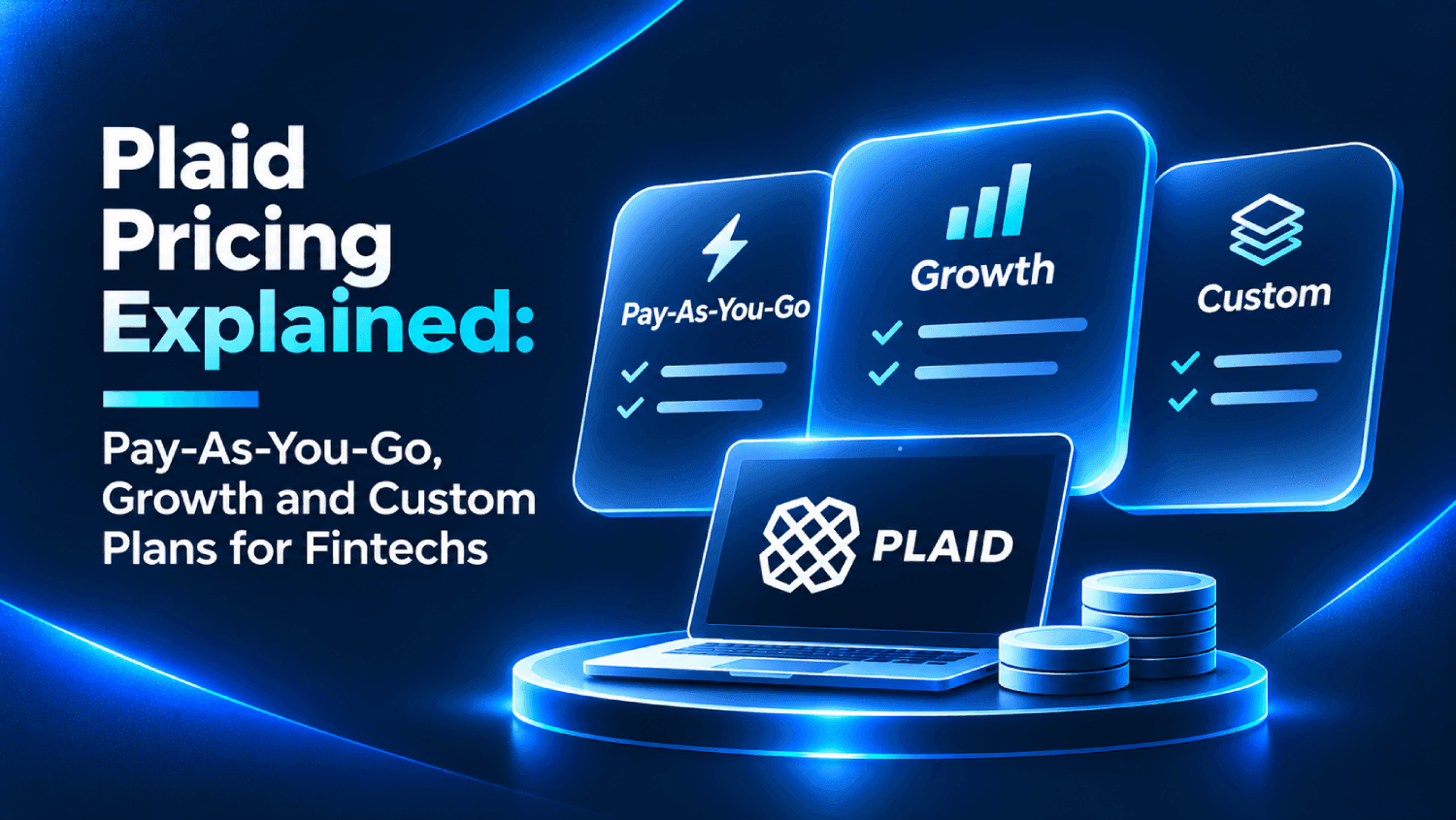
- Plaid publishes three pricing tiers: Pay As You Go, Growth, and a custom enterprise plan. Rates are on their public pricing page as of November 2026.
- The per-connection assumption is outdated. Your actual bill depends on which Plaid products you call, how often you call them, and your monthly volume.
- Pay As You Go has no monthly minimum and suits pre-revenue or low-volume builds. Growth offers lower per-call rates with a volume commitment.
- Products like Auth, Transactions, and Identity each carry separate fees. A single user session can trigger charges from multiple product lines.
- Teams comparing total cost of ownership should model their product mix before assuming Plaid is cheaper or more expensive than alternatives.
Plaid’s public pricing page as of November 2026 lists three tiers: Pay As You Go with no monthly minimum, Growth with volume-based rates negotiated during signup, and a Custom plan for high-volume or enterprise use cases. Pricing varies by product, not just by connection. A company calling Auth, Transactions, and Income Verification in a single session pays three separate line items, so effective cost depends entirely on the product mix and call frequency you build into your integration.
Why Most People Misread Plaid Pricing Before They Build
The common assumption is that Plaid charges a flat fee per linked bank account. That framing comes from the early days of consumer apps that only needed a one-time account connection. It has not reflected how Plaid bills since the company expanded its product catalog.
Plaid now operates as a multi-product API platform. The core categories include bank account verification (Auth), transaction retrieval (Transactions), identity confirmation (Identity), income verification (Income), balance checks (Balance), and asset reports (Assets). Each product is a separate API call, and each carries its own billing line.
A lending company verifying income before underwriting a loan might call Auth to verify ownership, Assets to pull a 90-day account snapshot, and Income to confirm employment. That is three products, three charges, one user. Teams that budget based on “connections” routinely undershoot.
What Does Plaid’s Pay As You Go Plan Actually Include?
Pay As You Go is Plaid’s entry-level tier with no monthly minimum or commitment. You pay only for the API calls you make. According to Plaid’s public pricing page as of November 2026, this tier is available without contacting sales and can be activated through the developer dashboard.
The model works well for a few situations. A startup in pre-launch using the sandbox environment pays nothing until go-live. A consumer app with unpredictable monthly active users avoids the risk of paying for capacity they never use. A small team prototyping a new product flow can test without committing to volume.
The trade-off is per-unit cost. Pay As You Go rates are higher than Growth-tier rates on a per-call basis. At low volumes that spread is negligible. At scale, it compounds. A team processing thousands of Transactions calls per month will overpay relative to a negotiated Growth rate.
How Does Plaid Growth Pricing Work?
The Growth plan is designed for companies that have moved past experimentation and have a predictable volume baseline. Plaid does not publish fixed Growth-tier rates publicly. Per their pricing page as of November 2026, Growth pricing is established during the signup flow and reflects expected monthly volume.
What Plaid does confirm is that Growth customers receive lower per-call rates than Pay As You Go in exchange for a volume commitment. The commitment threshold is not disclosed publicly. Teams negotiating Growth contracts should come prepared with 90-day usage projections by product, not just aggregate API call counts, because Plaid prices each product separately.
The Growth tier also includes priority support and additional features that are not available on Pay As You Go. Plaid does not specify those features by name on the public pricing page, so teams should ask during the sales conversation.
What Is Plaid’s Custom Enterprise Plan?
Custom pricing is for high-volume deployments that fall outside the Growth tier’s standard structure. This is a quote-based engagement and Plaid does not provide public rate cards for it. The drivers that typically influence a Custom quote include total monthly API call volume, the number of distinct Plaid products integrated, geographic coverage requirements, and contractual minimums.
Enterprise contracts typically include dedicated account management, SLA guarantees, and volume discounts that are not achievable through self-serve Growth pricing. If your monthly Plaid spend would exceed mid-five figures, a Custom negotiation is worth initiating. Plaid’s sales team can be reached through the contact form on their pricing page.
One point that matters during Custom negotiations: the composition of your product mix carries more weight than raw connection volume. A company making 50,000 lightweight Auth calls pays very differently from one making 50,000 Assets calls, because asset reports require Plaid to compile multi-day transaction histories and financial snapshots.
Plaid Pricing Plans Compared Side by Side
| Feature | Pay As You Go | Growth | Custom |
|---|---|---|---|
| Monthly minimum | None | Volume commitment required | Negotiated |
| Rate structure | Standard per-call rates | Discounted per-call rates | Quote-based |
| Sales contact required | No | Partial (signup flow) | Yes |
| Sandbox access | Yes (free) | Yes (free) | Yes (free) |
| Priority support | No | Yes | Yes |
| Best for | Pre-launch, low volume, prototyping | Growing fintechs with predictable volume | High-volume or enterprise deployments |
| Publicly published rates | Yes | Partial | No |
Which Plaid Products Drive the Most Cost?
Not all Plaid products cost the same, and the gap matters when you are modeling a budget. Plaid’s pricing page as of November 2026 confirms that individual products are priced separately, but specific per-call dollar figures are not all publicly listed. The pricing page invites Growth and Custom prospects to get a quote, while Pay As You Go rates are visible after account creation in the developer dashboard.
What is clear from Plaid’s product documentation is that some products carry meaningfully higher per-use costs because of what they require Plaid to do on the backend. Assets, which generates a snapshot of bank account history for underwriting, requires pulling and formatting transaction data across a specified window and costs more than a simple Auth call that only verifies account and routing numbers. Transactions calls, which retrieve ongoing transaction data with each refresh, accumulate cost proportionally to how often your product refreshes them.
The practical implication: a budgeting tool that refreshes transaction data daily for every user will generate far more Plaid cost than a one-time-verification KYC flow. These are architecturally different use cases with dramatically different cost profiles, even if the monthly active user count is identical.
The FintechSpecs Product-Mix Cost Model: How to Estimate Your True Plaid Spend
The most common budgeting mistake is multiplying “expected users” by “a connection fee.” A more accurate framework requires three inputs.
First, list every Plaid product your integration calls. Auth, Transactions, Identity, Income, Balance, Assets, and Investments are separate billing lines. Second, estimate the call frequency per product per user per month. Auth is typically called once at onboarding. Transactions may refresh daily or weekly. Balance checks may fire on every login. Third, multiply by user volume and sum across product lines.
Say a personal finance app onboards 1,000 new users per month and refreshes transaction data weekly for its entire active base of 5,000 users. The onboarding flow calls Auth once and Identity once per new user. The ongoing flow calls Transactions four times per month per active user. That produces 2,000 Auth calls, 2,000 Identity calls, and 20,000 Transactions calls monthly. Those are three different line items, and the Transactions volume dominates the total. A company estimating cost per “connected account” would miss the Transactions volume almost entirely.
This model, which we call the FintechSpecs Product-Mix Cost Model, reframes Plaid pricing from a connection count exercise into a call-frequency exercise. It is the difference between budgeting $X per user and budgeting $Y per product per usage pattern.
What Do Developers and Founders Actually Report About Plaid Costs?
A consistent pattern emerges when reviewing Plaid cost discussions across developer forums: sticker shock most often comes from Transactions refresh costs rather than initial connection fees. Teams that set up frequent polling intervals find that their Plaid line item grows faster than their user base, because active users generate disproportionately more API calls than new users do.
A second cost pattern worth flagging is around failed or abandoned connections. When a user starts the Plaid Link flow but does not complete it, some API calls may still be billed depending on which steps in the flow were reached. This is worth confirming with Plaid support before launch, particularly for consumer apps where abandonment rates during onboarding can be high. The onboarding drop-off patterns common in fintech apps mean this cost can be non-trivial at scale.
A third pattern: teams that migrate from Pay As You Go to Growth mid-year often find the Growth negotiation easier than expected once they can show 60 to 90 days of real usage data. Plaid’s sales team responds to concrete projections, not estimates. Building that data before the conversation speeds up the process.
How Does Plaid Pricing Compare to Alternatives?
Plaid is not the only bank data connectivity option. Plaid’s product breadth across institution coverage, developer tooling, and product depth is wider than most competitors, but that breadth comes at a cost. For teams where bank connectivity is a narrow, well-defined use case, a more focused provider may cost less.
Plaid alternatives like MX, Finicity, and Quiltt each price differently and suit different use cases. MX positions itself toward enterprise financial institutions. Finicity, now part of Mastercard, competes on credit decisioning data. Stripe Financial Connections offers bank data as part of the broader Stripe payments platform, which matters for teams already paying Stripe for payments.
The comparison is not straightforward because coverage, reliability, and product depth vary. A team building in the lending space should model cost across multiple providers using the Product-Mix Cost Model above before committing to any single vendor. Our full breakdown of Plaid vs MX vs Finicity across coverage and pricing covers those trade-offs in detail.
Hidden Costs That Affect Plaid’s Total Cost of Ownership
Four costs tend to get missed in initial Plaid budget projections.
Institution coverage gaps can force a fallback flow. Plaid’s institution coverage is extensive but not universal, and Plaid does not publish a confirmed count of supported institutions on its public pricing page. When a user’s bank is not supported or the connection drops, teams often build a manual account verification fallback (micro-deposits, for example), which adds engineering cost and sometimes a separate vendor cost.
Webhook infrastructure adds engineering overhead. Plaid’s real-time transaction and balance updates arrive via webhooks, which requires maintaining a listener service. That is not a Plaid line item, but it is a real infrastructure cost that scales with event volume.
Re-authentication events cost money. When a user’s bank connection expires and needs to be re-authenticated, that often triggers another round of API calls. For apps with long-lived users, re-auth costs can represent a meaningful fraction of total Plaid spend. This is one of the hidden API costs that compress fintech SaaS margins in ways founders do not anticipate.
Compliance costs downstream are not visible in Plaid pricing but are relevant to total cost of ownership. If you are pulling income or asset data for underwriting, FCRA compliance requirements apply to how you store and use that data, adding legal and compliance overhead on top of API fees. The fintech product and compliance readiness checklist covers what that entails by product category.
Frequently Asked Questions About Plaid Pricing
Does Plaid charge per connection or per API call?
Plaid charges per API call, not per linked bank account. Each product (Auth, Transactions, Identity, etc.) is billed separately. A single user onboarding session that calls Auth and Identity generates two separate charges. Ongoing products like Transactions generate recurring charges every time your system requests a data refresh, which means high-frequency apps pay significantly more than one-time-verification flows.
Is Plaid free to use for developers?
Plaid’s sandbox environment is free and supports full integration testing without incurring production costs. Production API calls are billed starting from your first live call. The Pay As You Go tier has no monthly minimum, so you only pay when real users connect real accounts. For pre-revenue or prototype-stage builds, the cost is zero until you go live.
How do I move from Pay As You Go to a Growth plan?
Growth pricing is initiated through Plaid’s signup flow or by contacting their sales team directly. The strongest negotiating position is 60 to 90 days of real Pay As You Go usage data broken down by product. That lets Plaid’s team quote accurately and gives you a basis for comparing the Growth rate against your current per-call spend. Teams that enter the conversation with projections only typically receive less favorable terms than those with demonstrated history.
What drives a Custom pricing quote from Plaid?
Four factors dominate Custom quotes: total monthly API call volume across all products, the specific product mix (high-cost products like Assets carry more weight), geographic coverage requirements if you need non-US institution support, and contractual minimums you are willing to commit to. A company calling Auth at high volume negotiates from a different position than one calling Assets at the same volume, because the backend cost structure differs.
Does Plaid charge for failed or abandoned connections?
Billing for incomplete Plaid Link flows depends on which API calls were made before the user abandoned. Some steps in the connection flow trigger billable calls even if the user does not finish linking. Plaid’s documentation and support team can confirm exactly which calls in your specific integration flow are billable. This is worth confirming before launch, particularly for consumer apps where onboarding abandonment is common.
Can I estimate my Plaid costs before going live?
Yes, using the Product-Mix Cost Model: list every Plaid product your integration calls, estimate call frequency per user per month for each product, multiply by projected user volume, and sum across product lines. The sandbox environment lets you map your exact call sequence before going live. Pay As You Go rates are visible in the developer dashboard after account creation, which gives you a concrete per-call rate to plug into the model.
How does Plaid pricing compare to Stripe Financial Connections?
Stripe Financial Connections and Plaid overlap primarily on bank account verification and balance retrieval. Stripe’s pricing for Financial Connections is listed on the Stripe public pricing page. Teams already integrated with Stripe for payments may find bundled pricing considerations relevant. Our comparison of Stripe Financial Connections vs Plaid covers product depth, coverage, and cost side by side.
What to Do Before Signing a Plaid Contract
The single highest-value thing you can do before committing to a Plaid plan is run a 30-day production pilot on Pay As You Go and instrument every API call by product. That gives you a real usage profile, not an estimate. With that data, you can apply the Product-Mix Cost Model and project annual spend at two or three volume scenarios: current growth, 2x, and 5x. If the 5x scenario puts you in a range where Custom pricing would apply, begin the sales conversation before you need it, not after.
Contract negotiation with Plaid, like most API infrastructure vendors, rewards preparation. Knowing your product mix, your call frequency per product, and your projected volume ceiling gives you the information Plaid’s team needs to quote competitively. Teams that go in without that data receive standard rates. Teams that go in with 90 days of real usage data and a clear growth model have something to negotiate against.
The core insight here is not that Plaid is expensive or cheap. It is that Plaid pricing is fundamentally a function of product mix and call frequency, and most cost surprises trace back to teams who modeled it as a connection count instead. Build with that understanding from day one and the number on your monthly invoice will not surprise you.