
TLDR
- Payoneer charges no annual fee for standard accounts, but that changes if you hold a balance and withdraw infrequently.
- The FX markup on currency conversions sits at 2% above the mid-market rate for most transactions, as of Payoneer’s public pricing page.
- Receiving fees depend entirely on how money arrives: bank transfers from clients using Payoneer’s payment links cost 3%, while ACH and direct bank debits carry their own rates.
- Withdrawal costs vary by destination and method, and they stack with FX fees when you are pulling funds into a non-USD account.
- Running the full fee stack on a typical freelancer or marketplace seller scenario reveals costs that look small individually but compound fast at volume.
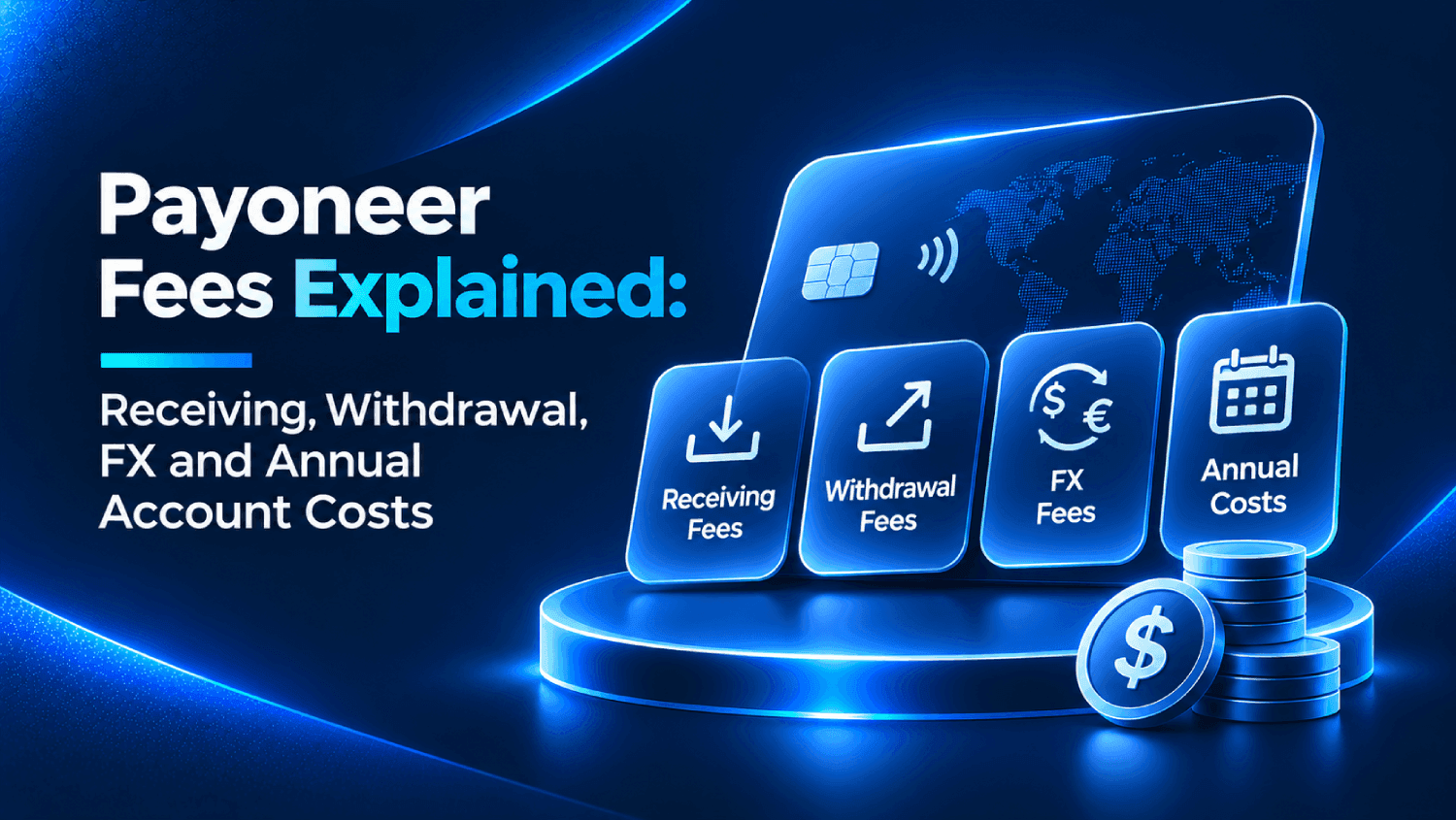
Payoneer fees break into four categories: receiving money, sending money, currency conversion, and withdrawals. The annual fee is $29.95 and applies only if your account receives less than $2,000 in a 12-month period, as of Payoneer’s public pricing page. FX conversions carry a 2% markup over the mid-market rate. Receiving payments from clients via Payoneer’s payment request system costs 3% for credit or debit card payments. Local bank transfer receipts and withdrawal fees vary by currency corridor and method.
Why Most People Underestimate Payoneer’s Total Cost
The headline numbers look manageable in isolation. A 2% FX fee sounds small. A $3 withdrawal fee sounds negligible. The problem is that these fees rarely occur alone. A freelancer receiving a client payment in GBP, converting it to USD, then withdrawing to a local bank account pays fees at every step of that chain.
Most fee pages, including Payoneer’s own, present charges by category rather than by transaction flow. That presentation makes it easy to miss how fees compound. This guide maps each fee to the moment it fires, then builds a worked scenario so you can see the total damage on a real payment.
What Does Payoneer Charge to Receive Money?
The receiving fee depends on the payment method the client uses, not on how much they send. This distinction matters because the same invoice can carry a 0% fee or a 3% fee depending on the payer’s payment method.
| Payment Method | Fee to Recipient | Notes |
|---|---|---|
| Payoneer to Payoneer (same currency) | 0% | No fee if both parties hold Payoneer accounts |
| Client credit/debit card via payment request | 3% | Charged to the recipient, not the payer |
| Local bank transfer to Payoneer receiving account (USD, EUR, GBP, JPY, AUD, CAD, MXN) | 0% to 1% | Receiving accounts in select currencies; some currencies carry a small fee |
| Payment from marketplace (Fiverr, Upwork, etc.) | Varies by marketplace | Payoneer does not set this rate; the marketplace does |
Payoneer’s receiving account network is one of the product’s core selling points. Users can receive USD, EUR, GBP, and several other currencies into local bank-equivalent account details, which means international clients pay a domestic transfer rather than an international wire. That can eliminate the payer’s wire fees and reduce friction, but Payoneer does charge 1% on some receiving account currencies, as noted on their public pricing page as of November 2026.
What Are Payoneer’s FX Fees?
Currency conversion markup is where Payoneer’s fee structure becomes most consequential for anyone operating across multiple currencies. Payoneer charges 2% above the mid-market exchange rate for currency conversions, as of their public pricing page checked in November 2026. This applies when you convert a balance from one currency to another within your account.
The mid-market rate is the benchmark rate shown on Google or XE.com. Payoneer’s rate will consistently be 2% worse than that benchmark. On a $10,000 conversion, that is $200 in FX cost alone, invisible unless you compare the two rates side by side.
Compare that to Wise Business, which charges a variable fee that often falls between 0.4% and 1% depending on the currency pair, or Airwallex, which advertises rates close to the interbank rate with a low fixed markup. The gap matters most for businesses converting large volumes regularly. For a quick look at how these platforms compare on cross-border payout costs, the cross-border payout fee comparison across Wise, Airwallex, Nium, and Payoneer breaks down the corridors where the differences are sharpest.
What Does Payoneer Charge to Send Money?
Sending money between Payoneer accounts in the same currency is free. That is the product’s most favorable scenario and the one most prominently featured in its own marketing.
Sending to a bank account outside Payoneer is a different story. Payoneer charges a fee that varies by destination country and payment method, as of their public pricing page in November 2026. The company does not publish a single flat rate for all outgoing payments. Instead, fees depend on the destination currency and local payment rail used. For specific corridor pricing, Payoneer’s fee calculator on their website lets you enter the destination country to see the applicable rate.
One structural point worth flagging: when you send money in a currency different from your account balance, a currency conversion fires before the payment leaves. That means the 2% FX fee applies on top of any sending fee, and many users miss the conversion charge because it happens quietly in the background.
What Is the Payoneer Annual Fee?
Payoneer charges a $29.95 annual fee if your account receives less than $2,000 within any 12-month period, as of their public pricing page in November 2026. Accounts that consistently receive above that threshold pay no annual fee.
This structure functions as an inactivity fee rather than a true subscription charge. For active freelancers and marketplace sellers, it is a non-issue. For accounts that receive sporadic payments or sit dormant for periods, the $29.95 is deducted automatically from the account balance. If the balance is insufficient, Payoneer reserves the right to close or restrict the account.
What Are Payoneer’s Withdrawal Fees?
Withdrawal costs depend on the method and destination. Payoneer supports bank account withdrawals in most countries, and fees vary by geography.
| Withdrawal Method | Fee | Notes (as of November 2026) |
|---|---|---|
| Bank transfer (US bank, USD) | $1.50 per transfer | Flat fee, no percentage |
| Bank transfer (non-USD, local currency) | Varies by country | Often $1.50 to $3.00 flat, plus FX if converting |
| Payoneer Mastercard (ATM withdrawal) | $3.15 per transaction | Plus applicable ATM operator fees |
| Payoneer Mastercard (point of sale purchase) | No Payoneer fee | Currency conversion at 3.5% if non-USD purchase |
The card’s FX rate for point-of-sale purchases in a foreign currency is 3.5%, which is notably higher than the 2% conversion fee charged on account-to-account conversions. Users who frequently spend abroad on the Payoneer card are paying a premium compared to traveling with a card that uses mid-market rates.
The Payoneer Fee Stack: A Worked Scenario
Consider a UK-based consultant who invoices a US client for $5,000, receives the payment via Payoneer’s payment request system, converts it to GBP, and withdraws to their UK bank account. Here is what the fee chain looks like.
| Fee Event | Rate | Cost on $5,000 |
|---|---|---|
| Client pays via credit card (3% receiving fee) | 3% | $150.00 |
| USD to GBP conversion (2% FX markup) | 2% on $4,850 | $97.00 |
| Withdrawal to UK bank account | Approx. $1.50 to $3.00 flat | $2.00 |
| Total fees | ~$249 |
That is roughly 5% of the gross invoice eaten by fees before the consultant sees a pound in their bank account. If the client pays via local bank transfer to Payoneer’s USD receiving account instead of by card, the receiving fee drops to 0% or 1%, cutting total cost to around $100. The choice of payment method the client uses has the single largest impact on total fees paid.
This is the FintechSpecs Fee Stack Model for evaluating Payoneer costs: map every transaction to its trigger event (receipt, conversion, withdrawal), apply the applicable rate at each node, then total the chain. Fees that look small at a single node often reveal a 4-6% total cost when you trace the full flow. Apply this model to any corridor you use regularly before assuming Payoneer is the cheapest option.
How Do Payoneer Fees Compare to Alternatives?
Payoneer’s fee structure is competitive for one specific use case: receiving payments from large marketplaces (Fiverr, Upwork, Amazon) that have negotiated direct integrations. In that context, receiving fees are set by the platform, withdrawals are low-cost, and the Payoneer infrastructure delivers reliably across a wide range of payout countries.
Outside that context, the 2% FX markup and the 3% card receiving fee put Payoneer at a disadvantage versus dedicated multi-currency account providers. Wise Business charges conversion fees that are significantly lower on most currency pairs. Airwallex and Tipalti offer tighter FX rates for businesses processing higher volumes. For a full comparison of mass payout alternatives, including how Tipalti and Trolley stack up against Payoneer for marketplace operators, the Tipalti vs Trolley vs Payoneer payout comparison covers the structural differences in depth.
For businesses evaluating their entire payout infrastructure, the right comparison is not Payoneer vs. one alternative. It is Payoneer vs. the specific corridor, volume, and payment method mix you actually use. The fee calculator on Payoneer’s website is the right starting point for any corridor-specific calculation.
Which Payoneer Fees Are Negotiable?
Payoneer does not publish a tiered pricing structure for standard accounts. The rates on the public pricing page apply to all users unless you are operating at enterprise scale or running a managed marketplace program through Payoneer’s B2B platform. At that level, pricing is quote-based, and the drivers are monthly payment volume, number of payees, and geographic distribution of payments.
If your business moves over $100,000 per month through Payoneer, requesting a custom rate conversation is worth the effort. FX markups and per-payment fees are the most commonly negotiated elements. The receiving fee structure is less flexible because it is tied to the card network interchange rates Payoneer itself pays. For founders thinking through how to build payment infrastructure that minimizes these kinds of embedded costs over time, the hidden costs that kill fintech SaaS margins is worth reading before you sign anything long-term.
Frequently Asked Questions About Payoneer Fees
Does Payoneer charge a monthly or annual fee?
Payoneer charges a $29.95 annual fee, but only if your account receives less than $2,000 in a 12-month period, as of their public pricing page in November 2026. Accounts with regular inbound payments above that threshold pay no annual or monthly fee. The charge is deducted automatically from your Payoneer balance when it applies.
What is the Payoneer fee for receiving money from a client?
Payoneer charges 3% when a client pays via credit or debit card through Payoneer’s payment request system, as of November 2026. If the client pays via local bank transfer to your Payoneer receiving account, the fee is 0% to 1% depending on the currency. Payoneer-to-Payoneer transfers in the same currency are free.
How much does Payoneer charge for currency conversion?
Payoneer charges a 2% markup above the mid-market exchange rate for all currency conversions within the platform, as of their public pricing page in November 2026. The mid-market rate is the rate shown on Google or XE.com. For every $10,000 converted, you pay approximately $200 in FX fees. The card’s foreign purchase rate is higher, at 3.5%.
What are Payoneer’s withdrawal fees to a bank account?
Payoneer charges $1.50 per withdrawal to a US bank account in USD, as of November 2026. Withdrawals to non-US bank accounts in local currencies vary by country, typically ranging from $1.50 to $3.00 flat. If your Payoneer balance is in a different currency than the withdrawal destination, the 2% FX conversion fee also applies on top of the withdrawal fee.
Are Payoneer fees to send money different from receiving fees?
Yes. Sending between Payoneer accounts in the same currency is free. Sending to a bank account outside the Payoneer network carries fees that vary by destination country and are not published as a single flat rate. Payoneer’s fee calculator on their website shows corridor-specific costs. Currency conversion fees apply separately whenever the sending and receiving currencies differ.
Can you avoid Payoneer’s FX fee?
You can reduce exposure by keeping funds in the original received currency and spending or withdrawing in that same currency. If you receive USD and withdraw to a USD bank account, no conversion fee fires. The FX fee applies only when Payoneer converts one currency to another. Holding multiple currency balances and matching them to same-currency withdrawals is the most direct way to avoid conversion costs.
Is there a Payoneer fee calculator?
Payoneer provides a fee calculator on their website that lets you enter a destination country and amount to see applicable withdrawal and sending fees. It does not automatically stack the full fee chain (receiving plus conversion plus withdrawal) in one view, which is why running the FintechSpecs Fee Stack Model manually across the full transaction flow gives a more accurate total cost picture than using the calculator alone.
What to Do If Payoneer’s Fees Don’t Work for Your Volume
The 2% FX markup is not punishing at low volumes or for occasional cross-border invoices. It becomes a material drag on margins for businesses processing hundreds of thousands of dollars monthly across multiple currencies. At that scale, platforms like Airwallex, Wise Business, or Nium offer FX rates that are meaningfully tighter, often with API access that makes reconciliation easier to automate.
For marketplace operators specifically, the question is whether Payoneer’s pre-built marketplace integrations and global payout coverage justify the FX premium compared to building on a payout API directly. For a broader evaluation of payout infrastructure options, the best outbound payment and payout APIs for B2B SaaS covers providers that offer programmatic payout with more transparent FX pricing. If you have already decided to move away from Payoneer, the Payoneer alternatives comparison ranks the strongest cross-border payment platforms by use case.
The core insight here is that Payoneer’s pricing is designed for the recipient who wants broad reach and simple onboarding, not for the business that wants optimized FX on every dollar. Those are different products serving different needs, and the fee structure reflects that. Know which one you are before you commit.