
TLDR
- Persona does not publish a flat per-verification fee. Pricing depends on which verification type you run, your monthly volume, and whether you need a dedicated environment or just API access.
- The free Sandbox plan lets you test flows at no cost, but production access requires a paid plan with a monthly minimum commitment.
- Document verification, database checks, government ID lookups, and liveness checks each carry different unit economics. Running all four in a single flow multiplies cost quickly.
- High-volume fintechs negotiate custom rates. The published pricing on Persona’s site reflects starter tiers, not what a Series B company processing tens of thousands of verifications per month actually pays.
- Plan minimums and verification type stacking are the two variables most buyers underestimate. Both can double effective cost per verified user compared to a headline per-check rate.
Persona’s pricing has three moving parts: the plan tier you are on, the verification types your flow uses, and the volume you run each month. As of Persona’s public pricing page (checked November 2026), Persona offers a free Sandbox environment for testing, with paid production plans starting at a published rate that includes a monthly minimum. Exact per-check costs for document, database, and government ID verifications vary by tier and are quote-based at higher volumes. Fintechs evaluating Persona should budget for plan minimums in addition to per-verification costs, since the two stack.
What Does Persona Actually Charge For?
Persona is an identity verification platform that lets fintechs build multi-step KYC flows combining document verification, selfie and liveness checks, database lookups, government ID network queries, and watchlist screening. Each of those components is a billable unit, not a bundled flat fee.
That architecture means your effective cost per verified user depends on the number of verification steps in your flow, not just how many users you onboard. A flow that runs a government ID check plus a selfie match plus a database lookup costs more per user than a flow that runs document verification alone. Most fintechs build multi-step flows to meet BSA/AML requirements, so the cost compounds.
Persona also charges differently based on whether you are using their hosted, no-code flow builder or the API directly. Teams that need custom flows, embedded components, or webhook integrations typically land on higher tiers with different unit pricing. If you are comparing Persona to other KYC providers, the best KYC providers for fintech SaaS guide breaks down how those architectures differ across the competitive field.
What Are Persona’s Published Plans?
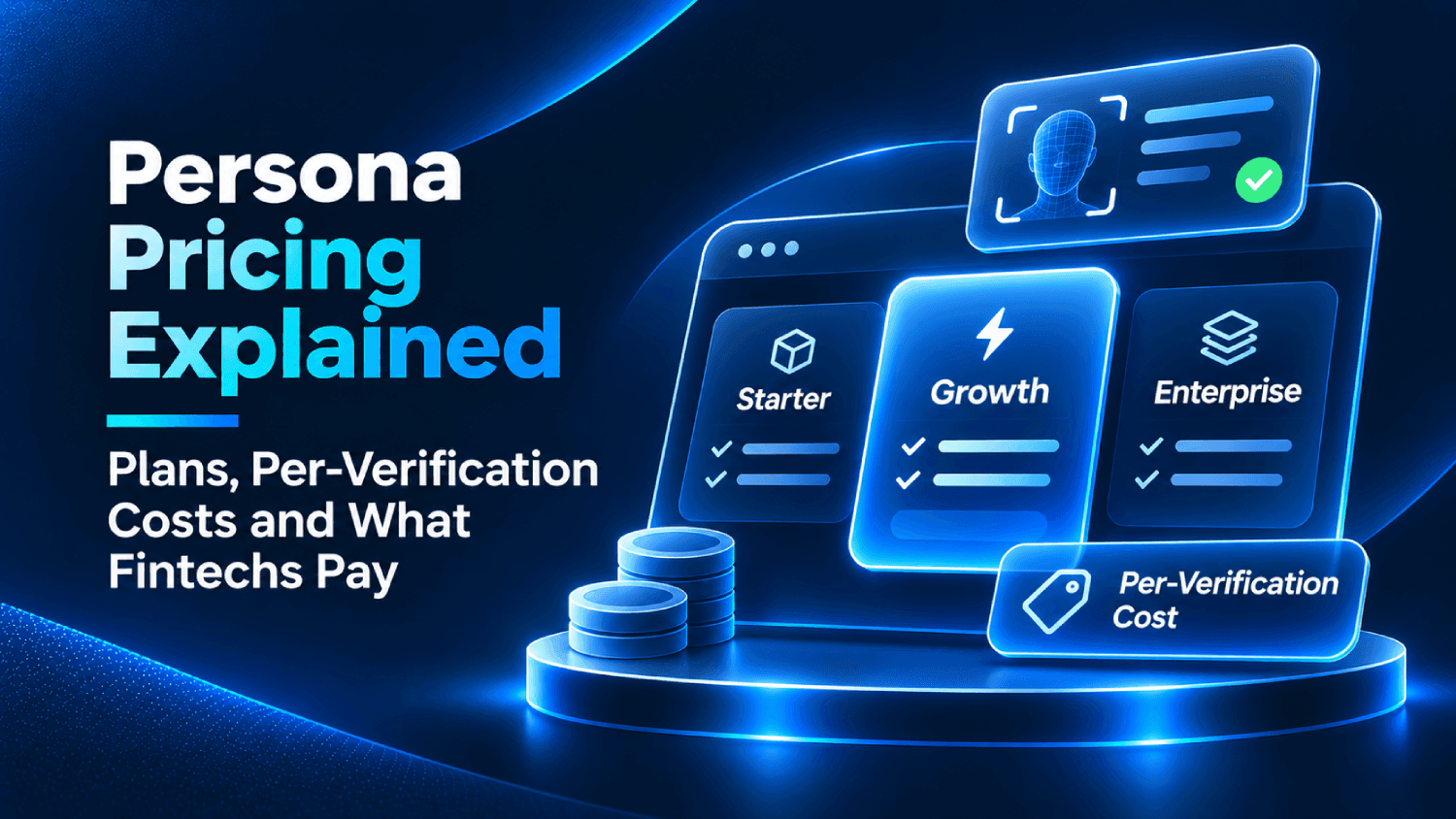
As of Persona’s public pricing page (checked November 2026), Persona structures access across three main tiers: a free Sandbox for testing, a Starter plan for early production use, and an Enterprise tier for high-volume or compliance-intensive deployments.
Sandbox (Free)
The Sandbox plan is free and gives full access to Persona’s flow builder, test verifications, and API in a non-production environment. No credit card is required. It is useful for prototyping onboarding flows and stress-testing edge cases before you commit to a paid plan. Test verifications do not count against production quotas.
Starter Plan
The Starter plan enables production verifications. As of Persona’s public pricing page (November 2026), Persona does not publish a flat monthly fee for the Starter tier publicly in the same way a SaaS tool publishes a seat price. Instead, pricing is structured around per-verification costs with a monthly minimum. The specific per-verification rate and minimum are not publicly disclosed; Persona’s site directs prospective customers to contact sales for exact figures once they have defined their verification flow.
Enterprise Plan
Enterprise pricing is fully quote-based. Persona does not publish rates for this tier. Volume discounts, dedicated infrastructure, SLA commitments, and custom workflows are all negotiable at this level. Companies running more than a few thousand verifications per month typically end up here, and the effective per-check cost is lower than Starter rates but requires a larger contract commitment. Persona does not publicly disclose the thresholds that trigger Enterprise eligibility.
What Verification Types Drive Persona KYC Pricing?
This is where most buyers get surprised. Persona’s per-verification cost is not one number. It is a function of which checks you activate inside a flow. The major billable verification types on the Persona platform include:
- Document verification: Automated review of government-issued IDs (passports, driver’s licenses, national IDs). Covers authenticity checks, data extraction, and tamper detection.
- Selfie and liveness checks: Compares a live selfie to the document photo. Liveness detection prevents spoofing with printed photos or videos.
- Government ID database lookups: Queries official government records to confirm identity data matches what the document shows. Availability depends on country.
- Database verification: Cross-references identity data against third-party databases including credit header data and address history.
- Watchlist and adverse media screening: Checks PEP lists, OFAC sanctions lists, and adverse media sources. This is distinct from the base document check and billed separately.
- Phone and email verification: Lightweight signals used as early-funnel checks before heavier document verification runs.
A minimal flow might run only document verification plus selfie. A BSA-compliant onboarding flow for a money services business might add a government ID database lookup, watchlist screening, and a phone check on top of that. Each layer adds to the per-user cost. If you are evaluating what full AML compliance actually adds to your cost structure, the cost breakdown for KYC per verification shows how these layers stack across providers.
The FintechSpecs Verification Stack Calculator: How to Estimate Your Persona Cost
Because Persona does not publish a single per-check number, the most useful thing a buyer can do before getting on a sales call is build a verification stack estimate. Here is how to do it.
Start by listing every check in your intended onboarding flow. Count how many verifications you expect per month, then segment by pass rate. Not every user who starts a flow completes it, and not every document check passes on the first attempt. A retry on a failed document scan is typically billed as a second verification, depending on your contract terms. Confirm this with Persona before signing.
Next, multiply your expected monthly verifications by the number of billable steps in your flow. If you run 1,000 users through a four-step flow, your billed unit count is not 1,000. It could be closer to 3,500 to 4,000 once you account for retries and failed-then-retried checks. That gap between user count and billed verification count is the single most common source of budget overruns for early-stage fintechs.
Finally, add your plan minimum. If the Starter plan carries a monthly minimum floor, you will pay that floor regardless of whether you hit it in verifications. At low volumes, the minimum will dominate your cost. At higher volumes, the per-check rate dominates. The crossover point is worth calculating explicitly before you sign.
Persona Pricing vs. Competitors: How Does the Cost Compare?
| Provider | Pricing Model | Published Per-Check Rate | Monthly Minimum | Best For |
|---|---|---|---|---|
| Persona | Per verification, by type | Not publicly disclosed; per-verification rates and minimums require a sales conversation for all production tiers | Yes (amount not publicly disclosed) | Multi-step KYC flows, US fintechs |
| Socure | Per verification, module-based | Quote-based | Yes | High-volume digital identity, fraud signals |
| Alloy | Per decision, orchestration-layer | Quote-based | Yes | Multi-vendor orchestration across KYC and KYB |
| Sumsub | Per verification; some published tiers | Partial public pricing on their site | Varies by plan | Global onboarding, crypto and neobanks |
| Trulioo | Per verification, country-based pricing | Quote-based | Yes | Cross-border identity, global coverage |
Persona sits in the same pricing tier as Socure and Alloy: quote-based at meaningful volumes, with published pricing reserved for entry-level access. The practical difference is that Persona leans heavily on its no-code flow builder and embedded components, which matters for product teams without deep compliance engineering resources. Alloy, by contrast, positions itself as an orchestration layer that sits above multiple data vendors, which changes the cost model entirely. For a direct head-to-head, the Alloy vs. Persona comparison goes deeper on where each fits.
What Do Fintechs Actually Pay? A Worked Scenario
To illustrate how billed units stack up, consider a seed-stage neobank onboarding 500 new users per month. Their flow includes document verification, a liveness check, and a watchlist screen, three billable steps per user. For example, assume a 15% document retry rate: that hypothetical flow would generate roughly 575 document checks, 500 liveness checks, and 500 watchlist screens, for approximately 1,575 total billed units per month. The specific rate Persona charges per unit is not publicly disclosed and would depend on the plan and negotiated terms, but the structure of how units stack is the key dynamic to understand.
If their plan minimum is higher than what 1,575 billed verifications cost at their per-check rate, they pay the minimum. For early-stage companies, this is common for the first three to six months before volume ramps. The plan minimum is effectively a fixed cost of compliance infrastructure, not a pure variable cost. Teams building financial projections should model it as a baseline, with per-verification overage on top once volume clears the minimum.
At Series A, the same company might be processing 8,000 to 15,000 users per month. At that volume, the per-check rate starts to dominate, and the minimum becomes irrelevant. That is also the point where negotiating a custom rate with Persona’s enterprise sales team becomes worth the time. The difference between Starter rates and a negotiated Enterprise rate at 10,000 verifications per month can be meaningful in absolute dollars, even if the percentage discount looks modest. For context on how compliance costs scale with company stage, the real cost of compliance broken down by stage gives useful benchmarks.
What Factors Drive Persona’s Quote-Based Enterprise Pricing?
When Persona’s sales team builds a custom quote, the variables that move the number most are volume, verification type mix, geographic scope, and contract length.
Volume is the most obvious lever. Higher monthly verification counts get lower per-check rates. The discount curve is not linear. The jump from 1,000 to 5,000 verifications per month typically produces a larger percentage reduction than the jump from 10,000 to 50,000.
Verification type mix matters because some checks are more expensive to run than others. Government ID database lookups, which query live government records, cost more than a simple database verification against third-party data. A flow heavy on government ID queries will price out higher than one relying on document verification plus liveness only.
Geographic scope affects cost because international document verification and cross-border government database access carry higher costs than US-only flows. A US neobank verifying domestic users prices differently than a money transfer operator verifying users from 40 countries.
Contract length is a standard lever in SaaS and API pricing. Annual commitments typically produce better rates than month-to-month. Persona, like most enterprise identity vendors, uses contract length as a discount mechanism rather than publishing tiered pricing by commitment term.
What Are the Hidden Costs in Persona’s Pricing?
Several cost categories do not appear in a headline per-check rate but do appear on invoices.
Implementation and integration time is not billed by Persona, but it is a real cost. Using Persona’s flow builder with minimal API customization is relatively fast. Building deeply custom embedded flows, or integrating Persona’s decisions into a downstream risk engine, requires engineering time that varies by team.
Retry billing is the most financially significant hidden variable. If your contract charges for every verification attempt rather than every successfully completed verification, failed document uploads, blurry selfies, and connectivity errors all count. Clarify the retry billing model explicitly before signing.
Watchlist screening frequency is a second variable. Some compliance programs require ongoing periodic rescreening of existing users, not just onboarding-time checks. If you run monthly rescreens on 50,000 existing customers, that volume can exceed your onboarding verification volume, and it may be billed at a different rate than your onboarding flow. This matters especially for fintechs with large existing user bases expanding their compliance programs. The fintech compliance readiness checklist includes a section on rescreening obligations that is worth reviewing before scoping your Persona contract.
Dedicated infrastructure for Enterprise customers is sometimes priced separately. Persona offers dedicated tenancy for companies that require data isolation or have contractual requirements prohibiting multi-tenant environments. If your compliance program or enterprise customers require this, budget for it explicitly.
How Does Persona’s Pricing Compare for KYC Specifically?
This article covers Persona’s KYC pricing, meaning individual identity verification for natural persons. Business entity verification (KYB) is a separate product category with different pricing dynamics. Persona does offer KYB capabilities, but KYB pricing involves business registry lookups, beneficial ownership verification, and EIN matching, all of which carry different unit costs and are covered separately in the KYB pricing breakdown that compares Persona, Middesk, Baselayer, Sumsub, and Alloy side by side.
For KYC specifically, Persona competes most directly with Socure, Jumio, Onfido (now part of Entrust), and Sumsub. Among those, Sumsub is the most transparent on pricing, with some published per-verification tiers visible on their public pricing page. Persona and Socure both require a sales conversation for anything above entry-level volumes. That opacity is a signal that pricing is highly negotiated and that published rates are more of a starting point than a commitment.
Frequently Asked Questions About Persona Pricing
Does Persona charge per verification or per user?
Persona charges per verification attempt, not per user. A single user who runs through a three-step flow generates three billable verifications. If a document check fails and the user retries, that retry may be billed as an additional verification depending on your contract terms. Confirm retry billing policy before signing. This distinction means your billed verification count will always be higher than your onboarded user count.
Is there a free tier for Persona?
Yes. Persona offers a free Sandbox environment for testing flows, verifications, and API integrations. The Sandbox is fully functional for development and QA but does not process live production verifications. There is no ongoing free production tier. Moving to production requires a paid plan with a monthly minimum commitment. The Sandbox has no stated time limit as of Persona’s public site (November 2026).
What is Persona’s pricing for high-volume fintechs?
High-volume pricing is quote-based and negotiated directly with Persona’s enterprise sales team. Persona does not publish volume discount thresholds or rate schedules for enterprise contracts. The key variables in a custom quote are monthly verification volume, verification type mix, geographic scope of users, and contract length. Companies processing tens of thousands of verifications per month typically see materially lower per-check rates than Starter plan pricing, but the absolute dollar savings depend heavily on flow complexity.
How does Persona’s pricing compare to Alloy or Socure?
All three are quote-based at meaningful volume and structure pricing around per-verification or per-decision costs with monthly minimums. Alloy positions itself as an orchestration layer above multiple data vendors, which adds an orchestration fee on top of underlying data costs. Persona and Socure both provide their own verification infrastructure rather than acting purely as an orchestration layer. Socure tends to focus on higher-volume, risk-signal-heavy use cases. Persona’s strength is its no-code flow builder, which reduces implementation cost for product teams.
Does Persona charge for failed verifications?
This depends on your contract. Persona’s default billing approach charges for verification attempts, which can include failures. Some enterprise contracts include provisions for failed checks, such as not billing for certain failure modes or capping retry billing. This is a negotiable term. Buyers at any volume should request explicit language in their contract covering how failed verifications and document retries are billed before signing.
What is Persona’s pricing for watchlist screening?
Persona does not publicly disclose the per-screen cost for watchlist and sanctions screening as of November 2026. It is a separate billable component from document verification and liveness checks. For fintechs that need ongoing periodic rescreening of existing users in addition to onboarding-time checks, the cumulative cost of rescreening can exceed onboarding verification costs at scale. Budget for both use cases separately when scoping a Persona deployment.
Conclusion
Persona’s pricing is not complicated once you understand its structure, but that structure is genuinely different from what most buyers expect. The mistake is treating it like a SaaS tool with a fixed monthly seat fee. It is an API product with per-call economics, a mandatory plan minimum, and a cost that multiplies with each verification step you add to a flow. A four-step onboarding flow costs roughly four times as much per user as a single document check, before retries.
The practical implication for a founder or VP Finance evaluating Persona is this: define your verification flow before you get on a sales call. Know how many steps you need to run, your expected monthly user volume, your document retry rate, and whether you need ongoing rescreening. Those four inputs determine your actual cost more than the headline per-check rate ever will. Teams that go into pricing conversations without that scope end up with contracts sized for simpler flows than they actually run.
At seed stage, the plan minimum will likely dominate your cost. At Series A and beyond, the per-check rate and flow complexity take over. Both phases reward the same thing: clarity about what you are actually verifying and why, before you commit to a contract structure. The fintechs that overpay on identity verification are rarely the ones that pushed back on price. They are the ones that signed before they knew their own flow.