
TLDR
- Baremetrics pricing is not a flat monthly fee. It scales with tracked ARR, so a company at higher revenue pays significantly more than one at a lower band on the same plan.
- The Recover add-on for dunning and failed payment recovery carries its own cost on top of the base subscription, and that combined line item surprises most buyers mid-evaluation.
- Baremetrics publishes its pricing publicly, which makes it easier to model costs before you talk to sales, but the ARR-tier structure means your bill will grow automatically as revenue grows.
- ChartMogul is the most common alternative evaluated at the same stage. The two tools differ on data model, integrations, and pricing structure in ways that matter at different revenue bands.
Baremetrics charges based on the ARR it tracks, not a fixed seat or feature tier. According to the official Baremetrics pricing page, the Launch plan is free up to $180K ARR (tracked), then $49/mo up to $360K ARR. The Growth plan runs $69/mo from $360K to $3.6M ARR, and the Scale plan is $409/mo for $3.6M+ ARR. The Recover dunning add-on is priced separately on top. A company growing from one ARR band to the next will see its Baremetrics bill increase automatically, without changing plans or adding users.
What Is Baremetrics and Who Uses It?
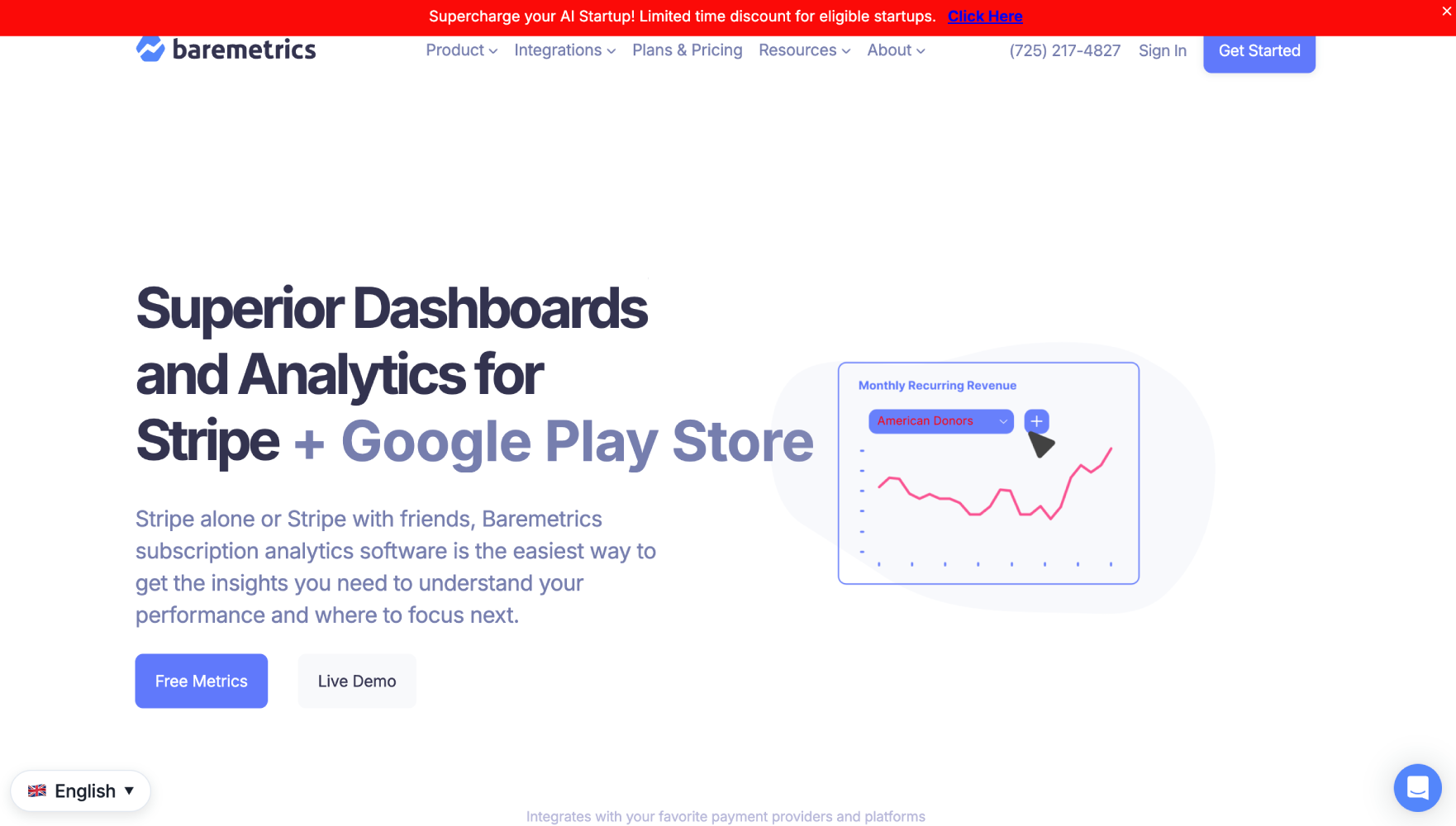
Baremetrics is a subscription analytics and revenue intelligence platform built for SaaS and subscription businesses. It connects to payment processors and billing platforms, then surfaces metrics like MRR, ARR, churn rate, LTV, and net revenue retention in a single dashboard.
The core audience is founders and finance leads at subscription businesses who want real-time visibility into revenue health without building their own analytics layer. It sits between a raw billing tool like Stripe and a full BI platform like Looker. Baremetrics does the subscription math so your team does not have to build and maintain it.
The product also includes Recover, a dunning tool designed to reduce involuntary churn from failed payments, and Cancellation Insights, which captures exit survey data when subscribers leave. According to the official pricing page, Cancellation Insights is available as an add-on at +$129/mo across Launch, Growth, and Scale plans.
How Does Baremetrics Pricing Actually Work?
The pricing model is ARR-based, meaning your monthly cost is determined by how much recurring revenue Baremetrics is tracking for you. This is a common structure for subscription analytics tools, and it aligns the vendor’s incentive with yours: as your business grows, their platform becomes more valuable, and you pay more.
According to the official Baremetrics pricing page, the plan structure is built around ARR bands rather than granular MRR tiers. The Launch plan is free up to $180K ARR tracked, then $49/mo up to $360K ARR. The Growth plan is $69/mo from $360K to $3.6M ARR. The Scale plan is $409/mo for $3.6M+ ARR. Annual plans can include up to a 35% discount on listed prices.
What most people miss is that the meter runs on the ARR Baremetrics sees through your connected integrations, not what you self-report. If you connect Stripe and your tracked ARR grows into the next band, your plan cost moves accordingly at your next billing cycle. There is no manual upgrade required, which means there is also no warning before the increase hits.
What Are the Baremetrics Plans and ARR Tiers?
Baremetrics publishes its plan structure publicly, which is one of the cleaner pricing pages in this category. The table below reflects the published plan structure as listed on the official Baremetrics pricing page. Annual billing can include up to a 35% discount; confirm exact annual rates directly on the pricing page at time of purchase.
| Plan | ARR Band | Listed Monthly Price |
|---|---|---|
| Launch | Up to $180K ARR | Free |
| Launch | $180K to $360K ARR | $49/mo |
| Growth | $360K to $3.6M ARR | $69/mo |
| Scale | $3.6M+ ARR | $409/mo |
These figures are sourced directly from the Baremetrics pricing page. Verify before budgeting, since ARR-based pricing pages update when the vendor reprices tiers.
The annual billing discount is material, up to 35% off listed prices according to the pricing page. The exact discounted rates should be confirmed on the pricing page at time of purchase.
What Does the Baremetrics Recover Add-On Cost?
Recover is Baremetrics’s dunning product. It handles failed payment retries, in-app payment update prompts, and automated email sequences to recover subscriptions that lapse due to card declines. For most SaaS businesses, involuntary churn from failed payments runs between 1% and 3% of MRR monthly, so a dedicated dunning tool can pay for itself quickly.
According to the official Baremetrics pricing page, Recover is priced at +$129/mo or 10% of recovered revenue, whichever applies. This pricing is uniform across all plans: Launch, Growth, and Scale all show the same Recover add-on structure. It does not vary by plan tier. Because the fee has a performance component, the actual monthly cost will fluctuate depending on how much failed-payment revenue your account recovers in a given period.
The practical implication: a business recovering $8,000 per month in otherwise-lost MRR through Recover will pay more in absolute dollars than one recovering $1,500, even if the percentage rate is identical. Budget for Recover as a variable line item, not a fixed one. For teams comparing this model to standalone dunning tools, our roundup of the best dunning tools for SaaS payments and failed renewals covers how performance-fee models compare to flat-fee alternatives.
The FintechSpecs MRR Bracket Scenario: What You Actually Pay at Three Growth Stages
The abstract tier table is less useful than a worked scenario. The FintechSpecs MRR Bracket Scenario applies the published Baremetrics plan structure to three hypothetical SaaS companies at different ARR levels, using the base plan rates from the official pricing page plus the Recover add-on. These are illustrative scenarios built from published pricing, not real customer data. Annual billing discounts of up to 35% are not applied here, use the official pricing page to calculate your discounted rate.
| Company Stage | Tracked ARR | Base Plan (listed monthly) | Recover Cost (illustrative) | Total Monthly Estimate |
|---|---|---|---|---|
| Early SaaS | $120K ARR | Free (Launch) | +$129/mo or 10% of recovered | $0 to $129+ per month |
| Growth Stage | $500K ARR | $69/mo (Growth) | +$129/mo or 10% of recovered | $69 to $198+ per month |
| Scaling | $4M ARR | $409/mo (Scale) | +$129/mo or 10% of recovered | $409 to $538+ per month |
The base plan cost alone jumps substantially between ARR bands. That is not a complaint about the pricing model, it is just what ARR-tiered pricing does. For founders who expect to grow fast, the right question is not what Baremetrics costs today but what it costs at your 18-month revenue target.
Say a company is at $300K ARR today and expects to hit $1.5M ARR in 18 months. Their base plan moves from $49/mo (Launch) to $69/mo (Growth) in that window. That delta on the base plan is modest, but Recover fees scale with the growing revenue pool, and the total Baremetrics bill could be a materially different number than what they started with. Apply the annual discount from the pricing page to get the actual numbers for your specific case.
What Integrations Does Baremetrics Support?
Baremetrics connects natively to Stripe, Braintree, Recurly, Chargebee, Paddle, and several other billing platforms. Stripe is the most common entry point and the integration most thoroughly documented in Baremetrics’s own help content.
The integration depth matters for pricing accuracy. If your subscription data is spread across multiple billing sources, Baremetrics aggregates ARR across all connected sources, which is how it determines your pricing tier. A company with revenue in Stripe and revenue in Chargebee, both connected, would be tracked at the combined total ARR for tier purposes.
Businesses running complex billing setups, including usage-based pricing models, may find that Baremetrics’s calculations require some manual cleanup. For teams evaluating whether their billing stack is set up correctly before connecting an analytics tool, the Fintech SaaS scale checklist covers revenue data hygiene as part of the path to $10M ARR.
How Does Baremetrics Pricing Compare to ChartMogul?
ChartMogul is the most direct comparable tool in the market. Both platforms are subscription analytics tools with revenue-based pricing, native billing integrations, and dashboards covering churn, LTV, and cohort retention. The difference shows up in data model depth and pricing structure at higher revenue levels.
ChartMogul’s pricing was not independently verified against a source page for this article. The figures cited in prior versions of this comparison could not be confirmed against ChartMogul’s official pricing page at time of publication. Before using any ChartMogul pricing figures in a vendor comparison, check ChartMogul’s current pricing page directly. ChartMogul does not publish a Recover-equivalent dunning product as a built-in add-on.
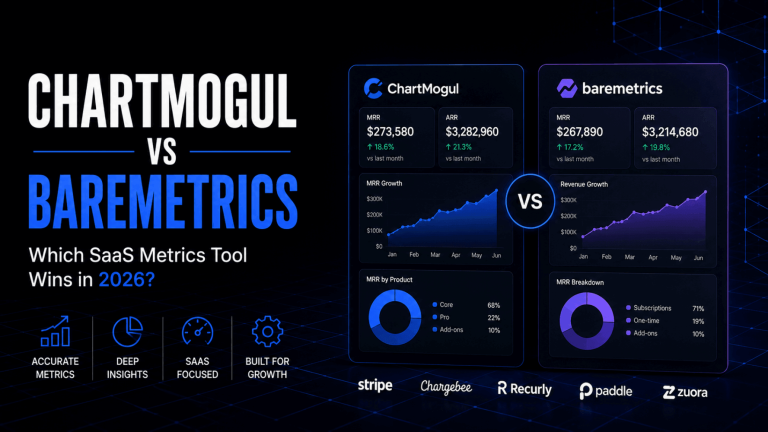
Our full ChartMogul vs Baremetrics comparison covers the differences in data model, cohort depth, and integration breadth for teams trying to pick one.
| Feature | Baremetrics | ChartMogul |
|---|---|---|
| Free tier | Yes (Launch plan, up to $180K ARR) | Confirm on vendor pricing page |
| Entry paid plan | $49/mo (Launch, $180K to $360K ARR) | Confirm on vendor pricing page |
| Dunning add-on | Yes (Recover, +$129/mo or 10% of recovered) | No native equivalent |
| Pricing model | ARR-tiered | Revenue-tiered |
| High-revenue tier | $409/mo at $3.6M+ ARR (Scale) | Confirm on vendor pricing page |
Baremetrics figures sourced from the official pricing page. ChartMogul figures should be verified directly at chartmogul.com/pricing before finalizing any comparison.
What Happens to Pricing Above $3.6M ARR?
The Scale plan at $409/mo covers $3.6M+ ARR. Above the Scale tier’s published rate, Baremetrics may move to quote-based pricing for enterprise accounts. The public pricing page should be consulted for current terms at that revenue level.
At that scale, the cost drivers typically include the total ARR tracked, number of connected data sources, Recover usage volume, and any custom data retention or reporting requirements. Enterprise contracts in this category often include annual minimums and volume discounts rather than the per-month ARR-tier structure used for smaller accounts.
For teams at or approaching that scale who are comparing vendor costs, the lack of fully published enterprise pricing is a signal to run a formal evaluation process rather than a quick self-serve signup. The FintechSpecs fintech vendor evaluation framework outlines the seven checks to run before signing any contract in this category.
What Is the Real Total Cost of Baremetrics?
The FintechSpecs Total Cost Stack for Baremetrics has four components that buyers should model before committing.
The first is the base plan, which is the published ARR-tiered rate. This is the number most people anchor on, and it understates the real bill for any team using add-ons. The second is the Recover add-on, which carries a performance-based fee, +$129/mo or 10% of recovered revenue, that scales with recovered revenue. The third is the billing frequency premium: paying monthly instead of annually increases the per-month cost, with annual plans offering up to a 35% discount according to the pricing page.
The fourth is growth exposure. Because the plan tier is determined by tracked ARR, a company growing quickly will cross into higher-cost bands without any manual action on their part. Budget the Baremetrics line item at your projected ARR 12 months out, not your current ARR, or you will under-budget it. This is the same math that creates sticker shock when founders building toward $5M ARR finally check their tool costs. The dynamics are covered in detail in our piece on hidden costs that compress fintech SaaS margins.
Who Should Choose Baremetrics and Who Should Not?
Baremetrics is a strong fit for Stripe-first SaaS businesses that want fast time-to-insight and a built-in dunning tool they do not want to build or buy separately. The dashboard is opinionated, the Stripe integration is deep, and Recover handles a problem most early-stage SaaS teams neglect until involuntary churn becomes visible in their numbers.
It is a weaker fit for businesses with complex billing architectures, multiple revenue streams that do not map cleanly to subscription logic, or teams that need granular custom metrics and cohort segmentation at a data-warehouse level. At that point, a dedicated subscription analytics platform with more flexible data modeling may serve better than Baremetrics’s more prescriptive setup.
Businesses under $180K ARR that need core analytics only, without dunning, should evaluate whether the Baremetrics Launch free tier covers their needs before comparing against other paid tools. The free tier covers the range where most early-stage SaaS businesses operate, and the cost savings compound meaningfully during the phase where every dollar is allocated to growth.
Frequently Asked Questions About Baremetrics Pricing
Does Baremetrics charge per seat or per user?
No. Baremetrics pricing is based on the ARR tracked through connected billing integrations, not the number of users who access the platform. You can add team members to your Baremetrics account without paying more per seat. The only variable that moves your plan cost is your tracked ARR crossing into a new tier on the published schedule.
What is the cheapest Baremetrics plan?
According to the official Baremetrics pricing page, the Launch plan is free for businesses with up to $180K in tracked ARR. Beyond that threshold, it moves to $49/mo up to $360K ARR. Businesses under $180K ARR can access core subscription analytics at no cost on the Launch plan. Confirm current terms on the Baremetrics pricing page before signing up, as plan structures can change.
How is Recover pricing calculated?
According to the official Baremetrics pricing page, Recover is priced at +$129/mo or 10% of recovered revenue. This rate is uniform across all plans, Launch, Growth, and Scale. Because the fee has a performance component, the monthly total will vary. A month with high failed-payment recovery volume will cost more than a quiet month, which makes it difficult to budget as a fixed line item.
Does Baremetrics pricing change automatically as ARR grows?
Yes. When your tracked ARR crosses into the next tier, your plan cost updates at the next billing cycle. There is no manual upgrade required, and no prorated credit if your ARR drops back below a threshold mid-cycle. For fast-growing companies, this means the Baremetrics line item will increase automatically without any action from your team, which is worth flagging in your SaaS operating budget.
Is there a Baremetrics free trial?
Baremetrics has offered a free trial period historically. The current terms and trial length should be confirmed directly on their pricing page or through their signup flow, as trial terms can change. Do not assume trial availability from third-party reviews, since these go out of date quickly.
How does Baremetrics pricing compare to building subscription analytics in-house?
The build-versus-buy math favors Baremetrics strongly at early ARR levels. A custom subscription analytics layer requires engineering time to build, maintain, and extend as your billing logic changes. At the published Baremetrics plan rates for a fully-featured external platform, the break-even against even one day of engineering time per month is clear. The calculus shifts only when your data requirements become specific enough that an off-the-shelf tool cannot model them accurately, which typically happens at higher ARR levels with complex billing needs.
What billing integrations does Baremetrics support?
Baremetrics supports native integrations with Stripe, Braintree, Recurly, Chargebee, Paddle, and several other billing platforms. Stripe is the most commonly used and has the deepest integration documentation. For teams running multiple billing sources simultaneously, Baremetrics aggregates ARR across all connected sources to determine the appropriate pricing tier. Confirm current integration availability on the Baremetrics integrations page, as new connections are added periodically.
Should I pay monthly or annually for Baremetrics?
Annual billing is cheaper per month, up to 35% off listed prices according to the pricing page. If your business has stable ARR and you are confident in the tool, annual billing is the right default. The exception is a business in rapid ARR growth where you might want to re-evaluate tools at the 6-month mark. In that case, monthly billing buys optionality at a cost premium, and that premium is the price of staying flexible.
What Pricing Mistakes Do Buyers Make With Baremetrics?
The most common mistake is budgeting Baremetrics at current ARR and forgetting to model future tiers. A company in the Launch plan growing toward $400K ARR will move into the Growth plan band automatically. That is a plan change with no product change, no negotiation, and no notice requirement.
The second mistake is treating Recover as optional during the evaluation phase and then adopting it after go-live without modeling the incremental cost. Dunning is genuinely valuable, and the Recover product is capable, but adding it post-signup means your effective Baremetrics cost is higher than what you originally compared against ChartMogul or other tools. For teams building out their subscription revenue infrastructure, the broader context of pricing mistakes that fintech founders repeat applies directly to vendor selection decisions, not just product pricing.
The third mistake is not accounting for the monthly versus annual billing difference when comparing vendor costs. Annual billing on Baremetrics can be up to 35% cheaper than monthly billing. Always compare the same billing cadence when evaluating subscription analytics tools side by side, or the numbers will mislead you in either direction.