
TLDR
- ChartMogul’s free plan caps at $10,000 MRR. Cross that line and you move to paid tiers immediately.
- Paid plans are priced as a percentage of MRR, so your ChartMogul cost grows automatically as your business grows.
- The Launch plan costs $179 per month as of November 2026, covering MRR up to $200,000. Scale pricing above that is quote-based.
- Revenue-based pricing means a company at $190,000 MRR pays the same as one at $20,000 MRR on Launch. Cross $200,000 and the bill changes.
- Teams comparing ChartMogul against alternatives should factor in MRR trajectory, not just current MRR.
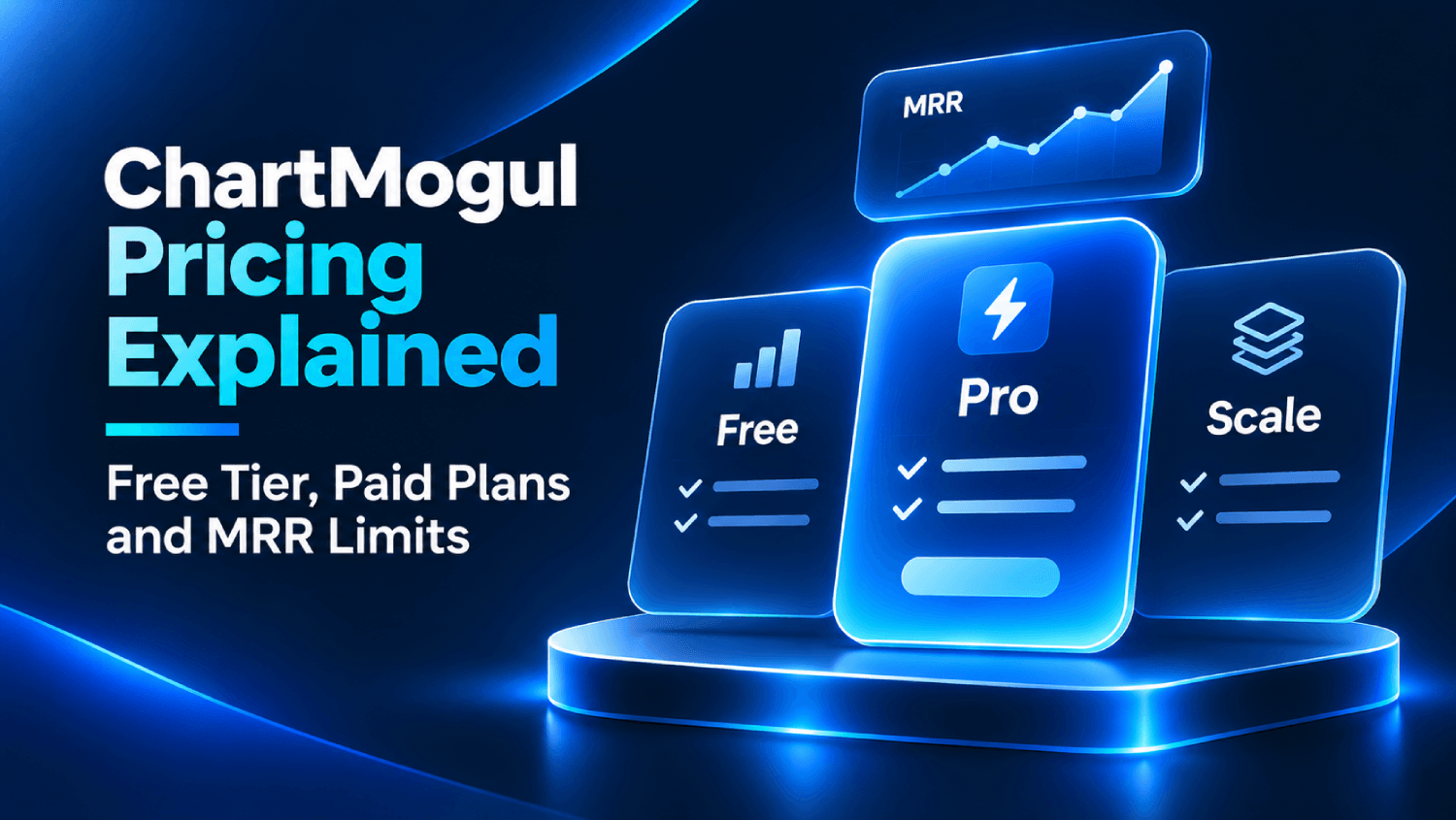
ChartMogul offers a free plan for companies under $10,000 MRR, a Launch paid plan at $179 per month for MRR up to $200,000 (as of ChartMogul’s public pricing page, November 2026), and a Scale plan with quote-based pricing above that threshold. All paid tiers are structured around MRR volume, meaning your subscription analytics cost rises as your recurring revenue rises.
Why ChartMogul’s Pricing Model Surprises Growing Teams
Most SaaS tools charge per seat or per feature tier. ChartMogul charges based on how much revenue flows through your connected billing systems. That distinction matters a lot at $50,000 MRR, and even more at $150,000 MRR, because the meter is always running against your growth.
The assumption that ChartMogul is “free for small companies” is partly true, but the free tier has a hard ceiling. Once your MRR exceeds $10,000, the free plan stops working. There is no grace period or soft enforcement described on ChartMogul’s public pricing page. You are on the Launch plan at $179 per month as of November 2026.
This model is not arbitrary. ChartMogul’s value proposition is tracking subscription metrics, so its pricing is directly tied to the complexity and volume of the data it manages. A company at $200,000 MRR has more customers, more churn events, more plan changes, and more cohort complexity than one at $5,000 MRR. The pricing reflects that. What it also means is that your infrastructure cost line for analytics is not fixed. If you are modeling a path to $10M ARR, ChartMogul’s cost needs to appear in your OpEx forecast as a variable, not a constant.
What Does ChartMogul’s Free Plan Actually Include?
The free plan is called Free and covers companies with up to $10,000 MRR, as of ChartMogul’s public pricing page reviewed November 2026. It includes core SaaS metrics: MRR, ARR, churn rate, customer lifetime value, and cohort analysis. Data source integrations with billing platforms like Stripe, Braintree, Recurly, and others are available on the free tier.
The free plan is not a stripped-down trial. It is a fully functional product for pre-revenue or early-revenue teams. The constraint is purely the MRR ceiling, not feature gating. That makes it genuinely useful for founders who want to build good metrics habits before they have meaningful revenue to track.
One structural implication: because the free tier includes real integrations and real metrics, switching costs accumulate quickly. By the time a team hits $10,000 MRR and tips into paid, they have months of historical data, configured dashboards, and team members who know ChartMogul’s interface. That is a retention mechanism baked into the pricing model, not a coincidence.
ChartMogul Plans Compared: Free, Launch, and Scale
| Plan | MRR Limit | Monthly Price | Pricing Type |
|---|---|---|---|
| Free | Up to $10,000 MRR | $0 | Fixed |
| Launch | Up to $200,000 MRR | $179/month | Fixed |
| Scale | Above $200,000 MRR | Quote-based | Negotiated |
All prices are as of ChartMogul’s public pricing page, November 2026. ChartMogul does not publish annual vs. monthly pricing differences on their public page beyond these tiers, so any discount for annual commitment would need to be confirmed directly with their team.
The jump from $0 to $179 per month at $10,001 MRR is the sharpest pricing cliff in ChartMogul’s structure. A team earning exactly $10,500 MRR is paying $179 per month for analytics, which represents roughly 1.7% of their gross revenue on that tool alone. That percentage drops as MRR grows within the Launch band. At $200,000 MRR, $179 per month is less than 0.1% of revenue.
What Does the ChartMogul Scale Plan Cost?
ChartMogul does not publish pricing for the Scale plan. It is quote-based, and the company does not publicly disclose the factors driving the quote. Based on how the product is structured, the variables that typically influence enterprise analytics pricing in this category include total MRR volume, number of connected billing systems, number of team seats, and any custom data integrations or API access requirements.
If you are approaching $200,000 MRR, the practical move is to contact ChartMogul’s sales team before you cross the threshold, not after. Waiting until you are over the limit removes negotiating room. Teams that know their MRR trajectory can often negotiate better terms when they come in with a 12-month forecast in hand.
For context on how to approach this vendor conversation, the FintechSpecs fintech vendor evaluation framework covers the questions worth asking before signing any analytics or infrastructure contract.
The MRR Cliff Problem: A Worked Scenario
Consider a B2B SaaS company growing at 15% month-over-month from $6,000 MRR. At that rate, they cross $10,000 MRR in roughly three months. They have been on ChartMogul’s free plan, their finance team uses it daily, and their investor reporting is built around ChartMogul exports.
At the moment of crossing the $10,000 threshold, the company has two options: pay $179 per month for Launch, or migrate to an alternative. Migration at that stage means rebuilding integrations, re-exporting historical data, retraining users, and introducing metric discrepancy risk during a period when investors are actively watching the numbers. In practice, almost every company pays the $179 and continues. That is the switching cost embedded in the free-to-paid cliff.
Now extend the scenario. The same company reaches $180,000 MRR twelve months later. They are paying $179 per month on Launch and comfortably within the plan limit. Six months after that, they cross $200,000 MRR. Now they enter Scale pricing, negotiated, opaque, and almost certainly higher than $179 per month. The team that budgeted a fixed $179 per month for subscription analytics now needs to renegotiate a contract while also managing hypergrowth operations. This is the second cliff, and it hits teams that did not model for it.
A straightforward rule for any team on a revenue-tiered analytics plan: identify the date you will hit your next pricing threshold, not just your current tier. If that date is within six months, the renewal conversation with the vendor should start now. This applies to ChartMogul’s $10,000 and $200,000 MRR transitions equally, and to any comparable tool that prices against revenue volume.
What Features Change Between ChartMogul Plans?
ChartMogul’s public pricing page does not list a detailed feature-by-feature breakdown separating Free from Launch at the feature level. The primary differentiator between Free and Launch is the MRR limit, not feature access. The Scale plan is where additional capabilities like dedicated support, advanced API limits, or custom integrations may apply, but ChartMogul does not publish those specifics publicly as of November 2026.
What ChartMogul does publish is that all plans include core metric calculations: MRR, ARR, customer churn, net revenue retention, average revenue per account, and cohort analysis. This is relevant because it means you are not paying the Launch fee to access better metrics. You are paying it because your revenue volume crossed a threshold.
Teams evaluating ChartMogul for metrics like net revenue retention and cohort expansion tracking should cross-reference this against the broader subscription analytics category to understand what competitive tools offer at similar price points.
How Does ChartMogul Cost Compare to Running Your Own Metrics Stack?
The alternative to paying ChartMogul is building metrics internally, typically by querying your billing data directly in SQL, piping it into a BI tool, and maintaining the logic yourself. The honest cost of that path is not zero. Someone on your team maintains the queries, investigates discrepancies, handles billing API changes, and answers finance and investor requests. That time has a real cost, usually measured in engineering or finance hours per month.
At $179 per month, ChartMogul Launch is priced below the cost of a single hour of a senior finance or engineering hire in most US markets. The break-even calculation favors ChartMogul for any company where maintaining internal metrics would consume more than two or three hours per month. Most companies at $50,000 to $200,000 MRR are past that threshold. The question at the Scale tier, where pricing is undisclosed, is whether the value still justifies the cost relative to building in-house or switching to a competitor.
If you are tracking the metrics that actually drive fintech growth decisions, the analytical overhead of building and maintaining those calculations internally is non-trivial, particularly for cohort analysis and net revenue retention calculations that require precise subscription state tracking.
ChartMogul vs Baremetrics: Which Pricing Model Fits Your Stage?
ChartMogul and Baremetrics are the two most common subscription analytics platforms in this category. Their pricing structures differ in ways that matter depending on your MRR. FintechSpecs has a full ChartMogul vs Baremetrics comparison covering features, integrations, and use cases by company stage. For this pricing-specific discussion, the key distinction is that ChartMogul’s MRR-based tiers create predictable pricing within each band but unpredictable transitions between bands. Baremetrics also uses MRR-based pricing; their current published tiers and exact thresholds are detailed in that comparison article, which reflects the most current public pricing available.
The choice is not purely about current price. It is about where you will be in 12 months and what your pricing will look like there.
What Should You Budget for ChartMogul at Different Growth Stages?
| MRR Range | ChartMogul Plan | Monthly Cost (Nov 2026) | Cost as % of MRR |
|---|---|---|---|
| $0 to $10,000 | Free | $0 | 0% |
| $10,001 to $200,000 | Launch | $179 | 1.79% to 0.09% |
| Above $200,000 | Scale | Not publicly disclosed | Not publicly disclosed |
The percentage cost of ChartMogul falls sharply as MRR grows within the Launch band. At $10,001 MRR, $179 per month represents significant overhead. At $150,000 MRR, it is negligible. This is by design. The model is generous in absolute dollar terms at the high end of Launch, which is why most teams stay through the entire band without reconsidering alternatives.
The cost inflection point to plan for is the Scale transition. Without knowing the Scale price, you cannot build an accurate forward model. Contacting ChartMogul at around $150,000 MRR to get a Scale quote, even informally, gives your finance team 12 to 18 months to absorb the number into forecasting.
Frequently Asked Questions About ChartMogul Pricing
What is the ChartMogul MRR limit on the free plan?
The ChartMogul free plan covers companies with up to $10,000 MRR, as of ChartMogul’s public pricing page reviewed November 2026. Once your connected billing systems show MRR above that threshold, the free plan no longer applies and you move to the Launch plan at $179 per month. The free tier includes full access to core metrics, not a limited feature set.
How much does ChartMogul cost per month on the Launch plan?
The Launch plan costs $179 per month as of ChartMogul’s public pricing page, November 2026. It covers MRR from $10,001 up to $200,000. The price does not scale within that band. A company at $11,000 MRR and a company at $195,000 MRR both pay $179 per month on Launch. Above $200,000 MRR, pricing is quote-based through ChartMogul’s sales team.
What happens when my MRR exceeds $200,000 on ChartMogul?
When your MRR crosses $200,000, you move from the Launch plan to the Scale plan. ChartMogul does not publish Scale pricing publicly as of November 2026. The cost is negotiated based on your specific situation. Teams approaching that threshold should contact ChartMogul proactively to get a quote before the transition, since the scale of the price increase is not predictable from published information.
Does ChartMogul charge per seat or per user?
ChartMogul’s public pricing page does not list per-seat charges as a primary pricing driver for the Free or Launch plans as of November 2026. The core pricing variable is MRR volume. Whether seat limits apply at the Scale tier is not publicly disclosed. Teams with large finance or operations teams using ChartMogul dashboards should confirm any seat restrictions directly with ChartMogul before committing to a Scale contract.
Is ChartMogul worth it for a company under $10,000 MRR?
At zero cost on the free plan, ChartMogul is worth using for any subscription business that wants reliable MRR, churn, and cohort data without building internal tooling. The main consideration at that stage is that switching away later creates historical data migration risk. Starting with ChartMogul at $5,000 MRR means your analytics history lives there. That is not a reason to avoid it, but it is a reason to treat the tool selection as a longer-term commitment than it appears.
Can I pay ChartMogul annually instead of monthly?
ChartMogul’s public pricing page does not explicitly state annual billing options or any annual discount percentage as of November 2026. If annual billing is available, the discount terms would need to be confirmed directly with ChartMogul. Any company negotiating a Scale contract should ask about annual commitment discounts as part of that conversation.
What billing integrations does ChartMogul support?
ChartMogul supports integrations with major billing platforms including Stripe, Braintree, Recurly, Chargebee, and others through its data import tools. The range of integrations is available across all plan tiers including the free plan. Teams running more complex subscription pricing models with usage components or multi-currency billing should verify their specific billing setup is supported before migrating historical data.
What to Do Before You Cross a ChartMogul Pricing Threshold
The practical advice is not complicated, but most teams skip it. When your MRR is at 70% to 80% of any ChartMogul tier ceiling, that is the time to do two things: get a quote for the next tier, and run a lightweight competitive comparison to confirm ChartMogul still fits your needs at the higher price point.
At the $10,000 MRR cliff, the decision is usually straightforward. $179 per month is low enough that most teams pay without evaluating alternatives. At the $200,000 MRR cliff, the decision deserves more scrutiny. The Scale quote may come back at a number that changes the calculus, particularly if your data needs have grown simpler (a stable, low-churn subscription base with one billing system) rather than more complex. Some teams at that stage find they can cover their actual reporting needs with direct BI tooling at lower total cost.
Revenue-based pricing creates a characteristic that most SaaS teams miss: the tool that fits you perfectly at $50,000 MRR has the same features at $200,000 MRR, but costs more by virtue of your own success. That is a reasonable model for a vendor to use. It is also a reason to revisit the buy-vs-build calculation at each major pricing milestone rather than treating ChartMogul’s cost as a fixed infrastructure line.