
- Most merchant of record platforms are built for self-serve checkout. Enterprise SaaS buyers want purchase orders, net 30/60/90 invoicing, multi-entity contracting, and tax handled across dozens of jurisdictions.
- The gap between “supports invoicing” and “supports enterprise invoicing” is significant. Only a handful of MoR platforms can process a PO-backed deal, generate a compliant invoice, apply VAT/GST correctly, and reconcile it without manual intervention.
- Net terms add credit risk. MoR platforms that offer net terms either absorb that risk themselves or pass it through a financing partner. Which model applies changes your cash flow and your liability exposure.
- The right enterprise merchant of record SaaS solution depends less on feature lists and more on where your buyers are, how they procure software, and whether you can afford to wait 60 days for settlement.
- This list covers platforms that have documented support for enterprise billing workflows, not platforms that technically accept invoices but break under real procurement pressure.
Enterprise merchant of record platforms handle the full commercial and compliance stack for SaaS companies selling to large buyers: tax calculation and remittance across global jurisdictions, invoice generation with PO matching, net terms from 15 to 90 days, multi-currency settlement, and contract-level billing. The best enterprise merchant of record SaaS options include Paddle, FastSpring, Cleverbridge, Digital River, 2Checkout (Verifone), PayPro Global, Stripe with tax add-ons, Maxio, Chargebee, and Zoho Books paired with a tax layer. Each handles the MoR role differently, and the right fit depends on deal structure, buyer geography, and whether you need the platform to absorb credit risk on net terms.
Why Enterprise SaaS Buyers Break Standard MoR Setups
The assumption that MoR platforms are “mostly for self-serve checkout” is not unfair. Most of the marketing around Paddle, Lemon Squeezy, and similar tools shows a checkout embed, a tax-handled transaction, and a clean dashboard. That story is true for PLG companies selling $49/month plans.
Enterprise procurement works differently. A Fortune 1000 IT buyer does not enter a credit card at checkout. They submit a purchase order, expect a net 30 or net 60 invoice, need the vendor legal entity on the invoice to match their approved vendor list, and require the invoice to carry specific line-item descriptions for their ERP. If you are selling a $120,000 annual contract, that process is not optional.
The compliance layer compounds the problem. An enterprise MoR must calculate VAT on a German buyer’s invoice, remit GST for an Australian entity, handle reverse-charge VAT for EU B2B transactions, and still produce a clean audit trail. Getting any of that wrong exposes the seller to back-tax liability. Understanding that distinction is the starting point for making a real platform decision, which our breakdown of merchant of record vs. payment processor models covers in detail.
What Is the FintechSpecs Enterprise MoR Stress Test?
Evaluating enterprise MoR platforms on feature lists alone produces misleading results. Most platforms check the same boxes on paper. The meaningful differences surface only under specific procurement pressure, a German buyer requiring a valid VAT ID on the invoice, a US healthcare system that will not pay until a PO number appears on the invoice header, a Japanese enterprise whose AP team expects Qualified Invoice System compliance.
To cut through the feature noise, FintechSpecs developed a four-part evaluation model for enterprise MoR selection called the Enterprise MoR Stress Test. The framework emerged from mapping the failure modes most commonly reported by SaaS finance teams who switched platforms after signing enterprise contracts, not from testing in a lab. Run every platform on your shortlist through these four checks before you get to a demo.
Check 1: PO-to-Payment Cycle Support. Can the platform accept a purchase order number, tie it to an invoice, and hold the receivable until payment clears on the buyer’s terms? Platforms that only support card-on-file fail this check immediately.
Check 2: Tax Jurisdiction Depth. Does the platform remit tax in every country where your enterprise buyers are located, including VAT, GST, and US sales tax at the state level? A platform registered in 30 jurisdictions is not the same as one registered in 100.
Check 3: Net Terms Credit Model. When the platform offers net 30/60/90, who holds the credit risk? If the MoR absorbs it, you get paid faster but pay a fee. If the buyer holds it, you wait but keep more margin. Both models exist. Know which one you are signing up for.
Check 4: ERP and CRM Integration Fidelity. Can the platform push clean invoice data into Salesforce, NetSuite, or SAP without a custom middleware layer? Enterprise finance teams will not approve a vendor whose billing data requires manual reconciliation.
Apply all four checks in sequence. A platform that fails Check 1 does not need to reach Check 4. The Stress Test is not a scoring rubric, it is a filter designed to eliminate platforms before they waste six weeks of your implementation calendar.
The 10 Best Enterprise MoR Platforms for SaaS with Net Terms
1. Paddle
Paddle is the most developer-friendly enterprise MoR on this list. It handles tax in over 200 countries and territories, acts as the seller of record on every transaction, and has expanded its enterprise billing features significantly since acquiring ProfitWell. For net terms, Paddle supports invoice-based billing with configurable payment terms, though its native PO matching workflow is less mature than dedicated B2B billing platforms.
Paddle fits best for companies that have a mix of self-serve and enterprise buyers and want one system for both. The trade-off is customization. Large enterprises with complex invoice requirements sometimes find Paddle’s invoice templates restrictive compared to platforms like Cleverbridge. A broader comparison of how Paddle positions against other MoR options for B2B SaaS is available in FintechSpecs’ MoR comparison across Stripe, Paddle, Lemon Squeezy, and Polar.

2. FastSpring
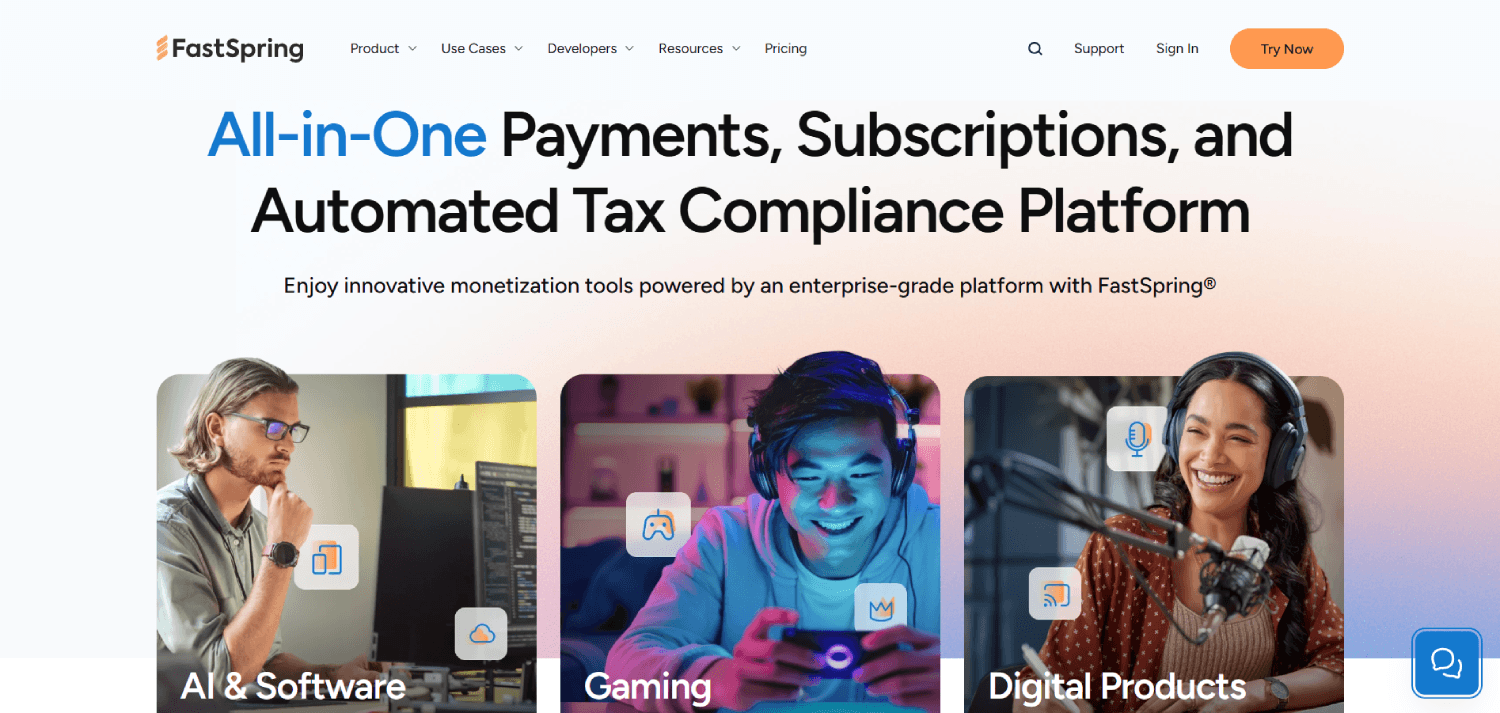
FastSpring has been a quiet workhorse for B2B software companies selling to enterprise buyers globally. It supports net terms, purchase order workflows, and multi-currency invoicing natively. FastSpring acts as the MoR and remits taxes across a wide range of jurisdictions, which removes the compliance burden from the seller entirely.
The platform’s enterprise invoicing module allows sellers to customize invoice layouts, add PO reference numbers, and configure payment due dates. FastSpring’s settlement to the vendor happens on a fixed schedule rather than tied to buyer payment, which matters for cash flow planning. It fits mid-market SaaS companies selling five-to-six-figure annual contracts where the buyer base is geographically spread.
3. Cleverbridge
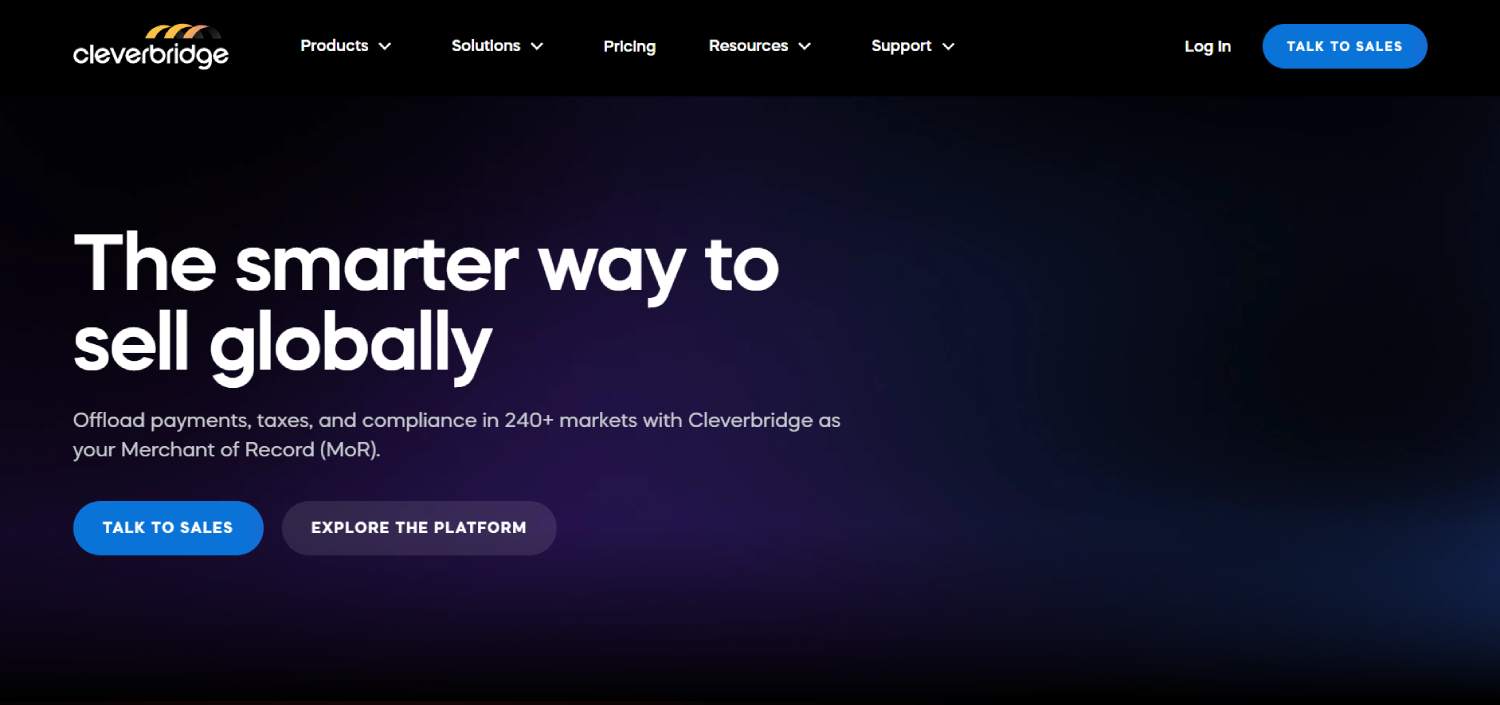
Cleverbridge is purpose-built for enterprise software and SaaS revenue management. It handles subscription billing, one-time licenses, and enterprise contracts, and it has deeper PO and net terms support than most generalist MoR platforms. Cleverbridge handles tax compliance across over 200 countries and territories and has dedicated support for German, Japanese, and US enterprise procurement workflows, which are among the most demanding.
Cleverbridge is not self-serve to implement. Onboarding involves a contract negotiation and a dedicated implementation team. For SaaS companies doing real enterprise volume with complex contract structures, that investment tends to pay back quickly. Pricing is not public; it is based on revenue volume and contract complexity.
4. Digital River
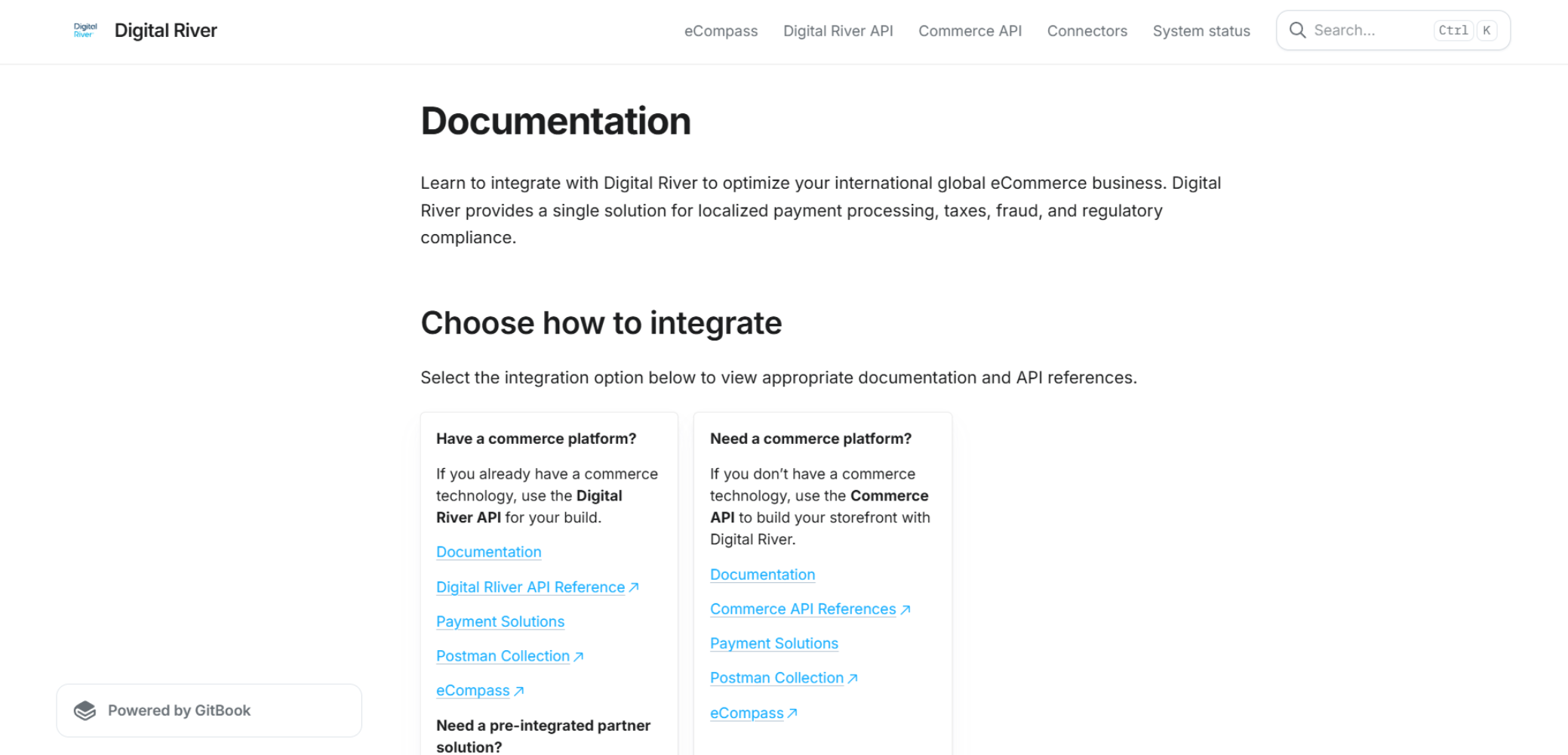
Digital River is one of the oldest enterprise MoR providers and arguably the most complete for global enterprise compliance. It supports net terms, purchase order billing, and invoicing in over 170 currencies. Digital River’s tax infrastructure covers VAT, GST, and US sales tax with dedicated compliance teams in each region.
The platform’s age shows in its integration experience. Connecting Digital River to a modern SaaS stack requires more engineering work than newer platforms, and the UI reflects an enterprise-software era that predates current design standards. For large SaaS vendors selling to regulated industries like defense, healthcare, or government, Digital River’s compliance depth often outweighs those friction points.
5. 2Checkout (Verifone)
2Checkout, now operating under the Verifone brand, supports global payments, MoR tax handling, and invoice-based billing for subscription and license models. It processes transactions in over 200 countries and supports 45-plus payment methods. For net terms, 2Checkout supports invoice payment with configurable due dates, though its enterprise PO workflow is less documented than Cleverbridge or Digital River.
2Checkout fits companies that need broad geographic payment method coverage alongside MoR tax handling. Its recurring billing engine handles upgrades, downgrades, proration, and annual renewals cleanly. Pricing is transaction-based with enterprise plans available on request through their sales team.
6. PayPro Global
PayPro Global targets SaaS and software companies specifically and offers full MoR services including tax compliance, subscription billing, and global payments. For enterprise buyers, PayPro Global supports invoice generation, net terms configuration, and purchase order reference fields on invoices.
PayPro Global’s differentiation is in its localization depth. It supports local payment methods in markets that larger platforms deprioritize, and its team has experience with enterprise procurement in Eastern Europe, Latin America, and Southeast Asia. Pricing is not publicly listed in detail; the company offers custom quotes based on volume.
7. Maxio (formerly SaaSOptics + Chargify)
Maxio occupies a distinct position on this list: it is not a pure MoR platform, but it handles enterprise SaaS billing with net terms, PO-backed invoicing, and subscription lifecycle management at a depth that pure MoR platforms rarely match. For companies that want to remain the merchant of record themselves while outsourcing billing complexity, Maxio is the strongest option here.
Net 30, 60, and 90 terms are configurable per customer. Invoices support custom fields for PO numbers, contract IDs, and line-item descriptions. Maxio integrates with Salesforce, HubSpot, NetSuite, and QuickBooks. The distinction from a full MoR is that Maxio does not handle tax remittance or seller-of-record liability. Companies using Maxio still need a separate tax layer, typically Avalara or TaxJar. Teams weighing this kind of billing-layer approach against full MoR coverage will find relevant context in FintechSpecs’ review of Stripe billing alternatives for usage-based pricing, which examines how these platforms handle subscription complexity independently of compliance liability.
8. Chargebee
Chargebee is a subscription billing platform with strong enterprise invoicing capabilities. Like Maxio, it is not a full MoR by default, but its invoice workflows handle PO numbers, net terms from 0 to 90 days, multi-currency billing, and customer-level payment terms without customization. Chargebee integrates with Avalara for tax compliance, which partially closes the MoR gap.
Chargebee’s enterprise tier supports quote-to-cash workflows, approval chains for invoices, and credit note handling. For B2B SaaS teams with a heavy sales-assisted motion, Chargebee’s CPQ (configure, price, quote) integration with Salesforce reduces the gap between signed contract and issued invoice to hours rather than days.
9. Stripe with Stripe Tax and Revenue Recognition
Stripe is not a merchant of record by default. When a company processes through Stripe, the company remains the seller of record and retains full tax liability. Stripe Tax, their add-on product, automates tax calculation and, for some jurisdictions, handles registration and remittance. Stripe Invoicing supports net terms, PO fields, and multi-currency billing.
The caveat for enterprise use is meaningful. Stripe Tax does not cover every jurisdiction that a full MoR handles, and Stripe itself will not stand as the legal seller on your invoices. For US-centric SaaS companies selling primarily to US enterprise buyers where tax complexity is manageable, Stripe’s stack is powerful and integrates deeply with a modern GTM and ERP setup. For global enterprise deals with VAT complexity, a dedicated MoR like Paddle or Cleverbridge is the more defensible choice. How Stripe compares to MoR-first platforms across dimensions like tax coverage and settlement timing is examined in detail in FintechSpecs’ Stripe vs Adyen analysis for B2B SaaS.
10. Zoho Books + Zoho Commerce
Zoho Books with Zoho Commerce is the lightest-weight option on this list and is appropriate only for smaller enterprise accounts or companies in early stages of building out a B2B sales motion. Zoho Books handles invoicing with configurable net terms, multi-currency support, and PO reference fields. Tax compliance requires manual setup or integration with a third-party tax engine.
Zoho does not function as a merchant of record. It is an accounts receivable and invoicing layer, not a global compliance platform. Its inclusion here reflects that many seed-to-Series A SaaS companies use it as a bridge while building volume toward a platform like Paddle or Cleverbridge. At that stage, the cost of a full MoR often does not match revenue complexity, and Zoho handles the basics without heavy implementation cost.
Feature Comparison Table: Net Terms, PO Support, Invoice Customization, and Tax Handling
| Platform | Full MoR | Net Terms | PO Support | Invoice Customization | Global Tax Handling | Pricing Model |
|---|---|---|---|---|---|---|
| Paddle | Yes | Yes (configurable) | Partial | Moderate | 200+ countries | % of revenue |
| FastSpring | Yes | Yes | Yes | High | 100+ jurisdictions | % of revenue |
| Cleverbridge | Yes | Yes | Yes (deep) | High | 200+ countries | Custom / negotiated |
| Digital River | Yes | Yes | Yes | High | 170+ currencies | Custom / negotiated |
| 2Checkout (Verifone) | Yes | Yes (configurable) | Partial | Moderate | 200+ countries | % of revenue + tiers |
| PayPro Global | Yes | Yes | Yes | Moderate | Wide (custom) | Custom / volume-based |
| Maxio | No (billing layer) | Yes (0-90 days) | Yes | High | Requires Avalara/TaxJar | Tiered SaaS pricing |
| Chargebee | No (billing layer) | Yes (0-90 days) | Yes | High | Requires Avalara add-on | Tiered SaaS pricing |
| Stripe (+ Tax) | No | Yes | Yes | High (via API) | Partial (Stripe Tax) | % per transaction |
| Zoho Books | No | Yes | Yes | Moderate | Manual / limited | Flat monthly SaaS |
How Do Net Terms Actually Work in an Enterprise MoR Context?
Net 30 means the buyer has 30 days from the invoice date to pay in full. Net 60 gives 60 days. The buyer’s procurement team often dictates these terms based on their internal accounts payable cycle, not as a negotiating favor. When a large enterprise says “we pay net 60,” that is a hard constraint on their AP system.
For a SaaS company using a full MoR like Paddle or Cleverbridge, the settlement model determines your cash reality. If the MoR pays you on a fixed schedule regardless of when the buyer pays, you get predictable cash flow but the MoR charges accordingly for absorbing that float. If the MoR remits after the buyer settles, your cash flow mirrors the buyer’s payment behavior, including late payments.
To make the mechanics concrete: consider a Series B SaaS company that closes a $180,000 annual contract with a US healthcare system. The buyer issues a PO, expects a net 60 invoice, and their AP cycle means actual payment lands on day 72. Under a fixed-settlement MoR, the vendor might receive funds within 10 to 15 business days of invoice issuance, paying a 1 to 3 percent float fee. Under a pass-through model, they wait 72 days. At $180,000, that timing gap has real working capital consequences for a company doing under $5M ARR, the kind of consequence that does not appear in a feature comparison but shows up on the bank statement. This is an illustrative scenario rather than a case study, but the structure of the problem applies broadly across enterprise SaaS billing. The FintechSpecs review of hidden costs compressing fintech SaaS margins details how billing and payment infrastructure choices create exactly these kinds of below-the-line surprises.
The practical implication: when comparing MoR platforms on pricing, always model the settlement timing alongside the fee percentage. A platform charging 5 percent with 10-day settlement may cost less in real terms than one charging 3.5 percent with pass-through settlement on a net 60 book of business.
Which Enterprise MoR Platforms Handle Global Tax Best?
Tax handling is where the gap between platforms becomes concrete rather than theoretical. A full MoR registers in each jurisdiction as the seller, calculates the correct tax rate at the transaction level, collects it from the buyer, and remits it to the relevant authority. The SaaS vendor sees none of that complexity.
Digital River and Cleverbridge have the deepest enterprise tax infrastructure on this list. Both have dedicated compliance teams per region and handle edge cases like B2B reverse-charge VAT in the EU, Japanese consumption tax, and Canadian GST/HST by province. FastSpring covers a broad range of jurisdictions and is more accessible for mid-market teams that do not have a tax attorney on staff.
Paddle’s tax coverage is wide in terms of countries listed, but the depth of its compliance documentation for complex enterprise scenarios is thinner than what Cleverbridge publishes. For a SaaS company selling primarily into the US, EU, and UK enterprise market, Paddle handles it cleanly. For a company with meaningful revenue in Japan, South Korea, Brazil, or India, the question is worth a direct conversation with Paddle’s enterprise team before committing.
Platforms like Chargebee and Maxio that require a separate tax engine give you more flexibility but also more integration surface area to maintain. If Avalara updates its tax rates and there is a sync delay, your invoices carry incorrect tax. That is a compliance risk the MoR model exists specifically to eliminate. Teams assessing the full compliance exposure that comes with managing their own tax layer will find the FintechSpecs breakdown of compliance costs by company stage a useful reference alongside this platform comparison.
What Should an Enterprise SaaS Team Look for Beyond Feature Lists?
Feature parity across this category is closer than it appears on comparison pages. The differences that actually drive platform selection in enterprise deals tend to be operational, not technical.
Buyer-side recognizability matters more than most SaaS finance teams expect. Enterprise accounts payable teams receive invoices from hundreds of vendors. When an invoice shows “Paddle BV” or “Cleverbridge Inc.” as the seller rather than the SaaS vendor’s name, the AP team sometimes routes it as an unknown vendor. Some MoR platforms offer white-label invoicing or co-branded invoice formats to reduce that friction. Confirm this before signing a contract.
Implementation timelines also vary significantly. Paddle and Chargebee can typically be integrated by an engineering team in a matter of days to a few weeks for standard setups. Cleverbridge and Digital River enterprise implementations often take 60 to 90 days and require dedicated project management on both sides. For companies mid-deal with a large enterprise buyer, that timeline can be a deal-breaker.
Finance teams evaluating this category should also think about how the MoR decision intersects with their broader payment infrastructure choices. The FintechSpecs review of payment infrastructure tools for SaaS founders provides context on how MoR platforms sit within the larger payments stack, including how they interact with payment orchestration and payout layers that enterprise billing decisions often touch.
Frequently Asked Questions
What does a merchant of record do for enterprise SaaS companies?
A merchant of record is the legal entity that processes the sale, collects payment, remits taxes to the relevant tax authority, and takes on liability for chargebacks and refunds. For enterprise SaaS, this means the MoR handles VAT, GST, and US sales tax compliance across multiple jurisdictions, generates compliant invoices, and absorbs the compliance burden so the SaaS vendor can focus on the product. The vendor receives net revenue after the MoR’s fees.
Can a merchant of record platform support purchase order workflows?
Yes, but not all of them do this well. Cleverbridge, Digital River, FastSpring, and PayPro Global have documented PO support where the buyer’s PO number appears on the invoice and triggers the net terms cycle. Platforms like Paddle and 2Checkout have PO reference fields but fewer native workflows for PO-backed deal approvals. Billing-layer platforms like Chargebee and Maxio have mature PO workflows but require a separate tax engine to achieve full MoR-equivalent compliance.
How do net 30, 60, and 90 terms work when using a merchant of record?
When an enterprise buyer requests net 60, the MoR issues an invoice dated on the contract start date or delivery date with payment due 60 days later. The MoR either pays the SaaS vendor on a fixed internal schedule (absorbing the float risk for a fee) or remits after the buyer pays (passing the float risk to the vendor). Which model applies depends on the MoR platform and the terms in your vendor agreement. Always confirm settlement timing before comparing platforms on price alone.
Is Stripe a merchant of record for enterprise SaaS?
Stripe is not a merchant of record by default. When you process payments through Stripe, your company remains the seller of record and retains full tax liability. Stripe Tax automates tax calculation and handles remittance in some jurisdictions, which closes part of the compliance gap. For US-focused enterprise SaaS with manageable tax exposure, Stripe plus Stripe Tax plus Stripe Invoicing covers most use cases. For global enterprise deals with VAT obligations in the EU, UK, Australia, or Canada, a platform that acts as the legal seller of record provides more complete protection.
What is the difference between a merchant of record and a billing platform like Chargebee or Maxio?
A merchant of record is a legal entity that stands as the seller in a transaction and handles tax remittance, chargeback liability, and regulatory compliance. Chargebee and Maxio are billing and subscription management platforms that automate invoice generation, net terms, revenue recognition, and subscription lifecycle management. They do not assume the seller-of-record role or remit taxes on your behalf without a third-party integration. For full MoR coverage, you need a platform like Paddle, FastSpring, or Cleverbridge.
How much does an enterprise merchant of record platform cost?
Most full MoR platforms price on a percentage of revenue processed, typically in the range of 3.5 to 9 percent depending on volume, contract terms, and the complexity of jurisdictions covered. Cleverbridge and Digital River negotiate custom pricing for enterprise accounts and do not publish rate cards. Billing-layer platforms like Chargebee and Maxio charge flat monthly SaaS fees based on revenue under management, typically starting at a few hundred dollars per month and scaling to several thousand for enterprise tiers. Stripe charges per-transaction fees plus Stripe Tax as an additional line item.
What is reverse-charge VAT and which MoR platforms handle it?
Reverse-charge VAT is a mechanism in the EU where a B2B buyer accounts for VAT themselves rather than paying it to the seller. This applies when a SaaS company sells to a VAT-registered business in another EU country. The MoR must correctly identify when reverse-charge applies, zero-rate the invoice, and include the buyer’s VAT ID and a reverse-charge statement. Cleverbridge and Digital River handle this natively. Paddle handles it in its standard EU tax flow. Stripe Tax supports reverse-charge scenarios but requires correct configuration on the seller’s side.
Which enterprise MoR platform is best for SaaS companies selling into Japan?
Japan has specific invoicing requirements under its Qualified Invoice System (introduced in 2023) and consumption tax rules that differ from standard VAT frameworks. Cleverbridge has explicit documentation and compliance support for Japanese enterprise procurement. Digital River also handles Japan with dedicated regional expertise. Paddle covers Japan in its tax remittance network but has less published documentation on Japan-specific enterprise invoice formatting. Any SaaS company with material Japanese enterprise revenue should confirm Japan invoicing compliance directly with the platform before signing.
The Platform Selection Decision Comes Down to One Axis
The real split in this category is not between good and bad platforms. It is between platforms that treat enterprise invoicing as a configuration option and platforms where enterprise invoicing is the core product. Cleverbridge and Digital River were built for enterprise software distribution and have had to solve PO workflows, net terms settlement, and global tax for decades. Paddle and FastSpring started closer to the developer checkout market and have built upmarket from there. That origin shapes how each platform handles edge cases.
For SaaS companies below $5M ARR with a small number of enterprise deals, Paddle or FastSpring typically offer the best balance of MoR compliance coverage and implementation speed. For companies above $10M ARR with enterprise contracts as a primary revenue driver, Cleverbridge or Digital River’s depth becomes worth the longer onboarding and higher minimum fees. Billing-layer platforms like Chargebee and Maxio make sense when the company wants to control the seller-of-record role and has the tax infrastructure in place to back it up. Companies scaling through that transition can find useful benchmarks in the FintechSpecs fintech SaaS scale checklist for reaching $10M ARR.
One final point that gets overlooked: the MoR you choose affects how your enterprise buyers experience your brand on every invoice. When a $200,000 contract invoice comes from “Cleverbridge Inc.” instead of your company name, procurement teams sometimes treat it as a third-party vendor relationship rather than a direct software purchase. That friction is solvable with co-branded invoicing, but only if you negotiate it upfront. White-label invoicing availability should be on your checklist before you sign any MoR contract at the enterprise tier.