
- Standard SEO rank trackers miss where fintech buyers are increasingly making decisions: AI-generated answers in ChatGPT, Perplexity, Gemini, and Google AI Overviews.
- The platforms on this list track citation frequency, brand sentiment, competitor co-mentions, and answer accuracy across multiple AI models simultaneously.
- Fintech has higher stakes than most categories: a single AI hallucination about your compliance status or fee structure can poison a sales cycle before it starts.
- Pricing across these platforms ranges from $29/month for entry-level monitoring to custom enterprise contracts, with meaningful capability gaps at each tier.
- The FintechSpecs AI Visibility Stack framework (defined below) gives you a structured way to evaluate any tool against fintech-specific requirements before you sign.
The nine best AI visibility tracking platforms for fintech companies are Otterly, Peec AI, SE Ranking, Morningscore, Nightwatch, ZipTie, Conductor, SEMrush, and BrandMentions. Each monitors how ChatGPT, Perplexity, Gemini, and Google AI Overviews describe your brand, cite your products, and position you against competitors. For fintech companies specifically, the right choice depends on whether you need compliance-sensitive sentiment tracking, multi-model citation coverage, or integration with existing SEO workflows. Choosing the right AI visibility tracking platform for fintech starts with knowing what each tool actually measures.
Why Do Fintech Companies Need AI Visibility Tracking Separately From SEO?
A fintech company can rank #1 on Google for “best business checking account” and still be completely absent from the answer ChatGPT gives when a CFO asks the same question at 9pm before a board meeting. These are two different information systems with different sourcing logic, different trust signals, and different update cycles. Treating them as the same problem is how fintech brands lose early-stage pipeline they never knew existed.
The fintech-specific risk is more acute than in other industries. When an AI model describes your product incorrectly, whether it invents a fee structure, mischaracterizes your regulatory status, or positions you as a consumer tool when you are B2B, that hallucination travels. Buyers screenshot AI answers. Sales teams get forwarded bad summaries. And unlike a bad review, an AI hallucination does not have a “reply from founder” button. You need to know it is happening before it costs you a deal.
AI search is also changing how buyers discover fintech infrastructure. As covered in how AI search is changing B2B fintech buyer behavior, early-funnel discovery is increasingly happening inside AI chat interfaces rather than on Google’s first page. If your brand does not appear in AI-generated shortlists for queries like “best ACH API for SaaS” or “compliance-ready BaaS providers,” you are losing consideration before the buyer ever visits your site.
What Is the FintechSpecs AI Visibility Stack Framework?
Before evaluating individual tools, fintech marketers need a consistent framework for what they are actually measuring. Most GEO platform comparisons conflate four distinct capabilities that serve different strategic purposes. The FintechSpecs AI Visibility Stack breaks these into four layers:
- Citation Presence: Does your brand appear at all in AI-generated answers for your target queries? This is the baseline. Without it, everything else is noise.
- Sentiment Accuracy: When your brand is cited, is the characterization accurate? For fintech, this means checking whether AI models correctly describe your licensing, fee structure, supported markets, and product category.
- Competitor Co-mention Position: In answers that name multiple providers, where does your brand appear? First mention carries different weight than a parenthetical afterthought at the end of a list.
- Answer Drift: How does AI coverage of your brand change over time as models update? A platform that only shows you today’s snapshot without historical comparison cannot tell you whether your GEO efforts are working.
Any tool worth paying for should address at least two of these four layers. A tool that only tracks citation presence without sentiment or position context is giving you a vanity metric, not intelligence you can act on. Use this framework to interrogate demos before you commit.
Which AI Models Should Fintech Visibility Tracking Cover?
The minimum viable coverage for a fintech brand in 2025 is four models: ChatGPT (OpenAI), Perplexity, Gemini (Google), and Google AI Overviews. Each has different sourcing behavior and reaches different audience segments.
ChatGPT has the broadest enterprise adoption for research tasks. When a VP Finance asks “which embedded banking providers support multi-tenant architectures,” they are often doing it in ChatGPT. Perplexity skews toward technically sophisticated users and cites sources inline, which means citation placement is traceable. Gemini is deeply integrated into Google Workspace, making it relevant for buyers who do research inside the tools they already use daily. Google AI Overviews appear at the top of organic search results and represent the highest-volume AI touchpoint for most fintech categories.
Some platforms also track Claude (Anthropic), Meta AI, and Copilot (Microsoft). For B2B fintech, Copilot coverage matters if your buyers are enterprise organizations using Microsoft 365. For most seed-to-Series B fintechs, the four primary models are sufficient to start.
What Are the 9 Best AI Visibility Tracking Platforms for Fintech Companies?
| Platform | Starting Price | AI Models Covered | Best For | Fintech-Specific Strength |
|---|---|---|---|---|
| Otterly | $29/mo | ChatGPT, Perplexity, Gemini, Claude | Early-stage fintechs, lean marketing teams | Low barrier to entry, prompt library |
| Peec AI | Not publicly disclosed | ChatGPT, Perplexity, Gemini | Marketing teams needing simplified multi-model tracking | Dashboard simplicity for non-technical users |
| SE Ranking | Varies by plan | Perplexity, AI Overviews | Fintechs already using SE Ranking for SEO | Perplexity citation tracking with source attribution |
| Morningscore | Varies by plan | ChatGPT | Teams starting with ChatGPT rank tracking | Focused ChatGPT tracking, gamified interface |
| Nightwatch | Varies by plan | ChatGPT, Perplexity, Gemini, Google AIO | Marketers wanting unified SEO and AI search monitoring | Cross-channel visibility in one report |
| ZipTie | $250/mo (per public pricing page) | Multiple LLMs including technical models | Technical fintech teams analyzing LLM retrieval logic | LLM data retrieval analysis, API access |
| Conductor | Custom pricing | Google AIO, multiple models | Large financial institutions, distributed content teams | Enterprise workflow integration, team permissions |
| SEMrush | $199/mo (per public pricing page) | Google AIO, ChatGPT (via integrations) | Fintechs already paying for SEMrush’s broader platform | AI Overviews tracking alongside organic position data |
| BrandMentions | Varies by plan | Multiple AI sources and web monitoring | Fintech brands tracking reputation across both AI and web | Broad mention monitoring including AI-generated content |
Otterly: Best for Early-Stage Fintechs Watching Budget
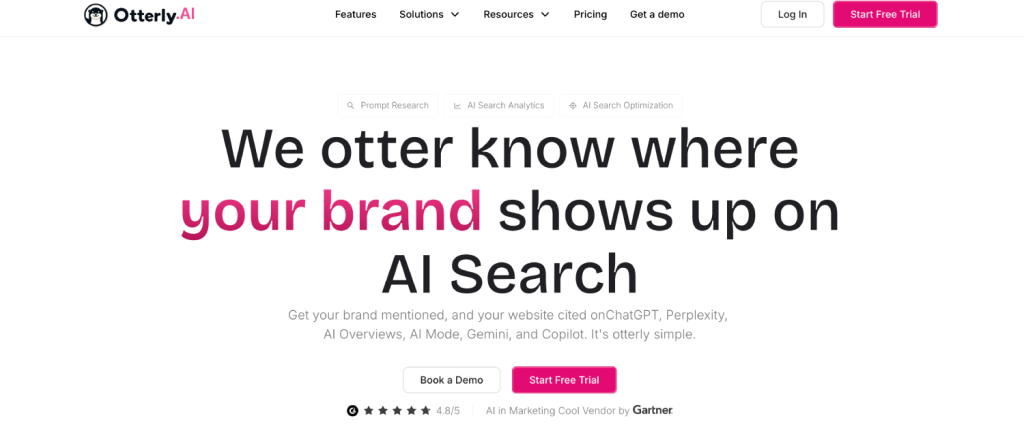
At $29/month, Otterly is the lowest-cost entry point on this list with genuine multi-model coverage. It tracks brand mentions and citations across ChatGPT, Perplexity, Gemini, and Claude, and lets you build a library of prompts that mirror the queries your buyers are actually typing. For a seed-stage fintech with a two-person marketing function, that is often enough to establish a baseline and spot obvious hallucinations before they spread.
The trade-off is depth. Otterly surfaces citation presence well, but it does not give you the co-mention positioning analysis or historical drift tracking that a Series B company running a formal GEO program needs. Use it to learn what AI models are saying. Graduate to something more structured when you need to prove that your content changes are actually moving the needle.
Peec AI: Best for Marketing Teams Who Do Not Want to Learn a New Tool
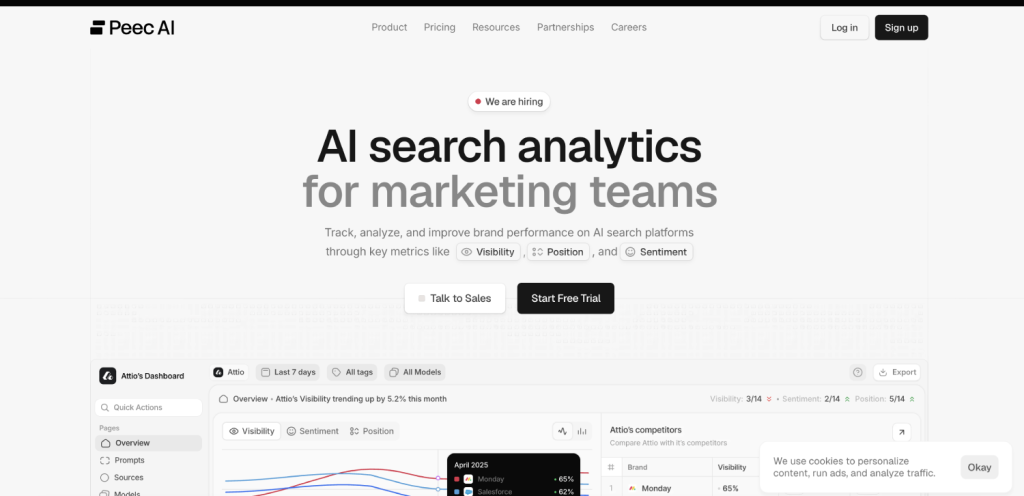
Peec AI positions itself as an AI search analytics platform built for marketing teams, not data teams. According to information surfaced in the Gauge platform roundup, the interface is designed to minimize the learning curve for people who need to monitor visibility across ChatGPT, Perplexity, and Gemini without becoming AI infrastructure experts. For fintech marketing teams where the person running GEO also owns paid, content, and email, that matters.
Peec AI does not publicly list pricing, so you will need to request a demo to get a number. Factor in that ambiguity when comparing against Otterly’s transparent $29/month. Opaque pricing structures are common in this category because platforms are still figuring out what the market will bear.
SE Ranking: Best for Perplexity Citation Tracking With Source Attribution
SE Ranking added AI visibility monitoring to its existing SEO platform, and the Perplexity tracking module is its strongest differentiator. Because Perplexity cites sources inline, SE Ranking can show you not just whether your brand appears in a Perplexity answer but which specific URL was cited. For fintech companies trying to understand which content assets are earning AI citations, that distinction is significant. Pricing varies by plan and is not listed at a single flat rate on SE Ranking’s public pricing page.
If you are already paying for SE Ranking’s SEO features, the AI monitoring addition is a natural expansion rather than a separate budget line. If you are not, buying SE Ranking purely for AI visibility tracking is probably not the right economic decision when Otterly or Nightwatch cover similar ground at a lower entry cost.
Morningscore: Best for Teams Starting With ChatGPT Rank Tracking Specifically
Morningscore built ChatGPT tracking as a focused feature rather than a full AI visibility suite. Pricing varies by plan and is not listed at a flat public rate. The platform’s gamified interface, which turns SEO and AI tracking into something resembling a progress dashboard, is polarizing. Some marketing teams find it motivating. Others find it distracting when they are trying to pull data for a board deck.
The coverage limitation is the honest constraint: Morningscore’s AI tracking has historically focused on ChatGPT rather than offering true multi-model coverage. For fintech brands, that means you are missing Perplexity and Gemini data, which represent real buyer touchpoints especially for technical and enterprise audiences.
Nightwatch: Best Unified View of SEO and AI Search in One Report
Nightwatch covers ChatGPT, Perplexity, Gemini, and Google AI Overviews alongside traditional rank tracking, and packages them into shared reporting. That unified view is the practical argument for choosing it over a dedicated AI-only tool: your content team can see whether a page that ranks #4 organically is also getting cited by Perplexity, or whether it exists in neither channel. That cross-channel visibility is harder to replicate when you are stitching together data from two separate platforms.
Pricing varies by plan and is not publicly listed at a single flat rate. The company markets itself toward marketers who need consolidated reporting rather than toward technical teams who want API access to raw LLM data. ZipTie serves that technical audience better.
ZipTie: Best for Technical Teams Who Want to Understand LLM Retrieval Logic
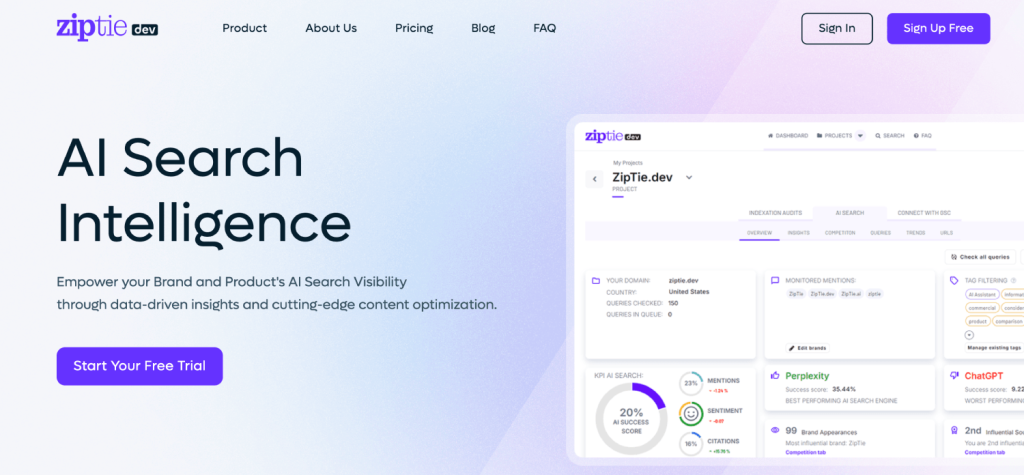
At $250/month per their public pricing page, ZipTie costs more than most of the other options on this list. The price differential is justified for one specific use case: understanding why an AI model is or is not citing you, not just whether it is. ZipTie is built for technical users who want to analyze the retrieval mechanisms behind LLM outputs, which matters when your engineering or product team is the one responsible for fixing the underlying content and structure issues.
For a fintech company where the marketing function does not have engineering support, ZipTie is probably overkill. For a company that has already identified specific AI citation gaps and needs to diagnose root causes, the API access and retrieval analysis justify the cost. This is a specialist tool, not a starting point.
Conductor: Best for Large Financial Institutions With Distributed Teams
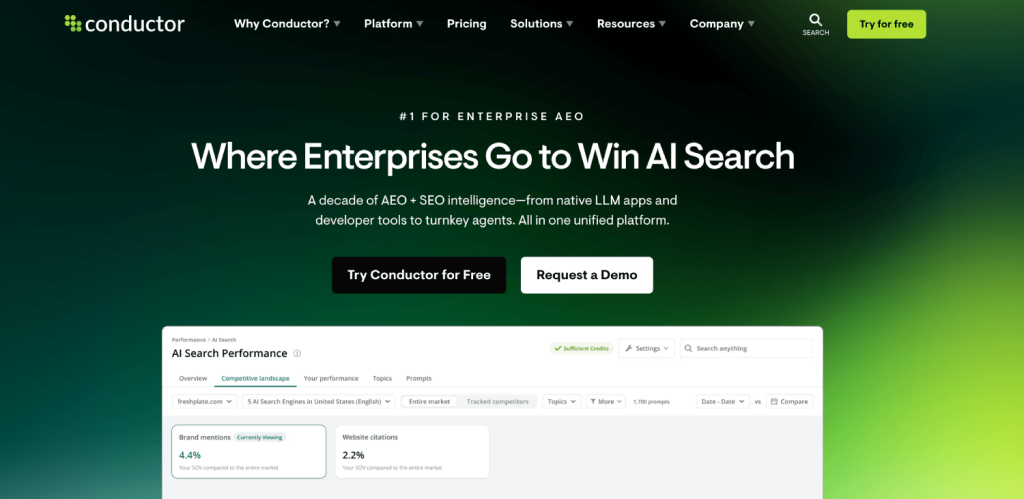
Conductor is an enterprise content intelligence platform that has added AI Overviews tracking to its existing suite. The differentiator is organizational: Conductor is built for companies with distributed content teams, editorial workflows, and complex permission structures. A regional bank with a 20-person content team across four divisions will get more operational value from Conductor’s workflow tooling than from a platform designed for a single marketer running 50 prompts per week.
Pricing is custom and negotiated, which is standard for enterprise software. If you are a startup, the sales cycle alone may not be worth it. Conductor’s sweet spot is established financial institutions that already have content operations at scale and need AI visibility woven into existing workflows rather than bolted on separately.
SEMrush: Best If You Are Already Paying for the Platform
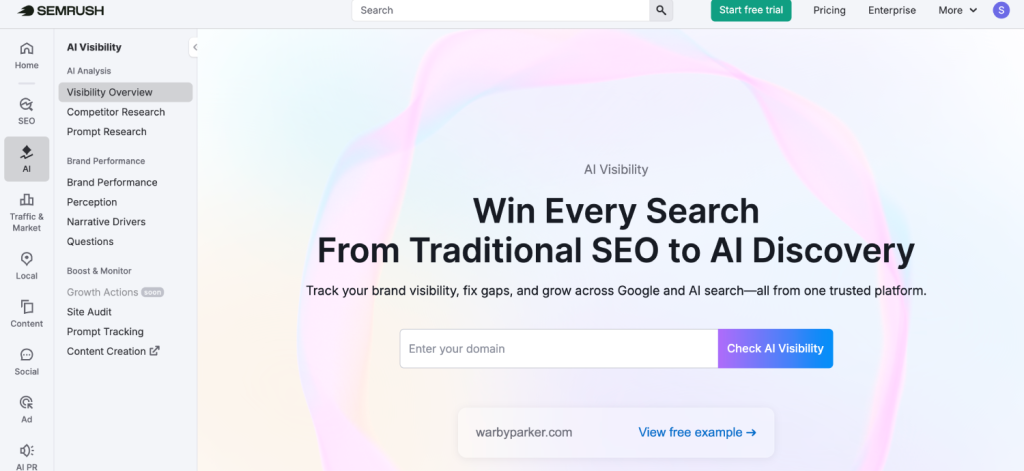
SEMrush at $199/month per their public pricing page includes AI Overviews tracking alongside its broader organic search suite. The AI visibility features are not its primary value proposition, but for a fintech team already using SEMrush for keyword research, competitive analysis, and backlink tracking, the AI Overviews data becomes a practical addition without adding a new vendor relationship. The catch is that SEMrush’s AI monitoring is most developed around Google AI Overviews and less comprehensive for ChatGPT and Perplexity compared to dedicated platforms like Nightwatch or SE Ranking.
Do not buy SEMrush for AI visibility tracking alone. Buy it if you need a full SEO platform and want AI monitoring included. The economics only work in that direction.
BrandMentions: Best for Tracking AI-Generated Content Alongside Web Reputation
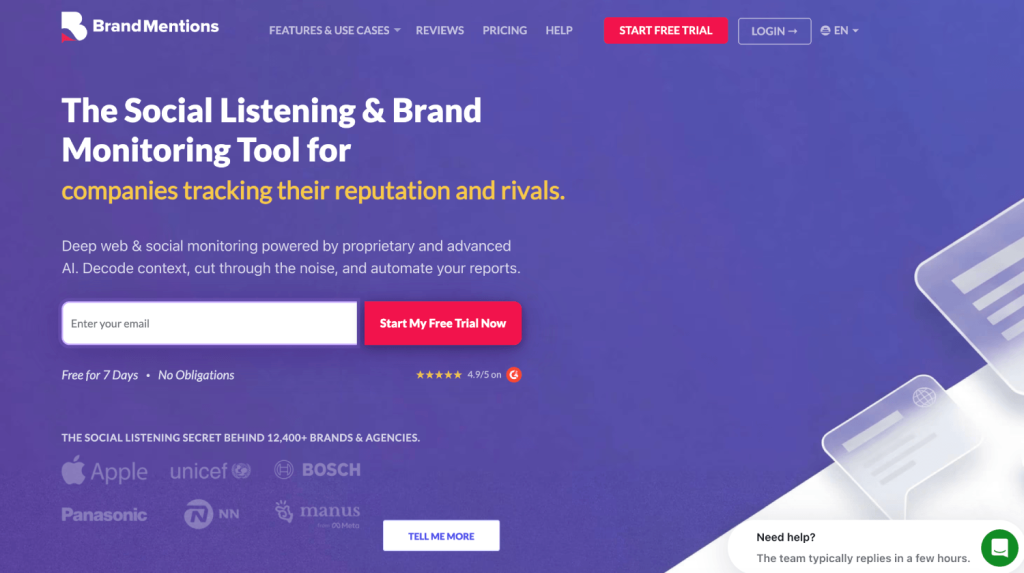
BrandMentions takes a broader approach than most tools on this list: it monitors brand mentions across the web, social platforms, and AI-generated content simultaneously. For fintech companies that are managing reputation across multiple surfaces simultaneously, that consolidated view has real utility. Knowing that your brand is being described positively in Perplexity answers but negatively in AI-generated blog content that surfaces in search gives you a more complete picture than any single-surface tool provides. Pricing varies by plan and is not listed at a flat public rate.
The trade-off is focus. Platforms purpose-built for AI search monitoring will give you deeper model-specific data than BrandMentions, which treats AI as one channel among many. Choose it when your brand monitoring need is broad. Choose something more focused when AI citation strategy is the primary objective.
What Should Fintech Companies Look For Beyond Basic Citation Tracking?
Most platforms in this category will tell you whether your brand appeared in an AI answer. Fewer will tell you something useful about what to do next. Four capabilities separate genuinely useful AI visibility platforms from dashboard vanity generators.
First, prompt customization matters enormously. The queries a fintech company needs to track are different from a retail brand’s. You need to be able to input the exact phrases your buyers use: “best BaaS provider for card issuing,” “compliance-ready payment infrastructure for fintech,” “ACH API with same-day settlement.” Platforms that only let you track your brand name without controlling the prompt context are giving you an incomplete picture. Understanding how to structure content so ChatGPT actually cites your brand starts with knowing which prompts you need to appear in.
Second, competitor co-mention tracking tells you something citation tracking alone cannot: your relative position in AI-generated competitive comparisons. When a buyer asks “compare the top ACH payment APIs,” the AI generates a list. Your presence, position on that list, and the language used to describe you versus competitors are all signals worth tracking. Most platforms offer this, but the prompt scope and update frequency vary significantly.
Third, historical tracking lets you measure whether your GEO investments are working. A snapshot of today’s AI answers is informative once. A 90-day trend line showing that your citation rate in ChatGPT answers about embedded finance APIs went from 12% to 34% of tracked queries is a result you can defend in a budget conversation. Platforms that only show current state without historical comparison make it impossible to demonstrate ROI.
Fourth, alert systems matter more for fintech than for most categories. If an AI model starts describing your product with inaccurate compliance language, or starts recommending you for a use case you do not support, you want to know within days, not quarters. This connects directly to the broader challenge of generative engine optimization for fintech SaaS, where content strategy and monitoring have to work together.
How Much Should Fintech Companies Budget for AI Visibility Tracking?
The honest answer is that this category is still pricing itself. Based on publicly available pricing from the platforms listed above, the range runs from $29/month (Otterly) to $250/month (ZipTie) for self-serve plans, with SEMrush’s $199/month sitting in the middle as a bundled option. Enterprise platforms like Conductor do not publish pricing.
Consider a specific scenario: a Series A fintech company with $8M raised, a three-person marketing team, and a primary product category facing five direct competitors. That team needs multi-model coverage (minimum ChatGPT, Perplexity, Gemini, and Google AIO), competitor co-mention tracking for those five competitors, and enough prompt slots to cover 30 to 50 target queries monthly. Otterly at $29/month likely covers the prompt volume but may not have the competitor co-mention depth they need. Nightwatch or SE Ranking’s mid-tier plans would be more appropriate, even at a higher monthly cost. ZipTie at $250/month is hard to justify until that team has a technical resource to act on the retrieval-level data.
A fintech company already investing in a GEO agency for fintech SaaS may find that the agency includes platform access as part of the engagement, which changes the calculus. In that case, the agency’s chosen platform matters more than your independent tool selection.
FAQ: AI Visibility Tracking for Fintech Companies
How do you track ChatGPT rankings for a fintech brand?
You run structured prompts representing your target buyer queries through a monitoring platform that queries ChatGPT via API and records whether your brand appears, where it appears, and how it is described. Tools like Otterly, Morningscore, and Nightwatch automate this process. You define the prompts, set the tracking frequency, and the platform handles the query execution and result recording. Manual tracking by running prompts yourself is possible but not repeatable at scale.
What is the difference between AI visibility tracking and traditional SEO rank tracking?
Traditional rank tracking measures where your URL appears in a list of blue links for a given keyword. AI visibility tracking measures whether your brand or product is mentioned in a synthesized, conversational answer generated by an AI model. These are different information systems: different sources, different ranking signals, and different update mechanisms. A page that ranks #1 in Google organic search can still be absent from AI-generated answers for the same query, and vice versa. Both metrics matter for fintech brands that want full distribution coverage.
Can AI visibility tracking platforms detect hallucinations about fintech products?
Yes, with important caveats. These platforms record the actual text of AI-generated answers, which means you can read what an AI model said about your product and identify inaccuracies. However, they do not automatically flag hallucinations. Someone on your team needs to review the captured answers and compare them against your actual product specs, pricing, and compliance status. For fintech companies where accuracy is a regulatory and reputational concern, that manual review layer is not optional.
How often do AI models update their knowledge of fintech products?
This varies by model and depends on whether the platform uses retrieval-augmented generation (real-time web access) or a static training cutoff. Perplexity retrieves live web content for most queries, meaning its answers can reflect content published recently. ChatGPT’s base model has a training cutoff and may not reflect recent product changes unless web browsing is enabled. Gemini has real-time web access in most configurations. This difference matters for fintech companies that have recently changed pricing, launched new features, or updated compliance certifications.
Is tracking Perplexity visibility different from tracking ChatGPT visibility?
Structurally, yes. Perplexity cites its sources inline, which means you can trace exactly which URL was used to generate a claim about your product. ChatGPT’s base model does not consistently cite sources in the same traceable way, making it harder to know which content asset drove the citation. This makes Perplexity tracking more useful from a content optimization standpoint. SE Ranking’s Perplexity module and several other platforms are built to surface those source attributions explicitly.
Do fintech companies need separate tools for Google AI Overviews tracking?
Not necessarily. Several platforms on this list, including Nightwatch, SEMrush, and Conductor, track Google AI Overviews alongside other AI models. The reason some companies track AI Overviews separately is volume: Google AI Overviews appear at scale across organic search results, meaning they affect the highest-traffic queries in most fintech categories. If your primary concern is defending top-of-funnel organic visibility, AI Overviews tracking deserves its own attention. The full context for this is covered in how Google AI Overviews are changing fintech SEO.
What fintech content types are most likely to earn AI citations?
Structured comparison content, pricing pages with clear data, and authoritative explainers on regulatory topics tend to earn AI citations at higher rates than generic blog posts. AI models prioritize content that is specific, factual, and easy to extract clean answers from. For fintech, this means product pages that clearly state supported geographies, fee structures, and compliance certifications are more likely to be cited than vague feature overview pages. This is the core premise of content-level GEO strategy, which connects directly to the broader challenge of why fintech content is harder to produce than regular SaaS content.
How do you build a business case for AI visibility tracking investment internally?
The strongest argument is not “AI search is growing” but rather “we do not know whether AI models are describing our product accurately, and inaccurate AI descriptions are reaching buyers before they talk to us.” Frame it as a brand accuracy problem, not a marketing reach problem. Supplement that with a competitor audit: run 10 to 15 target queries through ChatGPT and Perplexity manually, record which competitors appear and how they are described, and present those findings alongside your brand’s absence or mischaracterization. That is a concrete data point that finance and executive teams can weigh against a $29 to $250/month tool cost.
How Do AI Visibility Platforms Fit Into a Broader GEO Strategy?
A tracking platform is not a strategy. It is instrumentation. The fintech companies getting real value from AI visibility monitoring are the ones who have connected the data to a content production and optimization workflow. They track which queries they are missing, audit the content that competitors are getting cited for, produce better versions of that content, and re-run the tracking cycle 30 to 60 days later to measure movement.
That workflow sits inside a broader GEO versus SEO strategic decision that fintech marketing teams are working through right now. The companies moving fastest are not choosing between SEO and GEO. They are running SEO for volume and GEO for trust, recognizing that AI-generated answers have disproportionate influence on high-intent buyers who have already done their surface-level research and are now asking AI tools to synthesize a shortlist. That is exactly the buyer who converts. For fintech teams thinking through how this fits their overall growth motion, the fintech SaaS GTM stack provides useful context on where AI visibility fits relative to other distribution channels.
The platforms on this list give you visibility into a channel that most fintech companies are currently flying blind on. The FintechSpecs AI Visibility Stack framework gives you a way to evaluate whether any given platform is actually covering the four layers that matter: citation presence, sentiment accuracy, competitor co-mention position, and answer drift over time. A tool that only checks one of those four boxes is not an AI visibility strategy. It is a notification service.