
- Stablecoin payment APIs are production-ready infrastructure, not crypto experiments. Bridge, BVNK, Circle, and a handful of others now process billions in real settlement volume.
- The provider you choose determines your corridors, your FX spread (measured in basis points, or bps, where 1 bps equals 0.01%), and whether you can actually settle in Brazil, Nigeria, or the Philippines without a local entity.
- Infrastructure providers (Bridge, BVNK, Fireblocks, Zero Hash) are not the same category as consumer checkout gateways (Coinbase Commerce, Helio). Mixing them up leads to the wrong integration.
- Licensing matters more than it did two years ago. MiCA (Markets in Crypto-Assets Regulation, the EU’s stablecoin regulatory framework) and VASP (Virtual Asset Service Provider, the licensing designation used in most non-US jurisdictions) status now determine which corridors are legally accessible.
- The cheapest spread on paper often costs more in practice once you account for settlement delays, FX conversion windows, and corridor exclusions.
The best stablecoin payment API for a fintech platform depends on where your money is going, not just which coins you want to support. For US-to-LATAM corridors, Bridge and BVNK lead on coverage and settlement speed. For USDC-native infrastructure with deep developer tooling, Circle’s Programmable Wallets API is the reference standard. For institutional custody with stablecoin rails, Fireblocks and Zero Hash are the defaults. Coinbase, Stripe, and Paxos serve different niches, and the remaining providers fill specific regional or vertical gaps.
Why Stablecoin Rails Are a Real Settlement Layer Now
Most payment engineers who have not looked at this space since 2022 still think stablecoins mean wallet addresses, manual confirmations, and crypto-native counterparties. That was accurate then. It is not accurate now.
The infrastructure layer has matured into something that looks, from an API perspective, almost identical to an ACH or SWIFT integration. You POST a payment, specify an amount and destination, and receive a settlement confirmation. The blockchain is abstracted. The end recipient often does not need a crypto wallet at all, because providers like Bridge and BVNK handle the off-ramp to local bank accounts or mobile money networks on the other side.
The meaningful difference from traditional rails is settlement finality. USDC on Solana settles in under 400 milliseconds. EURC on Base settles in seconds. A correspondent-banking wire to Brazil can take two to three business days and consume 150 to 300 bps in FX and intermediary fees. For platforms doing cross-border payouts, contractor payments, or B2B supplier settlements, the unit economics of stablecoin rails are now genuinely competitive. If you are building payment infrastructure and have not evaluated this layer, the ten most expensive fintech infrastructure mistakes frequently include exactly this gap.
Corridor and Coverage Reference Table
This table reflects publicly available documentation and announcements as of mid-2025. Coverage changes frequently. Verify corridor availability directly with each provider before building.
| Provider | US Send | LATAM | EU / UK | Africa | Asia-Pacific | Supported Stablecoins | Primary Use Case |
|---|---|---|---|---|---|---|---|
| Bridge | Yes | Strong (MX, BR, CO, AR) | Yes | Limited | Limited | USDC, USDT, EURC | Cross-border B2B payouts |
| BVNK | Yes | Yes (MX, BR, CO) | Strong (EMI licensed) | Yes (ZA, NG) | Limited | USDC, USDT, EURC, GBPT | B2B stablecoin settlement |
| Circle | Yes | Yes | Yes (MiCA licensed) | Limited | Yes | USDC, EURC | Programmable wallets, USDC infra |
| Fireblocks | Yes | Yes | Yes | Yes | Yes | USDC, USDT, PYUSD, others | Institutional custody + settlement |
| Zero Hash | Yes | Yes | Yes | Limited | Yes | USDC, USDT, PYUSD | Embedded stablecoin for fintechs |
| Paxos | Yes | Limited | Yes | Limited | Yes (SG licensed) | USDP, PYUSD (issuer) | Regulated stablecoin issuance |
| Stripe Crypto | Yes | Expanding | Yes | Limited | Limited | USDC | Fiat-to-stablecoin onramp |
| Triple-A | Yes | Limited | Yes (MAS licensed) | Limited | Strong (SG, MY, PH) | USDC, USDT, BTC | Merchant acceptance, payouts |
| Cross River | Yes | Limited | Limited | No | No | USDC | US-regulated stablecoin settlement |
| Coinbase Commerce | Yes | Limited | Yes | Limited | Limited | USDC, ETH, BTC, others | Consumer crypto checkout |
How to Compare Stablecoin API Providers Without Getting Burned: The FintechSpecs Settlement Stack Test
Most provider comparisons lead with coin support lists and developer docs quality. Both matter, but they are table stakes. The decisions that actually set your unit economics are four layers deeper. We call this the FintechSpecs Settlement Stack Test, a four-check framework for evaluating any stablecoin API before you build on it.
Check 1: Corridor Depth, Not Just Corridor Count
A provider claiming “50 countries” may mean 50 countries where a beneficiary can receive a wire after a stablecoin leg, with two to three days of correspondent banking delay on the back end. That is not a stablecoin payout. Corridor depth means local settlement: local bank account credits, mobile money delivery, or real-time payment network integration in-country. Ask each provider what the last-mile settlement mechanism is in your target corridors, and what the actual credit timeline is after blockchain confirmation.
Check 2: Spread Transparency at Volume
FX spread is the difference between the mid-market rate and what you actually receive on conversion. Stablecoin providers frequently quote “0 FX fees” while embedding 30 to 80 bps in the conversion rate. Ask for the specific spread applied on your volume tier, in writing, for each currency pair you care about. 50 bps on a $500K monthly payout volume is $2,500 per month in invisible cost. Providers that refuse to state their spread in bps before you sign a contract are not being coy. They are being evasive for a reason.
Check 3: Licensing Fit for Your Jurisdictions
MiCA (fully applicable from December 2024) requires stablecoin issuers and payment providers operating in the EU to hold specific authorizations. VASP registration is required in most non-US markets to legally facilitate stablecoin payments on behalf of clients. If you are a US-regulated fintech embedding stablecoin rails for a product that touches EU or UK users, your provider’s licensing status in those jurisdictions becomes your compliance exposure. Circle and BVNK both hold relevant EU licenses. Paxos holds a Singapore MAS license. Cross River operates under its US bank charter. Verify this yourself with each provider, because license status changes.
Check 4: Custody and Settlement Segregation
Who holds the stablecoin during transit? Some providers operate omnibus wallets where your funds are commingled with other clients’ funds until settlement. Others offer segregated wallets per client. For fintech platforms holding float on behalf of end users, the omnibus versus segregated question is not just operational. It is a regulatory one. If your provider fails, omnibus wallet clients may find themselves in a creditor queue. Segregated wallet holders have a cleaner claim. This is the same question embedded finance teams ask of BaaS providers, and the answers matter just as much here. For more on those structural questions, the hidden economics of Banking-as-a-Service covers the custody and float dynamics that apply to stablecoin rails too.
Which 10 Stablecoin Payment API Providers Actually Belong on a Fintech Shortlist?
1. Bridge
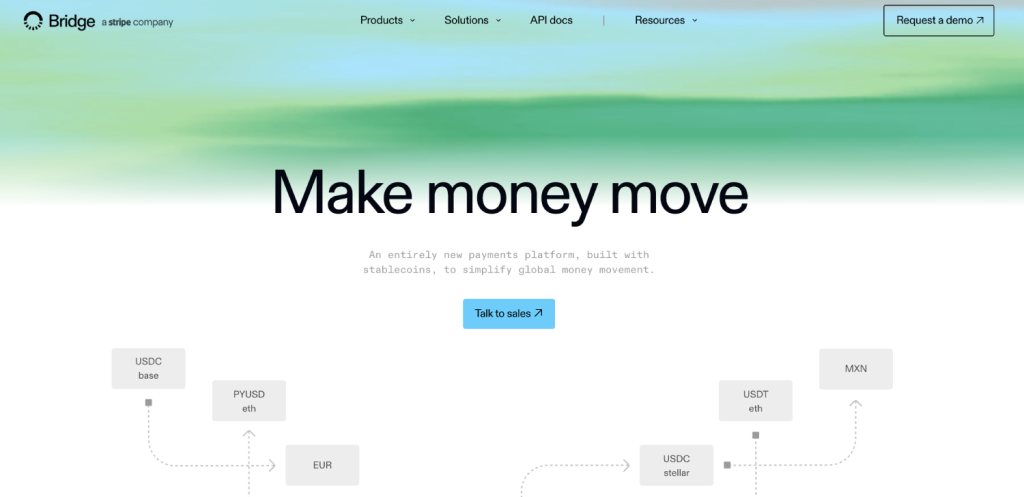
Bridge is the most-cited infrastructure provider for cross-border B2B stablecoin payouts in North America and Latin America as of 2025. Stripe acquired Bridge in late 2024, which adds a significant distribution and compliance backstop. Bridge’s API lets platforms move funds in stablecoins with on-ramp and off-ramp legs handled programmatically, including local currency delivery in Mexico, Brazil, Colombia, and Argentina.
Bridge is an infrastructure play, not a consumer checkout product. Its developer docs are oriented toward platforms building payment flows, not merchants adding a “pay with crypto” button. Settlement to local bank accounts in LATAM corridors is the core use case where Bridge outperforms alternatives. Pricing is not publicly listed and requires direct negotiation, which is typical for this tier of B2B infrastructure.
Best for: US-headquartered fintechs building LATAM payout infrastructure or contractor payment platforms needing programmatic off-ramp to local accounts.
2. BVNK
BVNK is a London-based stablecoin settlement infrastructure provider with an EU Electronic Money Institution (EMI) license and coverage across Europe, Latin America, and parts of Africa. Its API supports USDC, USDT, EURC, and GBPT, and the platform handles both stablecoin-to-fiat and fiat-to-stablecoin conversions with FX settlement.
BVNK’s differentiation is its multi-currency settlement network, which allows a single API integration to handle payouts in multiple fiat currencies via stablecoin rails. For B2B platforms with EU and LATAM exposure simultaneously, it is one of the few providers with genuine regulatory coverage in both regions. BVNK does not publicly list per-transaction pricing, but the company positions its spread competitively against correspondent banking rates.
Best for: Fintech platforms with EU regulatory requirements plus emerging-market payout corridors, particularly where EURC settlement is needed alongside USDC.
3. Circle (Programmable Wallets and USDC APIs)
Circle is the issuer of USDC and EURC, which means its API is the most direct path to native USDC infrastructure. Circle’s Programmable Wallets product lets platforms create and manage wallets for end users, send and receive USDC across multiple chains (Ethereum, Solana, Base, Avalanche, Polygon), and automate transfers via REST API.
Circle holds a MiCA license for EURC in the EU, making it one of the few providers where the coin issuer and the API provider are the same entity. This removes a trust layer that exists when you use a reseller API on top of Circle’s own infrastructure. Circle’s developer documentation is extensive, and the company’s USDC Payments API is specifically designed for B2B settlement use cases. Pricing for the API layer varies by product and volume, and Circle’s public developer docs provide onboarding guidance without publishing per-transaction fees directly.
Best for: Platforms that want native USDC infrastructure with multi-chain support and direct issuer relationship, particularly for EU corridors requiring MiCA-compliant EURC.
4. Fireblocks
Fireblocks is the dominant institutional digital asset custody and transfer network. Its stablecoin payment API sits on top of its Multi-Party Computation (MPC) custody layer, which means every transfer carries the security guarantees of institutional-grade key management. Fireblocks supports USDC, USDT, PYUSD, and a wide range of other assets across over 50 blockchains.
Fireblocks is not optimized for consumer-facing checkout or high-frequency micro-transactions. Its pricing structure (not publicly listed, contract-based) and onboarding requirements reflect an enterprise and institutional client base. For fintech platforms managing significant stablecoin treasury positions alongside payment flows, or for neobanks holding stablecoin float, Fireblocks offers a level of custody infrastructure that lighter-weight payment APIs do not replicate.
Best for: Series B and above fintechs with institutional treasury requirements, or platforms where stablecoin custody security is as important as payment throughput.
5. Zero Hash
Zero Hash is a B2B white-label stablecoin and crypto infrastructure provider specifically designed for fintechs that want to embed stablecoin functionality without building compliance and licensing themselves. Zero Hash holds money transmission licenses across US states and handles USDC, USDT, and PYUSD settlement.
Its model is explicitly infrastructure-as-a-service: a fintech platform integrates Zero Hash’s API and the end user never sees the Zero Hash brand. This is the same embedded infrastructure model familiar from BaaS, applied to stablecoin rails. Zero Hash’s compliance infrastructure handles the MTL burden at the state level, which reduces the compliance lift for early-stage fintechs. For platforms evaluating how embedded stablecoin compares to traditional embedded payment rails, the comparison of outbound payment and payout APIs provides useful structural context.
Best for: US fintechs at seed to Series B that want to embed USDC or USDT payouts in their product without acquiring their own money transmission licenses.
6. Paxos
Paxos is the issuer of USDP (Pax Dollar) and co-issuer of PayPal’s PYUSD stablecoin. Its stablecoin API is more relevant to platforms that want to build on a US-regulated, OCC-chartered trust company infrastructure than to platforms shopping for the cheapest FX spread. Paxos holds a Major Payment Institution license from the Monetary Authority of Singapore (MAS), making it one of the few providers with both US trust company status and Asia-Pacific regulatory standing.
Paxos is not the right choice for a team needing a quick LATAM payout integration. It is the right choice for a regulated financial institution that needs stablecoin infrastructure from a counterparty with equivalent regulatory standing. PYUSD’s distribution through PayPal also gives Paxos indirect consumer reach that pure B2B infrastructure providers lack.
Best for: Regulated financial institutions, broker-dealers, or enterprise platforms where counterparty regulatory status is a procurement requirement.
7. Stripe Crypto (USDC Onramp and Payouts)
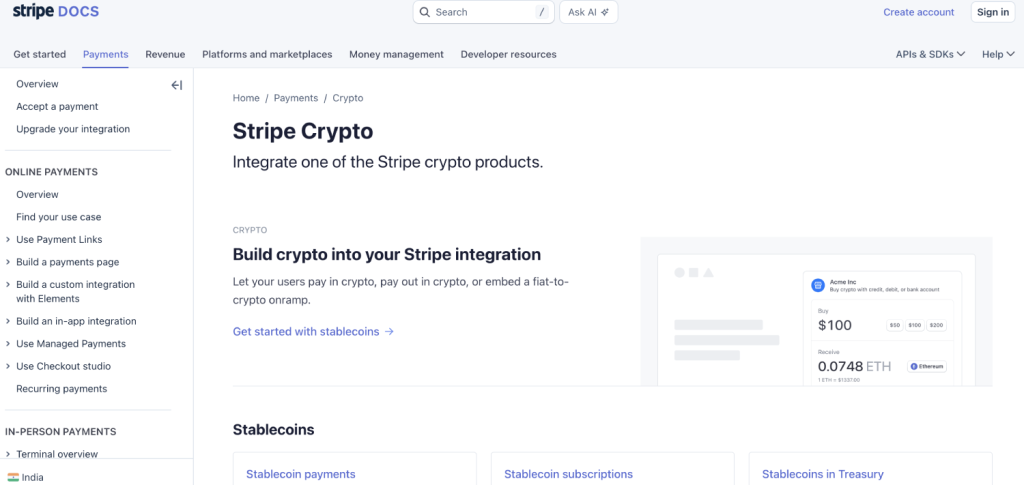
Stripe’s stablecoin infrastructure now includes a USDC onramp (fiat-to-USDC conversion for end users), stablecoin payouts for platforms paying out to users in USDC, and, through its acquisition of Bridge, an expanding cross-border payout layer. Stripe’s documentation is clear that USDC payouts via Stripe are currently available to US-based platforms with US-based recipients, with international expansion ongoing.
For platforms already on Stripe, adding USDC payouts is an incremental integration rather than a new vendor relationship. For platforms not on Stripe, the stablecoin layer alone is not usually sufficient justification to switch. Stripe’s strength here is ecosystem integration, not corridor depth. Stripe does not publicly list per-transaction fees for stablecoin payouts separately from its standard payout pricing.
Best for: Platforms already built on Stripe that want to add USDC payout capabilities without a new API vendor, particularly for US-to-US stablecoin transfers.
8. Triple-A
Triple-A is a Singapore-based payment provider licensed by the Monetary Authority of Singapore (MAS) that specializes in stablecoin and crypto payment acceptance and payouts across Southeast Asia. It supports USDC, USDT, Bitcoin, and Ethereum, and its API handles both merchant acceptance and B2B payouts.
Triple-A’s primary differentiation is Asia-Pacific corridor depth. For platforms with significant volume in Singapore, Malaysia, the Philippines, or broader ASEAN markets, Triple-A has local relationships and licensing that most US-origin providers lack. Its EU presence exists through EMI arrangements, and the US corridor is supported but not its core strength. Pricing includes a percentage fee per transaction, and specific rates require direct inquiry.
Best for: Platforms with APAC-centric payment corridors, particularly fintechs distributing to Southeast Asian contractors, suppliers, or end users.
9. Cross River Bank (Stablecoin Settlement API)
Cross River Bank is a federally chartered bank that has extended its payment infrastructure into blockchain-linked settlement, including a USDC payment API for platforms that need the backing of a US-regulated bank rather than a money transmitter. Cross River’s stablecoin payment API connects directly to its core banking infrastructure, which means stablecoin settlement and traditional ACH or wire settlement can coexist in a single API relationship.
Cross River’s stablecoin coverage is US-centric. It is not the right provider for LATAM or APAC payout corridors. Its value proposition is specifically for fintechs that need a bank counterparty rather than a non-bank infrastructure provider, which matters for certain institutional or regulated platform contexts. As with evaluating any bank partner, the sponsor bank selection criteria covered in sponsor bank programs for fintech startups apply directly here.
Best for: US fintechs that need stablecoin settlement from a federally chartered bank counterparty, and where non-bank infrastructure providers are excluded by institutional or regulatory requirements.
10. Coinbase Commerce (and Coinbase Prime)
Coinbase Commerce is a consumer-facing crypto payment acceptance product. It supports USDC, ETH, Bitcoin, and other assets, and it is oriented toward merchants wanting to accept crypto payments from retail customers. It is not B2B payment infrastructure. Developers can integrate it via API, but the product design, the UX flows, and the documentation are all consumer checkout-first.
Coinbase Prime, by contrast, is the institutional prime brokerage product for large-scale stablecoin custody and settlement, comparable in positioning to Fireblocks. For B2B fintech infrastructure, neither Coinbase Commerce nor Coinbase Prime is the first choice, but Coinbase Commerce belongs on the shortlist because many fintech platforms get asked about it by clients who are familiar with the Coinbase brand and want to understand why (or whether) it fits their infrastructure needs. It generally does not fit production B2B payment infrastructure requirements, and that is worth saying plainly.
Best for: Consumer-facing checkout for platforms where end users are already Coinbase users, or for crypto-native products where the Coinbase brand is a user trust signal. Not recommended for B2B settlement or cross-border payout infrastructure.
Is Bridge or BVNK Better for Stablecoin Settlement?
This is the most common head-to-head comparison among fintech teams evaluating LATAM and EU corridors simultaneously. Bridge wins on LATAM depth, particularly Mexico and Brazil, where its off-ramp to local bank accounts is more mature than BVNK’s. BVNK wins on EU regulatory standing, with an EMI license that allows it to operate as a regulated payment institution within EU member states without relying solely on MiCA stablecoin-specific provisions.
For a platform focused exclusively on US-to-LATAM payouts, Bridge is the stronger choice. For a platform with EU client exposure where EURC or GBPT settlement is needed, BVNK is more defensible from a compliance standpoint. Platforms with both corridors should consider whether running two API integrations is preferable to accepting the weaker coverage in one region from a single provider. The answer depends on your volume. At low volume, a single vendor simplifies operations. At high volume, the spread difference across corridors justifies the integration overhead.
How to Add USDC Payouts to a Fintech Platform
The integration path depends on whether you want custodial or non-custodial wallet architecture, and whether you need to handle off-ramp (USDC to fiat) or on-chain-to-on-chain transfers only.
For most B2B fintech platforms, the practical path is:
- Choose an infrastructure provider (Circle, Zero Hash, Bridge, or BVNK) based on your corridor requirements and licensing constraints.
- Complete provider KYB (Know Your Business) onboarding, which typically takes five to fifteen business days and requires corporate formation documents, beneficial ownership information, and a use case description.
- Integrate the provider’s REST API for wallet creation, balance management, and transfer initiation. Circle’s Programmable Wallets API, for instance, creates user wallets with a single POST request and returns a wallet address for deposit.
- Implement webhooks for settlement confirmation events. Most providers fire a webhook on blockchain confirmation (typically one to two confirmations for USDC on Solana or Base) and again on off-ramp settlement to the destination bank account.
- Build your reconciliation layer. Stablecoin transactions settle continuously, not in batches, which changes the reconciliation logic compared to ACH. For platforms new to continuous settlement, the compliance and reconciliation tooling covered in the fintech product and compliance readiness checklist provides a useful starting framework.
The KYB step is where most integrations stall. Providers with institutionalized onboarding (Circle, Zero Hash, Fireblocks) move faster than newer entrants. If your use case involves high-risk jurisdictions or complex entity structures, budget three to four weeks for onboarding regardless of provider.
What Does a Stablecoin Payment API Actually Cost?
No provider in this category publishes a full rate card publicly. This is structurally similar to card processing: headline rates exist, but the actual economics depend on volume, corridor, and negotiating leverage. Here is what is verifiable and what is not.
| Provider | Public Pricing Available? | Typical Fee Structure | FX Spread Disclosed? |
|---|---|---|---|
| Bridge | No | Per-transaction + FX spread | Not publicly |
| BVNK | No | Per-transaction + FX margin | Not publicly |
| Circle | Partial (developer tier visible) | API usage tiers + FX on conversion | Not publicly |
| Fireblocks | No | Annual platform fee + per-transfer | Not publicly |
| Zero Hash | No | Revenue share or per-transaction | Not publicly |
| Paxos | No | Enterprise contract | Not publicly |
| Stripe Crypto | Partial | Percentage of onramp transaction | Not publicly |
| Triple-A | Partial | Percentage per transaction | Not publicly |
| Cross River | No | Bank contract terms | Not publicly |
| Coinbase Commerce | Yes (1% per transaction per public pricing page) | Flat percentage | Yes (conversion fee disclosed) |
Coinbase Commerce is the only provider in this list with fully transparent public pricing. Every other provider requires a sales conversation or sandbox agreement before disclosing full economics. This is not unique to stablecoins. The hidden costs killing fintech SaaS margins covers how undisclosed spread and conversion fees compound across payment infrastructure layers in exactly this way.
Consider a platform processing $2M monthly in cross-border contractor payouts. At a 50 bps blended spread (conservative for a mid-market provider), that is $10,000 per month in FX cost alone, before any per-transaction fees. At 100 bps, it doubles to $20,000. The difference between providers is often in this range, which means the spread negotiation on a $2M-per-month payout book is worth more time than the API integration itself.
Infrastructure Providers vs Consumer Checkout Gateways: Why the Distinction Matters
Conflating these two categories causes expensive mistakes. Infrastructure providers (Bridge, BVNK, Zero Hash, Circle, Fireblocks) are designed for platforms embedding stablecoin rails into a product. They handle compliance, custody, and settlement as a service. The end user of the platform never interacts with the provider directly.
Consumer checkout gateways (Coinbase Commerce, Helio, BitPay, NOWPayments) are designed for merchants who want to accept crypto from retail buyers. They come with hosted checkout pages, QR codes, crypto-to-fiat auto-conversion, and consumer-facing UX. They are not designed to process programmatic B2B payouts or to handle stablecoin float for a fintech platform’s treasury.
The failure mode is building a B2B payout product on a consumer checkout API and discovering that the provider has no off-ramp infrastructure, no SLA for settlement timing, and no compliance support for your platform’s obligations toward its own end users. If you are building payment infrastructure rather than a merchant checkout button, you want infrastructure providers exclusively. The broader context for this decision sits within how embedded payment infrastructure gets selected, which the top embedded payments providers for B2B SaaS platforms covers in detail.
Frequently Asked Questions
What is the best stablecoin payment API for a US fintech platform?
For US-to-LATAM corridors, Bridge is the strongest choice for programmatic off-ramp to local bank accounts. For native USDC infrastructure with multi-chain support and MiCA-compliant EU coverage, Circle’s Programmable Wallets API is the reference standard. For fintechs wanting embedded stablecoin without acquiring their own money transmission licenses, Zero Hash handles the compliance infrastructure on your behalf. The right answer depends on your corridors and regulatory context, not on which provider has the best documentation.
Which stablecoin provider has the best US and LATAM coverage?
Bridge, now owned by Stripe, has the deepest US-to-LATAM payout corridor coverage, with programmatic settlement to local bank accounts in Mexico, Brazil, Colombia, and Argentina. BVNK covers some of the same LATAM corridors alongside stronger EU regulatory standing. No single provider offers best-in-class coverage across US, LATAM, EU, Africa, and APAC simultaneously. Platforms with multi-region needs frequently run two providers to cover primary and secondary corridors without compromising on settlement quality in either.
How do I add USDC payouts to my platform?
Select an infrastructure provider (Circle, Zero Hash, or Bridge for most US platforms), complete their KYB onboarding process, integrate their REST API for wallet creation and transfer initiation, and implement webhooks for settlement confirmation. The KYB process typically takes five to fifteen business days. The blockchain confirmation step for USDC on Solana or Base takes under a minute. The off-ramp to a local bank account on the destination side adds one to two business days depending on the provider’s last-mile settlement network in that corridor.
What is MiCA and why does it matter for stablecoin APIs?
MiCA is the EU’s Markets in Crypto-Assets Regulation, which became fully applicable in December 2024. It requires stablecoin issuers and payment providers operating in EU member states to hold specific authorizations from an EU-based financial regulator. For a fintech platform, this means your stablecoin API provider must hold a MiCA-compliant license if your product touches EU users or processes payments denominated in EURC. Circle and BVNK both hold relevant EU authorizations. Using a non-compliant provider for EU-corridor stablecoin settlement creates regulatory exposure for your platform, not just for the provider.
What is a VASP and do I need one for stablecoin payments?
VASP stands for Virtual Asset Service Provider, the designation used in most non-US jurisdictions for entities that facilitate crypto or stablecoin transactions on behalf of others. Most countries that have implemented FATF (Financial Action Task Force) crypto guidance require VASP registration or licensing. If you are building a platform that moves stablecoin on behalf of end users, you may be operating as a VASP in the jurisdictions where those users are located. Most fintech infrastructure providers handle VASP registration in their operating jurisdictions, but your platform may have its own obligations depending on where you are incorporated and where your users are.
Which stablecoin payment API has the lowest FX spread?
No provider publicly discloses its FX spread in basis points across all currency pairs. Coinbase Commerce discloses a conversion fee on its public pricing page, but it is a consumer checkout product, not B2B infrastructure. For infrastructure providers, spread is negotiated based on volume and corridor. At meaningful volumes (above $500K monthly), spreads are typically negotiable. The tightest spreads on USDC-to-fiat conversions tend to come from providers with strong local banking relationships in the destination currency, which varies by corridor. Always request a specific spread in bps, in writing, before committing to an integration.
Is stablecoin payment infrastructure regulated in the United States?
Yes, though the regulatory framework is fragmented. US stablecoin infrastructure providers operating as money transmitters must hold state-level Money Transmission Licenses (MTLs) in most states where they operate. Bank-chartered providers like Cross River operate under federal banking supervision. The GENIUS Act and related federal stablecoin legislation is moving through Congress as of 2025 but has not yet created a unified federal framework. For now, compliance obligations depend on how your platform’s stablecoin activity is classified, which entity in the stack holds the MTL, and which states your users are located in.
The Provider Choice Sets Your Unit Economics, Not Just Your Tech Stack
Most fintech infrastructure decisions feel like technical choices but play out as financial ones. Stablecoin payment APIs are the clearest example of this. The chain you settle on, the provider you route through, and the FX conversion terms you negotiate at signing determine your effective cost per cross-border transaction for the life of that integration. Switching providers after you have built wallet infrastructure, reconciliation logic, and user-facing payout flows is expensive in engineering time and disruptive to any user who has a wallet address tied to your current provider.
The practical hierarchy for most B2B fintech platforms is this: start with corridor fit, then verify licensing, then negotiate spread, then evaluate developer experience. Doing it in reverse (picking the provider with the best docs and figuring out corridors later) is how platforms end up with a beautifully integrated API that cannot actually pay out to their users in Mexico City or Lagos.
Stablecoin rails are now a serious settlement layer. The maturity gap between the best providers and traditional correspondent banking is closing on speed and cost. The gap that still exists is on geographic coverage and regulatory completeness. That gap is where the provider selection decision actually lives.