
- Alloy and Persona solve adjacent problems: Alloy is built for complex, rules-driven identity decisioning across multiple data vendors; Persona is built for configurable, workflow-driven identity verification with a strong UI layer.
- Neither platform is a single KYC vendor. Both are orchestration layers, but they route data and decisions differently, and that distinction drives the buying decision.
- Companies with multi-product compliance programs, high transaction volumes, or layered fraud rules tend to outgrow Persona’s workflow model and move toward Alloy’s decisioning engine.
- Persona wins for teams that need fast deployment, polished end-user identity flows, and flexible no-code templates without deep engineering involvement.
- Pricing is not publicly disclosed by either vendor in full, but per-verification cost, vendor pass-through fees, and platform fees all vary significantly based on volume and contract structure.
Alloy and Persona are both identity orchestration platforms, but they serve different operational realities. Alloy is purpose-built for financial services companies that need a centralized decisioning engine to route identity, fraud, and compliance signals across multiple data providers. Persona is designed for product teams that want to build configurable identity verification flows quickly, with less reliance on engineering. The right choice depends on whether your bottleneck is rules complexity or deployment speed.
Why “One KYC Vendor” Breaks Down at Scale
Most early-stage fintech teams pick a single KYC provider, integrate it, and move on. That works until it does not. A single vendor’s pass rates, data coverage, and pricing tier become a ceiling on your onboarding conversion and a single point of compliance failure.
The real problem is that identity verification is not one check. It is a sequence of checks: document verification, database lookups, watchlist screening, liveness detection, and sometimes income or business verification layered on top. No single data provider excels at all of these. Alloy’s own positioning, reflected in public product documentation, centers on connecting multiple data sources through one decisioning layer so companies are not locked to one provider’s data quality. Persona takes a similar approach with its modular verification components, which teams can combine into a single flow.
The pattern companies run into after their first vendor contract is covered well in FintechSpecs’ analysis of why fintech users drop off during onboarding: rigid flows that cannot adapt to edge cases, high manual review rates for borderline applicants, and no fallback when a vendor has a data gap. An orchestration layer solves each of those problems, but only if it fits how your team operates.
What Is Alloy, and Who Actually Uses It?
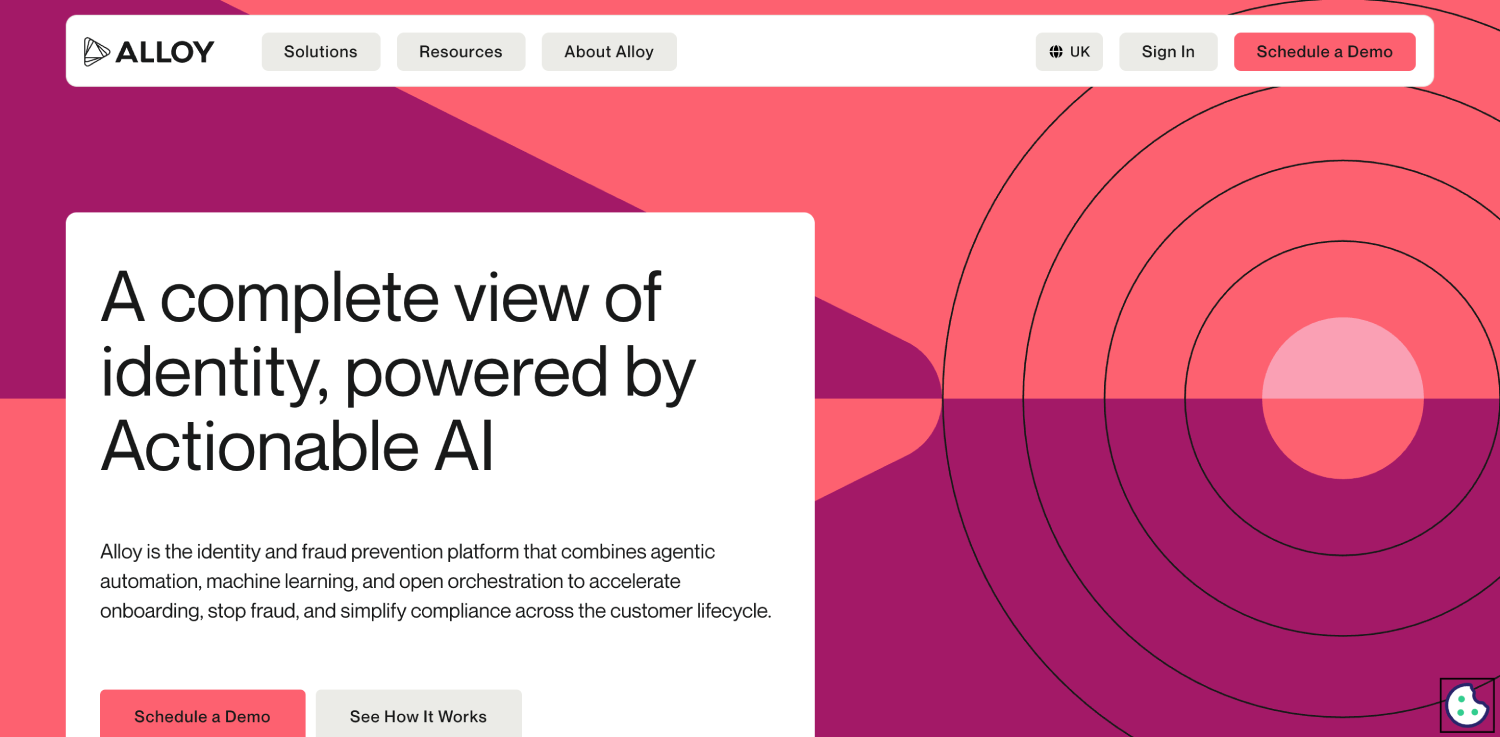
Alloy is an identity decisioning platform built primarily for financial institutions, fintechs, and banking-as-a-service companies. Its core product is a rules engine that sits above your KYC, KYB, fraud, and AML data vendors and routes applicants through decision logic you define. You connect data sources (Socure, Experian, LexisNexis, Sardine, and others) and write rules that determine which sources get called, in what order, and what outcome each combination triggers.
Alloy positions itself as a layer for companies that already know what compliance decisions they need to make and want to centralize that logic outside their own codebase. It is particularly common in companies running embedded banking programs, where sponsor bank requirements mean explicit, auditable decision logic for every onboarded customer. According to Alloy’s public product documentation, the platform supports onboarding, ongoing monitoring, and transaction review, not just initial KYC.
The buyer profile is typically a Series B or later fintech with a compliance team that can configure rules, or an embedded banking program where the sponsor bank has specific data and decisioning requirements. Engineering involvement is required to integrate, but ongoing rule changes can happen without code deployment.
What Is Persona, and Who Is It Built For?

Persona is an identity verification platform that emphasizes configurable, embeddable verification flows. Its product centers on what the company calls “dynamic flows,” which are structured identity workflows you assemble from modular components: government ID checks, database verifications, selfie and liveness checks, and custom business logic. Product teams without compliance engineering resources can build a working verification flow in days using Persona’s no-code and low-code tooling.
Persona also handles orchestration, but the frame is different. Where Alloy presents a decisioning engine that you populate with rules and data sources, Persona presents a workflow builder that you configure to produce a compliant outcome. Both route across multiple data providers, but Persona abstracts more of that routing away from the buyer. Its marketplace of pre-integrated verification providers lets teams swap or stack data sources without writing routing logic by hand.
Persona’s buyer is typically a product-led company, often a marketplace, gig platform, or consumer fintech, that needs identity verification to meet regulatory requirements or reduce fraud, but where the compliance function is not yet mature enough to operate a full rules engine. Engineering teams tend to prefer Persona’s developer experience for initial integrations, while Alloy’s integration depth becomes valuable later.
How Do Alloy and Persona Handle KYC Orchestration Differently?
The sharpest difference between the two platforms is where the orchestration logic lives. In Alloy, the decisioning logic is explicit and operator-owned. You define rules in Alloy’s workflow editor that determine which data vendors are called, in what sequence, and what the output of each combination means for the applicant’s status. That produces an auditable decision tree your compliance team can show to a regulator or a sponsor bank.
In Persona, the orchestration is embedded in the flow design. You configure which verification steps appear, in what order, and under what conditions, but the platform handles much of the routing logic for you. That is faster to set up and requires less ongoing maintenance, but it also means less granularity in the decision record. For a sponsor bank audit, Alloy’s output is typically more defensible because the logic is explicit rather than inferred from a flow configuration.
Both platforms support cascading across data vendors, meaning if one provider returns an inconclusive result, the platform can automatically call a second provider. Alloy’s cascade rules are operator-configured and highly specific. Persona’s are configured through the flow builder and are somewhat more abstracted. For companies where per-verification cost optimization matters, Alloy’s explicit cascade control produces more predictable cost outcomes, since you can specify exactly when a more expensive data source gets called.
The FintechSpecs Rules Complexity Score
Rather than a generic feature comparison, a more useful frame is the Rules Complexity Score, a FintechSpecs proprietary self-assessment framework that maps your compliance program’s complexity to the right platform architecture. Score yourself on four dimensions, then read across.
- Decision logic depth: Does your compliance program require conditional rules (if the applicant is in state X and the product is Y, apply rule set Z)? Score 1 for yes, 0 for no.
- Multi-vendor routing: Do you need to route different applicant segments to different data providers based on risk tier, geography, or product line? Score 1 for yes, 0 for no.
- Sponsor bank or regulatory audit requirement: Does your program require an explicit, exportable decision record for each applicant? Score 1 for yes, 0 for no.
- Ongoing monitoring: Do you need continuous KYC or transaction-level re-verification after initial onboarding, not just at application? Score 1 for yes, 0 for no.
Score 3 or 4: Alloy is the stronger architectural fit. The rules engine, multi-vendor routing, and audit trail align with programs at that complexity level. Score 0 to 2: Persona’s configurable flows will get you live faster with less operational overhead and a better end-user experience out of the box.
Side-by-Side Feature Comparison: Alloy vs Persona
| Capability | Alloy | Persona |
|---|---|---|
| Core architecture | Rules-driven decisioning engine | Configurable verification workflow builder |
| Data vendor integrations | Pre-built integrations with 190+ data providers | Pre-built integrations via Persona Marketplace |
| No-code/low-code configuration | Limited; primarily operator-configured rules | Strong; flow builder accessible to non-engineers |
| Audit trail and decision records | Explicit, exportable per-applicant decision logs | Flow completion records; less granular decision logic visibility |
| Ongoing KYC monitoring | Yes, native product | Available but secondary to onboarding use case |
| Transaction-level fraud decisioning | Yes, through Alloy’s transaction monitoring module | Not a primary use case |
| KYB (business verification) | Yes, native | Yes, via modular components |
| AML watchlist screening | Yes, native | Yes, via integrations |
| Sponsor bank compatibility | Designed for it; used widely in embedded banking programs | Compatible, but not primary positioning |
| End-user UI/UX layer | Minimal native UI; primarily back-end decisioning | Strong; polished hosted and embedded UI flows |
| Developer experience | Comprehensive API; steeper onboarding curve | Well-documented API; faster initial integration |
| Publicly disclosed pricing | Not publicly disclosed; volume-based contracts | Not publicly disclosed; per-verification plus platform fee |
| Primary buyer | Series B+ fintechs, embedded banking programs, complex compliance teams | Product-led companies, marketplaces, gig platforms, early-stage fintechs |
How Much Do Alloy and Persona Cost?
Neither Alloy nor Persona publishes a public pricing page with per-verification rates. Both operate on enterprise contracts that vary based on verification volume, number of data vendors connected, and which modules are enabled. Alloy’s pricing structure typically involves a platform fee plus per-verification charges that include pass-through costs from underlying data providers. Persona follows a similar model.
The per-verification cost benchmark for standalone KYC providers in the US market is covered in more detail in FintechSpecs’ breakdown of KYC per-verification pricing for fintechs, which gives context for what “expensive” actually looks like across vendor types. What both Alloy and Persona add on top of raw verification costs is the orchestration layer itself, which can reduce overall per-applicant cost if the cascade logic prevents unnecessary calls to expensive data sources.
For early-stage companies, Persona tends to have more accessible entry-level pricing and is more likely to engage without a long procurement cycle. Alloy’s sales process is enterprise-oriented and typically requires a minimum contract commitment. Teams evaluating both should request sandbox access and ask specifically about pass-through vendor cost transparency before signing.
Where Does Alloy Win Outright?
Alloy is the stronger choice for any company operating under an explicit compliance program with a sponsor bank, a BaaS provider, or a regulatory requirement for documented decisioning. The platform’s rules engine produces a clear, auditable record of why each applicant was approved, declined, or routed to manual review. That record is defensible in a bank exam and can be exported to show a compliance officer or auditor without additional tooling.
Alloy also wins for companies running multiple products on the same identity infrastructure. A company offering both a consumer card and a business credit line can configure separate rule sets for each product in one Alloy instance, routing the same applicant through different logic depending on which product they applied for. That kind of multi-product decisioning is architecturally difficult to replicate in Persona’s flow-based model.
For KYB-heavy programs, Alloy’s native business verification capabilities are more developed than Persona’s. If your program involves verifying both the business entity and its beneficial owners in the same decisioning flow, with ongoing monitoring of both, Alloy handles that natively. Teams doing deep KYB work should also review FintechSpecs’ direct comparison of Alloy vs Middesk for KYB platform selection, which covers the KYB-specific decision in more depth.
Where Does Persona Win Outright?
Persona wins when deployment speed and end-user experience are the primary constraints. A marketplace that needs to verify seller identities before they can transact, or a consumer app adding ID verification to reduce fraud, gets to production faster with Persona than with Alloy. The flow builder, the hosted UI components, and the pre-built integrations reduce the engineering time from weeks to days in most cases.
Persona’s verification UI is also a differentiator. The platform provides a polished, mobile-optimized identity verification experience that teams can embed directly or host without building a custom front end. For consumer-facing products where drop-off during verification is a real conversion problem, Persona’s UI layer is a meaningful advantage. Alloy, by contrast, is primarily a back-end decisioning engine and expects the buyer to own the user-facing experience.
Teams that are just beginning to formalize their compliance program will also find Persona’s template library more accessible. Pre-built flows for common use cases like US consumer KYC or marketplace seller verification give a compliance team a starting point that meets baseline requirements without writing rule logic from scratch. For more context on what good onboarding infrastructure looks like before you’re at the scale of needing a complex rules engine, the Fintech Product and Compliance Readiness Checklist on FintechSpecs is a useful reference.
What About Alternatives to Both Alloy and Persona?
If neither platform fits, the comparison is worth widening. Socure occupies a different position: it is primarily a predictive identity data provider with its own decisioning layer, rather than an orchestration platform that sits above third-party vendors. It is strong for US consumer identity but not designed as a multi-vendor orchestration layer.
Veriff is a document and biometric verification provider that Alloy has integrated with directly, per Alloy’s public announcements. It is a data vendor rather than an orchestration layer, which means it sits beneath both Alloy and Persona rather than competing with them at the same layer.
Sumsub is the most direct global-scale alternative, particularly for companies operating outside the US. Based on publicly available analyst commentary and SERP data for this category, Sumsub is positioned as the choice for global scale and speed, versus Alloy for complex orchestration and Persona for maximum customization. For US-focused buyers, the Alloy versus Persona decision remains the primary one. Teams building fraud detection infrastructure on top of identity verification should also look at the broader field covered in FintechSpecs’ review of fraud detection and risk tools for fintech startups.
Which Platform Has Better Fraud Decisioning Built In?
Alloy has invested more heavily in transaction-level fraud decisioning. Its product suite extends beyond onboarding KYC to include transaction monitoring and ongoing risk scoring, which means a company can use Alloy for both the initial identity decision and the ongoing behavioral risk assessment on the same customer. That reduces vendor sprawl and gives compliance teams one place to configure rules across the full customer lifecycle.
Persona’s fraud capabilities are primarily scoped to identity fraud at the onboarding stage: synthetic identity detection, document fraud, account takeover at account creation. It does not position itself as a transaction monitoring platform. For companies where fraud risk is concentrated at onboarding rather than in ongoing transactions, that distinction is immaterial. For companies where post-onboarding fraud is significant, Alloy’s broader scope matters.
For dedicated fraud orchestration that goes beyond identity verification entirely, both platforms are complementary to, rather than replacements for, dedicated fraud stacks. Teams building out a full fraud infrastructure should consult FintechSpecs’ review of fraud orchestration platforms for high-growth fintech teams to understand where identity decisioning ends and behavioral fraud detection begins.
A Worked Scenario: Choosing Between Alloy and Persona at Series
The following is a constructed illustrative scenario, not a real case study. It is designed to show how the Rules Complexity Score plays out against a specific company profile.
Consider a Series A consumer lending company processing roughly 5,000 new loan applications per month. They are operating under a sponsor bank agreement that requires documented KYC decisions, an automated adverse action reason code for each declined applicant, and quarterly reviews of their decisioning logic. They have two engineers on the compliance infra team and a dedicated compliance officer.
That profile points toward Alloy. The sponsor bank requirement for documented decision logic is the deciding factor. Persona could handle the verification steps, but producing an auditable decision record with the specificity a bank examiner expects requires either Alloy’s rules engine or a significant amount of custom engineering on top of Persona. The compliance officer’s ability to adjust rule thresholds without opening a pull request is an additional operational advantage with Alloy.
Now change one variable: remove the sponsor bank. The same company, self-funded, applying their own risk appetite without external regulatory requirements, with two engineers and a small compliance function. Persona’s faster deployment, better end-user UI, and lower initial configuration burden win. They get to production in two weeks instead of six, and they can revisit the decision if they take on a bank partner later.
Frequently Asked Questions
Is Alloy a fintech company or an infrastructure vendor?
Alloy is an identity decisioning infrastructure vendor, not a fintech in the consumer sense. It builds tools that financial services companies and fintechs use to make identity and risk decisions during customer onboarding and ongoing monitoring. It does not offer financial products directly to consumers. Alloy’s customers are typically banks, fintechs, and embedded finance platforms that need a centralized layer to manage KYC, fraud, and AML decisioning across multiple data sources.
How much does Persona cost per verification?
Persona does not publish per-verification pricing publicly. Pricing is negotiated based on verification volume, the types of checks enabled, and the number of integrations used. Persona has historically been more accessible for early-stage companies than Alloy in terms of minimum contract size, but both move to volume-based enterprise contracts at scale. The best approach is to request a sandbox account and ask specifically about pass-through data costs during the sales process.
What are the main competitors of Persona?
Persona’s direct competitors in configurable identity verification include Alloy (for orchestration depth), Sumsub (for global markets), Veriff (for document and biometric verification), and Socure (for US identity data quality). Jumio and Onfido are also competitive in the document verification layer. The distinction matters: some are data providers, some are orchestration layers, and some are both. Persona competes most directly as an orchestration-plus-UI layer for product teams that want to own the verification flow without building it from scratch.
What is the difference between identity verification and identity decisioning?
Identity verification is the act of confirming that a person is who they claim to be, typically through document checks, biometrics, or database lookups. Identity decisioning is the process of taking verification outputs and making an automated risk decision, such as approve, decline, or escalate to review, based on configurable rules. Persona handles both. Alloy is primarily a decisioning layer that can ingest verification results from Persona or other providers, but the decisioning logic is where Alloy’s value concentrates.
Can Alloy and Persona be used together?
Yes. Some companies use Persona to handle the end-user-facing verification flow (document capture, liveness, initial checks) and route the outputs into Alloy’s decisioning engine for the final compliance decision. This setup preserves Persona’s UI advantage and Alloy’s rules depth, but adds integration complexity and cost. It makes sense when a company has a sponsor bank requiring Alloy’s audit trail but also values Persona’s end-user experience. For most companies, choosing one platform is sufficient.
Which platform is better for KYB (business verification)?
Alloy has more developed native KYB capabilities, including beneficial ownership verification and ongoing business monitoring. Persona supports KYB through modular components but is not its primary positioning. For companies where business verification is the core use case, particularly those serving SMBs or operating B2B embedded finance programs, Alloy is the stronger fit. Middesk is a dedicated KYB alternative worth evaluating alongside both.
Does Persona support AML watchlist screening?
Persona supports AML watchlist screening through its integrated verification components and marketplace integrations. It covers OFAC, PEP, and adverse media checks as part of a configurable flow. The coverage is sufficient for most initial customer onboarding programs. For ongoing transaction monitoring and continuous AML screening after onboarding, Alloy’s monitoring module offers more depth, and dedicated AML platforms may be necessary for higher-risk programs.
What should I ask a KYC orchestration vendor before signing?
Ask four things: First, which data providers can you connect, and are their costs passed through transparently or bundled? Second, how are decisioning changes (rule edits, threshold adjustments) made, and do they require engineering involvement? Third, what does the audit trail look like for each applicant decision, and can it be exported in a format a regulator or sponsor bank will accept? Fourth, how does the platform handle manual review queues, and does it include tooling for review teams or just an API output?
The Decision That Actually Matters
The buying decision between Alloy and Persona is not about which platform is technically superior. Both are competent orchestration layers with real deployments at scale. The decision is about which problem you are solving right now. If your compliance program requires documented, configurable decision logic that can be reviewed by a sponsor bank or regulator, Alloy’s architecture is designed for that work. If your primary problem is deploying a compliant, user-friendly identity flow quickly without deep engineering investment, Persona gets you there faster.
What most teams miss is that these platforms are not permanent choices. The compliance programs that need Alloy’s rules depth usually did not need it at seed stage. The natural progression for many fintechs is Persona early, Alloy later, or a hybrid at scale where Persona handles the UX and Alloy handles the decision record. Knowing that in advance means you can build your initial Persona integration with that migration in mind, rather than discovering eighteen months later that your audit trail does not meet your sponsor bank’s requirements.
The deeper argument is that the “one KYC vendor is enough” assumption is the real problem to retire, not the choice between these two platforms. Any company processing meaningful onboarding volume is already operating a de facto orchestration layer. The question is whether that logic lives in a purpose-built platform with an audit trail, or in a tangle of conditional code that nobody wants to touch before an exam.