
- Stablecoin infrastructure is not a crypto-native experiment anymore. It is a layered, regulated stack with distinct vendors for issuance, custody, settlement, on/off-ramps, and treasury management, each of which can be evaluated like any other fintech vendor.
- The passage of the GENIUS Act in 2025 moved GENIUS Act compliant stablecoins from regulatory gray area to defined legal category, and several providers already operate inside that framework.
- The stablecoin stack has at least five distinct layers. Choosing one provider and assuming it covers everything is the single most common mistake fintech and B2B SaaS teams make when evaluating this space.
- Circle, Stripe/Bridge, and BVNK are credibility anchors used by regulated institutions. Fireblocks and Anchorage Digital anchor the custody layer. Paxos and Ondo Finance anchor issuance. Rain and Littio serve distinct treasury and digital dollar account use cases.
- Most teams should start with one layer, typically settlement or treasury, before touching issuance or on-ramps. Adding complexity too early is how stablecoin projects stall.
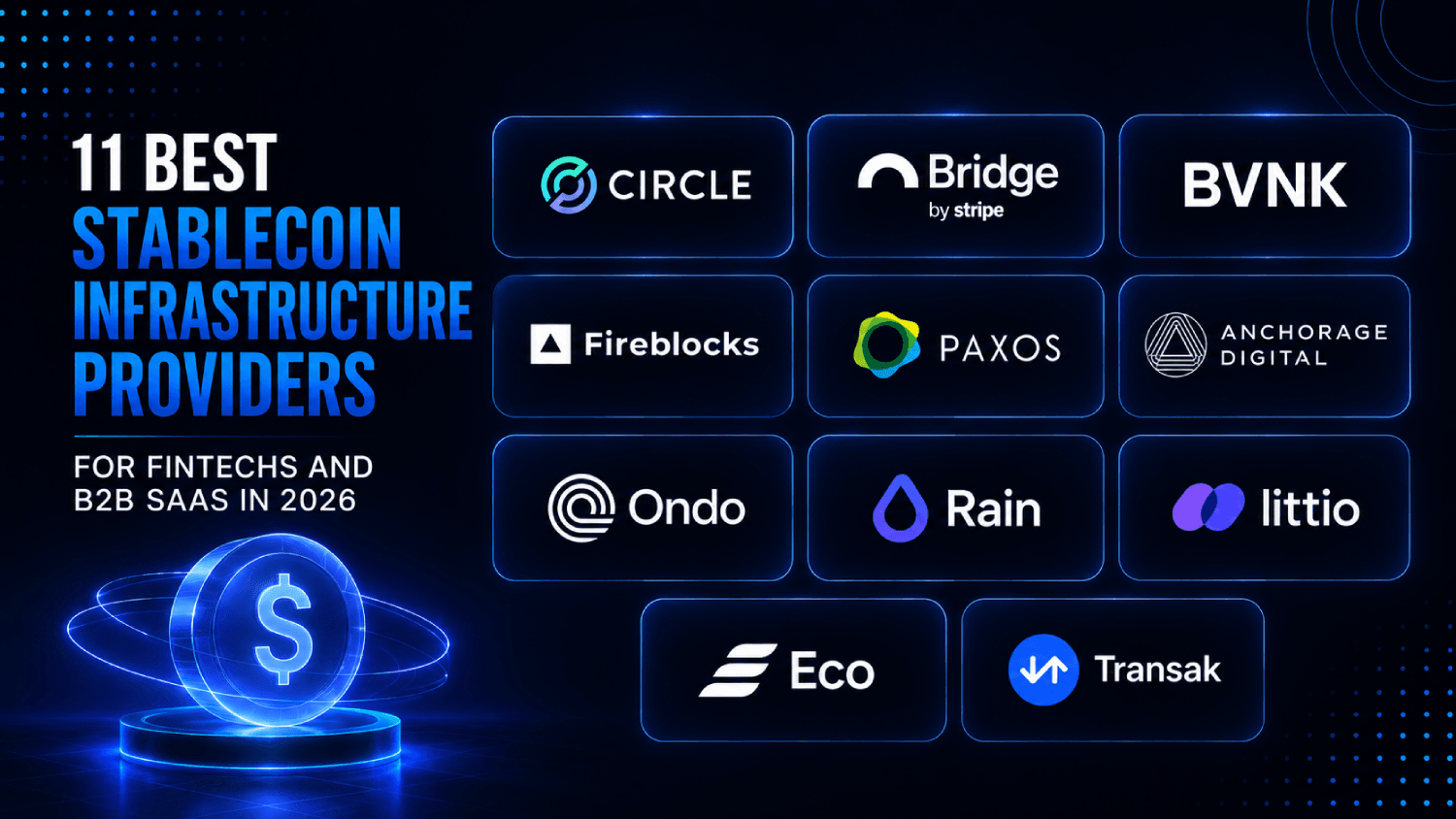
The best stablecoin infrastructure providers for fintechs and B2B SaaS platforms in 2026 are Circle (USDC issuance and settlement), Stripe/Bridge (API-first stablecoin orchestration), BVNK (enterprise treasury and settlement), Fireblocks (institutional custody and transfers), Paxos (regulated token issuance), Anchorage Digital (federally chartered custody), Ondo Finance (tokenized yield), Rain (digital dollar accounts), Littio (cross-border digital dollar banking), Eco (stablecoin orchestration), and Transak (fiat on/off-ramps). Each operates at a different layer of the stablecoin stack and solves a different problem.
What Is the Stablecoin Infrastructure Stack, and Why Does It Matter for Fintechs?
Most fintech teams approaching stablecoins for the first time treat it as a payment method, roughly equivalent to adding a new currency. That framing misses about two-thirds of the decision surface. Stablecoin infrastructure is actually a stack, and the layers do not automatically talk to each other.
The FintechSpecs Stablecoin Layer Map breaks the stack into five distinct layers: issuance (who mints and redeems the token), custody (who holds the private keys and manages security), settlement rails (who moves value between wallets or counterparties), on/off-ramps (who converts fiat to stablecoin and back), and treasury or account management (who provides the UI, reporting, and yield on stablecoin balances). A sixth emerging layer is programmable money, which covers smart-contract-based payment logic, escrow, and conditional transfers.
A fintech building international supplier payments needs the settlement layer and an off-ramp. A SaaS company holding reserves in USDC needs the custody layer and possibly the treasury layer. A neobank wanting to offer USDC accounts to end users needs all five. Mapping your use case to the correct layer before evaluating vendors cuts the vendor list in half and eliminates months of false starts. If you want a broader map of where stablecoins sit in the full fintech infrastructure stack, the Fintech Infrastructure Stack in 2026 gives you the complete picture across all payment rails.
How Has the GENIUS Act Changed Stablecoin Infrastructure for US Companies?
The GENIUS Act established a federal licensing framework for payment stablecoin issuers in the United States, with requirements covering reserve composition, redemption rights, AML compliance, and disclosure. For infrastructure providers, this created a clear compliance bar that separates regulated issuers from unregulated ones, and it gave institutional buyers a legally defensible basis for using stablecoin rails.
In practice, this means Circle’s USDC and Paxos-issued tokens now operate under a defined regulatory regime that a corporate treasury team or compliance officer can actually present to a board. That was not true before 2025. The GENIUS Act also clarified that payment stablecoins are not securities under US law, which removed one of the largest legal blockers for SaaS platforms that wanted to hold or transact in stablecoins.
For vendor evaluation, GENIUS Act compliance has become a minimum qualification for US-regulated fintechs, not a differentiator. If a provider cannot demonstrate how their token or infrastructure aligns with the Act’s reserve and redemption requirements, that conversation should end early. Compliance mistakes at this layer are expensive. The Fintech Product and Compliance Readiness Checklist covers the compliance gates that matter before you go live.
Which Stablecoin Infrastructure Providers Are Worth Evaluating in 2026?
1. Circle (USDC Infrastructure)
Circle is the issuer of USDC, which is currently the most widely used regulated dollar stablecoin for institutional and developer use cases. Circle’s infrastructure includes the Circle APIs for programmable wallets, cross-chain transfers via Cross-Chain Transfer Protocol (CCTP), and direct integrations with Ethereum, Solana, Base, Arbitrum, and several other networks. For a fintech building on top of digital dollar rails, Circle is effectively the default starting point.
USDC is backed 1:1 by US dollar-denominated reserves held in regulated US financial institutions, and Circle publishes monthly attestations from a Big Four accounting firm. That reserve transparency is what makes USDC the institutional-grade choice when a compliance team needs documentation. The Circle developer platform allows programmable wallets, gasless transactions, and account abstraction, which matters for product teams who need stablecoin functionality without exposing end users to blockchain mechanics.
Circle’s pricing for API access is not publicly disclosed as a flat rate; it varies by product tier and transaction volume. Enterprises typically negotiate directly. For smaller teams, the developer sandbox is free to access, and the Circle developer documentation is comprehensive enough to evaluate feasibility before any commercial conversation.
2. Stripe/Bridge (Stablecoin API Orchestration)
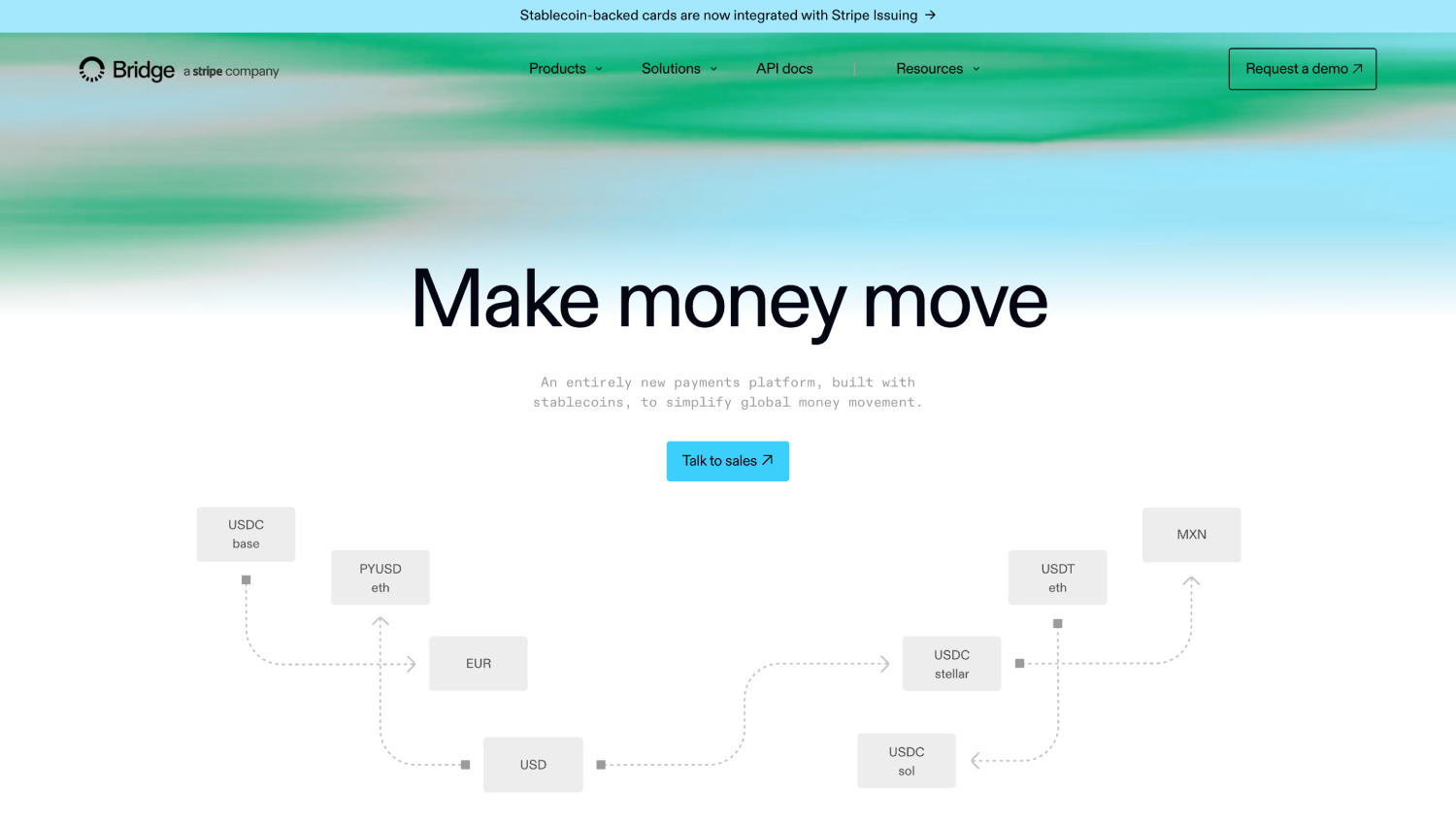
Bridge, acquired by Stripe in late 2024, is the cleanest API-first stablecoin orchestration layer available to fintechs right now. It handles conversion between stablecoins and fiat, multi-currency stablecoin accounts, and programmable transfers across chains. Stripe’s acquisition gave Bridge distribution into a customer base that was already comfortable with Stripe’s developer experience.
The Bridge API abstracts most of the blockchain complexity. You send a fiat amount, specify a destination, and Bridge handles the conversion, routing, and settlement without your product needing to manage private keys or gas fees. For a B2B SaaS platform that wants to add stablecoin settlement to an existing Stripe integration, this is the lowest-friction entry point in the market. Bridge supports USDC and USDT on multiple chains, including Ethereum and Solana.
Bridge’s pricing structure is not published as a public rate card; it is negotiated at the enterprise level. Given the Stripe backing, teams already in Stripe’s network should expect a smoother commercial process than they would get approaching Circle or a custody provider from scratch. If you are evaluating how stablecoin rails fit into a broader payment infrastructure decision, the comparison of Stripe vs Adyen for B2B SaaS gives context on where Stripe’s infrastructure strategy is heading.
3. BVNK (Enterprise Stablecoin Treasury and Settlement)
BVNK sits between the settlement layer and the treasury layer, and it is one of the few providers that takes both seriously for enterprise customers. It offers stablecoin accounts in USDC and USDT, multi-currency conversion, and business payment rails into over 40 countries. BVNK is licensed in the UK (FCA) and operates under e-money regulations in the EU, which makes it a viable option for US fintechs with European operations.
Where BVNK differentiates from Circle or Bridge is in the treasury management interface. It gives finance teams a dashboard for managing stablecoin balances, FX conversion, and settlement reporting, which is closer to what a CFO needs than what a developer needs. Most stablecoin infrastructure skews heavily toward developers; BVNK’s product deliberately includes the finance operations persona.
BVNK pricing is not public. Commercial terms are negotiated directly, and the sales process targets businesses moving meaningful volume. Teams at the seed or pre-Series A stage will likely find Circle or Bridge a faster start, while BVNK is better positioned for Series B companies running cross-border treasury operations at scale.
4. Fireblocks (Institutional Custody and Wallet Infrastructure)
Fireblocks is the dominant custody and wallet infrastructure provider for institutional digital asset operations. It uses multi-party computation (MPC) cryptography to secure private keys, meaning no single party ever holds a complete key, which reduces custody risk significantly compared to traditional cold storage. Fireblocks supports over 50 blockchains and is used by hundreds of financial institutions, exchanges, and fintechs for moving and storing digital assets including stablecoins.
For a fintech that needs to hold stablecoin balances on behalf of customers or move large volumes between counterparties, Fireblocks provides the security architecture that satisfies enterprise-grade security reviews. It also offers a Policy Engine for programmable transaction approval workflows, which is how compliance teams enforce dual-authorization requirements on large transfers without manual intervention.
Fireblocks pricing is annual contract based and not publicly disclosed. It is not suited for early-stage teams testing the market, but it is the standard choice for any company that has scaled past proof-of-concept and needs institutional-grade infrastructure.
5. Paxos (Regulated Token Issuance)
Paxos is a regulated blockchain infrastructure platform and stablecoin issuer with a Trust Company charter in New York and an in-principle approval from the Monetary Authority of Singapore. Paxos issues USDP (Pax Dollar) and has historically issued BUSD for Binance and PYUSD for PayPal, the latter of which put Paxos’s issuance infrastructure inside a consumer-facing payment product at scale.
For fintechs and enterprises that want to issue a branded stablecoin or white-label a regulated dollar token, Paxos’s Stablecoin-as-a-Service offering is one of the few regulated pathways available in the US. The PayPal relationship is the clearest proof point that this infrastructure can operate at consumer scale inside a mainstream financial product.
Paxos also offers settlement infrastructure through its Paxos Settlement Service, which was used by Credit Suisse, Société Générale, and Instinet for accelerated equity settlement. That settlement history matters for fintechs pitching stablecoin rails to risk-averse institutional clients who need to see prior institutional use.
6. Anchorage Digital (Federally Chartered Crypto Custody)
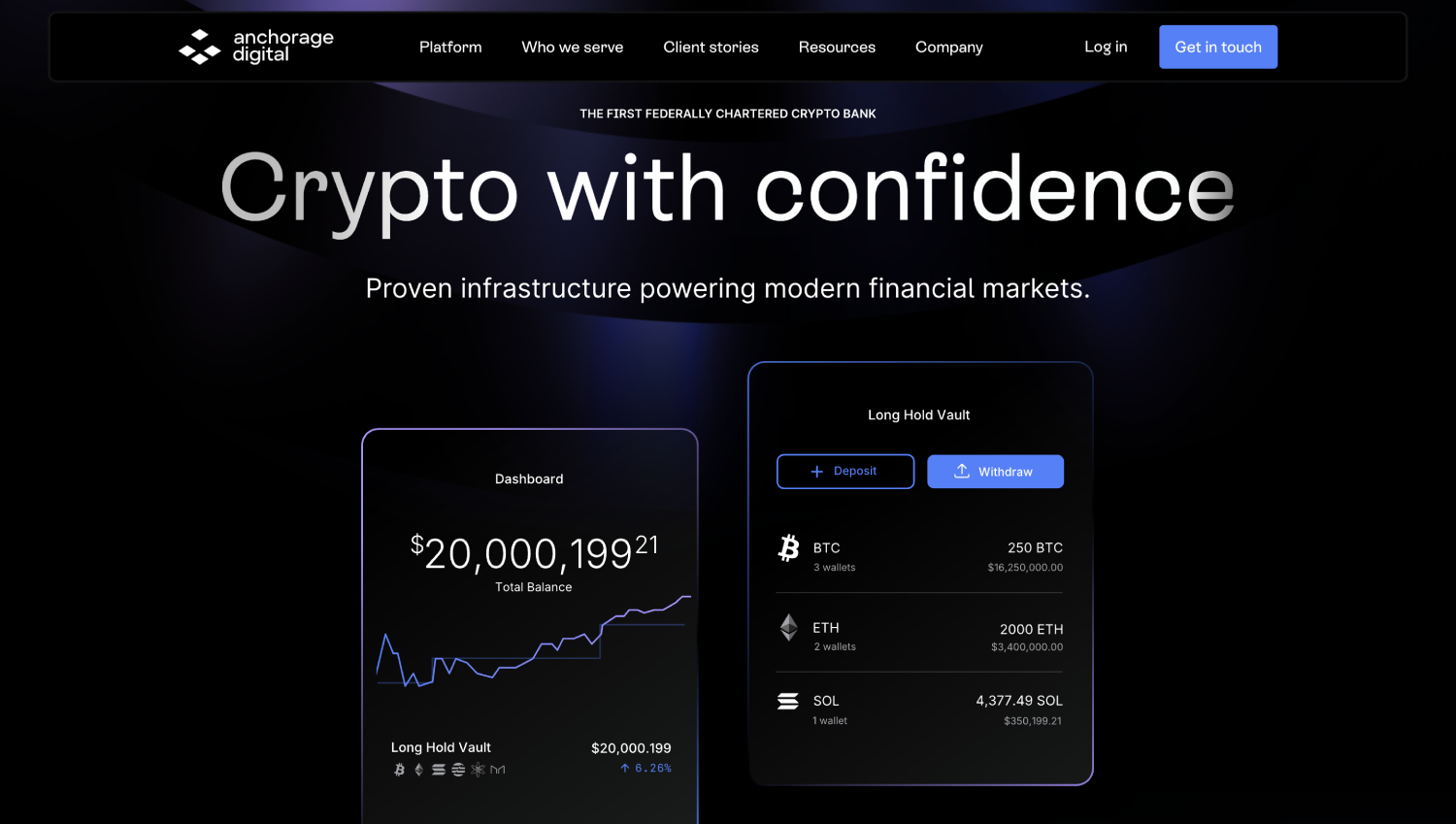
Anchorage Digital holds a federal bank charter from the Office of the Comptroller of the Currency, making it the only federally chartered crypto bank in the United States. For fintechs that need to custody stablecoins under a framework that bank regulators recognize, Anchorage is the only native digital asset institution that clears that bar without relying on a traditional bank partnership.
Anchorage offers custody for stablecoins including USDC, staking infrastructure, and governance participation for institutional clients. Its client base is primarily hedge funds, asset managers, and digital asset funds, but regulated fintechs dealing with large stablecoin balances increasingly need what Anchorage provides: federally regulated custody with the audit trail and reporting that a financial examiner expects.
Anchorage pricing is not publicly available and is structured for institutional clients with meaningful AUM. It is not a vendor for early-stage startups, but it belongs in any shortlist where regulatory standing of the custodian is a board-level requirement.
7. Ondo Finance (Tokenized Yield on Stablecoin Reserves)
Ondo Finance occupies a layer most stablecoin discussions skip: what to do with stablecoin reserves when they are not in motion. Ondo offers tokenized access to short-term US Treasury exposure through products like OUSG (Ondo Short-Term US Government Bond Fund) and USDY, a yield-bearing dollar token. For a fintech or SaaS company holding significant USDC reserves, Ondo’s infrastructure turns idle stablecoin balances into a yield-generating position without leaving the on-chain environment.
This matters practically for B2B SaaS companies that collect payments in stablecoins or hold customer float. Instead of letting that float sit idle in a USDC wallet earning nothing, Ondo allows programmatic allocation to tokenized Treasury exposure and redemption back to USDC. The yield is not guaranteed and depends on prevailing Treasury rates, but the structure creates a treasury management option that a CFO can model against traditional money market alternatives.
Ondo’s products are available to qualified purchasers and institutions, with access restrictions that vary by jurisdiction. US retail access is limited, but the institutional product set is production-grade and used by DeFi protocols and family offices as reserve management tools.
8. Rain (Digital Dollar Accounts and Settlement)
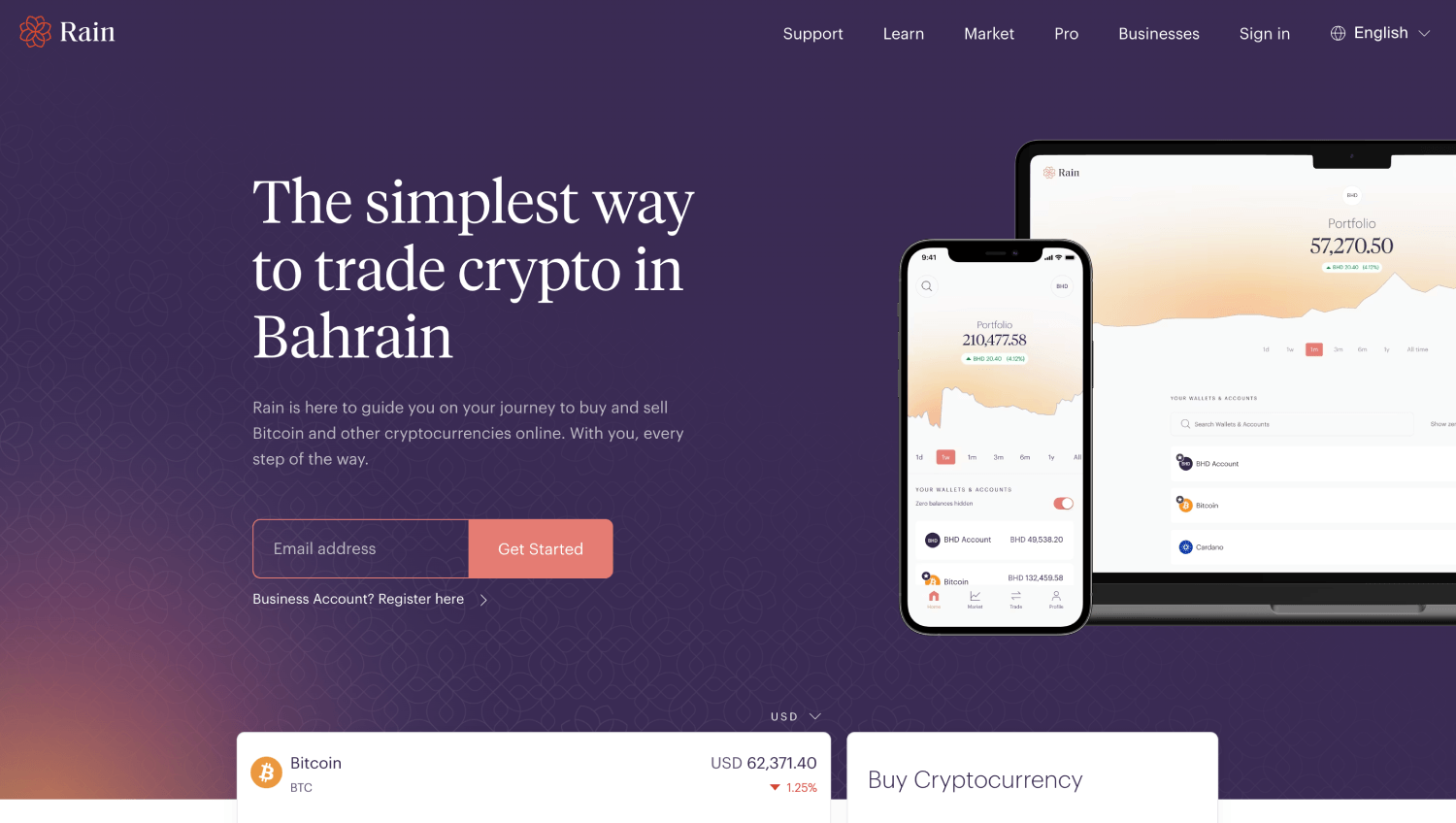
Rain operates at the intersection of stablecoin settlement and enterprise payment infrastructure, offering digital dollar accounts, cross-border settlement on stablecoin rails, and spend management for businesses. Rain’s focus is on replacing slow and expensive SWIFT wires with stablecoin-settled alternatives for enterprise treasury operations and cross-border supplier payments.
Rain is not a crypto company selling into enterprise; it positions itself as payments infrastructure that uses stablecoins as the settlement layer. That framing matters for sales cycles inside traditional finance teams who may reject a “crypto product” but will evaluate a faster, cheaper wire alternative. Rain has appeared in several enterprise fintech evaluations as the operational layer between a company’s bank account and its foreign counterparties.
Rain’s pricing is not public. It targets mid-market to enterprise buyers and is not set up for self-serve onboarding at the same speed as Bridge or Circle’s developer tools.
9. Littio (Cross-Border Digital Dollar Banking)
Littio provides digital dollar accounts and stablecoin-native financial services primarily for companies and individuals operating across Latin America and other emerging markets. For US fintechs serving customers in markets where local currency instability is a real problem, Littio’s infrastructure gives end users access to dollar-denominated accounts settled in USDC without requiring a US bank account.
The use case is narrow but high-value: a B2B SaaS platform paying contractors or vendors in Colombia, Brazil, or Mexico can use Littio’s rails to deliver dollar-denominated value faster and at lower cost than traditional wire alternatives. Littio sits at the on/off-ramp and account management layer rather than the settlement or custody layer, which means it typically complements rather than competes with providers like Circle or Bridge.
10. Eco (Stablecoin Orchestration Layer)
Eco functions as a neutral orchestration layer across the stablecoin infrastructure stack, routing transactions across multiple providers and chains based on cost, speed, and liquidity. According to the provider’s own positioning, Eco acts as a clearinghouse-style abstraction that lets fintechs avoid building direct integrations with each settlement provider independently.
For a product team that wants to support USDC on multiple chains without managing separate integrations for Ethereum, Solana, and Base, an orchestration layer like Eco reduces the engineering surface significantly. The trade-off is that orchestration layers introduce an intermediary in the settlement path, which means an additional dependency to monitor for uptime and compliance purposes.
11. Transak (Fiat On/Off-Ramp Infrastructure)
Transak specializes in fiat-to-crypto and crypto-to-fiat conversion, covering over 160 countries with local payment method support including bank transfers, debit cards, and regional rails. For a fintech that needs to let users convert fiat to USDC or receive stablecoin payments and convert them to local currency, Transak’s on/off-ramp infrastructure handles the regulatory complexity of operating in multiple jurisdictions without requiring the fintech to hold money transmitter licenses in each market.
The on/off-ramp layer is where many stablecoin payment integrations fail in practice. Moving USDC between wallets on-chain is straightforward; getting fiat in or out of the stablecoin stack at scale, across multiple countries, with compliant KYC, is the hard part. Transak’s network of local payment rails and pre-existing regulatory relationships is what makes it worth evaluating at this layer specifically. Transak is also covered in the crypto on-ramp and off-ramp API comparison if you want a deeper provider breakdown at this layer.
How Do These Providers Map to the Five Stablecoin Stack Layers?
| Provider | Primary Layer | Key Asset | Best For | US Regulated |
|---|---|---|---|---|
| Circle | Issuance + Settlement | USDC | Developer-first stablecoin foundation | Yes (GENIUS Act aligned) |
| Stripe/Bridge | Settlement Orchestration | USDC, USDT | Fintechs already on Stripe | Yes |
| BVNK | Treasury + Settlement | USDC, USDT | Enterprise cross-border treasury | UK/EU licensed |
| Fireblocks | Custody + Wallet Infra | Multi-asset | Institutional asset security | Yes (SOC 2 Type II) |
| Paxos | Issuance + Settlement | USDP, PYUSD | Branded/white-label stablecoin issuance | Yes (NY Trust Charter) |
| Anchorage Digital | Custody | Multi-asset | Federally chartered custody requirement | Yes (OCC Charter) |
| Ondo Finance | Treasury Yield | USDY, OUSG | Yield on stablecoin reserves | Qualified purchasers |
| Rain | Account + Settlement | USDC | Cross-border enterprise payments | US-based |
| Littio | Account + On-Ramp | USDC | LatAm and EM digital dollar accounts | Varies by market |
| Eco | Orchestration | Multi-chain | Multi-chain routing abstraction | Varies |
| Transak | On/Off-Ramp | Multi-asset | Global fiat-to-stablecoin conversion | Multi-jurisdiction |
What Stablecoin Stack Should a Fintech Startup Build On?
The answer depends on where your product sits in the value chain and what your compliance posture looks like. A useful starting framework is what FintechSpecs calls the Stablecoin Stack Decision Ladder: four sequential questions that determine which layers you actually need and in what order to build them.
Step one: are you moving money between known counterparties, or are you serving end users directly? Known-counterparty settlement, such as paying a supplier or a partner, requires only the settlement layer and potentially custody. Serving end users requires KYC at the on-ramp, which adds regulatory obligations that most early-stage fintechs underestimate.
Step two: do you need to hold stablecoin balances, or just move them? Holding creates a custody requirement. Moving does not, assuming you use a provider like Bridge that handles custody on your behalf. Step three: do you need to issue your own token, or will USDC or USDT suffice? Most fintechs should use an existing regulated stablecoin rather than issue a new one. Issuance adds regulatory overhead that is only justified when branded differentiation or a specific product mechanic requires a proprietary token. Step four: what is your primary geography? US-focused products can standardize on Circle and Bridge. Cross-border products serving emerging markets need an on/off-ramp provider with local rail access.
A Series A fintech doing cross-border B2B payments should realistically start with Bridge for settlement, Transak or a similar provider for on-ramps in target markets, and defer the custody and yield layers until they have meaningful float. Trying to build all five layers simultaneously is where most stablecoin projects stall before reaching customers.
How Do USDC and USDT Infrastructure Differ for Business Use Cases?
USDC and USDT are both fiat-backed stablecoins pegged to the US dollar, but their infrastructure characteristics and compliance profiles differ in ways that matter for B2B fintech applications. USDC, issued by Circle, publishes monthly reserve attestations from Deloitte and operates under a framework explicitly designed for GENIUS Act compliance. USDT, issued by Tether, has a longer and more contentious regulatory history, though it remains the highest-volume stablecoin by market capitalization.
For US-regulated fintechs, USDC is the defensible choice when compliance review is a requirement. Banking partners, enterprise clients, and regulated counterparties are more likely to accept USDC than USDT in 2026 because of the reserve transparency gap. USDT remains dominant in global trading and certain cross-border corridors, particularly in Asia, where its liquidity advantage is real and the compliance calculus is different.
BVNK and Bridge both support USDT alongside USDC, which means you do not have to choose a single stablecoin at the infrastructure layer. The practical approach is to default to USDC for domestic US compliance-sensitive flows and maintain USDT capability for corridors where liquidity or counterparty preference requires it. Forcing a single stablecoin across all geographies adds friction that a flexible infrastructure provider can eliminate.
What Does Stablecoin Infrastructure Actually Cost to Run?
Consider a B2B SaaS company moving $2 million per month in supplier payments cross-border via traditional bank wire. At a blended cost that industry sources typically cite in the range of $25 to $45 per wire plus an FX spread, figures that vary materially by bank, corridor, and wire volume, the company might spend between $3,000 and $8,000 per month on payment costs depending on wire volume and currency pairs. A stablecoin settlement layer through Bridge or BVNK charges a percentage-based fee on converted volume; neither company publishes a public rate card, so treat any specific percentage as illustrative until confirmed in a commercial conversation.
As a rough planning scenario at 0.2% on $2 million per month, that works out to $4,000 per month in provider fees. Whether that is cheaper than wire depends on current wire costs, the FX spread charged by the bank, and whether the stablecoin settlement eliminates settlement delays that have working capital implications. The hidden cost that most models miss is gas fees on Ethereum mainnet, which can range from negligible to materially expensive depending on network congestion. Layer 2 networks like Base, Arbitrum, or Solana reduce gas costs dramatically and should be the default chain selection for cost-sensitive B2B payment flows.
The costs that actually kill stablecoin projects are not the transaction fees. They are the compliance costs of licensing, KYC/AML infrastructure, and legal review, which according to FintechSpecs’ analysis of compliance costs by funding stage can run $50,000 to $150,000 in the first year before a dollar of volume moves. Stablecoin infrastructure adds a meaningful increment on top of standard fintech compliance overhead, so that baseline matters when building your budget model.
What Are the Biggest Risks When Choosing a Stablecoin Infrastructure Provider?
Counterparty risk at the issuance layer is the one that gets underweighted most. If your settlement infrastructure relies on a stablecoin that loses its peg even temporarily, any in-flight transactions become difficult to reconcile and your end users bear the economic exposure. This is not a theoretical risk; it has happened with algorithmic stablecoins and with USDC briefly during the Silicon Valley Bank event in March 2023. Using a GENIUS Act compliant stablecoin with published reserve attestations does not eliminate this risk, but it reduces the probability and gives you documentation if something goes wrong.
Vendor concentration risk is the second category. Building your entire stablecoin stack on a single provider, particularly one that handles custody, settlement, and on-ramps simultaneously, means a single point of failure across your payment operations. The more operationally critical stablecoin rails become to your product, the more important it is to have fallback paths at each layer. Evaluating vendor risk before signing multi-year contracts is covered in the vendor risk management tools guide if you want a structured approach.
Regulatory risk is real but has decreased materially since the GENIUS Act. The remaining risk is jurisdictional: a stablecoin infrastructure provider that is well-regulated in the US may not be licensed to operate in every market your product serves. Before building on any provider, verify their licensing status in your target geographies, not just their US compliance posture.
How Should Fintechs Evaluate Stablecoin Infrastructure Providers Before Signing?
The FintechSpecs Stablecoin Provider Stress Test is a four-check framework for evaluating any stablecoin infrastructure vendor before a contract is signed. First, reserve verification: can you access third-party reserve attestations for the stablecoin(s) the provider uses or issues? If not, decline. Second, licensing coverage: does the provider hold the relevant licenses in every geography where you will operate? A US money transmitter license does not cover cross-border flows into the EU or LatAm. Third, chain and asset flexibility: does the provider support the networks and stablecoins your product needs today, and can they add new ones without a re-integration? Providers that lock you to a single chain create migration costs later. Fourth, incident history: has the provider experienced any custody incident, security breach, or peg deviation in the past 24 months, and how did they handle disclosure and remediation?
The stress test is designed to be run in a 60-minute discovery call, with documentation requests sent before the meeting. Most vendors who cannot answer these four questions with specific, documented answers are not production-ready for a regulated fintech. The fintech vendor evaluation framework goes deeper on the full commercial and technical diligence process if you need a more comprehensive template.
Pricing negotiation follows compliance verification, not the reverse. Too many teams negotiate price before confirming regulatory coverage, then discover mid-implementation that the vendor does not support their target market. Fix the sequence.
Frequently Asked Questions About Stablecoin Infrastructure Providers
Who are the biggest stablecoin infrastructure providers for enterprise fintechs?
Circle, Fireblocks, Paxos, and Stripe/Bridge are the largest by institutional adoption in the United States. Circle anchors the USDC issuance layer. Fireblocks dominates institutional custody. Paxos handles regulated white-label issuance. Bridge, now part of Stripe, is the dominant API-first settlement layer for developer teams. BVNK is the leading enterprise treasury and settlement provider for cross-border operations, particularly for companies with European and global exposure.
What is the difference between a stablecoin issuer and a stablecoin infrastructure provider?
A stablecoin issuer mints and redeems the token and holds the backing reserves. Circle and Paxos are issuers. A stablecoin infrastructure provider builds the rails, APIs, custody, or account management tools that let other companies use stablecoins in their products. Fireblocks, Bridge, and BVNK are infrastructure providers. Most fintechs need infrastructure providers, not issuance capabilities. Issuing your own stablecoin requires regulatory licensing and reserve management that most startups should not take on before Series C at the earliest.
Is USDC or USDT better for B2B fintech applications in the US?
USDC is the default choice for US-regulated B2B fintech applications. Circle publishes monthly reserve attestations from Deloitte, and USDC is explicitly designed for GENIUS Act compliance. USDT has higher global liquidity and is preferred in certain international corridors, particularly in Asia, but its reserve transparency has been historically weaker and it is harder to defend to compliance teams at regulated institutions. Most US fintechs start with USDC and add USDT support only where a specific geography or counterparty requires it.
Do I need a money transmitter license to use stablecoin infrastructure?
It depends on your business model and what you are doing with the stablecoins. If you are moving stablecoins on behalf of users and holding funds in transit, most US states will consider you a money transmitter. If you are a business settling your own supplier payments or managing your own treasury, the licensing picture is different. Using a licensed provider like Bridge or Transak for on/off-ramps shifts the MTL burden to the provider in many cases, but it does not eliminate your obligation to understand the regulatory treatment of your specific use case. Get a legal opinion specific to your product before going live.
What chains should a fintech build stablecoin infrastructure on?
Solana and Base are the two best defaults for cost-sensitive B2B payment flows in 2026. Both support USDC natively through Circle, both have sub-second finality, and both have gas costs low enough that transaction fees do not eat materially into payment economics. Ethereum mainnet remains important for settlement involving DeFi protocols or institutional counterparties who require it. Arbitrum is a reasonable secondary option for Ethereum-compatible flows where gas cost matters. Building chain-agnostic from day one, using a provider like Bridge or Eco that abstracts chain selection, reduces migration costs later.