
- Building a fraud orchestration platform in-house takes 12 to 18 months before it matches the baseline capabilities of a mid-tier vendor, and that estimate assumes you already have machine learning engineers, risk analysts, and data infrastructure on staff.
- The real cost of building is not the initial engineering sprint. It is the ongoing headcount required to maintain rules, retrain models, respond to novel attack patterns, and satisfy auditor requests.
- Most teams that choose “build” are actually choosing to delay launch by a quarter or more, during which fraud losses accrue against unprotected transaction volume.
- A feature checklist and a sales demo cannot surface contract lock-in, model opacity, compliance gaps, or what happens when your fraud rate spikes and the vendor’s SLA says “reasonable efforts.”
- A structured proof-of-concept or RFP, run against your actual transaction data, exposes these risks before the contract is signed.
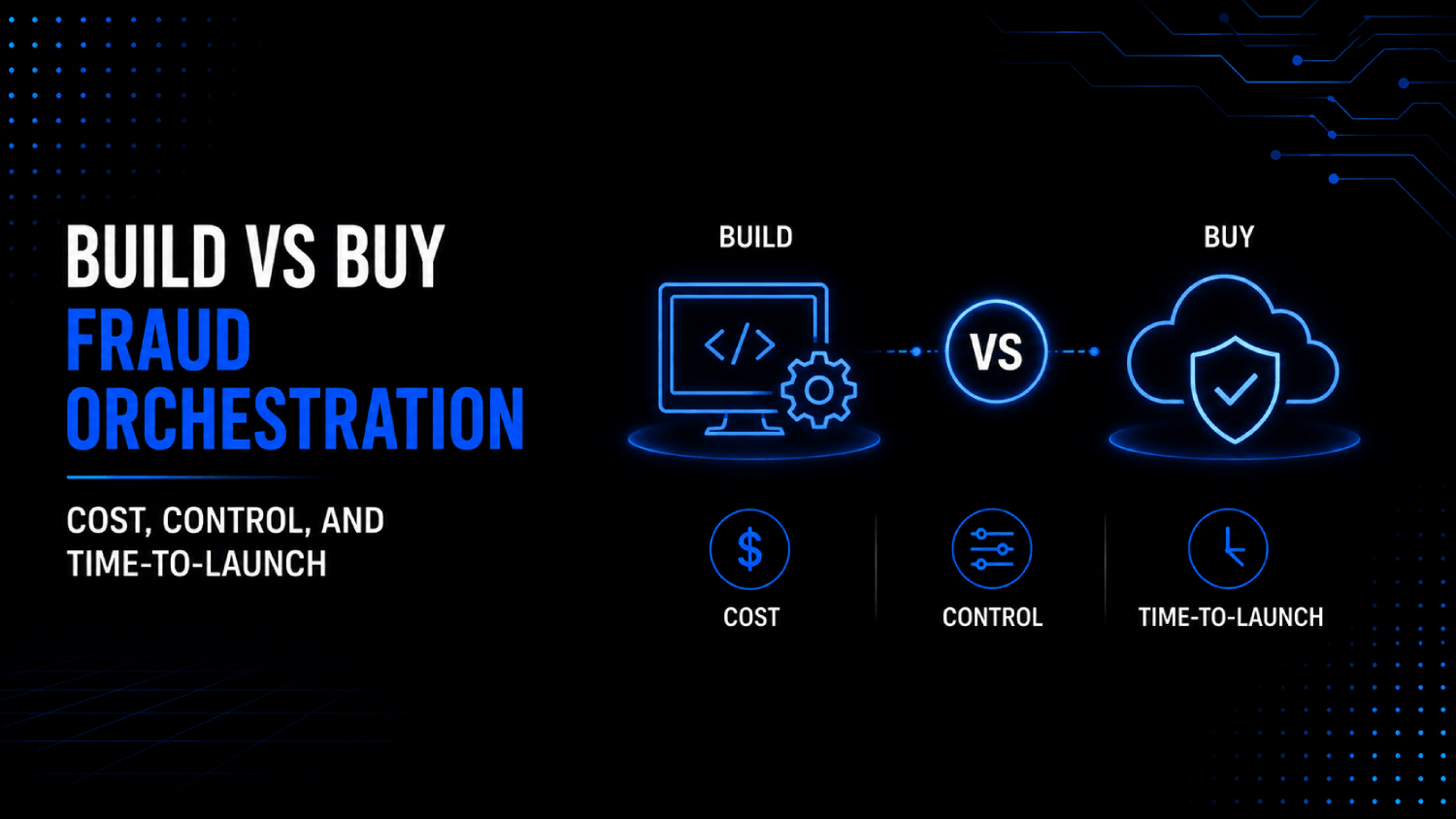
For most fintech companies under $50M in annual payment volume, the build vs buy fraud orchestration decision resolves in favor of buying: it is faster, cheaper over a 24-month horizon, and lower risk than building from scratch. Companies above that threshold, or those with regulatory requirements that commercial vendors cannot meet, face a different calculation. The decision depends on three variables: your fraud surface area, your engineering capacity, and how much operational control your compliance posture actually requires.
What Is Fraud Orchestration and Why Does the Build-vs-Buy Question Matter Now?
Fraud orchestration is the coordination layer that sits above individual detection signals. It connects device intelligence, identity verification, transaction monitoring, behavioral analytics, and rules engines into a single decisioning workflow, then routes each transaction or user action to an accept, decline, or review outcome.
A rules engine alone is not fraud orchestration. Rules engines fire conditions against known patterns. Orchestration adds model scoring, signal weighting, feedback loops, case management, and audit trails. If you are evaluating whether to build or buy, you need to be precise about which layer you are actually building, because the engineering lift is very different.
The question has sharpened recently because the vendor market matured. Platforms like Unit21, Alloy, SEON, Sardine, and Featurespace now cover orchestration, case management, and model management in a single contract. That changes the build calculus significantly. Five years ago, buying meant stitching together three or four vendors. Today it often means one API and a configuration UI. That does not make buying automatic. But it raises the bar for what “build” has to beat.
What Does It Actually Cost to Build a Fraud Decisioning Platform?
The honest answer is that most teams underestimate the cost by a factor of two or three, because they scope the initial build and forget the maintenance tail.
A realistic build breaks into three cost buckets. First, there is the initial engineering investment: data pipelines, model training infrastructure, a rules engine with a UI that non-engineers can actually operate, case management tooling, and integrations to your identity, payment, and core banking layers. Second, there is the ongoing operations cost: a risk analyst or fraud analyst to tune rules and review cases, an ML engineer to retrain models as fraud patterns shift, and a compliance engineer to produce audit artifacts for your sponsor bank or regulator. Third, there is the opportunity cost of engineering time that is not going into your core product.
Consider a Series B lending platform processing $8M per month. At that volume, even a 0.5% fraud rate represents $40,000 in monthly losses. The pressure to launch fraud controls is real. But the engineering team needed to build a production-grade orchestration layer, including rules management, model inference, case queuing, and audit logging, realistically requires three to five engineers for six to nine months before the system handles edge cases reliably. That estimate assumes senior engineer compensation in the US, a team of three to five engineers, and a six-to-nine-month timeline to production , putting the fully-loaded engineering cost at roughly $600,000 to $1.2M before the first rule fires in production. Buying a vendor contract at $60,000 to $120,000 per year looks different against that comparison.
This pattern appears consistently across fintech infrastructure decisions. As covered in 15 Hidden Costs Killing Your Fintech SaaS Margins, the costs that damage fintech unit economics are rarely the line items that appear in the original budget.
The Ongoing Maintenance Problem
Fraud patterns are not static. Card testing attacks evolve weekly. Synthetic identity techniques shift in response to KYC changes. Account takeover methods adapt to MFA deployments. An in-house platform requires continuous model retraining, rule updates, and integration work as your stack changes. Risk practitioners who have shipped production fraud systems consistently report that annual maintenance consumes more engineering time than the original build , a pattern documented in post-mortems across fintech infrastructure teams, though no single published study has quantified it definitively. The build cost is not a one-time event.
Vendor platforms, in contrast, update their models against consortium data from every client on the platform. A fraud attack that hits one fintech gets incorporated into the detection layer that protects all of them. That network effect is genuinely difficult to replicate in-house unless your transaction volume is large enough to train statistically meaningful models on your own data alone.
What Does It Cost to Buy a Fraud Orchestration Vendor?
Vendor pricing for fraud orchestration platforms is rarely public, and most vendors do not publish per-transaction rates. Pricing typically follows one of three structures: a platform fee plus per-transaction cost, a volume-tiered annual contract, or a revenue-share model tied to fraud losses prevented.
From publicly available information and vendor positioning, entry-level contracts for platforms serving seed-to-Series A companies generally start in the range of $2,000 to $5,000 per month for modest transaction volumes. Enterprise contracts at higher volume can run into six or seven figures annually. The exact figure depends on transaction count, the number of signals purchased, and whether you are buying the rules engine only or the full orchestration stack including case management and model scoring.
What vendors rarely make visible during a sales demo are the costs that appear after signing. These include professional services fees for initial configuration, per-seat pricing for analysts accessing the case management UI, data egress costs if you want to export your own decisioning history, and minimum volume commitments that create financial risk if your transaction volume drops.
| Cost Category | Build In-House | Buy Vendor Platform |
|---|---|---|
| Initial investment | $600K-$1.2M+ (engineering time, 6-12 months) | $0-$50K (integration, onboarding, professional services) |
| Ongoing annual cost | $300K-$600K (1-2 FTE risk/ML engineers) | $24K-$200K+ (contract, volume-dependent) |
| Time to first rule in production | 6-18 months | 4-12 weeks |
| Model update frequency | Depends on internal ML capacity | Continuous (vendor-managed, consortium data) |
| Compliance audit support | Must build internally | Varies by vendor; often included |
| Customization depth | Full | Limited to vendor’s configuration layer |
| Lock-in risk | None | High (data portability, model opacity) |
When Does Building In-House Actually Make Sense?
Build makes sense in four specific situations, and most companies claiming they are in one of these four situations are actually not.
The first is genuine regulatory mandate. Some bank partnership agreements or regulatory frameworks require that fraud decisioning logic remain proprietary and cannot be hosted on a third-party platform. If your sponsor bank or primary regulator has stated this in writing, build is not optional. Verify it in writing before scoping the build, though, because sales teams at vendors that work with regulated entities will often tell you this is not actually a hard requirement.
The second is proprietary data advantage. If your company sits on a genuinely distinctive data asset , a novel behavioral signal or a proprietary alternative data source that no vendor can ingest or model against , building lets you exploit that advantage. Fintech lenders using non-traditional underwriting signals sometimes fall into this category.
The third is transaction volume that makes model training economically viable in-house. Without sufficient data volume, your internally trained models will underperform consortium-trained vendor models. The exact threshold depends on the fraud type and attack frequency, but companies processing fewer than one million transactions per month typically do not have enough fraud signal volume to train competitive models without consortium data.
The fourth is a strategic moat decision. If fraud detection is not just an operational necessity but a core product feature, and your competitive differentiation depends on a better fraud experience than competitors, building may be worth the investment. Even here, the more common answer is to build orchestration logic on top of vendor-supplied signals rather than replacing the vendor entirely.
The FintechSpecs Fraud Architecture Scorecard
Before issuing an RFP or committing to a build, score your situation against these weighted criteria. This framework, which we call the FintechSpecs CTRL Matrix (Cost, Time, Risk, Control), is designed to cut through the noise of vendor demos and internal advocacy for building.
How to Use the CTRL Matrix
Rate each item from 1 (strongly favors build) to 5 (strongly favors buy). Weight each category as indicated. Sum the weighted scores. A total above 70 favors buying. A total below 40 favors building. The range in between requires deeper POC work before committing.
| Criterion | Weight | Build Signal (Score 1-2) | Buy Signal (Score 4-5) |
|---|---|---|---|
| Time to production requirement | 25% | 12+ months acceptable | Under 90 days required |
| In-house ML/risk engineering capacity | 20% | Dedicated team exists today | No ML or fraud engineering staff |
| Transaction volume for model training | 20% | 1M+ transactions/month with fraud labels | Under 500K transactions/month |
| Regulatory/data residency constraints | 15% | Hard requirement for in-house decisioning | No hard regulatory constraint |
| Fraud surface complexity | 10% | Highly proprietary, distinctive attack vectors | Standard fintech fraud patterns |
| Internal product roadmap capacity | 10% | Fraud infra is a planned core product feature | Engineering bandwidth is constrained |
Disqualifying Questions
These questions do not affect the scorecard score. A “no” to any of them should pause the build decision regardless of the total score.
- Do you have at least one engineer who has shipped a production fraud model and can describe the retraining cycle they used?
- Has your legal or compliance team reviewed whether vendor-hosted decisioning is permissible under your bank partnership agreement?
- Do you have labeled fraud data from at least six months of transaction history, or a plan to acquire it?
- Is your engineering team’s current roadmap capacity sufficient to absorb a 6-to-12-month fraud infrastructure project without delaying core product features?
- Does your CFO understand that the initial build cost does not include the ongoing maintenance cost, and has that been modeled over a 24-month window?
What Should a Fraud Orchestration POC Actually Test?
A demo shows you a vendor’s best-case scenario on synthetic data. A proof-of-concept run against your actual transaction history shows you whether the platform can detect your actual fraud patterns.
Most teams run POCs that are too short, use too-clean data, and measure the wrong outcome metrics. A meaningful fraud orchestration POC should run for at least 30 days on real historical data and measure against outcomes you can independently verify.
POC Success Metrics
Define these before the POC starts, not after. Vendors who push back on pre-agreed success criteria are a signal worth noting.
| Metric | What It Measures | Minimum Threshold for Vendor Consideration |
|---|---|---|
| False positive rate | Legitimate transactions declined | Vendor should match or beat your current rate |
| True positive rate (detection rate) | Fraudulent transactions correctly caught | Improvement over current baseline required |
| Time to first alert | How fast real-time decisioning fires | Under 300ms for synchronous payment flows |
| Rule configuration time | How long to create and deploy a new rule | Under 30 minutes for a non-engineer analyst |
| Audit trail completeness | Can you explain every decision to an auditor? | Every decision must have a logged, exportable reason code |
| Data portability test | Can you export your full decisioning history? | Full export in a standard format within 24 hours |
| Model explainability | Can your risk team see why the model scored a transaction? | Feature-level explanation available without vendor professional services |
The false positive rate deserves particular attention. Fraud prevention teams often focus on catch rate, but false positives create direct revenue loss and damage user experience. A vendor who catches 20% more fraud but declines 5% more legitimate transactions may be a net negative for your business depending on your average transaction value and customer acquisition cost. The trade-off between fraud prevention and user experience is one of the most consequential decisions fintech teams face, and vendors who gloss over false positive rates in demos are not doing you a favor.
How to Structure a Fraud Orchestration RFP
Most fraud orchestration RFPs are too focused on features and not focused enough on operational risk, compliance posture, and contractual terms. A feature checklist comparison between Alloy, Unit21, SEON, and Sardine will tell you what each platform can do. It will not tell you what happens when your fraud rate spikes 300% over a weekend, how the vendor’s SLA is actually enforced, or what your data looks like if you need to migrate off the platform in 18 months.
Required RFP Sections
Beyond the standard feature and pricing questions, include these sections explicitly:
- Incident response: Describe the procedure and timeline when a novel fraud attack pattern emerges. Who is the named contact? What is the maximum response time before a rule update is deployed?
- Model transparency: What features does the fraud model use? Which of those features are derived from consortium data vs. your own transaction data? Can you audit the model weights?
- Data ownership: Who owns the fraud labels generated from your transactions? Can those labels be used to train models that serve other clients?
- Subprocessors and data residency: List every subprocessor that touches transaction data. Where is data stored and processed?
- Exit terms: What is the data export procedure? What format? What is the timeline? Are there fees for data retrieval at contract end?
- Compliance artifacts: What documentation does the vendor provide for BSA/AML audits, PCI DSS assessments, or regulatory examinations?
Contract Red Flags
These terms appear in vendor contracts often enough to warrant a specific list. Each one should trigger a negotiation or a harder look at alternatives.
- SLA language that says “commercially reasonable efforts” rather than specifying a numerical uptime guarantee with financial remedy for breach.
- Auto-renewal clauses with renewal notice windows shorter than 60 days, which functionally trap you into a renewal before you have time to run a competitive evaluation.
- Provisions that allow the vendor to use your transaction data to improve models that serve other clients, without your explicit consent per transaction type.
- Pricing structures that tie your contract value to transaction volume with no cap, creating unbounded cost exposure as you scale.
- Exclusivity or preferred-vendor language that limits your ability to run a second fraud vendor in parallel for redundancy or A/B testing.
- Indemnification caps set at the value of your annual contract fee, which may be far below the actual cost of a fraud breach or regulatory fine attributable to vendor failure.
For a broader view of fintech vendor evaluation, How to Evaluate a Fintech Vendor Before You Sign: A 7-Point Buyer Framework covers due diligence methodology that applies directly to this process.
What Architecture Does an In-House Fraud Platform Actually Require?
Teams scoping a build often start with the rules engine and stop there. Production fraud orchestration requires more layers, and each one adds engineering complexity and maintenance cost.
At minimum, a functional in-house fraud orchestration platform requires: a data ingestion layer that normalizes events from payment, identity, and device sources in real time; a feature store that computes and serves fraud signals at low latency; a rules engine with a non-technical UI for risk analysts; a model inference endpoint that scores transactions against trained ML models; a case management system for manual review queues; an audit logging layer that records every decision with its full input state; and a feedback loop that labels reviewed cases and routes them back into model training data.
The feature store and real-time inference components are where most in-house builds stall. Serving model features at sub-100ms latency, at scale, requires either significant infrastructure investment or a managed ML platform like Databricks or Vertex AI, which add their own cost and complexity. Teams that underestimate this often launch with a rules-only system, discover their false negative rate is unacceptable, and then face a second build project to add model inference on top.
The compliance layer compounds this. Regulated fintechs need audit-ready decision records that satisfy BSA/AML examination standards. Building an audit logging system that satisfies a bank examiner is different from building application logging that satisfies a developer. Many teams build the latter and discover the gap only when their sponsor bank requests documentation. For a detailed view of compliance costs by stage, The Real Cost of Compliance in FinTech SaaS, Broken Down by Stage is worth reading before finalizing a build vs. buy decision.
The Hybrid Path Most Teams Overlook
The build vs. buy framing implies a binary choice. Most mature fraud teams operate on a hybrid architecture that buys signal and orchestration infrastructure but builds proprietary rules and models on top of it.
A common pattern: buy a vendor platform for device intelligence, identity verification, and consortium-model scoring, then build custom rules and a secondary model layer on top of the vendor’s API output using your own data. This approach captures the vendor’s network effect and time-to-launch advantage while preserving control over proprietary decisioning logic. Platforms like Sardine and SEON are designed to support this model, exposing raw signal outputs that allow clients to build on top rather than treating the platform as a black box.
The hybrid path is not free of risk. It can create decision attribution complexity, where it becomes unclear whether a wrong outcome was caused by vendor signal error or your own rules logic. It also creates a partial dependency on the vendor: you have invested in integration depth without the full flexibility of a wholly owned system. Run the disqualifying questions above against the vendor API layer, not just the full platform, before committing.
Frequently Asked Questions
What is fraud orchestration and how does it differ from a fraud rules engine?
A fraud rules engine evaluates transactions against static or dynamic conditions and returns a pass or fail. Fraud orchestration is the broader system that coordinates multiple detection signals, including rules, ML model scores, device intelligence, and behavioral analytics, into a single workflow, routes outcomes to accept, decline, or review queues, and maintains case management and audit logs. Rules engines are one component of fraud orchestration, not a substitute for it.
How much does it cost to build a fraud platform in-house?
A production-grade in-house fraud orchestration platform typically requires three to five senior engineers for six to twelve months before it handles edge cases reliably. At US senior engineer compensation rates, the initial build cost runs $600,000 to $1.2M or more before accounting for infrastructure. Ongoing maintenance requires at least one dedicated risk engineer and one fraud analyst annually. Most teams underestimate total cost by ignoring the maintenance tail, which often exceeds the initial build cost over a 24-month horizon.
When should a fintech company buy a fraud orchestration vendor rather than build?
Buying is the right default for companies that lack a dedicated ML or fraud engineering team, need production fraud controls in under 90 days, process fewer than one million transactions per month, or have no hard regulatory constraint requiring in-house decisioning. At these parameters, vendor platforms reach production faster, benefit from consortium fraud data, and cost less than internal builds over a 24-month total cost of ownership comparison. Build only when you have a genuine data advantage, a regulatory mandate, or transaction volume sufficient to train competitive in-house models.
What should a fraud orchestration POC measure?
A POC should measure false positive rate, true positive rate, real-time decision latency, time to deploy a new rule, audit trail completeness, and data portability. Run it for at least 30 days on real historical transaction data, not synthetic data or vendor-provided demos. Define success thresholds before the POC starts. Vendors who resist pre-agreed thresholds or push to run the POC on their own sample data are signaling something worth investigating.
What are the biggest contract red flags in fraud vendor agreements?
The most consequential red flags are SLA language that says “commercially reasonable efforts” without numerical uptime guarantees, auto-renewal clauses with notice windows shorter than 60 days, provisions permitting the vendor to use your transaction data in models that serve other clients, unbounded volume-based pricing with no cap, and indemnification limits set at annual contract value rather than actual exposure. Exit terms covering data export format, timeline, and cost are often missing entirely from initial contract drafts and must be negotiated explicitly.
Does buying a fraud vendor create compliance or audit risk?
It can, depending on your regulatory context. Sponsor bank agreements sometimes require that fraud decisioning logic be documented and reviewable by bank examiners. If a vendor treats its models as proprietary black boxes and does not provide feature-level explanations, you may not be able to satisfy that requirement. Before signing, confirm in writing that the vendor can provide decision-level audit artifacts, a list of all subprocessors handling transaction data, and data residency documentation suitable for regulatory examination. Some vendors charge for this documentation as a professional service add-on.
What is the hybrid approach to fraud orchestration?
The hybrid approach buys vendor-supplied fraud signals and orchestration infrastructure while building proprietary rules and secondary model layers on top of the vendor API. This captures the vendor’s consortium data advantage and time-to-launch speed while preserving internal control over custom decisioning logic. It works best when the vendor exposes raw signal outputs rather than only a final decision score. Platforms designed for this model provide API access to individual signal components. The risk is decision attribution complexity if a wrong outcome is unclear whether it originated from vendor signal error or internal rules logic.
How do I choose between fraud vendors once I’ve decided to buy?
The category comparison of top fraud orchestration platforms is a separate evaluation from the build vs. buy question. Once you have decided to buy, structure your vendor comparison around a live POC on your own transaction data, using the success metrics above, rather than feature matrix comparisons. Top 5 Fraud Orchestration Platforms for High-Growth Fintech Teams covers vendor-level differentiation and is the appropriate next step after this decision guide.
The Decision Before the Decision
Most teams that come to the build vs buy fraud orchestration question have already formed a preference, shaped by an engineer who wants to build something interesting, a CFO who sees vendor contracts as recurring cost to eliminate, or a demo that made a platform look effortless. The actual work of this decision is stress-testing that preference against real data: your transaction volume, your engineering headcount, your compliance requirements, and what a 24-month total cost model actually looks like when you include maintenance.
A structured POC or RFP does not just help you choose a vendor. It exposes whether the build option is actually scoped correctly, whether the vendor you are considering can meet your compliance requirements in writing, and whether the contract terms you are being offered reflect a real partnership or a lock-in structure dressed as one. 10 Critical Mistakes When Choosing Fintech Infrastructure maps almost perfectly onto the moments where build vs. buy decisions go wrong: optimistic timelines, underscoped maintenance costs, and contract terms that seemed fine until they were not.
Run the CTRL Matrix. Run the disqualifying questions. Run a 30-day POC with pre-agreed thresholds. The answer you get from that process will be more durable than anything a sales demo or an internal advocate can give you.