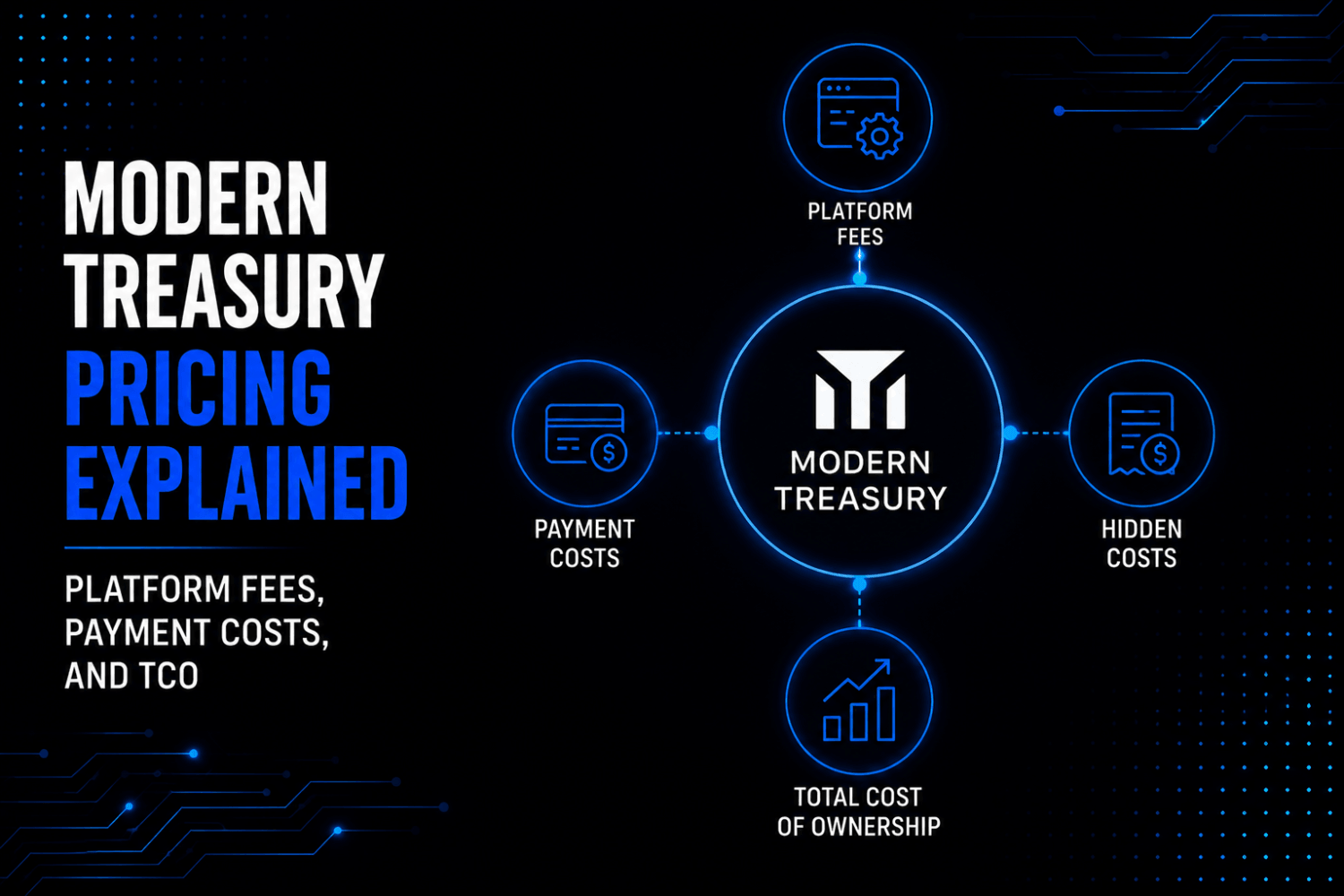

- Modern Treasury does not publish a standard rate card. All pricing is quote-based, and the number you get depends heavily on payment volume, payment mix, and how well you negotiate before signing.
- The platform fee is only one layer. Per-transaction fees, implementation costs, support tiers, and data access charges stack on top, and buyers routinely underestimate total cost of ownership by 40% or more.
- Buyer-reported contract minimums typically start in the range of $2,000 to $5,000 per month, with enterprise deals running significantly higher once usage fees are included.
- Three categories of hidden cost catch teams off guard: overage charges on payment rails, fees for premium support or dedicated onboarding, and costs tied to third-party bank connections that Modern Treasury does not directly control.
- Alternatives exist at lower price points, but switching carries real migration risk. Get competing quotes before signing, not after.
Modern Treasury pricing is entirely custom and contact-gated. The company’s public pricing page confirms usage-based pricing across ACH, wires, RTP/FedNow, push-to-card, and stablecoins, but publishes no rate card. Buyer-reported platform minimums typically fall between $2,000 and $5,000 per month before per-transaction fees are applied. A realistic first-year total cost of ownership for a Series A or B company running moderate payment volume lands between $60,000 and $180,000, depending on rail mix and implementation complexity. You need at least three competing quotes to know whether the number you are offered is market rate.
What Does Modern Treasury Actually Do, and Why Does It Affect Pricing?
Modern Treasury is a payment operations platform that sits between your product and your bank, providing a unified API to initiate ACH, wire, RTP, FedNow, push-to-card, and stablecoin payments, alongside ledgering, reconciliation, and approval workflows. It is not a payment processor in the Stripe sense. It does not hold funds or act as a money transmitter. It connects to your existing bank or banking partner and provides the orchestration layer on top.
That distinction matters for pricing because Modern Treasury’s fees cover software access and API calls, not interchange or bank fees. Your bank’s own transaction fees are separate and additive. A company moving money through JPMorgan Chase or Silicon Valley Bank via Modern Treasury pays Modern Treasury’s platform and per-transaction fees, then pays the bank’s own wire or ACH fees on top. Many buyers miss this double-layer structure when building their initial budget.
The platform’s positioning targets fintech companies, vertical SaaS platforms, and any company where payment operations is a product function rather than a back-office afterthought. That target market tends to have higher willingness to pay, which shapes how Modern Treasury structures its pricing conversations.
What Are Modern Treasury’s Confirmed Public Pricing Details?
Modern Treasury’s public pricing page confirms that pricing is usage-based and scales with payment volume. It does not list a single per-transaction rate for any payment method. The page states that pricing varies by payment method and is optimized for cost and speed, but exact figures require contacting sales.
What is publicly confirmed: the model is usage-based, not seat-based or feature-tiered in the traditional SaaS sense. You are not paying for user licenses. You are paying for API calls, payment initiations, and potentially for certain platform capabilities depending on your contract structure.
What is not publicly confirmed: specific per-transaction rates for ACH, wire, RTP, FedNow, push-to-card, or stablecoin rails. Platform minimums. Implementation fees. Support pricing. Data export or webhook fees.
What Do Buyers Actually Report Paying? The FintechSpecs Cost Layer Model
Because Modern Treasury does not publish rates, the most reliable signal comes from aggregated buyer reports and procurement disclosures across fintech communities. The following framework, which FintechSpecs calls the Cost Layer Model, breaks the total bill into five discrete layers. Knowing each layer before you enter the sales process is the only way to avoid sticker shock at contract review.
Layer 1: Platform Minimum
Buyer reports from procurement forums and fintech Slack communities suggest platform minimums in the $2,000 to $5,000 per month range for companies at the seed-to-Series B stage. Larger enterprise deployments, particularly those with complex multi-entity structures or high payment volumes, may carry minimums well above that. The minimum is a floor, not a ceiling. If your usage fees exceed the minimum, you pay usage. If they fall below, you pay the minimum.
Layer 2: Per-Transaction Fees
Modern Treasury’s pricing page confirms that fees differ by payment rail. ACH is generally the cheapest rail, with per-transaction costs that buyers report in the range of a few cents to around $0.50 per payment depending on volume commitments. Wire transfers carry higher per-transaction rates. RTP and FedNow, the real-time rails, command a premium. Push-to-card fees vary by card network rules. Stablecoin payments are a newer addition, and pricing for that rail is not widely reported yet in buyer communities.
The rail mix in your contract matters more than the headline platform fee. A company that primarily moves payroll via same-day ACH has a very different effective rate than one running high-value wires for insurance disbursements or real-time payouts through FedNow.
Layer 3: Implementation and Onboarding
Modern Treasury does not publicly list implementation fees. Buyer reports suggest that straightforward integrations for teams with existing API experience can be completed without a paid professional services engagement, but complex deployments involving multi-bank connections, custom ledger structures, or approval workflow configuration often require either a paid onboarding package or significant internal engineering time. One benchmark from fintech forums puts internal engineering costs for a mid-complexity implementation at 4 to 8 weeks of developer time. At a fully loaded engineering cost of $15,000 to $20,000 per month , an illustrative figure based on commonly cited mid-market engineering benchmarks, not a verified industry standard , that translates to $30,000 to $40,000 in internal cost that never appears on your Modern Treasury invoice.
Layer 4: Support Tiers
Standard support is included, but access to dedicated account management, faster SLA response times, or implementation support may be gated behind a higher contract tier. This is standard practice across payment infrastructure vendors. If your team needs hands-on support during a high-stakes go-live, ask specifically what support SLA your contract tier covers before signing.
Layer 5: Bank Connection and Data Fees
Modern Treasury connects to banks via direct integrations, and the terms of those connections vary. Some buyers report that certain bank connectivity features or data access capabilities carry additional charges depending on the banking partner involved. Webhook delivery, data exports, and API call volumes above certain thresholds are worth clarifying in your contract negotiation. These are the fees that appear on month-three invoices when no one expected them.
Three Usage-Band Cost Models: What Does Modern Treasury Cost at Different Scales?
The following scenarios are illustrative models built from buyer-reported ranges and publicly available information. They are not guaranteed quotes. Use them as a starting point for your own budget exercise, then adjust based on your rail mix and negotiated rates.
| Usage Band | Profile | Est. Monthly Platform + Usage | Est. Implementation (Year 1) | Est. Year 1 TCO |
|---|---|---|---|---|
| Early Stage | Series A, 500-2,000 payments/month, primarily ACH | $2,000 to $4,000/month | $20,000 to $35,000 (internal eng) | $44,000 to $83,000 |
| Growth Stage | Series B, 5,000-20,000 payments/month, mixed rails | $6,000 to $15,000/month | $30,000 to $50,000 (internal + vendor) | $102,000 to $230,000 |
| Scale Stage | Series C+, 50,000+ payments/month, multi-rail, multi-entity | $20,000 to $50,000+/month | $50,000 to $100,000 | $290,000 to $700,000+ |
The early-stage band is where the minimum floor does the most damage. If you are processing 500 ACH payments per month and your usage fees would naturally fall at $800, you are still paying $2,000 or more. That effective per-transaction cost looks nothing like the per-unit rate in your contract. Model both the floor scenario and the volume scenario before projecting costs at low payment volumes.
At the growth stage, rail mix becomes the dominant variable. A company running 10,000 ACH credits per month has a meaningfully lower bill than one running 10,000 same-day ACH or RTP credits at the same count. Build your cost model by payment type, not just by transaction count.
What Hidden Fees Do Modern Treasury Buyers Encounter After Go-Live?
Three categories of cost surprise buyers consistently after they have already integrated. Knowing them in advance gives you something specific to negotiate or clarify at contract time.
Return and Reversal Fees
ACH returns, wire recalls, and payment reversals may carry separate processing fees. These are low-frequency events for most companies, but for businesses with any meaningful payment failure rate, they add up. Ask specifically: does the contract include fees for returned ACH credits, NOCs (notifications of change), and wire recalls?
Approval Workflow and User Seat Ambiguity
Modern Treasury includes approval workflows as part of its core product. What is less clear is whether adding finance team members or auditors to the approval flow triggers any additional user-access charges at higher tiers. Confirm this before your finance or compliance team needs direct platform access.
Bank-Side Pass-Through Fees
This is the most commonly overlooked cost. Modern Treasury’s fee sits on top of your bank’s own transaction fees. A same-day ACH credit initiated through Modern Treasury triggers both Modern Treasury’s per-transaction fee and your bank’s same-day ACH origination fee. For high-volume senders, the bank-side fee can equal or exceed the Modern Treasury fee. Review your bank’s origination fee schedule alongside the Modern Treasury quote, not separately.
The pattern of hidden infrastructure costs is not specific to Modern Treasury. Our breakdown of 15 hidden costs that compress fintech SaaS margins covers how these stacking fees affect unit economics across the stack.
What Are the Right Questions to Ask Before Signing a Modern Treasury Contract?
Procurement teams who go into the Modern Treasury sales process without a prepared question list routinely sign contracts with ambiguous terms they later have to renegotiate. These are the questions that matter most:
- What is the monthly minimum commitment, and how long is it locked in?
- How does per-transaction pricing change as we cross volume thresholds, and are those thresholds automatic or do they require renegotiation?
- Are return fees, reversal fees, and NOC fees included or billed separately?
- What support SLA is included in this tier, and what would a higher SLA require?
- Are bank connectivity fees included, or are any banking partner integrations billed separately?
- What happens to pricing if our payment mix shifts from ACH to RTP or FedNow over the contract term?
- Is there an implementation or onboarding fee, and is it waived at our contract size?
- What are the data export and API rate limit terms, and do any overages carry fees?
- What is the contract term, and is there a price escalation clause in year two or three?
- Can we add stablecoin payment rails mid-contract, and at what pricing?
Most of these questions will not produce surprise answers, but asking them signals to the sales team that you have done your homework, which consistently produces better initial offers.
How Does Modern Treasury Pricing Compare to Alternatives?
Modern Treasury is not the only API-first payment operations platform. For buyers where budget is a primary constraint, or where the feature set of a full payment operations layer is more than the use case requires, several alternatives merit a quote request.
| Vendor | Pricing Model | Best Fit | Key Difference vs Modern Treasury |
|---|---|---|---|
| Increase | Usage-based, some public pricing | Teams wanting direct bank access with transparent rates | Operates on its own bank charter rather than connecting to third-party banks, which removes the intermediary layer but also means your compliance and vendor governance relationship is with a single chartered institution rather than your existing bank |
| Dwolla | Usage-based, quote-based at scale | ACH-heavy use cases at growth stage | Narrower rail support; lower entry cost reported |
| Stripe Treasury | Usage-based via Stripe pricing | Companies already on Stripe infrastructure | Tightly coupled to Stripe; less bank-agnostic |
| Column | Direct bank model, usage-based | Companies that want a single chartered bank relationship | National bank charter; deeper programmatic control over payment rails without a middleware layer, but requires accepting Column as your banking counterparty |
| Treasury Prime | Quote-based | Fintechs needing embedded banking alongside payment ops | BaaS-first vs payment ops-first positioning |
Increase in particular has positioned itself as a more transparent alternative, with some public pricing signals on its developer documentation. Our direct comparison of Modern Treasury vs Increase as payment operations infrastructure covers the feature and positioning differences in detail. For a broader view of the payment infrastructure category, FintechSpecs’ roundup of payment infrastructure tools for SaaS founders covers additional vendors across use cases.
The core trade-off with alternatives is not price versus quality. It is price versus bank-agnosticism and feature breadth. Modern Treasury’s strongest differentiator is that it works across multiple banking partners, which matters if you need redundancy or plan to switch banks without rebuilding your payment integration. Alternatives like Increase and Column are built on their own bank charters, which changes the technical and compliance relationship in ways that affect some buyers’ vendor governance requirements.
What Is the Real Total Cost of Ownership for Modern Treasury?
Total cost of ownership for Modern Treasury has four components that most budget models miss when teams focus only on the monthly platform fee.
The first is integration engineering. Even for teams with strong API experience, a production-ready Modern Treasury integration covering payment initiation, ledgering, reconciliation, and approval workflows takes meaningful engineering time. That time has a real cost whether it shows up on the Modern Treasury invoice or not.
The second is ongoing maintenance. Payment operations integrations are not set-and-forget. Rail changes, bank API updates, reconciliation edge cases, and new payment product launches all require engineering attention over the contract lifetime. Budget roughly 10 to 20 percent of the initial integration effort annually for ongoing maintenance.
The third is switching cost. Once your payment operations are built on Modern Treasury’s API and ledger model, migrating is expensive. The switching cost functions as an invisible annual fee because it keeps you in the contract even when better pricing is available elsewhere. Treat this as a real cost when evaluating the initial build decision, not as an afterthought.
The fourth is opportunity cost of the minimum. If your usage fees will naturally fall below the contract minimum for the first 6 to 12 months while you scale payment volume, you are effectively prepaying for capacity you are not using. Model the ramp period carefully, and negotiate a lower minimum or a ramp pricing structure for the first year.
Understanding how infrastructure companies structure these cost layers is important context. Our analysis of how fintech infrastructure companies actually make money explains why minimum commitments and usage stacking exist in the first place, and how to negotiate around them.
Should Early-Stage Companies Sign a Modern Treasury Contract?
At the seed or pre-Series A stage, the contract minimum relative to actual payment volume creates a cost structure that usually does not pencil out. If you are running fewer than 2,000 payments per month and have not yet validated your payment operations requirements, the cost-to-value ratio of a full Modern Treasury contract is unfavorable compared to alternatives with lower entry costs or more transparent usage-based pricing.
The case for Modern Treasury at early stage is specific: if your product requires multi-bank redundancy, complex approval workflows, and a production-grade ledger from day one, and if your investors or enterprise customers require a named infrastructure provider at that tier, the premium is defensible. For most early-stage companies, that case does not hold. A lower-cost alternative or a direct bank API gets you to payment validation without locking in a high minimum before you know your volume.
This fits a broader pattern in fintech infrastructure buying. The 10 most expensive mistakes when choosing fintech infrastructure consistently includes over-buying on platform sophistication before product-market fit is confirmed.
Frequently Asked Questions About Modern Treasury Pricing
How much does Modern Treasury cost per month?
Modern Treasury does not publish a standard monthly fee. Buyer reports suggest platform minimums between $2,000 and $5,000 per month for early-to-growth stage companies, with usage-based transaction fees layered on top. Larger enterprise deployments carry higher minimums. The only way to get an accurate number is to request a quote directly from their sales team and compare it against at least two competing quotes from alternatives.
Does Modern Treasury charge per transaction?
Yes. Modern Treasury’s pricing model is usage-based, with per-transaction fees that vary by payment rail: ACH, wire, RTP, FedNow, push-to-card, and stablecoins each carry different rates. Modern Treasury’s public pricing page confirms this structure but does not publish specific per-transaction rates. Your blended effective rate will depend on your payment mix and negotiated volume pricing.
What is the minimum contract for Modern Treasury?
Modern Treasury does not publish a minimum contract value. Based on buyer-reported figures from fintech procurement communities, monthly minimums for growth-stage companies typically fall in the $2,000 to $5,000 range. Contract term minimums of one year are common. Enterprise customers with higher payment volumes may face higher minimums but also have more negotiating leverage on per-transaction rates.
Are there implementation fees for Modern Treasury?
Modern Treasury does not publish an implementation fee schedule. Straightforward integrations may not require a paid professional services engagement, but complex deployments involving multi-bank connections, custom ledger structures, or multi-entity approval workflows carry real implementation costs in the form of internal engineering time. Buyers report 4 to 8 weeks of developer effort for mid-complexity integrations, which at typical fully loaded engineering costs represents a substantial internal spend before the platform goes live , the $30,000 to $40,000 range is commonly cited in fintech forums as a reference point, though your actual cost will depend on team composition and wage structure.
What payment rails does Modern Treasury support?
According to Modern Treasury’s public pricing page, the platform supports ACH, domestic wires, RTP (The Clearing House), FedNow, push-to-card, and stablecoin payments. Rail availability depends on your connected banking partner, so not every rail is available through every bank integration.
How does Modern Treasury pricing compare to Increase or Dwolla?
Increase operates as its own bank and publishes more pricing transparency on its developer documentation than Modern Treasury does. Dwolla focuses primarily on ACH and typically has a lower entry cost for ACH-heavy use cases. Modern Treasury’s advantage is bank-agnosticism and a broader feature set including ledgering and approval workflows, which commands a higher price. For a detailed comparison, our Modern Treasury vs Increase analysis covers the technical and pricing differences directly.
Can you negotiate Modern Treasury pricing?
Yes, and buyers who come prepared consistently report better outcomes. Volume commitments, multi-year terms, and competitive quotes from alternatives are the three most effective negotiating inputs. Specific items that buyers have successfully negotiated include reduced per-transaction rates at volume thresholds, waived implementation or onboarding fees, ramp pricing for the first year to account for lower initial payment volumes, and enhanced support SLAs without additional cost. Enter the conversation with documented payment volume projections by rail, not just total transaction counts.
What is Modern Treasury’s uptime and how does it affect pricing decisions?
Modern Treasury’s public site reports 99.99% uptime. For a payment operations platform where downtime means failed payment initiations, that figure matters to the total cost calculation: downtime has a direct revenue cost. When comparing Modern Treasury against alternatives, confirm the SLA in the contract, not just the marketing page figure, and verify whether that SLA covers the connected bank’s API availability or only Modern Treasury’s own infrastructure layer.
The Honest Budget Framework for Modern Treasury Evaluation
The most common mistake in Modern Treasury budget planning is treating the quote as the cost. The quote is one layer of five. Platform minimum plus per-transaction fees plus bank-side pass-throughs plus implementation engineering plus ongoing maintenance equals the actual cost. For a growth-stage company processing a mixed rail volume, that total regularly lands between 1.5x and 2.5x the headline quote in year one.
Build your model in three scenarios: floor (usage falls below minimum), expected (your projected volume at 12 months), and upside (your projected volume at 24 months if payment growth accelerates). The floor scenario is usually the one that actually plays out in year one, especially for companies still scaling their payment product. If that floor scenario number is not tolerable for your unit economics, negotiate the minimum down or start with an alternative platform at lower commitment.
Request quotes from at least two alternatives before your final Modern Treasury negotiation. The alternatives do not need to win the evaluation. They need to exist as credible options in the room. Procurement teams that arrive with documented competing quotes consistently report that Modern Treasury’s initial offer is not its final offer. That is true of almost every enterprise fintech vendor, and understanding how to run a fintech vendor evaluation before you sign is the structural advantage most buyers ignore until it is too late.